10/6/17

Art Road Trip: Ottawa, Part One (Inuit Art)


Ottawa's National Gallery of Canada (NGC) isn't the Smithsonian and it doesn't try to be. It's mostly as advertised: a repository of works from our northern neighbor and that makes it a treasure in its own right.  Remarkably, prior to comedian Steve Martin's recent curation of the works of landscape artist Lawren Harris, few Americans had thought much about Canadian art. Their loss. I will highlight a few things that struck my fancy in a recent visit to the NGC. Full disclosure: I'm not an art historian, so my remarks will be personal, observational, and preferential.


The Canadian aesthetic begins with how Canadians view indigenous peoples. They neither ghettoize native peoples nor assume that works from academically trained practitioners of the "fine arts" tradition are superior or more complex. It's normal to enter a NGC gallery and see works from "First Nations Peoples" such as the Cree, the Crow, the Tlingit, or the Métis (Indian/European mixed race) standing cheek by jowl with oils, sculptures, and other pieces produced by Euro-Canadians. And when curators comment on a Haida carved box from the Northwest, they do so with the same reverent terms they apply to Impressionist or Renaissance paintings.

My favorite First Nations artists are the Inuit. Art from the Arctic Circle region consists largely of ritual objects, stone-engraved prints, graphic designs, drawings, sculpture, and vernacular items such as baskets, clothing, fishhooks, harpoons, blankets, and tools. Some of these are ancient and date as far back as the 5 th century BCE, but much is more recent. That's because a lot Inuit art is analogous to that from Native Americans of the Southwest: it developed in response to Euro-Caucasian market forces. In other words, it was made for trade or sale. This became even more pronounced in the 1960s when the Canadian government set up art cooperatives to bring outside income into remote areas. It worked especially well in Cape Dorset, located on the southwest tip of Baffin Island. Today, Cape Dorset prints and carvings fetch handsome prices across the globe.


 My love of Inuit art comes from having seen works on paper from Pudlo Pudlat (1916-92) in both Montreal and Toronto in the 1970s, and then the NGC's retrospective of his work in 1990. I'll leave it others to determine Pudlo's place in the Inuit artistic pantheon, but if you have any doubts about whether art can change society, consider that in the 1970s most North Americans knew little about Baffin Island other than what they read in tales of ice-bound explorers and now it's the center of Canada's newest territory, Nunavut.  Its art is often naturalistic, mythical, or religious in nature, but there are also heavy doses of geometric design and representations of ordinary life. Some of my favorites are trenchant comments cloaked in humor on the ways in which tradition melds, contrasts, and clashes with Western religion, politics, customs and technology. There are scores of graphic artists on display at the NGC, but you need not take a crash course to appreciate their skillfulness, whimsy, or command of color and shape.

Carving is the best-known Inuit tradition. There's a gallery devoted to centuries of Inuit carving and even a brisk walk through will reveal the differences between museum and gallery quality works and the cheap knockoffs pedaled in tourist shops. Carvers originally worked in antler and ivory (from walruses and narwhals). Some still do as First Nations are allowed to hunt whales and game, but most newer works are fashioned from resin, bone, or soapstone—polished and buffed to a high sheen. These works are solid, weighty, and tactile. Popular themes include marine animals, bears, mythical creatures, and people. 


I highly recommend spending a lot of time in these galleries. Let's face it, you don't need to go to Ottawa to see European art, but you might to see stuff from Baffin Island. It may be the world's fifth largest island (who knew?), but all of Nunavut has just 37,000 people. Inuit art will help you imagine what life was once like in such a remote land. It also challenges you to imagine it is now. Art and technology have helped transform Nunavut, but next time you're in Montreal, pause to consider that Cape Dorset is still another 1250 miles to the north!     

10/4/17

New Music for Early October: Featuring Shelly Waters, Swearingen and Kelli and More

-->


Remember this name: Shelly Waters. Her new self-titled recording showcases a voice that demands adjectives such as huge and wide ranging. Best of all, she really knows how to sing. These twelve tracks capture her in many moods. “Drink the Water” is a gritty and grungy song in which the soulfulness of an old Motown record meets the muscularity of a Stax recording with Waters wailing above the Hammond B-3 about the man who done her wrong. She gets saucy on “Red Hot Red,” a retro road song with surf guitar, gets bluesy in old-style country way on “Jackpot,” covers Neil Diamond’s “Red Red Wine” like it’s a six-tissue weepy, makes the miles melt away in the (ahem!)  MyFirst Car,” and goes all Emmy Lou-like on “Evangeline.” Waters milks emotions from her material, sometimes in a commanding way, as she leads a bold electric song like “Blood, Sweat, and Tears,” and sometimes by making herself vulnerable, as in the lovely “Louisiana Rain.” ★★★★

 
Add E.J. Ouellette to the list of local artists whose music ought to get out more. He’s a Virginian by birth, but he and his band Crazy Maggie have long been a fixture in the Boston rock scene, though he’s more of a hybrid than a true rocker. Think Steve Earle with a fiddle. A Noisetrade sampler highlights his mix of roadhouse rock, blues, folk, and Celtic. He can swamp out on songs like “Conjure Man,” but hecan also put on the Irish and get reel; “Jenny’s Jam” is an exciting exploration of the Celtic standard “Jenny’s Chickens,” which is known in Scotland and Cape Breton as “Sleepy Maggie.” ★★★ ½

The National Parks” bills itself as an “alternative,” a (perhaps too expansive) label thrown onto music that takes advantage of electronics and strays a bit too far from the pop mainstream. The first adjective that pops into my mind upon listening to Until I Live is “shimmery.” Songs such as “Caracao,” “Anywhere,” “Meridians,” and “Take You Away” are indicative of the band’s preference for upbeat love songs and a surround sound presentation style that generally opens small, becomes big, and swells. Vocalist Brady Parks has a pleasant voice, though it is sometimes subsumed by all the production. At times, “alternative” means too many musical ingredients, which is what I felt about the string bridge of “Monsters of the North.” But I liked the use of strings on “You Are Gold” where things come together in a dramatic manner that feels like it ought to be playing behind a film. I also liked the simpler, sincere, yet mildly goofy “BaBa Ra.” Guess I’m suggesting that this band could use my stylistic variation—not just more things added to the mix. ★★★

The husband-wife team of Swearingen and Kelli (A.J. and Jayne) offer up a delightful new album heavy on love songs. Swearingen grew up in Pennsylvania with a love of outlaw country, Jim Croce, and the guitar playing of David Lindley. Kelli was weaned on artists such as John Denver, Glen Campbell, and Fleetwood Mac. It probably won’t surprise you to learn that their music draws from country, folk, pop, and soul—the stuff we tend to call Americana. It’s honest stuff and they have great voices. Listen hard to the launch notes from Swearingen; he’s a baritone, but you’ll hear bass at the bottom. Kelli is skillful in adding hints of defiance to her prettier tones. The title track of Marrying Kind is tender, but forceful—as befits a song about a woman who thinks she might not be cut out for matrimony, but might go there—on her own terms! Freedom and risk-taking also get workouts on “Trying to Try” and “Survival.” For his part, Swearingen adds husk through both voice and a variety of guitars, including a lap steel and an old Rickenbacker. The only video currently available from the new record is “Annalise,” a bittersweet remembrance of true love. This one is a tad lighter than some of the rest, so check out older stuff on their Website as one of the things I like about these folks is the way they mix things up. ★★★★     

Feel like you're out of touch with what the college crowd is into? Since 2003, Louisville's Forecastle Festival has showcased hot bands. I heard a mix tape previewing the 2017 festival that also included some past performances. Check out reggae-influenced "Feels Like Summer" from Weezer; the emo "Barbary Coast" from Conor Oberst; the ambient "Horizon" from Tycho; cacophonous rock from Big Thief ("Shark Smile"); power pop from Farro ("Walkways"); punk from Beach Slang ("Spin the Dial"); and soulful sounds from Chicano Batman ("Friendship")and Jeffrey James. There's also some badass rap that disses Kanye West from Jack Harlow. Others to check out include: Rayland Baxter, Jay Jayle, Oyster Kids, Whitney, and a host of others. You won't like it all, but at least you'll set your personal refresh button. ★★★

Joshua Radin and Rachel Yamagata have teamed up for a EP appropriately named The Coffee House Tour. Radin has been around for a while and you may have caught him on TV with Ellen DeGeneres. He offers sweet-voiced acoustic music that's like being wrapped in a blanket made of musical fleece. "Falling" is a fragile, pretty song about cutting to the no-BS part of a relationship: When you're falling/Do you think of me?/Are you the road or the end? "High and Low" is the logical follow-up: an I-in-for-the-long run song of commitment. These, like "My My Love" are bright songs sung in high tenor voice. I wish he'd do more at places where he aspirates, but that's me. Rachel Yamagata is the one who adds oomph. Her "Let Me Be Your Girl" won't knock you over with its pop lyrics, but she gives it some blue-eyed soul grit and meshes well with the song's strong bass structure. She's jazzy soulful on "Stick Around," and evokes late-night country blues on "Black Sheep." ★★★ ½

10/2/17

Beartown Derivative but Redeems Itself

-->

BEARTOWN (20160
By Fredrik Backman
Atria Books, 415 pages.
★★★

Here's a rarity: a Fredrick Backman book I merely liked instead of loving. It tells of a small Swedish town whose better days are in the past. Beartown lies in the sticks, it's cold, its economic base has withered, and more of its population struggles than thrives. In the States we'd call it a "tough" town. There is even a gang of black-jacketed men that frequent the local bar and menace everyone except the bar's owner, Ramona.

Beartown doesn't have much going for it—except hockey—a stand-in for what passes for civic pride. Hockey rules in Beartown and its best players are idolized, even when still in their teens. Seventeen-year-old Kevin Erdhal is a god on ice—one destined for the NHL, the former fate of Beartown's general manager Peter Andersson. Kevin and his brilliant coach David might even bring a national juniors championship to Beartown, which might mean a new rink, a hockey academy, and needed economic revitalization. It's practically a given that David's former mentor, Sune, will be fired as A-level coach and that he and Kevin will transition to A hockey.

A quick word on Swedish hockey: There are six levels of competitive hockey and things get serious when a player advances to the highly competitive top junior leagues for players aged (mostly) 16-21. The best junior players go A-level (for HockeyAllvenskan), a steppingstone to professional hockey for elite players. This is important for this story, as Swedish hockey is generally a club sport rather than one identified with schools. They have presidents, executive boards, well-heeled sponsors, and general managers, not just a coach or two.

Bang… bang … bang…. That's the sound of hockey pucks smacking up against the rink boards and it's also Backman's cue to look for chips in the ice that misdirect good intentions, good manners, good values, and basic dignity. Eventually. The first 170 pages of Beartown are derivative of Britt-Marie Was Here, but with a different town, older kids, hockey instead of soccer, and sans quirky Britt-Marie. After page 170, the novel turns darker and that's what saves it. Of hockey Backman writes, "It's only a game. It can only change people's lives." But not necessarily in good ways.

After page 170, Beartown ceases to be as much about hockey the sport and more about the culture of hockey—one that turns boys into skating warriors, transforms them into a wolf pack of spoiled brats, sows the seeds of misogyny, and so robs them of their childhood that they develop adult habits—mostly the bad ones. Beartown's adults have plenty of bad habits to pass on: alcoholism, domestic strife, hooliganism, ruthless ambition, emotional absenteeism, and a whole lot of stuff that falls into the category of what is often dubbed "the hidden injuries of class."
Backman once again assembles memorable characters. On the youth side there is Kevin, the hulking blue-collar defenseman Bobo, the pampered William Flyt, and Kevin's best friend, the sullen and secretive Benji. There's also a quartet of 15-year-olds: Peter's daughter Maya, her BFF Ana, immigrant Amat, and his best bud, the pudgy Zacharias. On the adult side there is Peter, a former star and present-day milquetoast; his passionate lawyer wife, Kira; Amat's single-parent mother, Fatima; and a wide ensemble of venomous hockey moms, amoral sponsors, local lowlifes, a teacher growing wiser by the moment, and a trio of protective sisters. The salty-tongued Ramona, though, is hard to resist. A sample Ramona rant: "Keep your trap shut when I'm talking! Fucking men! YOU'RE the problem! Religion doesn't fight, guns don't kill, and you need to be fucking clear that hockey has never raped anyone! But do you know who do? ...MEN! It's always fucking men!"

Of course, even Ramona is cribbed from the character Bank in Britt-Marie Was Here and Beartown is that book's Borg [town name, not Star Trek characters] set in the woods. Objectively speaking, Beartown is more pastiche than panache. But it does raise big questions, not the least of which is that its strip-away-the-crap look at sports obsession is like a high stick to the nose. If all a town cares about is its junior hockey team, does it have any values at all? Backman invites us to extend that metaphor. And so we should.

Rob Weir


9/29/17

Sam Gleaves and Tyler Hughes: September 2017 Album of the Month


Sam Gleaves and Tyler Hughes
Community Music

The unpretentious title of this album is also its dominant mood. This is Appalachian music featuring warm, inviting vocals and fancy pickin’ that never sounds like showing off. Sam Gleaves made a splash a while back with his admission that he’s gay and proud. That wouldn’t raise an eyebrow in much of the urban Northeast, but it was an act of courage in the backwoods part of Virginia from which he hails. Here’s the deal, though. A confessional such as his will get huzzahs from the LGBTQ community and its allies, but you still need to be good if you want applause from music fans. So get this in your head: he’s not just good, he makes mountain music the way it ought to be made. This record, a collaboration with a fellow Virginian, Tyler Hughes, is the sort you’ll dust off any time you feel like you need to get back in touch with things fundamental and time-honored. One listen to “Living with Memories” will remind you you’re hearing the real deal, not a bunch of studio enhancements. It’s an elemental sort of country weepy, but there's not a false note to be heard. It made me think back to the days in which music was supposed to connect on the personal level, not make you stare at the musicians like they were gods. Is it a bit corny? Sure, but it also invokes walking by a neighbor's house when he looks up and says, "Hey--want to hear an old song my grandfather used to play?"

Gleaves and Hughes are equally sublime on the delicate harmonies of the wholesome “When We Love,” the breakout solos and forays into the minor key of “Georgia Row,” and “Mister Rabbit,” an Appalachian children’s song popularized by Burl Ives that is rendered here in a more folkloristic style. Gleaves and Hughes also give us a pastoral remake of “I Can’t Sit Down” to make Sister Rosetta Tharpe smile from the Beyond. (I caint sit down/I caint sit down/Just got to heaven and I’ve got to walk around.] They give a spiritual twist to “I Washed My Face in the Morning Dew” and make “Lonesome Homesick Blues” sound like we tuned in the Wheeling Jamboree on Sunday afternoon. Two soothing high tenor voices and enough instruments to fill a music shop: guitar, fiddle, autoharp, mandolin, banjo, dulcimer…. These are songs and tunes that scurry and circle, slow down and crawl, give a swift kick and lift your soul to the clouds. It such fun that it’s easy to overlook just how accomplished it is. Call it honest, earnest music that will melt the stony heart of a flinty cynic.

Rob Weir

9/27/17

Scorces's Silence an Overlooked Masterpiece


SILENCE (2016)
Directed by Martin Scorsese
Paramount, 161 minutes, R (violent images)
★★★★★


If I told you that a really long, slow, and frequently gruesome movie about 17th century Portuguese missionaries to Japan might be the best film you’ll see all year, would you believe me? You should.

Silence joins The Last Temptation of Christ and Kundun to complete Martin Scorsese’s trilogy about faith, the need for tolerance, and the limits of the latter. It’s the movie he’s wanted to make his whole life, or at least since 1990, when he first tried to bring Shūsaku Endō’s novel to the screen. Scorsese, like many Roman Catholics in a secular age, has long struggled with church doctrines fashioned in the Middle Ages that make sweeping demands on believers, but are often rooted more in custom, archaic power structures, and the arcane reasoning of theological tribunals than in Biblical commands or the needs of followers. Scorsese also ponders deeper eschatological mysteries: life’s meaning, eternity, and the nature of God. He concludes that faith and reason are often incompatible lovers.

This is especially the case when it comes to God. One of the greatest conundrums is whether God hears our prayers. If so, why does it often seem as if we are alone in the universe? If you think about it, all organized religions are rooted in a monstrous conceit. Each poses an omnipotent, ineffable god yet insists that theirs is the only true deity—as if somehow they alone among finite beings comprehend the infinite.

In Silence, Fathers Rodrigues (Andrew Garfield) and Garupe (Adam Driver) add another layer of irony. Their self-claimed task is to smuggle themselves into Japan, minister to the scattered faithful, and find Father Ferreira (Liam Neeson), one of the few priests not reported killed in the wake of the Shimbara Rebellion (1637-38), a revolt against Tokugawa shoguns widely (and conveniently) blamed on foreigners. So our two fathers leave Portugal, where the Inquisition remains in full force and non-Catholics meet fates similar to those suffered by Japanese Catholics! As they seek Father Ferreira, think a 17th century version of the search for Dr. Livingstone meets Heart of Darkness. They find small bands of faith-starved Christians, but also hair-curling persecutions: burnings, drownings, beheadings, and a few tortures not even Europeans had considered. Through it all, the question persists: Why is God silent?

Rodrigues and Garupe also meet a different kind of inquisitor, Inoue Masashige (Issey Ogata). He’s like Torquemada meets Marcus Welby—calm, reasoned, and a strange blend of mercy and unspeakable cruelty. He’s quite willing to forgive those who apostatize by trampling on an image of Jesus—something the professed devout believer Mokichi (Shinya Tsukamoto) does repeatedly to save his neck—and then promptly begs priests for forgiveness. There is a scene between Rodrigues and Inoue that is at once a masterful parry of rhetoric thrusts and a portrait of chilling psychological terror. Again the big questions: What is the duty of the faithful? It is easy to despise Mokichi, a Japanese mash up of Judas and Peter in the Garden of Gethsemane, but would you renounce your faith if by doing so you saved others? What if the cost of doing so meant that you and your flock would be forever lost? Would you save them, or bear the guilt that you let them perish? At what point does doubt overwhelm faith and fervor? How do you live with yourself if you turn your back on God? And what if God speaks in the silences, not during self-perceived acts of faith?

The film reaches surprising conclusions that, like Inoue’s demeanor, evolve with—mixed metaphor intended—explosive quietude. Silence is beautiful to watch and its locations (in Taiwan) are sumptuous and Zen-like. Garfield is wonderful as a devotee torn between desire to emulate Jesus and the fear he's not up to the task. Driver has a lesser role, but is also superb in his battle between reason and moral impulses of potentially disastrous consequence. Both are outdone by Tsukamoto and Ogata. Tsukamoto's Mokichi takes his place among Uriah Heap, Gollum, Francis Urquhart, and Peter Baelish as one of fiction's greatest obsequious, treacherous characters. For his part, Ogata stuns. Watch how he uses his seated body to collapse like a trapped toad, only to slowly inflate and assume a Yoda-like counselor's position. When he does this, he is about to puff again and mete out monstrous fates—all with a Mona Lisa smile upon wan lips. 

Does Scorsese solve the riddles of faith, tolerance, and the nature of God? Of course not, but you will never think of such issues the same way again. They will probably haunt you in your solitude.

Rob Weir

#silence

9/25/17

Richard Russo's Trajectory Hits the Target


TRAJECTORY (2017)
By Richard Russo
Alfred A. Knopf, 243 pages.
★★★★

Readers of this blog know that I am a big fan of author Richard Russo. They also know I am not a fan of short fiction. This raises the question of how I’d feel about a collection of short stories from Russo. Answer: Pretty good. Russo is such a gifted writer that I suspect he could generate interest if he penned the ingredients in haggis.

It certainly helps that the tales in Trajectory are closer to novellas than to conventional short stories. There are just four spread across 243 pages, which affords Russo more space for his characters to breathe and develop. But first, let’s muse on the title. The hardcover dust jacket sports a single archery target set against a wooded backdrop. The implication is that a well-drawn arrow fired toward the target will either land in or around the bull’s-eye, but that an errant shaft has a good chance of being lost in the forest. As any archer knows, the slightest quiver, twitch, or loss of focus alters the outcome. Sometimes, so does luck. These are precisely the scenarios played out in Trajectory. Complexity is layered into the narratives via protagonists who occupy a middle position between contrasting characters whose trajectories direct them toward success or failure.

“The Horseman” juxtaposes a smart but inhibited play-it-safe English professor between a student caught plagiarizing, family pressure, and a burnt-out colleague on one hand, and her imposing but misunderstood former mentor on the other. It is one of the better looks at academic insecurity I have ever read. To add a personal note, every professor I’ve ever respected has felt like a fraud at some point—and it’s a fear I certainly experienced.

“Voice” follows a different scholar to Venice, where he must confront a mistake, ageing, a resentful brother, a sad widower, and two enigmatic women. Is there a better place to explore feeling lost than labyrinthine Venice?

The sands of time also get a workout in the remaining stories. “Intervention” is set amidst the wreckage of the housing market collapse and manages to connect that debacle to deep family dynamics, sidetracked dreams, failed expectations, and successes that feel like failures. “Milton and Marcus” finds an unnamed writer torn between the thrill of the chase and his own grasp on reality when Hollywood courts him as a script doctor for a proposed blockbuster. He is appropriately anonymous as the writer is a bit player in a game he knows he can’t win: “It’s all bullshit and you know it, just as you know that in due course you’ll be fired, though probably not by the people flattering you now.” He’s also caught between the demands of a prima donna director and the memory of a deceased friend: an actor for whom he wrote the first treatment of the script in question a decade earlier. This one comes off as a cautionary allegory and serves as a devastating takedown of the vacuity, amorality, airbrushed mountebanks, and flea-like attention span of modern celebrity. But would you join the Big Dance of money, posturing, and positioning?

Many of the things that make Russo a great writer are on display in Trajectory: his poignancy, his facility with stripping emotions to their core and conveying them in ways that hit home, the manner in which he universalizes individual drama, and the skill with which he presents pathos and pulls back before it becomes bathos. There’s always a tinge of hope amidst the darkness in a Russo tale. Also humor, but of the nuanced kind that makes you chuckle just before you say, “Ouch!” Russo is like that—sort of like taking a stroll in a tranquil glade just before a wayward arrow whizzes past your head.

Rob Weir

#richardrusso 

9/22/17

Ocean Liners and Monsters at Peabody Essex Museum


 Ocean Liners: Glamour, Speed, and Style
                        (through October 8, 2017)
It's Alive: Classic Horror and Sci-Fi Art from the Kirk Hammett Collection
                        (through November 28, 2017)
Peabody Essex Museum, Salem, MA


The Peabody Essex Museum (PEM) wants to become New England's second leading art museum. Until recently, PEM was mostly a memorial to Salem's 18th and 19th century maritime glories, which it honored with a cabinet of curiosities assemblage of all things watery. This means that it lacks a sizable permanent collection of paintings and objects that make art critics and curators swoon. Solution: If you can't beat the Boston Museum of Fine Arts, launch exhibits outside of the venerable MFA's métier.  

Ocean Liners is a perfect PEM exhibit—one that's simultaneously right in its saltwater tradition, yet innovative and unique. Prior to the 1960s, high-speed transportation across oceans conjured ocean liners, not airplanes. * From the mid-19th century until well into the 1950s, "speed" meant New York to London in under a week and those who could afford it, went in "style." The PEM exhibit is the stuff of enchanting mid-century Hollywood films in which classy passengers donned formal-wear for dinner. There were, of course, those traveling on the cheap—below-decks budget travelers and immigrants in steerage—and the PEM show gives a nod to those with fewer means, but the ballroom set dominates. Think Cary Grant and Deborah Kerr in an Affair to Remember, a clip from which is part of the show. (So too is one of my all-time favorites, the hilarious Marx Brothers "stateroom" scene from A Night at the Opera.)


The breadth of the exhibit surprised me—more than 200 objects in all. There are numerous advertising posters from the golden age of steamship travel and these should be viewed as masterpieces of graphic design. Even smaller objects—such as dinner menus and hard-colored postcards—are exquisitely done. In fact, the word "glamorous" often seems inadequate, as well-apportioned ocean liners were floating mansions sporting carved oak paneling, detailing from masters in the decorative arts, Arts and Crafts furniture, and fine dining for 750 at tables outfitted with linen, gleaming silverware, fine china, and delicate crystal. Wallpaper, pianos, Art Deco tea services, lighting, fixtures, paintings, and decorative sculpture—you name it and it was done with upscale polish. Well-chosen costumes—of both passengers and crew—add to the ambience. It took a village to service what was, in essence, a floating small town. 

 
I longed for more on the below-decks crowd, but one of the more interesting things is how the ships were mirrors of social change. This is especially the case in observing  ways in which 1950s versions of modernism and 1960s trends tamped down the elegance. Seeing the well heeled in designer mini skirts, casual wear, and broad-lapeled suits reminds me that the upper crust simply can't do hipster without looking like poseurs. You can literally see Cary Grant-like sophistication losing out to the faux mod vibe of Sean Connery as James Bond. 

* Jet aircraft engines were developed in the 1920s, but World War II first demonstrated their potential. There were no commercial jet flights until 1952 and they were few in number because early "turbojet" technology led to catastrophic metal fatigue. "Turbofan" modifications moved mechanical energy away from, rather than through, the turbines and solved most turbojet problems. But jet engines didn't displace long-distance propeller planes until the late 1960s.  


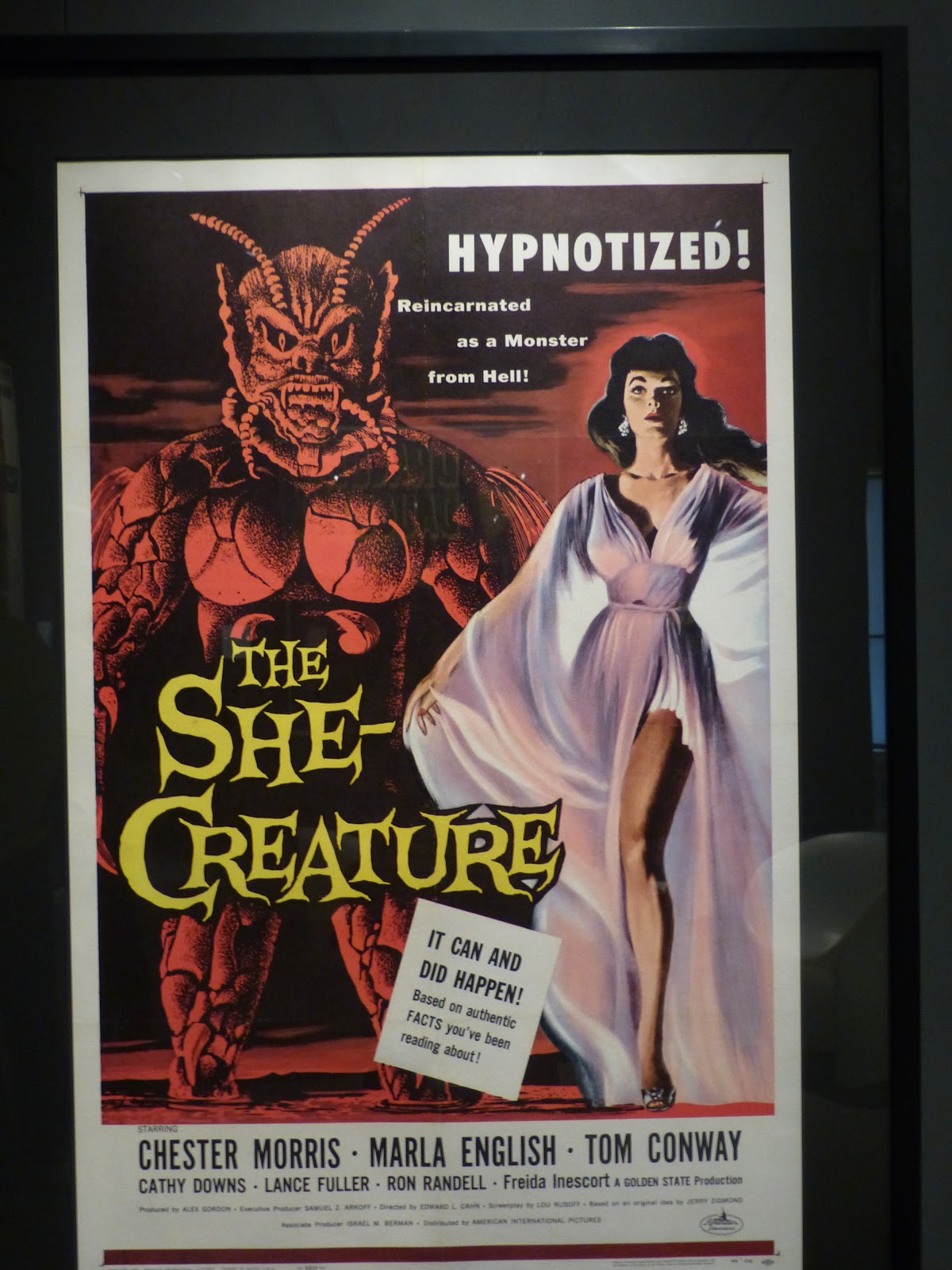
It's Alive is the other end of the spectrum. It is 90 movie posters and objects from Kirk Hammett's personal collection of the era of classic horror and sci-fi, mostly the 1920s into the 1970s. If Hammett's name doesn't ring immediate bells, he has been the lead guitarist for Metallica since 1981. If you're a metalhead, you know that he usually wields guitars with movie scenes painted upon their bodies—almost always reproductions from posters he owns. I'll bet legions wish we had emulated what Hammett did and kept our childhood ephemera in mint condition.

There is, of course, a Gothic, ghoulish vibe to all of this, but because Hammett's stuff comes from the earlier era, it is more psychological horror than the blood-splattered graphic stuff of today. In a video, Hammett (b. 1962) speaks of how these old films and images were strangely comforting for an unorthodox and shy kid coming of age in the Bay Area in the 1970s. To this day he says he tries to play out horror film scenes on his guitar. Again, though, we're talking Frankenstein and Day of the Triffids, not Texas Chainsaw Massacre. Although his collection includes posters for two of the scariest films I've ever seen, Nosferatu (1922) and Psycho (1960), these films must be seen to induce nightmares. This is true of nearly everything you'll see. There's a goofy charm to Cold War sci-fi films such as The Day the Earth Stood Still, Japanese monster movies like Godzilla, and the various Frankenstein and Dracula offerings.

I pre-scouted this exhibit for friends wondering if it would be okay for their eight-year-old. Although you might want to steer clear of a creepy oversized projection from The Mummy, most kids will be fine—especially if they are in the midst of their dinosaur/monster phase. The eight-year-old in question loved the show. You will too if you just channel your own dinosaur/monster childhood.

The final takeaway is the irony of a guy from Metallica resurfacing as an art curator. It just goes to prove an old adage: live long enough and you too have a shot at obtaining respectability!

Rob Weir
  

Just can't trust 'fake news'


#PeabodyEssexMuseum