Showing posts with label Pop-Rock World. Show all posts

7/4/25

July 2025 Recent Releases: Guy Clark, Little Falls Trophy, Jack Barksdale, Lisa Crawley, Paranoid Larry


Late spring and summer are often slow for new releases. Perhaps that explains why compilations and remixes hit the market about this time.


I won’t complain if I get a Guy Clark release. Clark (1941-2016) is sometimes considered the granddaddy of outlaw country, not because he was the first, but because his devil-take-care attitude and his propensity for drawing like-minded rebels to his home and tours made him seem like the leader of a Texas gang. And, most importantly, because his songs were covered in trail dust. Dublin Blues is a 30th anniversary re-release of his 1995 album of the same name. Some have said it was best. I’m not sure about that, but you could make a great case for it. If you don’t know, “Dublin Blues” is not Irish. It’s a staple of country music, a heartbreak song. (There is a Dublin, Texas, so maybe that’s the inspiration, though there’s a reference to the Spanish Steps, which are in Rome.) Clark could fashion a song out of anything. There’s a lesson about growing up and but not appreciating things until it’s too late in the talking blues “Randall Knife” and the (ahem!) longevity of “Black Diamond Strings” (with Emmylou Harris).  I doubt there’s anyone who can’t relate to “Stuff That Works.” My personal favorite is Clark’s “The Cape,” his venture into a Pinocchio-like refusal to grow up if it means a cessation of dreaming.


New Jersey’s Little Falls Trophy, Doug Albregts’ one-man band, put out LPs in 2021 and 2023, but decided to mine them and release material more in tune with the grunge scene of the 1980s/90s, the driving energy of The Who, and a few other things he liked (The Beatles, B-sides). The result is Rehashed. If you like things layered and plugged in, this one’s for you. You can listen to or scroll through the album here. My favorites are “My Little Sunshine,” “Armstrong Park,” and his cover of “The Weight.”


Before he was 12, Jack Barksdale made a huge splash for his guitar/piano/mandolin prowess and mastery of the blues, folks, and country music. He was praised for his maturity, his songwriting, and his deep understanding of multiple genres. He’s 17 now, but maybe growing up fast wasn’t the best thing for this Fort Worth performer. I found his new LB Voices disappointing. It is filled with too many sound-alike tracks and his gravel, smoke, and spit vocals more of an affectation than compelling. I liked “The Man, the Myth, the Legend,” a song about a musician out of place with the now. The problem is that that too many other tracks have the same dolorous tone, vocal style, and slow pacing. Listen, for example, to “Entropy,” eight minutes that could be three; or God is Dead, I am Dead, and So Are You.” Put simply, the album needs more changes of pace. In each track there are terrific guitar runs and licks, but only a few like “Martyrs” stand out, and it mainly because of the presence of Sarah Jarosz. Barksdale will become a major country music star one of these days, but let’s call this one his sophomore slump.


Lisa Crowley is a New Zealand singer/songwriter who labels herself an indie pop performers. Her latest EP, New Girl Syndrome, is infused with pop, but with a bit soul and torch singing mixed in. “Gatekeeper” is a romantic Chicken Little-like track about a man who has come knocking at her door a few times too many and she’s laying down the law. “Call it a Night” has some of the same vibe, though Crawley’s voice is more vulnerable on this one. It’s a heck of a voice, no matter how she casts it. On “Don’t Wanna Be” she also shows she can tickle the ivories.


Okay, did you actually expect I’d turn down a chance to review Paranoid Larry and His Imaginary Band? (It really is a band headed by Larry, his friend Sam Kulik, and a bunch of friends.) Larry’s persona is that of a man with a long white beard, and a full mane of snow white curls, though it could be a wig for all I know. He  promises that the music will make you feel a little bit better. “or a little worse.” Did I mention that the new record is titled Wombat Mating Calls? Larry’s voice is best described as robust and unusual. His band consists of expected guitars, keys, and bass, but also clarinet, trombone, sax, tuba, and bongos. (Yes, I said bongos!) “Never Buys Back” is about what buying someone a drink won’t get you. “Water Under the Bridge (Over Troubled Water)” opens with I got a mailbox full of bills overdue/I got an old horse whose name is Glue… He’s got a million of them. How about “Jesus Shaves” or “Breakfast is the Most Important Beer of the Day?” It’s all a lark, of course, but these guys don’t let satire get in the way of laying down skillful grooves. Paranoid Larry invites comparisons to Frank Zappa and the Mothers of Invention, though I’m more inclined to say Captain Beefheart and His Magic Band. Who says you have to be serious to be a serious musician?


Rob Weir


7/17/24

July 2024 Music: Brian Mackey; Fink and Marxer; Melissa Carper; Amy Annelle; Charlie Overbey ; Khoomei Beat; Alba Haro


I’ve never met Brian Mackey but there’s something about Good Morning Ireland, the smoothness of his voice, and the sentiments in his lyrics that makes me want to. He’s not from the Auld Sod; he was born in New Jersey, lives in New York, has been kicking around the alt.folk and alt.rock scenes since the early part of the century and has been carrying a heavy load. He recently became a father again, but his son Brian died from a heroin dose–the shadow on the cover. As good songwriters do, he picked up his pen to spill out some of his pain and hope. Good Morning Ireland is an album of healing and people dealing with unresolved issues. “Cold,” for instance, is about a woman he asks, And who made you so cold/And this feelin’ you’re under/Who made you so damn cold…. The pop-influenced “Don’t Be Sad” is an uplifting song suggesting that making connections is the key to betting past disappointments big and small: Regret is a long drive/You don’t wanna take by yourself…. “Dublin Night Bird” which inspired the album title, could have been maudlin. After all, it’s about traveling to Ireland with his son’s ashes to scatter. Mackey uses his light and expressive tenor to sing his sadness, yet find small-but-poignant reasons to hang on. And let’s not forget the healing power of love. There are several such songs on the album, but try “More Than Anyone” with its splashes of bluegrass fiddle and soaring notes that collectively bring a smile. There are sixteen tracks in all and I admired every one of them.


It’s been a while since last I heard Cathy Fink and Marcy Marxer and it was joyful to know they are still making compelling music. Their voices, banjos, guitars, mandolin, and ukulele are joined by the yangqin (Chinese hammer dulcimer) of Chao Tian on From China to Appalachia. The album is exactly as promised, one that demonstrates the affinity and intersection between American and Chinese traditional music. In a baker’s dozen tracks they move back and forth between the two cultures. Chances are good many listeners won’t know Chinese offerings such as “August Flower,” “The White Snake Song,” and “Nan Ni Wan,” though you might know a marching song popularized by Pete Seeger with an improbable title gleaned from Mao Zedong: “The Rules of Discipline and Eight Points of Attention.” You will probably be on more familiar ground with pieces such as Ola Belle Reed’s “High on a Mountain,” “Pig Ankle Rag,” “Mary Don’t You Weep,” and Cousin Emmy’s “Ruby, AreYou Mad at Your Man.” One listen to to “Glory Meets the Meeting House” will drive home what becomes obvious as you move through this wonderful project: Music crosses borders and ideologies to highlight our shared humanity.


We recently encountered Melissa Carper as one-third of Wonder Women of Country. Borned in Ya is her new solo LP. She hails from Arkansas but her approach is that of the big mountains and foothills back in the days when “Western” music was separate from “Country.” Western music was heavier on fiddles, swing music, jazz for the masses, and singing cured by campfires and wide open spaces. In other words, more Patsy Montana than Patsy Cline (or today’s airbrushed Nashville icons). The title track is a bit of a tease–a mix of country and evangelical fervor­–though Carper’s commanding voice is on full display. But check out the giddyup of “Lucky Five” supplemented by a band arrangement circa 1940. Or deliberately retro songs like “I Don’t Love You Anymore,” “That’s My Desire,” or “Every Time We Say Goodbye.” That’s because some of the material on the album is retro. “Every Time” was penned by Cole Porter, for instance. “Your Furniture” is another that Carper sings as if it ought to be coming from the speakers of an old Philco radio.  This is a delightful album that’s so outta of the past that it circles back and feels brand new. The album drops on July 19 so look for new videos once it’s on the streets.


Amy Annelle has had a rough stretch of bad health–endometriosis, fibromyalgia, mental health challenges–so it’s understandable she hasn’t had a new record for a while. You could assign a lot of meanings to “Pull Tabs and Broken Glass,” the first track on The Toll. She now lives in Austin, so that song has a real Texas feel, though she prefers to call herself a folk and Americana artist. The catchy “Down and Out in Denver” certainly has more of a folk vibe, the sort that’s upbeat despite themes of mistakes and regret. This is another album that releases in July with only a few advance videos available. Though it’s not on The Toll, “Distance Lullaby,” which she wrote doing Covid lock down, gives you another taste of her music.


The album In Good Company by Charlie Overbey reminds us again that the barriers between rock and country music have pretty much collapsed. Overbey is the lead vocalist on each track. His is a strong, gravely voice but once you listen you’ll wonder if he’s trying to take us back to the glory days of electric music or is offering a new kind of outlaw boot rock. This much is clear; every track except one has an electric guitarist. None other than Nils Lofgren does the honors on “CChampagne CocaineCadillacs and Cash," a so long to the crazy life and the woman he shared it with. But don’t expect mellow acoustic, even though that’s Overbey’s axe of choice. Duane Betts plugs in for Overbey’s “Life of Rock n Roll.” It too poses as a farewell to rock, but perhaps with tongue in cheek. To return to the song without an electric guitar, that would be “Miss Me” with John Graboff on pedal steel. Not everyone will agree, but for me it was the only track that didn’t sound like everything else.   


Short Cuts:


If you’ve never heard Tuvan throat singing, you must. Tuva is a section of Siberia and Mongolia that was once the domain of nomadic herders who lived in yurts. It still is to some extent though modernity has altered many aspects of life. Khöömei Beat is a quintet of five Tuvan musicians who use overtone vocals to imitate sounds of nature and communicate across vast distances. Changys Baglaash sports a softer drone sound and updated arrangements than traditional Tuvan singing but it’s still unforgettable. Try “My Ancestor’s Khoomei" and listen for the growls and improbable sounds. If you like it, seek more. “Dembildey” is available.


Alba Haro is from Barcelona where she studied cello and jazz vocals. Next up was Boston’s Berklee School of Music for a master’s in production and performance. The latter informs her EP Triptica. “Amanece” is frenetic free form modern music followed by a poem. “Acoral” features sad strings, periods of relative silence, keys, and Haro’s haunting sometimes keening vocals. This avantgarde project won’t be everyone’s cup of tea, but I was intrigued.


12/15/23

Music for December: Finch/Ni Bhriain, Gravet de Coulomb, Kumara, Powers, Earl


The term “Celtic music” is often more marketing than historical circumstance. Many of the progenitors of what we often now think of a single genre that features jigs, reels, airs, and sad songs were once played by parlor, castle, and dance hall musicians. Catrin Finch and Aoife Ní Bhriain remind us of the first two in a collaboration titled Double You. Finch is a highly celebrated harper. She has won major awards, recorded more than a dozen and a half albums, once served as the harper for the Prince of Wales, and teaches at both the Welsh College of Music and Dance and the Royal Academy of Music in London. Ní Bhriain is an Irish fiddler with an impressive collection of prizes of her own. Their instrumental duos also depart from associations of Celtic music with New Age music. Finch and Ní Bhriain find the intersections between classical and traditional music in nine serious compositions whose nod to Celtic humor is that all nine titles are one word beginning with the letter W. Most are also longer, because they take their time to establish themes and spin off from them. “Woven” begins with delicate fiddle with Finch’s harp acting almost like a drone in its repetitious delicacy. As if unfolds, though, it’s akin to a suite in several movements that open and close via Ní Bhriain’s bowing. “Wonder” has an appropriate air of mystery, almost as if the harp is walking us through a mist draped with repeated fiddle pulses that scaffold Finch’s precise harp notes and bell-like tones. The appropriately named “Whisper” is quiet, builds, and evolves into something more pastoral before it ends seven minutes later with a return to quiet music with space between the notes. If you watch the videos, know that the album sound is better balanced, but you can see from their respective intensity that Finch and Ní Bhriain are serious about what they do and how they do it. 


Le gravetat de Coulomb is a Catalonian trio that between them give a workout to a variety of flutes, accordions, drums, tambourine, and bass clarinet, and voices. Their latest project, L’efecte doppler, indeed involves changes in sound frequencies, but it also references a modulating style of flute playing. Most of the album is devoted to “Gypsy” dances. “El salt de la rata” might be the most familiar as it’s a joyous jota, a folk dance in ¾ time. “Tu” is a chotis but might also sound vaguely reminiscent; its three-voice call-and-response vocal evokes traditional Quebecois singing, though the instrumentation differs. “Una punxa al peu” has a celebratory village feel and invokes visions of a tune chasing its own tail. “Ottawa és més a la vora del món real que del Japó” is an unusual tune that changes flavor and tempo. It’s not on the album, but you can sample what they are like in concert. Hey, you try trying flute and percussion at the same time!


Kumara is the stage name of an interesting collaboration between Uganda’s Samite Mulondo, sessions violinist Sean Harkness, and chamber musician Shem Guibbory or, as Samite notes, a melding of African, jazz, and operatic music with “flow.” If you don’t recognize the plucked instrument on “River Crossing,” it’s a litungu, an eight-stringed Kenyan bowl lyre. The sonics in the background are a combo of violin and electric guitar. In a similar vein, the structure of “Adunga Jam” is set by the tune’s namesake instrument, an eight-stringed–they have anywhere from 7-10–­arch harp with wood and leather bodies. As you will hear, it sets a hypnotic pace for guitar and Harkness’ impressive violin work. You can hear splashes of Samite’s vocals on “Conversation in C Minor” and “Forest Music.” I emphasize, though, that this is mostly an instrumental album, not a Samite solo project. You might recognize the tones of the more familiar thumb piano on “Waxed Kalimba,” though the tune itself has a traveling feel. This project is intended as a post-Covid healing effort and the trio’s very name derives from Sanskrit and roughly translates  “higher self.” I’m not sure we are post-Covid, but the music has a decided calming effect.


Summerlyn Powers is an Alabama folk/country singer now living in Nashville. She’s young, but as her five-song EP The Hive indicates, she’s poised and ready. The namesake song is somewhere between rock and a boot kicker with Powers’ voice muscling its way through an electric mix. She turns to a bit of rockabilly on “Let’s Roll” and tamps down the noise for the soulful “Healing Like I Am.” The latter sports the line crying when need to/laugh ’cause you have to… hope you’re healing like I am. It’s kind of like Powers in that it’s straightforward but ambiguous–a relationship song that’s somewhere between breaking up and not being ready.  Ready or not, Powers is primed to arrive.


Ava Earl is a bubbly singer from Alaska who has been prolific despite her relative youth. Too Much falls into the category of acoustic pop and, to be forthright, just isn’t my bowl of cloudberries. Earl’s vocals are earnest but girly and her lyrics don’t always connect. What would you anticipate for a song titled “For Hell?” Having listened to it several times, it’s still not clear what she’s driving at. At its center is a woman who is five months pregnant, but after that I’m not sure where we’re supposed to go. There’s a musing on tall buildings as secular religion that leads to this: I can’t be too greedy/Cause it’s you that I need/Don’t break my heart. The whole thing is wrapped in a light orchestral backing. “Too Much” has good instincts–a young feminist’s message that it’s okay to be yourself–but it veers into bad luck at romance and hearing loss. (She also explores the latter in  “Ears Bleed.”) Yet it’s hard to derive weightiness in such a bright tune that seems to have the dance hall in mind. Moreover, lyrics such as I regret half the things that I said/ I know I talk too much/ I guess I’ll make a fool of myself, until you shut me up isn’t exactly in-your face defiance. In my estimation, message music and bouncy pop are seldom a good mix.


Rob Weir


12/14/22

Give Music as a Gift: Jamie McDell Artist of the Month and Others


Still searching for holiday ideas? Give the gift of music. Here are some artists to consider. 


“World-famous in New Zealand” was a joke punchline when I lived there in 2001. Back then the music scene consisted largely of bad cover bands and acts no one would ever wish to cover. Things have gotten better since then. Jamie McDell, my December Artist of the Month, is a case in point. She’s an Auckland native who has also lived in Nashville, Toronto, and Vancouver. McDell comes by her peripatetic lifestyle courtesy of her father, who quit his job when Jamie was 7 to move his family of four onto a boat for a year. Jamie got her sea legs by learning to play the songs of John Denver, James Taylor, and Jimmy Buffett, and obtained stardom of a sort when the record she made at 16 went gold. Ahh, but there’s the rub; in New Zealand gold means selling 2,500 units; in the USA you need half a million. That’s why so many from abroad trek to Nashville, which is where the self-titled Jamie McDell was made.

            Nashville’s potential pitfall is that it likes to pigeonhole. As you can hear, McDell can do country but she carries an alt.country label because: (a) Folk music isn’t a popular label, and (b) McDell’s country is somewhere between traditional and outlaw. Suits me just fine; she’s a wonderful storyteller and, once you listen to “Botox” and hear that catch in her voice you know that she’s a singer, not an all-flash-no-substance "performer." Call this one and “Boy Into a Man” later on the album feminism without the sermon. Why botox? Because the song is about the ways in which socially constructed masculinity is built upon forced images of femininity. As a sampled line puts it, ask the doctor to make me shorter/so you can get your manhood back. This record is filled with gems, including the semi-autobiographical “Sailor” (the studio version includes the McCray Sisters) and the power she draws from the open sea. On “Mother’s Daughter,” though she confesses that mom, not her wanderlust father, shaped her more. It's a weepie, but a good one. McDell isn’t afraid to tell tales on herself, as she does on “Not Ready Yet” and the dangers of running wild in “Limousine Running.” Let that one run as next up is amazing. McDell sits back-to-back with Robert Ellis to sing and harmonize on “Worst Crime.” What was her transgression? Listen.  


Picot is a Barcelona-based band built around the duo of Jordi Marfà (voice, mandolin, violin) and Daniel Pitarc (keyboards). Their debut record Les alles del cavall, which I’m told translates The Horse’s Wings. It’s Catalan, though, so I’m trusting my computer translation software on this. Don’t call it Spanish; Catalan has similarities in that it’s a Romance language, but it immediately derives from Vulgar (“popular”) Latin and probably began life as proto-Celtic. That helps explain why Catalan music often has a Celtic flair. “La casa que vull (The House I Want)” is an example of the Catalonia’s mixed roots. It sounds simultaneously African–as does a lot of Mediterranean music–but the plucked mando notes and swooping violin passages evoke pan-Celtic structures.

            Two other tracks to investigate are “T’he engendrat amb dolor (I Begot Your Pain)” which is as atmospheric as the video clip. Marfà’s voice is big and dramatic but the instrumentation is airy and light, almost nouveau Renaissance. It frames a song that borrows snippets of poetry (in Catalan) from everyone from Whitman to Jean Cocteau. “Tan Petita (So Small)” is another intriguing piece in that its African notes are more Caribbean than Sub-Saharan.  


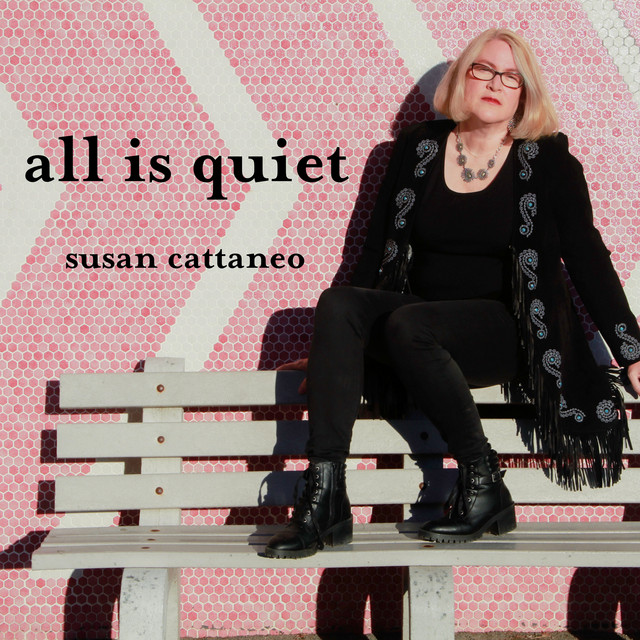
Susan Cattaneo has long been a mainstay of the Boston music scene. Don’t let her respectable demeanor fool you; she has a serious set of pipes and can sing about pain with the best of them. The title track of All is Quiet testifies to this. She sits serenely on the stage and rips off a line like idle hands make idle worries and when she soars on the all is quiet refrain, we’re talking upper part of the sky. Cattaneo gives us dark things, but also delivers the message to “Hold Onto Hope” and echoes an old Lui Collins line that the only way out is through. “Borrowed Blue” is a tender song about the bond between daughters and mothers. Again, though, Cattaneo has been around the block enough times to know there are also situations in which, as a song title puts it, there are “No Hearts Here.” Cattaneo is the kind of singer I really like, one who puts the song upfront in a voice that mixes pretty ornaments with burnished maturity that resonates around the edges. Hey, even songbirds have to land.       


Warden and Co. is a Saratoga Springs-based trio that began life making kids music and still dabble in it, but has evolved into a folk-rock band. If there is an upside to the COVID crisis, it is that most musicians spent more time at home and seized the day to write and create. Frontman Seth Warden, who is also a middle school teacher, wrote enough material for Somewhere and a future release. On the album version of “Somewhere” Warden shares the mic with his 13-year-old daughter, Lovella. The song is about a dad’s hope on one level, but it’s also about connecting with one’s roots. Doug Moody’s fiddle enhances the sweetness of Warden’s smooth vocal. Lovella’s pretty good, actually, but if you want something with more grit try “Middle of Madness,” which has a splash of Tom Petty, especially in its questioning of all the competing claims of “truth.” It also gives percussionist Brian Melick a workout. But it’s hard to argue with the self-explanatory pop-laced “Living for Love.” I like these guys a lot, though objectively its top-heavy mid-tempos offerings invoke a sameness, so some might wish to track shop.


How about some world music? Kadaily Kouyate is a Senegalese-born kora player who now lives in London. If, like me, a six-string guitar is perplexing enough for you, try 21. The kora is a demanding instrument but, in the hands of a master such as Kouyate it sounds a bit like a hammer dulcimer and is capable of virtuoso pieces as well as those of great delicacy. In the second category place “Janjon Ba,” Kouyate’s tribute to a 13th century warrior. It’s done with such gentleness that it evokes a seasonal tune more than anything military. “Diyanamo” opens with sprays of notes and eventually has the precision and feel of something classical. “Kontandiro” has slightly darker tones but is also a meditative journey. Kouyate is often known for his social message songs but this album, Aado, features Kouyate’s instrumental fingering rather than direct politics, even if the title does translate as social customs.


Doriana Spurrell hails from North Carolina. Her EP Forward opens with a goodbye song, “Don’t Wake Me.” It’s unusual to lead with an “I’m outta here” song, but one gets the sense that Spurrell would rather be in the moment instead of fantasy land. “Until I Die” is another enigmatic song that suggests she’s after a vibe somewhere between torch singing, the blues, and attitude. What do you do with lines such as: To tune out so many floating bodies, like seas of plastic strangling all my hobbies/I won’t bleed for them, I won’t bleed for them. She specializes in missed connections songs; “Never Needed Words,” which is about her late grandfather, is another example. Depending on your POV, she’s either being honest about how life can overwhelm or she’s still trying to figure out how to find the path forward. She has an interesting voice, though she should lay off comparisons to Nick Drake or Brandi Carlile until her voice ripens and her pencil sharpens.      


If you are a fan of swirly wall-to-wall sound, try HeyDreamer, a three- (sometimes four-) piece rock band from Atlanta anchored by lead singer and electric guitar slayer Melody Kiser. “Untamed” is poppy and danceable, “Feel the Fire” has heart-thumping bass lines, and “As Cities Burn” is spacey and echoey. The latter, though, is filled with studio tricks that don’t serve much purpose. Overall, the record strikes me as over-produced. When things quiet down for a song like “Choose Me,” they also thin out. It gives me pause, but that’s not saying you will react the same way.   


Rob Weir


10/22/21

Albert Freixas, Delgres, Alisa Amador, Left Vessel, Dirty Snowman, Fernando, Grace Womack


Albert Freixas
cut his teeth in the jazz scene of his native Barcelona before spinning off into other genres. Chroma, his third solo venture, shows us both the foot inside the door and the one stepping out. He calls his music “hard bop” and John Coltrane comparisons pop up, but Chroma covers too much turf for that. The “Every Time We Fall” video opens to rising smoke. It has a pop vibe and we witness Freixas playing a lap electric, a straight up electric, and a bass guitar. We notice his smooth voice and well-patterned melody lines. By contrast, “Personal Light” is atmospheric and enigmatic, a blend of pop and elements of Catalan jazz. “My Well” is soulful, and “I Call” a short a capella with backing vocals. “Broken Song” is bluesy, moody, and supplemented by spoken word, rap, and horns. Get the point? Freixas is always controlled, but seldom constrained by categories.


Delgrès
is a dynamic “power trio” based in France, but with Caribbean roots. Most of the songs on 4:00 am are sung in Creole, and the band is named for mulatto French officer Louis Delgrès, who switched sides during an 1802 rebellion in Guadeloupe. “Mo Jodi” (“I’ll Die Today”) is where funk meets swamp blues and a New Orleans funeral band. As you will hear, most of the songs are just Baptiste Brondy’s drums, Rafgee’s sousaphone-acting-as-bass, and Pascal Danaë’s guitar and booming vocals. “Lundi Mardi Mercredi” has a more delicate opening, but it doesn’t take long till they unleash the grunge that backs Danaë’s singsong rap-like lyrics. You’ll not make out most of them, as Delgrès is more about groove and move. They so deemphasize clarity that a song like “L’ecole” evokes lo-fi music. (Could we say they give it the old-school try?) Mostly it doesn’t matter, but on “Just Vote for Me” it would help to hear the lyrics more clearly. The video is ironic and poignant. Watching world leaders past and present (including George W. Bush, Trump, Yeltsin, Putin, Boris Johnson, Theresa May, Kim Jong-un) trying to prove their “commoner” statuses via “dance” moves is hysterical, but Delgrès makes a deeper point by juxtaposing white candidates making rather obvious overtures to people of color. Newsreel footage of violence drives home the message. Still, it would be nice if we could make out lyrics like these: If you give me your hand/I can take you anywhere/You know I am your friend….


Alisa Amador
comes from solid musical stock. Her parents founded the award-winning pan-Latin Sol y Canto, of which Alisa is a sometimes member. She is, though, very much her own person and possesses the chops to grab your attention in English or Spanish. On Narratives, she serves delights such as “Burnt and Broken,” an exploration of the fragility of life and love. “Timing” is shot through with vintage Motown, and, yes, she can pull it off. If you want to hear something in Spanish, listen to “Nada quever” (“Nothing to See.”) You’ll notice that Amador likes to loiter on chanteuse benches. She also tosses in occasional notes that skirt the borders of atonality. The latter make them moodier than a lot of folk music.


Left Vessel
is the stage name of Nick Byron Campbell, and was inspired by being plunked on the noggin by a falling pine cone. It’s also the name of his former band. On One (and Driftless), Campbell exchanges his rock and roll duds for a shaman’s soft goods and an ever-present knit cap. The music is often atmospheric and electronically New Age-like, as heard on “Arrival” or “Empty Frame” in which his voice climbs into the falsetto range. One (and Driftless) is a concept album that Campbell calls “sound art.” I generally dislike such made-up appellations, but it fits, if we allow room for songs such as “Your Winter” and “Hold Your Laughter,” which some might label folk. I wouldn’t. Both are a bit too oblique, but Campbell is up to some intriguing things. He won’t be everyone’s cup of tea, though, so listen and see what you think. 


If need to get loud, Colorado’s Dirty Snowman Society is a potage of punk, psychedelic, and arena rock. Its recent record is called Snowblind. If titles like “Kiss Me or Kill Me,” conjure grunge, you wouldn’t be wrong. It’s where big bass, wailing guitar, high-octane, pounding drums, attitude, and danger collide. “Once” sounds softer, but not really. The instrumentation throttles between simulated vibes and jam band riffs that stuff Frank Costantini’s vocals into a wall-to-wall sound envelope. “Mirror” is everything you’d ever want, if you like your decibels high. Slide the volume to the right and rock on. This one reminded me of Black Sabbath with a better singer. (Yeah, Ozzie was always overrated.) 


Looking for something different? Try Anuang’o Fernando and Maasai Footsteps. It’s an appropriate title as Fernando is as much dancer as musician. I wish there were more videos of him dancing, as the songs draw inspiration from the traditional music of Kenya’s Maasai people. “Source” (and source-like) recordings are often less interesting out of context. Movement is crucial for the Maasai, whose dance styles are at once grounded but airy. Watch this video if that statement sounded contradictory. The songs are often drone-like behind keening lead vocals. “Emburkoi” and “Mukula” are in this vein, though “Eranjoi” has what could be incongruously labeled an old-time revival sensibility.  


Grace Womack
is a junior at the University of Texas. Her Yellow Cowboy Hat introduces a voice with promise that’s not yet ready to graduate. The title suggests country music, but Womack mixes of pop, R & B, and piano bar jazz inevitably draw comparisons to Lake Street Dive, Kacey Musgraves, and Billy Joel. I’d call these aspirational rather than descriptive labels. “Pity the Fool,” an infatuation-gone-bad tale, showcases songbird vocals and piano, but the melody fails to land. “Oblivion,” her second single, has similar virtues and drawbacks. We must go to the title track before Womack’s soulful tones and energetic backing music command attention. In a word, Yellow Cowboy Hat lacks solid hooks, which is precisely what a new singer needs in a market flooded with pretty voices.   


Rob Weir


9/24/21

September 2021 Artist of the Month: David Byrne


DAVID BRYNE’S AMERICAN UTOPIA (2021)

Directed by Spike Lee

HBO and Universal Pictures, 105 minutes, Not-rated


For September’s Artist of the Month, here’s something different, yet familiar. David Byrne has been a household name since his days as lead singer and guitarist for Talking Heads. In case you weren’t into post-punk music—yours truly went full folk and Celtic for much of the 1980s—Talking Heads was perhaps the most beloved of “new wave” bands. New wave groups took punk’s DYI approach to music, but didn’t totally reject commercial rock and pop. It mined them and created an arty hybrid.


Talking Heads recorded eight albums before disbanding in 1991. Byrne subsequently busied himself with solo albums, collaborative work with artists such as Brian Eno and St Vincent, and scores for everything from TV and film to dance and art installations. American Utopia was his 10th solo album and inspired a Broadway musical of the same name. In 2020, Byrne joined forces with director Spike Lee to film the show, which went into (very) limited theatrical release before being released on HBO. The limited release was probably designed not to harm the theatre box office, but the show has been a smash hit and opened a new season earlier this month. For those who don’t live in the Big Apple or don’t wish to sell body parts to buy Broadway tickets, Spike Lee’s film is the next best thing to seeing Byrne in concert.


Posters for the play generally render the word Utopia upside down. In many ways that’s appropriate. Although the Scottish-born Byrne has long been a US citizen and a devoted New Yorker, the play is simultaneously critical and optimistic. As he puts it, “We need to change. I need to change.” Appropriately, he utters this before launching into “Hell You Talmbout,” a Janelle Monáe song and litany of black people unjustly killed, such as Sandra Bland, Eric Garner, Freddie Gray, and Trayvon Martin. If this sounds as if Byrne is getting political, it’s not that simple. The show opens with him holding a (rubber) brain and musing on connections, including brain pathways, the molecular structure of the universe, and those between people. Byrne wants to explore ways in which we can become more fully human. The tone is set by the second song, the Talking Head’s “I Know Sometimes a Man is Wrong/Don’t Worry about the Government.” Byrne wants us to save ourselves from everything from climate change and racism to arrogance, isolation, and being lazy (including intellectual and moral laziness.) 


The show, the film, and the music are jaw-dropping amazing. The play is not the same as the album. There are 21 songs plus a reprise of “Everybody’s Coming to My House,” the hit single from the American Utopia album, but only five songs come from that recording. The production makes you think, makes you anxious, makes you want to purify your social sins, and makes you boogie. It includes eight Talking Heads songs—including “Burn Down the House–and before the curtain drops, audience members are literally dancing in the aisles. All of the songs were penned by Byrne except the aforementioned Monáe composition and Fatboy Slim’s “Toe Jam.”


The production dazzles. Choreography was done by Brooklyn-based dancer and producer Annie-B Parson and is full of energy, verve, and nods to marching bands. Byrne loves marching bands, so his musicians are untethered. Thanks to wireless technology, even electric keyboards, bass, and electric guitar are free to roam. So too are the percussionists. All 12 cast members bang, scrape, or shake percussion instruments at some point, but half of them are primarily drummers. Lee’s overhead and back-of-stage camera work highlights both the simple (line marches) and the complex (weaves, zigzags). And let’s give a shout out to the principal dancers and backup singers, the lithe and stunning Tendayi Kuumba and the incredible Chris Giarmo. I don’t know why the bearded Giarmo is so heavily made up, but his pas de deux with Kuumba are so well-executed that they make Dancing with the Stars look like a junior high sock hop. Also heap praise on cinematographer Ellen Kuras, who makes us aware of the dynamic stage lighting that enhances American Utopia.


Byrne is, of course, front and center of the suited but barefooted ensemble. He is the draw and lead vocalist, but he’s also a fully engaged cast member. When he sings “I Dance Like This,” he indeed moves well for a 69-year-old, but he knows he’s no Kuumba or Giarmo. Our ears are on Byrne, but our eyes on the professional dancers, and the groove comes from Karl Mansfield’s portable keyboard, Bobby Wooten III’s bass, and Angie Swan’s electric guitars. Everyone sings. Byrne remains in fine voice, though there is a notable falloff in places, understandable for a soon-to-be septuagenarian.


Text Box: utopiaYou might not notice that last point and who could fault you? I return to the point that Byrne wants us to enjoy ourselves and to think. That continues through the coda, where he leads the entire bundled up crew for a post-show winter bike ride through the theatre district. Byrne’s both an avid cyclist and an advocate of a post-fossil fuels world. The only sour note is the pre-film “conversation” between Lee and Byrne. If only it had been. It was more a short-on-information mutual admiration/chuckle fest that stands in marked contrast to the show’s carefully constructed arc. It’s a good time to grab a bowl of snacks, sit back, and prepare to get connected. You will come away hopeful that our upside-down utopia can be righted.


Rob Weir

4/14/21

Spring 2021 Cleanout: Katzman, Regrettes, Scroggins & Rose, Shalhoub, Sweater Set and more


Time once again to try to clean out the old musical backlog. Here are some capsules with links to my favorite track and another to try if you’ve got a thirst for more.


Los Angelino Theo Katzman serves potage on his latest record, which has the intriguing title of Modern Johnny Sings Songs in the Age of Vibe. Katzman gives us some rock, soul, funk, pop, and jazz, and shows his chops as a singer, guitarist, bassist, keyboard player, and percussionist.


            Recommend: “You Could Be President” is a backdoor slam on he who shall not be named. Katzman’s soulful, but affected falsetto befits the song. This one is cool live studio track with backing musicians. 

            Try:The Death of Us” has a self-explanatory title. Katzman knows how mix his funk with pop hooks 


Staying in LA for a moment, The Regrettes are a feminism-meets-genre hopping quartet that borrow from punk, DYI garage band, riot grrrl vibes, pop, and sly parodies of mid-20th century girl groups. It is built around lead vocalist Lydia Night. Their latest EP is titled How Do You Love?


            Recommend:“Dress Up” highlights their mashup traits. Are they serious or just having a goof? Yes. 

            Try:Pumpkin” is quieter, but no less insouciant. 


If we head up the Left Coast to San Fran, you will find the blue/newgrass sounds of Scroggins and Rose. Tristan Scroggins plays mandolin and Grammy-nominated Alicia Rose the fiddle, though her classical chops might make you want to call it a “violin.” As the last comment suggests, their version newgrass–showcased on Curios–is more classically influenced than the usual jazz/trad mix. Their music takes some concentration, but it’s worth it.


            Recommend: “I Can Find a Way to Fix It” has Tristan in a minimalist mood. Alicia gets to do the fancy stuff.  

            Try:“Calabacitas is in the same vein, though the two trade fancy licks. You’ll hear how Rose garnered that Grammy nom. 


Cross the Bay to Oakland for a meet-and-greet with Lebanese/Arab-American singer Naima Shalhoub, whose Siphr is moody and melancholy, yet defiant. Shalhoub is a powerful singer with controlled vibrato. She’s also a social activist, which no doubt helps her put her special spin on the blues.


            Recommend: “Two Rivers” is sung in Arabic with lyrics drawn from the Book of Isaiah and guitar work suggestive of Tuareg blues. The song’s meaning is open to interpretation, as befits someone who has also mused over borderlands of other sorts

            Try: The bump-and-thump “Roumieh Prison Blues.”  Its namesake is an infamous overcrowded lockup in Lebanon where several violent protests have occurred. 


Hiss Golden Messenger is a folk/folk rock band out of Durham, North Carolina. They will be dropping a new album soon, but their 2019 Terms of Surender is worth investigating. They are anchored by lead vocalist/guitarist MC Taylor in a lineup that’s sometimes a solo, but also expands to as many as eight others. The approach shifts accordingly and invites handles such blues, rock, swamp rock, Americana, and bluegrass.


            Recommend: “I Need a Teacher,” which was inspired by a Tarheel state teachers’ strike. (NC is one of the worst places to be a teacher!) The song honors educators and their students. 

            Try: The title track “Terms of Surrender,” which has a bit of country flavoring.  


There’s something delightfully retro about The Sweater Set (Maureen Andary and Sara Curtin). This DC-area duo has been touring for more than a dozen years and recorded their latest release Fly on the Wall in 2018. Gigging was delayed first by maternity duties–both had a set of twins within months of each other–and, of course, the Covid shutdown. Theirs is folk with a bit of cowgirl lurking around the edges.


            Recommend: “Dawn Chorus” with its splash of clarinet, big rolling strums, and mellifluous harmonies.

            Try: “Hostage” is a love song with a retro feel.


The rock band Strange Ranger used to be called Sioux Falls. I gather they been based in Montana and Portland, Oregon, though a recent article places them in Philadelphia, so take you pick. It generally builds songs around the lead vox of Isaac Eiger. Their rock is of a softer, shimmery variety, and their latest record is 2019’s Remember the Rockets.


            Recommend: “Ari’s Song,” which opens to Fiona Woodman’s bird-like vocalizations before Eiger comes in with his high tenor. It’s more sunshine pop than rock. 

            Try: “Pete’s Hill,” highlights the band’s atmospheric approach. Don’t bother trying to make out the lyrics; lushness is the point.


Melody Duncan sounds British, though she’s actually an Atlanta native. Maybe it’s her lollipop girl group tones. She has toured with some of the biggies–Emmylou, Steve Earle, Brandi Carlilie, The Mulligan Brothers–but Wolf Song is a solo venture that has hints of folk, indie rock, and chamber-pop. My short take is that I like her fiddling, guitar, and keys but I’m just not a fan of little girl voices.


            Recommend:Wolf Song,” which isn’t about four-legged critters per se.

            Try: “Paper,” which has the mentioned chamber-pop flair


Rob Weir