Showing posts with label art. Show all posts

8/21/24

Vermont: The Best Place to See a Circus Museum


Shelburne Museum

Shelburne, Vermont


Surprise! You don’t need to journey to Sarasota to see the best circus remembrance in America. I’m happy about that because I doubt I’ll ever return to Florida: too hot, too many bugs, too many reptiles, and too many Republicans. The best place to capture the atmosphere, excitement, and assorted paraphernalia of the circus is Vermont’s Shelburne Museum, 7 miles south of Burlington.


The entire 45-acre campus is a delight that includes some of the finest folk art in America, 39 buildings, 20 gardens, and a landlocked steamship, but let’s focus on the Circus Building. Instead of jabbering on, I will divide a smattering of photos into sections: circus posters and objects; the circus parade; and circus photographs.


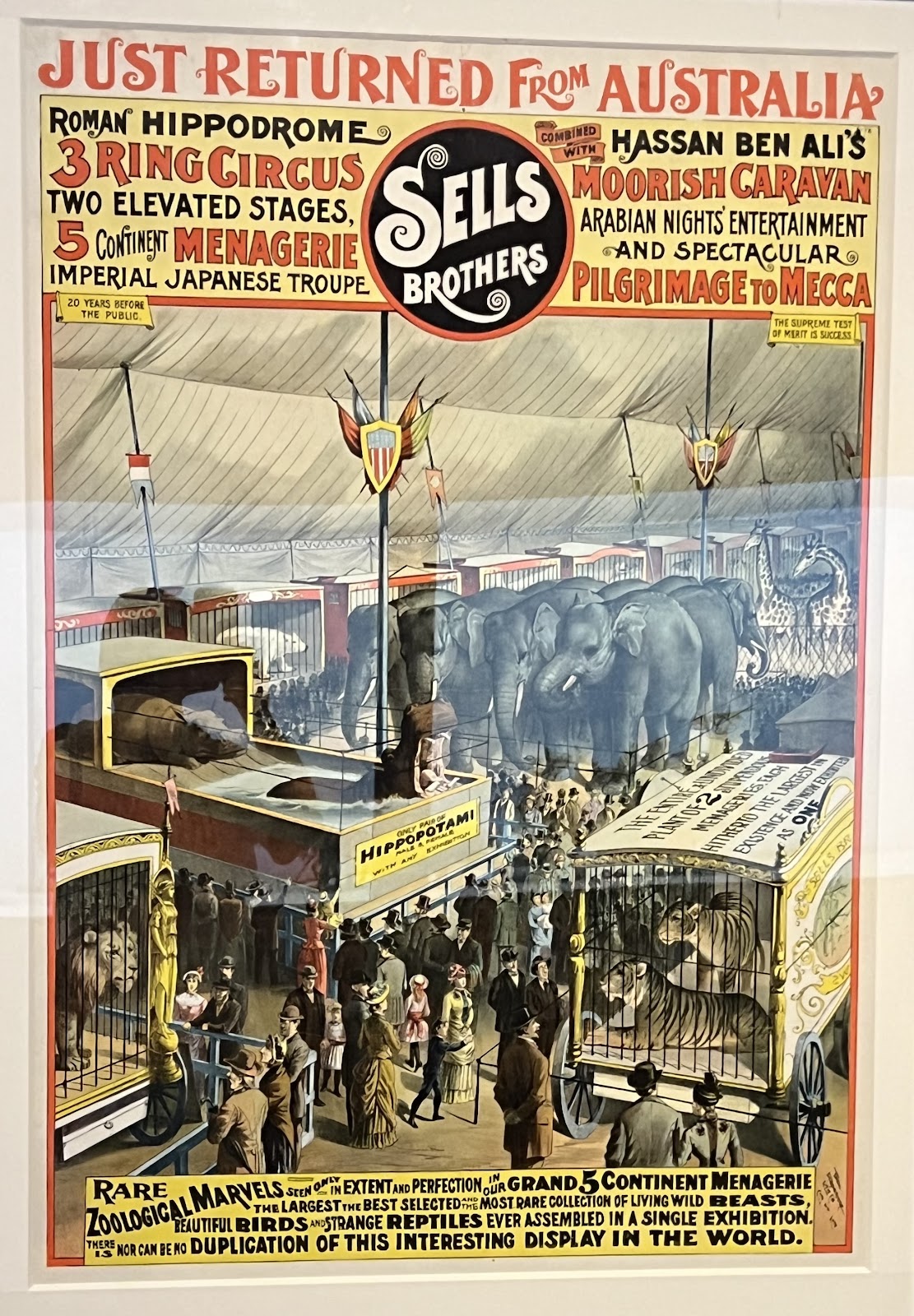
Let’s start with the posters. There are more of them than you will see in Sarasota, they are quirkier, and they are culled from more circuses. There were nearly large ones in American history and scores of smaller ones. Here’s a good index if you want to explore some.  A downside about which I’ve previously written: It’s hard to put posters under glass, hang them straight, and avoid bounce from indoor lighting. I’ve selected some that can be best captured digitally.



Ye Olden Days carousel painting


 The centerpiece of the Circus Museum is it’s enormous circus parade. It is the work of two men best described as obsesses visionaries: Edgar Decker Kirk of Harrisburg, Pennsylvania who, between 1910-56 jig-sawed some 3,500 pieces. They began as a creative toy for his four kids and evolved into a delight for neighborhood children as well. The second was Roy Arnold of St. Johnsbury, Vermont. He was more systematic in his designs and had a small team of assistants who fashioned a 1” = 1’ parade stretching 525 linear feet that were carved between 1925-55. The Shelburne Museum’s collection is considered folk art mastery and I think you can see why. 


The Big Top (darkened to take me out of reflection)


Note the detail in the figures


Tableaux were often circus features


One could do a study of ethnic misrepresentations at the circus

Including the all Indians are Plains Indians stereotype!


This summer the museum also has a small photo display from Elliot Fenander of a shoot he did in Pittsfield, Massachusetts of the Beatty-Cole Brothers Circus in 1972. The circus rolled into a very wet town in 1972 in which the soil was too soggy to erect the Big Top but–as the expression  goes–the show must go on! 


8/19/24

Ringling Museum in Sarasota


John and Mabel Ringling Museum

Sarasota, Florida


It’s summertime and this year the living has been more muggy than easy. It seems like a good time to think about the circus, but don’t ask me to explain my logic. As I have written elsewhere on this blog, the circus­, professional baseball, and vaudeville were the first forms of American popular culture. People didn’t or couldn’t travel very far from home until well into the 20th century, so the circus came to them.


It was truly “lions, tigers, and bears, oh my!” Imagine rural America, which was most of it until after 1920. There were backwater towns in which the most exciting thing was the sound of a train whistle. Now imagine the circus arriving at a local train station and unloading fancy wagons, some of which contained exotic animals. As roustabouts hurriedly erected tent cities at the fairgrounds, a giant parade as much a mile long snaked through the town. What gawker would not wish to see the animals, acrobats, clowns, and sideshows? As late as the early 1960s the arrival of the circus thrilled kids like me in my medium-sized Pennsylvania town.


My adult self understands how cruel circuses were to animals and “freak show” attractions, but I confess a lifelong fascination with three-ring circuses. I’ve been fortunate enough to visit three of the best repositories of circus memorabilia in America. Baraboo, Wisconsin, used to be the granddaddy of all. From 1884-1918 it was the winter home of the Ringling Brothers circus. For a time it in consolidation with Barnum & Bailey was the “Greatest Show on Earth.” I visited Baraboo back in the 1980s, aka/the age of film photography so I have no digital images to post, but Baraboo’s collection of circus wagons was second to none, as was its poster gallery. Both remain vivid in my memory.


Baraboo is still open but it closed for a time in the 21st century and came back as Circus World Museum. I’ve not been there but I’ve heard it’s not the same, though there is a Bigtop where you can see some live acts. After 1917 the Ringlings briefly wintered in Bridgeport, Connecticut, before decamping to Sarasota, Florida, the subject of this travelogue. So too did other circuses, including Forepaugh, Golmer, and Sells. John Ringling deeded the property to Florida and it’s now overseen by Florida State University. 


Sarasota is a huge complex whose main attraction is Ca’ d’Zan, John Ringling’s fanciful and palatial mansion. It also features a large art museum (the subject of a later piece). I wouldn’t say the Circus Museum is forgettable, but it’s certainly not the best collection of circus art in North America. It does have several restored circus wagons and an open-space culling of memorabilia, but we often find out more about the Ringlings and other entrepreneurs than the circuses and performers. 


John Ringling's private rail car


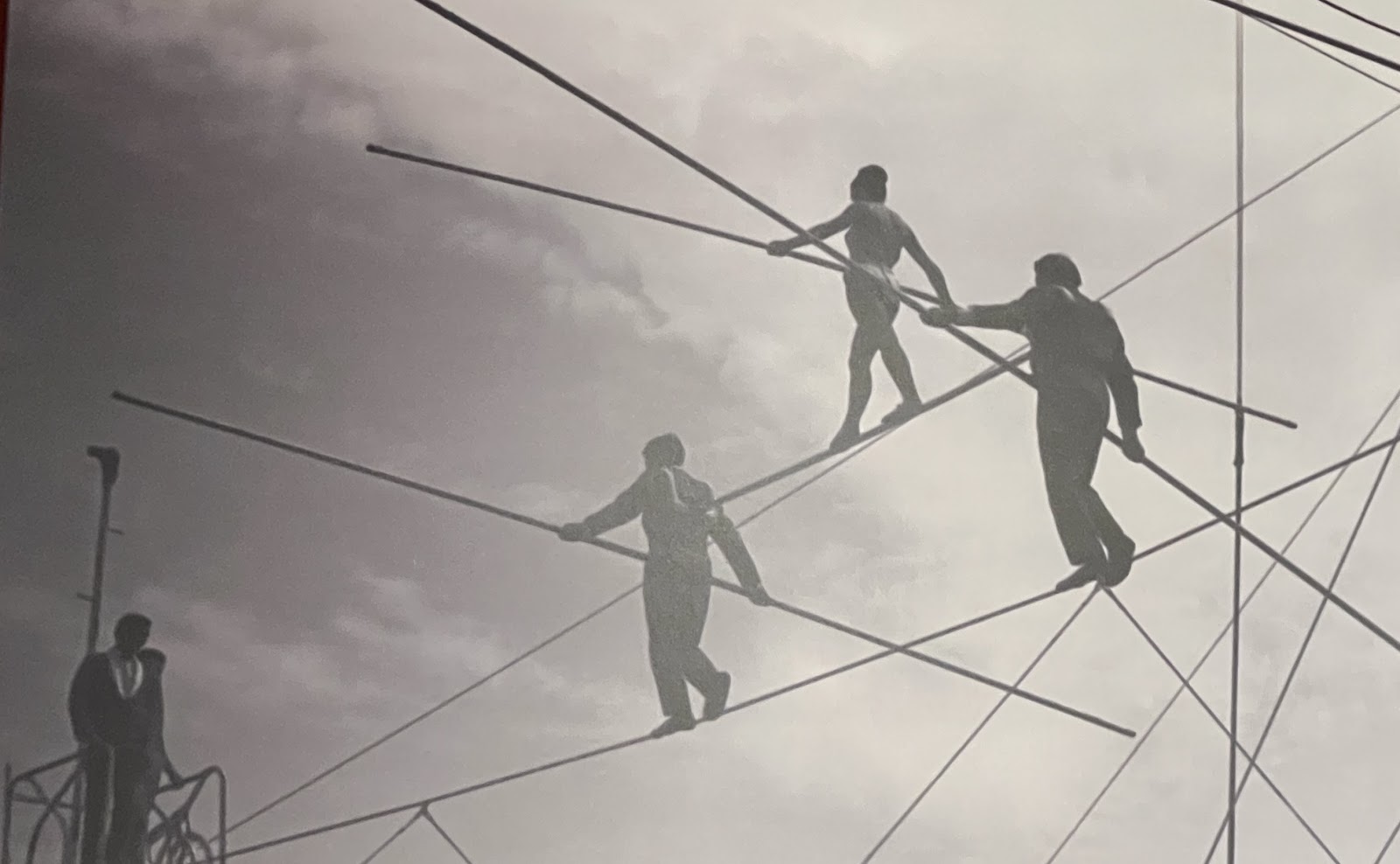
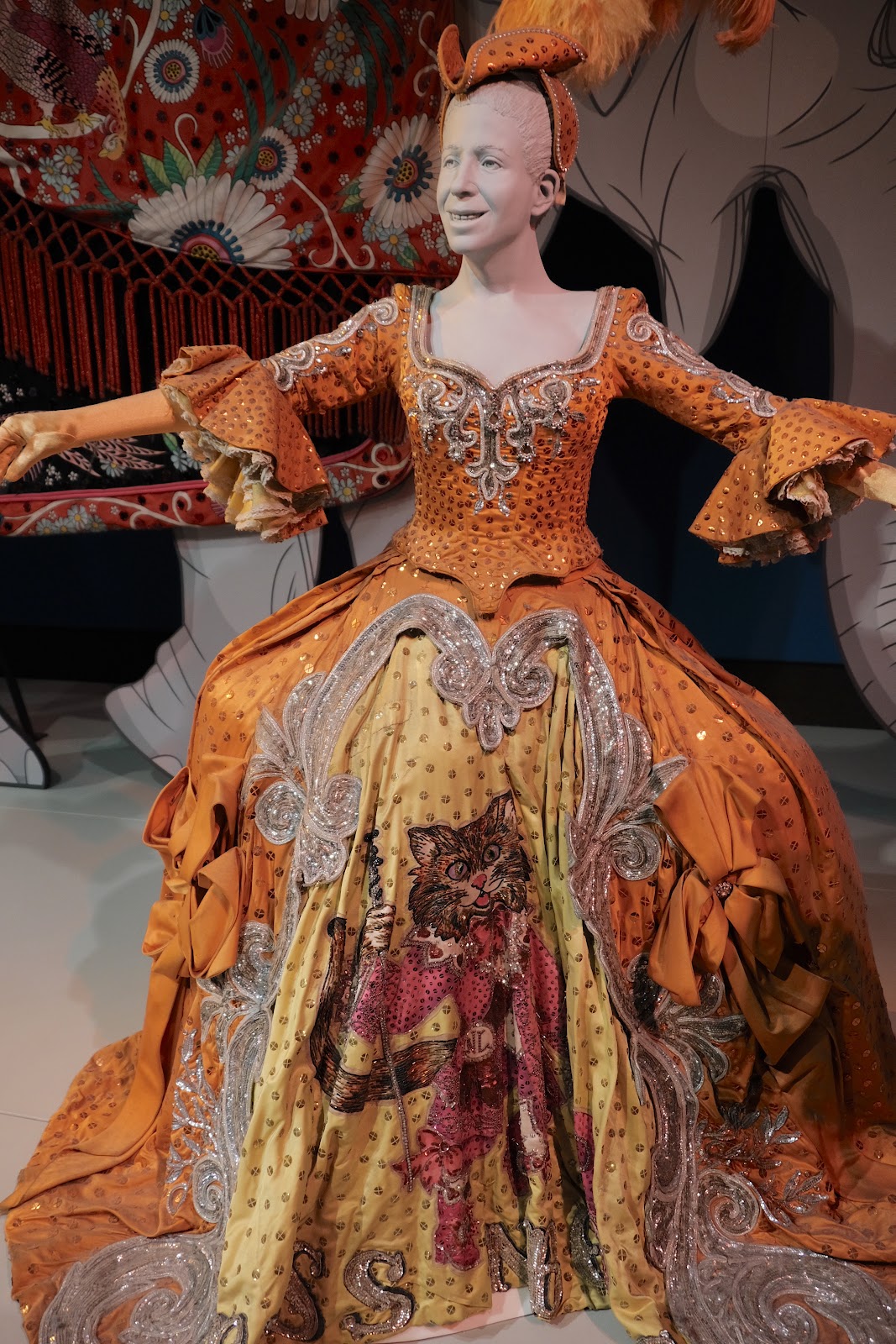
The foyer has a wall of colorful posters, but they are under glass and harsh lighting makes many of them hard to see. The most outstanding part of the Circus Museum is, oddly, the memorabilia linked to its star acts. These, though, could have been better interpreted. Information is given but (ironically) this part of the museum suffers from being too dark! You have to be of a certain age to recognize names such Clyde Beatty, Emmett Kelly, the Flying Wallendas, General Tom Thumb, or the Zacchini Brothers. I’d recommend that if you visit you jot down names of objects and people that intrigue you and look them up later.


The original clown car


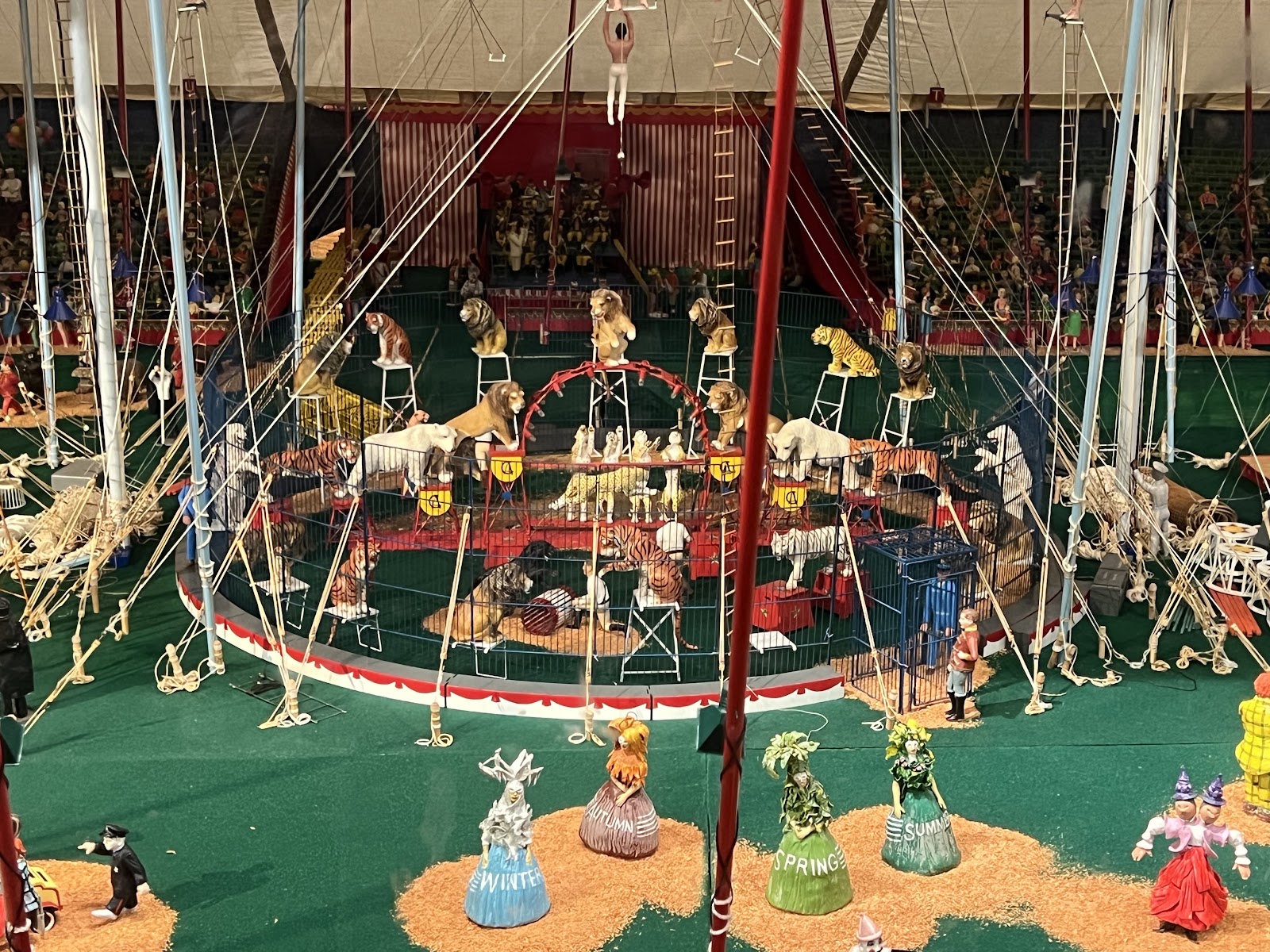
 The centerpiece of the Circus Museum is an entire circus in miniature created by businessman Howard Tibbals (Hartco Flooring). It’s a combination of assemblage and handmade objects that swelled to 42,000 pieces over 30 years–a 20th century circus in ¾ model scale. Tibbals was handy with tools and fashioned much of the circus in his workshop, a tribute to his skill and his obsession with the circus. It’s quite impressive, even when the overall effect is that of a model train project on steroids. Tibbals had an eye for detail, though, and you will come away with a sense of how awesome the circus could be. It’s mind-boggling to consider that such a thing in reality could roll into a town in the morning and be ready to welcome patrons in the evening. 


Stay tuned, though, for my vote for the best capture of circuses available to curious minds and kids seeking wonderment.


Rob Weir  

3/1/23

The Midcoast Exposes Maine's Contradictions


THE MIDCOAST (2022)

By Adam White

Hogarth Publications, 329 pages.

★★★★


Andrew, the narrator of The Midcoast observes, “The vast majority of humans … never get all that close to the center of anything.” He grew up in Damariscotta, Maine, and dreamed of getting away as soon as he could. Though his father was the only orthopedic surgeon in the county, his parents’ divorce, an unrequited love, and processing lobsters for Ed Thatch reinforced his desire to leave and not look back. That's precisely what Andrew tried to do. He went to a fancy prep school, graduated from Amherst College (where he played lacrosse), married, moved to Boston, and fathered two children.


Then, he and his family found themselves in the center of something: the 2013 Boston Marathon bombing. They vacated the area mere minutes before the bombs exploded. This prompted Andrew to move his family back to the safety of Damariscotta, a decided scaling back of big dreams. Instead of making big bucks, Andrew is an underpaid teacher at Lincoln High school. Ed, whom he considered to be raw-boned and dull-witted, has gone from lobstering to contracting and financial success. But the biggest shock was to find Ed married to Stephanie LeClair, the object of Andrew’s teenaged desire.


The Thatches have two children: EJ, a town policeman, and Allie, an ebullient lacrosse fanatic who hopes to enter Amherst. Ed doesn't know much about the sport or colleges and is keen to pick Andrew's brain on those subjects. He has fancy associates among the summer people but retains the social mindset of a lobsterman. Ed also fears that Stephanie is out of his league and scrambles to keep her in the manner in which he believes she prefers. She, in turn, obtained her bachelor's degree and became a later-in-life major player in local politics. In her heart of hearts, though, Allie’s plan is the life Steph thought should have been hers. Plus, she’s suspicious of Allie’s boyfriend. Oh dear! Do we think that a cast of people in roles they either didn't desire or don’t fit them will end well?


Damariscotta is often cited as the most beautiful town in Maine. If you know that area of Maine, you’re probably aware of the region’s stark contrasts. In his debut novel, author Adam White incisively captures this. Damariscotta lies on a tidal river and is 12 miles from the ocean. The further one gets from the coast, though, the more Vacationland–the slogan on Maine license plates–looks like a wood pulp version of the Southern Appalachians. It’s the world about which Carolyn Chute writes. Nearby Lewiston, where few people with higher aspirations wish to live, is just 41 miles from the ocean. Unlike Damariscotta, it’s a played-out manufacturing city with sketchy areas. Were it not its medical facilities and Bates College, Lewiston might have crumbled into scale by now.


White’s novel is a study in character contrasts as well as lifestyle departures. This is revealed through plot devices such as arrogance, failure to execute a promised task, looted yachts, drugs, crooked local officials, and a lobster bake gone terribly wrong. The Midcoast morphs into a crime novel, a good thing from a reader's perspective. The themes I've laid out might sound depressing, but the story is a compelling one made more so through the depth of those who populate it. Many detective and mystery novels employ stock figures who serve as foils for a protagonist we know will make things right. Those in The Midcoast affect us to a greater degree because they seem so real.


If you have paid attention to recent news, you know that well-to-do parents cut corners to obtain special privileges for their children. Of course, we also learn that ambition can motivate or destroy. Or, if you will, it’s a validation of the Tenth Commandment: Thou shalt not covet. White hooks us through other age-old scenarios. Did you ever wonder how life would have turned out had you taken Path B instead of Path A? On a less weighty and metaphorical note, the novel asks: How are you going to keep ‘em down on the lobster farm once they've seen the bright lights of Amherst and wealth?


Rob Weir


4/23/21

Experience the Magic of Glasstastic


GLASSTASTIC

Brattleboro Museum and Art Center

Through June 15, 2021


For the past ten years, the Brattleboro Museum and Art Center has housed one of the most innovative education-meets-art projects imaginable. Kids from across the country in grades K-6 draw imaginary creatures and write about them. In turn, a committee chooses a few dozen or so, and glass artists render them in 3-D. This year's exhibit spotlights 27 of these wonderfully whimsical and inventive critters. It's a toss of the coin which is more magical, the work of the professional artists or the imaginations of the kids. The works range from the silly to the scary and the touching to what might be called burgeoning political awareness.


Here's a small sample:


Rachel Cousino’s “Biwwy” is a doughnut crossed with candy corn. Biwwy has a small brain but a big heart, the latter of which is used to help people like the homeless. 


“Snoogle” by Sarah Balint-Wohl enjoys the company of others and likes to live in a field of flowers for he can hide from predators.


One of my favorites stories is the “Flower Cat “by Aliana Miller. Allow me to quote her: “One day there was a little girl whose mother was sick. She went outside to get some flowers for her mom. But then out popped a flower cat! The girl picked flowers for her mom, and the cat asked why. ‘Because,’ the girl said ‘I want my mom to feel better.’ The cat said, ‘you can give the flowers to her but I have healing powers. So I can use my healing powers to heal your mom so she's not sick anymore.’ The flower cat and the girl became best friends forever.”


Gertrude, a monster designed by Timmy, has spikes and gripping feet so he can climb. Raspberries are Gertrude’s favorite food is raspberries and he can run 63 mph. We don't know why Gertrude is a he, but who cares?


One of my favorites is “The Flying Lunchbox” from Marleigh Vose. Anyone who has ever left lunch on the counter needs one of these. All you have to do is say, “On lunch!” and it uses its wing, invisible feet, and six eyes to find you. Plus, it will make food for you.


One of the more elaborate creatures, “Swirly,” was designed by Ava. It lives in Swirly Town on Planet Swirly and likes to sit in the grass and watch the sunset, eat fruit and be happy. 


August Davis drew what looks to be a narwal named “August Junior.” that for some reason likes to play basketball.


John Max Malcovsky drew a creature called “Tigon,” which could have come from a medieval bestiary. It has wings like a dragon but the rest of him looks like a tiger. He hunts, but he also likes to explore caves. 


Olivia Sawyer drew a creature called “Drake.” According to Olivia, “Drake is creative, happy, funny, and loves to sleep all day. When not sleeping he likes to bake cookies, draw, and give hugs.” Olivia tells us, he “always likes to eat a lot of cookie dough, doesn't everybody?” And because he likes to look good, he wears a top hat.


Kudos to the glass artist whose craft is everywhere on display. Not all artists deign to enter the realms and minds of children, so glass hats off to: Mariel Bass, Josh Bernbaum, Marta Bernbaum, Jocelyn Brown, Robert Burch, Dominique Caissie, David Colton, Dan Coyle, Robert Dane, Allie Dercoli, Robert Du Grenier, Sandy Dukeshire, Alissa Faber, Nic Flavin, Westley Fleming, Zak Grace, Chris Hubbard, Claire Kelly, Jordana Korsen, Lynn Latimer, Sally Prasch, Bryan Randa, Chris Sherwin, Randi Solin Jen Violette, and Andrew Weill.


As an added bonus, another BMAC gallery has a selection of photos from past exhibits.


3/24/21

Bruce Ackerson Puts Whimsy Back into Art


Bruce Ackerson

Birds-Eye Views

Fine Arts Center, University of Massachusetts Amherst

Through May 14, 2021

Artist Website: https://bruceackerson.net/section/225137.html


I was only passingly familiar with the works of Northampton-based artist Bruce Ackerson until the UMass Fines Art Center launched an exhibit of his paintings titled Birds-Eye Views. It is, of course, exceedingly difficult to get to see the exhibit at present, but Ackerson has a superb Website of all that is in the UMass exhibit and more that is not.


Birds-Eye Views is an apt title, but it also a limiting one. Ackerson does skew our vision by placing our eyes in the sky and forcing us to gaze downward. In this regard, he reminds me a bit of Grant Wood. “Boxcar Getaway,” for instance, is fraught with danger reminiscent of Wood’s “Death on Ridge Road.” The survival odds are low for the figure attempting to allude his pursuers by leaping off a cliff onto a moving train. “Baddy Redpants” has a better chance; he has used a moving flock of sheep to put distance between himself and those chasing him. Ackerson, though, is East Coast to Wood’s Midwest, suburban to his rural, and is more interested in keeping us off balance than in inducing pathos. 


Ackerson perhaps also echoes Wood in that his style might be called deliberate primitivism. If you’re going to defy perspective, go whole hog. Don’t worry about table legs that don’t look to be 3-D, walls that lean, or cartoon-like figures. According to the UMass writeup, Ackerson’s is an “imaginative take on popular culture, modern life and the hidden world of the human psyche.” In works such as “Artist” or “Artists and Collectors,” we are not sure if the central figure is showing us a canvas or a picture window that opens onto the real world.   


What will strike most people is Ackerson’s sharp, often surreal sense of humor. For all the high-falutin’ ways one could describe Ackerson’s works, his own take is that a lot of it is simply “goofy.” It’s hard not to love the lack of pretense in that description. It’s also hard not to see that he’s right. “Port-o-Pool” is dips in the back of a semi; “Girls Having Fun” is three women giving two lads an eyeful, but from their perch atop a cliff the boys can’t access. Ever wonder what Santa does in the off-season? “Walk in the Woods” will inform you. If you’ve had it up to your eyeteeth with burly males throwing their weight around, check out “Two Macho Men” and let me know your preferred outcome. “Saving Timmy” will raise a snort from anyone old enough to remember the TV show Lassie.


There are several themes that come through in Ackerson’s works beyond perspective and humor. One is that a lot of them are set at the beach. This probably linked to the time he spends in Provincetown on Cape Cod; its Rice Polak Gallery is where many of Ackerson’s works are for sale.  He enjoys depicting running figures bolting out of pools or across cliffs and sand dunes, then adds twists of why they’re in a hurry. “Swimming and Cake” and “Cake Time” are mad dashes out of the water and toward a groaning board laden with yummy delights. An even funnier take on his predilection for food themes is “Pizza!” It’s as if training for the Olympics ceased to indulge in rapture that comes in a crust. Ackerson enhances the illusion via an aerial perspective that makes it look as if servers are bearing sacred offerings.


He also indulges us in other fantasies. “Presents for Everyone!” is the way life should be. In a different vein, “Strap-on Wings” evokes a low-altitude training school for a would-be Icarus. Think you’ve had a bad day? “One Thing After Another” will make you feel better. “Joggers” is an amusing-if-ominous sprint that (perhaps) is a backdoor commentary on those who claim the world dates only to 4,004 BCE.


If I had to pick one of Ackerson’s painting as my favorite, the honor would go to “Spaghetti Night.” Mom and dad y fancy themselves as jugglers and are attempting the famed “pass” maneuver, except instead of Indian clubs they are tossing pasta-and-sauce-filled plates across the room with predictable results. Three children look on, two with arms out in a supplicative manner as their airborne dinners splatter onto the floor. It appeals to my boyhood sense of wonder and mirth. I admire an artist who makes me laugh aloud instead of muttering over affectations and pretense.


Rob Weir


7/21/17

Sabra Field at Middlebury College Museum of Art

-->   
SABRA FIELD, THEN AND NOW: A RETROSPECTIVE

Middlebury College Museum of Art

Through August 13, 2017


If you don’t live in Vermont, perhaps the name Sabra Field doesn’t ring immediate bells. But you know her art. With the possible exception of Woody Jackson—he of the black and white Holsteins that grace Ben & Jerry’s Ice Cream products—no recent artist has done more to evoke Vermont’s rural heritage than Ms. Field. Not many artists can claim that 60 million people have seen her work. In 1991, she pulled out nostalgic stops for a red barn, verdant fields, green hills, and blue skies ensemble that graced U.S. postage stamps. If that sounds more commercial than artistic, read on.


Although she is now 82, has lived in East Barnard since 1967, and has been producing art since her undergraduate days in the 1950s, her Middlebury College retrospective is aptly titled “Then and Now.” It includes old favorites among the 100 works on display, but also more recent work like a sixteen-panel assemblage titled “Cosmic Geometry,” which on the surface appears to a collection of spirals, angles, architectural details, shapes, and natural objects, but which might also be viewed as metaphors for life and passages. Even more stunning is her “Pandora Suite,” a powerful exploration of the human experience from the exaltations of love to the ugliness of racism and the insanity of war. There’s much more to Sabra Field than barns and farms.


Still, there’s no escaping the fact that Field is first and foremost associated with tranquil wood block prints that capture the solitude of the Vermont countryside. And if you wonder about the postage stamp thing, consider that for many years Field grappled the same challenge that most artists face: how to parlay the creative spirit into something that resembles making a living. She raised a family, taught art to supplement the family budget, flogged her work at craft fairs, and did small shows. Emily and I first saw her work in the 1970s at the Montshire Museum in Norwich, and the fact that it’s science museum gives you a clue that Field's impact was more modest back then. Here’s another tip-off; we own a few of her prints—things we bought for much less than they’d go for now! 


 If you look hard at Field’s prints, you begin to realize that she’s doing more than romanticizing rural vistas or seeking to fossilize fading ways of life. There is a Zen-like quality to a lot of her work. In some cases, Japanese aesthetics are pretty obvious, but there are others in which it’s subtler. You stand before scenes of waving grass, puffy clouds, undulating fields, and lumpy mountains that are bisected by fence lines, silos, shadows, of contrasting patches of color and, without realizing it is happening, you sink into a meditative state. Others, like “Fox in Winter” or any of a number of deep frost scenes force you to think upon the dance of life, struggle, survival, and mortality. Or, if you wish, you could just see her work as appealing to the eye. If you can make it to the show, though, you’ll learn from the captions and a video that Field had more in mind than simply making pretty pictures. My personal take is that we ought to take regional artists such as she much more seriously than we do. But I suspect that Sabra Field would be happy that people like what they see—no matter what they make of it.
 

If you can’t get to Middlebury before August 13, don’t despair. Ms. Field is an alum and the college is a repository for her work, so there’s likely to be something on display next time you’re passing through. And there are always Vermont galleries to consider. Field is now such an icon that it’s a rare independent gallery than doesn’t have something of hers on offer. You’ll know her work when you see it. First the color will grab you, then the composition, and then…?


Rob Weir