Showing posts with label How Cool Is This?. Show all posts

2/21/26

Winter Memories: Nostalgia or Analogy?

Covered bridge in Fairfax, VT near our house  (NMP)


Is it the curse of old men to dwell on the past? This winter has been so cold and snowy that it reminds me of when winter excited me. The 1970s were distressful: stagflation, gas shortages, high unemployment, appalling fashion and music, and inability to land a teaching job. Emily and I desperately wanted to leave Pennsylvania.

Lots of people like Pennsylvania, but it was too conservative, plus about all this working-class lad knew about the world was nearby Maryland, West Virginia, and Washington, DC. I got married in 1978; Emily and I wanted to live in New England, she because of relatives in the region and me because I was seduced by photos in National Geographic. Those are not the best reasons for pulling up stakes, but we vowed to move to move whenever one of us got a job up north. It happened eight months later. We’ve traveled a lot since then, but we always head back to our adopted homeland of New England.

We now reside in Massachusetts, but our first New England home was in northwestern Vermont where Emily got a job offer. That’s world-class irony, as Vermont and Rhode Island were the only New England states where none of Emily’s relatives lived. The only time either of us had ever seen Vermont was when we were driving to the Clark Art Institute in Williamstown, Massachusetts, got turned around in its notorious traffic rotary, and accidentally drove across the border to Pownal, Vermont. It did not leave a good impression. Pownal was rundown and sported a tawdry greyhound betting track. Its parking lot was where we reversed direction and hightailed it back to Williamstown.

We moved to northwestern Vermont in early winter, before I drove back to Pennsylvania to finish my Masters degree courses. On my return trip, I stopped in Montpelier for a job interview. It was so cold I couldn’t feel my feet!  After all, I was armed with acrylic sweaters, light jackets, thin socks, and ankle-high footwear. I didn’t get that job, thus I was unemployed and, like many newlyweds, cash was tight. Burlington was out of our price range, so we rented a basement apartment in Milton, nearly 20 miles north. We froze our tushes off, but were sustained by the adrenaline of discovery before discovering wool, down parkas, tire chains, engine block heaters, and the wisdom of throwing a snow shovel in the trunk. 


We were once among the idiots walking across Button Bay! (NMP)
 

Somehow, it felt romantic to bundle up, dare to walk upon frozen Lake Champlain, hear the snow make a noise under our feet that was a cross between a crunch and a squeak, and watch the thermometer plunge below zero Fahrenheit. I took to calling Vermont “The Land of Right-Angle Smoke.” There were several weeks in which one degree would have constituted a thaw. The air was so heavy and laden with ice crystals that warmed air could not rise through it. River valleys were filled with homes where woodsmoke climbed 25-30 feet above the roofline, smacked into the cold air mass, and made an L-shaped turn. It couldn’t have been healthy to breathe that air, but I didn’t think about it back then.

I finally secured a teaching job, in Milton no less. The community was poor, but I adored teaching in the grades 7-12 high school. When I left after seven years, it had zilch to do with the kids. Oh, sure, I had occasional discipline problems, but nothing I couldn’t handle and I deeply empathized with those growing up without the resources that ought to be guaranteed every youngster. In a literal sense, Emily and I grew up in Vermont. Small wonder it holds a special place in our hearts and we seldom turn down a chance to venture across the border (near Brattleboro) and keep going until we make it to Burlington or beyond. 

Snow falling 1" per hour in our MA backyard
 

Maybe I’m remembering all this because right now, winter in Massachusetts feels like one in Vermont. We’ve had several large snowstorms that crunch-squeak beneath our now-appropriate footwear and numerous subzero nights. Is it geezer nostalgia? I’d plead guilty to miss being in my 20s when the cold didn’t make my joints throb or send me under a mountain of quilts. Maybe. Ask me again about nostalgia in June, when Vermont skies are blue, days are pleasantly warm, farmers’ markets are crowded, and small boats flash brightly-colored sails on Lake Champlain.

Rob Weir

NMP = Not My Photo. There were no consumer digital cameras until the 1990s.


9/19/25

Let’s Hear It for Massachusetts Politics


Rally vs. Trump in Northampton on his birthday


Readers of this blog know that I lambast politicians on a regular basis just to stay in shape. This time I’m here to praise a few, not bury them. I’m lucky enough to live in Massachusetts, where politics is serious stuff. We actually expect our elected officials to listen to us. If you’re not good with constituent service, you’re chum for bigger fish.


Let me lead with something that made me proud to live in Northampton. On Saturday, thanks to the tireless efforts of our friend Devin Bruce and a generous donation from Marjorie Hess, we dedicated a roofed, outdoor stage at the Forbes Library. Such things happen across the country, but how often do you find a state senator dancing with the city mayor? Mayor Gina-Louise Sciara was unabashedly sashaying with Senator Jo Comerford, as Representative Lindsay Sabadosa, several city councilors, library trustees, the Forbes director, and the audience applauded. This wasn’t a political stunt; it’s how Jo and Lindsay act most of the time. Some in the crowd were elderly and I watched Jo and Lindsay offer their arms to help them get up and down. Jo told me it’s one of her favorite things to do. I hugged both of them, whom I see at my local café, and told them they “rock.” I don’t always agree with our mayor, but I’d be the last to say she doesn’t care. 


A shout out to U.S. Representative Jim McGovern. He lives in Worcester, an hour away, but his district is large. Jim is a member of the Amherst Cinema and attends all manner of events west of Worcester. How many people can say that about their U.S. Reps? He’s also an outspoken critic of Donald Trump. Jim attends protests and holds town forums on current politics that fill halls and large churches.


Most of us in Western Mass also love U.S. Senator Elizabeth Warren and find it rude, crude, and unrefined when Trump calls her Pocohantes. He hates her because she speaks truth to power and is uncowed by his bullying tactics. She knows way more about economics than Trump, supports working people, and thinks that consumer protection is far more important that unbridled capitalism. Nor is she afraid to rub noses with the masses.


Our governor is Maura Healey, the first lesbian governor of any state. Yeah, she’s the kind of person Republican radicals think is immoral. She was attorney general before she was governor and here’s what her “lifestyle choice,” as conservatives like to call it, affects her job. Not. One. Damn. Bit. I sometimes wish she was more forceful, but she has a 60% approval rating. Trump’s is 39%. ‘Nuff said.


How about Mayor Michelle Wu of Boston? She calls herself a “pragmatic liberal” and embodies that label. She not only supports working women, she has served on both the city council and as mayor while nursing her newborns. Wu helped develop the Boston Green New Deal, stood up to Trump when he claimed Boston was riddled by crime by using actual statistics, has told ICE it’s not welcome, and gets along well with cops and fire fighters. Right-leaning opponents got behind Josh Kraft, son of the New England Patriots owner. Wu crushed him in the primary with 72% of the vote.


The cherry on the sundae is that because we border Vermont, Bernie Sanders is a frequent visitor!


Area Code 413. That's us!

 It's true that neither Vermont nor Massachusetts is a utopia, but if you’re a dispirited progressive and can’t stand living in a red state any longer, move to Deep Blue Massachusetts. Even better, come to Western Mass, as pockets of old-style machine politics proliferate in Eastern Mass. In addition to the pols I praised, other progs in Western Mass include: Natalie Blais, Mindy Domb, Adam Gómez, Homar Gomez, Robyn Kennedy, David LeBouef, Jake Oliveira, and Budd Williams. Massachusetts grades strictly by percentages on the progressive scale. If you only vote according that scale 71% of the time, you get a C-! My apologies if I missed a few progressives. What a treat to live in a region where the list of hacks is short and mayors dance with state senators. 


Rob Weir


4/21/25

Glasstastic Returns to Brattleboro

Glasstastic (Through November 1, 2025)

Brattleboro Museum and Art Center

10 Vernon Street

Brattleboro, VT Weds-Sun 10-4


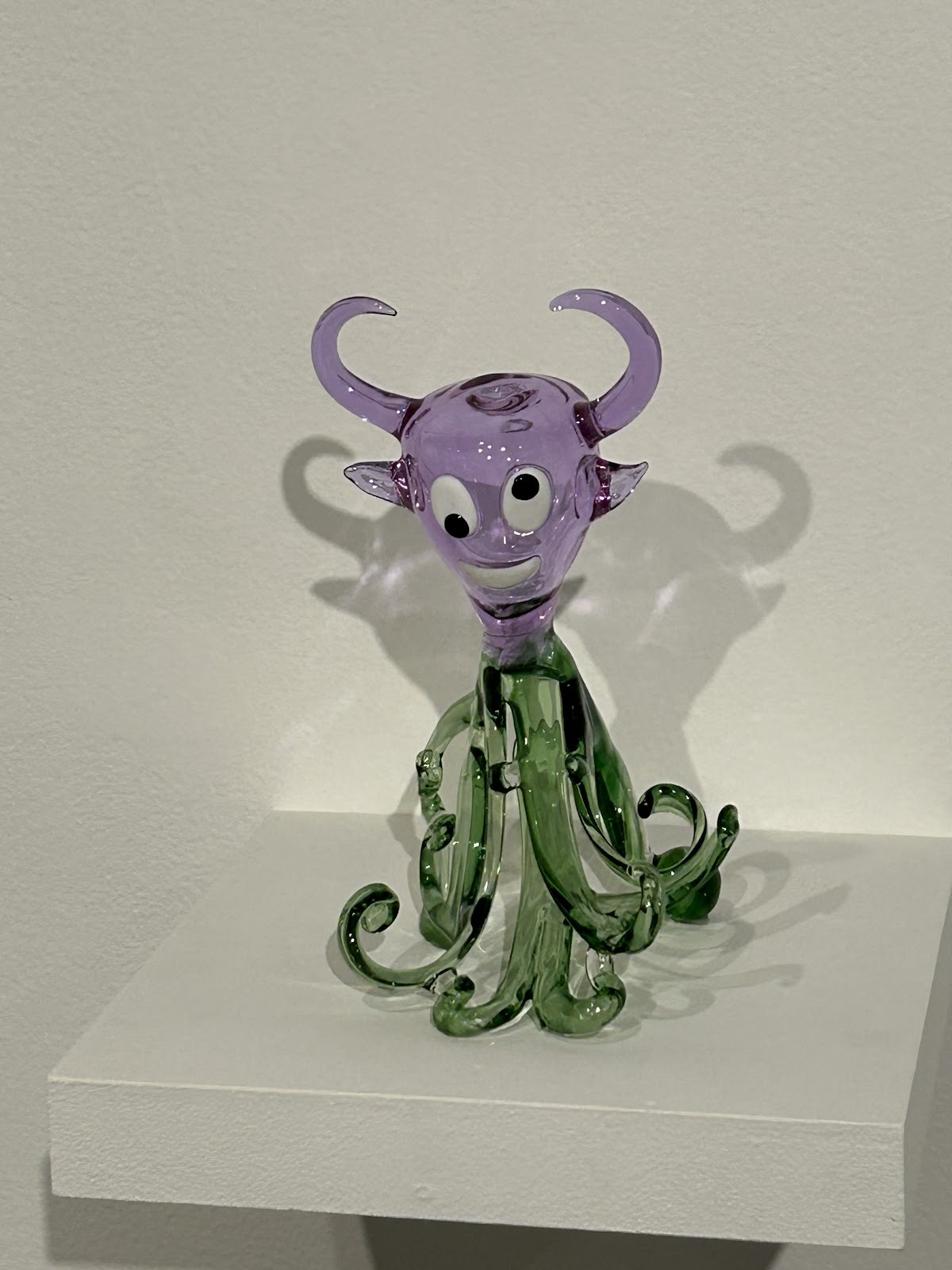
Welcome back! I’m talking about one of the coolest ideas ever. Fourteen years ago the folks at the Brattleboro Museum and Art Center (BMAC) launched an innovative and delightful idea. They asked kids from kindergarten through sixth grade to draw an imaginary creature and write a “story”– usually just a few lines, often filled with charming misspellings– about their beasties. As the curators note, quite a few creatures “love pizza and dancing.” A panel of 20 artists chose one to be rendered into glass sculptures based on the kids’ drawings.


It started small but these days they get more than a thousand entries from all over the country. I must say that if you’re like a lot of Americans you’re probably not feeling very hopeful about the nation these days, but the 2025 Glasstastic show is guaranteed to put a smile on your face, even when a child or two writes something personal that will tear at the old heart strings.


Here are a few images to whet your appetite. I highly recommend that you get there to see this exhibit in person. These iPhone shots can’t convey the overall vibe, whimsy, and creativity involved. Major kudos to the BMAC for taking the minds and experiences of children seriously and to the glass artists for allowing their inner children to come out and play.


Admit it. You’d like to have a “Demon Slug” on your dresser. Or perhaps a glass pirate skeleton, or Tina, an underwater creature who turns colors according to her emotions. Then there’s Alf, who has anger issues because his father died from cancer. You reckon eleven-year-year-old Simon might be sharing his own pain? We can only wish that he gets to meet “Smilie” soon. Or maybe Alfred, the 82-year-old critter whose mustache is so strong he can stand on it and can hoist little George over his head.


Photos are labeled with the child’s name and age followed by the artist’s name. Enjoy! (Ignore last label; there is a format error I can't find!)


Gavin Oparowski, 10, Demon Slug  Andrew Weill


Maddie Kolb, 10, Tina  David Colton

Clara Lumenello, 11, Smilie  Chris Sherwin
Maddie Gruey, 11, Alfred & George  Bryan Randa


Simon Hamilton, 11, Alf – Jen Violette     


    Reagan Loucy, 8, Webs the Tarandrabat

  Wesley Fleming


6/10/24

Promise and Failure of the Arts and Crafts Movement


Sometimes the very best and very worst ideas are one and the same. Industrialization began to catch on in the early 19th century and by mid-century was on its way to becoming dominant in how goods were manufactured in Western society. You didn’t have to be a Luddite to be critical of the factory system. It was dirty, unhealthy, wasteful of natural resources, and exploited wage-earners. It did make goods make goods cheaply, but that was a mixed blessing. Even when they cost less, they were also “cheap” in quality, generic, and reduced consumer choices. In clothing and footwear, for example, “bespoke” goods tailored to fit the wearer were replaced by predetermined sizes. Thus was born the old joke “one size fits none.”


In Britain various visionaries–some driven by artistic motives, others by social and political ideals–asked a simple question: Should manufactured goods be rejected in favor of all things artisan-made? Proponents of the arts and crafts movement thought that reviving handcraft work would yield well-made and beautiful objects that could be sold at prices the masses could afford. They were right about the aesthetics of their endeavors, but dead wrong on how affordable they would be, as anyone who has ever attended a high-quality craft studio or show can attest.


The arts and craft movement fought the good fight. You name it and it was made: wallpaper, metal work, lamps, pottery, furniture, textiles, painting, houses…. You’ve probably heard of some of the key movers and shakers: Charles Robert Ashbee, William Arthur Smith Benson, Walter Crane, Charles Rennie Mackintosh, William Morris, and John Ruskin. The latter two could be considered movement lynchpins. Much of it was a based upon romanticized notions of medievalism. The paintings of Edward Burne-Jones and Dante Gabriel Rosetti went a step further and evinced Greek and Roman tales that were reworked in the Middle Ages! In many respects those Victorians seeking to rediscover the “folk” in everything ending up producing things no laborer or ploughman could dream of affording. Google some of the “cottages” Philip Speakman Webb built in the name of “art of the common building.


The Arts and Crafts movement made its way to the United States, where it was just as naïve as its European influencers. Frank Lloyd Wright drew inspiration from Webb. Do you live in a Wright home? Many American designers are also acclaimed figures: William Wallace Denslow (illustrator of The Wonderful Wizard of Oz), Elbert and Bertha Hubbard, William “Dard” Hunter (handmade paper), architect William Lightfoot Price,  Gustav Stickley. The U.S. movement stumbled over the same contradictions as the Europeans in that most acolytes were designers whose work was made by others–often via the same industrial methods they sought to dethrone.

Nonetheless, those designs and finished products are gorgeous. You can see them in many places, including: Ashcroft in North Carolina, the Arden Community in Delaware, Craftsman Farms in New Jersey, the Museum of Arts and Design in New York, the Rhode Island School of Design, and the Renwick Gallery in Washington, DC. To whet your appetite here are a few gems from the Museum of American Arts and Crafts in St. Petersburg, Florida. No need to concentrate of the design firms; just enjoy the beauty of these objects. It’s the difference between the artistic and the prosaic.


1/7/24

An Epiphany Tale


Two of six


Today is Epiphany, symbolically Jesus’ introduction to the Gentiles. It’s January 6 in a non-Leap Year. Therein lies several tales, including my Christmas cactus (officially a Schlumbergera).


As I’ve noted before, it’s unlikely that Jesus was born on December 25. Unless you’re a Biblical literalist–nobody know for certain what happened at Bethlehem or when. One thing is clear, though. Despite those manger scenes you see at churches during the Christmas season of “Wise Men/Three Kings” bearing gifts–gold, frankincense and myrrh–manger scenes neglect the observation that the Wise Men came from “the east.” (Garrison Keillor once speculated that myrrh was a tuna casserole!) The “east” was Persia and would have been Zoroastrian Magi with a reputation for practicing alchemy, astrology, and astonishing tricks. The word “magic” derives from them.


Most manger scenes are now back in storage. That’s odd because there were no Ubers or airflights back in first century, so it would have taken the Magi around 12 days to get to the manger via camels. That span of time was the inspiration for the many, many versions of “The Twelve Days of Christmas.”


Here’s where it gets weirder. December 25 to January 6 = 12 days. Except, December 25 and January 6 weren’t always December 25 or January 6. Huh? In what Westerners  call 45 B.C. Julius Caesar instituted a solar calendar, which was inaccurate by roughly 11 minutes per year. In 1582, some places converted to the more accurate Gregorian calendar (though it’s off by about 26 seconds each year, hence leap years). It wasn’t put in place in Britain until 1752, which meant 11 days needed to be lopped off the calendar.


In legend, there were riots in which crowds chanted “Give us our 11 days.” That might not be true; some believe it was a joke embedded in a William Hogarth painting–he a bit of a trickster in his own right. That said, not everyone was happy about matters. For some in the Eastern Orthodox tradition, today is the “real” Christmas. This brings me to my Christmas cactus, which gets bright pinkish red blooms in the winter. Ahh, but when?


Years ago, I was in Glastonbury, England. It has associations with King Arthur, but never mind that. In legend, one hawthorn–“holy thorn”–tree bloomed in the spring and again at Christmas. In the tale, it first sprouted from part of the staff of Joseph of Arimathea. (He was the man who gave the crucified Christ his tomb.) Move forward to 1752. Villagers descended upon the tree on December 25, but no blooms. They returned on January 6 and it did so. A sign from above? For many years Glastonbury celebrated Christmas on January 6.


My cactus didn’t bloom for about five years. This fall we re-potted it and began to see red buds on the tips of several fronds. On December 25, there was one that opened. Today, there are six. Just sayin’.


Rob Weir


PS: Sad tale: Vandals have hacked at the Glastonbury hawthorn and it’s now officially dead, though grafts hold out hopes of renewal.


10/13/23

My Medieval Summer Part Three: Hammond Castle


Hammond Castle

Gloucester, Massachusetts


Without conscious intention on my part, this summer involved a nostalgic trip to the past. My MA is in medieval history, but I abandoned that quest nearly 40 years and instead pursued a Ph.D. in U.S. history. Truth be told, though, I’ve always had a soft spot for medieval studies. In June, I visited Musée de Cluny and Ste. Chapelle in Paris and a few days later, ventured to the magnificent 13th century ChartresCathedral


In September I continued my trip in the Wayback Machine (WABAC in the old Mr. Peabody cartoons) in an unlikely medieval site: Gloucester, Massachusetts. That’s where John Hays Hammond  Jr. (1888-1965) erected Hammond Castle in the 1920s.


As such things go, it began with a rich person and obsession. Hamond came from wealth and as he traveled around Europe, he collected a few things that were more grandiloquent that the tea towels, scarves, bric-a-brac, and chocolates most of us acquire in Europe. His goal was nothing less than to recreate a castle and cathedral in Gloucester based on Chartres. 


That didn't quite happen. First of all, Chartres was never a castle. Secondly, Hammond Castle is a classic mishmash: part Gothic cathedral, part medieval castle, and part French Renaissance chateaux. It houses things Hamond bought in his journeys, plus lots of stuff–like an entire shop and home–that he had shipped over. Nor did his towers and Great Hall reach the 121-foor height of Chartres, but his 81-footer is pretty impressive.


Hammond added to his collections as his wealth increased. Among other things, he was an inventor whose work in radio waves and unmanned flight pioneered in remote control devices and presaged drones. He studied with Alexander Graham Bell, idolized Thomas Edison, did a lot of work for the defense department, and was on the board of directors of RCA. 


The Gloucester of his days was a thoroughly blue-collar (and often gritty) fishing port. I doubt that he hobnobbed much with the locals, as he was also a bit of a bohemian. He married a female artist but was bisexual, which would not have set well with locals back then. Not that they knew; Hamond's friends and social set led lives walled off from the hoi polloi. 


Another way Hammond made money was through building concert organs. If you’re thinking, “Oh cool, Hammond organs!” don’t make the same mistake that I did. These are not the instruments used by rock n’ roll and studio musicians. His were used in much more formal settings and were more akin to what you see in cathedrals and symphony halls. He filled the wall cavities with (literally) thousands of organ pipes. What are the odds that two unrelated individuals named Hammond built organs? One hundred percent in this case! 


The photos (best viewed in full-size mode) show that Hammond Castle is an eclectic place. It’s simply a matter that John Hammond Jr.. collected bigger things than most of us and had a lot more money at his disposal. It would drive a purist crazy, but the best way to approach is to enjoy each detail in its own right and not try to imagine how it would have looked in any particular time period. It displays objects from ancient Rome through the Renaissance and that, my friends, is a whopping span of about 1,800 years!  --Rob Weir


11/25/22

I Swear I've Given Up Swearing


I don’t make New Year or Lent resolutions. My reflective period comes around Thanksgiving. It seems a better time to take stock and see if I can work on attitude adjustment. I did something last year that worked pretty darn well. The word “darn” is a hint. Give up? I vowed to quit swearing.


I’ve never had a serious potty mouth, but I’m guilty of invectives when angered or frustrated. Before I retired, I had occasional bad teaching days and mind-numbing stupidity has always gotten under my skin. I never cussed out a student; I waited until I was out of earshot and let loose. Stupidity was another matter, especially politics, rip-off artists, and Massachusetts motorists. I’ll be understatedly charitable and say that we deserve every dime we pony up for auto insurance. Quite a few Bay State drivers are candidates for the psych ward.  


I’ve done well in my quest to stop swearing–not 100% but good enough to be in the A/A- range. That’s a shocker. Those who know me can attest that I’ll never be confused with a New Age crystal hugger. My academic philosophy is rooted in conflict theory, the belief that social change comes through opposition rather than consensus. Metaphorically (and sometimes literally), I doubt those in charge ever give up anything unless they’re forced to do so. I still call out miscreants and work myself into a righteous lather, so how on earth did I manage to can foul outbursts?


First, I’ve never used religious swears. I know enough to know what I don’t know, so I find it pointless to get into debates over the supernatural. My gut tells me it’s weird to postulate the existence of an omnipotent, omniscient power in one breath and insist in the next that any principality can be completely contained in a book or single faith. I try to respect the best of all religions, though I’m tempted to swear at those who insist they hold a monopoly on truth, use religion to gain wealth, or employ violence and claim they are commanded to use it. But even when I feel utter contempt and express it, I try not to be profane.


Weariness was another motivator. I became so sick of hearing f-bombs that I opted out of adding to air pollution. F-bombs have become the domain of boorish hipsters, the poorly educated, MAGA hat-wearing clods, teenagers trying to sound tough, hip-hoppers too unimaginative to find a decent rhyme, and legions of others who reflexively let loose whenever they are unhappy. Hipster f-bombs are especially irksome; they’ve managed to make all things f-related boring. When I hear a hipster swear I think, “Stuff it in your knitted cap. Nobody but you thinks you’re cool.”


Another word I refuse to use starts with B and slanders women. I find it so offensive that when women use it to discuss themselves or other women, I want to e-mail them applications for the National Organization of Women. That’s not a bad idea; I often wonder if feminism ever happened. When it comes to other demeaning terms for women’s bodies (or a person’s sexual preferences)–the kind you hear from Trump and bad boy rappers–I advocate mandatory pig snout transplants.


I find the lesser swears the hardest to avoid, though there is a long tradition of invented substitutes. W. C. Fields is credited with coining drat and Godfrey Daniels, Robin Williams (as Mork) used shazbot, and the movie version of Room Service gave us jumping butterballs. I’ve heard people use son of a monkey, frick, frak, and the ever-popular freakin.’ I invented my own faux curse: “I don’t give a sqwanker’s farley.”


But the main reason I curbed my cussing is that I cope better when I refrain. Maybe it’s that short pause when my brain is processing a suitable alternative–an adult timeout that gets me centered. I often shake my head at things that used to set me off. Plus, there are a lot of unhinged people in the world, so it’s not the best idea to flip the bird or fulminate around someone nuttier than a Snicker’s.


This holiday season I vow to cleanse my tongue further. I figure what’s the point of learning lots of vocab and confine myself to a few 4-letter terms? Wish me luck.


If you’d like to pursue a similar path but can’t go cold turkey, try impolite jargon few others will understand. The English, Irish, and Scots lexicons contain gems such as bauchule, berk, bloody eejit, bollocks, filthy cow, glakit, and sodding buggeration. I’d translate for you but, you know.


Rob Weir

11/21/22

Cranberries: Bogs to Bags to Bellies


I recently wrote about common crackers. Millions of Americans are about to shovel in an equally unpretentious food and I don’t mean the fan-tailed meleagris, aka/ the turkey. I’m talking about its bright red plated sidekick: cranberries.


This fall I knocked off a bucket list item by venturing to Chatham on Cape Cod to see and hear all about the cranberry harvest. Suffice it to say I had little idea about the process or the challenges facing growers. My defense is that I grew up in dairy and mixed farming country; cows and wheat I know, cranberries not so much. I’m not sure I ever saw fresh cranberries as a kid; for all I knew, they grew inside cans or muffins.


Like farmers of all kinds, cranberry producers work hard and are at the mercy of the weather and the market. Cranberries have to be tended constantly despite the fact they grow in “bogs.” Too much or too little rain wreaks havoc and the picking season is maddeningly short–pretty much October to the week before Thanksgiving. Then it’s pray for a good price. The bulk of Massachusetts cranberries are sold to two large firms: Ocean Spray or Quebec processor Fruit d’Or. Don’t want to accept what they offer? Good luck with all those berries.


Sixty-one-year-old Dave Ross of Little Scoop Cranberry Farm hires help for the harvest, but he’s essentially a one-man operation. In the company of Emily and friends Dominique and Tess we toured Dave’s property and got the lowdown. You’ve probably seen pictures of berries floating on ponds. I foolishly thought cranberries grew in water like some mutant form of red rice. I knew they ripened on bushes, but I was thinking something along the lines of tall, watery domesticated blueberries. I should have been thinking about wild blueberries–the sort that grow on the surface and are seldom higher than a foot or so high. 


The water is the nearly last step, not the first. Before that happens, a cranberry bog isn’t very picturesque; it’s a big messy shrubland with weeds and other vegetation poking out. Any standing water comes from Mother Nature, not human hands. The berries ripen and look a bit like rounded vermilion coffee beans. When they blush red, it’s time to turn on the taps.


Here's where I was really clueless. All those aerial shots of cranberries suggest they float in a deep lake, so I assumed boats were somehow involved in knocking the berries off their stems. What was I thinking!? Some kind of weed whacker for fruit? Actually, cranberry ponds are shallow enough that in ye olden days farmers donned waders, carried snapping scoops through the water, and plucked the berries from the vines. A few hobby farmers still do that if there are growing only for personal use.


Today, most cranberries are harvested by something that looks like a Rube Goldberg lawn mower crossed with an egg beater. They are driven through the water and rotating blunt blades knock the berries into the water. Because cranberries have four air pockets in which the seeds are held, the berries rise to the surface. Cranberry dogs then round up the berries and put them in a corral. Oh wait! I’m wrong about that. Actually, booms are used to contain them and it depends on how meticulous the farmer gets in collecting them. Those that are not gathered help reseed the area. Those wicked cool crimson seas pictured on the Internet are the contained berries that get vacuumed into the back of trucks through wide hoses; no aquatic Roombas need apply. 


Then berries are cleaned, sorted, and sent to the distributor while farmers spend the holiday season hoping for a nice check that covers growing costs, hired labor, and leaves a bit of profit behind. Soon, it’s first-and-ten/do it again as they prep for the next year’s crop. Let’s be frank:  New England cranberry growers are at a metaphorical crossroad. Hybrid berries increase their yield, but can old-style bogs compete with the enormous square plantation-style production of Wisconsin, which is now the largest producer in the nation?

 I hope so. Dave’s farm is a throwback, but it’s colorful in ways no industrial farm can be. I gained appreciation for how something as unpresuming as a cranberry is a labor of love. I shall ponder this each time I bite into a muffin or see a red berried puddle on my Thanksgiving plate.


Rob Weir

 [Note: All photos are mine except the two harvester machines and old-fashioned scoop.]