8/3/18

Black Panther the Breaking Wave of a New Trend?


BLACK PANTHER  (2018)
Directed by Ryan Coogler
Walt Disney Studios Motion Pictures
PG-13, 135 minutes
★★★ ½

I had a bad back when Black Panther was in theaters and finally caught up with it on DVD. If you’ve not done so already, you should definitely see this film, though a few caution flags might deter you from jumping onto the critical acclaim bandwagon.

In brief, this black superhero movie postulates a hidden African empire, Wakanda, which formed when four of five warring tribes—the warrior-like Jabari are holdouts—united and agreed to share vibranium, a metal deposited by a meteorite. Vibranium has qualities that allowed Wakanda to develop a civilization and level of technology far in advance of anywhere else on earth. Our tale opens when T’Challa (Chadwick Boswick) ascends to the Wakanda throne, endures challenges, and seeks advice from Queen Mother Ramonda (Angela Bassett). Think Joseph Campbell's hero's journey cycle. T'Challa also puts up with his meddlesome sister/tech wiz Shuri (Letitia Walker), and good-natured needling from all for his obvious infatuation with his ex-lover Nakia (Lupita Nyong’o).

No Marvel Comic franchise—especially one released as a summer blockbuster—is going to be a romantic comedy, so lets first address just this much of the film. It’s a very good thing to see Africans and African Americans cast as heroes and heroines instead of modern-day Stepin Fetchits or worse: pimps, whores, drug dealers, gangbangers, or goofy sidekicks to white stars. Lest anyone be tempted to label Wakanda a black fairy tale, know that the Kingdom of Greater Zimbabwe (11th-15th century) was indeed far in advance of any European society of the time. Take away Wakanda’s futuristic trappings and replace the high tech with advanced Iron Age knowledge, and a Wakanda-like civilization is historically accurate.

In like fashion, the idea of a cloaked superior civilization is a common comic book and fantasy trope. Think of Wonder Woman’s Amazonia, Uganda in Ignatius Donnelly’s Caesar’s Column, Charlotte Perkins-Gilman’s Herland, Atlantis, some of the lands in Gulliver’s Travels, even Brigadoon. There are literally scores of examples found within utopian literature and science fiction. Once again, it’s refreshing to populate such worlds with black faces.

Black Panther is strongest in constructing Wakanda. Director Ryan Coogler deftly and succinctly gives us just enough information about beliefs, rituals, family structure, power structures, everyday life, and challenges to bring his fictive world to life. He does so on par with the backdrop Patty Jenkins developed in Wonder Woman; Coogler's is also a world in which women have important roles. T’Challa is the Black Panther, but the film’s women are well-developed personalities with the ability to advise, assist, even humble T’Challa.

The central story also intrigues. As it transpires, some very nasty folks also know about vibranium, including Ulysses Klare (Andy Serkis), who is essentially an arms dealer on steroids. He masterminds the theft of an ancient museum object whose vibranium is mislabeled as iron, and intends to sell it to the highest bidder. Obstacles in his way include T’Challa—posing as the chief of a backward African nation, the Wakanda seen by outsiders—his regimental commander Okoye (Danai Gurira), a CIA agent named Everett Ross (Martin Freeman), and Erik Stevens (Michael B. Jordan), a former agent with lots of issues, including megalomaniacal dreams of creating a global black empire the way Alexander the Great built his: by conquest.

This sets the stage for the film’s central drama, but it’s also where Coogler’s imagination wanes. A film director doesn’t have to follow comic book conventions. Wonder Woman took on a look that transgressed its World War II time period, even though it anachronistically blended the past and the future. Coogler resorts more to standard cloak-and-dagger techniques as prelude to a potentially apocalyptic battle. In that struggle, he too liberally borrows from what has already been done. Just change a few costumes and props, and you’ve seen these battles in Lord of the Rings, Game of Thrones, Star Trek, and Star Wars, especially the last of these. When Everett Ross takes command of an advanced fighter craft he’s never piloted, he must intuit its operation and trust his instincts. He is essentially Luke Skywalker tapping into the Force. In similar fashion, the giant rhinos in Black Panther are analogous to the AT-AT Walkers of Star Wars or the wargs in Lord of the Rings.

Some have criticized Martin Freeman’s role in the film, and I suppose it depends upon how you wish to spin it. You could see his presence as a sop thrown to white audiences; on the other hand, you could argue Coogler is making snide comment upon black sidekick roles by casting a white actor in that position. (Freeman is definitely not the superior intellect.) Mostly, though, the last third of Black Panther loses both the sociology and the humor that made the first two-thirds so compelling. It goes for easy thrills and hyper-sensationalism; in doing so, the film becomes ordinary instead of distinct.

It is clear, though, that there is great global desire on the part of audiences to see something other than white heroes on the screen. Black Panther has already grossed more than $1.3 billion worldwide and that number is climbing daily.  In this sense, Black Panther might well touch off a trend that will overwhelm any artistic shortcomings. That deserves applause.

Rob Weir

8/1/18

Clark Art Institute's Summer Exhibitions


Women Artists in Paris 1850-1900 (through September 3, 2018)
City Transformed (through September 16, 2018)
The Age of Iron (through September 16, 2018)
Blind Eye (through October 8, 2018)
Clark Art Institute, Williamstown, MA

Clicking on images will open a larger picture.

Williamstown’s venerable Clark Art Institute has four special exhibits on view this summer. Were they a baseball game, we’d score it two extra base hits, a single, and a whiff.

The season’s biggest show is Women Artists in Paris 1850-1900. I wish I could call it revelatory, but it’s not, and it’s neither the fault of the artists nor the show’s curators. A remark from Elizabeth Jane Bouguereau, the wife of famed academic salon painter William-Adolphe Bouguereau, sums up the problem. She painted in her husband’s style and was considered at best a copyist. (Many critics insisted most of her works were actually done by her spouse.) Her reply was that she’d rather win renown as a fine replicator of William-Adolphe Bouguereau than be forgotten altogether.

This is another way of saying that female artists of the day enjoyed the light of the French countryside, the intellectual life of Paris, and each other’s company, but social shackles limited what they could do. This means that, though the paintings on display are well executed, most of them reinforce the cult of domesticity rather than challenge it. Most French women, in particular, largely basked in the stylistic light defined by men rather than generating their own heat. In other words, whether they dabbled in impressionism, realism, portraiture, or academic painting, they had to swab colors according to male rules. After all, it wasn’t until 1865 that Rosa Bonheur became the first female artist to win Legion of Honor recognition; there was no formal association of women artists until 1881, and no woman was admitted to the School of Fine Arts in Paris until 1897.

Beaux
Those who obtained notice mostly did so through their associations with men. Berthe Morisot, for example, was married to Édouard Manet’s brother; Mary Cassatt’s career was aided by her friendship with Edgar Degas. As did Elizabeth Bouguereau, they also evoked male artists. Much of Morisot’s work is reminiscent of Renoir, and though Cecilia Beaux rendered white on white and black on black magnificently, her work invites comparisons to John Singer Sargent.

Mainly, though, there isn’t much tension in the works, mostly because women were not welcome to set up easels in cafes, racetracks, absinthe houses, or brothels. This means their subjects tend to be “safe” ones: themselves, each other, rural genre scenes, society drawing rooms, and women nurturing children. Often, they cross the border from sweet to saccharine.

The show’s biggest surprises come when we see something different. Cassatt has long been among my least favorite artists because her endless images of romanticized motherhood make me roll my eyes. But I really liked her self-portrait, which was rendered in looser brushstrokes and rougher finish than her mother-and-child staples. Cassatt, though, is topped by American Elizabeth Nourse, whose inward exudes self-confidence and a hint of insouciance.

Cassatt
Nourse
My takeaway from the exhibit was that the paintings that stood out were those that took tentative steps across the line—and these usually came from Americans and Scandinavians. One exception, though, is Ukrainian Marie Bashkirseff, whose “The Meeting” does indeed capture grit, that of street boys. France’s Amélie Beaury-Saurel’s “Into the Blue” also captivates with a woman casually blowing cigarette smoke into the air as if she couldn’t care less what the observer thinks.  Britain’s Marianne Stokes portrays dark psychological gloom in her “Death and the Maiden,” which evokes the Pre-Raphaelites.

Bashkirsheff
Stokes
Beaury-Saurel
Schjerfbeck
 

My personal favorites were Scandinavian women who seemed willing to unmoor themselves from social expectations. Many of those works fall into the category of symbolism. Norway’s Kitty Kielland captures unsettling light in her “Evening Landscape at Stokkavannet,” and there’s plenty of tension in the works of Finland’s Helene Schjerfbeck. Overall, though, this exhibit tries way too hard to make feminists of bohemians and hangers-on. A more honest engagement with the obstacles female artists faced is in order. 


A far more interesting look at 19th century can be found in the photographic exhibit City Transformed. It is a literal snapshot of Paris during the same crucial period between 1850-1900. Those who remember their European history will recall that, in 1852, Bonaparte’s nephew declared the Second Empire and took the name Napoleon III.

The Second Empire only lasted until 1870, but that was long enough for Napoleon III to charge George-Eugéne Haussmann with the task of transforming the city of grime into the City of Light. Today’s visitor to Paris sees little of the pre-Haussmann city. He so thoroughly remade the French capitol that in a dazzling 50 years, Paris hosted the world’s fair five times (1855, 1867, 1878, 1889, 1900). In 1889, a new icon arose: the Eiffel Tower. It so stunned the world that planners of Chicago’s 1893 exposition came up with Ferris wheel to rival the tower. As you can see in a photo from 1900, Chicago’s rejoinder was easily co-opted.

City Transformed gives us peaks at what Haussmann and his successors tore down. Note the center gullies of old cobblestone streets; they used to carry away the “slops” from chamber pots tossed into the streets in hope of timely rains. Featured photographers include Édouard Baldus, Charles Manville, Felix Thiollieer, and Eugène Atget, the last of whom is regarded as one of the masters of the early days of photography. This exhibit embodies the coming social changes of which Women Artists in Paris merely hints. 


The Art of Iron superbly takes iron mongering out of its normal context, isolates it, and hangs it at a level where we can appreciate it. It samples treasures found in a museum in Rouen, but it spotlights works from the improbably named Jean-Louis Henri LeSeq Destournelles (1818-82) and his son Henri (1854-1925).

It used to be that material culture was relegated to anthropological or folk art exhibitions. These days we have come to appreciate the beauty and intricate design that’s often inherent in everyday objects. This exhibit fits nicely with City Transformed, as anyone who has marveled over Parisian street lights or Metro signs knows first hand. It’s also a wonderful mix of craft and whimsy.


The Clark’s Stonehill Center currently houses Los Angeles artist Jennifer Steinkamp’s Blind Eye. It is the Clark’s first video installation—six computer-generated projections in which Steinkamp uses the Clark’s natural surroundings. The aim is to create hyper-reality with a 3-D effect. Alas, the impact is a big meh! It’s all pleasant enough, but one wonders about trying to improve upon what the naked eye can observe. Her installation of free-floating blooms is intriguing, but I doubt she was aiming at what it evoked for me: animated scenes from the Hollywood film Avatar. Maybe the Clark ought to leave this sort of thing to Mass MoCA.  

Rob Weir    

7/30/18

The Nest an Impressive Debut

The Nest (2016)
By Cynthia D’Aprix Sweeney
HarperCollins, 353 pages.
★★★★


The plum is a chubby, often delicious fruit with an attractive exterior. It’s also one that spoils easily and can sometimes hide inner rot behind its shiny skin. That’s also the case of the sound-alike Plumb family in April D’Aprix Sweeney’s superb debut novel. The relationships in this book are so acidic that you might want to don protective gear before opening it. Let’s put it this way, even Amy Poehler’s endorsement notes how nasty the Plumbs are, and she’s no shrinking violet! Poehler also likens the Plumbs to a disaster from which one can’t divert the eyes—and she’s right.

The Plumbs are: older brother Leo, a golden boy turned narcissist; Beatrice, a promising fiction writer who has fallen to the status of one-hit wonder; Walker, a gay antiques dealer furtively spending his husband’s money on sure-fire schemes that aren’t; and sad sack, about-to-turn 40 Melody, who is married to good-guy Walter, is the mother of twin teens—Nora and Louisa—and is mortgaged above the gunwales in a New York City market in the throes of the housing market collapse. What keeps any Plumb afloat is the promise of the “Nest,” a trust fund set up by their late father to be doled out when Melody reaches that magic 40th birthday.

That’s the plan, anyhow. None of them actually knows how much is in the kitty, but each has planned as if it the Nest will feather their lifetime dreams. After the chaos of 9/11 and the Bush recession, though, the Nest evolved into a theoretical lifeline. Through circumstances you need to discover for yourselves, Leo jeopardizes the Nest. Or will he save it? Like everything about the Plumbs, that very question touches off incendiary discussion. Even worse, it leads several family members to hatch even dumber schemes.

Sweeney’s book is tightly plotted in ways that heighten drama in plausible ways. The dialogue is funny in ways that make you roar out loud one moment, and cringe the next. The novel also contains auxiliary characters of varying degrees of believability: Paul Underwood, who publishes a literary magazine; Beatrice’s one-time agent and Leo love-interest, Stephanie; Plumb matron Francie, who  washes her hands of her children, yet demonstrates the roots of their acidity; 19-year-old Matilda, who has the misfortune of thinking Leo will help her; a smart black teen named Simone, whose orbit intersects with Nora’s; and New York City fireman Tommy O’Toole, who (literally) harbors a secret connected to his wife’s death when the Twin Towers fell.

As you can see, that’s a lot of characters, and it’s a testament to Sweeney’s skill that she can bring them all to life. It does, however, cause some motive believability problems in some sections of the book. When it comes to the capacity for selfishness and self-inflicted wounds, however, there’s very little that happens to the Plumb principals that defy internal logic. My sole complaint is that, to a minor degree, Sweeney wrote herself into a corner from which she had to extract her characters too quickly. In this sense, the fate of several of the Plumbs seems contrived and overly generous.

This novel has been on my bucket list for over a year; it took that long for my local library’s wait list to clear. I was glad I persisted. Or, do I mean to say that I’m ashamed to have spent so much time with such thoroughly unlikable characters? It often feels like the real Nest is one of vipers! But, hey, Amy Poehler isn’t bad company to keep if you’re enduring deplorables. This is an impressive debut, and we can only hope that Ms. Sweeney doesn’t follow in Beatrice’s footsteps when penning her next one.

Rob Weir
-->

7/27/18

Art Road Trip to Brattleboro, Vermont

Steve Gerberich, Best of Springs, Sprockets, and Pulleys
Robert Dugreiner, Handle with Care
Roz Chast, Can’t We Talk About Something More Pleasant
Brattleboro Museum and Art Center through September 24, 2018

Not many people think of Brattleboro, Vermont, when they think of art museums. After all, it’s a small venue—only five galleries—located in a town of just 12,000 people that’s 100 miles from Boston and 200 from New York. Sometimes it’s a good thing to have some distance between you and the art establishment. The Brattleboro Museum and Art Center (BMAC) often launches creative exhibits that are not the sort you’d find elsewhere. This summer it has three strong shows.

The star of the summer is Steve Gerberich, an Iowan who has an eye for what he can do with small motors, cast off objects, a vivid imagination, and an offbeat sense of humor. He says his whimsical assemblages are equal doses of Joseph Cornell, Marcel Duchamp, Alexander Calder, Robert Rauschenberg, and Jean Tinguely, but somehow I think he forgot to mention Rube Goldberg. It takes a creative mind to find a personified plastic mouse, fit it back-to-the-viewer in a box, and then imagine metal tea strainers as cat faces that move back and forth as a rodent’s worst nightmare—even if he is conducting the orchestra!

“Cash Cow” (1990) is funnier still, a wood, bicycle, and hide body—the bovine sporting sneakers instead of hooves—plus various gears, levers, musical instruments, and machine parts slapped together to create a surrealistic milking machine. In other pieces he uses teapots for heads, lampshades for hats, broom bristles for hair, and machine parts for noses to create everything from the world’s strangest-looking rock band to machines that do nothing but still manage to fascinate. Gerberich is just a lot of fun. His kinetic sculptures are where engineering, artistic vision, and boyhood wonder collide. You will smile your way through this exhibit. That is, whenever you’re not exclaiming, “This is so cool!”


In “Handle With Care,” Robert DuGrenier juxtaposes glass and objects to create self-contradictory combinations. For instance, his “In Case of Fire Break Glass” is a series of metal hammerheads attached to glass handles. “Double Burner” is a gas oven grate atop melted glass extruded below. A rusty can is shown with a milky substance pouring forth—also glass. In his own way, DuGrenier is making small jokes á la Gerberich. His are a bit more poignant, though, as a fire that swept away his barn inspired them. In such situations we learn that not even “rugged” implements such as hoes, rakes, and shovels emerge unscathed. On a more basic level, though, mixing glass and metal invites the viewer to reconsider all things prosaic.


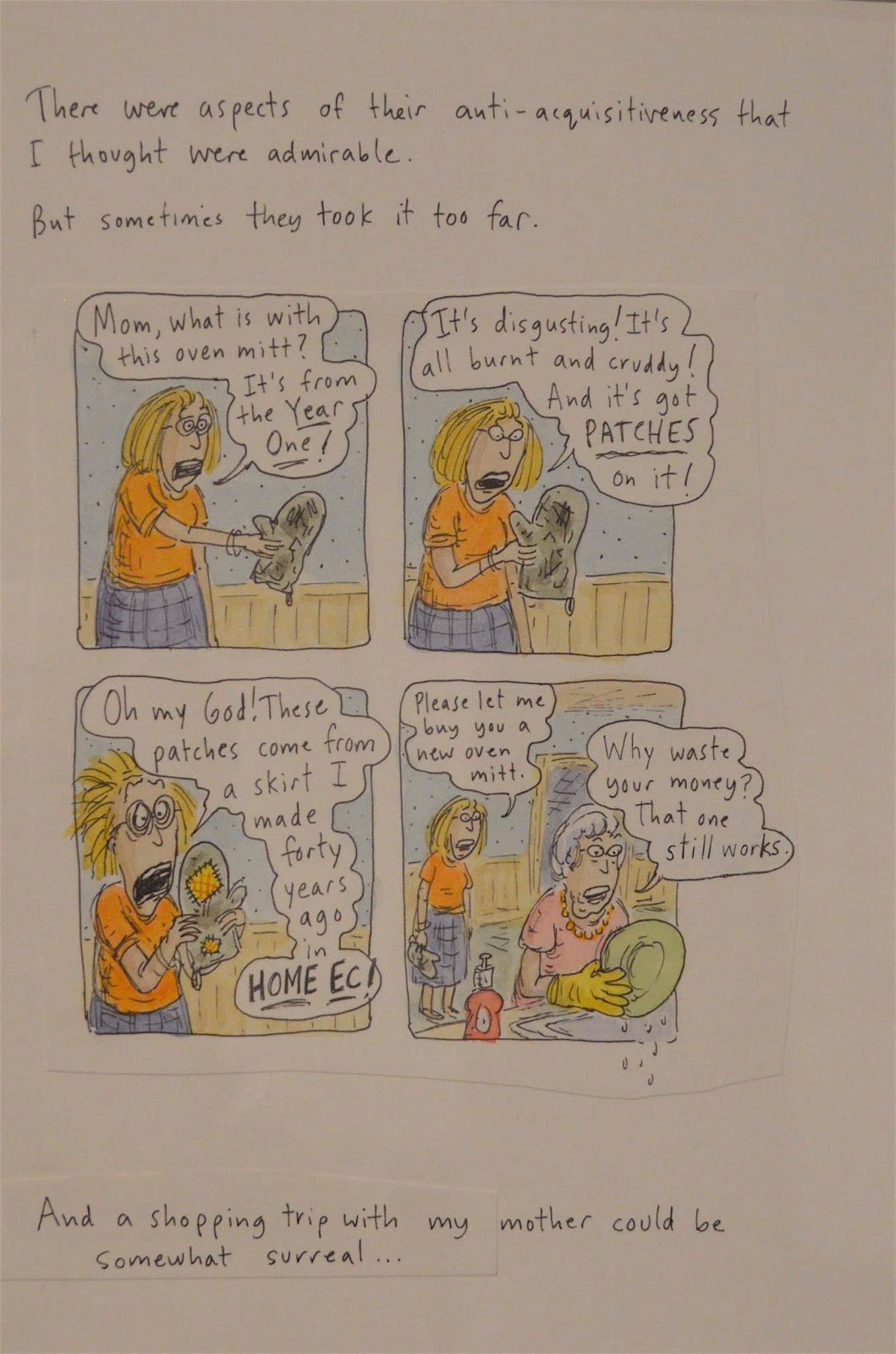
Humor has long been the stock and trade of Roz Chast, one of the best known of all American cartoonists and graphic novelists. Her “Can’t We Talk About Something More Pleasant” demonstrates the levity within the deeply tragic: the care for elderly parents and their ultimate demise. The panels on display come from two sections of her memoir: “The Beginning of the End” and “The End.” If you know anything about Chast, you are aware that she had a complicated relationship with her parents; on one hand, they drove her crazy, but on the other they provided an endless supply of mirth and material. Some would classify Chast’s work as New York Jewish humor. Although there is truth in that, her work transcends any particular religious or cultural tradition. How many of us have, at some point, shaken our heads when pondering how we managed to come from that family? And what is more commonplace than negotiating the communications and values gaps that divides one generation from the next? Chast dares wonder if these haunt from beyond the grave. 


The BMAC has several other exhibits that, in my view, are less successful. David Rios Ferreira creates collage like illustrations in which botany, race, gender, and colonialism intersect. Or, at least, that’s his aim. I see that, but only is glimpses. His densely layered surfaces too often come across as chaotic mishmash that's like a dinner entrée with too many ingredients. Maybe it was the obfuscatory statements he made about his own work, maybe it was the overuse of earth tones, or maybe it was that he tried to tick the box of every au courant oppression, but this exhibit never engaged me.

I enjoyed the vibrant colors in “Painting Time” by Debra Ramsay, but it’s hard to get past the reality that this installation is simply strips of acrylic painted in bold hues and strewn willy-nilly onto the floor of a small side gallery. The various colors represent the four seasons. Conceptually, I like the idea of reducing time’s passage to basic colors rolled onto strips suggestive of film stock. Mostly, though, I saw only a pile of pleasant pigments. I would have been more enamored of a video showing Ramsay rolling paint and talking about how we can “see” time as flowing ribbons of color.  

I zipped through “Terrestrial Vale” by Susan Macdonald, her silverpoint and graphite on paper look at plants bedded down for winter. She produces spectral like renderings of bundled-up plants and captures in spirit the fragility of living things as winter settles in. I confess, however, that I have never warmed to the forms Macdonald uses. To my eye—admittedly sharpened by photography—the images appear sketchy and incomplete, as if they are black and white negatives waiting to be printed.

But here’s the deal. Not even artists themselves like or appreciate all art. What’s special about the BMCA is that it’s small enough that visitors end up sampling things they’d otherwise not consider at all. I applaud it for its diversity and its boldness. And who knows, maybe one day I’ll come to appreciate silverpoint.

Rob Weir

7/25/18

Love and Mercy: Video Review

Love and Mercy (2015)
Director Bill Pohland
Lionsgate, 120minutes, PG-13
★★★

Films about Baby Boomer idols seldom set the box office on fire. I suspect that’s because Boomers have their own memories and no one else particularly cares, though it certainly doesn’t help that so many films about the 1960s and 1970s are either dreck or uneven. Love and Mercy, a Brian Wilson biopic, falls into the second category. Although it’s no masterpiece, it is certainly worth watching as a download or stream. That’s how most of us ended up seeing it, as it did only modest business when it went into wide distribution in June 2015.

Here’s why you should see it. First, the Beach Boys were far more than the surf songs that get radio oldies play ever summertime. Brian Wilson is one of the most creative minds in the music business, and I mean that across genres. The sand-and-party hits notwithstanding, the Beach Boys’ 1966 album Pet Sounds was and is a landmark in soundscaping. Rolling Stone lists it as among the 40 most influential albums in popular music history; some claim it surpasses Sgt. Pepper’s Lonely Hearts Club Band as the most important recording of the entire 1960s. Such debates seldom go deeper than personal preference, but wherever it’s ranked, serious music critics will tell you that familiarity with Pet Sounds is an essential part of anyone’s musical education. The next time you hear “Good Vibrations,” listen deeply. On that hit single and throughout Pet Sounds, Brian Wilson reinvented what we think “rock” music means and sounds like. From the opening Theremin sounds to all the strings, horns, key shifts, and “pet” sounds—today we'd call them “found sounds” (bicycle bells, soda can percussion, disconnected background voices)— Wilson collapsed composition and genres to create music that some found “weird,” but which has stood the test of time.

The second reason to see the film is that this music came from Brian Wilson’s head. Paul Dano, who does a superb job of inhabiting the mind of a tortured genius, portrays the youthful Wilson. I was reminded of Tom Hulce’s performance as Mozart in the 1984 film Amadeus. Actors, of course, are paid to pretend to be another person, but it’s another thing altogether to display how the mind works. It’s hard enough to define creativity, let alone make an audience “see” it at work. Like Hulce, Dano used facial expressions and body movements to make us imagine what the inside of Wilson’s head was like.

That’s not a place most of us would wish to reside; Brian Wilson battled with mental illness, and must still use heavy-duty meds to control schizophrenia. When we meet an older Wilson—played by John Cusak—in 1986, he was under the tyrannical and Svengali-like control of Dr. Eugene Landy (Paul Giamatti), a charlatan who tore down Wilson’s ego, kept him sedated, and bilked him. The film presents Landry as a more evil version of Wilson’s authoritarian father (Bill Camp). That’s both simplistic and a contrived close the circle Hollywood device. Still, we get the point that Brian Wilson often lacked the support systems he needed.

The film is essentially four acts and a coda: a truncated look at the rise of the Beach Boys, Wilson’s simultaneous creative assent and mental descent, the nadir of the Landy years, and romantic salvation at the hands of his eventual second wife, Melinda Kae Ledbetter (Elizabeth Banks). The coda, which plays over the final credit, is the real Brian Wilson performing the movie’s titular song, which he released on his 1988 comeback album.

Dano, Cusak, and Banks are very good in the film. Also convincing are Kenny Wormald, Brett Davern, and Jake Abel in the roles of Brian’s brothers Dennis and Carl, plus cousin Mike Love. Graham Rogers is also solid as the fifth Beach Boy, Al Jardine. The musical sequences are all the more remarkable given that the soundtrack is a pastiche of Beach Boys tapes, recreations by the actors, and an original score from Atticus Ross.

I was less enamored of the usually reliable Paul Giamatti, whose Landy was both histrionic and cartoon-like. I felt the same about Camp’s performance. As is often the case, the film also takes liberties with Wilson’s actual biography and gives him credit for several innovations that weren’t actually his. One wonders why this was necessary given that Wilson’s story is already sufficiently dramatic and unique. The film’s major flaw, though, lies with continuity lapses in the script penned by Michael Alan Lerner and Oren Moveman. They opted for flashback/flash forward sequencing that works for those who already know about Wilson and the Beach Boys, but which is clunky for those who don’t. I also found it jarring to see Dano, who looks sufficiently like younger Wilson, in one moment, and Cusak the next. Cusak is a fine actor, but he doesn’t look much Dano or Wilson.

Overall, though, this is a decent look at Brian Wilson. All non-Boomers should see it to learn about Wilson’s iconic compositions. Maybe the Beach Boys will never be your thing, but Pet Sounds will change the way you hear music.

Rob Weir


7/23/18

Wonderstruck an Overlooked Small Gem


WONDERSTRUCK (2017)
Directed by Todd Haynes
Amazon Studios, 117 minutes, PG.
★★★★


Director Todd Haynes' latest film is titled Wonderstruck, and I was gobsmacked by it. I also understand why it only earned back about a third of its budget at the box office. The reason is the same as why I didn't make it to the cinema to see it; it appears to be a kids' film. It is, after all, based on Brian Selznick's illustrated children's book. (Had I known Selznick also wrote The Invention of Hugo Cabret, which Martin Scorsese so successfully brought to the screen, I might have reconsidered.)

Wonderstruck is indeed a kids' film, yet it isn't. In my experience, most neither-fish-nor-fowl projects confuse more consumers than they land. That's too bad, as Wonderstruck is truly a movie that can be enjoyed by audiences of all ages. It centers on a boy named Ben (Oakes Fegley), who lives in Gunflint, Minnesota, with his single mom (Michelle Williams in a cameo). Ben is plagued by two obsessions—a reoccurring nightmare in which he's pursued by wolves and questions about the father he has never known. When Ben turns 12—the year is 1977—he asks for information on his father; instead he gets a wallet for his birthday.

Soon thereafter, his mother dies in a car crash and he is sent next door to live with a relative. Circumstance sends him across the way to his old home on a stormy night—a play on the film's title—and he is struck by lightening at the moment he is using a landline to call a New York City bookstore that he thinks is linked to his mysterious father. Ben survives, but he is left deaf.

Interwoven with Ben's story is that of Rose (Millicent Simmonds), a whip-smart but headstrong girl living in Hoboken, New Jersey, in 1927. She too is deaf—and no, the connection is not entirely direct; the stories are separated in time by 50 years. In each story, though, our two deaf children run away from home and journey to New York in search of an absent parent—a mother (Julianne Moore) in Rose's case.

Rose's New York is a city of wonder—Broadway lights, elegantly dressed people, energy, and a palpable air of optimism. It's also on the cusp of technological change; horses vie with early automobiles for the right of way, and pedestrians know to be careful when trying to cross streets. Ben's New York a half-century later is a decayed, dirty, perilous place filled with winos, hustlers, thieves, and stack-heeled black men. It's still a wonder, but of an edgier sort.

Haynes bathes Rose's New York is grey and sepia tones, as though he's providing a gauzy peek behind time's curtain. Ben's New York is in color, but one of the jarring, garish hues of late psychedelia. Haynes also adds small splashes of grounding detail. Rose's 1927 is that of Babe Ruth, radio, and the transition from silent to sound movies; Ben's 1977 is stamped by inner city blight, television, and the big Consolidated Edison power blackout. In each case, though, the children will need benefactors to survive in a city that's hard on the ears, but is positively cruel to those who hear nothing. 
Wonderstruck is like two separate fairy tales, but Haynes stitches them together expertly into a heartwarming and uplifting story. He skirts the borders of sentimentality, but never quite transgresses them. That's quite a trick, as every part of this film could have gone too far. You will be impressed by the storytelling and strong performances—the kids are very good and Moore plays two roles—but the film's visual impact will stay with you for even longer. In addition to the light, watch what Haynes does with spaces—confined ones such as small rooms, cramped buses, and crowded streets, but also empty ones such as after-hours' theaters and museums, or Flushing Meadows 13 years after the World's Fair closed, the Unisphere already showing signs of wear. Such spaces are perfect metaphors for our two deaf children. They are, at once, open to the vast vistas that their eyes take in, but closed to subtle meanings that are hard to communicate through signs or hastily scribbled words. 

Maybe this film also struggled to put people in the seats because audiences don't expect such sweetness from Todd Haynes. He is, after all, known for hipper projects such as Velvet Goldmine (1998), Far From Heaven (2002), I'm Not There (2007), and Carol (2015). It may not be Haynes' usual fare, but Wonderstruck is wonderment—a veritable cabinet of curiosities. That's a clue, by the way, but you'll have to watch the film to know why!

Rob Weir

7/20/18

July 2018 Album of the Month: Eleanor Dubinsky


ELEANOR DUBINSKY
Soft Spot of My Heart


Chances are that when an artist is declared a rising star in French, Spanish, Portuguese, and English language publications, she’s probably pretty good. If you retain any doubt, let me proclaim that Eleanor Dubinsky is very, very good. She’s also working on her Czech, so maybe by the time you read this she will have added another feather to her crowded accolade cap.

Ms Dubinsky hails from St. Louis. We know she’s good with languages, but she’s even better as musician. She has studied cello and guitar and has tremendous voice control over a repertoire that’s a jazz/folk mash—with perhaps more jazz shining through on Soft Spot of My Heart, her third release. But she’s really eclectic. How many performers do you know who have been seen at both Lincoln Center and on Animal Kingdom?

Among the many things that is obvious from the start is that Dubinsky is more than just a lovely a voice; she knows how to sing. Her timing is impeccable and she hits all those small spaces in the way that marks gifted jazz chanteuses. She is not, however, grounded in classical jazz. Like many of today’s artists, hers is a mashable musical planet.

This album is folk music as blended with the rhythms of Brazilian and Latino jazz. It was recorded in Portugal and in New York, and it's easy to detect her global influences. After all, "El sabor de la vida" is in Spanish, and "Cuando voya me trabajo” at once shows off her chops in Spanish, Portuguese, and French. In the latter, she sways to bright piano and hollow percussion beats with such ease that you’ll  understand why she wins raves everywhere she appears.

“Turn It Around” is a catchy song with bright splashes of brass, soulful background singers, and stunning phrasing. “Soft Spot of My Heart” is so fragile and beautiful that it could be a spotlight slow dance for future weddings. It’s also the most folk-like song on the album. The album version of “Wind Will Not Knock It Down” is jazzier—mainly just Dubinsky, piano, and beats. Listen to how she allows the song to breathe. She paces her vocals and when she soars, it’s to allow the drama of the song to shine through, not because she’s trying to impress us with pyrotechnics.

I also quite admired “Free Again,” an I-love-you-but-I-must-let-you-go song with late-night coloring in her voice, piano heavy on the dark keys, and small touches of electric guitar. If you need some uplift in these our troubled times, try “You are Special, You are Beautiful.” It was written to empower all those folks the Trumpinistas like to decry— a song that urges all to standup and be valued. Dubinsky's arrangement is equal parts soulful, blue, and bright.

Eleanor Dubinsky has enormous talent, a global worldview, a positive values system, and an amazing voice. I’d say that’s pretty much the complete package. If you don’t know her music, listen and love. Clear a soft spot in your heart to store the joy she will bring.

Rob Weir
-