12/28/18

The Overstory is Brilliant and Unsettling


The Overstory (2018)
By Richard Powers
W. W. Norton and Company, 502 pages.
★★★★★
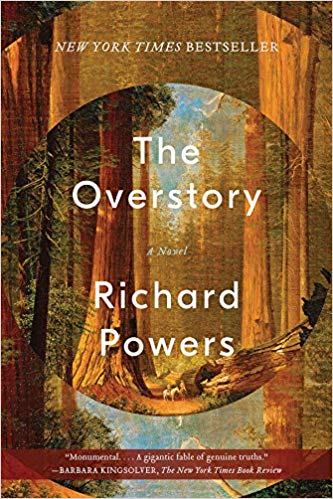
Pete Seeger used to muse, "The human race, if it survives...." Richard Powers' magisterial and National Book Award-winning The Overstory, might lead you to conclude that the best hope for the planet would be humankind's demise.

Powers dons the mantle of a literary sociologist/biologist with a deep streak of sympathy for eco anarchists. His is a hard novel to explain, but it is both an important book and—despite its bleak assessment of our species—a joy to read. Stick with me; it's more about trees than humans. Powers draws inspiration from Peter Wohlleben 's 2015 bestseller The Hidden Lives of Trees. Powers sees trees as social, migratory, emphatic, and communicative. They sing, warn each other of dangers, feel pain, remember, and forecast the future. If that sounds too crunchy for you, consider that there are trees—increasingly fewer—that have lived since Jesus was on earth. Powers writes, "… [T]he word tree and the word truth come from the same root." The Overstory opens with a two-page meditation that closes with this line: "The pine she leans against says: Listen. There is something you need to hear."

The Overstory is an ambitious novel with nine major characters; ten if we consider Powers as an interlocutor. It has two major themes that are philosophical questions of the highest order. The first is: Who owns the earth? The second comes from the character Doug Pavlichek, a former Vietnam War pilot who plants saplings to placate an eco consciousness that awoke when he was shot down and his parachute came down in a banyan tree. His question is coarse, but on target: "What the fuck went wrong with mankind?"

Nature and plants define all of the characters in the book. Nick Hoel, a fifth generation Iowan, is the last heir to a tree many thought extinct, the American chestnut. We meet him as he's trying to give away his art and about to lose the farm. Only one person bothers to exit the highway to explore his free art offer, Olivia Vandergriff, a lass whose life took a new turn after she electrocuted herself while stoned, but was revived. Patricia Westerford—clearly patterned after Wohlleben—also took new turns. As a graduate student, her theories of tree intelligence met with such ridicule she was dubbed "Plant Patty" and driven from academia. She retreated to Oregon, became a park ranger, and is 'discovered' in her old age. Needless to say, she is deeply conflicted about all of this. 

We also find Mt. Holyoke grad Mimi Ma, who is shocked when the mini park outside her office is taken down; and Adam Appich, a psychologist studying activist mindsets who becomes a covert convert. Ray Brinkman and Dorothy Cazaly were college sweethearts and actors who planted a tree on each anniversary, until ennui turned the flame to a smolder. And then there is the intriguing Neelay Mehta, a precocious computer geek who "skitters through the schoolyard like a traitor to childhood." His life changes when he is paralyzed from a fall from an oak tree. From his wheelchair, he designs elaborate games and complex alternative universes that make those of Second Life and Sim City look as simple as checkers.

All nine will, in various ways, be drawn into the battle for the planet, several of them gravitating to a radical activist group modeled on Earth First. Such struggles take place against long odds. Powers is no Pollyanna when it comes to tree huggers and radicals. At times you will find yourself wondering whether you are reading about the only sane people left on the planet, or a band of dreamers who make Summer of Love hippies seem like pragmatists. Powers pits them against an industry that is the wood-based equivalent of oil and coal barons intent upon extracting resources until the last penny is earned from them. As in most such confrontations, the ones accused of being "violent" are not the ones who light the first fuse.

Powers' sympathy is with the trees, but his skepticism parallels that of Doug Pavlichek: "The greatest flaw of the species is its overwhelming tendency to mistake agreement for truth." (You can almost hear Al Gore shouting "Amen!" from the wings.) There are magic words we use: jobs, housing, renewable resources, reforestation…. Yet, as Westerford contemplates the question of how to best help the world she realizes, "The problem begins with the word world. It means two opposite things. The real one we cannot see. The invented one we cannot escape." Wisdom lies in what is hidden: "The beech told the farmer where to plow. Limestone underneath covered in the best, darkest loam a field could want." Powers vividly describes the worlds that dependent upon trees. As he puts it, "People aren’t the apex species they think they are. Other creatures–bigger, smaller, slower, faster, older, younger, more powerful–call the shots, make the air, and eat sunlight. Without them, nothing."

This is such a beautifully written book that you can unearth Websites devoted to quotes from it. Ultimately, though, Powers' message is, "Be still and feel." Then act and hope that it's not already too late to reverse what went wrong with mankind.

Rob Weir
  

12/26/18

Hark is a Misfire Remake of Being There


Hark (2019)*
By Sam Lipsyte
Simon & Schuster, 304 pages

There is a thin line between that which is snarky and hip, and prose that loses its impact. Sam Lipsyte's Hark weaves across both sides of that border on a regular basis.

The first chapter, which serves as something of a prologue, is so chaotic that I almost bailed on the novel before I even got started. I received an uncorrected advance copy, so perhaps editors have rescued the book's gateway, but the rest of what I read is a mix of sharp satire and sociology masquerading as fiction. Maybe Hark rushes to a brilliant conclusion, but I can't comment upon this. Hark is a work that I kept pushing aside in annoyance and picking up again in the hope that I was missing something. There will be no spoilers in this review; I gave up for good two-thirds of the way in.

Lipsyte's intent is to skewer celebrity culture, as well as Americans' rush to jog down a dollar-strewn path to bliss. His antihero is Hark Morner, who just wants everyone to "focus" and pay attention. His is essentially a Ram Dass Be Here Now point of view that replaces Dass' idea of building mental mandalas with "mental archery." What is mental archery, you ask? It's pretty much as it sounds. There are 52 exercises in which one strikes various archers' poses. There is no quiver or arrow; the act of moving and visualizing allegedly helps one "focus." This is an intriguing backdoor critique of the American Rut, one marked by rushing from one mindless task to another, and the anesthetizing effects of helter-skelter surfing in a plugged in and screen bound world.

Hark's only message is that we need to "focus," but American society isn't big on simple messages unless they can be monetized. Hark is a blissful naïf, but his devotees are neither. Lipsyte populates Hark's world with those who think mental archery is a marketable concept, though they've clearly failed to achieve the focused state Hark advocates. Or, more accurately, they are focused on quite different goals. Hark wants to give mental archery to the world as a gift; his devotees want to promote him as a pay-to-see guru.

Hark is thus shoved into a world of hucksterism and hype that he neither desires nor understand. Imagine a motivational speaker who only tells people to focus. No one would pony up to hear that, right? Wrong! The best parts of Lipsyte's novel probe how easy it is to get people to buy bromides and placebos, no matter how improbable or trite. Hark doesn't even tell his massed audiences what we should focus upon. He is akin to a benign and clueless Wizard of Oz, but there is no Toto to pull back the curtain.   The problem, though, is that because we already know this, we plow through Hark hoping to find interesting character backstories. Alas, mainly we find a cast that's either amoral, dull, or both. What is left is a lampoon for the yoga-and-sprouts crowd that they probably won't get.

I leave open the possibility that others will find this book funnier than I. There is, however, no getting around the fact that we are riding the one-trick pony that is the runt litter of a mighty stallion: Jerzy Kosinski's Being There (1970). Hark Morner is an updated Chance Gardner, the shut-in innocent groundskeeper set adrift, and whose knowledge base consists of advertising hooks he overheard on television. Chance is similarly embraced and promoted by those seeking easy answers. Toss in the focus angle from Robert Pirsig's Zen and the Art of Motorcycle Maintenance (1974) and Barbara Ehrenreich's Bright-sided (2009), her searing critique of the positive thinking movement, and you've got Hark.

There is, of course, room for revisiting old ideas; with the exception of Ehrenreich, we are talking about decades-old works. Alas, Hark is not that book. Lipsyte's pursuit of a hipster vibe that is just out of his reach is made manifest in a lack of thoughtful or likable characters. This distances the reader from both the humor and the author's chosen tone. Regarding the latter, there is a sense that maybe Lipsyte really wanted to remake the values-challenged world of Bonfire of the Vanities.

Once again, I cannot comment upon how Lipsyte resolved (or failed to resolve) all of this. I guess I lost my focus.

Rob Weir

* This book is scheduled for release in 2019, but it's already widely available.    

12/24/18

In Any Language, the Kindergarten Teacher is Creepy


The Kindergarten Teacher  (2015)
Directed by Nadar Lapid
Kino Lorber Films, 119 minutes, In Hebrew and English
Not-rated (full frontal nudity, disturbing themes)
★★

Boston Globe film director Ty Burr recently wrote of films that were, in his estimation, unjustly overlooked. My viewing of the Israeli film The Kindergarten Teacher makes Mr. Burr 0-1. Although the film features a stunning performance from the actress Sarit Larry, The Kindergarten Teacher needs to go back to nursery school.

The film centers on Nira (Ms. Larry), who is a beloved and creative kindergarten teacher. At 40-something she’s also suffering from a midlife crisis. Her kids are grown, her husband (Lior Raz) has morphed into a doughy slob, and she seeks to rekindle her passions in a poetry class, but her verse is as limp as the rest of her life. In essence, Nira is on autopilot. She is jarred to attention when she notices that one of her pupils, 5-year-old Yoav (Avi Shnaidman), has a strange tic. Yoav suddenly becomes vacant-eyed, prances back and forth rapidly, and recites original poetry. He doesn’t even know some of the words in his poems and can’t explain how they come to him or what they mean. Neither Nira nor Yoav’s nanny Miri (Ester Rada) know what to think, but each appropriates his words—Nira for her poetry class and Miri as a backdrop for acting auditions.

Is Yoav the poetry parallel to Mozart, a child prodigy whose creative gifts unwrap before his mind is fully developed? Is it some sort of brain disorder such as Tourette syndrome or glossolalia? When Nita’s poetry teacher (Gilles Ben-David) begins to praise Nira’s pilfered poems, she develops an obsession with Yoav that borders on unrequited psychosexual pedophilia. She finagles Miri’s dismissal to eliminate her access to Yoav’s genius, and seeks to convince his father Amnon that Yoav’s gift needs to be nurtured. Amnon, though, is an arrogant and despotic upscale restaurateur who tells Nira that he will do nothing to promote such a frivolous pursuit and envisions a far more practical course for his son. He even forbids Nira from encouraging Yoav, and pulls him out of her school when he learns she has disobeyed that order. This leads Nira to a desperate act.

This story is overlaid with Israeli racial tension. There has long been a split within Israel between Ashkenazi and Sephardic Jews, the former whose ties go back to Northern and Western Europe and the latter to the Iberian Peninsula, Anatolia, and North Africa. It manifests itself physically in that Ashkenazi Jews tend to lighter-skinned and Sephardim are darker hued. In The Kindergarten Teacher, Sephardim such as Nira and Miri are cast as more vulnerable to the opinions and power of Ashkenazi such Nira's poetry teacher or Amnon. This racial theme is juxtaposed with that of the poet as a misunderstood outsider easily crushed by indifference, commerce, and tyrants.

The good things in this film can be summed in a single name: Sarit Larry. Hers is an astonishing physical presence. She isn’t exactly beautiful—adjectives such as handsome or striking work better—yet it is hard not to look at her when she’s on the screen. Her every move is a combination of grace and deliberation. Even her resignation and ennui are elegant. The bad is pretty much everything else: a moth-eaten script, unexplained motives, and creepy situations that take us the very edge of the unforgiveable before backing off ever so slightly. It’s ultimately hard to determine whether one should be saddened or outraged. While I am often a fan of cinematic ambiguity, this film drifts too close to darker human impulses for my comfort level.

All of this begs the question of why there was a U.S. remake of this film. American film companies often do near shot-by-shot remakes of foreign films in the belief that American moviegoers won’t watch subtitles. Such films are almost always flops, in part because there are cultural differences that simply don’t translate well stripped of their context. To pick just one example, Israeli kindergarten teachers have levels of physical contact between teachers and students that would be prosecuted in America.  In 2018, Netflix released an English-language version of The Kindergarten Teacher directed by Sara Colangelo and starring Maggie Gyllenhaal as Lisa Spinelli. I guess Nira was too Jewish for Netflix, but no matter; it’s the same film shortened by 29 minutes. I’ve not seen it and have no plans to do so. Colangelo won a director’s award at Sundance, but the Netflix film hasn’t played much outside of film festivals. From where I sit, that’s not a tragedy. Call me squeamish, but The Kindergarten Teacher in any language is an inappropriate lesson plan.

Rob Weir
  

12/21/18

Gregory Alan Isakov: Catch a Rising Star


Gregory Alan Isakov
Nine Songs
NoiseTrade
★★★★

I first heard Gregory Alan Isakov's music in a Starbucks and that alone tells you that he's an artist who has attracted industry attention. The 39-year-old South African-born, Philadelphia-raised Isakov now resides in Boulder, and he has cranked out seven albums since 2003. You'll hear some high production values in Isakov's sampling of past offerings on his NoiseTrade offering in the form of added strings, guitar, and studio musicianship. Although I personally find that orchestral strings and folk/Americana music can stray upon affected and sugary ground, Isakov is good enough to rise above the processing.

If you don't know, Isakov's big breaks came from commercials. His 2009 song "Big Black Car" was used in a MacDonald's commercial, just as "Time Will Tell" showed up in a Subaru ad. Some of his songs have also been background music in TV shows and films. Don't be put off by any of this. "Big Black car" is a helluva song. It's the ultimate not-made-for-each-other tale: Well you were a dancer, I was a rag/The song in my head, well, was all that I had/Hope was a letter I never could send/Love was a country we couldn't defend. For the most part the song is just Isakov's consolatory voice and just the right amount of acoustic guitar and banjo. "Time Will Tell" is on the opposite end of the hope scale; its themes are endurance, perseverance, and long-term commitment. Again, its back porch banjo-led simplicity is a great virtue. (I'm pretty sure there's a touch of musical saw in the recorded version.) I'm also very enamored of the tender and nostalgic "The Stable Song." It also features some fine lyrics that fit as snug as a winter blanket, including this gem: Now I've been crazy, couldn't you tell/Threw stones at the stars, but the whole sky fell.

I'm not sure Isakov needed all the extras in "Dark, Dark, Dark." In a similar manner, the echo chamber effects, creates a melancholy mood in "Liars," but for me the big symphonic build produces more distancing than connectivity.  I found myself thinking that the intimacy of a live performance would be dramatic rather than melodramatic. I'll take a small song like "Master and Hound" any day. Ditto a heartfelt composition such as "Amsterdam," which captures a moment I'm sure most of us have experienced, that of being on an overlong journey that loses it wonder and makes you think of home. If you already know Isakov, this NoiseTrade collection is something of a "greatest hits" collection you'll yearn to have. If you're a newbie, enjoy your introduction to an artist who deserves the attention that has come his way. Let's just hope Isakov keeps thing simple.

Rob Weir


-->

12/19/18

Sully: Video Review


Sully (2016)
Directed by Clint Eastwood
Warner Brothers, 96 minutes, PG-13
★★★


My aversion to malls is well documented, which means I often see mall films on DVD long after they've departed the cinemas. And, yes, I usually watch DVDs rather than downloads because my house is surrounded by signal-sucking trees. Consider this a video review.

Unless you live under a rock, you are aware of the basics of this story. On January 15, 2009, a US Airways Airbus A320 took off from New York's LaGuardia Airport and climbed to 2,800 feet before slamming into a flock of geese that took out its engines. Captain Chesley ("Sully") Sullenberger made a successful emergency landing in the icy Hudson River. Miraculously, all 155 people on board were rescued.

Sounds like great stuff for a feature film, doesn't it? Not really. Hollywood films trade in drama and melodrama. There is no drama in Sully because we already know the outcome. Director Clint Eastwood tries to whip up a bit of drama by emphasizing mobility challenged passengers, by showing us Sully (Tom Hanks) walking down the watery aisle of his plane as co-pilot Jeff Skiles (Aaron Eckhart) urges him to abandon the plane lest the plane sink with Sully on it, and by focusing on first responders. Well, we also know the plane didn't sink. We also know that the captain being the last person to abandon ship is a standard movie trope. In other words, because there is no drama, melodrama must suffice. This is especially the case when Eastwood portrays first responders as if the downed Airbus was 9/11-Upon-Hudson.

You will notice that the film is just 96 minutes long. That's really as much as Eastwood could stretch the material, and even then we flash back to Sully's boyhood before Eastwood fixates on the part of the historical record that is less known. Although the public immediately hailed Sully as a hero, the National Transportation Board was uncertain he deserved that status. They ran several computer scenarios that showed Sully had time to land to land at either of two nearby airports. Were that true, Sully would have been guilty of recklessly endangering the passengers and crew. If you followed the story, you know what happened with that; if you've not, I won't spoil your only unknown.

The drama might have been helped had Hanks been half as animated as Eckhart. Hanks portrays Sully as clinically analytical, phlegmatic, and stoic. Sully might indeed be a hero, but Hanks' emotional impact is akin to that of Mr. Spock. (The real Sully seems much warmer than Hanks plays him.) Eckhart out does Hanks and whips up the annoyed anger one might expect from a person immediately dragged before an inquiry board after coming within a whisper of losing his life and that of 154 others.

Eastwood deserves credit for putting us in the pilot's chair for those "What would I have done?" moments. Likewise, the sets and cinematography add loud notes of verisimilitude. The film was nominated for a slew of awards and won a few, but none of the acclaim was really merited; quite a lot came from committees seeking to honor Captain Sullenberger, not this movie. What we really have is a movie that could have been a made-for-TV special. Sully isn't a bad film by any means; it's mostly a bit of vicarious escapism. If you've not already seen it, there are worse ways to wile away a dark winter's night. Just don't watch it if you plan to fly anywhere in the near future!

Rob Weir 

12/17/18

Abel Raises Cain: Today's Type of News Yesterday


Abel Raises Cain  (2005)
Directed by Jenny Abel
Crashcourse Documentaries, 82 minutes, Not-rated (but totally PG-13)
★★ ½

When Alan Abel died on September 14, 2018, the New York Times obituary was headed: "Alan Abel, Hoaxer Extraordinaire, Is (on Good Authority) Dead at 94." The Times was alluding to an embarrassing moment from its past. In 1980, Abel fed the paper a fake obituary, complete with the hysterical tidbit that he had died while filming a vampire film titled Who Will Bite Your Neck, Dear, When All My Teeth are Gone? To its credit, the Times did use a fact-checker, who was hoodwinked by the actors Abel hired to portray everyone from the undertaker to his grieving widow.

When Abel passed for real, some newspapers credited him with having invented "fake news." That's not true, and it's also self-serving. Abel was a hoaxster, but a good-natured one whose aim was, in his words, to give the public "a kick in the intellect." Jenny Abel documented her father's eccentricities more than a decade ago. As she makes clear, her childhood was filled with hilarity, but not a lot of money; her dad refused to cash in on his elaborate pranks and her mother, Jeanne, was his number one enabler. And what wonderful bamboozles they were.

In 1959, for example, he formed the Society for Indecency to Naked Animals (SINA), and launched crude staged protests with signs depicting cows in muumuus and dogs wearing shorts. He kept SINA going for more than a decade. In 1963, self-proclaimed supporters even picketed the White House. Those supporters were apparently grammatically challenged, as the conjunction "for" and the preposition "to" are jokes within a joke that suggested that SINA was in favor of indecency! As SINA attracted media attention, Abel called upon a friend to help him script the organization's material: a then unknown Buck Henry using the pseudonym G. Clifford Prout.

A sampling of other Abel hoaxes included a fake celebrity lottery winner, the Topless String Quintet, the International Sex Bowl, and the write-in presidential campaigns of Yetta Bronstein in 1964 and 1968. In taped interviews Yetta—Jeanne in an outrageous Yiddish grandmother guise—proclaimed: "Vote for Yetta and things will get betta." Aside from SINA, Abel's most flamboyant pranks were Omar's School for Beggars, a training course for panhandlers, and the Ku Klux Klan Symphony Orchestra, which briefly tricked David Duke into accepting an offer to guest conduct! During the Watergate hearings, Abel struck again and posed as a Beltway insider who claimed to possess the missing 18 ½ minutes of tape that would incriminate President Nixon.

Sound outrageous and unbelievable? Maybe not these days. If there is any solace, it wasn't any better back then. The media ate it up. Abel appeared on shows hosted by Johnny Carson, Phil Donohue, Jenny Jones, Jerry Springer, and Morton Downey, Jr. Even news anchors such as Tom Snyder and Walter Cronkite fell prey. Some were infuriated when they discovered they'd been had. Isn't it often the case that people get angry with others when their own laziness is to blame? Abel was often filmed wearing cheesy and obvious disguises. Worse still, he was on air dozens of times without disguise and under his own name, though he had written several books about his practical jokes and was known to the media. He got away with it because journalists often failed to do their homework. Scholars have written about Watergate's deleterious effects on news-gathering. Abel was indeed a kick in the intellect but, alas, the joke was on him; sensationalism triumphed.

You will have noticed I've said little about the documentary. You can and should watch it on Vimeo to appreciate how Abel was the P. T. Barnum of the television age. It is, though, a rather crude effort—as family documentaries often are. It is the only film Jenny Abel ever directed, and she is among a long line of directors who stumbled because she couldn't get sufficient distance from her subject. There is a lot of repetition and her film frequently fragments both chronology and the narrative, and I don't mean in any arty or hipster fashion. It often feels like the work of a film school novice. What is good about it, though, is that Jenny Abel had access to rich archival material and her father's own notes, videotapes, and presence.

Abel Raises Cain is ultimately about an eccentric jokester. It is both funny and a sobering prelude to the age of Trump. If it disturbs you, don't blame Alan Abel. It's our own damn fault for not paying closer attention.

Rob Weir

12/14/18

Matt Litzinger: Gentle Music for the Season


Matt Litzinger, All These Years; Sampler


This is the time of the year for things sweet and gentle, and New Hampshire's Matt Litzinger is just the guy to deliver. He even has a deal for you: download his new EP All These Years and you can also get a free sampler.

Litzinger fits snugly in the singer songwriter folk tradition. He's not going to dazzle you with all manner of studio bling. Check out "Time Turner" from the sampler. He recorded it live because it conveys the personal and warm immediacy of his lyrics and performance style. Many of his songs are unabashedly wholesome. "Chelue," for instance, is told from the POV of his grandfather and the life he built. It is a three-generation tale of a boy and a girl (Chelue) who fell in love early, married, and watched their kids and grandkids grow. Litzinger sings this one with a bit of a rasp reminiscent of how John Prine might attack such material. He celebrates the same kind of devotion in "Piper's Song," which is dedicated to his daughter. This little piano/guitar based melody with its theme of a sunbeam bringing light into an often dark world could come off as mawkish, were it not for the fragile sincerity which Litzinger conveys his feelings.

If ambiguity is your taste, try "Airport Song." It's about a man driving his love to the airport and neither of them has anything to say. This part of the song is melancholy and slower than when he tells us he's counting the days until "she'll be back in my arms." There's just enough doubt in all of this for us to imagine a happy ending, or to think that the song is about a flame that has died out and the reunion is just wishful thinking. Another in the vein of how do you want to spin it is "City Folks." It tells of a person who rides commuter rail to work and dreams of being able to fit seamlessly into city life, though he doesn't. It's mostly a grass-is-greener tale, but it could also be read as a paean to country living.

However you want to think of these songs, you'll find Litzinger's pacing unhurried, his songs calming, his approach unpretentious, and his melodies the type that stick in your head. This is curl up-to-cocoa folk music that lifts the spirit.

Rob Weir