8/2/19

Renoir and Ida O'Keeffe at the Clark

Renoir: The Body, The Senses (through September 22, 2019)
Ida O'Keeffe: Escaping Georgia's Shadow (through October 6, 2019)
Clark Institute of Art
Williamstown, MA 


This summer's blockbuster exhibit at the Clark is devoted to Pierre-Auguste Renoir (1841-1919). In Renoir's lifetime he was heralded but his star faded to the point that, in 1986, one critic proclaimed him the "worst artist to ever achieve canonical status." I wouldn't go that far, but I confess that I'm more in second camp than the first. He's not my least favorite Impressionist–a category I reserve for Mary Cassatt–but I generally spend my time in Impressionist galleries gazing at the work of those I find more interesting (Pissarro, Monet, Manet, Morisot, Sisley).

The Clark's core collection features a lot of Impressionist works, so you go with what you've got and build on it. It's Renoir show dwells upon his nudes and how his attention to color, form, and texture impacted subsequent artists. His admirers were many and varied, among them Picasso, Maillol, Léger, and Matisse. Selections of their work are displayed as well so that one can make comparisons. Did this change my mind about Renoir?    

Not really. I get what art historians have said about Renoir's cheerful palette, one that's heavy on pastels and soft lines. At the end of the day, though, there's a reason why his work found favor with the tastemakers of his day when critics savaged many of his contemporaries. Renoir simply didn't spill much bathwater, even when painting nudes. His fleshy puffball bodies stand solidly within a canon forged by past masters such as Titian, Ruben, and Tintoretto. Some have called Renoir's work innocent in a prelapsarian fashion, though today some of the bodies he painted look pretty young and might ruffle contemporary feathers. I'm not going there other than to say that it's usually unfair to pass ex post facto judgment on cultural value systems. For me, Renoir's faces are more problematic than his bodies; they often appear vacant and/or insipid.

Picasso
Mostly The Body, The Senses underwhelmed me because I found the work of Renoir's admirers far more interesting than his own. There is a telling remark is one of the panels in which Renoir is quoted as saying that he did not see his work as a radical departure as it was always his intent to fit within the sweep of Western European painting. He largely succeeded, which begs the question of whom do we find more appealing, those who long to conform (Renoir) or those who spit in the eye of convention (Manet, Picasso, Lautrec). My vote goes to the rebels. 

Ida and Georgia at Peace

For me, the Clark's best current exhibit is one devoted to Ida Ten Eyck O'Keeffe (1889-1961). If that last name tempts you to wonder if she was related to Georgia O'Keeffe (1887-1986), the answer is yes; she was one of Georgia's sisters and to say that there was family drama involved would be an understatement.

Let's start with why we know Georgia's name, but not Ida's. It's not because Ida was trying to piggyback on her older sister. She was a serious artist in her own right who apprenticed with a printmaker before obtaining an MFA at Columbia. Another sister, Anita, also trained as an artist. Here's where it gets ugly. Georgia was fiercely protective of her own artistic reputation and didn't like family competition. Anita faithfully gave up her art career at Georgia's insistence, but Ida did not. Georgia at first supported Ida, but things eventually soured and Georgia did little to help and quite a lot to discourage. (It probably didn't help matters that Georgia's husband, photographer Alfred Stieglitz, tried to seduce Ida. She rebuffed him, but one wonders if this got back to Georgia.)
 

The real question is how Ida's work stacks up. She's not another Georgia and her work is best approached on its own merits. The Clark showcases several aspects of her work. She was assuredly an observant modernist with an eye for reducing objects to geometric forms and sharp angles. I particularly liked her series of paintings depicting the solidity of Highland Light in North Truro (Cape Cod). Note how the lighthouse beam captures a fish as if it is being beamed aboard. She captures similar abstracted magic of a harbor scene in which bridge, sails, and cables are reduced to straight lines and bathed in somber light.  


Ida also painted buildings differently. Compare, for instance, how Ida rendered a Missouri limekiln as if it were a Spanish cathedral. It evokes the rooted-earth and reduce-to-basic shapes style of someone such as Charles Sheeler or Charles Demuth. If you know Georgia O'Keeffe's paintings of New Mexico adobe churches you can see how Ida tracked differently. There is also Star Gazing in Texas, which shows Ida at home with the proletarian art of the Great Depression. She's more Grant Wood than Georgia O'Keeffe in this iteration.


 Is Ida O'Keeffe an underappreciated great artist? That might be a bit much to claim, but she's intriguing and one wonders what her reputation would have been without all the family sturm und drang. She once proclaimed that she too would have been famous if she had a Stieglitz backing her. Was this a passive aggressive backslap at her headstrong and ego-fragile sister? Perhaps. Georgia invested a lot of energy is creating a Stieglitz-free niche for herself once she began spending more time in New Mexico than in New York, but it was her New York reputation that gave her the space and money to break out. Could she have done so without Stieglitz? As they say, families are complicated!

Rob Weir  

7/31/19

Number One? Who We Trying to Kid?

Downtown Elsewhere

It happens regularly about this time of the year. I wean myself from politics, ignore the talking heads, plug my ears to nostrums, and take a road trip. For several weeks I avoid TV, cancel the newspapers, and ban my index finger from tapping my AP Mobile app. I just try to observe what I see without filtering it through any third party.

As it often does, this year’s summer vacation tour detoured me through parts of Elsewhere USA. It’s an alien land to me because I live in Bubbleville. Mine is a place where democratic socialists do rhetorical battle with liberals, though both agree that Republicans are troglodytes. Not many people in Bubbleville care about a person’s race, sexuality, gender identification, immigration status, or religion. We tend to think reproductive rights are sacred, that gun ownership isn’t, and that healthcare should be free for all. Elsewhere USA generally believes the opposite. Another way of saying this is that Bubbleville USA is more like Canada than like Elsewhere USA.

For years I’ve simply shrugged when those from Elsewhere tell me that the residents of Bubbleville are unrealistic. No more. It’s time for Elsewhere to face the truth: you can don your MAGA hat, strap your gun to the truck rack, and wave as many flags as you want but you still reside in what a White House placeholder calls a “shithole country.”  

Eating Moss?
If that sounds harsh, open your eyes before you shoot off your mouth. Where is the vaunted American wealth? Oh it’s there all right­, in greenswards and McMansions screened from the sight of trailer parks, crumbling roads, Dollar General stores, fast food joints, gutted out downtowns, rust, desperation, and dilapidation. Visit some famous site and park among the BMWs, Volvos, and Teslas. Enjoy the view because once you leave you won’t see those vehicles in any Elsewhere towns within a 40-mile radius of that site. It’s back to screened-in security for those with means and it’s a dinner of magical thinking for Elsewhere USA. Raise the roof and chant “USA Number One!” even though you couldn’t come up with the scratch to repair that roof. Keep on chanting though there is little objective evidence to justify the wear and tear on your tonsils.

Elsewhere USA is a place where 40% of the population couldn’t scrape together $400 to cover an emergency. Even if you can, so what? Buying piles of plastic crap made in China doesn’t make you Number One. A gas-guzzler in the driveway, a 60-inch TV in the den, an iPhone in your hand, and tossing $10 in the church collection plate won’t make you Number One either. Look around. There just aren’t that many nice Elsewheres. Maybe that’s why so many flag wavers take solace in believing America is the strongest nation in the world. That might not be true either–America hasn’t actually won a war since 1945–but the ability to defeat someone militarily doesn’t make you Number One.  It just makes you the national equivalent of the 4th grade playground bully with big muscles and a pea-sized brain. Queue John Prine singing, “Your Flag Decal Won’t Get You into Heaven Anymore.” 

Even if you have some money you still must consider the question posed by the Apostle Peter: “How then shall we live?” I don’t wish to romanticize Canada, from whence I write these words. There are plenty of problems here, but it is also consistently greener, cleaner, safer, and more prosperous than Elsewhere USA. In Canada, poverty resides in screened-in vest pockets and the average Joe and Jacques live better–even when they don’t own as much stuff. I’ve seen seedy looking places north of the border, but they stick out because they are unique, not the norm. Above all, there is an ineffable quality I note each time I’m here. How to describe it? Less anger? Greater civic pride? More self-respect? Maybe it’s as simple as paying more attention to living a good life than to shouting empty slogans.
Bubbleville Values

We try to live well in Bubbleville as well. It doesn’t always work. Our roads aren’t as good as they should be, we have too many homeless folks and empty storefronts, and there are still too many Bubbleheads in Bubbleville that don’t read enough, worry too much about material things, and are too individualistic. Overall, though, we get out more and are good at putting things into a global perspective. Seldom do I walk around Bubbleville and environs and think, “Just shoot me” when I imagine living there. It’s flat out better in Bubbleville than Elsewhere. We don’t need slogans to tell us that. The evidence is before our eyes.


7/29/19

July 2019 Album of the Month: Real Vocal String Quartet


Real Vocal String Quartet
Culture Kin

Have you noticed how many classically trained musicians cross musical borders these days? Call it the Yo Yo Ma Effect. It's not exactly accurate to say that the San Francisco-based Real Vocal String Quartet (RVSQ) is treading new ground as well. It has always been a genre-defying group that, when the mood strikes, is a chamber music ensemble, a jazz combo, or a world music lineup. On Culture Kin, though, RVSQ outdo themselves. The basic idea is to explore connections between San Francisco and its 8 "sister" cities: Abidjan (Cote D'Ivoire), Amman (Jordan), Barcelona, Caracas, Cork, Osaka, Sao Paolo, and Seoul. This means bringing aboard international collaborators to play along with the RVSQ core: Irene Sazer (violin), David Langley (cello), Sumaia Jackson (violin), and Sam Shahan (bass).

I'd give Culture Kin an album of the month nod even had I heard just "Holding an Eye." Irish singer and bodhran artist Máirtin de Cógáin performs it and I am ready to proclaim it the song of the year. It has everything I love in music: a gorgeous melody, skillful vocals, deliberate pacing, and lyrics that will rip your heart from your chest. A lively fiddle jig bridge serves to suggest hope that will be dashed. Yeah, I'm a sucker for Celtic weepies, but listen before you judge me!

Fely Tchaco
This is an album that takes you places, though you're not always sure where. "Woul Le M'en Fe" has a cool cello bop that sets the table for violin explorations that are like a blender mix of Balkan keening, Irish verve, and Appalachian sparseness. Cote D'Ivoire's Fely Tchaco's vocals stay within this hard-to-label feel. "Seasons Song" and "Bright Sun, Shade of a Tree" both opt for a minimalist vibe. The former features Korean violinist Soo-Yeon-Lyuh, who turns an Appalachian vibe inside out and makes it cry in ways only Asian music can. "Bright Sun" is harder still to describe. It's an unusual piece, perhaps even a bit odd until you get caught up in its intrigue. "Ananta" is another in that vein. It uses percussive cello to frame bird-in-flight fiddles, shifts into a punch/counterpunch groove, and segues to moody fiddle that skirts ominous boundaries before allowing the dominant melody to sneak out for a soft landing. "For Choro" and "Aurora" take us inside Latin traditions, the first a quirky waltz that chases itself around a bit and comes off as evocative of, say, a 1940s film score. The second opens with tango bass lines and funereal-like strings. It has been said that the passion of tango burns with such fire that when it ends, it's as if life's candle has been snuffed. This tune is a bit like that. In a related fashion, "Exist"is a watery and reflective tune enhanced by the hang drums of Sicily's Laura Inserra.

If you're looking for something that's way beyond what the ordinary, this is one to check out. It made me wonder why radio play is so formulaic when explorers such as RVSQ take us to far better spaces.   
Rob Weir

Hang Drums, in case you wondered!

-->

7/24/19

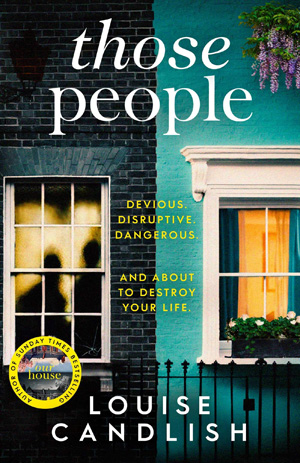
Class Tensions Simmer in Those People

Those People  ( 2019)
By Louise Candlish
Berkley/Penguin, 368 pages
★★★★

 American literature used to abound with novels that stripped away the veneer of middle class life and exposed ugly truths. Now just a handful of authors–Joan Didion, Richard Ford, Jonathan Franzen, Tom Perrotta, Stewart O’Nan–would dare. In the United States, social stratification has become the Great Denial. In the prevailing myth, all Americans are members of the middle class and that way of life is one of materialistic bliss.

Contrast this with Britain, where social class is openly discussed and bourgeois values are not universally admired. Louise Candlish held those values to the fire in Our House (2018) and in her latest novel, Those People, turns up the flames. She takes us to Lowland Way, a bourgeois oasis just 8 miles from Central London. It’s a classic gentrified neighborhood whose residents hired help to rehab old houses then settled in for the long haul. Lowland Way is surrounded by greenswards and shot through with an unexamined paternalism that’s more mid-20th century than early 21st. Though some of the women work, most are inordinately fixated on children, dog walking, and worrying about the cygnets (swan chicks) on the park pond. Naomi Morgan has even won praise from local officials for spearheading Play Out Sunday–a weekly traffic blockade of the neighborhood so that children can recreate on the street.

She and her husband Ralph reside at # 7 Lowland Way. Ralph is the unofficial patriarch of the neighborhood. He’s the successful owner of a leather goods manufactory, drives a flash car, and is a bit on the haughty side. His younger brother (by two years) Finn lives at #5 with his wife Tess and their children. Ralph and Finn go to the pub regularly and are best buddies. New parents Ant(hony) and Em(ily) Kendall live at #3.The other member of the inner circle is 60-year-old Sissy Watkins, who is divorced and runs a desirable B & B from her home to make ends meet. She lives across from #1, which is empty since the death of Jean Booth, whom everyone misses. It’s a cozy little set up in which residents comment on how lucky they are.

Their urban idyll receives a jolt when #1 passes to Jean’s cousin Darren Booth and his partner Jodie. On the surface they are “those people” of the book’s title. Darren is what many Brits unflatteringly call a “bloke,” a 57-year-old working-class man of few social graces and even fewer filters. The same is true of his salty-tongued partner Jodie. They are the neighbors from hell that tear down walls and trees, convert # 1 into an unofficial used car lot, and their home into a 24/7 scaffold-covered construction sight with loud music blaring and the occasional booze-filled party raging.

Booth and his neighbors get off on the wrong foot and it degenerates from there. The Kendalls can’t sleep and they worry about the possible hearing damage done to their child from all the noise. Ralph fumes about all of the junky vehicles–including an ugly van in front of his house–parked on the street and he blows his stack when he learns from the local council that it’s perfectly legal to keep them there. Finn echoes his brother, Tess grows disgusted with Darren’s uncouth language and disrespect, and Sissy struggles to make ends meet when her ratings suffer and bookings decline. All are appalled that Darren and Jodie are more prone to tell them to “fuck off” than to negotiate.

What to do about a problem like Darren and Jodie? The local council and police are either understaffed or loath to act, so how will locals cope?  Candlish guides us through shifting dynamics, several tragedies, and an ongoing police investigation that casts doubt on guilt and innocence. Candlish starts her novel eight weeks before a major incident and takes us week by week through a series of subplots, shaky alibis, and unreliable first-person narratives. Are Darren and Jodie just as awful as they seem, or is all of this a bad case of bourgeois snobbery and assumption of privilege? It is to Candlish’s credit that she does not resort to cut-and-dried morality. Soon, there is both inter- and intra-class rivalry and we begin to wonder if maybe we’ve misjudged whom Candlish intends those people to be. (Maybe the answer is both!)

This is a potboiler, not the sort of thing you’d read in an English lit class, but it’s a very good one. Candlish perhaps artificially widens class barriers, but she is keenly aware that they exist, which I find this preferable to the aforementioned Great Denial. Those People is set in England, but it should make North American readers consider the class gulf that, among other things, played out in the 2016 U.S. presidential election. If you don’t think there are millions of Darren Booths from sea to shining sea, you’re living in a bubble. Even if you’re not up for a sociology lesson, Those People is a great summer read.

Rob Weir
-->

7/22/19

Echo in the Canyon a Musical Treat

Echo in the Canyon (2019)
Directed by Andrew Slater
Greenwich Entertainment, 82 minutes, PG-13.
*****


I was misty-eyed by the time the credits rolled for Echo in the Canyon. I confess that I mourned for my lost youth, but that’s not the only reason.

Echo in the Canyoncaptures an extraordinary moment (1965-1967) in which dozens of musicians occupied Laurel Canyon and evolved a subculture that was part of Los Angeles yet separate from Lala Land’s skin-deep glitz. Laurel Canyon’s winding roads and steep hillsides made it a vest pocket retreat in which neighbors showed up at each other’s doors, guitars at hand, and “invented” folk rock. It’s certainly open for debate as to whether it was a literal invention, but it’s safe to say the Laurel Canyon sound was unique: jangly electric guitars sharing space with acoustic instruments, three-part harmonies adding depth to folk melodies, and Folk Revival seriousness giving way to a sense of playfulness. I suppose this was destined to happen when the “neighbors” formed such now-iconic groups as The Association, The Beach Boys, Buffalo Springfield, The Byrds, The Mamas and the Papas, and The Mothers of Invention. Call Laurel Canyon LA’s answer to the Bay Area’s hippie scene that gave birth to acid rock and 1967’s Summer of Love.

Echo in the Canyongoes a step beyond a simple retelling of the past. It also appends rehearsal and concert footage from a 2015 (and beyond) project spearheaded by Jakob Dylan. To commemorate the 50thanniversary of Laurel Canyon’s initial flowering, Dylan assembled a new generation of talent­–Fiona Apple, Beck, Jade Castrinos, Norah Jones, Cat Power, Regina Spektor–to recreate the Canyon vibe. Dylan does so in ways that simultaneously evoke the music of the past yet give it small interpretative tweaks that make the golden oldies sound fresh. 

Viewers will instantly notice that Jakob isn’t exactly a chip off the old block. Maybe he’s not a poet laureate, but he’s a much better singer and musician than his old man. He’s also a better human being who lacks his father’s tempestuous ego. There is simpatico energy between Jakob and the musicians with whom he shares the stage, as well as mutual respect for both those who went before him and peers bringing their own ideas to the project.

Normally I find that films that are half documentary and half in the present lose coherence and are merely half good. Add producer to Dylan fils’ virtues. There is a lot of ground to cover yet the film manages to strike a then/now balance in a concise 82 minutes.  

The history part of the film is a mix of stock footage and interviews. Among the talking heads–in both senses of the noun–are legends such as producer Lou Adler, Eric Clapton, David Crosby, Roger McGuinn, Graham Nash, Michelle Phillips, Ringo Starr, John Sebastian, Steve Stills, Brian Wilson, and Tom Petty. Petty’s presence is poignant given that he died in 2017 and the footage on screen is his last recorded interview. Yes, there’s a lot of shared admiration and retelling of old war stories, but mostly the talk is about music. McGuinn, for example, gives a cogent lesson in musical cross-fertilization. He acknowledges the influence of The Beatles and The Rolling Stones, but also demonstrates how The Beatles took one of his licks and tweaked it. Ringo appears to say that Sgt. Pepper probably wouldn’t have sounded as it did had The Byrds never recorded, or if Brian Wilson (Beach Boys) had never imagined the Pet Sounds album. 

David Crosby is especially candid and insightful. In the midst of a flurry of speculation about why Buffalo Springfield broke up, Crosby flicks aside all the “creative disagreement” niceties for this tidbit: “I got kicked out of the band because I was an asshole.” Michelle Phillips is equally forthcoming about her promiscuity, and Brian Wilson reveals that he went to four different studios to get the–if you will–correct vibe for the various parts of “Good Vibrations.” As for why those vibrations eventually hummed discordantly and the Canyon scene began to fall apart, again all manner of theories abound: the life cycle of groups, acid rock’s shift to individual virtuosity, infighting…. Once gain Crosby cuts through a lot of pomposity and puts forth a simpler explanation, one involving what happens when you give a bunch of kids millions of dollars to play with. With a twinkle in his eye he notes, “Before you know it it’s bring out the smoke machines and sing the hits.” In other words, creativity and community gave way to the very L.A. commercialism from which they tried to hide in Laurel Canyon.

Things seemed to have gone much smoother for the latter day concerts. Jade is a revelation; she comes off as an enraptured 21stcentury hippie chick–in a good way. Her infectious smile is a perfect counter to Apple’s serious demeanor. It might also surprise that BobDylan gets only an oblique nod. Fair enough; he wasn’t a West Coast guy. Nor are The Doors mentioned, perhaps because they were a rock band, not a folkrock ensemble. Curiously conspicuous by her absence is the Queen of Laurel Canyon: Joni Mitchell. Too mercurial and difficult? 

Nitpickers will find openings. Some have dismissed the film as romantic, others that it’s little more than an exercise in nostalgia. But let me circle back to my moist eyes. Yeah, I wish I was young again, but it also had a lot to do with the fact that the music is just so damn good it hurts. It’s those gorgeous melodies, jangly guitars, textures, hooks, riffs, and ineffable qualities that seep into our DNA. Above all, Laurel Canyoncaptures the hopes of a generation before it was expelled from the Garden. 

Rob Weir

7/19/19

Karen Jonas, John Westmoreland, Makru, and More


Karen Jonas, Lucky Revisited

Every now and then you run across a recording that's so audacious that all you can do is applaud its chutzpa. Such a work is the 4th release from Karen Jonas. This album is sass, poise, and one helluva voice. Jonas gives us stripped down versions of songs from her back pages, some new material, and an unapologetic turn-back-the-calendar approach to country music before it became slick and safe. Her new version of "Lucky" is honed to a dangerous edge. Jonas sings it as if it's part of the soundtrack of a gritty film noir film set in a dusty Texas town filled with desperate people. She positively eviscerates the Golden Fifties myth in "Butter." She frames her video with an old-style TV screen and melts the song in suggestive nastiness whose sugary sprinkles are like a diaphanous dress waiting to be unzipped. Hers is a feminist country music, even when it evokes the past. It doesn't get any more throwback stylistically than "Ophelia" but then again, few past country stars could have gotten away with a lyric such as when a man calls you a whore, go on and the find the closest door…walk out. Want an old-time weepy? "Country Songs" is about a girl who hated country music until she came of age and had her heart broken: So thank you for teaching me to sing country songs/For making me so sad I want to sing along. She completes her stroll through yesteryear with two excellent covers–one of Dylan's "It Takes a Lot to Laugh, It Takes a Train to Cry," and Hank Williams' "Lovesick Blues." ★★★★

John Westmoreland, Cast Fire

Some music grabs you with memorable melody lines, others with lyrical grace or pulsing energy. John Westmoreland–known for his guitar work with Diali Cissokho & Kaira Ba–stirs your soul. That's exactly where he's aiming with Cast Fire, an album full of "grief singing," vocal stylizations borrowed from Karelia. Don't think depressing; think honorific and contemplative. "The Sparrow" was inspired by being part of a song/prayer circle attending to a dying man. A small bird glided into the room, perched upon a lampshade, and just as gracefully departed. Westmoreland's guitar is at once suggestive of a slow flamenco and of feathery flight. He allows his bright notes to ring and frame his expressive baritone voice. "Thomas" honors his departed grandfather and is a meditation on life, death, and the soul. If the music sounds Baroque, it's because Westmoreland synchs his nylon-stringed Guild with a torban, a Ukrainian lute/psaltery combination. "Open Your Eyes" also evokes an ancient music feel, this time induced by guitar arpeggios, hand percussion, violin, and bansuri, a wooden flute from India. Everything on this album is designed to induce inner thought. The gorgeous notes and fretwork of "Land of the Living" takes you to one part of the human experience, "All Saints Day" to another. You might notice that Westmoreland's videos feature a lot of free-style interpretive dance. His music encourages personal journeys. He takes one of how own on an innovative cover of "All Along the Watchtower." Maybe you'll do your own dance to the jazzy but moody instrumental "Waltz in A Minor." Don't flee from lamentation; remember that laments come from the living. They express sorrow and regret, but are also cathartic and cleansing. ★★★★

Makrú, Tu Mission

Makrú is a global kitchen sink band from California that plays a mash of ska, regaae, flamenca, cumbia, rumba, and jazz. This befits a group whose members were born in Colombia, El Salvador, Spain, Turkey, and the United States. If you think of the Spanish-speaking world as branching south and west from Spain into Latin America, you get an idea of the multiple influences Makrú put into play. On "Cloud," we hear a soft Caribbean-like melody filtered through a reggae pulse and faintly Middle Eastern undertones. It, as much of the album, is anchored by the vocals and vihuela (Mexican guitar/timple blend) of Colombia's Jenny Rodríquez, and the cájon (box drum) and vocals of El Salvador-born Raúl Vargas. The instrumental "Where You Wanna Be" is a pastiche that moves from jazzy to dance hall and back to jazz in a start/stop arrangement in which Haluk Kecelioglu spins out oud (Turkish lute) notes like a mandolin player. Vargas takes the lead vocals on the titletrack and it too takes twisty turns. It opens with the wistfulness of an island ballad, but evolves into something akin to a Mexican corrido. I have no Spanish so I can't comment on the song lyrics, but I do know that Makrú band members are associated with social activism. I like the eclectic approach of the band, as well as its tendency to blend traditional styles with the urgency of pop music and the contemplativeness of jazz. ★★★★

Short Takes

The NoiseTrade sampler of Nicole Boggs and the Reel, Live at Oceanway serves up soul fused with hard-edged rock. Boggs belts out the self-descriptive “Life of the Party,” and laments looking for love in all the wrong places on “Fool for a Fool” and “Sleeping with the Enemy.” If you think Lake Street Dive’s Rachael Price has a big voice, listen to Boggs.

NoiseTrade recently paired with Paste Magazine and has begun to make past performances available through the latter's Daytrotter Sessions. British folk rockers Mumford and Sons now play large venues. We hear them in a quieter, less glitzy mode on a seven-track August 30, 2013 stopover in Troy, Ohio, where they jammed with a handful of friends in an empty high school auditorium. One of the selections is a cover of Dylan's "Don't Think Twice It's Alright," but by far the stellar track is a sensitive rendition of "Like a Hurricane."


Garrett Dutton goes by the handle of G. Love and generally fronts a trio called Special Sauce. Check out a solo performance titled G. Love Live at Daytrotter. He's from Philadelphia, but this four-song acoustic country blues set sounds more bayou than Schuylkill Expressway. My favorite track was "Rainbow," in which he gives an acoustic slide a fine workout. I also enjoyed the hard driving, good summer fun "Soulbbq" and "Diggin Roots," which he recently recorded with Keb' Mo'. 

A final blast from the past comes from Daytrotter's sampler of a Bon Iver concert from July 21, 2008. Back then they had just one album, For Emma, Forever Ago. (The band would go on to win a Grammy in 2012.) For those who don't know, Bon Iver is the brainchild of Justin Vernon, and the name a phonetic spelling of the French bon l'hiver, or "good winter." Vernon hails from Wisconsin, where they know about winter. Bon Iver is often billed as an indie rock band, though folk with some rock would be a better description. Listen to "re: Stacks" [sic] to hear the band's soft side, and "Creature Free" for its now-trademark combo of soft, pause, speed up, flirt with havoc, and return to soft. Vernon's falsetto lead is featured on all tracks, the other two being "Flume" and "Lamp Sum."

Rob Weir


7/17/19

Invictus Video Review: Good Sports Flick

Invictus (2009)
Directed by Clint Eastwood
Warner Brothers, 133 minutes, PG-13
In English, Afrikaans, Xhosa, Zulu, Maori
★★★½

I got psyched for the women's World Cup soccer final by watching a film about rugby. Huh? Not the same, I know, but I watched Invictus, which I had never seen, partly because of the controversy stirred up by conservatives because of Megan Rapinoe's strident anti-Trump remarks. I notice that the right never goes into a tizzy when one of its own such as Tom Brady, Dale Earnhardt Jr., John Rocker, Curt Schilling, or Tim Tebow spout their views, but never mind. Let me address something that Invictus does well. It puts to rest the naïve belief that sports should be politics-free. They never have been.  Take a look at controversy and tragedy at the Olympic games in 1932, 1968, 1972, 1980, and 1984. Even in a good year, the Olympics does a better job at flaming nationalism than of celebrating athletic excellence.

Soccer and rugby long ago gave up the pretense that sports exist independent of politics.  Director Clint Eastwood takes us to the 1995 Rugby World Cup, which was held in South Africa less than 5 years after Nelson Mandela (Morgan Freeman) was released from his apartheid jail cell after 27 years, and just one after he was elected South Africa's first black president. His nation's rugby team, the Springboks, was a source of pride for whites, but Mandela noticed that the black majority rooted for whomever was playing the Springboks. To their eyes, the very name and color of the jersey represented decades of apartheid. Mandela, though, resisted calls for a new name and jersey, as he knew his job was to represent all South Africans, plus he needed to attract foreign investment for South Africa's fragile democracy. The last thing he needed was a flight of white money with the World Cup coming to Johannesburg. His task was to make the Springboks a symbol of national pride. The problem, though, was simple: the Springboks sucked! So how to meld a team and get everyone to root for it, especially when the squad had but one black player, Chester Williams (McNeil Hendriks)?

Mandela decided that the racial healing began with team captain François Pienaar (Matt Damon), who was sired in a racist Afrikaner* home. In not-entirely-accurate scenes Pienaar buys into the new South Africa, comes to admire Mandela's struggle, and whips the squad into shape. Pienaar's transformation was capped by a visit  to Robbens Island where Mandela was jailed for nearly three decades, and the Springboks–at Mandela's suggestion–began to capture black support by conducting clinics in the townships to which they were confined and still concentrated.

You can look it up, so no need to worry about spoilers. In the 1995 tournament, South Africa shockingly defeated heavily favored Australia and eventually won the Cup by upsetting the New Zealand All Blacks in the final. This was especially shocking given that the All Blacks featured Jonah Lomu, an explosive giant (6'5", 276 pounds) and the most dominating athlete of my lifetime (with the possible exception of Secretariat!).

I liked the film, though I certainly recognize its limitations. In feel it's a bit like Chariots of Fire, which is to say that drama and over-the-top melodrama occupy adjacent stadium seats. Invictus had generally good reviews when it debuted a decade ago, with a few naysayers finding it too "manly" in a thudding, muddy, spit-blood kind of way. Rugby is a much tougher sport than gridiron football–no padding-–but it's not quite as bone crunching as viewed on the screen. You might also wonder why we see Damon bruised and sliced during a game, but looking spit-polish fine the next day. (Did he bathe in Arnica to get rid of his bruises?) You could also be (rightfully) skeptical as to whether Mandela spent his entire first year in office fixating on the Springboks. In sum, this is a rather typical sports film–insert any sport here–with an arc of demoralization followed by team bonding, hard work, and glorious triumph. You could even call this an Eastwood family vanity pic; Scott Eastwood played one of the Springboks and his brother Kyle composed and/or co-arranged the music.

Nonetheless, it's a highly entertaining movie even though ten years later we know that much of the South African dream died when Mandela passed in 2013. Do I even need to tell you that Morgan Freeman was superb as Mandela? He was nominated for a Best Actor Oscar, though he didn't win. The surprise is how good Damon was; for a dude from Boston, he sports an excellent Afrikaans accent. His acting is subtle, not a histrionic Hollywood star turn. Kudos to both Eastwood and Damon for making us see the latter as a rugby player, not a celebrity hunk. 

If you're wondering about the film's title, it is that of a poem by William Earnest Henley (1849-1903) that Mandela often recited in confinement. [Follow the links for further details.] The movie is based on a book written by John Carlin, who writes about the connections between–what else?–sports and politics.

Rob Weir

*Afrikaner references the 17th century white Dutch who colonized South Africa. The English took over "Cape" colony in the 19th century. Afrikaners fled to the interior, formed the Orange Free State, and eventually melded with French, Germans, and Swedes, all of whom spoke a variant of Dutch called Afrikaans. The Union of South Africa was formed in 1910 and absorbed the Orange Free State, which precipitated the Boer Wars–Boer a word for Dutch farmers–that ended in defeat of the Boers. They, however, came to dominate the Union and, in 1948, put apartheid into place, a system akin to segregation in the US but much more brutal.
-->