8/9/19

Marianne and Leonard: An Unconventional Love


Marianne and Leonard: Words of Love (2019)
Directed by Nick Broomfield
Roadside Attractions, 102 minutes, R (for drugs, brief nudity, sexual frankness)
★★★★

What is love? Is it gazing into the eyes of another and seeing no others? Is it a fever that never breaks? Lifelong faithfulness? Continuous mutual commitment? A partnership of equals? Two horses pulling the same cart? Fireworks, roses, and chocolates?

If you think love is contained by any of the above, you might wish to steer clear of Marianne and Leonard, the new documentary about the relationship between Marianne Ihlen and Leonard Cohen. Theirs was an unconventional love that was more akin to the yearning of a poet for a muse that one doesn't always wish to find.

It began in 1960, when Cohen was an unknown writer fleeing Montreal's frigid winters for the sun-kissed Greek isle of Hydra. There he met Marianne Ihlen, an about-to-be divorced mother of a young son. Cohen was Jewish, dark, and brooding; she was Norwegian, blonde, and free-spirited. If you'd like to extrapolate this into a yin/yang sort of thing, you wouldn't be far from the mark.

This documentary is from director Nick Broomfield, who also gave us Kurt and Courtney (1998), so you know he doesn't shy from uncomfortable material. The relationship between Ihlen and Cohen was not always healthy or happy. If you know Cohen's song "So Long Marianne," you already know a lot about the arc of their time together and apart. The muse thing didn't always go as planned. Cohen's desire to be a Canadian lion of letters was dealt a rude blow when all but a few reviewers trashed Beautiful Losers, the novel he wrote on Hydra. One critic called it "verbal masturbation" and Canadians seldom talk like that! Even before this, though, Cohen exhibited symptoms consistent with bipolar disorder. When he was in Hydra, he thought he should be in Montreal; when in Montreal, his thoughts drifted to Hydra. His relationship with Ihlen was like this as well. He yearned deepest for Marianne when she was absent; when she went to him, fire turned to ice.

Retsina, drugs, and free love didn't help mood swings. Neither was faithful and Broomfield reminds us that he too was one of Marianne's lovers. One also gets the sense that Ihlen wasn't always a good mother. Still, it is fair to comment–as so many feminist historians have–that the Sixties' emphasis on free love was often a trap for women. The pill and sexual openness brought with them the expectation that women should yield to male desire. To put it another way, the veil of sexual mystery was lifted and revealed a wall of patriarchy.

It's also fair to observe that Cohen, even when depressed on Hydra, was a better person before his poetry and songs brought him fame. With it came egoism; as Cohen's star ascended, Ihlen's waned. Nonetheless, it never burned out completely, no matter who was with whom. Their love was genuine and literally followed them from Hydra to the grave. Though they had not been together for decades, Cohen pledged his love to Marianne as she lay dying and he was destined to follow three months later.

Bloomfield's film makes excellent use of available footage, especially that from Cohen's 1976 Bird on a Wire tour, where see him musing on Marianne when he's so high that his eyes look like two dark saucers tucked under his brow. We also see snippets from other interviews, including his surprisingly nonchalant response to leaving a Buddhist monastery after three years (1994-97) to discover he had been embezzled and is broke. His comeback was astounding, as was his reinvention in the early 21st century as a behatted, suited, cool septuagenarian who often looked–can you believe it–happy!

Alas, we have less of Marianne in the film. Though she gets top billing, the film should more accurately be called Leonard and a Dash of Marianne. She flits in and out of Cohen's orbit like a Nordic Tinkerbell. I longed to know what she thought of Cohen's other muse, Suzanne Elrod, or of his conquests of everyone from Joni Mitchell to Rebecca De Mornay. Did she care about his legion of one-night stands? One can't fault Bloomfield for not having material that doesn't exist, but a bit more critical analysis might have served to underscore the depth of the Ihlen/Cohen devotion to each other. Most of the talking heads, especially Judy Collins (wearing a horrifying wig!) address Cohen's magnetism and brilliance, not his melancholy. This isn't a hagiography, but it does sometimes lean in that direction.

Whatever its shortcomings, Marianne and Leonard is a film that makes you walk away feeling perplexed. It also sticks with you and, in my case, I liked it the more I (if I might) mused upon it. It is as I posed at the start of my review: a love story. It might not make you comfortable, but I have always maintained that a relationship only needs to make sense to those who are in it.

Rob Weir

8/7/19

Gunsmoke and Horseshit: How Mass Murder Became Boring


 Gilroy. El Paso. Dayton. Queue the tears. The roses. Hollow prayers. Teddy bears. Political doublespeak. And horseshit. Lots of horseshit. Almost as much horseshit as the tonnage of guns and ammo in the Misguided States of America.

Is there any point to writing about mass murder these days? It might sound callous, but mass murder has become mind numbingly boring. We know several things that surpass the likelihood of the sun rising: that not a damn thing will change and that tomorrow somewhere else will break out the tears, roses, prayers, and Teddy bears. And through their anguish, the survivors will have to endure the indignity of doublespeak and horseshit.

If Columbine didn't move the needle and if gun-toting monsters create forums and Websites claiming Sandy Hook was faked, you know that taking out a few Texans at Walmart or some angry white dude in Ohio –and aren't they always white dudes?–who slew his sister and anyone else in the way won't change things. Where will it be tomorrow? A ballpark? The White House? Disneyworld? Another synagogue? Another Sunday school class?  A mosque? Spin the wheel. Which state gets its 30 minutes of shame, blame, and infamy?

I'm sick of it. We all know the answer. It's what's it's always been. Take. Away. The guns. That's what they did in Scotland. That's what is happening in New Zealand. But we also know what will be said instead. Check your favorite phrase from the list below:

·      This was the action of a lone mentally deranged gunman.
·      If we had concealed carry laws, someone would have taken out the gunman.
·      The majority of gun owners are law-abiding and it's not fair to lump them with murders.
·      If we banned guns we wouldn't stop murders.
·      If you outlaw guns, only outlaws will have guns. (Well, yeah!)
·      We don't want a nanny state.
·      The 2nd Amendment gives me the right to bear arms.
·      This is no time to politicize gun violence. (And when would be the time?)

Any one of these is child's play to demolish. Try to make it harder for mentally ill people to get guns and the N.R.A. throws a wobbly. Maybe we should just compile a list of all the deranged people in the nation and give each a small tactical nuclear weapon. Or would that be redundant? Do we even want to discuss why it's nearly always white men who are so bat shit crazy and why they think it's okay to take others with them down the exit ramp?

Hey Colorado, Ohio, and Texas are concealed carry states. What happened? Couldn't anyone get their gun out of the pants they were busy crapping? Concealed carry is an even bigger load of horseshit than the idea that armed teachers will protect students from angry white boys.

How can I chastise law-abiding gun owners? Easy: On both the levels of complicity and and of the greater public good. There are all manner of things we can't do because community good tops individual rights. Maybe you could safely operate a car at 100 mph. Try telling that to the cop who pulls you over. Maybe you can do a controlled burn of the woods behind your house. Then, again, maybe you can't. Hey, why not legalize heroin? Maybe your kid needs a beating. Don't try it in public and don't leave any marks. Who says you need auto insurance to be on the road? Yada, yada, yada… But the thing is, if you think guns are sacred you are complicit in an uncivil attack on the very ideals of public safety and the greater public good. You are saying, "My right matters more than the welfare of others."  

You are right that nothing can make us completely safe. But you don't have to be a math major to compute the odds. A run-around appeal to 100% safety just marks you as foolish, stupid, selfish, or all three. It's this simple: Nowhere else has mass shootings of this magnitude. There are many dangerous places in the world–Brazil, Syria, and certain provinces of Mexico–but for all of Trump's rage over criminal Mexicans, its 29,000 homicides aren't a patch on our 40,000. But even were ours lower, shouldn't we compare ourselves to the safest nations, not the least? 

As for the rest, yes it's time for a nanny state. We clearly cannot police ourselves. We can't even agree that no one needs a military assault rifle to shoot Bambi. So let the government step in. Get rid of all the guns. All of them. The Second Amendment does not impress me. It never meant what you thought it did anyhow, but we have the capacity to alter the Constitution so let's repeal the damn thing. You know, like we did the 18th. Change the Constitution. Like we did when we decided that slavery was not humane or that women should have the right to vote. The "original intent" of the Founders is just another bucket of horseshit for the pile. The Founders knew they weren't creating a perfect union or a perfect document. That's why they created provisos for changing the Constitution and it's why we've done so 27 times.

I'd like to politicize the hell out of guns. Declare the NRA a terrorist organization. After all, white males have killed more Americans than Al Qaida ever did. Suspend Mitch McConnell over a fiery spit until he reveals how he's been bought and sold by the gun lobby. Make pro-gun Bernie Sanders feel the heat as well.

Of course, none of this will happen. The roses, Teddy bears, and tombstone industry will continue to thrive. But shall we? Or will the methane of all the horseshit raise the global temperature, melt the ice caps, and wash us away in a Biblical-style flood? Don't bet against the Last American firing his AK-47 into the sky before he sinks to perdition. 

8/5/19

Her Smell a Mess that Sometimes Intrigues


Her Smell (2018/19)
Directed by Alex Ross Perry
Gunpowder and Sky, 135 minutes, R (language, drug use, adult situations)
★★★


The most accurate way to describe Her Smell is to call it a mess. It's often an intriguing and interesting mess, but it is nonetheless a shambles of a film kept together by music and decent acting.

It's the waning days of punk rock, but the female trio Something She can still command a good-sized audience through the charisma of lead singer and guitarist Becky Something (Elisabeth Moss). That is, when she's not too stoned, pissed off, psychotic, or all three to arrive on time, if at all. She's become an addicted flake who pays more attention to her charlatan shaman Ya-ema (Eka Darville) than to band mates Ali (Gayle Rankin) and Mari (Agyness Deyn). Nor does she give a damn that her tempestuous and  behavior is bankrupting her manager Howard (Eric Stoltz) and breaking the heart of her mother Ania (Virginia Madsen). To top it off, she has an infant daughter, Tama, to her ex-husband Danny (Dan Stevens), formerly known as "Dirtbag Danny" but now trying to find stability via sobriety, a new wife, and acting as Tama's only sane caregiver.

Think of Becky as a wigged out self-destructive prima donna. She gets away with a lot because she's the kind of electric personality who can show up two hours late for a gig, sing a song or two, toss her guitar onto the stage, strut off into the wings, and listen to the wild applause of adoring acolytes. Yeah, this kind of shit went down a storm during punk rock's heyday! Then tastes changed, audiences began to notice that their heroes and sheroes were seriously screwed up, and that a lot of them were terrible musicians. The last isn't true of Becky or her band, but when a drugged out Becky commanders a studio where Howard hopes to record a new band, even she notices that The Akergirls have a sweeter, more melodic sound that—in her words—is "what young people are listening to." (Cara Delevigne is a "member" of the Akergirls.) In other words, there are increasingly fewer reasons to put up with Becky.

This is a film about addiction, ego, and wicked bad behavior. It's not structured enough to be a slice of musical history and, at times, it hardly seems structured at all. This is partly deliberate and partially a result of a hodgepodge script. Director Alex Ross Perry opts for a cinéma vérité approach that is effectively jarring in spotlighting how an addicted person's world is a manic series of scattershot bang-bang disconnected episodes that never cohere. Becky's tantrums and narcissism sometimes reminded me of Madonna's Truth or Dare, though Madonna would never be as unorchestrated as Becky. If you're not prepared for this kind of filmmaking, much of Her Smell might seem like anime with live actors. Objectively, it is hard to watch at times, though overall I think the shaky camera documentary approach lent an air of verisimilitude.

In films such as this, though, you know that resolutions are limited: early death, getting clean, or hovering between addiction and sobriety. Was it a mistake to interject a backstory of a daughter? I'd yield to anyone who accused Perry of stitching into a rough-edged film elements of sentimentality and conventionality. One could certainly argue that this is a forced fit. There are also parts that are just plain dumb, especially those involving Becky's shaman. Okay, there are some weird mystics out there, but this character is badly developed and seems more of a cartoon than someone anybody would follow.

Moss is pretty good as Becky, even when she seems to be channeling Courtney Love. Deyn and Rankin are also solid as her band mates. They strike the right balance between concern and screw-you anger toward Becky. Moss provides her own voice in some of the songs–though the band Bully did much of the soundtrack–and though Moss probably won't headline a club near you, she's credible as a snarling punk rocker. She also does a sensitive piano-backed cover of Bryan Adams' "Heaven." We're not talking Lady Gaga here, but Moss is certainly proving that her chops and range are broad and diverse.

Is this movie worth a look? If you can get past the fact that there are more holes in the script than in Becky Something's stage fishnet stockings, yes. But take me to heart. Overall the film is a bit like DYI punk rock. That is to say that at times it's pure shite, but when it rings true, Her Smell rocks you.  

Rob Weir


8/2/19

Renoir and Ida O'Keeffe at the Clark

Renoir: The Body, The Senses (through September 22, 2019)
Ida O'Keeffe: Escaping Georgia's Shadow (through October 6, 2019)
Clark Institute of Art
Williamstown, MA 


This summer's blockbuster exhibit at the Clark is devoted to Pierre-Auguste Renoir (1841-1919). In Renoir's lifetime he was heralded but his star faded to the point that, in 1986, one critic proclaimed him the "worst artist to ever achieve canonical status." I wouldn't go that far, but I confess that I'm more in second camp than the first. He's not my least favorite Impressionist–a category I reserve for Mary Cassatt–but I generally spend my time in Impressionist galleries gazing at the work of those I find more interesting (Pissarro, Monet, Manet, Morisot, Sisley).

The Clark's core collection features a lot of Impressionist works, so you go with what you've got and build on it. It's Renoir show dwells upon his nudes and how his attention to color, form, and texture impacted subsequent artists. His admirers were many and varied, among them Picasso, Maillol, Léger, and Matisse. Selections of their work are displayed as well so that one can make comparisons. Did this change my mind about Renoir?    

Not really. I get what art historians have said about Renoir's cheerful palette, one that's heavy on pastels and soft lines. At the end of the day, though, there's a reason why his work found favor with the tastemakers of his day when critics savaged many of his contemporaries. Renoir simply didn't spill much bathwater, even when painting nudes. His fleshy puffball bodies stand solidly within a canon forged by past masters such as Titian, Ruben, and Tintoretto. Some have called Renoir's work innocent in a prelapsarian fashion, though today some of the bodies he painted look pretty young and might ruffle contemporary feathers. I'm not going there other than to say that it's usually unfair to pass ex post facto judgment on cultural value systems. For me, Renoir's faces are more problematic than his bodies; they often appear vacant and/or insipid.

Picasso
Mostly The Body, The Senses underwhelmed me because I found the work of Renoir's admirers far more interesting than his own. There is a telling remark is one of the panels in which Renoir is quoted as saying that he did not see his work as a radical departure as it was always his intent to fit within the sweep of Western European painting. He largely succeeded, which begs the question of whom do we find more appealing, those who long to conform (Renoir) or those who spit in the eye of convention (Manet, Picasso, Lautrec). My vote goes to the rebels. 

Ida and Georgia at Peace

For me, the Clark's best current exhibit is one devoted to Ida Ten Eyck O'Keeffe (1889-1961). If that last name tempts you to wonder if she was related to Georgia O'Keeffe (1887-1986), the answer is yes; she was one of Georgia's sisters and to say that there was family drama involved would be an understatement.

Let's start with why we know Georgia's name, but not Ida's. It's not because Ida was trying to piggyback on her older sister. She was a serious artist in her own right who apprenticed with a printmaker before obtaining an MFA at Columbia. Another sister, Anita, also trained as an artist. Here's where it gets ugly. Georgia was fiercely protective of her own artistic reputation and didn't like family competition. Anita faithfully gave up her art career at Georgia's insistence, but Ida did not. Georgia at first supported Ida, but things eventually soured and Georgia did little to help and quite a lot to discourage. (It probably didn't help matters that Georgia's husband, photographer Alfred Stieglitz, tried to seduce Ida. She rebuffed him, but one wonders if this got back to Georgia.)
 

The real question is how Ida's work stacks up. She's not another Georgia and her work is best approached on its own merits. The Clark showcases several aspects of her work. She was assuredly an observant modernist with an eye for reducing objects to geometric forms and sharp angles. I particularly liked her series of paintings depicting the solidity of Highland Light in North Truro (Cape Cod). Note how the lighthouse beam captures a fish as if it is being beamed aboard. She captures similar abstracted magic of a harbor scene in which bridge, sails, and cables are reduced to straight lines and bathed in somber light.  


Ida also painted buildings differently. Compare, for instance, how Ida rendered a Missouri limekiln as if it were a Spanish cathedral. It evokes the rooted-earth and reduce-to-basic shapes style of someone such as Charles Sheeler or Charles Demuth. If you know Georgia O'Keeffe's paintings of New Mexico adobe churches you can see how Ida tracked differently. There is also Star Gazing in Texas, which shows Ida at home with the proletarian art of the Great Depression. She's more Grant Wood than Georgia O'Keeffe in this iteration.


 Is Ida O'Keeffe an underappreciated great artist? That might be a bit much to claim, but she's intriguing and one wonders what her reputation would have been without all the family sturm und drang. She once proclaimed that she too would have been famous if she had a Stieglitz backing her. Was this a passive aggressive backslap at her headstrong and ego-fragile sister? Perhaps. Georgia invested a lot of energy is creating a Stieglitz-free niche for herself once she began spending more time in New Mexico than in New York, but it was her New York reputation that gave her the space and money to break out. Could she have done so without Stieglitz? As they say, families are complicated!

Rob Weir  

7/31/19

Number One? Who We Trying to Kid?

Downtown Elsewhere

It happens regularly about this time of the year. I wean myself from politics, ignore the talking heads, plug my ears to nostrums, and take a road trip. For several weeks I avoid TV, cancel the newspapers, and ban my index finger from tapping my AP Mobile app. I just try to observe what I see without filtering it through any third party.

As it often does, this year’s summer vacation tour detoured me through parts of Elsewhere USA. It’s an alien land to me because I live in Bubbleville. Mine is a place where democratic socialists do rhetorical battle with liberals, though both agree that Republicans are troglodytes. Not many people in Bubbleville care about a person’s race, sexuality, gender identification, immigration status, or religion. We tend to think reproductive rights are sacred, that gun ownership isn’t, and that healthcare should be free for all. Elsewhere USA generally believes the opposite. Another way of saying this is that Bubbleville USA is more like Canada than like Elsewhere USA.

For years I’ve simply shrugged when those from Elsewhere tell me that the residents of Bubbleville are unrealistic. No more. It’s time for Elsewhere to face the truth: you can don your MAGA hat, strap your gun to the truck rack, and wave as many flags as you want but you still reside in what a White House placeholder calls a “shithole country.”  

Eating Moss?
If that sounds harsh, open your eyes before you shoot off your mouth. Where is the vaunted American wealth? Oh it’s there all right­, in greenswards and McMansions screened from the sight of trailer parks, crumbling roads, Dollar General stores, fast food joints, gutted out downtowns, rust, desperation, and dilapidation. Visit some famous site and park among the BMWs, Volvos, and Teslas. Enjoy the view because once you leave you won’t see those vehicles in any Elsewhere towns within a 40-mile radius of that site. It’s back to screened-in security for those with means and it’s a dinner of magical thinking for Elsewhere USA. Raise the roof and chant “USA Number One!” even though you couldn’t come up with the scratch to repair that roof. Keep on chanting though there is little objective evidence to justify the wear and tear on your tonsils.

Elsewhere USA is a place where 40% of the population couldn’t scrape together $400 to cover an emergency. Even if you can, so what? Buying piles of plastic crap made in China doesn’t make you Number One. A gas-guzzler in the driveway, a 60-inch TV in the den, an iPhone in your hand, and tossing $10 in the church collection plate won’t make you Number One either. Look around. There just aren’t that many nice Elsewheres. Maybe that’s why so many flag wavers take solace in believing America is the strongest nation in the world. That might not be true either–America hasn’t actually won a war since 1945–but the ability to defeat someone militarily doesn’t make you Number One.  It just makes you the national equivalent of the 4th grade playground bully with big muscles and a pea-sized brain. Queue John Prine singing, “Your Flag Decal Won’t Get You into Heaven Anymore.” 

Even if you have some money you still must consider the question posed by the Apostle Peter: “How then shall we live?” I don’t wish to romanticize Canada, from whence I write these words. There are plenty of problems here, but it is also consistently greener, cleaner, safer, and more prosperous than Elsewhere USA. In Canada, poverty resides in screened-in vest pockets and the average Joe and Jacques live better–even when they don’t own as much stuff. I’ve seen seedy looking places north of the border, but they stick out because they are unique, not the norm. Above all, there is an ineffable quality I note each time I’m here. How to describe it? Less anger? Greater civic pride? More self-respect? Maybe it’s as simple as paying more attention to living a good life than to shouting empty slogans.
Bubbleville Values

We try to live well in Bubbleville as well. It doesn’t always work. Our roads aren’t as good as they should be, we have too many homeless folks and empty storefronts, and there are still too many Bubbleheads in Bubbleville that don’t read enough, worry too much about material things, and are too individualistic. Overall, though, we get out more and are good at putting things into a global perspective. Seldom do I walk around Bubbleville and environs and think, “Just shoot me” when I imagine living there. It’s flat out better in Bubbleville than Elsewhere. We don’t need slogans to tell us that. The evidence is before our eyes.


7/29/19

July 2019 Album of the Month: Real Vocal String Quartet


Real Vocal String Quartet
Culture Kin

Have you noticed how many classically trained musicians cross musical borders these days? Call it the Yo Yo Ma Effect. It's not exactly accurate to say that the San Francisco-based Real Vocal String Quartet (RVSQ) is treading new ground as well. It has always been a genre-defying group that, when the mood strikes, is a chamber music ensemble, a jazz combo, or a world music lineup. On Culture Kin, though, RVSQ outdo themselves. The basic idea is to explore connections between San Francisco and its 8 "sister" cities: Abidjan (Cote D'Ivoire), Amman (Jordan), Barcelona, Caracas, Cork, Osaka, Sao Paolo, and Seoul. This means bringing aboard international collaborators to play along with the RVSQ core: Irene Sazer (violin), David Langley (cello), Sumaia Jackson (violin), and Sam Shahan (bass).

I'd give Culture Kin an album of the month nod even had I heard just "Holding an Eye." Irish singer and bodhran artist Máirtin de Cógáin performs it and I am ready to proclaim it the song of the year. It has everything I love in music: a gorgeous melody, skillful vocals, deliberate pacing, and lyrics that will rip your heart from your chest. A lively fiddle jig bridge serves to suggest hope that will be dashed. Yeah, I'm a sucker for Celtic weepies, but listen before you judge me!

Fely Tchaco
This is an album that takes you places, though you're not always sure where. "Woul Le M'en Fe" has a cool cello bop that sets the table for violin explorations that are like a blender mix of Balkan keening, Irish verve, and Appalachian sparseness. Cote D'Ivoire's Fely Tchaco's vocals stay within this hard-to-label feel. "Seasons Song" and "Bright Sun, Shade of a Tree" both opt for a minimalist vibe. The former features Korean violinist Soo-Yeon-Lyuh, who turns an Appalachian vibe inside out and makes it cry in ways only Asian music can. "Bright Sun" is harder still to describe. It's an unusual piece, perhaps even a bit odd until you get caught up in its intrigue. "Ananta" is another in that vein. It uses percussive cello to frame bird-in-flight fiddles, shifts into a punch/counterpunch groove, and segues to moody fiddle that skirts ominous boundaries before allowing the dominant melody to sneak out for a soft landing. "For Choro" and "Aurora" take us inside Latin traditions, the first a quirky waltz that chases itself around a bit and comes off as evocative of, say, a 1940s film score. The second opens with tango bass lines and funereal-like strings. It has been said that the passion of tango burns with such fire that when it ends, it's as if life's candle has been snuffed. This tune is a bit like that. In a related fashion, "Exist"is a watery and reflective tune enhanced by the hang drums of Sicily's Laura Inserra.

If you're looking for something that's way beyond what the ordinary, this is one to check out. It made me wonder why radio play is so formulaic when explorers such as RVSQ take us to far better spaces.   
Rob Weir

Hang Drums, in case you wondered!

-->

7/24/19

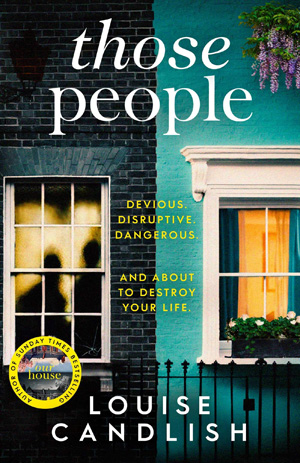
Class Tensions Simmer in Those People

Those People  ( 2019)
By Louise Candlish
Berkley/Penguin, 368 pages
★★★★

 American literature used to abound with novels that stripped away the veneer of middle class life and exposed ugly truths. Now just a handful of authors–Joan Didion, Richard Ford, Jonathan Franzen, Tom Perrotta, Stewart O’Nan–would dare. In the United States, social stratification has become the Great Denial. In the prevailing myth, all Americans are members of the middle class and that way of life is one of materialistic bliss.

Contrast this with Britain, where social class is openly discussed and bourgeois values are not universally admired. Louise Candlish held those values to the fire in Our House (2018) and in her latest novel, Those People, turns up the flames. She takes us to Lowland Way, a bourgeois oasis just 8 miles from Central London. It’s a classic gentrified neighborhood whose residents hired help to rehab old houses then settled in for the long haul. Lowland Way is surrounded by greenswards and shot through with an unexamined paternalism that’s more mid-20th century than early 21st. Though some of the women work, most are inordinately fixated on children, dog walking, and worrying about the cygnets (swan chicks) on the park pond. Naomi Morgan has even won praise from local officials for spearheading Play Out Sunday–a weekly traffic blockade of the neighborhood so that children can recreate on the street.

She and her husband Ralph reside at # 7 Lowland Way. Ralph is the unofficial patriarch of the neighborhood. He’s the successful owner of a leather goods manufactory, drives a flash car, and is a bit on the haughty side. His younger brother (by two years) Finn lives at #5 with his wife Tess and their children. Ralph and Finn go to the pub regularly and are best buddies. New parents Ant(hony) and Em(ily) Kendall live at #3.The other member of the inner circle is 60-year-old Sissy Watkins, who is divorced and runs a desirable B & B from her home to make ends meet. She lives across from #1, which is empty since the death of Jean Booth, whom everyone misses. It’s a cozy little set up in which residents comment on how lucky they are.

Their urban idyll receives a jolt when #1 passes to Jean’s cousin Darren Booth and his partner Jodie. On the surface they are “those people” of the book’s title. Darren is what many Brits unflatteringly call a “bloke,” a 57-year-old working-class man of few social graces and even fewer filters. The same is true of his salty-tongued partner Jodie. They are the neighbors from hell that tear down walls and trees, convert # 1 into an unofficial used car lot, and their home into a 24/7 scaffold-covered construction sight with loud music blaring and the occasional booze-filled party raging.

Booth and his neighbors get off on the wrong foot and it degenerates from there. The Kendalls can’t sleep and they worry about the possible hearing damage done to their child from all the noise. Ralph fumes about all of the junky vehicles–including an ugly van in front of his house–parked on the street and he blows his stack when he learns from the local council that it’s perfectly legal to keep them there. Finn echoes his brother, Tess grows disgusted with Darren’s uncouth language and disrespect, and Sissy struggles to make ends meet when her ratings suffer and bookings decline. All are appalled that Darren and Jodie are more prone to tell them to “fuck off” than to negotiate.

What to do about a problem like Darren and Jodie? The local council and police are either understaffed or loath to act, so how will locals cope?  Candlish guides us through shifting dynamics, several tragedies, and an ongoing police investigation that casts doubt on guilt and innocence. Candlish starts her novel eight weeks before a major incident and takes us week by week through a series of subplots, shaky alibis, and unreliable first-person narratives. Are Darren and Jodie just as awful as they seem, or is all of this a bad case of bourgeois snobbery and assumption of privilege? It is to Candlish’s credit that she does not resort to cut-and-dried morality. Soon, there is both inter- and intra-class rivalry and we begin to wonder if maybe we’ve misjudged whom Candlish intends those people to be. (Maybe the answer is both!)

This is a potboiler, not the sort of thing you’d read in an English lit class, but it’s a very good one. Candlish perhaps artificially widens class barriers, but she is keenly aware that they exist, which I find this preferable to the aforementioned Great Denial. Those People is set in England, but it should make North American readers consider the class gulf that, among other things, played out in the 2016 U.S. presidential election. If you don’t think there are millions of Darren Booths from sea to shining sea, you’re living in a bubble. Even if you’re not up for a sociology lesson, Those People is a great summer read.

Rob Weir
-->