1/7/22

Under the Whispering Door Sweet, but Derivative


UNDER THE WHISPERING DOOR (2021)

By T J Klune

Tom Doherty Associates Book, 389 pages

★★★
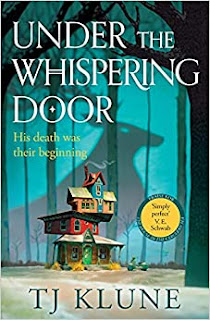


The House in the Cerulean Sea, TJ Klune’s previous novel, was one of my favorite novels of 2021. Under the Whispering Door also has its delights, though aspects of it suggest that he might have cranked it out a bit too hastily. In many ways, it’s the same book as Cerulean Sea, but with different characters and a different setting.


Gone are the mythological characters of Cerulean Sea, but they give way to a new cast of speculative individuals. The book’s subtitle hints at what is in store: Death is Only Their Beginning. Think a blend of Cerulean Sea, A Christmas Carol, a splash of Greek mythology, and a gay novel. It opens upon Scrooge-like attorney Wallace Price, who is powerful, ruthless, vain, and heartless. He has just fired his secretary of ten years for making the first mistake she has made in her time with the firm. Then he drops dead. In Dickens-like fashion, he observes what his colleagues think of him as he is lowered into the ground. The word that appears on most lips is “asshole.”


Luckily for Wallace there’s no rush to judgment after death. He instead finds himself in quirky house akin to that of Cerulean Sea. Note its name: Charon’s Crossing Tea, Charon being the ferryman who transports souls to Hades in Greek myth. Wallace meets Hugo who runs the tea house, but the African American Hugo is more British in his mannerisms than Charon. Wallace is furious to learn he is dead, insists it’s a mistake, and demands that he be returned to life immediately. Hugo calmly chooses a tea blend for Wallace and bids him to drink. No questions will be answered until Wallace gets a grip on himself. Besides, who wouldn’t like a nice cuppa before shuffling off this mortal coil?


Wallace discovers that the tea house is the portal to the afterlife that the dead enter via a panel in the ceiling on the 4th floor when they are ready. He will meet an unusual group that includes Hugo’s grandson Nelson, who looks older than Hugo because Nelson lived to a ripe old age. There is also Mei, the Reaper who brings Wallace to the tea house and is still new to her job. There’s also wordless Nancy who lost a child; Alan, a murder victim; and Desdemona, who comes to the tea house to hold seances.


One of the tea house’s many quirks is that it’s a hangout for both the dead and the living. Hugo is among the latter, though his dog Apollo is a ghost like Wallace and the living patrons can’t see or hear ghosts. Wallace wonders if this means that Hugo is God, but is assured that he’s only the ferryman. There are vague references to The Manager, who must not get involved in any passing to the next realm if everyone knows what’s good for them. Wallace is literally hooked by a long line to Hugo. He remains intent on fleeing back to the land of living, until he encounters Cameron, who tried that and became a hollowed-out zombie destined to wander in mindless limbo for all eternity.


Wallace masters sitting down and how to eat some of Hugo’s delicious baked goods, but he has a lot to learn and not much time to absorb it. In another nod to A Christmas Carol, Wallace is forced to consider why he was an asshole and he wishes to redeem himself. He will also fall in love with Hugo. Talk about a relationship with no future!


Under the Whispering Door has been called a “gay love story” and a “fairy tale for adults.” Both labels are apt. There is a sweetness to Klune’s writing and doses of humor that make him a joyful read. Still, it’s very much a derivative work and its deux ex machina resolution is way too pat. Whereas Cerulean Sea felt wildly inventive and offbeat, this one induced feelings  akin to when I watch a sequel of a great movie that’s not bad, but not a patch on the original. I hope that Klune takes his time with his next novel and takes us somewhere new rather than simply changing his vest and returning us to the same party.


Rob Weir 

1/5/22

Connecticut River Flood of 1936

CONNECTICUT RIVER VALLEY FLOOD OF 1936 (2021)

By Joshua Stanley

The History Press, 175 pages.

★★★


The United States is blessed with numerous powerful and useful river systems. The flip side is that they tend to flood from time to time and a big river leaves devastation in its wake.


The 410-mile Connecticut is the longest in the Northeast, nearly 100 miles longer than the Hudson. Its floods don’t usually grab national attention like those along the Mississippi, but the Connecticut and its tributaries periodically wreak havoc. Three big ones in 1927, 1936, and 1938 were particularly fierce. Vermont was clobbered so badly in 1927 that the New York Times histrionically declared that it had been “destroyed.”


The granddaddy of Connecticut overflows occurred in 1936. It is the subject of a new book by Josh Shanley, whose background is in emergency management, fire rescue, and several other germane professions. Most studies of the 1936 floods have been local ones. Stanley’s contribution is to look at the entirety of the Connecticut River system. March 1936 involved a literal perfect storm; heavy rains fell upon thick ice formed during a colder-than-normal winter, leaving the water with few places to go except over the banks. Milder weather brought a second whammy, large sheets of dislodged ice. Instant frozen dams appeared—some higher than 30 feet-–that sped the course of the water, while other chunks split apart and slammed into bridges. Some were knocked off their moorings and several were washed away entirely, as were riverside rail tracks, roads, farm buildings, and homes. By Shanley’s reckoning, an adjusted $9 billion worth of property damage ensued and more than 100 people lost their lives.


Shanley opens his book with a look at how historical developments played a part in riverine disasters. Humans have been altering the Connecticut River in major ways since the advent of the Industrial Revolution. New England’s swift-flowing waters provided a natural power supply for factories, machines, and lighting. By the early 20th century, dams (often earthen) dotted the Connecticut River and feeder streams. Most were overtopped in 1936 and a half dozen were destroyed.


Pleasant Street Northampton


Shanley takes us on a north-to-south journey and assesses the damage from Comerford Station on the Monroe, New Hampshire/Barnet, Vermont, line to Hartford, Connecticut. Some of the worst damage occurred on Connecticut tributary rivers such as the Ammonoosuc, the Farmington, the Green, the Mill, the Millers, and the Wells. In all, 35 towns and cities suffered crippling storm damage. By way of illustration, Northampton, Massachusetts, saw a trolley bridge and a 1200’ iron span across the Connecticut wash away. Waters from the Mill River flooded the downtown, threatened a gasworks, and made Pleasant Street navigable only by rowboat. Overflow from the Connecticut inundated the Three County Fairground.


Shanley takes a chronicler’s approach rather than dramatizing the tales. His matter-of-fact account is loaded with statistics whose net effect is to drive home the severity of the cataclysm. He also accumulated quite a trove of photographs—both aerial and ground level—that graphically illustrates the tragedy.


Two things jump off the pages that make all of this more than a peek into the past. First, the responses both during and after the floods were heroic and extensive. Shanley tells of power plant workers working in rising water as they battled to pile sandbags that kept waters at bay. More impressive still, 250,000 New Deal Works Progress Administration workers turned their attention to repairs and flood control projects aimed at preventing future disasters. In Northampton, they had not yet completed their tasks before the town was buffeted by another flood in 1938, but among their efforts was the diversion of the Mill River away from the downtown along the very course it runs today. Those who think that the private sector does things better than the federal government should muse upon this. On an even more poignant level, consider today’s infrastructure plan paralysis. When the hue-and-cry arises that analogous projects are too expensive, remember that we are seeking to rebuild things that date to the 1930s, including flood control projects. Moreover, those major undertakings occurred in the middle of the Great Depression!  (Think maybe our priorities are bankrupt, not the Treasury?)


As Vermonters who endured the effects of Hurricane Irene (2011) can attest, Mother Nature often delivers reminders that humans aren’t as safe as they think. With very little editorial comment, Shanley ends his book by posing the question of whether we might be heading for a future repeat of 1938. If that sounds implausible, ask residents of New Orleans if Hurricane Katrina (2005) would have been less destructive had we taken care of surrounding wetlands.


Rob Weir


1/3/22

Crossroads: Too Long, but Provocative

By Jonathan Franzen

CROSSROADS (2021)

Farrar, Straus & Giroux, 592 pages.

★★★★


When I was young, I was involved in a Christian youth group that was the rival of a much more conservative group. Our liberalism was a point of pride, as was our equally affected hipness. The local leader dropped phrases like “Jesus and the boys (disciples)” and read from The Good News Bible, whose text now seems painfully embarrassing and antiquated. As is often the case, a lot of what passed for “cool” was shallow and transitory.


 Crossroads, the newest novel from Jonathan Franzen, took me back to those days. Once you learn that the title references a similar Christian youth group, you are halfway toward an understanding of its multi-layered meaning. It is set in the imagined First Reformed Church in the equally fictional New Prospect neighborhood of Chicago. We meet the Rev. Russ Hildebrandt, his wife Marion, and their four children: Clem (19), Becky (18), Perry (15), and Judson (10). Russ grew up Mennonite, but left that faith for various reasons, chief among them Marion and his interest in progressive causes such as civil rights and the plight of Native Americans. His devotion to do-good causes won Russ many admirers, and each summer he leads work camps to the Arizona Navajo reservation where a youthful epiphany occurred.  


 If you pay attention to American culture, you will have observed that the popularity of causes changes over time. That’s Russ’ dilemma. Crossroads takes place in the winter of 1971 and the spring of 1972. Among middle-class white kids impacted by Vietnam, changes in style, and new musical tastes, Russ’ coolness has faded like the allure of his ever-present sheepskin coat. Young people are flocking to First Reformed, but to Crossroads, which is led by a new groovy pastor, Rick Ambrose. Russ pours out his fall from iconic status thusly,


 "What galls me about so-called youth culture now is that people seem to think it came out of nowhere. The kids today think they invented radical politics, invented premarital sex, invented civil rights, and women’s rights. Most of them have never even heard of Eugene Debs, John Dewey, Margaret Sanger, Richard Wright. When I was in Birmingham in 1963, a lot of the protestors were my age or older. The only real difference now is their fashions–different music, different hair. And that’s just superficial."


 Russ knows that envy is wrong, but he’s stung by Rick’s popularity and justifies his jealousy by telling  
 himself that Rick is theologically weak and more of a hippie than a clergyman. He might be right about    t that. If only these matters were all that troubled Russ, things might have been simpler. It’s much harder,  t though, to explain away his attraction to Frances Cottrell, a widow with whom he contrives ways to spend time. 
 

The Crossroads group takes on aspects that blend cult-like behavior, pop psychology, and worldliness; and the novel takes a dark turn. What begins as a look at a youth group veers into many other things, including the backstories of troubled individuals. This is one of those novels in which the lines between sincerity and fraudulence are blurred–not just for the Hildebrandts, but for pretty much everyone around them as well. Flashbacks to the past make us wonder if all those problems are bred in the bone. Readers also come to realize that religion is merely the fulcrum that lifts the veil from other things: the thin line between righteousness and sin, faith versus mere ritual, clashing cultural values, purity and lust, addiction of all sorts, secrets well and poorly kept, coolness versus goodness, and how easy it is to drift if one is never fully present in the first place. 


 Many novelists build toward revelations and resolutions. Not Franzen. When you come to a metaphorical crossroads and paths diverge, which one does one take? Writers who make that choice clear and easy do a disservice to the human condition; it’s often hard to know the right path until one is far enough along to discern the consequences looming in the distance. If you need things tied together with a neat bow, look elsewhere. Not even Native American characters come across with much nobility. I will also warn that Crossroads is not a quick read. Frankly, the book did not need to be as long as it is, but it is nonetheless a provocative book.


 Is Franzen a realist or a cynic? That’s your call, though my vote goes for option A. Either way, though, Crossroads is a reminder that belief in anything should be rooted in things more substantive than fashion or bandwagon behavior. If it goes no deeper than a desire to be placed on a pedestal of coolness, it will not survive when the cultural winds shift.


Rob Weir

12/29/21

Dark City an Overlooked Sci-fi Noir Film


DARK CITY (1998)

Directed by Alex Proyas

New Line Cinema, 111 minutes (director’s cut), R (nudity, language)

★★★★


Dark City dovetails with my recent interest in film noir, though it’s a newer sci-fi movie. It tanked in North American theaters, but has come in for reevaluation. Subsequently, elements of it made their way into works such as The Matrix and Inception. The latter copied Dark City’s trippy f/x effect of a city building itself in front of our eyes, an afflatus also borrowed by Amazon Studios.


Dark City has inspired comic books and spin-off novels, plus director and screenwriter Alex Proyas went on to direct I, Robot, which was a huge hit. It didn’t hurt that the late Roger Ebert declared Dark City the best film of 1998, or that it won major non-Oscar awards.


Is Dark City a noir film? Absolutely! There’s not a speck of light in it until the end and cinematographer Darius Adam Wolski manipulates shadows, incidental light, and nighttime with the skill of 1940s masters. It's a good thing, as the entire movie is set in darkness and external settings look like a moving version of Edward Hopper’s Nighthawks. Dark City also shares film noir’s penchant for murder mystery, though it might be more accurate to call the murders more of a subplot.


In brief, John Murdoch (Rufus Sewell) is an amnesiac who has no idea why he’s being pursued. As he attempts to piece together his identity, he learns that Inspector Frank Bumstead (William Hurt) has marked him the prime suspect in a series of Jack the Ripper-like murders of prostitutes. John’s wife Emma (Jennifer Connelly) hasn’t seen John in weeks, as he stormed out after learning that she had an affair.


So far, so normal, but it won’t stay that way. As a line in the movie puts it, “First there was darkness; then came the Strangers.” The latter are aliens manipulating humankind through a reluctant human intermediary, research scientist Dr. Daniel Scheher (Kiefer Sutherland). As we learn, it’s always dark because each midnight the aliens hold a “tuning.” As fast as you can “Shut it down!” everyone falls asleep, all transportation freezes to a halt, and the bald, black-cloaked aliens float from place-to-place exchanging memories and rearranging much of the city. For instance, one unkempt couple in a decrepit hovel awake to find themselves seated at a fancy table in a luxury apartment and have no recollection of having lived any other way. Injections to the front of the brain provide complete backstories.


Why? That’s what John wants to know. He literally doesn’t sleep, but unlike everyone else except Detective Eddie Walenski (Colin Friels), he remembers everything that happened since he last awoke. Whereas Walenski has gone ‘round the twist and is painting concentric circles everywhere, John is determined to find out if he’s actually a serial killer, why things grind to a halt a midnight, why the city shapeshifts, and why it’s always dark. He even escorts a hooker named May (Melissa George) and watches her undress to test whether he’s a murderer. He will learn about the Strangers from Scherer. Why are they doing all of this? It has something to do with wanting to unlock the secret of the soul, but I’ll leave it at that. Needless to say, John will be tasked with avoiding Bumstead and saving the city. If only he can find Shell Beach, he thinks he can do it.


That is, if reality is “real.” Dark City mixes enough speculative science with fiction to inspire interesting mind games. There is a reference to “Last Thursdayism,” a geek’s take on Creationist theory that postulates there is no objective way to prove that anything existed prior to what can be immediately perceived. And maybe there is no city at all; perhaps everyone is inside a Dyson sphere.


Dark City has been compared to Fritz Lang’s 1927 masterpiece Metropolis. I can see that, but it also borrows from Blade Runner (1982), Delicatessen (1991), The City of Lost Children (1995), and Star Trek’s Borg episodes. The Strangers are a lot like the Borg in that they exist as a hive mind, though Mr. Book (Ian Richardson) seems to be a male equivalent of a queen bee. Anticipate caper-like flights and f/x-infused showdowns.


If you don’t like science-fiction, you should avoid this movie. I found it stylish. gripping, and a really interesting non-conventional appropriation of film noir. Ebert was right; most Americans missed an outstanding movie.


Rob Weir


12/28/21

Fransec Sans: December 2021 Artist of the Month


FRANSEC SANS

L’Infiniti (The Infinite)


December’s Artist of the Month Fransec Sans brings something different to your playlist. He’s a Catalan sac de gemecs player. In English, that’s the Catalan bagpipes, a three-drone kit that looks a lot like a set of Highland pipes, but has a slightly more melodic and brighter sound. On his debut album L’Infiniti, Sans uses old tunes as his inspiration and arranges them for the 21st century. Call it nouveau medieval court and village material. The bagpipes are front and center, but the album also includes guitar, bass, piano, lute, flute, harp, violin, squeeze boxes, vocals, and percussion.


The entire album can be sampled online, but here are a few I think are typical. “Tres Tocs, un Cant” has a big production opening that soars, swells, and sounds positively anthemic.  Abruptly, it transforms into something akin to a community celebration. You can almost paint the picture in your head, but just as swiftly it revives the formal structure of the opening, before doubling back to the gala. Background vocalizations help drive the alternating moods.


“JNavarro” has a more distinct Catalan rural pulse that’s enhanced with offbeat percussion that’s sometimes deliberately and literally the case. The middle section is a chase-the-tail-around-the-circle structure that could be the soundtrack for a caper film. Listen carefully for the short, but effective lute passages. Sans often opens formal and slips into patterns freer and informal. He does this again on “El Meu Sud,” whose opening is mysterious, moody, and flute-driven. For lack of a better descriptor I call it enigmatic pastoralism. Again, though, the piece is instantly enlivened when air blows through the chanter and drones. Josep Aparicio’s call-and-response vocals add further color. The opening half of “Dolors Gegante” is atmospheric and wintery in feel when Albert Carbonell puts bow to violin strings, but the pipes usher in a fast-paced piece evocative of a springtime dance fest, complete with clicking castanets. Catalan dances are often ¾ time jotas or rumbas that occasionally drift into 6/8 tempo. That’s because latter not analogs to Cuban rumbas, rather faster-paced Spanish tunes called guarachas.  


Catalan dance is so ebullient that participants hurl themselves airborne. They also frequently feature vocals. More on this in a moment, but let me first note another unique feature of this album, its percussive mix of the tombril, a skin drum that’s a bit like a bodhran. Sans and his collaborators engage in some global beats when they blend it with bongos. “Amoretes” is a bit of a switcheroo in that it’s a lively dance tune from the start, courtesy of accordion from Carlos Belda and then goes briefly darker before surrendering to spirited abandon. Just before the end, they switch again for a few seconds of a quiet, slower pace before taking us out with a flourish. 


“Desperta'm” isn’t on the album, but you might enjoy the video of this short piece. It’s set in the woods during and after a thunderstorm and the piping sounds as if it could be a requiem for the trees, though it suggests hope for renewal at the end. It’s fun to see a mud-covered Sans maintain his composure, which is a neat trick for a guy whose favored sartorial getup is to dress in white!


For my taste, the only downside of the record occurs when Mariona Escoda sings. She is talented, but the quality of her voice simply doesn’t connect with me. On “Les Quintes” she warbles a jazzy tune whose high register sounds like a Japanese bird. This, I hasten, is a reflection of personal preference, so you should listen and feel free to disagree. Loving those bagpipes, though!


Rob Weir


12/27/21

Surf’s Down: Under the Wave at Waimea and Malibu Rising


UNDER THE WAVE AT WAIMEA (2021)

By Paul Theroux

Mariner Books, 416 pages.


MALIBU RISING (2021)

By Taylor Jenkins Reid

Ballantine, 371 pages


 In winter, Northern clime readers often seek novels that feature warm beaches. If they have hunky surfers, all the better. Oddly, two novels by major authors featuring surfer life came out in 2021. Now for the mixed message: They aren’t bad, but neither are they stellar.


Under the Wave at Waimea features Joe Sharkey who, as a young man, was Adonis on a board–perhaps the greatest on any ocean. Women fell at his feet and then into his bed. In Section I of Paul Theroux’s new novel, we meet Joe at 62 and in still another relationship, this time with Olive, a 38-year-old English emigree nurse. “Shark” remains well-enough known to get free drinks and other minor perks, but for the new wave-riding hotshots, he’s either ancient history or someone they’ve only heard of. Such is the fate of every star athlete, but Joe has never done anything but surf and there’s not much call for a guy who can’t ride the big waves anymore. What do you do when the sponsorships run their course? Shark has simple needs, but still…. He is depressed, drinks too much, a tragic car accident leaves him afraid of the water, and he might be suffering from dementia. 


Section II takes us back to Joe’s troubled childhood–how he got to Hawaii, his relationship with his father, family tragedy, being bullied, the challenges of being a haole among native Hawaiians, and smoking dope. Solace comes in the ocean and from his Yoda-like mentor Uncle Sunshine.


It’s back to the present in Section III in which Joe is metaphorically drowning and Olive is about ready to bail. The interjection of a new character, Max Mulgrave, alters a lot of lives. He’s a Vietnam vet and tech guru/mogul who came to Hawaii and altered his life completely. Some think he’s literally a saint. He and Joe will collide, but Joe has a lot of demons to exorcise before he can hope to collect his AWOL marbles. 


The most intriguing part of the novel only tangentially involves Shark. Theroux does a superb job casting light at the resentment indigenous Hawaiians hold toward non-natives, especially white ones. I could have done without Theroux’s shallow psychologizing, but he really falls off the wave with a trite and cliched climax. This is a readable novel, but a middling effort from a writer we know to be better.

★★★


Taylor Jenkins Reid has penned a better surf novel, but not by much. Theroux’s book suffers from a one-dimensional central character; Malibu Rising from too much going on. It’s about watery Malibu life, but it’s also a multigenerational family saga into which Reid plops references from her previous novel. Toss in loads of background characters, surf heroes, dropped names of celebrities, and alternating main characters, and it’s very easy for readers to lose focus.


Reid likes glamor with or without bling and there’s plenty of both in Malibu Rising. Some comes slathered in cheese and is named Mick Riva. Reid tells us that family stories “are myths we create about the people who came before us, in order to make sense of ourselves.” Such tales have creation myths and this one begins in 1956, when head-in-the-clouds Mick meets, impregnates, and weds down-to-earth June Costas whose family runs a rustic fry shop. Fried fish is not a good match for a guy who fancies himself the next Bobby Darin. Trouble starts when Mick actually is good enough to go pro. He’s also good at fathering children–but by different women.


In the end there are four in the immediate Riva circle, three of whom are essentially mothered by Nina, the eldest, when Mick dallies, and June dies. Nina drops out of school, runs the fry shop, and at 18, becomes legal guardian of her sibs and half-sibs. Forget road-warrior Mick, who marries five times! Jay and Hud(son) are surfers as was Nina, but she discovers she can make a lot more money modeling swimsuits. She will also lose her tennis pro husband, who deals with losing his # 1 ranking by going full-Mick on Nina. The youngest of the Riva line is Kit who, not surprisingly, grows up confused and petulant.


All of these crazy dynamics come to a head at one of the Riva clan’s legendary beach house parties. Everyone comes: celebrities, wannabes, surfers, exes, current dalliances, total jerks, and nobodies. Metaphorically speaking, the gathering is a mix of petrol and matches, conducive for new family secrets to leach out, hysterics, drinking, drugs, arrests, literal home-wrecking, and Nina’s discovery of the end of her tether.


Malibu Rising has a lot of characters, but the more problematic aspect is that many are so thoroughly phony and unlikable that it’s hard to imagine them as anything other than the architects of their own misery. At 371 pages, Malibu Rising isn’t a massive tome, but with all those characters and a span of a half century of time, it feels like a draft of an epic. Reid is always worth reading, but this one left me wondering if a modicum of common sense exists anywhere along the Ventura Highway.  ★★★ ½  


Rob Weir

12/22/21

The Lincoln Highway Another Fine Amor Towles Novel


THE LINCOLN HIGHWAY (2021)

By Amor Towles

Viking, 576 pages.

★★★★


The Lincoln Highway traverses through the town in which I grew up. Plus, Amor Towles’ last book A Gentlemen in Moscow is my favorite novel of the 21st century. You0214 could say I was psyched to read this one.


At first, I was mildly disappointed, but The Lincoln Highway grew on me with every page. If you don’t know, the Lincoln Highway runs from Times Square to Lincoln Park in San Francisco, and is generally regarded as the nation’s first transcontinental auto route. Towles’ tale isn’t about the highway per se, but it is about a helter-skelter road trip. Its principal character is Emmett Watson, who was sent to reform school for accidentally killing a bully in a fight. We meet him in 1954, the year he turned 18 and maxed out. Though he is person of few words, he can’t wait to get home to Nebraska to see his kid brother Billy, though he knows he’ll probably have to leave the Cornhusker State because of the bad blood he left behind. Leaving isn’t really a problem as his mother ran away, his father is dead, the farm has just been foreclosed, and Billy is being raised by friends.


He is surprised to find that his father left him several thousand dollars in cash and his old Studebaker. Surprise # 2 comes when Billy insists that he and Emmett should set off to find their mother in San Francisco, it being the last place from which she sent a postcard—8 years earlier.  Billy is a precocious kid with a love of maps and a head full of arcane/dubious information from a book he thinks will help them: Compendium of Heroes, Adventurers, and Other Intrepid Travelers by Professor Abacus Abernathy. As far as Billy’s concerned, that book might as well be the Bible.


But the biggest surprise of all is that two of Emmett’s friends from the reform school—Wallace Wolcott “Woolly” Martin and Daniel “Dutchess” Hewett—stowed away in the trunk of the warden’s car that deposited Emmett back home. What a pair of characters they are! Woolly comes from a lot of money, but he is 18 going on 10, if you discount his drinking and carousing. Dutchess was sent up for a theft he didn’t commit and he’s on the opposite end of the SES scale; it was his no-account actor father who framed him! Neither is exactly goal-oriented or has a very good sense of what belongs to them. Toss in maternal Sally Ransom, who is sweet on Emmett, down on her banker father, and possesses a mind of her own.


What transpires is a zigzag road trip to California by way of the Dakotas, New York City, and several stops east and west in between. Towles’ story is a mix of Huckleberry Finn, Bound for Glory, Travels with Charley, O’ Brother Where Art Thou? and The Odyssey­—all of which takes place over 10 days and is told in count-down form. You name it and it happens:  impulsive “borrowing” of Emmett’s car, a visit to a Catholic orphanage, hopping freight trains, danger on the rails, a black hobo camp, conmen, revenge, the discovery of exotic foods (like artichokes and fettuccini), cops looking for AWOL Woolly and Dutchess, a visit to the Empire State Building, a sad black man who—courtesy of Billy—identifies with Ulysses, double-crosses, and a morality play about greed.


As you probably surmised, this is a sprawling novel. It is often humorous, yet it’s also poignant, moving, and tragic. Amor Towles is simply an amazing author. He writes, “Wouldn’t it have been wonderful… if everybody’s life was like a piece in a jigsaw puzzle. Then no one person’s life would ever be an inconvenience to anyone else’s. It would just fit snuggly in its very own, specially designed spot, and in so doing, would enable the whole intricate picture to become complete.” Yeah, if only. But some pieces are simply the wrong shape.


Rob Weir