1/14/22

Once There Wolves a Compelling Short Novel


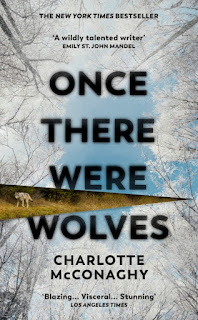
ONCE THERE WERE WOLVES (2021)

By Charlotte McConaghy

Flatiron Books, 255 pages.

★★★★★


If you transported Richard Powers to the mystery genre, you might end up with a novel such as Once There Were Wolves.  Australian-born Charlotte McConaghy has penned a novel that’s so good it’s already won a place among the best I will read in 2022. Among her many virtues is the ability to tell a gripping story compactly yet still spool out relevant details and backstories at a deliberate pace that keeps you turning the pages to confirm or dispute what you have inferred.


Initially, Once There Were Wolves seems like the sort of paean to nature that Powers could have written. Its central character Inti Flynn is an eco-warrior. She is in Scotland as part of a four-person team that’s trying to reintroduce wolves to the Scottish Highlands. It would not be too dramatic to call Inti a zealot. The book’s earliest chapters skirt the border of being a treatise on how nature self-heals when ingredients are added back into ecosystems. Inti is not shy in telling nervous locals of all the wonderful things wolves will bring, though all they can imagine is flocks of dead sheep with their throats slashed and entrails spilt.


About the time we are ready to think of this novel as a Scottish version of the battle between scientists and New England lobstermen, McConaghy begins to add ingredients of her own to the novel. We learn that Inti’s mute twin Aggie is with her in Scotland and that Aggie’s silent condition has no physical cause. The two have always been closer to each other than to anyone else in their lives and hints are dropped that something happened to Aggie when she was living in Alaska. Prior to that, Aggie was a lively, carefree young woman.


As noted, though, don’t expect to know the details of that until McConaghy is ready to reveal them. We do learn that the Flynn sisters come from a broken home, but not of the conventional sort. Their father was a tree hugger in British Columbia who was so over the top that he believed his environmental activism would single-handedly save the world. It was he who taught Inti much about surviving in the wild. By contrast, their mother is a cop in Sydney, Australia, who specializes in misogynistic crimes. It was she who helped Inti cope with an affliction; she has mirror-touch synesthesia–a condition linked to hyper-empathy syndrome–and literally feels the pain of other people and animals. If Aggie burnt her right hand, Inti also experienced it.


Things are not exactly going well in the Cairngorms of Scotland. Several locals led by Red McCrae and Stuart Burns have raised the rabble to staunch opposition to the wolves and Burns has shot one he claims strayed onto his land. That’s rubbish, but local police superintendent Duncan Mactavish can’t prove otherwise and has to talk Inti down from her high horse. (Another kind of horse factors into the story!) He and Inti are also attracted to each other, so Duncan faces a tough task. It doesn’t help that Inti is convinced that Stuart has been beating Lainey, his wife, and it gets very complicated when Stuart disappears. Author Nicholas Sparks once called small-town gossip the “toxic waste” of such places, an apt way of thinking of a Highland hamlet smaller than its nearby “large” town of Abernethy (pop. 945).


At this juncture, McConaghy begins to reveal more about Inti, Aggie, Duncan, Burns, and several of the other locals. The experience of reading Once There Were Wolves is a bit like watching a painter whose landscape we only see late in the process, as the artist lays on each of the colors one at a time. You can be excused if you conclude that humans are more vicious than wolves.


McConaghy keeps us guessing to the end and even if you do manage to unravel a mystery or two, their details will probably spin differently than you imagined. The final pages are a tad too abrupt in their sunny optimism given the darkness of what comes before. Yet, the ending is also probably just as you would have wished it. Again, one can only applaud Charlotte McConaghy’s concision. She tells a compelling tale in 255 pages when too many writers take twice as long to say half as much.


Rob Weir


1/12/22

The Narrow Margin a Wonderful Overlooked Noir Classic


THE NARROW MARGIN (1952)

Directed by Richard Fleischer

RKO Pictures, 71 minutes, not-rated.

★★★★ ½


Film noir had peaked in popularity by the time The Narrow Margin appeared in 1952. Very few film fans now recognize names such as Charles McGraw, Marie Windsor, or Jacqueline White and even in their day they were considered second-tier actors. Too bad on all fronts, as The Narrow Margin ranks among the best of forgotten film noir classics.


As is generally the case, the narrative arc seems simple, though you can rest assured that there are plenty of twists. LAPD Detective Sergeant Walter Brown (McGraw) and his partner Sergeant Gus Forbes (Don Beddoe) have been sent to Chicago to provide bodyguard duty for Mrs. Frankie Neal (Windsor), the widow of a mobster who has turned state’s evidence. She has a payoff list found among her dead husband’s effects whose contents would cripple a major crime syndicate. As a cab drops off Brown and Forbes in front of the safe house, we hear a much-quoted line that’s vintage noir. When Brown ponders what Mrs. Neal is like, Forbes predicts, “She’s the sixty-cent special. Cheap. Flashy. Strictly poison under the gravy.”


Things go wrong from the start. Forbes is murdered as the trio descends a dark stairwell and, though Brown wounds him, the assassin flees. It’s 1952, so the journey from Chicago back to California is by train, not an airplane. Brown faces the daunting task of single-handedly keeping Neal safe. His heart isn’t into it, as his dead partner left behind a wife and three kids, and Neal is a major piece of disagreeable work. She’s acid-tongued, demanding, and has the charm of an enraged hornet. Brown has a double compartment and he shoves Neal into one of them and tells her to lock the door and keep quiet. As if that will happen.


Brown cases the cars, identifies a known hoodlum, and fingers several others he suspects are hoods, including the nosy and rotund Sam Jennings (Paul Maxey). Brown also can’t help noticing an attractive blond named Ann Sinclair (White) who is traveling with her young son Tommy and a nanny. Focus Walter! It takes several days to make such a trip in 1952, and are were several stops along the way, any one of which raises the odds that more gun thugs will come aboard. He’s even openly approached by mobster Vincent Yost (Peter Brocco), who’d rather settle matters amicably; he offers Brown a $30,000 bribe to reveal where he has stashed Neal. It’s tempting when your client is contemptible.


Will Neal or Brown make it to LA? The Narrow Margin is a taut 71 minutes, most of which takes place inside a train. Credit goes to the direction of Richard Fleischer for keeping tension levels so high that the train’s cramped compartments, berths, and corridors never make the film seem claustrophobic. To be sure, there are MacGuffins and red herrings throughout Earl Felton’s screenplay. In retrospect, there are two major logic errors in the film but as Alfred Hitchcock observed, if directors do their jobs well, viewers won’t notice. Fleischer did his job very well.


Rob Weir


1/10/22

Now on View at the Hood Art Museum


Hood Art Museum

Hanover, New Hampshire

On View Now


The ultimate zero-sum-game is the attempt to rank comparative oppressions. Oppression is oppression.  I say this because my next comment might otherwise seem insensitive. In today’s (Dis)United States, Latinos are now the largest minority group. Other high-profile movements include Black Lives Matter, #MeToo, Stop AAPI Hate, pro-choice activists, and transgender rights groups. Conspicuous by its relative absence is the minority group that is at or near the bottom of0 virtually every negative social indicator: Native Americans. About the only thing that hits the news is when some sports team decides to drop a stereotypical mascot, something that should have been done five decades ago.


A few weeks ago, I paid a visit to Dartmouth College’s Hood Museum. The college used to have teams called the Indians, but now it has the remarkable Jami Powell (Osage) as its Curator of Indigenous Art. If you think it doesn’t matter if such a person is part of a museum’s staff, I invite you to drive to Hanover, New Hampshire, and then make such a statement.


The Hood is about install a piece from Jaune Quick-to-See-Smith titled Trade Canoe: Forty Days and Forty Nights. I was lucky enough to arrive just before the holiday break. Trade Canoe wasn’t yet on view, but most of the supporting exhibit was and I caught a preview. Here are just a few works of art that reminded me anew of how important it is to change the proverbial frame. 


Take this powerful work from Yatika Starr Fields (Osage/Creek/Cherokee) titled White Buffalo Calf Women March. You will notice that the three women are literally cut off at the knees. How appropriate for those marching to halt the Dakota Access Pipeline that would bisect Lakota land. Alas, as of now the go ahead has been given for this needless oil pipeline. Is the white flag a sign of surrender? Maybe not. Notice it is held by what appears to be a pair of ghostly hands. Is it really that the sky and the flag and reflected in water? If so, why would a paved highway run into that water? Another way of looking at it is that the surrender flag has been cast down. Are the hands the ghosts of ancestors? 


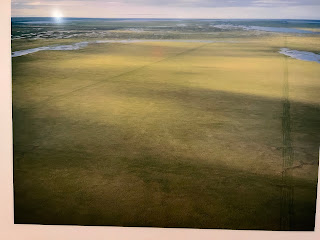
Subhankar Banerjee was born in India and is not Native American, but her photograph Known and Unknown Tracks is another reminder of what happens when we place oil ahead of indigenous rights or environmentalism. The wide expanse you see is the area near Teshepuk Lake in north-central Alaska. As you look at it, do you need me to remind you of the fragility of the tundra? Don’t fall for the malarkey that oil companies erase their eco-footprints.


Cara Romero (Chemehuevi) punctuates this in Oil Boom, a photographic “dreamscape” sandwich. Is the figure in the sepia water being born or drowning? 


Arthur Amiotte (Lakota) offers a more conventional collage of layered photos and print clippings in Saint Agnes Manderson, S. D. Pine Ridge Rez. Manderson is a town in South Dakota and the composition is a take on the complicated issue of assimilation. Spend some time with this. Embedded within is a history lesson involving missionaries, schools that sought to obliterate Lakota culture, Natives who assimilated, those who partially did so, and traditionalists. It often confuses whites when they encounter Natives with Anglo-sounding names like Arthur who ID as Native. Now you know why. 


In 2018, T C Cannon (Kiowa) was the subject of a fabulous retrospective at the Peabody Essex Museum. At the Hood we see his 1977 acrylic work Taos Winter Night. According to the curators, the spots might echo participation in a Sun Dance ritual. It can also be enjoyed on its own for its strong compositional elements. 


Roxane Swentzell (Santa Clara Pueblo)–see what I mean about names–works in ceramics. Her Sitting on My Mother’s Back is figurative on many levels: woman as nurturer, shelter, defiant figure, Mother Earth….  I couldn’t stop looking at this one. 


Swentzell collaborated with Rose Simpson (Santa Clara Pueblo) on the 21-foot-long Timeline Necklace. It’s a mixed media combination of ceramics, wood, wire, leather, and rope that also looks at women and motherhood. It also contains subtle reminders of single women, poverty, and resilience.


Leave it the dynamic Faith Ringgold to connect the color dots. She is African American and better known as a quilter, but her photolithograph United States of Attica, was made in 1972. It was inspired by the infamous 1971 prison riot that left 43 people dead and 91 wounded. It reminds us that H. Rap Brown (now Jamil Al-Amin) was right to assert that “Violence is as American as cherry pie.” This closeup is part of a larger map in the Pan-African colors of red and green and shows the toll in the Southeast.


I have loved Inuit art since the days when I taught high school Canadian studies. The Hood show Inuit Art/Inuit Quajimajatuqangit samples Inuit works on paper and stone carving.


I invite you to draw your own meanings from the following pieces, which I have labeled by artist (if known).  


Helen Kalvak Nightmare  


Sarah Joe Qinujua Ready to Leave for the Hunt   


1/7/22

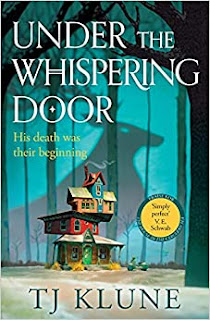
Under the Whispering Door Sweet, but Derivative


UNDER THE WHISPERING DOOR (2021)

By T J Klune

Tom Doherty Associates Book, 389 pages

★★★


The House in the Cerulean Sea, TJ Klune’s previous novel, was one of my favorite novels of 2021. Under the Whispering Door also has its delights, though aspects of it suggest that he might have cranked it out a bit too hastily. In many ways, it’s the same book as Cerulean Sea, but with different characters and a different setting.


Gone are the mythological characters of Cerulean Sea, but they give way to a new cast of speculative individuals. The book’s subtitle hints at what is in store: Death is Only Their Beginning. Think a blend of Cerulean Sea, A Christmas Carol, a splash of Greek mythology, and a gay novel. It opens upon Scrooge-like attorney Wallace Price, who is powerful, ruthless, vain, and heartless. He has just fired his secretary of ten years for making the first mistake she has made in her time with the firm. Then he drops dead. In Dickens-like fashion, he observes what his colleagues think of him as he is lowered into the ground. The word that appears on most lips is “asshole.”


Luckily for Wallace there’s no rush to judgment after death. He instead finds himself in quirky house akin to that of Cerulean Sea. Note its name: Charon’s Crossing Tea, Charon being the ferryman who transports souls to Hades in Greek myth. Wallace meets Hugo who runs the tea house, but the African American Hugo is more British in his mannerisms than Charon. Wallace is furious to learn he is dead, insists it’s a mistake, and demands that he be returned to life immediately. Hugo calmly chooses a tea blend for Wallace and bids him to drink. No questions will be answered until Wallace gets a grip on himself. Besides, who wouldn’t like a nice cuppa before shuffling off this mortal coil?


Wallace discovers that the tea house is the portal to the afterlife that the dead enter via a panel in the ceiling on the 4th floor when they are ready. He will meet an unusual group that includes Hugo’s grandson Nelson, who looks older than Hugo because Nelson lived to a ripe old age. There is also Mei, the Reaper who brings Wallace to the tea house and is still new to her job. There’s also wordless Nancy who lost a child; Alan, a murder victim; and Desdemona, who comes to the tea house to hold seances.


One of the tea house’s many quirks is that it’s a hangout for both the dead and the living. Hugo is among the latter, though his dog Apollo is a ghost like Wallace and the living patrons can’t see or hear ghosts. Wallace wonders if this means that Hugo is God, but is assured that he’s only the ferryman. There are vague references to The Manager, who must not get involved in any passing to the next realm if everyone knows what’s good for them. Wallace is literally hooked by a long line to Hugo. He remains intent on fleeing back to the land of living, until he encounters Cameron, who tried that and became a hollowed-out zombie destined to wander in mindless limbo for all eternity.


Wallace masters sitting down and how to eat some of Hugo’s delicious baked goods, but he has a lot to learn and not much time to absorb it. In another nod to A Christmas Carol, Wallace is forced to consider why he was an asshole and he wishes to redeem himself. He will also fall in love with Hugo. Talk about a relationship with no future!


Under the Whispering Door has been called a “gay love story” and a “fairy tale for adults.” Both labels are apt. There is a sweetness to Klune’s writing and doses of humor that make him a joyful read. Still, it’s very much a derivative work and its deux ex machina resolution is way too pat. Whereas Cerulean Sea felt wildly inventive and offbeat, this one induced feelings  akin to when I watch a sequel of a great movie that’s not bad, but not a patch on the original. I hope that Klune takes his time with his next novel and takes us somewhere new rather than simply changing his vest and returning us to the same party.


Rob Weir 

1/5/22

Connecticut River Flood of 1936

CONNECTICUT RIVER VALLEY FLOOD OF 1936 (2021)

By Joshua Stanley

The History Press, 175 pages.

★★★


The United States is blessed with numerous powerful and useful river systems. The flip side is that they tend to flood from time to time and a big river leaves devastation in its wake.


The 410-mile Connecticut is the longest in the Northeast, nearly 100 miles longer than the Hudson. Its floods don’t usually grab national attention like those along the Mississippi, but the Connecticut and its tributaries periodically wreak havoc. Three big ones in 1927, 1936, and 1938 were particularly fierce. Vermont was clobbered so badly in 1927 that the New York Times histrionically declared that it had been “destroyed.”


The granddaddy of Connecticut overflows occurred in 1936. It is the subject of a new book by Josh Shanley, whose background is in emergency management, fire rescue, and several other germane professions. Most studies of the 1936 floods have been local ones. Stanley’s contribution is to look at the entirety of the Connecticut River system. March 1936 involved a literal perfect storm; heavy rains fell upon thick ice formed during a colder-than-normal winter, leaving the water with few places to go except over the banks. Milder weather brought a second whammy, large sheets of dislodged ice. Instant frozen dams appeared—some higher than 30 feet-–that sped the course of the water, while other chunks split apart and slammed into bridges. Some were knocked off their moorings and several were washed away entirely, as were riverside rail tracks, roads, farm buildings, and homes. By Shanley’s reckoning, an adjusted $9 billion worth of property damage ensued and more than 100 people lost their lives.


Shanley opens his book with a look at how historical developments played a part in riverine disasters. Humans have been altering the Connecticut River in major ways since the advent of the Industrial Revolution. New England’s swift-flowing waters provided a natural power supply for factories, machines, and lighting. By the early 20th century, dams (often earthen) dotted the Connecticut River and feeder streams. Most were overtopped in 1936 and a half dozen were destroyed.


Pleasant Street Northampton


Shanley takes us on a north-to-south journey and assesses the damage from Comerford Station on the Monroe, New Hampshire/Barnet, Vermont, line to Hartford, Connecticut. Some of the worst damage occurred on Connecticut tributary rivers such as the Ammonoosuc, the Farmington, the Green, the Mill, the Millers, and the Wells. In all, 35 towns and cities suffered crippling storm damage. By way of illustration, Northampton, Massachusetts, saw a trolley bridge and a 1200’ iron span across the Connecticut wash away. Waters from the Mill River flooded the downtown, threatened a gasworks, and made Pleasant Street navigable only by rowboat. Overflow from the Connecticut inundated the Three County Fairground.


Shanley takes a chronicler’s approach rather than dramatizing the tales. His matter-of-fact account is loaded with statistics whose net effect is to drive home the severity of the cataclysm. He also accumulated quite a trove of photographs—both aerial and ground level—that graphically illustrates the tragedy.


Two things jump off the pages that make all of this more than a peek into the past. First, the responses both during and after the floods were heroic and extensive. Shanley tells of power plant workers working in rising water as they battled to pile sandbags that kept waters at bay. More impressive still, 250,000 New Deal Works Progress Administration workers turned their attention to repairs and flood control projects aimed at preventing future disasters. In Northampton, they had not yet completed their tasks before the town was buffeted by another flood in 1938, but among their efforts was the diversion of the Mill River away from the downtown along the very course it runs today. Those who think that the private sector does things better than the federal government should muse upon this. On an even more poignant level, consider today’s infrastructure plan paralysis. When the hue-and-cry arises that analogous projects are too expensive, remember that we are seeking to rebuild things that date to the 1930s, including flood control projects. Moreover, those major undertakings occurred in the middle of the Great Depression!  (Think maybe our priorities are bankrupt, not the Treasury?)


As Vermonters who endured the effects of Hurricane Irene (2011) can attest, Mother Nature often delivers reminders that humans aren’t as safe as they think. With very little editorial comment, Shanley ends his book by posing the question of whether we might be heading for a future repeat of 1938. If that sounds implausible, ask residents of New Orleans if Hurricane Katrina (2005) would have been less destructive had we taken care of surrounding wetlands.


Rob Weir


1/3/22

Crossroads: Too Long, but Provocative

By Jonathan Franzen

CROSSROADS (2021)

Farrar, Straus & Giroux, 592 pages.

★★★★


When I was young, I was involved in a Christian youth group that was the rival of a much more conservative group. Our liberalism was a point of pride, as was our equally affected hipness. The local leader dropped phrases like “Jesus and the boys (disciples)” and read from The Good News Bible, whose text now seems painfully embarrassing and antiquated. As is often the case, a lot of what passed for “cool” was shallow and transitory.


 Crossroads, the newest novel from Jonathan Franzen, took me back to those days. Once you learn that the title references a similar Christian youth group, you are halfway toward an understanding of its multi-layered meaning. It is set in the imagined First Reformed Church in the equally fictional New Prospect neighborhood of Chicago. We meet the Rev. Russ Hildebrandt, his wife Marion, and their four children: Clem (19), Becky (18), Perry (15), and Judson (10). Russ grew up Mennonite, but left that faith for various reasons, chief among them Marion and his interest in progressive causes such as civil rights and the plight of Native Americans. His devotion to do-good causes won Russ many admirers, and each summer he leads work camps to the Arizona Navajo reservation where a youthful epiphany occurred.  


 If you pay attention to American culture, you will have observed that the popularity of causes changes over time. That’s Russ’ dilemma. Crossroads takes place in the winter of 1971 and the spring of 1972. Among middle-class white kids impacted by Vietnam, changes in style, and new musical tastes, Russ’ coolness has faded like the allure of his ever-present sheepskin coat. Young people are flocking to First Reformed, but to Crossroads, which is led by a new groovy pastor, Rick Ambrose. Russ pours out his fall from iconic status thusly,


 "What galls me about so-called youth culture now is that people seem to think it came out of nowhere. The kids today think they invented radical politics, invented premarital sex, invented civil rights, and women’s rights. Most of them have never even heard of Eugene Debs, John Dewey, Margaret Sanger, Richard Wright. When I was in Birmingham in 1963, a lot of the protestors were my age or older. The only real difference now is their fashions–different music, different hair. And that’s just superficial."


 Russ knows that envy is wrong, but he’s stung by Rick’s popularity and justifies his jealousy by telling  
 himself that Rick is theologically weak and more of a hippie than a clergyman. He might be right about    t that. If only these matters were all that troubled Russ, things might have been simpler. It’s much harder,  t though, to explain away his attraction to Frances Cottrell, a widow with whom he contrives ways to spend time. 
 

The Crossroads group takes on aspects that blend cult-like behavior, pop psychology, and worldliness; and the novel takes a dark turn. What begins as a look at a youth group veers into many other things, including the backstories of troubled individuals. This is one of those novels in which the lines between sincerity and fraudulence are blurred–not just for the Hildebrandts, but for pretty much everyone around them as well. Flashbacks to the past make us wonder if all those problems are bred in the bone. Readers also come to realize that religion is merely the fulcrum that lifts the veil from other things: the thin line between righteousness and sin, faith versus mere ritual, clashing cultural values, purity and lust, addiction of all sorts, secrets well and poorly kept, coolness versus goodness, and how easy it is to drift if one is never fully present in the first place. 


 Many novelists build toward revelations and resolutions. Not Franzen. When you come to a metaphorical crossroads and paths diverge, which one does one take? Writers who make that choice clear and easy do a disservice to the human condition; it’s often hard to know the right path until one is far enough along to discern the consequences looming in the distance. If you need things tied together with a neat bow, look elsewhere. Not even Native American characters come across with much nobility. I will also warn that Crossroads is not a quick read. Frankly, the book did not need to be as long as it is, but it is nonetheless a provocative book.


 Is Franzen a realist or a cynic? That’s your call, though my vote goes for option A. Either way, though, Crossroads is a reminder that belief in anything should be rooted in things more substantive than fashion or bandwagon behavior. If it goes no deeper than a desire to be placed on a pedestal of coolness, it will not survive when the cultural winds shift.


Rob Weir

12/29/21

Dark City an Overlooked Sci-fi Noir Film


DARK CITY (1998)

Directed by Alex Proyas

New Line Cinema, 111 minutes (director’s cut), R (nudity, language)

★★★★


Dark City dovetails with my recent interest in film noir, though it’s a newer sci-fi movie. It tanked in North American theaters, but has come in for reevaluation. Subsequently, elements of it made their way into works such as The Matrix and Inception. The latter copied Dark City’s trippy f/x effect of a city building itself in front of our eyes, an afflatus also borrowed by Amazon Studios.


Dark City has inspired comic books and spin-off novels, plus director and screenwriter Alex Proyas went on to direct I, Robot, which was a huge hit. It didn’t hurt that the late Roger Ebert declared Dark City the best film of 1998, or that it won major non-Oscar awards.


Is Dark City a noir film? Absolutely! There’s not a speck of light in it until the end and cinematographer Darius Adam Wolski manipulates shadows, incidental light, and nighttime with the skill of 1940s masters. It's a good thing, as the entire movie is set in darkness and external settings look like a moving version of Edward Hopper’s Nighthawks. Dark City also shares film noir’s penchant for murder mystery, though it might be more accurate to call the murders more of a subplot.


In brief, John Murdoch (Rufus Sewell) is an amnesiac who has no idea why he’s being pursued. As he attempts to piece together his identity, he learns that Inspector Frank Bumstead (William Hurt) has marked him the prime suspect in a series of Jack the Ripper-like murders of prostitutes. John’s wife Emma (Jennifer Connelly) hasn’t seen John in weeks, as he stormed out after learning that she had an affair.


So far, so normal, but it won’t stay that way. As a line in the movie puts it, “First there was darkness; then came the Strangers.” The latter are aliens manipulating humankind through a reluctant human intermediary, research scientist Dr. Daniel Scheher (Kiefer Sutherland). As we learn, it’s always dark because each midnight the aliens hold a “tuning.” As fast as you can “Shut it down!” everyone falls asleep, all transportation freezes to a halt, and the bald, black-cloaked aliens float from place-to-place exchanging memories and rearranging much of the city. For instance, one unkempt couple in a decrepit hovel awake to find themselves seated at a fancy table in a luxury apartment and have no recollection of having lived any other way. Injections to the front of the brain provide complete backstories.


Why? That’s what John wants to know. He literally doesn’t sleep, but unlike everyone else except Detective Eddie Walenski (Colin Friels), he remembers everything that happened since he last awoke. Whereas Walenski has gone ‘round the twist and is painting concentric circles everywhere, John is determined to find out if he’s actually a serial killer, why things grind to a halt a midnight, why the city shapeshifts, and why it’s always dark. He even escorts a hooker named May (Melissa George) and watches her undress to test whether he’s a murderer. He will learn about the Strangers from Scherer. Why are they doing all of this? It has something to do with wanting to unlock the secret of the soul, but I’ll leave it at that. Needless to say, John will be tasked with avoiding Bumstead and saving the city. If only he can find Shell Beach, he thinks he can do it.


That is, if reality is “real.” Dark City mixes enough speculative science with fiction to inspire interesting mind games. There is a reference to “Last Thursdayism,” a geek’s take on Creationist theory that postulates there is no objective way to prove that anything existed prior to what can be immediately perceived. And maybe there is no city at all; perhaps everyone is inside a Dyson sphere.


Dark City has been compared to Fritz Lang’s 1927 masterpiece Metropolis. I can see that, but it also borrows from Blade Runner (1982), Delicatessen (1991), The City of Lost Children (1995), and Star Trek’s Borg episodes. The Strangers are a lot like the Borg in that they exist as a hive mind, though Mr. Book (Ian Richardson) seems to be a male equivalent of a queen bee. Anticipate caper-like flights and f/x-infused showdowns.


If you don’t like science-fiction, you should avoid this movie. I found it stylish. gripping, and a really interesting non-conventional appropriation of film noir. Ebert was right; most Americans missed an outstanding movie.


Rob Weir