2/25/22

Liz Taylor is Luminous in Butterfield 8


BUTTERFIELD 8 (1960)

Directed by Daniel Mann

MGM, 109 minutes, Not-rated

★★★★ ½ 
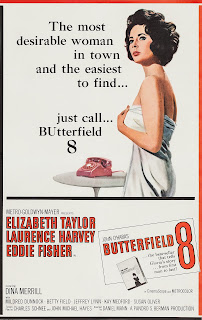


Elizabeth Taylor was truly one of the screen’s most beautiful leading ladies. If you don’t believe me, watch the first five minutes of Butterfield 8 as the camera pans over her face and sheet-draped body as she awakes in the empty posh apartment of the man with whom she spent the previous evening. Taylor was 28 then, pretty much at her glorious prime and six years before she played a boozy slightly rumpled harridan in Who’s Afraid of Virginia Woolf? for which she won her second Best Actress Oscar.


The later was shot in black and white, but Butterfield 8 was bathed in rich technicolor. Taylor won the first of her two Oscars for this film. First, a word on the title. If you were born after 1963 you don’t remember when telephones were still few enough in number that you could call an (actual) operator and ask to be connected by giving the exchange name and a number of two, as in Colony 17 or Butterfield 8. The inside joke is that Butterfield 8 was allegedly a modeling agency; it was really a high-class escort service, “escort” itself being a nod-nod-wink-wink name for hooker. Gloria Wandrous (Taylor) actually does some modeling but she’s also under psychiatric care for her active libido. It speaks volumes about American society of the day that a sexually vigorous woman would be treated for such a perceived malady.


Gloria has other issues though, including an explosive temper and drinking too much. The bed from which she arises belongs to Weston Liggett (Laurence Harvey) who leaves $250 by the bedstead before sneaking out. This leads to an outburst that is perhaps the film’s most reproduced still; when Gloria sees the money and note, she angrily takes out her lipstick and writes “No Sale” on Liggett’s elaborately framed mirror and storms off after grabbing a mink coat to cover herself. (Apparently the night before was pretty wild, as her dress was torn.)


Gloria lands in the apartment of her childhood chum Steve Carpenter (Eddie Fisher) for chaste consolation. You could say that so far Taylor was playing to type. She married eight times­–twice to Richard Burton–and Fisher was husband number four. Butterfield 8 gets much messier, as Liggett is married to Emily (Dina Merrill) whose family owns the chemical firm for which he works. Plus, Steve’s girlfriend Norma (Susan Oliver) is the proverbial nice girl who is tired of playing second fiddle to Gloria any time she commands Steve’s attention.


Steve might be the last person on the planet other than Gloria’s mother (Mildred Dunnock) who doesn’t know that Gloria is, in the parlance of the period, a tramp. The club owners know it, most of their patrons know it, Weston’s buddy Brigham (Jeffrey Lynn) knows it, and even her mother’s best friend, the snarky Francis (Betty Field) knows it. Weston, though, has become obsessed with Gloria and finds himself falling for her. Gloria dares hope that maybe Liggett can be her ticket to respectability because she's tired of being a tramp.


Butterfield 8 was based upon a John O’Hara story and is a searing tragic drama. As suggested, the values are those of an earlier time period, so expect the film to exploit thinking that today might seem head-scratching. Will Emily and Norma stand by their men? Can mama accept her daughter for who she really is rather than her willfully ignorant fantasy of her? Even the extras have issues, especially Happy (Kay Medford in a small but juicy part), an ex-vaudevillian who now operates a low-class motel that caters to surreptitious trysters.


This is an actors’ ensemble film and everyone in it is superb. Moreover, though the technicolor hues are vibrant, we view all the earmarks of film noir except the shadows. Maybe you won’t come away desirous of taking a course on psychology as understood in 1960–or maybe 1935, as O’Hara’s roman à clef was based on the unsolved murder of socialite Starr Faithfull–but I suspect you will find yourself so immersed in the film’s well drawn characters that you’ll forget to look at your calendar.


Rob Weir

2/23/22

Four Great Art Exhibits at UMass Amherst


If you’re in area, either as a resident or a traveler, this is a good time to head to the University of Massachusetts Amherst to partake of four shows. You can do them all in a morning or an afternoon and you’ll be treated to visual and thought-provoking images.


Let’s start with the show that closes soonest. The Augusta Savage Gallery is located in New Africa House and features Theater of the Streets: Social Landscapes Through the Lens of Jill Freedman. Few have done street photography as well as Freedman (1939-2019), because she was not afraid to venture into social fringes or where the action is. Though this show features shots from the late 1960s into the 1970s, many of her shots, including a police shakedown and a violent arrest, are sadly as fresh as your daily news feed. 


Gay rights became a full-fledged movement after the 1969 Stonewall Riots, but it still took courage to be out. “Greenwich Village Couple” intrigues in that its crossdressing male stares defiantly at the camera, while his more conventionally dressed partner leans away from the lens.


Freedman had a keen sense of irony. “Free Information” was taken in a seedy area of the subway and needs no further commentary from me. “Peep Show” is simply a great shot packed with humor. 


For pure artistry, though, “Poor People’s Campaign,” so named for the 1968 encampment on the Washington DC mall that took place after the assassination of the Rev. Martin Luther King. But Freedman captures something more wistful and sublime, a Black man playing his flute in a quiet place: the Reflecting Pool doing its thing as well. 


This show closes on March 11, so hurry if you want to see it.


The Hampden Gallery exhibit Shadows in the Cave presents paintings from Williamsburg, MA artist Alan Fortescue in which he takes a look at the American Dream lost, found, and frustrated. 


You will be drawn to his bold colors, many of them illuminated by after-dark street lights, before you catch on to his vision. His ethos is akin to that of Edward Hopper, whether the street is Chicago, New York, or State Street in Northampton.


This show is on view until April 15, but check the location before you head over. When I was there the Hampden Gallery had relocated to Bartlett Hall because flat-roofed Hampden Hall had sprung a major leak that necessitated moving the show.


The University Museum of Contemporary Arts in the back of the Fine Arts Center is the site for the other two shows, both of which are on view until May 1. 


The first, From My Heart to You–Dance and the Unifying Force of Social Consciousness captures the exuberance of African-American dance. The rather wordy title sounds heavier than it is. Any politics were of the cultural variety and within the two artists, not in your face.


 The first part spotlights the watercolors of Richard Yarde (1939-2011). If the backgrounds remind you of quilts, you’re right; his grandmother’s needlework inspired them. If I tried these dances, I’d be in traction! 


The second artist is photographer Barbara Morgan (1900-92) and her subject is the sublime Pearl Primus (1919-94), perhaps the foremost African-American practitioner of modern dance ever to grace the floor. Unlike white modernists such as Martha Graham, Primus was rooted in literal and metaphorical ways. Her center of gravity was low, her stance bold and wide, and she usually performed barefoot, as if she was trying to conjure the earth through the floorboards. Metaphorically, she was also grounded to her African roots. 


Both Yarde and Morgan taught at UMass from time to time, though Primus also took her substantial skills to other 5 Colleges schools.


The final show, also at the Museum of Contemporary Arts, is quite different. Nicole Eisenman: Prince has a punning title, as the Brooklyn-based Eisenman (b. 1965) has co-curated and contributed to a show featuring prints, both from the UMass collection and on loan.  When it comes to prints, Eisenman has chops and then some. She’s a RISD grad who has won such major awards as a Guggenheim Fellowship, a Carnegie Prize, and MacArthur Fellowship. 


Her work has been influenced by Expressionism, especially that of Germany, but also by sketches, cartoons, and caricature. It’s a large show that includes others in those genres. Sometimes Eisenman wears her politics on her sleeves. Take “Tea Party” for instance. We are not talking china cups and crumpets. A more direct nod to Expressionism is found in her wonderful “Man Holding His Shadow,” and haven’t you always wondered where shadows are stored? 


“Stick and Foot Guy” is influenced by block cuts and cartoons and two untitled works by cartoons crossed with nightmares. 


The show also includes works Eisenman and co-curators admire, including prints from Max Beckmann, Mabel Dwight, Edvard Munch, and many others. As a teaser, here’s one from an artist previously unknown to me: Benton Murdoch Spruance. His “The Bar at Doyles” (1939) is a delightful lampoon of male bar culture. Belly up to the bar boys. 


Rob Weir

2/21/22

Harlem Shuffle and Razorblade Tears


HARLEM SHUFFLE (2021)

By Colson Whitehead

Doubleday, 336 Pages.

★★★


RAZORBLADE TEARS (2021)

By S. A. Crosby

Flatiron Books, 326 pages.

★★★★


Here’s a tale of two books, one of which is written by Colson Whitehead, one of the great writers of our time; the other by S. A. Crosby, who is best known for gritty crime novels. In this case, though, it pays to know your genre. Both books develop strong central characters and are excellent reads, but the prize goes to Crosby for sticking with what he knows.


Whitehead’s tragic hero is Ray Carney, who he follows from 1959-64. He is an African American furniture store owner striving for respectability, though he does a bit of small-time fencing on the side. Everyone, it seems, has racket of some sort going in Harlem, so why not? Ray’s flaw lies in assuming he’s playing two equal halves against the middle, but he also assumes the halves are the same size. This puts him in a limbo in which he's too small to be the player he’d desperately like to be, but too decent to be a thug like his cousin Freddie. Harlem Shuffle is about who cons who, who has to follow the rules and who doesn’t, who has dreams and who has power, and the consequences of being on the wrong side at a given moment in time. Plot devices involve stolen jewels, dope peddling, cops on the take, the fragility of Black/White alliances, rival crime gangs, the 1964 Bedford-Stuyvesant riots, and how some cons transcend race. Can Ray survive games bigger than he? What about his marriage and his two children? Can he save Freddie?


Harlem Shuffle has echoes of Do the Right Thing and Whitehead is good on that score. He’s also superb at capturing the cusp-of-the-counterculture zeitgeist. It’s when he shifts into caper mode that the book loses steam, though even then Whitehead has his moments. Those moments are inconsistent, however, because caper crime isn’t his métier. When he goes there, he invites comparison to those who specialize in such works. Whitehead is a always better than middle of the pack, but his mistake is like Carney’s in thinking he can straddle the two halves. This makes Harlem Shuffle a good book, but not his best work. That’s another problem; when you set the bar as high as Whitehead has, we expect more than middling.


Razorblade Tears covers some of the same turf, albeit under different circumstances. Ike and Mya Randolph are grieving over Isiah [sic], their dead 27-year-old son who was murdered, along with his White husband, Derek. They are also raising their son’s daughter Arianna (via a surrogate). In this story, Ike is the man with middle-class pretensions. Though he got into trouble when younger, he now owns a landscape business and so disapproved of his son’s lifestyle that he refused to accept it. (Mya works in a hospital and embraced both young men.) Ike’s world is rocked when he finds racist and homophobic slogans sprayed on the boys’ vandalized graves.


Like it or not—and he doesn’t—Ike’s world collides with that of Buddy Lee Jenkins, Derek’s father. Ike recognizes Buddy immediately as poor White trash, plus his self-inflicted tattoos betray that Jenkins is also an ex-con. In his search for revenge Ike wants no part of Buddy and decides to go it alone. But when he finds the situation is bigger than he imagined, he and Buddy become unlikely partners who do battle with a motorcycle gang and some very, very nasty White nationalists into guns, running meth, and prepping for the coming war against people of color. Like the Ku Klux Klan, they’re not fond of gays either.


Buddy is essentially a gung-ho cowboy, but the tight-as-a-drum Ike isn’t much better. Ike doesn’t hesitate to rough-up a bunch of hipsters reluctant to say anything about Derek at the bakery where he worked or pick a fight in a gay bar. Once again families are at risk when violence comes to their respective doors.


Those squeamish about body counts probably ought to avoid this book. The biggest difference between Crosby’s approach and Whitehead’s is that, as a crime writer, neither Crosby nor his characters pull punches or hesitate to spill blood. To reiterate, Crosby is grittier than Whitehead and unafraid to wend his way to a darker ending. Crosby is, however, open to charges of trying too hard to be too contemporary by ticking PC boxes—there’s also a transgender character—but I found his straight-forward and less elegiac approach more appropriate for the genre.


Rob Weir


2/18/22

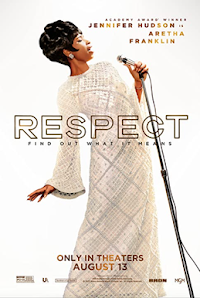
Respect an Uneven Look at Aretha Franklin


RESPECT (2021)

Directed by Liesl Tommy

United Artists, 145 minutes, PG-13

★★★


In 2009, an African American student in my class at Smith College asked me who sang “My Country t’is of Thee” at Barack Obama’s inauguration. It took me aback, but I had the presence of mind to ask her to YouTube more Aretha Franklin and read about her. Bless her heart, that’s exactly what she did and the “Queen of Soul” had a new young fan.


I tell this story because Respect is a bit like Franklin at Obama’s inauguration: a taste for those who know little about her. It won’t, however, tell them much. It lost money at the box office, but racism was not to blame. Like too many biopics in the “based upon” category, Respect tried to do too much, assumed too much, and relied too heavily on name recognition. It’s a decent movie, but ultimately a mid-pack pick.


The mature Aretha was played by Jennifer Hudson, Franklin’s own choice. As we see in the clip as the credits roll, she’s no Aretha, but who is? Hudson is about as close as it gets and deserves any kudos that come her way. The problem lies with Tracey Scott Wilson’s screenplay, which follows Franklin from 1952-72, when she recorded her best-selling record, the gospel album Amazing Grace. Twenty years isn’t a bad sweep for a biopic, but unless you know about Franklin’s life (or read up in advance), you’ll be lost in a welter of important-but-unexplained characters. For instance, at one point in the film a distraught Aretha calls upon her friend Sam.” That would be Sam Cooke (Kelvin Hair), who practically invented soul. Nor will you understand that when Aretha made Amazing Grace, “James” (Tituss Burgess) the minister comforting and accompanying her was James Cleveland, known as the “King of Gospel for reinventing the genre.


Respect is an odd film in several ways. There’s a lot about the dynamics between Aretha and her overbearing father, C. L. Franklin (Forest Whitaker), but it would have helped to state what is implied: that the Rev. Franklin was better at preaching than following the gospel. When we see Aretha pregnant at 12—and not by the man implied in the film–she was following C. L.’s footsteps; he impregnated at 12-year-old himself, plus two more before he married Barbara Siggers (Audra McDonald in a cameo), Aretha’s mother. On the positive side, the Rev. Franklin was an early civil rights activist, which is why famous people like the Rev. Martin Luther King Jr. (Gilbert Glenn Brown) hung out at C. L.’s Detroit home.


And so it goes. We get wonderful performances from Hudson, the woefully underrated Whitaker, Marlon Wayans as Franklin’s abusive first husband Ted White, Saycon Sengbloh and Hailey Kilgore as Aretha’s sisters Emma and Carolyn, Mary J. Blige as the tempestuous Dinah Washington who loves Aretha but doesn’t want her stepping on her turf, and Marc Maron as the manic music producer Jerry Wexler who made Franklin into a star.  


The last point is crucial. Aside from C. L., Wexler, and White, most of the rest of the people are there because they were in Aretha’s orbit. Alas, they are more like wallpaper than foundations. Director Lisel Tommy too often allows her film to become an African-American version of A Star is Born. Yet, she is uncertain whether she is making a film for the cognoscenti or the newbies. The first, of course, already know Aretha was the Queen of Soul; the second–the bulk of ticket-buyers these days–don’t get enough information to know much more than Aretha switched from a small market gospel singer to a chartbuster when Wexler sent her to Muscle Shoals to record with a bunch of White backcountry good ole boys. (They were far more than that!)  Add lots of music–superbly done by Ms. Hudson–and we get a very long film that’s also part musical documentary.


Put another way, Respect is a trifurcated film, part psychological drama, part Star is Born, and part cover album. It’s too bad, because the acting is really topnotch. Forest Whitaker should have gotten a Best Supporting Actor Oscar nod and Hudson should be singing the film’s title song, but Respect will be absent from the Oscars. Mid-pack films don’t generally get a lot of love when it comes to major awards. You can give it some, but educate yourself in advance.


Rob Weir


2/16/22

Hue and Cry at the Clark: What is Art?


HUE AND CRY:

            FRENCH PRINTMAKING AND THE DEBATE OVER COLORS

Clark Art Institute

Williamstown, MA

Through March 6

{Click on any image for bigger size/better color} 


The venerable Clark is far better known for its collection of iconic paintings than for printmaking, but Hue and Cry might make you reconsider your preconception. While you’re at it, rethink how you consider posters and other (potentially) reproducible works. These are so much part of both the consumer and art worlds of today that many people don’t know that there was once fierce debate over whether they were “art” at all.


Most of us have gotten past snobbish debates over taste, but the exhibit at the Clark does two things: It reminds us that the very use of color was once a battleground and it shows that printmaking is more complex than most of us imagine. The Clark show focuses on the French Belle Époque (1890s), though it also explores earlier printmaking as it developed following the French Revolution. A few terms are useful. Relief is perhaps the best known. Anything can be used, but wood is commonplace. An image is carved onto the wood, inked, and printed. Intaglio (including etchings, engravings, and mezzotints) starts with a plate of some sort (often metal) and the image is scored. The ink is applied and the plate transferred to a press. How the ink is applied leads to a whole bunch of other designations but I’ll spare you those except for the marvelous A la poupée, which means that the various colors are meticulously daubed onto the plate with wads. Various types of planographic images, which use prepared surfaces (like stone, which is a lithograph) and a clever process in which the image is made with something greasy (special pencil, crayon, etc.) and chemically sealed. The ink adheres to the surfaces, but not the grease. 


Debucourt    


Here are some images from the show. One of the earliest is Philibert Louis Debucourt’s Dance Mania (1809) from the Napoleonic Era that parodies upper crust culture. It’s made by the poupée process discussed above. It might not fit your view of art, but it’s a great satire and reminiscent of the sort of cartoon England’s William Hogarth did a century earlier but made into prints. Printmaking got more serious when Impressionists such as Camille Pissarro got into the act. It’s not the most stunning image in the show, but there’s a small crayon sketch of his Peasant Women Weeding the Grass (1894) with his instructions of how to apply colors. 


If a name pops out more than any other it that of Henri de Toulouse-Lautrec. He perfectly captured the Belle Époque in all of its energy, cultural rebellion, and decadence. Among my favorites are Box in the Grand Tier (1897) and The Englishman at the Moulin Rouge (1892). If you’re wondering why said Englishman is in grey, it’s because he’s trying to pick up one or both of the actresses in the assumption that they were also prostitutes. (He probably wasn’t wrong!) Critics wondered why some of Lautrec's reds were so lurid and why his perspectives were skewed. Note how he used furniture as framing devices. But what really set their teeth on edge is what we see in the billboard below and the poster for Vin Mariani: Lautrec was unabashedly commercial in many of his commissions. This shocked those who felt that art should somehow be above crass things. 


That’s as if artists weren’t flogging their wares in other ways. Paul Cézanne reproduced his famed The Bathers (1897) in lithographs for mass consumption and again invited debate over whether it was actually “art.” One wonders what they made of Émile Bernard, who rendered his Saint Mary Mother of God with a Lily (1895) as if it were something from the Middle Ages. 


And then there were Les Nabis, who sought to move beyond Impressionism, which was by then old hat. They were something of a bridge between the Impressionists and the Modernists, as we see in these image from Édouard Vuillard and Pierre Bonnard. Whether or not you like Bonnard’s Little Laundress (1896), his minimalist approach tells you all you need to know about the scene. It’s intriguing to think that Picasso was 15 when Bonnard’s images were en vogue, so you can imagine what next loomed on the horizon. And, of course, critics weren’t immediately impressed. Tell that to the collector who recently paid $106.5 million for one of Pablo’s works! 


Rob Weir

2/14/22

Jack Barksdale February Artist of the Month


Jack Barksdale

Death of a Hummingbird


Your first impression of Death of a Hummingbird might be that the vocals sound very young. You’re right, but you might want to cut some slack; Jack Barksdale is young–as in all of 14 now and just 13 when he made this record. Now listen to the instrumentals and you’ll wonder who the older dude is playing in the background. That’s also Barksdale. Now you’ll wonder how in the blazes a kid that young has fingers that old. Yep, this youngster from Fort Worth, Texas, is the proverbial child prodigy–and an enigmatic one at that.


One of the great debates about human beings is whether we are products of nature or nurture. Insofar as Barksdale is concerned, he’s almost entirely a force of nature. His father Brent says he can’t sing a note, has never played an instrument, and listened to a lot of Nirvana and Leonard Cohen when Jack was even younger–not exactly fodder for a repertoire that leans heavily upon blues and country with a just a tiny bit of Cohen around the edges. His mother Clara may have influenced him some by playing Nancy Griffith and Lucinda Williams records, but neither she nor Brent had the slightest idea until several years later that Jack had been writing original songs since he was seven. Ask Jack and he’ll tell you that his influences (besides Cohen) were Johnny Cash, Guy Clark, Lead Belly, Willie Nelson, and Townes Van Zandt. And he’s not just name-dropping. 


It's weird enough hearing blues from a pre-pubescent voice, or see Barksdale sharing stage swith grizzled vets, but it’s stunning to hear him go down the fretboard on guitar (acoustic, electric, slide), ukulele, and mandolin; blow out soulful notes on the harmonica; and tickle the old (non-) ivories on keyboards. Plus, I don’t know about you, but when I was 13, I would have had a lot of trouble fitting phrases like “translucently moving through time,” “blinded by the clouds,” “keep the spider fed,” “gypsy day dreams,” or “raindrops soaking my moral stances” into any kind of intelligible sentence, let alone fitting them into a song. And I’m 100% certain I couldn’t have written a song about young love like “Death of a Hummingbird.” (At 13, I wasn’t even looking for it!)


I’ll confess that I’m not a big fan of kids’ voices but man, can this youngster play! I can already imagine him a few years from now singing in deeper tones, and it’s almost scary to consider how much better he’ll be as an instrumentalist. “Sideways” feels like a novelty song at present. Now picture it with a voice that can add some spit and gravel and it becomes a Barksdale staple for years to come. He also delves into spooky gospel-influenced blues (“Revival Song No. 3”), sizzles the strings on “Bugle Boy Blues,” and I can only wonder where he came up with blues like “World Full of Nothing” and “Man in the Ground” My cowboy hat’s off to Barksdale for even having the guts to put blues like those on an album. I mean, sheesh, he’s not old enough to have that many blues.


Here he is on slide. Wait until he grow into those cowboy boots!  


 Rob Weir


2/11/22

Topsy-Turvy for Gilbert & Sullivan Fans

TOPSY-TURVY  (1999)

Directed by Mike Leigh

Pathé Films, 160 minutes, R (For brothel nudity, but I wasn’t corrupted)

★★★


When I was in junior high school, I made my only stage appearance in a production of H.M.S. Pinafore. I had pretty much forgotten about my short and inglorious acting career until recently seeing Topsy-Turvy, a look at the famed collaboration between librettist W(iliam) S(chwenck) Gilbert (Jim Broadbent) and composer Arthur Sullivan (Allan Corduner).


Most people either love Gilbert and Sullivan operettas or find them as embarrassing as soiled trousers. I’m in neither camp; in moderation I’m mildly amused, though I quickly OD on them. I was surprised when I first read that Mike Leigh directed this comic drama. Leigh is an unreconstructed lefty advocate of dumping the British monarchy and is more at home behind the camera of gritty working-class political dramas. It is its own testament to the enduring fame of Gilbert and Sullivan that he would indulge in such bourgeois pleasures.


"Topsy-turvy" is an archaic expression that means disorderly and upside down. That was the hallmark of Gilbert librettos that disrupted social convention. He was so famed for this that he appropriated topsy-turvy as a self-descriptor. Like any stratagem, though, overuse can turn a sockdolager into a pair of smelly gym socks. That’s the dilemma facing Gilbert and Sullivan in the film. Theirs was a wildly successful partnership, though they couldn’t stand each other and lived in different worlds. Gilbert was careless with money and often irreverent but he was also stubborn, impatient, and had an annoying talent for hearing only what he wished to hear. By contrast, Sullivan was a playboy, had aristocratic pretensions, wanted to write critically-acclaimed compositions, and dearly desired to see the back of Gilbert.


He almost got his shot. The duo is tapped out and revivals of past works are closing faster than a front door on a proselytizer. Even their actors are reaching the end of their respective ropes. You could run through a lot of pages of the Diagnostic and Statistical Manual of Mental Disorders with a cast like the insecure Richard Temple (Timothy Spall), backstabber Rutland Barrington (Vincent Franklin), and tipsy Leonora Braham (Shirley Henderson). Both men are running out of patience talking someone down from a tantrum-du-jour or dealing with Savoy Theatre owner Richard D’Oyly Carte (Ron Cook) who cares only about putting fannies in the seats. Gilbert is nobody’s Mr. Sensitive and Sullivan has decided it's time to make critics realize he’s a musical genius.


Sullivan’s problem is that he’s not nearly as good at the highbrow stuff as with the low. For his part, Gilbert needs money, pays scant attention to Sullivan’s alternative plans, and wants Arthur to listen to his latest bit of topsy-turvy. That might have gone better had he not filled it with rehashed devices that made it cliché upon cliché. In short, Sullivan needs a dose of reality and if Gilbert wants to draw another salary, he needs something fresher than limp celery. Fortunately, a London exhibition of Japanese arts and crafts unleashes new creative energies. The Mikado opened in 1885 and proved to be their biggest hit (672 performances), even though it did crib from The Sorcerer (1877). Gilbert and Sullivan launched five more productions before Gilbert retired in 1897.  


Leigh's film is a bit of topsy-turvy in that he assumed audiences brought foreknowledge to the movie theater. If you don’t, you may find it tough going until you get a handle on personalities and circumstances. (They already had nine co-productions under their belts when the film picks up the story.) It’s also one of those movies in which considerable scenery is chewed by everyone on the screen. For me, Broadbent’s performance stands out, as do those from Spall, Eleanor David as Sullivan’s mistress, and Andy Serkis as fey choreographer John D’Auban. I can always do without the grating Shirley Henderson and 22 years on, some may find The Mikado culturally offensive.


It is, however, a visual treat whose critical awards came mostly for costuming, makeup, and art direction. In a sense, it’s like a Gilbert and Sullivan production in that it’s fun in places but inconsequential as a whole. But maybe I’m just bitter that agents didn’t call after my stint in H.M.S. Pinafore.


Rob Weir