4/1/22

Criss Cross: Who's in the Cross Hairs?


CRISS CROSS (1949)

Directed by Robert Siodmak

Universal Pictures, 88 minutes, Not-rated

★★★
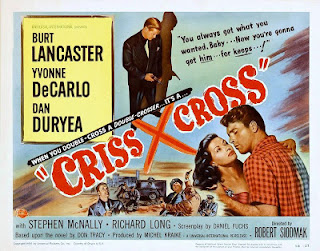


Criss Cross is film noir with a lead that many people forget made such films: Burt Lancaster. It’s easy to fathom why, as in both atmospheric noir and big budget films Lancaster played what we might call a semi-tough guy; that is, one with the brawn to muscle up in bad situations, but reluctant to do so because at heart he’s a doofus.


Lancaster is Steve Thompson, a down-on-his-luck guy who is trying to get over his ex-wife Anna (Yvonne De Carlo) and takes a job driving an armored truck. When Anna comes back into his orbit, that doesn’t do much for his mental health, though it’s physical health that’s in the most-immediate danger. It’s seldom good to dally with an ex-wife, especially when she has remarried, and extra especially if her new husband is a mobster. It’s also not the best of ideas to unwittingly involve family members in harebrained schemes.


 Anna, though, is Steve’s Achille’s heel. His rational brain thinks she’s an unreliable tramp, but he’s obsessed and can’t bear the idea of her being with another man. Things become muddy when he begins to encounter her in a cocktail lounge. One thing leads to another and Anna tells Steve she wants him, not new hubby Slim Dundee (Dan Duryea). That should be the sort of red flag you don’t want to wave in front of a bull, but that would require reason-over-passion thinking. Unluckily for Steve, he’s more bullheaded than an actual bovine.


As the film’s title suggests, this is a saga of double crosses in which it’s never quite certain who is playing who. DeCarlo is a femme fatale, but who’s side is she on? Detective Lt. Pete Ramirez (Stephen McNally) tries to keep Steve on the straight and narrow, but who are you going to believe, a copper or your hormones? Is Anna legit? What about her mobster husband? Is anyone going to get what they want? Can Steve play the part of a hero?


As I remind viewers of film noir from time to time, under the old Hollywood Code criminals were not allowed to prosper. Criss Cross intrigues partly because we are kept on our toes trying to figure out who all of the criminals might be and if any of them can go straight before it’s too late. A caper is involved and if you reckon things won’t go according to plan, you are correct. Again, though, Criss Cross is well enough constructed that we don’t know who gets over and who doesn’t until the last siren.


Lancaster is very good as a man consumed by smoldering rage. He’s like the proverbial trope of the guy with an angel on one shoulder and a demon on the other. Lancaster winds Steve so tightly that we never know if he’s going to throw a punch or simply slam down his drink and walk away. De Carlo’s Hollywood breakthrough came when she played the seductress Salome and, in many respects, she continued to present as a latter-day vamp until she aged out of the role. (Some might recall her as Lily in the campy TV show The Munsters.) In Criss Cross she echoes Salome in that she’s a woman who knows what she wants, even if those around her are uncertain about what that might be. Dan Duryea always makes a good heavy. In this one he is one part weasel and one part sharp-eyed hawk.


Aside from the score by Miklós Rózsa–one of classic Hollywood’s finest composer/arrangers–Criss Cross won’t dazzle you with its production values. Of course, most film noirs are essentially character studies and this one pivots around three superb actors. Each is dipped in cynicism. The thing about a crisscross is that a target forms where the lines intersect. You need to watch to see if anyone ducks a bullet.


Rob Weir


3/30/22

MLB's Blown Circuits


Tomorrow was supposed to be Opening Day of the Major League Baseball (MLB) season, but the impasse between owners and the players’ union (MLBPA)  delayed matters. It’s fashionable to blame owners, but if it’s ever appropriate to call down a curse on both houses, this is it. MLB is badly broken but all that happened is that two fat boys argued over who gets the biggest slice of pie.


I’m not sad the season won’t open on March 31. Baseball makes zero sense any place north of Atlanta until mid-April. I’m in favor of getting rid of gimmicky interleague play—especially now that there will be a designated hitter in the National League—and returning to a 154-game season. Here are some other things that need to be abandoned or altered.


1. No to seven-inning doubleheaders. MLB isn’t Little League.


2. Absolutely no to beginning extra inning games with a runner on second. What next, a homerun derby analogous to hockey’s ridiculous shootout? Or maybe like soccer’s corner kicks, the winner is the team that strikes out the least? Ugh!


3. No to expanded numbers of playoff teams. MLB should not emulate hockey’s every kid gets a gold star except for the intellectually challenged (who get high draft picks). In 1954, the Yankees won 103 games and didn’t even make the World Series (no playoffs then) because Cleveland won 111. That’s the way it should be. There are more teams today, so I’m okay with one playoff round, but it should be between the four teams in each league with the best winning percentage, even if that means a division winner is left out in the cold.


4. Raise player minimum salaries, but rework the arbitration system. It’s no such thing. Players get automatic raises no matter how lousy they’ve played. Wouldn’t you like to be Gary Sanchez and get a raise to $8 million for hitting .204 and being such a horrible backstop that you couldn’t catch a one-legged dog with a trawling net? I'm happy the Yankees shuttled him off to Minnesota.


5. Eliminate service time contracts. If a player stinks, he can be sent to the minors at any time, with the team on the hook only for the money stipulated in the contract. If some young player comes along and takes his job, the team should have the option of releasing the player to any team willing to pick up the remainder of his contract. I’m sick of non-talents clogging up rosters because of guaranteed MLB slots. Eliminating automatic roster spots would do more to help young players than anything the MLBPA proposed.

6. Eliminate the team salary cap and institute a salary floor. The cap is based on the false premise that it helps “small-market” teams. Nonsense! Only billionaires own MLB teams, but too many of them are tightwads. A salary floor would do more to force those teams to be competitive than penalizing large-market teams and putting the money into the pockets of those who don’t improve their teams. MLB practices trickle-down economics, the biggest load of hooey in the history of economic theory.

      The cap is also dumb in the respect that it puts large-city teams at a disadvantage. Has MLB ever heard of cost-of-living? I’m not crying Argentina for overpaid MLB stars, but if someone is going to write you a big check to play baseball, it sure will go a lot further in Kansas City than in New York, LA, or Boston, where a month’s rent would buy you a block of KC or Milwaukee.


7. Reinstitute the old strike zone (breastbone to top of the knees) to reduce walks. It would also get hitters to stop swinging for the fences on pitcher-friendly counts and might actually lead to more balls in play. My goodness, it might even bring back drag bunts, stolen bases, and the hit-and-run.

       Baseball has become really dull–almost as boring as football, where the ball is in play an average of just 11 minutes. (The rest of the time is swaggering quarterbacks barking numbers like little boys playing army, or patting each other on the butt so often that Freudian folklorist Alan Dundes once claimed that football is a closeted homosexual ritual.) For the record, both NFL and MLB games take the same amount of time to play, but MLB actually has about 7 minutes more action.


8. Ban analytics and hire scouts. I stop reading any article that plunges into Rosicrucian-like sabermetrics. These people are fraudulent number-crunchers with no love of sports and have made baseball roughly as interesting as reading actuarial tables. It would be one thing if they produced results, but they don’t. The much-hyped Moneyball followed the Oakland As 2002 season. In the past 20 years, Oakland has missed the playoffs 11 times and hasn’t been to the World Series since 1990, 12 years before sabermetrics hijacked MLB. Analytics cannot predict the vicissitudes of an MLB season (injuries, off years, Covid, trades, poor field conditions, mistakes, etc.). They can’t even assure that teams will be competitive.

       It takes good baseball minds to find and sign talent outside of the draft. The latter is hope and hype over experience; just 32% of drafted players ever make the majors.


9. Subtraction is addition. There are simply too many teams to produce exciting races. That’s to be expected when there are players who should not be in MLB in the first place. Instead of expansion, contraction with a dispersal draft is in order. These things should be done:

·      The Rays should be moved from Tampa to Montreal.

·      Miami should lose its franchise, as should Oakland. Arizona, Cleveland, Detroit, and Pittsburgh should be put on notice to improve their teams and attendance or they too will be slated for contraction. Two 12-team divisions would spotlight much better baseball.


10. Rod Manfred should be fired and the new commissioner should be independent of owners.


11. I’m in favor of one kind of salary cap: an upper limit on star contracts. Twenty-five million per is enough for anyone and would dissuade agent-induced team-jumping. It would also relieve franchises of the bind of needing 22 stiffs to pay for two great players.


12. Ticket prices should be slashed by 20% across the board. It would cost you at least $500 for a seat behind home plate at Yankee Stadium and the average cost for four people to attend one MLB game (with cheap seats factored in) is a whopping $253. It’s way more in Boston, the most expensive place to see a live game. For heaven's sake, this is the age of MLB.com and cable. I’m shocked anyone pays this kind of coin to sit in nosebleed discomfort when they can see a game better in the comfort of their home.

     Play more day games with further reduced ticket prices so the kids come back to baseball. If they don’t, start writing MLB’s epitaph.


Rob Weir


3/28/22

Oscars 2022: Do We Really Care?

Oscars 2022


This is the time of the year in which fellow movie fans ask me what I thought of the Oscars. Answer: I didn’t think about them and wasn’t tempted to watch. I’m only surprised when Oscars go to the right people because Oscars are mostly about Hollywood. Its exalted view of itself notwithstanding, Hollywood simply doesn’t matter anymore unless your idea of a good movie is a trip to the mall to sit in soda-splattered stickiness with a 100-decibel soundtrack pounding in your ears.


Everything I know about the Oscars came from my morning news feed. There is no point in watching hours of gushing over movies we’ve never seen and probably never will. I have no opinion about Best Documentary, Short Film, or Short Subject. Didn’t see any of them. I didn’t even see the animation this year. Were I redoing the Oscars, these awards would go with the clips of the technical awards that are shown as a two-minute highlight reel. Add the Best Original Song to that too. Please! There’s only so much schmaltz the human soul can endure.


I couldn’t care less about Hollywood’s self-proclaimed celebrities cavorting on the red carpet. The men all look like maître-des at cheesy restaurants and the women wear gravity-defying dresses that suggest a busload of Vegas showgirls took a wrong turn. No one wears this stuff in real life, nor could they; it would require a fortune in double-sided tape, wire, and polyester. Not to mention a bail bondsman to cover the public obscenity charges.


I only saw a clip, but does anyone else smell “stunt” regarding the Will Smith slap of Chris Rock? If it’s not a stunt, Chris Rock ought to be talking to lawyers.


Let me skip to the awards people do care about. I’ll start by saying that I thought CODA was a sweet and enjoyable film. Still, it is not the Best Picture. It’s not the joke Rocky was back in 1977 when it defeated Network and Taxi Driver, but there is an analogy. Is Rocky taught in film classes? Of course not! Is Taxi Driver? If not, drop that class, kiddos, because the prof is off the rails. Don’t think for a second that Martin Scorsese’s 2007 Best Director award for The Departed is because it really was his best effort. He won because in retrospect he was jobbed when he didn’t win for Taxi Driver, Raging Bull, or The Last Temptation of Christ. 


This brings me to this year’s outrage. I don’t care who thinks it was too long or off-putting, The Power of the Dog is so superior to any other film that it’s hard to imagine Academy members have a collective brain between them. I do not exaggerate when I say it’s a contender for the best film of the 21st century thus far. Why didn’t it win? Well New Zealand director Jane Campion did, but her film also uncomfortably challenged American mythology about cowboy culture, a phenomenon in which Americans believe though most of it never happened.


Since I’m on my bucking high bronco, how can anyone take the Oscars seriously when a film like The Power of the Dog wins one award and Dune wins five and The Eyes of Tammy Faye wins two? Dune isn’t awful, but it’s not very good either; The Eyes of Tammy Faye is, however, as trashy as its subjects, Jim and Tammy Faye Bakker. I think Jessica Chastain is a decent actress, but to give her a statue for this is like saying “Nice shoes!” to Bozo the Clown.


Now for the flat-out dumb. Dune for cinematography? That’s risible. Visual Effects, sure, but you can take any 30-seconds of The Power of the Dog and it’s more majestic and artistic than all of Dune. All Ari Wegner did in Power of the Dog is make you think New Zealand’s South Island is Montana in 1925. Gaze upon the fading wooden mansion with the hills and mountains of Otago as a backdrop and tell me Dune had better cinematography. I know good therapists. You can be helped.


Let me flame Dune one more time. I thought we were done with overblown Star Wars-like scores. John Williams has apparently passed his histrionic baton to Hans Zimmer. A great score enhances a film by setting moods unobtrusively; if you notice the score, it’s inappropriate. You often only appreciate quality work in retrospect, not because your ears hurt as you watch. Jonny Greenwood should have won for Power of the Dog.


If you’re wondering if anything met with my approval, the answer is yes. Jane Campion absolutely deserved to win, though I still think Best Director and Best Picture should be one award. (Does a Best Picture direct itself?) Tony Kotsur was terrific in CODA and I was delighted he won in what will likely be the role of a lifetime. Carpe diem, Tony! I’m okay with a Visual Effects win for Dune, which is all it should have gotten. Kenneth Branagh was deserving of Best Original Screenplay for Belfast.


The rest? I can’t say much. I’ve not yet seen West Side Story, King Richard, Licorice Pizza, or Drive My Car, which are on my list. Not much of the rest holds any interest. I saw The Lost Daughter and found it creepy in a bad way; Parallel Mothers? Almodóvar is Spanish for Woody Allen.


Rob Weir


March 2022 Reviews: David Franz ELDR Roger Friedman Myles Travitz DLU


David Franz is a Berklee School of Music grad, but he’s a California dude and it’s from there that he makes and produces music. His own material plumbs electric traditions such as blues, blue-eyed soul, desert rock, and psychedelia. “Baby Please” is pleading electric blues: Baby, baby please/Don’t let me miss out on your mystery. Call it the semi-optimistic bookend to “For My Own Health,” which is a growling Bad Boy admission: I’m beginning to think my optimism is a disease. That would be about right for the desperado into whose skin he crawls. “The Unknown” is written as a self-explanatory confessional with a soulful tune faintly reminiscent of the Classic IV’s hit “Spooky.” Franz impressively switches hats. “Nothing Is Meant to Last” has the sonic explorations of an acid rock jam band. Like “Tree Pose,” the vocals are subsumed in the mix, though the latter is hardly for the yoga crowd with its dramatic swoops that intentionally veer toward a retro early 60s film score direction. Franz is an impressive hombre and apparently others agree. Some of the guests on his tracks have connections to acts such as John Mayer, Supertramp, Sting, and Wilco.


Jameson Elder and his wife Hannah Rae are your classic cute couple. As ELDR they’ve released their debut recording My Love Looks Good on You. The title track is typical of their straight-ahead folk approach to the love songs that dominate the collection. It’s a pledge of eternal bonds: One day our bones won’t hold the weight they used to/The lines around our eyes will start to show through/But the words I’ve always spoken will still ring through/My love looks good on you. This is duo music in the truest sense in that they trade lead lines. Rae’s voice is higher than my usual taste, but she balances with Elder’s voice, which has more bottom. Most of the songs spotlight acoustic guitar, but Elder also plays electric, bass, keys, and synth. “Coming Undone” is about how love’s sudden blossom is an undoing if ever there was one. My favorite track, though, is “Safe with You,” for its catchier melody and cadence. At some point their repertoire will need more variety, but this will do just fine for now. ★★★ ½


Roger Street Friedman hangs out in Nashville these days, a place not known for subtlety. It helps, though, if you get Larry Campbell to co-produce an EP like Come What May. Instead of the glitz of the bright lights, Friedman retreated to his home studio to make a homespun record. It’s spare, but not barebones; Friedman accompanies his voice with mandolin, squeeze boxes, harmonium, and acoustic, baritone, and electric guitars, plus he invites some friends to join in. Musicians have tons of on-the-road songs, but Come What May is about love, healing, and coming home. The other original is cut from a different cloth. “Big Truth” is about Big Lies, the ultimate fake news: I see your color rise as you growl and rage/When history chooses sides you’ll go down in flames/You say that 2 plus 2 make 3/When big lies spread like a virus through the air/Big truth cures the disease. You might recognize Teresa Williams and Lucy Kaplansky adding harmonies. He also covers Bruce Hornsby’s “Mandolin Rain” and Shawn Colvin’s “Cry Like an Angel.” Each is quieter than the original. What I really like about Friedman is that he stays within himself. He has a strong voice, but knows when to add power, when to tamp things down, and when a little bit–like the dab of falsetto in his Colvin take–is enough.  ★★★★


I couldn’t help contrast Mother Moon, an EP from North Carolina native Myles Travitz with Friedman’s lighter touch. Travitz used to produce electronic dance music and counts among his musical heroes Mumford & Sons, The Lumineers, Cold Play, and Billy Joel. Those are not necessarily compatible influences. The Billy Joel connection comes when Travitz puts down his guitar and sits down at the piano. You’ll hear his keyboard in “Glow” and again on the title track, on which he also mans an acoustic guitar. I liked Travitz, but I think maybe his heart is still more Cold Play than Mumford & Sons. Travitz has a big voice, but at times it’s too big for the song. “Mockingbird” doesn’t need a Cold Play arena rock voice to carry it, whereas it works really well on “To Happiness,” on which really does rock. More control would give his quieter songs far more impact than belting them out. ★★★


I wanted to love Moch from the Scottish sextet DLÙ (Dawning). Moch lives up to its Gaelic term for a tight weave, but the music is all over the place–in good ways and bad. The heart of the band is fiddler Moilidh NicGriogair and accordion artist Zach Ronan, but the two tracks that most impress come from guest vocalist Joseph McCluskey: “Ràcan” and “Bràighe Loch lall.” These are more traditional and less tarted up with attempts to sound hip. The plucked fiddle strings evocative of a ukulele of “Am Politician” (the name of a pub) give way to accordion, but does a café-style tune need a full drum kit and electric guitar or detract from it? The latter, IMHO. In like fashion, the fiddle and guitars of “Anthem” are like oil and water in that the strings set a misty tone and Aidan Spiers’ wah-wah and Jack Dorrian’s bass pull it in a cacophonous direction. “Donalda’s” is upbeat and fun, but again there is more going on than needed and it makes the tune feel cramped. Don’t get me started on the disco opening of “Blue Reef;” it’s the wrong mood for what is at heart an introspective composition. "Moch" is another that’s bifurcated. It steers us through melancholy seas but plunges us into because-we-can rough waters, then sets us adrift with a pounding beat and sprayed accordion notes before docking with another loud passage that’s on-melody but out-of-synch with the overall composition. There is talent here, but right now DLÙ is too much of a young-folks-mucking-about band. Unplug, hand Spiers an acoustic axe, Gossart a goatskin, and build tunes to last, not hopped up for hipsters. ★★


Rob Weir


3/25/22

Beautiful World Where Are You a Mess


BEAUTIFUL WORLD WHERE ARE YOU? (2021)

By Sally Rooney

Farrar, Straus, and Giroux, 352 pages.

★★


If you have trouble with novels about people in their 30s who are trapped in perpetual adolescence, avoid Beautiful World Where are You? As you will probably infer from the title, this book centers on people in search of something. What, exactly, is the question.


Its major character is Alice Kelleher, another in the (too long) line of fictional characters who have written their way to renown and financial security. Yeah, like that like happens to so, so many novelists. Not! Alice had a breakdown (of a barely explained sort) a few years earlier and she’s still a bit loopy. She goes on a blind date with Felix Brady and by all accounts, it’s a bust. So, naturally, they will end up going on more, she will take him on one of her book tours, and they still don’t like each other very much, though Alice enjoys having sex with Felix. It makes as much sense as Alice’s best friend Eileen Lydon, who decides to sleep with the hunky Simon Costigan, a really nice guy though he’s more like a big brother and has a steady girlfriend. Not creepy enough for you? It seems as if the entire circle of people in Alice’s circle are bonking each other, though nothing seems to last longer than it takes to change the sheets. They are all competent in using technology and assuming affected hipness, but they are clueless about adulting or long-term relationships.


Alice doesn’t even do tech or hip; all she knows is books. So of course, she keeps sleeping with bad boy Felix, an inarticulate warehouse worker with debts, a taste for drugs and booze, and an abiding hatred for his brother. Simon is religious; Eileen is a drama queen and editorial assistant who knows a lot about art, but is seeking a “central principle.” She loves Simon but fears getting deeply involved with him because what if (gasp!) they got together and then broke up? Then he’d not be in her life. Duh!


There are more serious themes yearning to break out, if you call comments on celebrity culture weighty. Or an attempt to piggyback on the Covid pandemic. Alice writes, “It makes me wonder whether celebrity culture has sort of metastasized to fill the emptiness left by religion. Like a malignant growth where the sacred used to be.” To be hip about that question, isn’t the answer obvi? But wait, there’s more. There is the question of whether having a baby is the right thing to do in a world threatened by Covid and climate change. I don’t know, but shouldn’t one actually pay some attention to maturing before even making such queries?


The title comes from both a poem by Friedrich Schiller and a biennial art exhibition Rooney attended in Liverpool. Schiller’s poem was titled “The Gods of Greece” and is a lament for the loss of paganism, the coldness of Christianity, and nature’s lost magic. I’m not sure how this fits in Rooney’s novel. I suppose the biennial factors into Eileen’s love of art. At heart, though, there aren’t many true-sounding chords struck in Beautiful World Where are You?


 Ireland’s Rooney has been lucky; at 31 she actually has won a bit of acclaim. I liked her 2018 novel Normal People, but my view of Beautiful World is that it’s a freaking mess. Get back to me with these characters when they’ve got something to say.


Rob Weir


3/23/22

Black Angel Reconsidered


BLACK ANGEL (1946)

Directed by Roy William Neil

Universal Pictures, 81 minutes, Not Rated.

★★★  


Black Angel has long been considered a second-tier film noir, though lately its reputation has trended upward to the point that it’s now viewed as underappreciated. Watching it now suggests that both views are valid.


It’s one of those did-he-or-didn’t-he movies that will leave you guessing until the end. Catherine Bennett (June Vincent) is married to Kirk (John Phillips), a two-timer who is being blackmailed by his blonde bombshell lover, nightclub singer Mavis Marlowe (Constance Dowling), Things go considerably more than wrong when Marlowe is murdered in her swank apartment and Kirk is arrested for the slaying. The evidence is airtight, but although Catharine knows that her hubby done her wrong (as thugs might say) she doesn’t believe he’s capable of homicide. If she doesn’t prove that, Kirk will fry in the electric chair.


So, who else would you enlist to help you find the “real” killer other than Mavis’s ex-husband, a broken-down alcoholic pianist? That’s where Martin Blair (Dan Duryea) comes into play. He’s cynical about most things, but he has a soft spot for a sob story. Or is it the shapeliness of Catherine’s legs and her décolletage? The cops have Kirk dead to rights, though, and Captain Flood (Broderick Crawford) pooh-poohs Catherine’s insistence of his innocence. The more Martin and Catharine investigate, the more she is convinced that the real murderer is a guy named Marko (Peter Lorre), a former sleazy thug who now poses as a legitimate nightclub owner. Martin doesn’t like sticking his neck out for anybody, but he doesn’t have much to lose and the more time he spends with Catharine the more he finds himself falling for her. What ensues is a cat-and-mouse story that hinges on a brooch. 


There’s a lot to like here. Both Vincent and Dowling were knockouts, both of whom were also successful models. Then we have two guys born for the roles they played. Crawford as a flatfoot? The man made his living playing one and he was always convincing in doing so. Of course, there’s Peter Lorre, who is like a ferret come to life and seemingly as furtive as one. (Would you trust Peter Lorre?) Duryea is also superb. He was a malleable actor who could played a world-weary loser as he does in this film, a chiseler, a cowboy, or a romantic lead. He was also a very talented dancer.


Then we get to the head-scratching stuff. If you were trying to prove that a wise guy was guilty of a murder, how would you go about investigating him? Why you’d form a lounge act, naturally. Martin can tickle the ivories and it turns out that Catharine can pass as a sultry torch singer. Now all she has to do is get the act booked at Marko’s club, catch Marko’s eye, gain his confidence, and find some evidence without being fingered herself. She also has an odd motive for all of this. We can sympathize with her desire not to see an innocent man die–if indeed Kirk is innocent–but what’s with her professions of love for the man who jilted her? At some point, we wonder also why Martin continues his dangerous subterfuge. Maybe he does like the cut of Catharine’s jib, but all Martin can really foresee is the likelihood that he’ll be left in the lurch if Kirk is sprung. All indications are that Catharine will take the big lug back.


Sometimes one looks at an 81-minute film and proclaims it taut. In this case, more background into the evolving relationship between Catharine and Martin would help the ending make more sense. Nonetheless, Black Angel is often stylish and it holds together okay, even if not brilliantly so. Call it a B level noir that with a little extra credit could rise to a B+.


Rob Weir

3/21/22

Farmageddon in Bad Need of a Script Doctor


A SHAUN THE SHEEP MOVIE: FARMAGEDDON (2019)

Directed by Richard Phelan and Will Becher

StudioCanal and Netflix, 87 minutes, G

★★


I am a fan of both Nick Park and Shaun the Sheep. Alas, Farmageddon is more of a waste of clay than another Wallace and Gromit. As most know, Park’s Aardman Animations creations are done with molded figures that are meticulously manipulated through stop-motion placements. These cast the illusion of continuous motion akin to the hand-drawn individual cells in classic animated films.


Farmageddon has moments of inspired silliness, but this Shaun the Sheep feature will remind you of saccharine Disney/Pixar collaborations. It doesn’t help that it features an alien that looks like a cross between a rabbit and Maggie Simpson.


Plot is generally incidental in an Aardman movie. This one is no exception, though one wonders if Farmageddon would have been sharper had Park directed it rather than Richard Phelan and Will Becher. Shaun and his fellow sheep are hungry and bored, but are constantly on their guard, as farm dog Bitzer runs the grounds like a Marine drill sergeant on behalf of his master, Farmer John. Shaun, being a clever sheep, decides to order pizza, Bitzer confiscates it, but the boxes are empty. We learn that the culprit is Lu-La, an alien who has crash-landed in a field near the village center, has cloaked the ship, and is ravenously hungry. Lu-La has no idea where it is, but has a few powers to aid in being furtive, including the ability to imitate sounds. (There is no actual talking in the film; adults make gibberish sounds like adults in Peanuts creations.) Lu-La’s ramblings will eventually take him to Farmer John’s place, where Shaun befriends the visitor after both get involved in mayhem.


Farmer John thinks all the scuttlebutt about aliens is nonsense, but he senses a way to make a few pounds–this is a British production, dahlings–and constructs a cheesy, makeshift Roswell-like theme park, the film’s namesake Farmageddon. Meanwhile, Agent Red of M.A.D. (Ministry of Alien Detections) takes things more seriously. She’s a commanding sourpuss whose belief in aliens made her the target of ridicule as a child and she’s bent on proving her detractors wrong.


You can probably write the script from here. It’s part E.T., part 2001: A Space Odyssey part Night at the Opera with Farmageddon as its setting, and part caper film as Shaun tries to stop Lu-La from appropriating food from village stores. There are nods to other films, including Close Encounters, Alien, RoboCop, and Wall-E. These and Shaun’s travails are the best parts of the film. If only everything else was half as clever.


Farmageddon goes hypoglycemic when we learn that Lu-La is actually a naughty child who accidentally took the family flying saucer for a spin. I’m sorry, but we don’t need a Hallmark-like family values can Lu-La get back home family values saga. These parts are gag-me sweet and we know how things will turn out once we learn about Ub-Do and Me-Ma, Lu-La’s parents. (Me-Ma? Really?) Can Shaun and Lu-La get to the top of the rickety Farmageddon tower in time to send a tracker message with Bitzer and Agent Red in hot pursuit? No way. Lu-Lu is captured and made into a chicken pie. Oh wait, that was Chicken Run.


Farmageddon frustrates is an out-of-balance movie. Aardman Animations movies are generally at their best when they are as much for adults as for kids; this one tips the scales way over toward the age 7 and younger crowd. That’s fine in theory, but then why bother with all the homage or snark? It also might have helped to have an alien more convincing than Lu-La. And then there is the worst soundtrack I’ve heard this century. It features Nadia Rose, The Vaccines, and Kylie Minogue. You will not believe Minogue is a pop star; her singing is dreadful. Not that it matters, as none of the music enhances the film or builds connective tissue to it. Why is it there? Write me if you have the faintest idea.


Shaun is always fun and the stop-motion effects are remarkable, but Farmageddon made me want to scream, “Get me a script doctor.”   


Rob Weir