6/10/22

Aue Another Superb New Zealand Novel


AUÉ (2022)

By Becky Manawatu

Scribe Publications, 363 pages.

★★★★
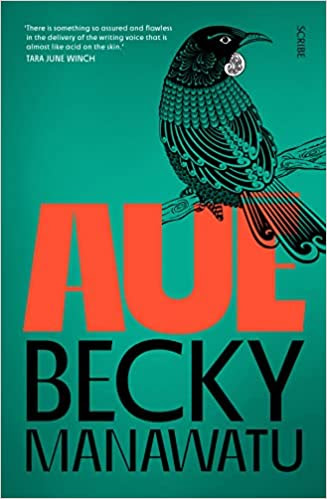


In the Māori language aué is an exclamation of surprise, alarm, or distress. Its multiple meanings depend upon the context in which it’s used, a bit like “holy crap or OMG!” in English.


In New Zealand, Becky Manawatu’s new novel, aué connotes distress most of the time, but also astonishment. Her novel will certainly draw comparisons to the late Keri Hulme’s masterpiece the bone people. Like it, Aué involves Māori living on the social edges. It probes three generation’s worth of damage wrought by marginalization, alcohol, drugs, gangs, and violence.


At its heart are two parentless brothers, the older Taukiri (“Tauk”) and young Arama (“Ari”). Tauk is sick of his life and about to take off for parts unknown to forge a new path. Before he goes, he places Ari with his aunt Kat and uncle Stuart in a small farming village near Auckland. He promises Ari he will return, though he has no idea how or when. He packs his clothes and guitar into his vehicle and straps his surfboard on the roof, the latter of which he plans to hock or sell if he needs money. Ari is crushed.


Kat is the sister of Tauk and Ari’s mother Jade, who disappeared shortly after her husband Toko was murdered. Theirs was a love story that parallels a Māori romance. Toko rescued her from a cycle of violence. Her best friend Savannah was murdered by Hash and Jade was then raped and claimed as the “girlfriend” of Hash’s gang mate Coon. Toko once tried to help Coon, but that was a mistake. To further complicate matters, Jade’s farther Hénare (“Head”) was also murdered and his wife Felicity also fled.


Kat is kind to Ari, but Stuart is a sadistic monster. One of Ari’s few comforts is his neighbor Tom, whose wife left him many years before and has long held a flame for Kat and contempt for Stuart’s treatment of her. Tom also has a daughter, Beth, who becomes Ari’s best friend. Beth and Ari construct an us-against-the-world fantasy world that’s often fashioned from Hollywood movies. Beth tries to bolster the fearful Ari’s confidence by calling him “Django,” derived from their inappropriate and clandestine viewing of the Quentin Tarantino film Django Unchained. Nice try on Beth’s part, but Ari is no Django; he’s so sensitive that every hurt, physical or psychological, commands application of multiple plasters (Band-Aids as we call them in North America).


You might infer that a lot of anguish, trauma, and violence will go down before things get better. Aué often reads like a fictionalized version of the hidden injuries of social class and poverty. Some reviewers have aptly noted parallels to Douglas Stuart’s Shuggie Bain. Manawatu paints several portraits of how hard it is for those living on the social margins to do the right thing when faced with externals that undermine good intentions. If you’ve ever wondered where the lines between victimization and heroism lie, Manawatu will further blur those boundaries, though she also clarifies them in several remarkable encounters of the unforeseen kind.


For Pakéha (white) readers, Aué can be a tough read at times. Manawatu uses Māori names and phrases and expects you to uncover their meanings. (There is an index of sorts.) Hope occurs in trickles and seeps, not torrents. The painful aspects make it an honest novel, even when you’re tempted to do as Ari, cover yourself in plasters, and cry out “aué!”  


I found it admirable that Manawatu did not make undue efforts to make the Māori world more accessible for white readers.  As in the United States, there is in New Zealand an increasing trend toward people of color expressing themselves in their own terms rather than catering to prevailing expectations. If this limits potential audiences, shame lands on those afraid to go outside of their comfort zones.


A more productive way to think of all this is that aué can only be expressed positively when those benefitting from marginalization pull The Other from the fringes to the center. Gangs, violence, and social damage generally occur in absence and want, not presence and plentitude.


Rob Weir  


PS: The correct spelling of aué should have a straight line across the e, not an accent mark. I simply couldn’t find a keyboard function that allowed me to do that.


6/8/22

The Sanatorium: Cheap Thrills


THE SANATORIUM (2021)

By Sarah Pearse

Penguin Group, 416 pages.

★★★


Elin Warner is on a ski holiday to Switzerland. In recent memory, her eight-year-old son Sam died in an accident and her mother of cancer. Elin dares hope a trip with her partner Will, whom she fears is losing patience with her, will quell her grief. It seldom works that way, in life or in fiction.


Sarah Pearse takes us to creepy places in her debut novel The Sanatorium. Locals still mention the sanatorium, though the grand building that once cared for people with mental disorders has been done over as Le Sommet Hotel, a minimalist glass and steel luxury facility set high in the Alps. Will, an architect, loves it; Elin finds it soulless. Nevertheless, she puts on her game face in the hope of fixing herself and repairing a deeply broken relationship with her brother Isaac, a longtime screw-up, who is there with his fiancé Laure.


Hopes of restful readjustment vanish with the discovery of the body of architect Daniel Lemaitre, who designed the hotel makeover. Daniel has long been missing, but his associates believed that he decided to leave the fast track and live in obscurity. Nope! When other people, including Laure, begin to vanish, things get hairy. Le Sommet developer Lucas Caron and his sister Cecile, the hotel’s general manager, try to calm guests, but they rub people the wrong way. After all, it’s hard to put a positive spin on disappearances. Anyone with a modicum of sense jumps on the bus to the valley below, despite the fact that it’s a scary ride down switchback turns in a snowstorm. Before everyone can vacate, though, a blizzard and avalanche close the road, stranding eight guests and 37 staff members.


The Sanatorium is a nerve-racking thriller in which things go bump in the snow. There’s nothing like terrified people with no place to go for revelations to ooze out, be it accidentally, strategically, or directly. Some will involve the old sanatorium, others are about loved ones, and still others concern grudges old and recent. Because it will be days before Swiss officials can mount the summit, Elin is authorized to launch a careful investigation and keep them apprised of developments. Just two small problems, Elin is an emotional basket case and she has neglected to tell local law enforcement that she’s an on-leave cop about to lose her job.


Can things get any worse? A rising body count and more disappearances accomplish that. Elin came close to being dispatched by a gas-mask wearing sadist and it’s hard to feel comfortable when it’s clear a serial killer is at work. That sicko has a gruesome modus operandi; victims surface with three fingers missing and wearing bracelets bearing non-sequential five-digit numbers. If you’re prone to nightmares, you might not wish to read this during daylight hours. What do we have here, Freddy Krueger with a mask?


Pearse sustains tension throughout because she populates her novel with liars. If no one is trustworthy, the usual process of winnowing red herrings and identifying legitimate suspects short-circuits. In a book in which anyone could be guilty, you must wend your way to the end where revelations come Agatha Christie-like. You might, however, feel cheated. Clues and circumstances stack to the point of overabundance, which leaves us with revealed connections that strain probability.


Ultimately Pearse is better at creating a nouveau Gothic mood than in penning a convincing murder mystery. It was a good idea to dispense with an omniscient investigator–they too stretch credulity–but Pearse solves one problem by creating another. We know that Elin is damaged, but not even an a messed up ex-cop would commit as many procedural errors as she. It’s one thing to invoke a Pandora’s box scenario, but it seldom works multiple times with the same person lifting the lid. Pearse paints herself into a metaphorical corner and drifts to conclusions that are more deus ex machina than logical. Plus, she over-explains; not every character or detail requires a lurid backstory.


This is a wildly popular novel, but I have mixed feelings about it. On many levels it’s clumsy and unbelievable. Yet it’s hard to dismiss that it’s also filled with nail-biting thrills. Many of them are undeniably cheap thrills, but evidence suggests we can be bought.


Rob Weir

6/6/22

See How Peggy Guggenheim Invented Herself

 PEGGY GUGGENHEIM: ART ADDICT (2015)

Directed by Lisa Immordino Vreeland

Submarine Deluxe, 95 minutes, Not-rated.

★★★★


 Tourists flock to Venice and crowd St. Mark’s Square. The cognoscenti have the wisdom to cross the Grand Canal and set their sights on a low-slung palazzo that fronts the water: the Peggy Guggenheim Foundation. It is a magical place to visit.


Very few people have seen Peggy Guggenheim: Art Addict, a documentary that debuted at the Tribeca Festival in 2015. Luckily, it’s now readily available in DVD and online. Its subject, Peggy Guggenheim (1898-1979), is an endlessly fascinating character and “character” is the right word if applied in stubborn but persistent terms. She was the niece of the filthy rich Solomon Guggenheim whose name is on a Frank Lloyd Wright-designed art museum in New York City. Peggy, though, looked to Europe and presciently began collecting modern art before it was fashionable to do so and before prices skyrocketed. 


Her second husband was surrealist painter Max Ernst, whom she divorced in 1946, and she refused to be tied down thereafter. Celibate she wasn’t; she lived a life as promiscuous as an alley cat, having slept with over 1,000 men by her reckoning. As you’ve already surmised, she had some money but little intention of being a conventional rich girl. How many of those do you know who befriended anarchist Emma Goldman? Or had the moxie to adorn the front of her palazzo with an erect naked horseman? One of her few nods to propriety is that the rider’s penis unscrewed so as not to offend visiting clerics. (If you’re wondering–and you know you are–it’s now welded in place as it was so often stolen!) 


 Peggy sponsored, supported, slept with, and purchased art from a veritable who’s who of the modern art scene, from Brâncusi to Tanguy via Calder, Dali, Kandinsky, Picasso, and scores of others. She moved to Venice in 1949, after closing money-losing galleries in Paris, St. Tropez, and London. Some of her art was displayed at the Venice Biennale in 1946, but most of it ended up in the palazzo into which she moved three years later. She was indeed an art addict, one who obsessively purchased works and chose to live in what was essentially an art gallery that happened to have some furniture. The palazzo was, in essence, the backdrop for the various parties, soirées, and salon evenings that defined her life in Italy.


Lisa Immordino Vreeland’s documentary spotlights Guggenheim’s life, loves, and collection. In part, it finishes one begun by Maya Deren and Marcel Duchamp in 1943. That’s actually the boldest thing about the film, much of which relies upon talking heads and art experts that tell us what is before our eyes: Guggenheim was an original, as was the stunning art she collected. I will add parenthetically that I was not an enthusiastic fan of modern art until the first time I set foot in the Peggy Guggenheim Collection. Maybe it was because being in Venice enhanced the experience, but I think it was because seeing it as I imagined Guggenheim displayed it made it more approachable than what it would have looked like in the more serious context of, well, New York’s Solomon Guggenheim Museum.


I recommend this documentary for its subject and the art, not the filmmaking. I guess in a way it’s appropriate that Vreeland didn’t try to dazzle viewers. When you have a subject this good, it’s generally a wise course to stay out the way. After all, what would it take to upstage Peggy Guggenheim?


Was Peggy a bohemian, a rich girl who played one, or a first-class crank? Draw your own conclusion but the smart money’s on “yes.” And if you’re ever in Venice, be sure to take a vaporetto across the Grand Canal to see what Peggy bought and wrought. 


Rob Weir


6/3/22

A Taste of Honey an Important Film


A TASTE OF HONEY (1961)

Directed by Tony Richardson

British Lion Film, 100 minutes, Not-rated. (Black & white)

★★★★★


If all A Taste of Honey conjures is a pop song by The Beatles or a cheesier Herb Albert cover in 1965, you’re missing a lot. For the record, the song’s original release was by Billy Dee Williams in 1961. It refers to the sweetness of a first kiss that lovers carry away when parted.


The film that bears that name is a British classic worthy of such an appellation. It’s in black and white and trust me; you wouldn’t want it to be any other way once you cast your eyes on Walter Lassally’s gritty cinematography. Set in the Salford section of Manchester shortly after World War II, we enter an impoverished environment where life unfolds so close to the margin that is but a small step up from living in a landfill. At the movie’s center is Jo (Rita Tushingham), a surly 17-year-old who lives in challenging circumstances with her narcissistic man-hungry mother Helen (Dora Bryan). Mum’s drill is to shift from one hovel to the next and sneak away when the landlord demands back rent. Jo wants out and who can blame her? Especially when the floozy Helen acquires a new boyfriend, Peter (Robert Stephens), who makes no bones about wanting rid of Jo after a strained trip to Blackpool.


Jo leaves school, takes a job selling shoes, and rents a backstairs walk-up near the docks that looks like a cross between a small warehouse and a chicken coop. Both furnishings and utilities redefine the term sparse, but it’s Jo’s to refurbish. The neighborhood is the sort in which begrimed children play with flotsam that washes up in the canal, pieces of wood, and debris from closed factories whilst singing “The Big Ship Sails on the Alley Alley Oh.” Believe it or not, that’s relevant.


Jo fancies herself independent, but she’s more street urchin than adult. The aforementioned song links to her first lover, Jimmy (Paul Danquah), a Black ship’s cook on an ocean-going vessel. He is kind and helps Jo, but is bound for the sea and they part with few future expectations. In addition to the taste of a honied kiss and  unbeknownst to Jimmy, he also leaves a bun in the oven. Geoffrey Ingham (Murray Melvin) also comes into Jo’s life. If you wonder if this film could get any bolder for 1961, the answer is yes; Geoff is so obviously gay that there’s no closet in which to retreat. Against what one would expect, though, Geoff moves in with Jo–certainly not as a lover, but as someone who will take care of her. He’s even willing to consider a lavender marriage.


British cinema has the term “kitchen-sink realism” for films such as this. Mike Leigh is probably the director today who comes closest to what Tony Richardson did seven decades earlier. There is no attempt to varnish truth to invite imagining all obstacles will be surmounted, nor can we assume they won’t be. This is cinema with the guts to trust audiences to enter the frame and reach their own conclusions. Characters do not magically transform. When Helen reemerges to attend to her pregnant daughter, she remains as self-centered as she always was and Jo retains a limited capacity to take a stand on what she wants. Put another way, “The Big Ship Sails on the Alley Alley Oh” is a children’s song, but the boat’s not necessarily on a happy course.


A Taste of Honey might seem like a bitter draft but despite its age, it’s an amazing film dealing with issues years in advance of Western society. Richardson painted with shades and shadows as dark as any film noir, though this is not one–more like a dramatized documentary of how people with limited life chances cope within constrained social environs. Oddly, it’s not depressing overall because it’s about survivors. Tushingham and Ingham both won acting awards at Cannes for this film and well-deserved they were. And what a treat to see a film that doesn’t spoon-feed viewers.


As I have said before, a great film takes us places we can’t go on our own. The look of A Taste of Honey and the acting styles therein are quite different from those of today, but this is truly an important document that any serious film fan should view.


Rob Weir

6/1/22

Kiss Me Deadly a Culturally Important Mess!


KISS ME DEADLY (1955)

Directed by Robert Aldrich

United Artists, 106 minutes, Not-rated.

★★ ½


 Kiss Me Deadly is almost impossible to rate. I arrived at 2 ½ via some convoluted math: 1 for movie-making, 2 as a story, and 4 for cultural significance (Divide 7 by 3 and you get 2 ½ .)


As filmmaking, this Robert Aldrich turkey sinks to the level of Ed Wood camp such as Plan 9 from Outer Space and shares some of its pseudo-science proclivities. Thinking of Kiss Me Deadly as camp will actually increase your enjoyment of it.


Aldrich had an interesting idea that oozed of personal vendetta. He was a leftist who expected to be targeted in the post-World War II Red Scare. It never happened, probably because he was such a small fish that potential inquisitors wouldn’t have acquired political or cultural capital by netting him. Aldrich hated crime writer Mickey Spillane, the creator of hard-broiled private investigator Mike Hammer. In Aldrich’s mind, Spillane was a fascist, an overdrawn assessment though not by much. (Spillane admired Ayn Rand–enough said.) 


In Kiss Me Deadly, Hammer (Ralph Meeker) is transformed into a sleaze-bag divorce investigator who gets results by prostituting his secretary Velda (Maxine Cooper). She seduces ‘em and Hammer blackmails ‘em. Hammer is so crude, amoral, and sadistic that cops like the LAPD’s Pat Murphy (Wesley Addy) despise him and probably wouldn’t bother to fish his corpse out of the Pacific Ocean were he to meet a suspicious end. As the story begins, Hammer nearly hits a barefooted hitchhiker, Christina Bailey (Cloris Leachman) when she flags down his racing sportscar. She tells him that she was placed in an insane asylum to keep her quiet, but to “remember me” if her pursuers murder her. That is exactly what happens and Hammer is also captured, drugged, and placed in his sports car with Christina, which is pushed off a cliff and explodes in a ball of fire.


We don’t know how he survives; it’s one of many can’t-be-bothered-to-stitch-it plot holes. Hammer launches an investigation–when he’s not having sex with Velda–that leaves more crumbs to follow than Hansel and Gretel. He visits a hood named Carl Evello (Paul Stewart), though this scene seems merely an excuse for his moll Friday (Marion Carr) to throw herself at Hammer like a hamster in heat. He also visits and harbors Christina’s roommate Lily Carver (Gaby Rogers) because, of course, the hoods staking out his apartment would never think to look for her there! Hammer gets personal when a Greek friend, Nick (Nick Dennis) is murdered an excuse to be more violent and more stupid.


The movie’s mystery will hinge on a pair of oxfords, a key, an assumed identity, poetry, and (metaphorically) opening Pandora’s box. To call A. I. Bezzerides’ script a mess is an insult to sloppiness. You’ve probably never heard of Meeker, Carr, or Rogers, nor should you. Though he did some 1950s TV, Meeker is a stiff masquerading as an actor and both Carr and Rogers had short careers. Cooper was terrific as Velda, though all of the women in the film are slutty and displayed in lurid poses. Don’t get me started on ethnic stereotypes.


 The question arises as to why Kiss Me Deadly is part of the Criterion Collection of films considered as important. It helps if your film is rejected by the Catholic League of Decency. (Nothing attracts attention like censorship!) It might have faded away had the CLD left well enough alone, but French intellectuals associated with the journal Cahiers du cinema, including director Claude Chabrol, championed the film once they saw it.


Why? This gets us to cultural significance. Kiss Me Deadly could be billed as Mike Hammer-meets Red Scare-meets fears of nuclear holocaust. The world’s first hydrogen bomb–700 times more powerful than the atomics dropped on Japan in 1945–was tested in 1952, less than two years before Aldrich began Kiss Me Deadly. The H-bomb provided the capacity to destroy all life on Earth. Fear was part of the rationale behind the Red Scare and numerous sci-fi novels and Hollywood films featuring aliens, monsters, mutants, or nuclear destruction. In other words, Aldrich’s turkey attained flight via a Zeitgeist updraft. This makes Kiss Me Deadly so bad it’s good. It did give Cloris Leachman her first break, so there’s that. Besides, it’s a guilty pleasure to watch Aldrich reduce Mike Hammer to a grotesque idiot.


Rob Weir

5/30/22

A Curse on Both Political Parties!


Why It’s Time to Change the Political Tune (in one chart)


Call me cynical; then explain why millions of people purport to despise both political parties, yet go the polls and select one or the other in the belief they’ve voted for the lesser of two evils. To me, that’s cynical. It’s voting against something, not for something. Is Monster versus Milquetoast really a choice?


There is just one solution and it will take time: Stop voting for Republicans or Democrats. Choose another option. If you’re on the left, vote Green or some other progressive party; if you’re conservative, vote Libertarian, just as long as you know that Ted Cruz and Rand Paul are liars, not Libertarians. (A true libertarian would not vote to restrict abortion access.)


I quit the Democratic Party during the Clinton administration and the only Republicans I’ve ever voted for were named Silvio Conte and Charlie Baker, the latter because who can even remember who ran against him? That tells you all you need to know about the Democratic wannabes.


This handy chart outlines why I’ve lost trust in both the Monsters (Republicans) and the Milquetoasts (Democrats).  Republican Monsters in column two; Democratic Milquetoasts in column 3.


School Shootings

Arm teachers, janitors, secretaries, and students.

Talk, talk talk.

Gun control of any sort

Repeal the 5th Commandment. Replace with the Second Amendment.

Talk, talk, talk.

Abortion

Why should we care about women and choices?

Talk, talk, talk.

High gasoline prices

Drill, baby, drill!

Talk, talk, talk.

Climate change

What climate change? Drill, baby, drill!

Talk, talk, talk.

Coronavirus

Fake news. Masks are evil. Sick? Drink bleach.

Talk, talk, talk.

Methamphetamine production

It’s a form of free enterprise.

Talk, talk, talk.

Inflation

Slash taxes on the rich and big corporations.

Talk, talk, talk.

Problems of blue-collar and service industry workers

Vote for us because we will stop those socialist job killers.

Talk, talk, talk. Wait a minute, who?

The destruction of American democracy

Trump won the election. Investigate that.

Talk, talk, talk.

Health care reform

Socialism!

Talk, talk, talk.

Education and student debt

College education is elitist (unless you can afford an Ivy). Ban CRT.

Talk, talk, talk.

Crime

Empower the cops and arm babies at birth.

Talk, talk, talk, though I’m sure this issue is racist.

Racism

Bring back slavery.

Oh, how terrible!

Cops killing people of color (even on camera)

They had it coming to them.

Oh, you really shouldn’t say that. How mean.

Immigration

Seal the borders, round up illegals, and ship ‘em back.

Talk, talk, talk, but maybe open the borders. You know, if it’s not too much trouble.

LGBTQ rights

Sinners! Ban them. Except for Log Cabin Republicans.

Talk, talk, talk.

Trade

Who cares as long as the Stock Market goes up?

Gee, we really ought to do something about China. If it’s not upsetting.

Runaway military spending

Huh? Triple the budget. Cut those wasteful social programs.

Oh golly, we really respect our vets, although we’re sorry we voted for that last dumb war.

Deficit

It’s the Democrats fault.

It’s the Republicans fault.

Choosing candidates and judges

Choose whoever is barely legal. Unless it’s Trump.

There must be 80-year-olds whose turn it is. I wonder if the Clintons would speak at a fundraiser?

Women in general

Yeah, we love babes. Especially blondes with shapely legs who want to have sex with Trump.

That is so rude I’m almost tempted to say something about it.


5/27/22

MUSEUM OF INTERNATIONAL FOLK ART: PART I

MUSEUM OF INTERNATIONAL FOLK ART: PART I

One Museum Hill

Santa Fe, New Mexico

[Clicking on individual photos = larger display]


If you visited our home, you’d find masks on several walls and small carvings and statues scattered among the things most people use to decorate their dwellings. Part of this has deep roots–Emily’s great uncle was a whittler and I love Inuit carving–but a lot of our objects d’art were inspired by having known the regal Miriam Usher Chrisman, an important advisor during my early graduate studies. She loved to invite grad students to her home, which she and her husband Donald filled with wonders gathered during their travels. As Miriam told the story, when they were younger and raising their children, they lacked the money to collect painting, sculpture, and other items associated with the (elitist) term “fine art.” So, they collected folk art instead.


It will thus come as no surprise when I tell you that Santa Fe’s Museum of International Folk Art (MIFA) is one of our favorite museums anywhere in the world. We’ve been there three times, but it’s so chockful of delights large and small that you could visit daily for a year and would probably still miss something grand.


The MIFA has expanded since our first visit and now has wings for special exhibits, not to mention an entrance corridor for assemblages such as saint medallions, etchings, and hangings. But the main attraction is its warehouse-like maze of folk art fashioned from wood, ceramics, clay, fibers, dried plants, and glass. It is true to its handle in that it is truly international in scope.


Among the marvelous things about folk art is that genres meld into one another and it’s impossible to judge any of it. By definition, most folk artists are untrained. As such the stories and cultural values embedded within objects take priority. Perhaps we can look at two pieces and see that artist A was a more skillful wood carver than B, but that in no way means you or anyone else will prefer one over the other. The MIFA has some themed displays, but often it doesn’t. For example, cases of ceremonial masks are hung willy-nilly and unless you grab the laminated card for individual cases–objects are numbered rather than placarded–you won’t know for certain if a mask is Amazonian or Ghanian.


You would exhaust yourself in short order if you tried to ID every object and the cool thing is that you don’t need to do so. The MIFA is a place to feel the magic of human creativity and it simply doesn’t matter who created, when, or why.


I could fill my blog with a month’s worth of pictorial postings but instead, here’s a Part I sampler. When I know something about the photo, it is so labeled. Otherwise, do what I did and take a casual meander to see what catches your eye.


Rob Weir


Mermaids abound, sirena in Spanish.


Mexican villages are a major theme of MIFA


Subtle commentary on anthropologists and tourists

West African, I think

Amazing. This large hanging is yarn pressed into warm wax!

African, but I forget where.