7/29/22

House of Hamill: July 2022 Album of the Month


 HOUSE OF HAMILL

Folk Hero


Earlier in July I partook of a “Watermelon Wednesday” concert at the West Whately Chapel. The featured act was a young trio called House of Hamill. I’ve no idea why they are called that, but this ensemble consists of three superb performers: Caroline Browning (bass, harmony vocals, and mandolin); Brian Buchanan (acoustic guitar, second fiddle, banjo, foot percussion, and vocals); and Rose Baldino (first fiddle, vocals, and banjo).


If Buchanan’s name is vaguely familiar, he’s a longtime mainstay of the Canadian folk rock ensemble Enter the Haggis in which he mostly plays first fiddle and sings. House of Hamill, though, is definitely anchored by the dynamic Baldino, Buchanan’s wife. The trio is a 21st century group in more ways than one. Buchanan plays a lot in Canada, but he and Baldino live in Pennsylvania, and Browning makes her home in North Carolina. They also embody the genre-mixing penchant so prevalent these days. Their music is Celtic, but the tunes they use for songs such as “Lord Randall” and “William Taylor” are original rather than traditional and end much better for women than they do in Child ballads. (Ironically, Rose did not know much about Child ballads until we chatted!) They also do a cover of Dougie Maclean’s “Turning Away” whose tempo is accented differently than Dougie’s. In another nod to how things are done these days, the song “The Bully of Skidmore Town” is a Celtic/bluegrass hybrid.


The songs on Folk Hero, their latest recording, are solid but their instrumentals are stunners. Baldino is a dynamo on the fiddle, a delicious blend of virtuosity and attacking her instrument until it smokes. (Her style reminds me a lot of Liz Carroll.) Like a lot of Celtic fiddle tunes those of House of Hamill carry whimsical titles such as “Superb Owl,” “Cat Bacon,” and “The Sneezing Loon,” not to mention “Quarantine Reel,” which is part of the “In the Dark” set. Baldino will get your heart pumping, but then there’s the gorgeous “Canyonlands,” a reflective, and bittersweet composition. “The Stone Row” is another original that stands out.


This is a really fine album that impresses more with each listening. It’s almost as good as seeing them live, but only the latter can truly capture Baldino’s energy and the band’s synergy. You should hear what they do on stage with a cover of “Bohemian Rhapsody!”


Rob Weir

7/27/22

Spectacles on Display at Shelburne Museum


EYESIGHT & INSIGHT: LENS ON AMERICAN ART

Pizzagalli Center for Art and Education (PCA&)

Shelburne Museum, Shelburne, VT

Through October 16


I confess that the fanfare for this small show at the Shelburne Museum induced something less than enthusiasm. Call mine an error of judging an exhibit by its title. It is, if I might, a sharply focused and clever idea for a humble-sized art showcase.

If you’re like me, spectacles are a necessary evil I equate with lost youth. I don’t give them a second thought other than the annoyance of wondering wherever on Planet Earth I might have plopped them down. The PCA&E’s downstairs gallery makes one realize how often and in how many ways eyeglasses show up in art. We quickly learn that more people through the ages have appreciated the utility of their glasses than those who have sworn at them.


In case you’re wondering, they have been a corrective accessory in Western culture
since at least 1290 and are thought to have first appeared in Italy. Prior to that, a 
small number of scientists –usually Catholic clerics–experimented with optics, but it
 was quite a breakthrough for weak and aged eyes when someone got the brilliantly 
simple idea of sticking a few lenses in a frame, fashioning a way to rest them on the 
bridge of the nose, and inspiring future generations to cry out, “dove ho lasciato i 
miei stupidi occhaili?” (“Where did I leave my stupid glasses?”) 
 

The Shelburne Museum show confines itself to American art from the 18th to the 
21st centuries. It draws upon materials in the permanent collection and a few 
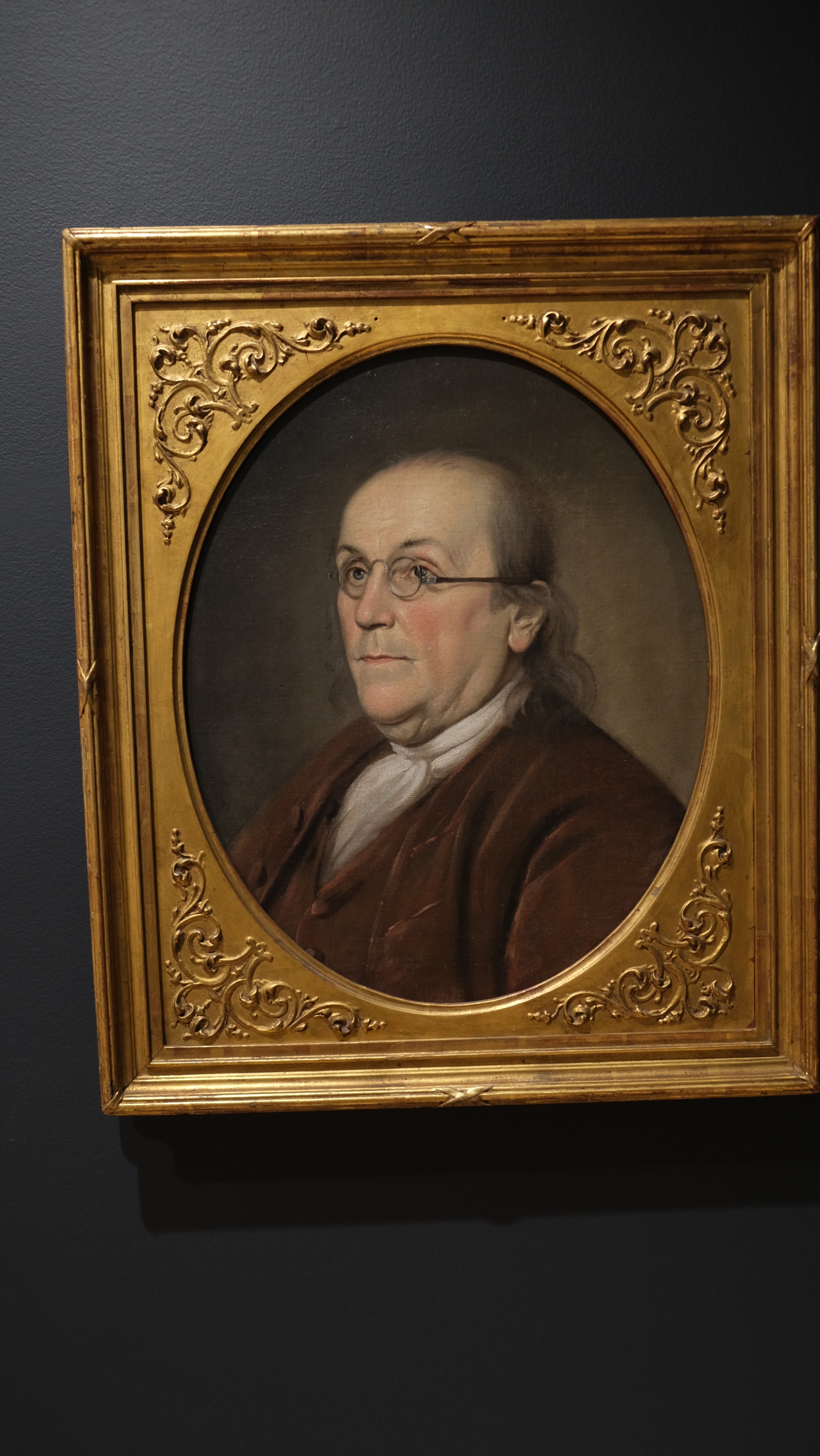
well-curated borrowed works. Charles Willison Peale appears twice, once in a 
self-portrait and again with a famous look at Benjamin Franklin, peering at us like 
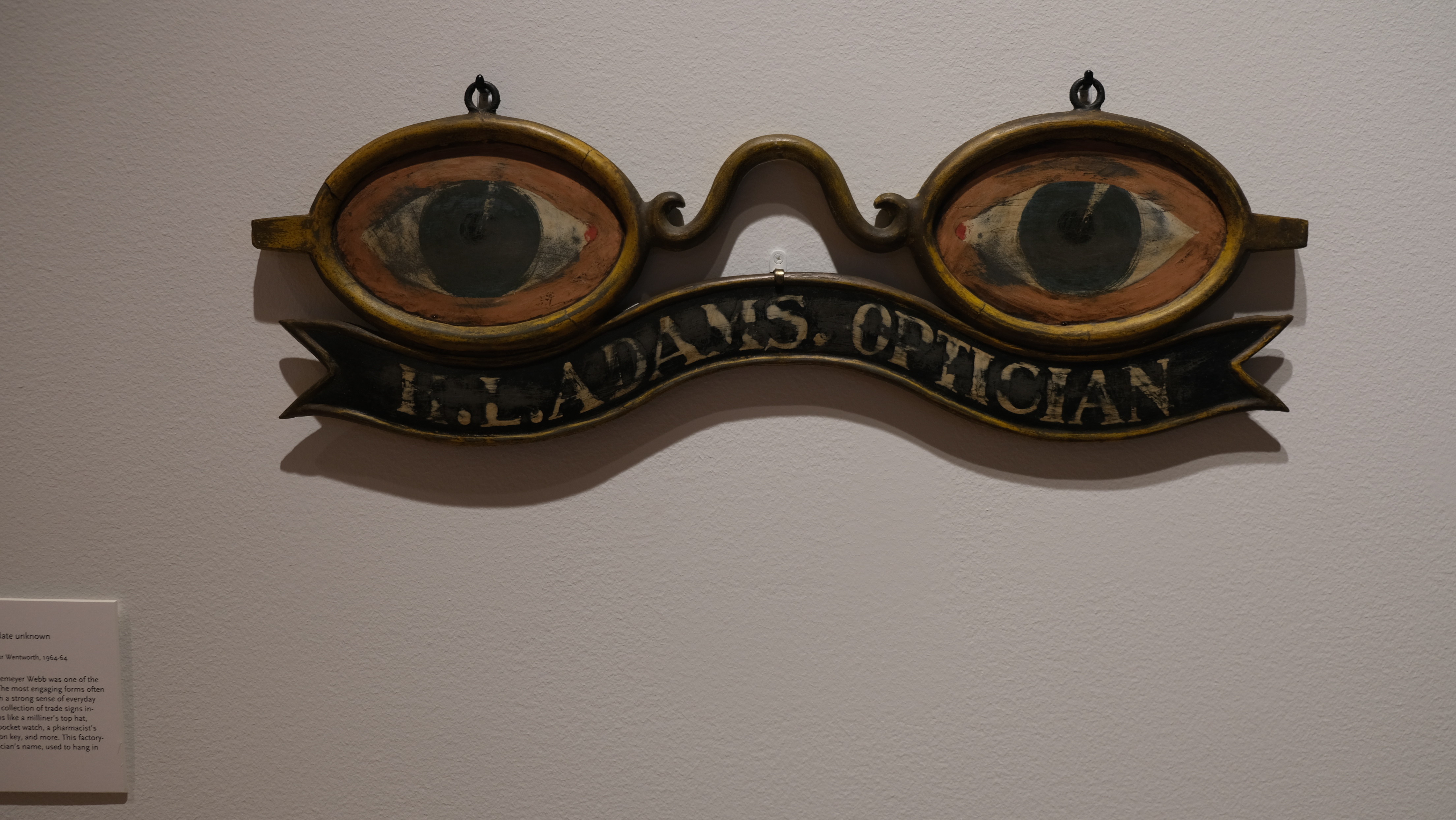
he’s about to begin a lecture. We also see several optometrist trade signs from 
the 19th century.  


  The PCA&E exhibit shows the utility of eyewear, but also has the sense to be playful 
and whimsical. There is, for instance, a 1983 photograph from Tseng Kwong Chi 
that’s a backdoor nod to Richard Nixon’s 1972 visit that thawed relations between 
the US and Red China. Tseng lives in Vancouver, but he dressed himself in a Mao 
suit and sunglasses in the guise of a diplomat. And that’s not even close to being 
the most puckish depiction of specs. There is a droll surrealist-style skeletal 
sculpture, but the Grand Nosepiece Award is a tossup between a 1952 
Life Magazine shot from the appropriately named J. R. Eyerman, and a 
Cindy Sherman image from 2016. Look closely at what Sherman has done; 
every person in the frame is she.  


  You will also find work from William Wegman, Howardeena Pindell, and the 
underappreciated Edwin Romanzo Elmer. But let’s go for humor once again; 
Richard Caton Woodville’s 1851 “Magic Glasses” tickles funny bones for several 
reasons. First, the figures in the painting are oddballs and the man in the dark 
glasses (which would have been rare back then) looks like some madcap 
Sherlock Holmes trying to blend into the woodwork. Maybe he is. Check out
the name of the publication he’s reading.
 
 
I recommend dropping into this show, which can be viewed in 15 minutes or fewer. 
Of course, that’s assuming you remember where you left your glasses.


Rob Weir

7/22/22

Tracy Flick Novel A Tad Flat


TRACY FLICK CAN’T WIN (2022)

By Tom Perrotta

Simon and Schuster, 262 pages.

★★★


In the 1932 Marx Brothers film Horse Feathers Professor Wagstaff (Groucho) is the new president of a college that hasn’t had a winning football season in many years. He tells shocked colleagues that the school can’t afford both education and football, so he intends to tear down the college and build a stadium.


Tracy Flick* has an analogous problem. She has been the loyal assistant principal to Jack Weede for many years. Jack is retiring and Tracy is in line to move up, but the school board and community are more anxious to fire its football coach and return Green Meadows High School (GMHS) to the glory it knew before previous coach Larry Holleran bolted to head a college gridiron program.


Still, Tracy is a shoo-in to replace Jack if she can bite her tongue and win over board president Kyle Dorfman. Tracy is whip smart, has a Ph.D., and nearly finished a law degree at the University of Chicago. She likes working at GMHS, but she does have a cold personality and a blunt manner. Tracy slips a bit when she tells Kyle she has some ideas on improving the curriculum—especially for high-ability students—but admits she doesn’t care much about football. Oops! He does care and longs for a new Holleran.


In an attempt to redeem herself she accedes to an idea of Kyle’s she doesn’t think has merit. He wants to up the school’s profile by setting up a hall of fame to honor notable people associated with GMHS. The problem is that GMHS isn’t a bad school, but neither has it been a distinguished one. This becomes obvious (and amusing) as nominations come in. In Kyle’s mind the obvious choice is Vito Falcone, who quarterbacked the football team in its glory days and had a brief NFL career. Tracy finagles the idea of having two inductees and champions a longtime administrative assistant known to all as Front Office Diane.


If you know much about the inner workings of bureaucracies, search committees, or ad hoc committees you know each has the capacity to complicate simple things and that even decisions set in stone are precarious until cemented into place. Bickering and discontent ensue, but the hushed backroom plotting is even worse. Tracy finds it hard to “be the flame” swaying in the wind as she has been advised to become. Matters are complicated by personalities, many of which are out of accord with reputations. Among those suffering from the catchall malady “issues” include Vito, Jack, Diane, Kyle, his wife Marissa, a student named Lily, and Tracy. The usual complications emerge: not-so-secret affairs, old wounds, revenge fantasies, hidden agendas, and let’s not forgot a losing football program. Perrotta wends his way to a conclusion that’s partly predictable and partly surprising.


I am a Tom Perrotta fan, but I had mixed feelings about Tracy Flick Can’t Win. It’s short and breezy but also flat in ways that are more visceral than easy to articulate. It is fair to say that if we ignore personality deficiencies there’s not much going on in the novel until the very end. Moreover, after a while the bickering, scheming, and anxiety begin to grate. Even Tracy, our protagonist, comes off as calculating and entitled. Others will be revealed to be either deeply flawed or imposters.


I think that Perrotta wanted to write a novel about powerful men versus talented women who have to force their way into the Boys’ Room in order to shine. If that was the goal, too many punches were pulled that should have landed with force. In my estimation it would have helped to have emphasized Tracy’s likable qualities earlier in the book. I won’t say if she “wins” or loses, but it’s certainly the case that some readers will conclude that GMHS should wipe its slate clean on every level. To return to Horse Feathers, Groucho’s big musical number was “Whatever It Is, I’m Against It.” That is the stuff of comedy, but it’s marshy ground for readers in search of sympathetic characters.


Rob Weir  


*If the name is familiar, she appeared as a high school student in Perrotta’s 1998 novel Election and was played by Reese Witherspoon in a 1998 movie adaptation.

Licorice Pizza Leaves a Bad Taste


LICORICE PIZZA (2021)

Directed by Paul Thomas Anderson

MGM/United Artists, 133 minutes, R (language, drugs, mentions of sex)

★


If you don’t know, a licorice pizza is an LP record. I’d sooner eat vinyl than ever see this film again. It is embarrassing, trite, and as empty as an LP’s center. Why this “comedy-drama-romance” (whatever that is) was nominated for a Best Picture Oscar can only be explained as still another Hollywood attempt to win over a youth market that long ago ceased to care.


The story, if there is one, involves the attraction of 15-year-old teen actor Gary Valentine (Cooper Hoffman) to 25-year-old Alana Kane (Alana Haim), a photographer’s assistant. Rather than tell him to get back to run along until he’s old enough for his acne to clear, she finds herself hanging out with Gary and his child actor friends. Despite protestations to the contrary, she kind of likes Gary. Oooookaaaay. She’s not elderly, but Harold and Maude this ain’t. It’s unclear to me what exactly it is supposed to be. It’s very broad–in an empty desert wasteland kind of way.


The movie is set in California’s San Fernando Valley in 1973, presumably because it provides director Paul Thomas Anderson with an excuse to present all the boys and men in ugly clothing and bad haircuts, and all the girls and women in miniskirts, dorky bikinis, and death-defying shoes. The story takes place against a backdrop of technological change, shifting cultural trends, Richard Nixon, Vietnam, and the OPEC oil embargo. It’s fair to say that another thing this film isn’t is something you’ll ever find on the History Channel. It’s easy to see that Anderson is commenting upon the vacuity of 70s’ society. It’s easy, though, because Licorice Pizza is all surfaces and no depth.


The script is as thin as a blade of grass on a diet. See Gary flirt. Watch Gary enrage the host of the Lucy Doolittle Show (Christine Ebersole channeling Lucille Ball) by conking her with a pillow. Oh, Gary has a great idea: Let’s sell waterbeds and round up kids, teens, and Alana to run it. A bad encounter with a stoned, threatening, and Barbara Streisand-invoking Jon Peters (Bradley Cooper) leads Gary to go into the arcade biz instead. Both ventures bear the name “Fat Bernie’s.”


That’s hardly the most-insulting aspect of the film. There is, for instance, Gary harassing Alana until she agrees to show him her “boobs.” William Holden and Mark Robeson stand-ins Jack Holden (Sean Penn) and Rex Blau (Tom Waits) show up in a demented scene that is so random it’s as if Anderson randomly plucked script pages from the binder. LA mayor-wannabe Joel Wachs (Benny Safdie) inexplicably decides to risk everything once he sees Alana’s legs. What all of them have in common is a burning desire to have sex with Alana, as does Gary. Perhaps this is indirect commentary on Harvey Weinstein, but you’d have better luck locating the Holy Grail than making that connection. These offenses are amateur hour in comparison to the character of Jerry Frick (John Michael Higgins), a so-called businessman who pops up from time to time to trade in stereotypes of Japanese women. There are multiple comments on Alana’s “Jewish nose.”  It’s enough to make me believe that Anderson’s 1973 mise en scène is simply an excuse to engage in naughty little boy behavior for which he’d be pilloried were the setting a contemporary one.


Surely, you might argue, the movie is a quirky offbeat lampoon of shallowness Hollywood-style. Charles Yu did this brilliantly in his novel Interior Chinatown and so have movies as diverse as Adaptation, Barton Fink, Day of the Locust, The Player, and Sunset Boulevard. I probably do a disservice to mention these in the same breath as Licorice Pizza, a collection of vignettes in search of any semblance of unity. How many tortured devices can one cram into 133 minutes? Let’s see, Haim’s mother and sisters play her mother and sisters. How meta (not!). Cooper is the late Philip Seymour Hoffman’s son. Leo DiCaprio’s father cameos as Mr. Jack, a cheesy emcee. Etc.


But let’s not quibble. At least Licorice Pizza has a good 60s’/70s’ soundtrack. Surely that must count for something, but I doubt it. I waited several months for this film to arrive via interlibrary loan, yet somehow that seemed shorter than the two plus hours I wasted on a concept as twisted as a stick of licorice. I never liked licorice.


Rob Weir

7/20/22

Museum of Dumb Guy Stuff (You've Got to See It!)


MUSEUM OF DUMB GUY STUFF

114 Mechanic Street

Portsmouth, NH


If you were walking down a street and saw this sign, would you stop and take a look? Of course, you would and so did we.   


Most museums take themselves very seriously. Not this one. It’s as advertised, a collection of guy-centric toys, treasures, and kitsch. Call it where tongue-in-cheek machoism meets the desire for perpetual boyhood. 


You’ll find it in Clay Emery’s basement. He convinced his wife Susan it would be a good idea by promising it would keep him out from underfoot, though Susan is often there to greet visitors as well. (Also two massive but gentle dogs.) Mostly, though, Emery gets artistic help–if that’s the right word–from his good friend Rod Hildebrand who helps him fashion and build dioramas.


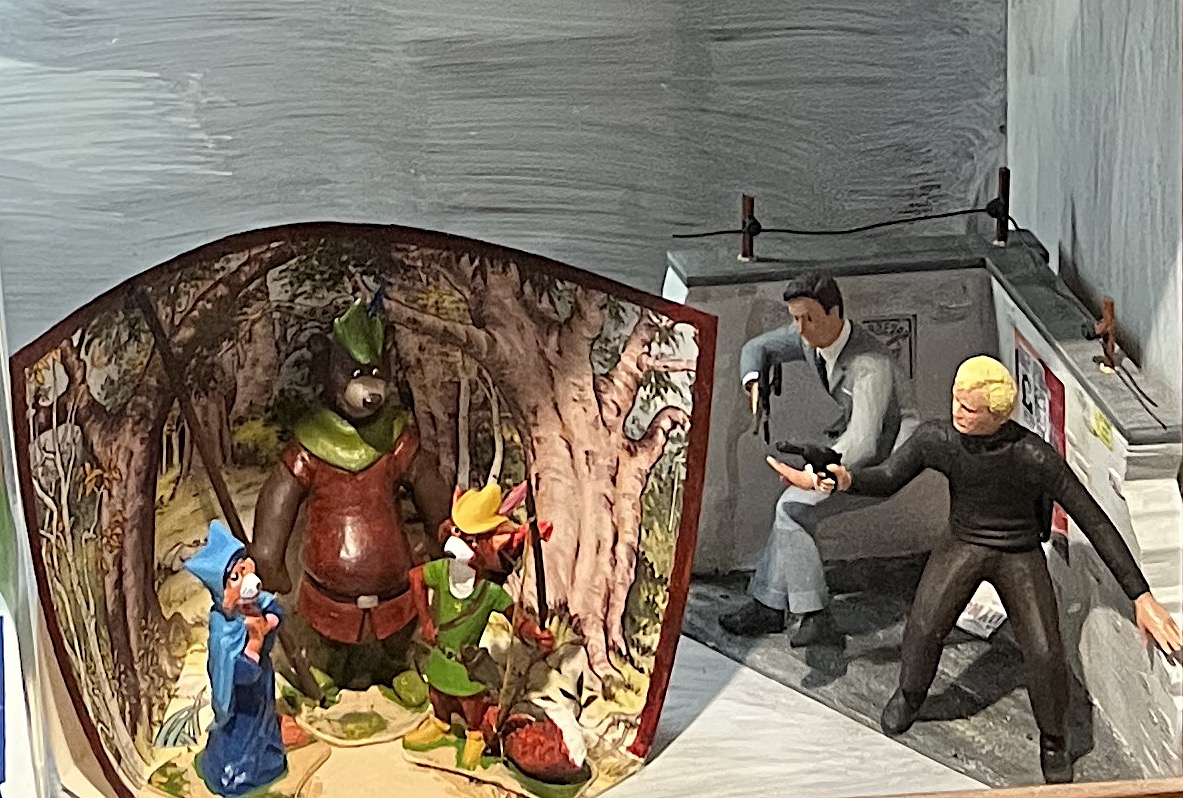
There's a bit of everything in Emery’s basement. Some of it is pieces from “kit busting,” a term previously unfamiliar to me. It’s pretty much self-defining. Manufacturers sell action figures and dolls with all manner of official accessories they think you will like. Emery and Hildebrand aren’t afraid to snap the lines they’re given and play figures within other scenarios. Why not have cartoon figures meet the Man from U.N.C.L.E.? They also did plenty of building g of their own; for instance, a coffee filter became part of the dress for an Old West female doctor. (Susan was a doctor in real-life.) 


I especially enjoyed the nostalgia trip as evinced in dioramas featuring Peanuts characters, The Three Stooges, and Crusader Rabbit and his friend Rags the Tiger. (They were the prototypes for Rocky and Bullwinkle and you can sort of see that in them.) 


You will also see Lara Croft and action figures of real people in movie roles such as Sean Connery, Clint Eastwood, and Tom Hanks. Barbies and G.I. Joe dolls get cast in new roles. And, of course, every collection needs some army guys. Both World War II and the French and Indian War get a workout in the museum. And what guy collection would be complete without a dinosaur or two or three? 


The centerpiece is a recreation, complete with toy train set, of Dover, New Hampshire as it was in 1959. Hildebrand even built the rocks used in the set. The trip back to 1959 is appropriate, as the entire museum is one big nostalgia trip.


Women need not fear drowning in a sea of testosterone. Irony and self-deprecating humor perhaps, but not testosterone. The greatest thing about the Museum of Dumb Guy stuff is that it’s done with such non-seriousness that you simply can’t see it and leave without chuckling. Nyuk, nyuk, nyuk.


Rob Weir


7/18/22

Rediscover Local Hero


LOCAL HERO (1983)

Directed by Bill Forsyth

Warner Brothers, 111 minutes, PG

★★★★


Local Hero was a favorite film of my friend Michael, who recently passed away. Like me, he loved all things Scottish. Local Hero is a classic that is part of a series of Scottish films from Bill Forsyth, a beloved director. Although the film’s externals–hair styles, clothing, automobiles, gender dynamics­–are dated, Local Hero bears another look for its what-goes-around-comes-around relevance.

Local Hero is a pastiche of farce, broad comedy, fairy tale, Brigadoon parody, and moral lessons. It begins in Houston, where Felix Happer (Burt Lancaster), the head of Knox Oil, has his eye on draining some of Scotland’s North Sea oil. Knox Oil needs a place to build facilities and a deep port for big tankers. His experts advise him that only a place called Ferness meets the criteria. Happer decides that “Mac” MacIntrye (Peter Riegert) is the man to finalize the details based on Happer’s mistaken assumption that Mac is “Scottish.” Mac is actually an 80s-style Yuppie of Hungarian descent who’s about as Scottish as Scotch tape, but what Happer thinks equals reality.

Mac is also commanded to report on what he sees in the sky because Happer is a passionate amateur astronomer. So, it’s off to Caledonia where he meets his gawky local contact Danny Olden (Peter Capaldi). Danny is instantly smitten with Marina (Jenny Seagrove), an oceanographer who believes her geologist bosses actually want to build a marine biology center in Ferness. When she exits–and she will resurface–Mac and Danny are off to the village via moors, one-track roads, Biblical rain, and fog.

They finally check into a B & B run by Gordon Urquahart (Denis Lawson), who is also the local accountant, bar owner, and unbeknownst to the visitors, pre-selected by Ferness residents to wring as much money as he can from the Yanks. Mac is all-business and wound tighter than a bodhran, but he can’t help but be attracted to Gordon’s wife Stella (Jennifer Black). Think of every joke you know of yokels getting over on city slickers and kilted variants appear in the film. Mac is oblivious to the fact that villagers have dollar signs dancing in their heads and discuss what they intend to do with their instant wealth the moment Mac and Danny are out of earshot.

Plot lines emerge involving everything from a rabbit, a baby no one wishes to discuss, a fishing boat whose name changes daily, misadventures with the village phone booth, a madcap motor bike fanatic (John Gordon Sinclair, the future star of Forsyth’s Gregory’s Girl), an African-born minister with the unlikely name of Murdo McPherson (Christopher Asante), a joie de vivre Russian fisherman, city guys on rocky beaches, a twist on mermaid legends, and a celidh whose musical selections vary (to put it mildly). The film’s humor—even that of the sexual variety—is gentle and droll. Some of it, such as Happer’s abusive therapist (Norman Chancer), is a thudding dud, but it helps to remember the film’s fairy tale qualities are unmoored from quotidian logic.

As you might expect, there is a midge in the cockaleekie soup. Everyone is anxious to sell except one hermit living in contented squalor on Ferness beach: Ben Knox (Fulton MacKay). Note the surname! Mac’s reports on seeing the aurora borealis and stalled negotiations are enough to send Happer to Ferness and Mac back to Houston.

From today’s perspective, several things stick out. The first is a difficult nut to crack, the question of preservation versus modernization. Should a place like Ferness be left alone like tartan encased in amber, or would locals benefit from joining the “real” world? Ferness–real-life Pennan–exudes stark beauty, but it’s also remote and jobs are scarce. On the other hand, refineries (and Mac’s Porsche) do enormous ecological damage. Forsyth cleverly and subtly riffs off Brigadoon rather than moralize, but from the perspective of 2022 it’s hard not to infer that Big Oil needs to become as archaic as Brigadoon.

A funny snippet occurs early on that suggests not even hurricanes wish to be in Houston. Forsyth used Mac, whose stay in Scotland unbuttons him, to consider desire. In short, what do we really want, things themselves or things that feed our souls? Watch and consider who is the happiest person in Local Hero. I thought about Michael as I viewed it, a sad moment but also one that made me ponder and smile.

Rob Weir


7/15/22

Edward Gorey House a Must-See for Cape Cod Travelers


EDWARD GOREY HOUSE

Yarmouth Port, Massachusetts


I’d like to introduce some new material for the Art Smarts section of the blog. If you will, call it small museums. Maybe you’re one of those who gets overwhelmed by places like New York’s Metropolitan Museum of Art, Boston’s MFA, or the Chicago Institute of Art. Often, you’re in one of those places, have a limited amount of time, try to cram in as much as you can, and end up viewing art the way you might observe a roadside fender-bender. Or, perhaps, you’ve simply grown weary of the “great artists” approach of such places. Small museums are antidotes. Many are more creative and few of them will exhaust you.


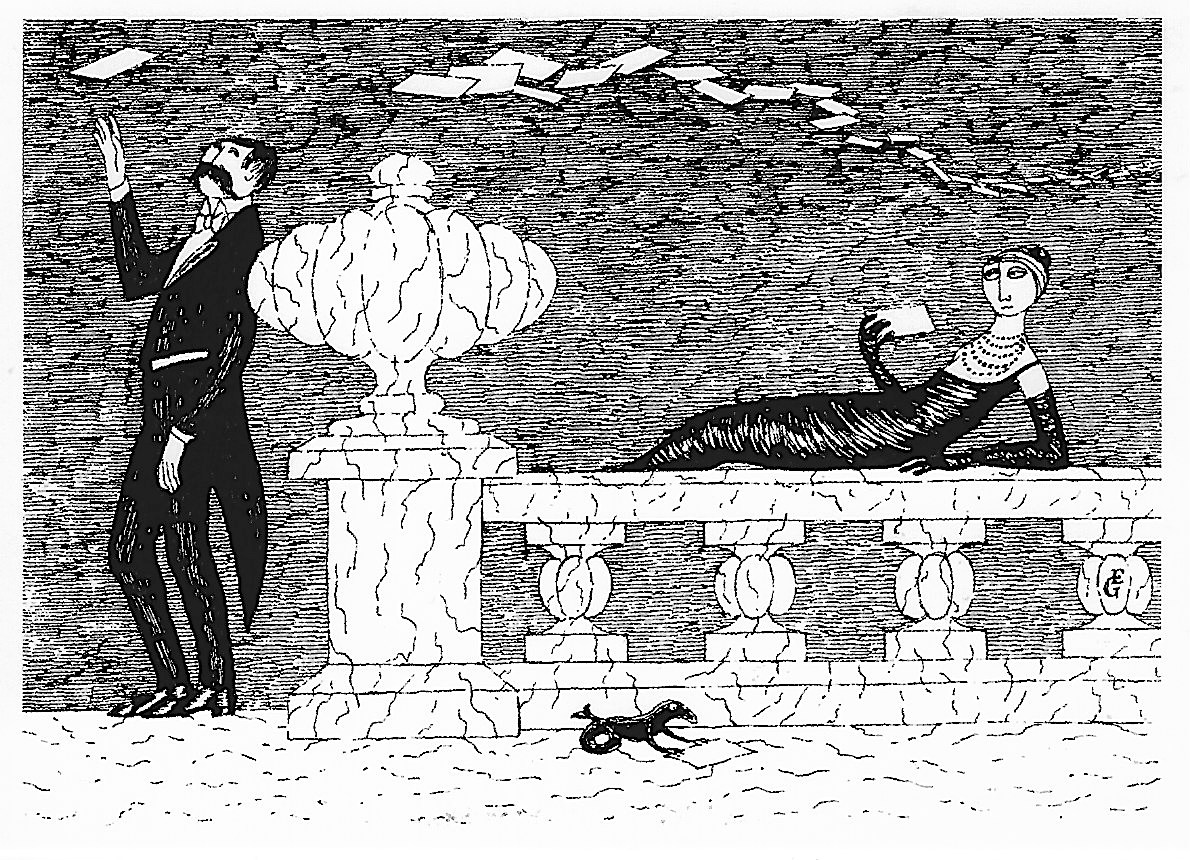
If you are headed for Cape Cod this summer or fall, be sure to stop at the Edward Gorey House in Yarmouth Port. It will be an hour or so well spent. Does the name Edward Gorey (1925-2000) ring a bell? If you’ve ever seen an episode of Mystery on PBS, Gorey’s illustrations introduce the episodes, complete with damsels in distress, falling cornices, cracking lightning, and lurking shady characters. 


Gorey is often labeled an illustrator, but that doesn’t quite get it. He specialized in etchings and drawings, but he also loved theatre and bagged two Tony Awards, one for costume design and the other for set design. In addition, he wrote or illustrated an untold number of books for children of non-snowflake parents. You know, the kind of kids who love a bit of, well, gore and a good scare now and then. Not that there was anything explicit about his work. I like to think of his verse, stories, and illustrations for the younger set as Edwardian surrealism. It’s analogous to his lead-ins for Mystery in that it’s vaguely creepy and endlessly amusing. The latter quality makes it irresistible for adults as well. 


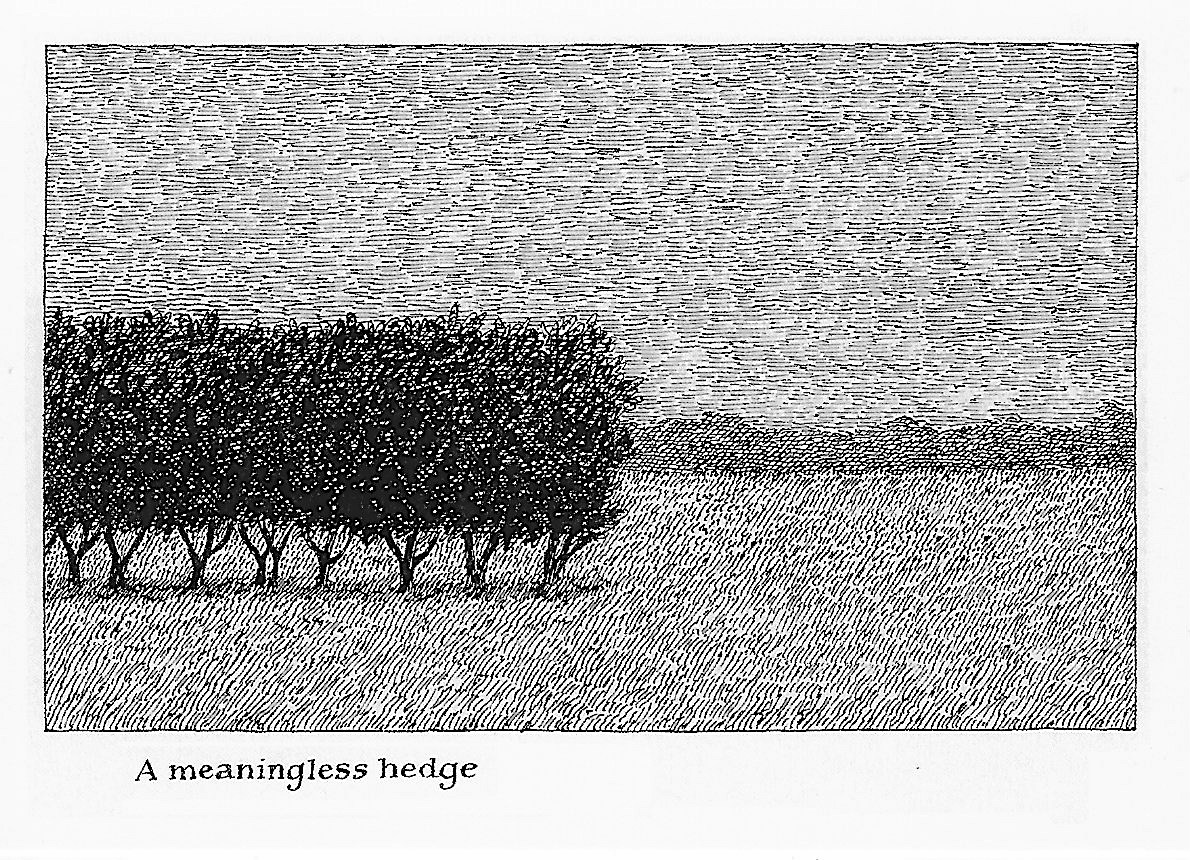
Gorey was embraced by the Goth movement, but that doesn’t quite fit either. It’s more like tongue-in-cheek Gothic. Gorey simply couldn’t resist figures with capes pulled across their faces, architecturally challenging hats, and faces as enigmatic as the Mona Lisa. Toss in some broken crockery, animals plucked from some madcap Bestiary, falling objects, Seuss-like odd words, and vile-weather settings and it’s welcome to the vision of Edward Gorey. He also delighted in offbeat humor–many of his books were credited to those with anagrams of his own name, such as Dodgear Wryde–and in finding offbeat ways of depicting prosaic things such as hedges, rocks, articles of clothing, or simply people doing nothing. 


Gorey was born in Chicago and studied at its Art Institute. He served in the Army during World War II, then attended Harvard. At the latter he got involved with the Poets Theatre and rubbed elbows with luminaries such as Alison Lurie and Frank O’Hara. He was a great admirer of Broadway choreographer George Balachine and worked on several of his shows, including Dracula. (What could be more appropriate?) His personal life was open to great speculation, the consensus being he was probably an asexual gay man. Meh. Who cares? 


Each season the Gorey House features one aspect of Gorey’s work and for 2022 the theme is dance. Think you don’t care about theatrical dance and ballet? Forget tulle and tutus; Gorey brought his skewed views to illustrations of dance as snobs would never recognize it!


The Gorey House also maintains shelves, niches, and cabinets of curiosities as he left them. Like a lot of artists, he was fascinated by shapes, picked up found objects whose designs he liked, and purchased items that simply caught his fancy. He adored cats, owned lots of them, and was a serial fascinationist who thought nothing of procuring bronze bugs, masks, and all manner of bric-a-brac. Treat yourself to a visit. You’ll leave smiling, which is the right attitude to have as you battle Route 6 traffic to wherever you’re headed.


Rob Weir