12/12/22

The Paris Apartment Not Fully Furnished


THE PARIS APARTMENT (2002)

By Lucy Foley

Harper Collins, 368 pages 

★★★


In the world of fiction these days it’s as if those in their late 20s or early 30s have collectively decided not to bother growing up until they hit 40. The mother of Ben and Jess has passed away, but Jess in particular uses that as an excuse to remain running in place. When she finally takes action, she moves sideways rather than forward. Older brother Ben lives in Paris, so what would anyone do? Probably not what Jess does: steal money from the cafe where she works, skip out of London, and cross the English Channel to find Ben. He’s a reviewer who wishes to be an investigative journalist, yet he lives in an impressive apartment on Rue des Amants. The only thing that's missing is Ben himself, a problem because Jess has very little money and is counting on Ben to help her. 


Jess makes inquiries in the neighborhood and the apartment complex–though she can't speak French­–but most have either never heard of Ben or have no idea where he is. The other major characters in this book are a watchful concierge; Sophie Meunier and her teenage daughter Mimi; her stepsons Nicholas and the thuggish Antoine; Antoine’s prickly wife Dominique; and Sophie's largely absentee husband, Jacques. 


Ben is a charmer, but Jess infers from the people in the apartment that something is off. It's as if there is some deep secret that nobody wants to talk about. Where is Ben? As the days go by and Jess becomes more desperate, she gains a reputation for being annoying. Or is she being stonewalled? 


The novel is told in the voices of several characters, each of which gives us clues about Ben without revealing where he is until the end. Ben is more than just personable; he has been an object of sexual attention for Sophie and Nicholas, and young Mimi would also love to have it off with him despite being rebuffed. Also mysterious is how Jacques, ostensibly a wine merchant, can afford such a piece of prime Parisian real estate or an elegant wife like Sophie who is a good thirty years his junior? Where does Jacques go for days at a time?


Jess's meanderings lead her to one of Ben's journalism contacts. She begins to think that his disappearance is linked to an investigation he hoped would be his big break as an investigative reporter. She fears that Ben is dead, perhaps murdered, though the club she visits, Le Petit Mort, is a different kind of expiration; in French its name means little death, an orgasm. Is there a link between this sex club and Ben's disappearance?


The Paris Apartment seeks to be a thriller, but is only partially successful. Foley relies upon too many obvious devices: being observed going into private areas of the apartment building, asking questions guaranteed to arouse distrust, mistaken identities, and insisting that her adult brother simply wouldn't vanish because he knew she was coming. Actually, she has qualities that suggest maybe he would split; she's a mess! Is it any wonder police officials dismiss her concerns? That, and a complete lack of any credible evidence.


To her credit, Foley resolves the police issue, but other aspects of the novel work against her. The mystery is eventually revealed, but after contrivances such as hysteria, ducking into a closet, a deus ex machina appearance, and an out of nowhere venture into family values. The warped ones make sense; the wholesome ones do not.


Too often The Paris Apartment reads like a nice treatment for a novel that didn't come to full realization. This being the second Lucy Foley novel I've read, I have come to believe that she, at age 36, simply hasn’t yet hit her stride as a writer. It's hard at times to separate Foley from Jess; we want more maturity from each and are disappointed when they don't deliver. In the case of the Jess, most of her actions are impulsive. That's fine if those qualities remain consistent, but are we to believe that her newly found life compass resulted from the shock she received? If so, add that to the contrivances list.


I would not categorize The Paris Apartment as a bad novel, but I would call it inconsequential. It moves along at a fast clip. It’s the sort of book you can polish off in a few sittings on cold winter nights, toss aside, and reach for something meatier.


Rob Weir


12/9/22

Fuller Craft Museum Worth a Visit


FULLER CRAFT MUSEUM

Brockton, MA


Words that are both nouns and verbs can cause confusion. Take the word fashion. As a noun it can mean something that's au courant, a stylish outfit, or a very silly costume created by a designer that no actual human being who has ever eaten a sandwich could or would ever wear. As a verb, it can mean to form, make, or assemble in a particular order.


Why the grammar lesson? Because “craft” is another such word. Consider its various uses. Among other things, it's a boat or airplane, a fashioned object, a skill, or a verb that means to make. The latter is where things get complicated. If you attend a craft fair, you'll see everything from wooden commodities and homespun sweaters to paper flowers, inexpensive jewelry, and dolls made from dried apples. I've not done exhaustive research (or any at all in this case!) but I venture to say that for most people, crafts are a synonym for folk art. It can also imply that the objects are (relatively) affordable because they have been made by hobbyists or unknown specialists. Some of it falls into what some have called “primitive art,” implying that they are more charming than precisely rendered, kind of like an adult version of a child's drawing.


If that's what craft means to you, the Fuller Craft Museum in Brockton will jar you. If you found work from its various crafters for sale you probably couldn't afford it! It is strictly high-end stuff made by highly skilled artisans whose work is more likely to be seen in a museum or gallery than in a retail outlet. Even woven poppets and dolls are of the kind one would display in a glass case rather than handing to a rambunctious four-year-old.


I don't know if this is commonplace or not, but when I was at the Fuller early last month, there was a display or what I imagine was a juried challenge: croquet mallets. The submissions are decidedly not your-mother's-mallet. Whimsy is the one similarity between Fuller Museum crafts and folk art. Once you get past the giggles induced by strikers fashioned from all manner of things—upside down flamingos, plumbing fixtures, other sporting goods—you begin to notice the skill involved in designing and rendering the unorthodox mallets.


Another exhibit focused on what increasing numbers of environmentalists have identified as a planetary anathema: plastic. Instead of landfilling materials with a degradable half-life comparable to uranium, plastic was repurposed as art. It's nothing I'd want to devote a wall to showcase, but it sure does beat having it end up in the gullets of marine life.


Another intriguing exhibit used plastic, shells, found materials, and/or stained glass to give a modern twist to the tesserae used in ancient mosaics. There was a red wave from Nancy Maloney, a curled figure by Ellen Aiken, a triptych from Lisa Houck, and a totem group m
ade by Cassie Doyon. One of my favorites was Eugenia Mezhirova's Crows in the Dark, which rendered the birds in over-sized form vis-a-vis the human world below. It reminded me of how nature began to take over during the worst days of COVID when people stayed indoors a lot and animals roamed free and unbothered.


There are even “conventional” museum items such as sculpture and painting. The Fuller is a small facility that sits on the shore of a pond. It is located near the Easton line, an important consideration as much of Brockton is so dire that by comparison, it makes Holyoke seem like a leafy suburb. You can avoid all of that when you travel to the Fuller. If you ever find yourself tooling around Boston's South Shore in Plymouth County, the Fuller Craft Museum is worth a peek.


 Rob Weir


12/7/22

The Courier: When the Cold War Was Hot


 THE COURIER (2020) 

Directed by Dominic Cooke

Lionsgate, 111 minutes, PG13 (language, partial nudity) 

★★★★


Unless you were there, it's hard to imagine just how close the West came to a nuclear war with the Soviet Union in the early 1960s. That wasn't just heated US politics; it was also the view of Lieutenant Colonel Oleg Penkovsky, the GRU officer in charge of Soviet military defense. The folly of this situation led him to do the unthinkable: commit treason. The Courier is based on Penkovsky's contacts with British courier Greenville Wynne.


Wynne (Benedict Cumberbatch) was a nebbish electrical engineer and businessman content to be a classic post World War II suburban guy. He did his job, returned home each night to his homemaker wife Sheila (Jesse Buckley) and son Andrew, put his feet up, and relaxed. He was about as far from any sort of intelligence officer as could be imagined, which is exactly why British MI6 recruited him and the CIA approved. All they had to do was convince the recalcitrant Wynne to do the job.


For all his bluster that the Soviet economy was superior to that of the West, Nikita Khrushchev (Vladimir Chuprikov) knew better. The allure of forging a trade with the British electrical firm outweighed rhetorical positions and Penkovsky (Merab Ninidze) was allowed to pursue a potential deal. Soon, Wynne was making trips to Moscow to booze and schmooze with Penkovsky. Those trips ended with a furtive passing of documents to Wynne. That information was probably the first inkling that the Soviets intended to place nuclear weapons in Cuba.


Wynne had little desire to play spy. He was assured by MI6 contact Dickie Franks (Angus Wright) and CIA officer Emily Donovan (Rachel Brosnahan) that all precautions would be taken and that both he and Penkovsky would be evacuated at the first signs of trouble. Another thing you wouldn't know if you've not studied the Cold War era is that such assurances were as hollow as a chocolate Easter Bunny. MI6, the CIA, the GGU, and the KGB only wanted information and didn't care much who they used to get it. The West relied on the patriotism and sense of duty of its contacts; the Russians resorted to fear, gulags, and extensive use of capital punishment.


A funny thing happened as Wynne and Penkovsky pursued their dangerous London-Moscow/Moscow-London business “negotiations; the two men became friends. After Sheila overcame her belief that Grenville had a Russian mistress, there was even personal contact between the respective families.


Given that all of this is historical, I give away nothing by saying that both men were used by their respective governments. How often can a Brit attend Russian ballets and late-night walks with a GRU officer before chumminess arouses suspicion? Wynne returned to Moscow one time more to arrange the Penkovsky family's defection to the West, but Big Brother was listening. As we've learned in the Brittney Griner case, a Russian prison is not a place you want to be.


It should be said as spy films go, The Courier is no Bridge of Spies (2015). Its strength lies in showing how an ordinary guy can get sucked into something way bigger than he can control. If you've seen Cumberbatch's stage performance in Frankenstein and witnessed his transformation into the monster with minimal makeup but maximum whole-body effort, you know his frame is a supple instrument. He is fully convincing in showing the physical and emotional toll spying took on Grenville Wynne. By the time he returned to Britain after a prisoner exchange, Cumberbatch/Wynne looks cadaverous. Ninidze was also superb as in the role of the more polished/more cautious Penkovsky. He was so good that he garnered several award nominations. On the minus side, Brosnahan never made me believe she was a CIA agent. She's too modern in style and demeanor, a problem compounded by a flat performance. I also wish Buckley had a bigger role, as she's a very good actress. 


The Courier is certainly worth watching, though. We might know how things went down, but seeing it happen underscores the paranoiac tenor of the times and the reckless brinkmanship that nearly precipitated nuclear folly. Sean Bobbitt's moody cinematography greatly enhances the film. Bobbitt painted with dark tones that made it a tossup which was bleaker, London or Moscow in the years 1961-63.  Director Dominic Cooke left himself open to charges of fostering distrust of one's government. Perhaps, but was he wrong? 


Rob Weir  


12/5/22

The Cellist a "New Cold War" Thriller


THE CELLIST (2021)

By Daniel Silva

HarperCollins, 458 pages

★★★★


Daniel Silva is a skillful writer of spy thrillers who usually situates his narratives within the ongoing struggles between Israel and their Arab and Palestinian enemies. In The Cellist though, he focuses on a different foe: Russia. It begins with the London murder of dissident Viktor Orlov. The stand-in Russian leader in the novel who ordered the hit–via packaged documents treated with a nerve agent–is clearly Vladimir Putin. British law enforcement has arrested Nina Antonova for the crime and the evidence looks airtig except that there is no logical motive. Nina writes for an anti-kleptocracy newspaper and is herself a dissident émigré.


This arouses the suspicion of Silva's hero, Gabriel Allon, a former super spy who now heads Israeli intelligence and can't fathom Antonova as a killer. It takes one to know one. Allon's the right man to investigate: erudite, a talented art restorer, an unapologetic defender of Israel, and (when need be) an efficient assassin. What he's not is a reckless cowboy; Allon operations are planned in meticulous detail. Silva's books are written with parallel care and intelligence. Not many writers would build a plot involving financial networks and Russian oligarchs with art, a cellist, and an apolitical philanthropist.


Allon touches base with Sarah Bancroft, a curator and business partner at London's Julian Isherwood Gallery. A painting, the Lute, comes to light that Bancroft thinks is a previously unknown Artemisia Gentileschi, a find that would send the art world into a frenzy. (Gentileschi was an Italian Baroque painter and is now recognized as the creator of works previously attributed to male artists.) Not coincidentally, Bancroft is a former CIA agent and her lover, Christopher Keller, an intelligence analyst.


 Allon also works on Martin Landesmann, a Zurich banker/philanthropist who heads an NGO, Global Alliance for Democracy. He's so pure that he has been dubbed “St. Martin” by admirers and critics alike. The final puzzle piece is the book's namesake, Isabel Brenner. Allon knows that if you want to catch a big fish you need potent bait. He's after a very big fish: Arkady Akimov, Russia's second richest man and the one who bankrolls Russia's leader. He happens to love art, classical music, and beautiful women. As one of the world's most accomplished musicians and a physical stunner, Isabel ticks the last two boxes very well. She also once worked for Rhine Bank (and with Allon).


It would be folly to try to get an agent close enough to kill Putin-not-Putin, so Allon’s plan is to send the Russian economy into a tailspin and somehow exonerate Antonova. The particulars are complex and need to be read to be appreciated, so suffice it to say things are done in steps via unwitting intermediaries. One of them is Rhine Bank, reportedly the world's most corrupt financial institution. Landesmann sets up a dummy investment group to breach Rhine Bank and its dealings with the Russian Laundromat, a pipeline for money to undermine democracy in revenge for the West’s role in the fall of the Soviet Union.


The Cellist features various intelligence networks and death-defying escapes. It is, admittedly on Silva's part, something of a revenge fantasy. If you read between the lines, in addition to the monomaniacal Putin stand-in, Rhine Bank is Deutsche Bank thinly veiled (which might actually be the world's most amoral credit/investment firm), and Arkady is a composite of numerous Russian sleazebags, one of whom is Putin's right-hand man Yevgeny Prigozhin. Silva has been outspoken in assertions that Donald Trump conspired with Putin to steal the 2016 election and that Trump and flunkies such as Q Anon, Paul Manafort, Lauren Boebert, Marjorie Taylor Greene, and anti-Semite Mary Miller orchestrated the January 6, 2021 insurrection. Some of them appear in drag in the novel. Oh wait, they're already in drag! They masquerade as human.


The Cellist is a novel with many pieces. To be candid, Silva’s desire to expose real-world villains occasionally force-fits some of the pieces. Covid, for example, makes a guest appearance and is only tangentially relevant to the plot, though more so than the January 6 alt.narrative he introduces. Plus, if U.S. Intelligence was as good as Allon’s, Trump would be swaying from a gibbet by now. But give me a choice between a smart counterfactual approach and a cliché-riddled thriller and I'll go with the former.


Rob Weir


12/2/22

Life Magazine Spotlighted at MFA Boston


LIFE MAGAZINE AND THE POWER OF PHOTOGRAPHY

Museum of Fine Arts, Boston

Through January 16, 2023


A current exhibit at the Boston Museum of Fine Arts (MFA) takes a deep look at Life Magazine. (That’s a journalism pun; Life’s chief competitor was Look.) 


Life goes to press


Life published weekly from 1883-1972 and monthly from 1978-2000. There’s still one called Life, but if you ignore magazines at the supermarket checkout, you might not be aware of that. It only does “commemorative” issues of iconic events and bears little resemblance to the original, though the photography remains stellar.


One might argue that the demise of Life doesn’t really matter. After all, one can go to Google Images and find any image one wishes. You could, but Life once offered that the Internet does not. At one time Life entered 25% of all American homes each week, which made it an influencer of public views on human-interest stories, but also of important social issues concerning war, race, technology, protest, and other public interest topics. I know of nothing substantive that reaches that much of the public today, unless one is naïve enough to think Tik Tok, Instagram, or Facebook are “substantive.” The latter actually contribute to the noise that distracts us from focusing on important things.


 The MFA exhibit is small, but it’s more than random pictures. You will also learn about how photographers and writers collaborated and about Life’s discerning–read picky–editors and photo curators. One measure of this is a long table piled high with rejected 35mm slides–a million of them! The above 1946 photo of Natalie Kosek with a bin of rejected photos and scads more on her desk, the bulk of which will end up there after a page dumps her garbage. Another display shows strips of negatives that meticulous editors wearing jewelers’ loops pored over to select the best images, and contact sheets showing how they were cropped.


 Life was a pioneer in bringing women aboard. Its first photo cover was from Margaret Bourke-White, soon to be a favored Life contributor. The subject is the Fort Peck Dam in Montana, and the internal spread shoed her shots of instant shanty towns that housed and attended to the needs of the construction crews. Other than New Deal agencies, I can’t think of another outlet that meant as much to Depression era shutterbugs than Life


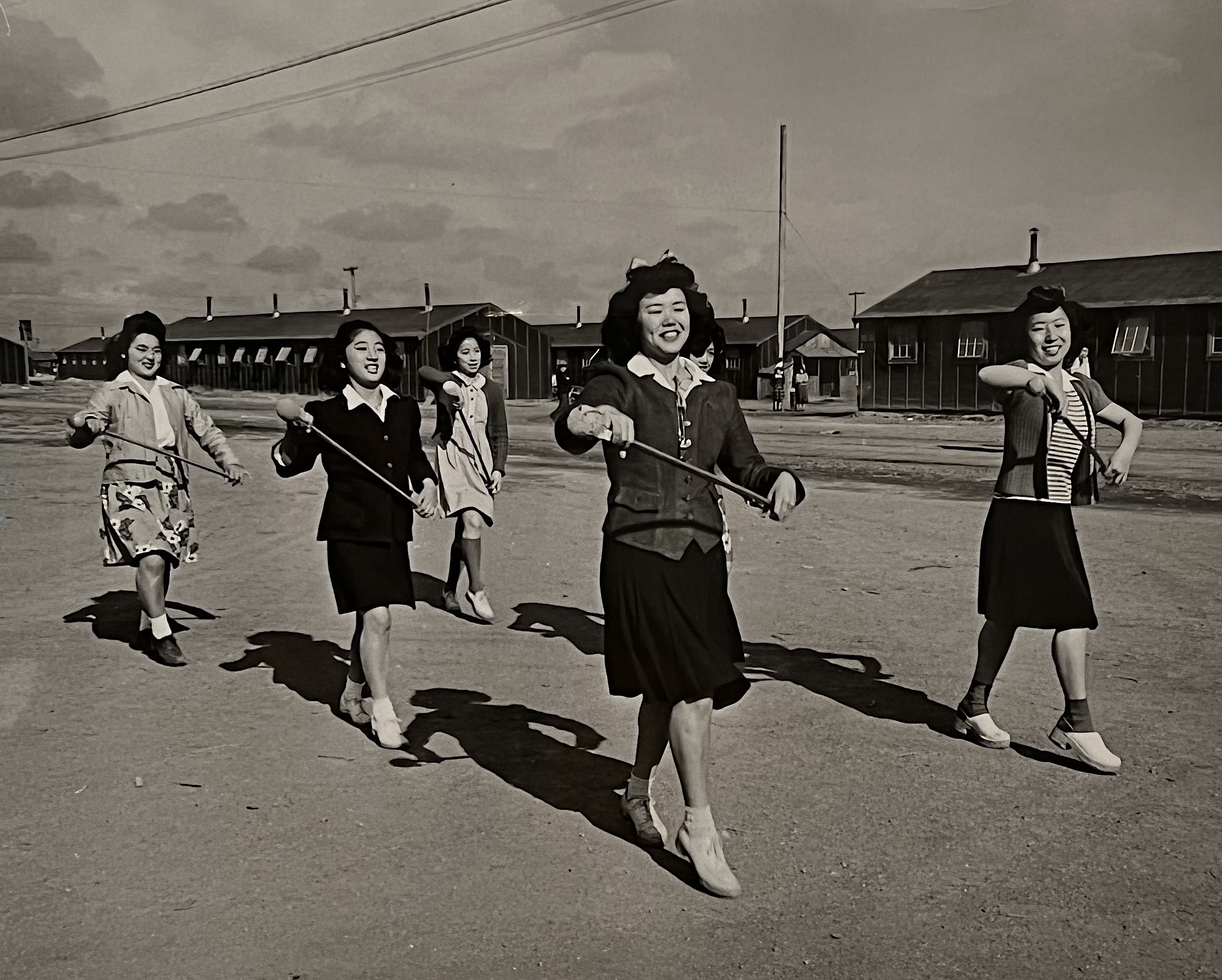
The magazine went to war in the 1940s. Robert Capa contributed an image that, at first glance, might make you wonder why it was chosen given that it’s out of focus. When you realize that it’s an American GI swimming ashore of D-Day in 1944, that blurry shot perfectly captures the frantic chaos of the invasion of France, the grim determination of the soldiers, and the dangers they faced. The magazine also excelled in subtle propaganda during the war. Carl Mydans went on assignment at the relocation camps where Japanese-American were interned as “enemy aliens” during World War II, surely one of the most shameful incidents in this nation’s history. Instead of belaboring sorrow, Mydans gave us seemingly banal shots. That was the point; Mydans normalized Japanese-Americans to underscore that they were as “American” as their jailers.


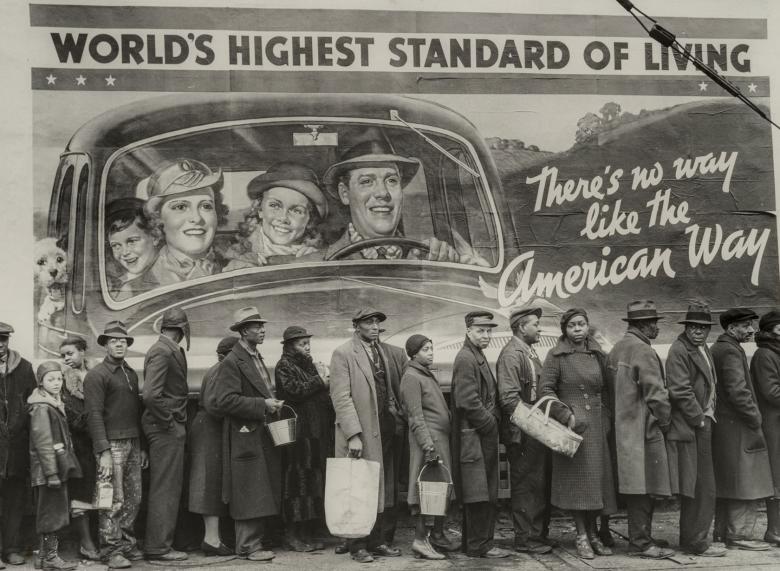
Numerous Life Magazine photos became so familiar that they were mythologized. A lot of history textbooks duplicated a brilliantly ironic Bourke-White image of African Americans standing in a food line. Chances are good it’s labeled a Great Depression breadline. Not so! They were victims of a 1937 Louisville flood. Alfred Eisenstaedt captured the euphoria of Victory over Japan Day in Times Square (1945). Popular opinion holds that it’s two sweethearts kissing; in truth, they were strangers and didn’t meet again until many years later. Such indeed is the power of photography! 


After the war, Life published another famous photographer, Henri Cartier-Bresson, whose people of Russia photos were rare glimpses behind the Iron Curtain. Frank Dandridge’s 1963 “Birmingham Bombing Victim” silently but powerfully portrayed the tragedy and pathos of racism and Neil Armstrong’s image of fellow Apollo 11 astronaut Buzz Aldrin—seen here reprinted in one of the aforementioned commemorative issues –altered the way Americans began to think of their solar system. Life seldom engaged in abstract art photography, but Fritz Goro contributed a stunning look at a red laser light fired through a pinhole in a razor blade. It’s especially stunning given that it was made in 1962.


Call me crazy, but maybe we need to revive Life and assign picky editors to Instagram.


Rob Weir  

11/30/22

The Lioness Over-Populated but a Heat-Pounding Thrill


THE LIONESS (2022)

By Chris Bohjalian 

Doubleday, 315 pages 

★★★ 1/2 


Chris Bohjalian isn’t the most literary novelist in the land, but he's certainly one of our finest storytellers. He does deep dives into background research, a talent he honed when he wrote for the Burlington Free Press back in the 1980s–before Gannett bled it and other dailies dry to divert their assets into Useless Today.


This time Bohjalian takes us back to the hair-trigger Cold War in the early 1960s as it played out in East Africa. Weddings gone wrong are so overdone as to have become cliché, but The Lioness is about a honeymoon gone so far off the rails that Hades would have seemed a relative paradise. It also sandpapers the sheen from varnished celebrity.


Popular actress Katie Barstow tied the knot with gallery owner David Hill and invited her peeps along on a destination honeymoon before that was a thing. Who could resist a luxury guided safari to Kenya? The guest list included her agent and her publicist, Peter Merrick and Reggie Stout respectively, but also three of her closest friends: actress Carmen Tedesco, African American actor Terrance Dutton, and screenwriter Felix Demeter. Katie's older brother Billy Stepanov, a self-help psychologist, and his pregnant wife Margie are also on the A-list. Everyone loves Katie; even though she and Billy were badly treated by their theatre parents, Katie is kind, confident, and bubbly–a mighty mite whose qualities evoke images of Veronica Lake.


Katie’s honeymoon is a let's-look-at-some-wild-animals adventure. Charlie Patton and his crew at Safari Adventures know where to find them, but caution everyone that the savannah is a place where the dead are eaten, not carried home. This is the setup for several jeep loads of circumstances that bump us between East Africa and Hollywood. Most of the book is set in the years1961-64, with flashbacks to childhood and a leap forward to a 2022 coda. In the 1960s, colonialism was collapsing across Africa, but borning independence was not a painless delivery. The fracturing of the Belgian Congo, threats of war between Kenya and the former German Tanganyika, untold numbers of rival tribes, and hostilities in Rwanda (!) made Africa an overripe fruit to be plucked during tit-for-tat Cold War proxy battles between the United States and the Soviet Union.


Patton respected lions, hyenas, leopards, crocodiles, and snakes, but he feared Americans and Russians: 


... they all scare me a hell of a lot more then pissed off rhinos and ornery lions. The rhinos know we are a threat and the lions have learned we can be very risky prey .... But the Russians and Americans? We are just pawns on the chess board. Harmless and expendable.


Consider that remark foreshadowing. Nationalist chaos, global anxiety, Yankee tourists, celebrities, and not-so-buried Western spook activity have all the markings of a hostage situation. But who are the kidnappers? They mockingly assume the noms de guerre of American astronauts Grissom, Glenn, Shepard, and Cooper and sound Russian, but who can be sure? What are the chances your abductors won't kill you once they collect their demanded ransom? When do you decide to take direct action and what should it be? What are the consequences of failure? Or, indeed, of success so far from settled civilization? 


Bohjalian educates his readers yet hides didacticism inside a novelistic structure that sucks us into the drama. Who is the titular lioness? I changed my mind several times before that identity was confirmed! Bohjalian also cleverly appropriates Cold War spy novel tropes such as agents, double agents, moles, and compromised loyalties. He overlays early 1960s norms of masculinity and femininity and what could be justified in the name of patriotism.


This is an ambitious novel, overly so in my estimation. Because Bohjalian has stuffed a lot of characters into a 315-page book, some by necessity must become sacrificial lambs. He similarly telegraphs other outcomes, another casualty of overpopulation. I am less charitable when he slips from early 60s norms and drifts into those of today.


To toss my critic’s hat in the closet, I doubt the above critique will matter to most readers. Bohjalian is simply a masterful spinner of yarns; tell a spell-bounding story and your audience is too invested to notice holes in the literary fabric. Call The Lioness a classic page-turner.


Rob Weir


11/28/22

That Touch of Mink Works on Several Levels


THAT TOUCH OF MINK (1962)

Directed by Delbert Mann

Universal Pictures, 99 minutes, Unrated

★★★★


That Touch of Mink is a charming romantic comedy and a slice of 1962 social values. The United States was in the thrall of post-World War II victory culture (to borrow Tom Engelhardt’s term). For those who came through the Great Depression and wartime shortages, materialism held allure. The mink in the film’s title was a marker of wealth, not a perverse desire to slaughter little brown weasels, hence a mink coat was an object of desire for millions of American women.


Gender roles were quite different in 1962. Patriarchy reigned, women working was perceived as temporary until marriage, the Baby Boom remained loud and prolific, and women pursuing men was commonplace. That’s the way it was; if you can’t take it, tell it to your therapist and avoid this movie. That Touch of Mink is about a society with prescribed roles. Looming on the horizon were the Port Huron Statement, Vietnam, feminism, and other things that shifted cultural perspectives.


You could view That Touch of Mink as the last gasp of a fading value system, or just as a fluffy romp. I recommend the second. It’s a late screwball comedy leavened by the sharp script of Stanley Shapiro and Nate Monaster; that is, lots of snarky badinage, an attract/repulse/attract romance, and improbable situations that make sense within their manufactured contexts. It’s funny!


Cathy Timberlake (Doris Day) is an Ohio-born woman living in New York City and sharing an apartment with Connie Emerson (Audrey Meadows). Connie slips her extra food through the window of the Horn & Hardart automat at which she works, but Cathy needs a job. She is dressed for an interview in full 1962 battle armor: a dress, hose, evening gloves, and coiffed hair. As she walks down the street, a chauffeured Rolls drenches her with dirty water. She is mortified by her condition and that the car didn’t stop. (Hey, she’s from Ohio!)


Actually, the car’s owner, Philip Shayne (Cary Grant) ordered the driver to circle the block but Cathy was gone. Later, he gazes out the window of his high-rise office and sees her going into the automat. He’s a busy executive and has an upcoming meeting, so he sends his assistant Roger (Gig Young) across the street to pay for cleaning her clothing. Mistaken identity occurs, Connie offers bad advice, and Cathy is outraged by Payne’s poor manners.


When she bursts into Shayne’s office to throw the money in his face, though, she is instantly smitten by his good looks and charm. It’s the start of an off-and-on courtship that rockets between giddiness to misunderstanding and back again. Cathy will get a mink and then some. Everything always works out in a screwball comedy, but first obstacles must be overcome, not the least of which is Cathy’s fear that Shayne is trying to bed her.


Screwball comedies without topnotch actors seldom work. No worries. Cary Grant was arguably the best screwball actor of all time. Who could wine, dine, beguile, and be silly better than he? Doris Day is also terrific. She walks a tightrope between naiveté and self-confidence, all the while swaying this way and that with superb comic timing. It’s the kind of role Marilyn Monroe might have taken, but Day was a superior talent.


The secondary roles are equally sharp. Gig Young is hysterical as the self-flagellating Roger, who left Princeton to work for the “evil” Shayne who tortures him with raises, a pension, and benefits! He’s so “miserable” that he sees a distracted therapist (Alan Hewitt) who pumps him for stock tips, mishears, and thinks Roger is gay.* Young gets some of the best lines in the film and he makes the most of them. Audrey Meadows shed her Honeymooners role as a doughty housewife, but retained her tart tongue. There is also a chewy role for John Astin–who later attained fame in The Addams Family­–as a sleazy suitor for Cathy’s affections. Even Mickey Mantle, Roger Maris, Yogi Berra, and umpire Art Passarella got into the act in a cameo diversion with Cathy and Payne sitting beside them in a Yankee Stadium dugout.


In all, That Touch of Mink is pure gold. Gold was $35.35 an ounce in 1962, about $328 in 2021 dollars. Great deal! Buy it! Gold now sells for nearly $1,760 and you can get a really nice coat for that.


Rob Weir


* Yes, humor was wrung from gayness in 1962. But that was a good thing, as movies subtly helped change perceptions. They helped in the evolution from being an illegal “perversity” to a humorous condition, and (eventually) acceptance.