5/16/25

The Quiet Librarian Worthy of Its Hype


The Quiet Librarian (2025)

By Allen Eskens

Mulholland Books, 305 pages.

★★★★★


The Quiet Librarian has been highly acclaimed and deservedly so. It is moving, tragic, and deceptively titled. Its main character, Hana Babìc, is indeed a cardigan-wearing cataloger living on a farm outside of St. Paul, Minnesota, but she’s so much more. Her colleagues like Hana and assume she prefers a quiet life, but even that’s not quite right.


This new novel from Allen Eskens takes us back to the 1990s when Yugoslavia dissolved and independent nations such as Bosnia-Herzegovina, Croatia, Macedonia, Serbia, Slovenia, and Srpska emerged. You might think that growing up Yugoslav would bind citizens no matter what flag they flew, but that’s not what happened. The former Yugoslavia exploded amidst sectarian violence defined largely by religion and ethnicity. Some of the worst violence took place in 1995, when Serbia (Eastern Orthodox) abruptly shelled Tuzla in Bosnia (Muslim), and killed 71 people; shortly thereafter the Serbs entered Srebrenica, rounded up more than 1,000 boys and men and slaughtered them. Eskens’ book is a work of fiction, but he adroitly revisits the sorrows of Bosnia thorough a powerful tale with teenager Nura Divjak as his foil. She grew up in a town of both Christians and Muslims, Serbs and Bosniaks. She attended a school that was primarily Serb, but few thought of her as a Muslim. Her little brother Danis’ played with a Serbian boy, Luka. In 1995, though, Bosnia and Serbia were at war and former neighbors Luka, Stanko, and Zorvic return to murder the Divjak family and burn down their home. Only Nura escaped by hiding in a crawlspace, though her arms were badly burned in the fire.


If you think the Serbs were brutal, they came to rue the wrath of Nura. She transforms herself as a veritable teenage Ninja to hunt down her family’s killers. At least that was the plan–before she becomes a spy and solider in a Bosniak unit. Such is her fierceness that she is known as “Night Mora” and a price is on her head. In Slavic mythology, Mora is a dark, beautiful woman who visits men in their dreams and then kills them. You might notice that “mora” is close to the English “mare,” as in nightmare.


Eskens employs an every-other-chapter structure of “Minnesota After Everything” and “Bosnia 1995 (or 1977or 1992).” So what’s all this have to do with a meek Minnesota librarian? Hana is drawn into her own nightmare when her best friend in the world, Amina, falls out of a window to her death. Or was she pushed? One witness says a man was at the window. Hana’s immediate concern, though, is for Dylan, Amina’s grandson, Dylan. Hana always promised to take care of him if anything happened to her. He is too young to remember his mother, who died six years earlier. It’s one thing to be a godmother in the abstract, but the independent Hana has never married and is vague on what raising a pre-teen means. Nor is she psychologically prepared to be drawn into an investigation led by Detective David Claypool.


As I have noted in other reviews, novelists often remind us that wars don’t simply end when a treaty is signed. (And isn’t it a pity that fiction writers understand this better than policymakers, generals, and conscience-challenged soldiers?) In a proverbial flash, Hana faces mourning, substitute motherhood, a creep who might have been Amina’s executioner, developing feelings for a detective, worries about her immigrant identity, and haunted by her own past. If you have read this far and are thinking romance, heart melted by a little boy, and being drawn into a world of violence, that’s not quite right either.


The Quiet Librarian is partly about trust, but it’s also a heart-pounding thriller, a mystery,  and a hall of horrors. Don’t even think of trying to read this book leisurely; it’s more like a two-day obsession, a proverbial page-turner. I suspect this book will be optioned for a movie very soon, but shame on you if you watch the TV version or wait for the movie. If it’s not on the shelf, ask your local (yes!) librarian to score an interlibrary loan copy for you.


Rob Weir

5/14/25


Edvard Munch: Technically Speaking

Harvard Art Museums, Cambridge, MA

Though July 27, 2025


I’ve not made an exhaustive study of this, but I suspect that Edvard Munch (1863-1944) is the most famous painter in Norwegian history. Who does not know “The Scream” (1893) or the slightly less famous “Ashes” (1894) and “Vampire” (1895)?


You’ve probably noticed that in museums these days that you can buy posters, postcards, coffee cups, t-shirts, and all manner of gear bearing images originally created by famous artists. There are those who call such things tacky, but in truth the horse left the barn as soon as it was technically possible to reproduce such works. A current Munch exhibition at the Harvard Art Museums explores the technical aspects of his “branding,” as it were.


Of course, in Munch’s time reproduction was technologically more difficult, no one wore art-shirts, and adorning something as practical as a coffee mug with a famous painting would have been considered crass. That said, if you look at what we do today it shares a characteristic with Munch’s reproductions: the quality varies tremendously in accordance with the materials, machinery, and tools used to create them–not to mention the original source used. (Was it a painting by someone trying to recreate the artist’s style? A line drawing? A copy of a copy in a book?  A chalk study? An earlier work that was altered in the final version?)  


The most common forms of reproduction in Munch’s time were woodcuts and lithographs; that is, one carves a wooden surface, inks the colors separately, and presses it onto another material (paper or linen usually), or etching a stone and doing the same. Each has its virtues–I sometimes like woodcuts better than the painting–but it’s hard to capture the exact colors the artist used with ink or prepare the surface carefully so it doesn’t smudge, run, or dry too fast.


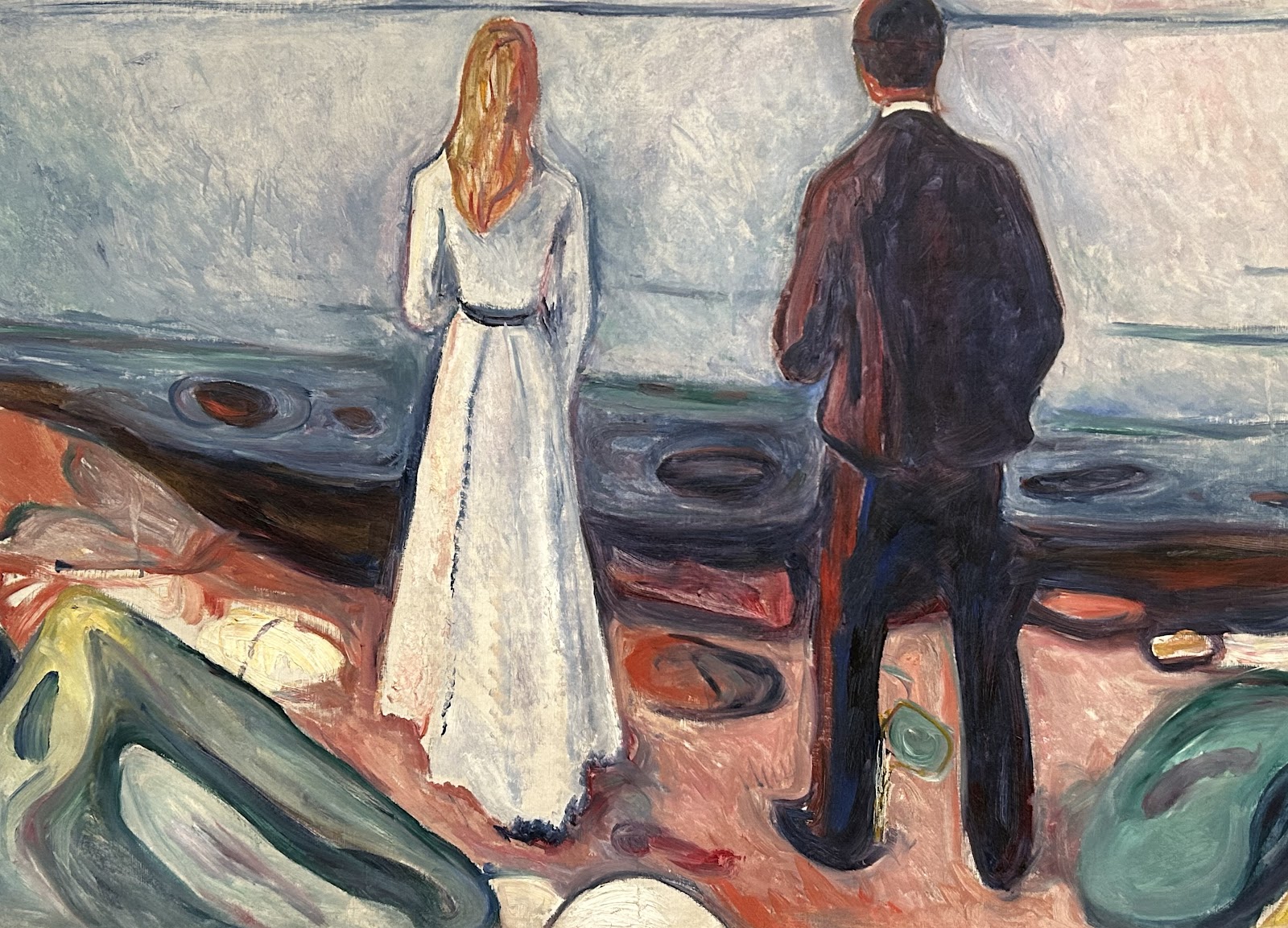
Munch was like a writer who does multiple drafts. Consider “Two Human Beings (The Lonely Ones)” (1906-08). He originally did a painting in 1892 that was printed. The first painting was destroyed and he worked on a new version from 1906-08, but reversed the position of the man and the woman. Scholars believe he did so because he worked from a woodcut of the original. 


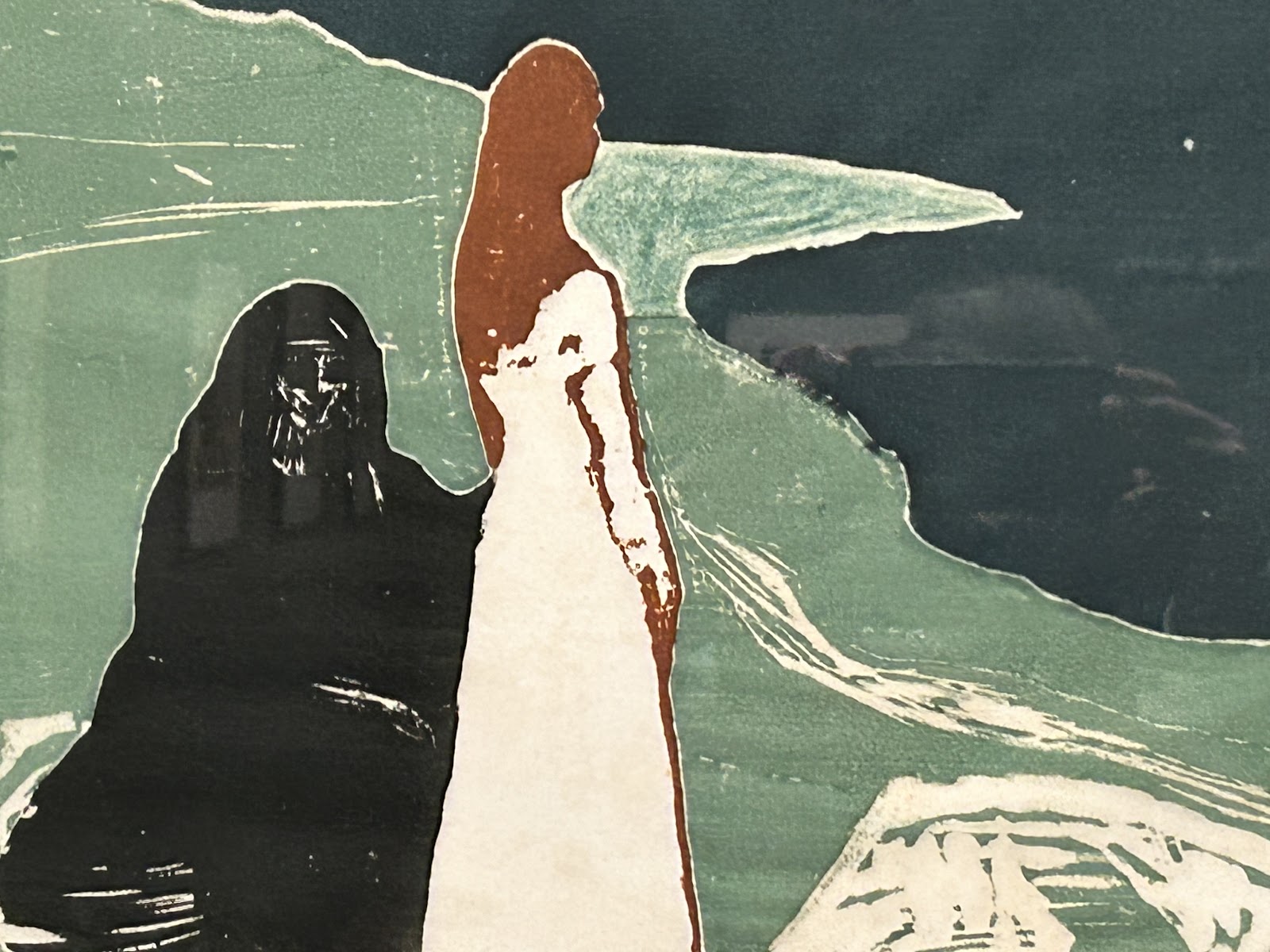
“The Seashore” isn’t one of Munch’s better known works, but if you look up the original you’ll see that it is of an old woman and a younger one on a beach. In the lithograph (probably unfinished) the older woman looks like Death and her features are indistinct. If you’re not sure what a lithograph looks like, here’s one and it’s a substantial chunk of rock. 


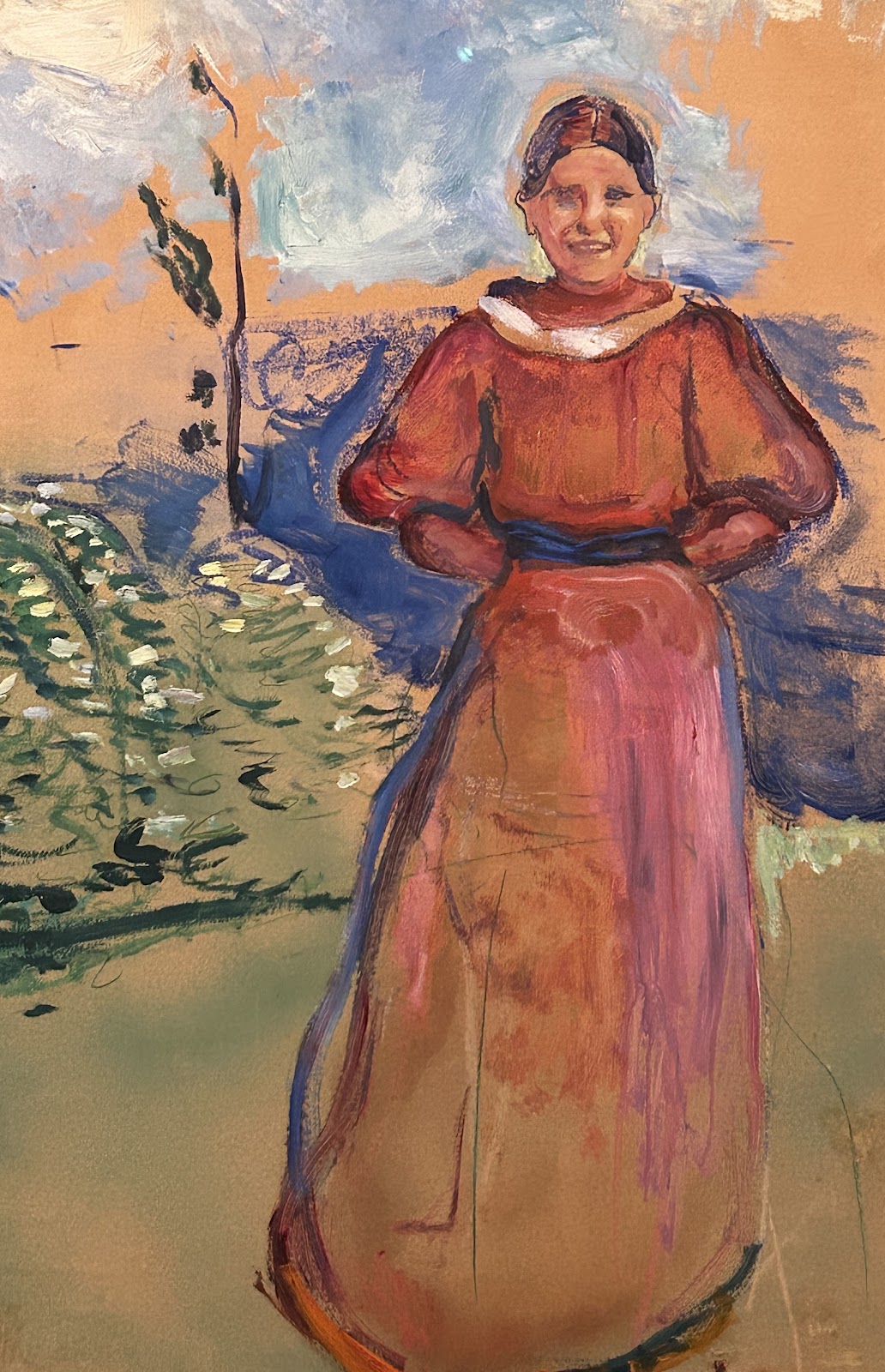
Speaking of rough drafts, Munch did this “Inger in a Red Dress” (1894) on a piece of cheap board. (Inger was a photographer and his youngest sister.) It’s quite different from the final painting. This one was done with wet-on-wet painting and was done when he was just beginning to make prints. You might (sort of) recognize this Munch lithograph. It looks a bit distressing, but the painting was titled “Madonna.” Not all versions of the prints looked all that that divine! Some had the child (embryo?) in the lower left and many did not. Munch made multiple versions as if he were tinkering with mood and subject.  


As x-ray radiology proves, “Winter in Kragero” (1915) was altered numerous times. Is finished? Unclear. Was it intended for some other purpose? Very possibly. It bears similarity to an earlier oil painting, “Old Fisherman on Snow-Covered Coast” (1910-11), though it too has been painted over and the fisherman bears resemblance to a woodcut he did of his neighbor. 


This self-portrait  gives pause for thought as well. It’s a woodcut; Munch did many of himself, but each has an unfinished quality about them. Did he do this for effect? Self-loathing? Did he just lose interest? Because the print would be more dramatic? Again, it’s a conundrum, but cheap reproductions–sometimes called “chromos”–were quite popular among the masses and it’s usually a good idea to follow the money! 


This Munch exhibit reminds us that past technology and that of the present also share similarities of intention and marketplace pressures. We claim that we can do a lot more things today–if we can find the time to do them. I suspect Munch would agree.


Rob Weir

5/9/25

Music for April and May 2025: Michael Rudd, Ron Pope, Grey DeLisle, Mary Bue, Mar Grimalt

Mary Bue


Faithful readers will notice that my posts have been delayed lately. It’s called “being on a book deadline.” Here’s a music column as I didn’t get one written in April. That’s okay, though, as things usually get a little slower in the spring.


One of the better projects I heard was from Michael Rudd. His path has been a bit twisty. He became a teacher and has been in New Mexico, Massachusetts, New Jersey, and back to New Mexico, where he’s now a principal at Acoma Pueblo, an indigenous adobe settlement atop a dusty high mesa. At some point he began to hear songs and tunes in his sleep. His second solo album, Going to the Mountain contains some of the results from his trip to the liminal side of things. The title track is a Western song that bespeaks his twisting path to full humanity. It opens with the words I know where I’m going/’Cause I know where I’ve been but if that sounds pretty tranquil, hang on. It’s also about a guy always searching for something. It’s a very western song; note I didn’t qualify it as “country.” It’s big and open like his gravelly voice and is as honest as a lot “country” is overly processed. “Before the Demon Comes” is in the same vein. He rocks out on The Far Side.” The thing about dream songs is that they take you to unexpected places, so be prepared to travel.


Ron Pope has been around a bit too. He comes to us from Nashville via Georgia with a stop at NYU. He and his wife (Blair Clark) founded Brooklyn Basement Records and, if Pope’s name sounds familiar, he scored big time in 2007 with his platinum hit “A Drop in the Ocean.” He hasn’t slowed down a bit. Pope has released two dozen LPs and EPs, has toured, and he and Blair are raising a daughter. Depending on who is telling the story, his music is either Americana, country, or folk. Pope’s most recent LP is titled American Man, American Music, which is as good a label as any as he’s never quite what you anticipate. “Klonopin Zombies  suggests social commentary on drug abuse, but it’s actually a personal song about how he was not in a good place after his grandmother passed away just eight days after her husband died. As you can see from the live performance, he’s a hard-working musician who’s unafraid to delve into topics mystical, painful, or sublime. Re: the sublime, Pope gives us “In the Morning with the Coffee On,” a love song centered on joyful small things. In a duet with Taylor Bickett, “I’m Not the Devil” he reminds us that he’s a good guy. Yet he also sings about veering from the straight and narrow on “Mama Drove a Mustang” whose blancmange  of rock, bluegrass, and country is atypical for someone with a voice as robust as his. Good stuff.


Grey DeLisle is a comedian, songwriter, and voice actress (Scooby-Doo! DC Comics, video games, etc.) As a singer she once did a tribute project to June Carter Cash, so it won’t surprise you to hear that her new project The Grey Album is a country album or, that as Los Angeles-based artist, she’s unabashed of having been married and divorced three times. DeLisle tells us rockabilly style, “I Can’t Be Kind.” She also sings “Hello, I’m Lonesome,” “Daddy Can You Fix a Broken  Heart,” “The Last Last Time,” and “I’m a Wreck.” In other words, DeLisle is from the old-fashioned heartache tradition of country music. As you will also hear, her vocal styles are insouciant, saucy, and an independent spirit. Credit her with the verve and nerve that gives us the term moxie. 


Mary Bue is another woman of many talents. She is a yoga devotee, has studied psychology, was hailed in 2020 as the best songwriter in Minneapolis, and has made her own Beatles-like pilgrimage to India. Her recent album The Wildness of Living and Dying is like a musical mind meld of her interests. It has themes of what she calls “world-sorrow” plus eco-awareness, expanded consciousness, and a potpourri of styles ranging from “piano poems” to electric instrumentation. The title track is heavy on dark keys and steady drumming, which make a fine contrast to her lovely voice. “Bedding Down with the Deer” has elements of Joni Mitchell in her younger, earthier days, though Bue takes full advantage of today’s mixing capabilities to backfill it with atmosphere. Be sure to check out “The Bones and the Marrow” video to capture Bue in a whirlwind of kinetic energy. She spends most of the video running and imploring us to stand tall amidst the tall pines within an electric arrangement spotted with sing-song mini raps. Mary Bue has (literal) down-to-earth values but she’s no head-in-the-sand blind optimist who is sure things will self-repair. This is her 9th album and watching the video helps me understand where all her energy comes from.


Mar Grimalt is a vibrant singer from Mallorca, one of Spain’s Balearic islands. Her album Espurnes I coralls translates “Sparks and Corals,” and that song alone shows us that when you have vocal talent to spare you can create magic with nothing more than a melody and a frame drum. Call her voice the spark and the malleted drum its hard coral contrast. She can also pick up a guitar and pick out “Cançò Final,” a cançò being a folk song in a style linked to 13th century troubadours. Grimalt sings as a woman sews in the background. Mar Grimlat won’t floor you with power or flashy technology. She has been quoted as saying that we often fail to appreciate what we have because it “weighs us down like tons and tons of concrete.” She should know; her family operates a concrete factory. She’s so retro that that “Reculls des versos” is again voice and frame drum and all the echoes and synth you hear were added in post-production.


Rob Weir


5/7/25

Small Towns: Buckland/Shelburne Falls, MA


I’ve long had a soft spot for the small towns of Buckland and Shelburne Falls, Massachusetts. Undoubtedly, one reason is that they seem more like Vermont towns than anything most people associate with the Bay State, which is pretty much true of most of Western Massachusetts. Buckland has 1,816 residents and is more spread out because of its agrarian past. It’s perhaps most famous as the place where Mary Lyon (1797-1849) lived. She was the founder of Mt. Holyoke College in South Hadley, 33 miles southeast of Buckland.


There is still a house in Buckland that calls itself the Mary Lyon House, but it’s one in which she lived, not her birthplace. It’s now a private residence and, needless to say, has been updated considerably since Lyon lived there. Her Congregational Church, though, still exists on Upper Street. That name says it all. Buckland and Shelburne Falls lie in the Berkshires foothills. Buckland has a village center of sorts with a Grange Hall, a post office, and a tiny historical museum, but what most people consider the middle of Buckland isn’t. If you travel from the south on Route 112 you make an odd loops-back-on-itself turn just before you come to Route 2 and drive a short distance with the Deerfield River on your left. At that point, you’re still in Buckland unless you cross the river, at which point you’re in Shelburne Falls. There are shops on the Buckland side with their backs to the river and just before you cross over you’ll see McCusker’s, everything you’d expect a village grocer to be and a point of local pride. If you can, though, travel just beyond the bridge for Buckland’s only real attraction, the Trolley Museum. At present, the museum isn’t open, but you can walk among some of its waiting-for-restoration stock.


Last trolley built in MA (1951)           


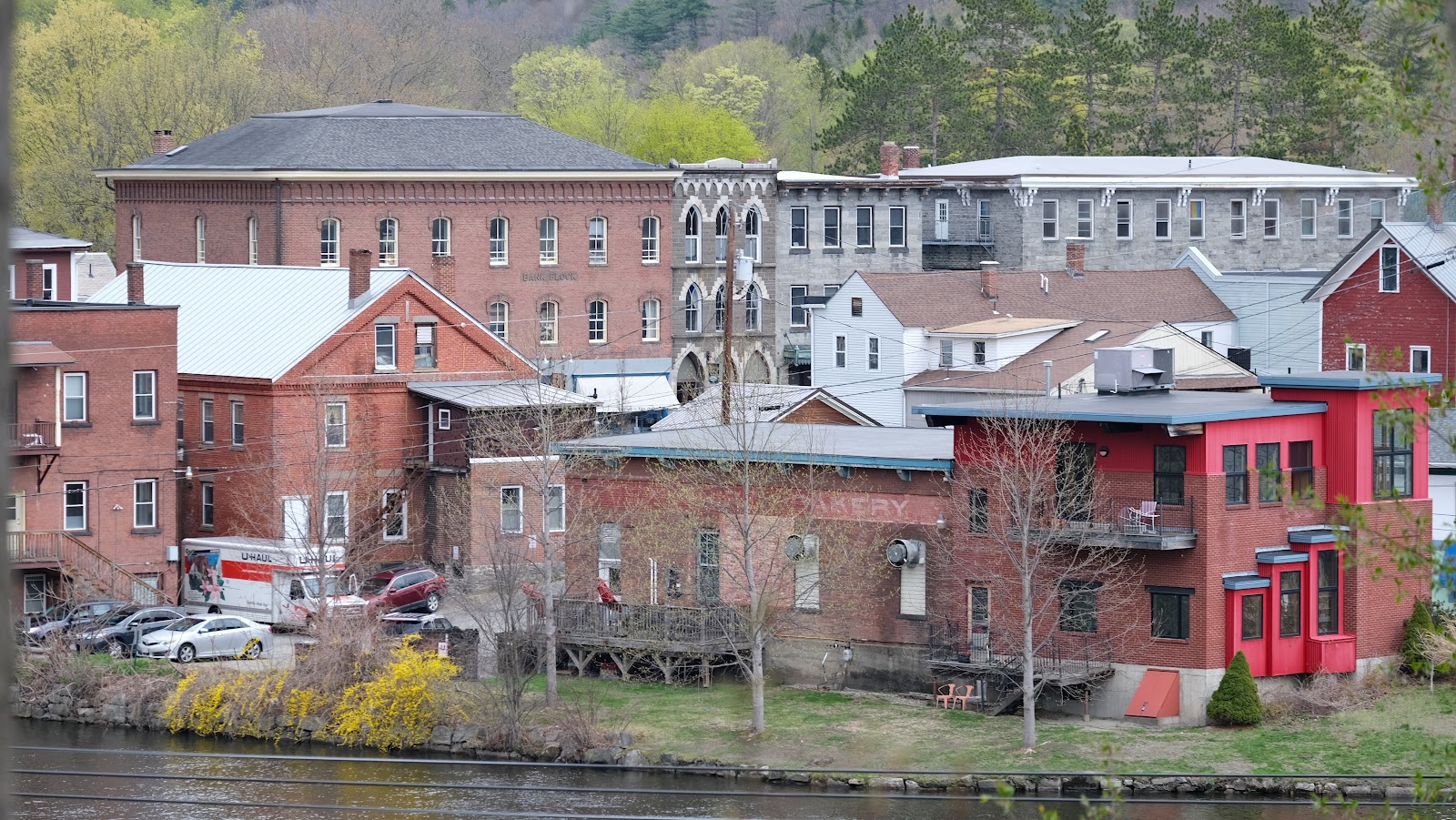
The compact village of Shelburne Falls (pop. 1,731) is where most people head. It really feels like small town Vermont. Its one-street main drag has angled-parking, shops, cafes, and art galleries. The auditorium in the village hall is used for community events, concerts, and a summer second-run movie series. Though you might not expect it, the Gypsy Apple has a reputation for being a superb French restaurant. 


Truss bridge in foreground; old trolley bridge behind it 


Shelburne Falls from Buckland side of Deerfield River  


Trolley bridge reflected in river; Buckland seen upside down  


Blooms on Bridge of Flowers


Spring Run Off


"Downtown"Shelburne Falls


Shelburne Falls has some quite lovely homes as you head towards Route 2, but that’s not why visitors come here. Its four-star attraction is slated to reopen soon (though check before you go): the Bridge of Flowers. Shelburne Falls is red brick and stone to Buckland’s wooden frames. Small industries, especially those devoted to Silas Lamson’s all-things-that-cut factories–he gets credit for the curved scythe–explains its different feel. People used to commute via trolley from Greenfield to the east and Charlemont to the west. The Bridge of Flowers was once where the trolley crossed the Deerfield River, though its capacity was such that heavy trade goods often had to be offloaded and taken across the truss bridge that now carries traffic. The trolley went bust in 1927, but two years later women’s clubs put loam beds on the old span and the Bridge of Flowers was born. It’s a gorgeous 400’ walk through seasonal plantings from May through October (or beyond), a riot of color against the backdrop of the river.


The Deerfield River has added bonuses. It makes a big bend and spills down a rocky waterfall and a side hydroelectric dam. When the river levels are high or the dam is doing its thing, it’s a roaring mini Niagara. Plus, there are glacial potholes carved into multi-colored metamorphic stone. 


Nearby is another village treat, a candlepin bowling alley. That facility might be the oldest continually operating bowling facility in Massachusetts, but even if it’s not, candlepin bowling is a blast. No one has ever rolled a perfect game and even seasoned pros know the agony of a well-rolled ball that chops straight through and knocks down two pins! Unless you are a pro you just can’t take candlepins seriously. Few novices break 100!


Outside the town you can challenge yourself with a hike up High Ledges Trail to see how the Deerfield has carved a valley through the hills and if it’s a clear day you can see deep into the Berkshires. You can refuel by driving on Route 2, the Mohawk Trail, toward Greenfield. Western Mass has six Shelburne Falls Coffee Roasters outlets, but its Ur store is on Route 2, a few miles from the village center. Do a little digging and you can detour past a large stay-out compound that is the home of Bill Cosby, though locals are more proud of war tax resistor Randy Kehler. When I say Shelburne Falls has a Vermont feel, it’s not just because the Deerfield River’s two branches originate in the Green Mountain State, it’s also its countercultural/nonconformist vibe.


Rob Weir

5/5/25

Swift River: Decent Debut


Swift River (2024)

By Essie Chambers

Simon & Shuster, 304 pages.

★★★


Swift River, the debut novel from Essie Chambers, is sure to be a crowd pleaser. Chambers has a great story to tell, even though her novel suffers from a common problem of new writers in trying to do too much and thereby shortchanging readers on the detail needed to clarify.


Hers is an intergenerational tale set in 1980, 1987, and 1915. Though the novel goes back and forth in time, Chambers often plays loose with time periods. At its center is nine- then sixteen-year-old Diamond Newberry. When her father Rob(ert) vanishes when she is nine, she is left as the only biracial person in Swift River. The only clues to Rob’s disappearance is that was accused of theft and left his wallet, license, a seed packet, a grocery list, and his shoes by the riverbank. Did he commit suicide out of shame? Diamond’s white mother, Anna, assumes so, though Diamond has dreams that he’s alive and has an entirely new family nearby.


Those in Western Massachusetts know Swift River as a short (32 miles) tributary of the Ware River known for trout fishing. Chambers appropriates the name for both the river and her small town. Given Chambers’ local connections, one could play guessing games. Dalton? Cummington? Goshen? Stop. Chambers spent much of her youth in Greenfield and is an Amherst High alum, even if her Swift River feels like an amalgam of Berkshires hilltowns. Anna suffered unspoken ostracism for marrying Rob and when he is gone, she goes into a downward spiral of unemployment and delusion. As for Diamond, she’s way smarter than most of her peers and doesn’t really think of herself as unusual until she hits her teen years. About all she knows of blackness is from TV characters such as Thlema Evans (“Good Times) and Wezzy (“The Jeffersons”).


By the time she’s 16, she can no longer ride her bicycle as, at nearly 300 pounds, she’s grossly obese. She’s also aware of her ramshackle home, trips to Goodwill for clothing, and long walks as her mother has a car but doesn’t drive. Chambers relates these matters, as well as Anna’s grandiose expectations associated with collecting Rob’s life insurance policy should he be declared legally dead, with poignancy mixed with humor. Some may wonder if they lend themselves to chuckles. Diamond finds herself with few friends other than “Fat Betty,” the local librarian and Shelley, an unorthodox white peer.


The first part of Swift River reads like a narrative peppered with memories, but the novel’s revelations come in the form of an epistolary novel (one told through letters). Diamond discovers a lot about why Swift River is so white via correspondence with her Aunt Lena, an Atlanta nurse. Even much of those come back to Diamond third hand via letters from Clara, Lena’s mother. Call Clara the 1915 part of the novel. This is how Diamond learns about “The Leaving,” when African Americans left Swift River en masse. Chambers turns usual narratives of black history upside down. The Great Migration (circa 1910-70) is the name given to black flight from the South to the North, but this Leaving is a flight in the opposite direction. So too is the notion of a “sundown” town, a warning to blacks not to be on the street after dark. In all of New England, only Groton, Massachusetts, and Darien, Connecticut, were ever considered sundown towns.


It's not entirely clear why Chambers pulled this switcheroo. It’s possible that she wanted to contrast Diamond’s unfolding racial awareness by juxtaposing it against her childhood naiveté, or that by the 1980s the promise of Lyndon Johnson’s Great Society was unraveling. Either way, though, a deeper explanation is needed, especially given that Clara did not leave Swift River. Clara is underdrawn and comes off as more of a device than a fully realized character.


Diamond, though, is so memorable that I think many readers will overlook the holes in the narrative. It still baffles me, though, why Chambers made her obese. What we are to think of that attribute? Does she just happen to be fat or is she being fat shamed? I sincerely doubt Chambers was aiming at the latter, but she leaves us with an open-ended coming of age story.


Rob Weir

5/2/25

The Last Ferry Out Will Likely Satisfy NA Readers


The Last Ferry Out (May 2025)

By Andrea Bartz

Random House Publishing–Ballantine Books, 320 pages

★★★


Mysteries and thrillers frequently parallel Alfred Hitchcock movies in that most have details that defy logic and probability. As Hitchcock observed, if you do the details well, your audience won’t notice. The new Andrea Bartz novel The Last Ferry Out works well as a heart-thumping thriller, but is marred by too much foreshadowing and forced resolution. It partially redeems itself by exposing the flaws of internalized colonial thinking.


Bartz’s protagonists are Abby and Eszter, a couple who met at the University of Wisconsin and, at age 27, became engaged. They are besotted with each other, though they are an odd couple. Abby grew up with an indecisive alcoholic mother, couldn’t wait to be out on her own, has minimal contact with her mother, and is an extrovert who goes hard (sometimes too fast) at things she wants. Estzer is a child of a successful Hungarian/Jewish immigrant family, but is introverted, analytical, and deliberate. Her parents don’t outwardly condemn her choices, but give little outward sign of agreeing with them or of embracing Abby. This enrages Abby, who reminds her beloved that she is an adult who doesn’t need their permission to get married. To Abby’s chagrin, Eszter wants to have a relationship with her parents.


Both young women are socially conscious. Eszter’s portfolio project at UWI–the feasibility of pairing those with resources with those without by opening a hybrid high-end resort that subsidizes low-income housing–evoked equal parts admiration and skepticism. Insofar as Abby knows, Eszter abandoned it as impractical. She tells Abby she is going to Miami to think things through. Abby, in turn, imagines that Eszter is getting cold feet. Has her father talked her out of getting married?


Bigger shocks await. Abby has actually gone to Isla Colel, a Mexican island off the Yucatan peninsula. (It’s an invention, though it shares some physical characteristics with Isla Mujeres near Cancun.)  Abby is devastated but filled with questions when she discovers that Eszter died of anaphylaxis there after accidentally consuming orejas cookies that contained nuts. Where was her EpiPen, which she so assiduously carried everywhere? Why didn’t she write and where is her journal? Why did Eszter lie to Abby about her whereabouts? Abby is inconsolable, hence she puts her job on de facto hold to go to Isla Colel, grieve, and investigate.


The bulk of the novel takes place on the island, which holds surprises of its own. The titular ferry to the mainland only runs once a week. It was once a tourist destination until a hurricane blasted its infrastructure. It is now home to an offbeat, tightknit assortment of expatriates, and locals who don’t find them as charming as they think they are. The oldest emigrant is German-born Rita, who acts as an experienced elder to the non-native community. Among the others on the island is hyper-sensitive Brady, who left his homophobic home in Australia; LA-born naturalist Pedro; and Amari, a gorgeous lesbian. The expats are carefree and gay-positive, as if a band of 20th century hippies were crossed with 21st century college students. (One wonders if Bartz intended her title to be a faint pun!)


 Most of the ex-pats rent from grumpy islander Gloria, whose husband Esteban is a fisherman whose fair-weather boat is one of the few private vessels on Isla Colel. He holds his views inside, but it seems as if everyone on the island holds secrets of one sort or another. Thus, Abby’s search for answers runs up against what is not said, temperamental WiFi, diversions, bad weather, Eszter’s lies, and dissuasion. Abby is suspicious of everyone she encounters, but how does one investigate without trusting someone or hastily jumping to conclusions?


NA (new adult) readers will probably find The Last Ferry Out satisfying and sensitive. As an older reviewer, I admired the strong framework Bartz established and her attempts to normalize non-heterosexuals. Yet, I also felt that the novel packed less wallop than it should have. There was too much petulance from major characters old enough to know better, and too many telegraphed clues and coincidences. The post-island revelations perhaps soothe, but they made me think of Hitchcock’s warning.  


If Bartz’s target audience is indeed the NA sector, The Last Ferry Out is the ticket aboard. Older readers, though, may long for something–for lack of a better term–more literary.


Rob Weir


4/28/25

What's On at the Rose Art Museum


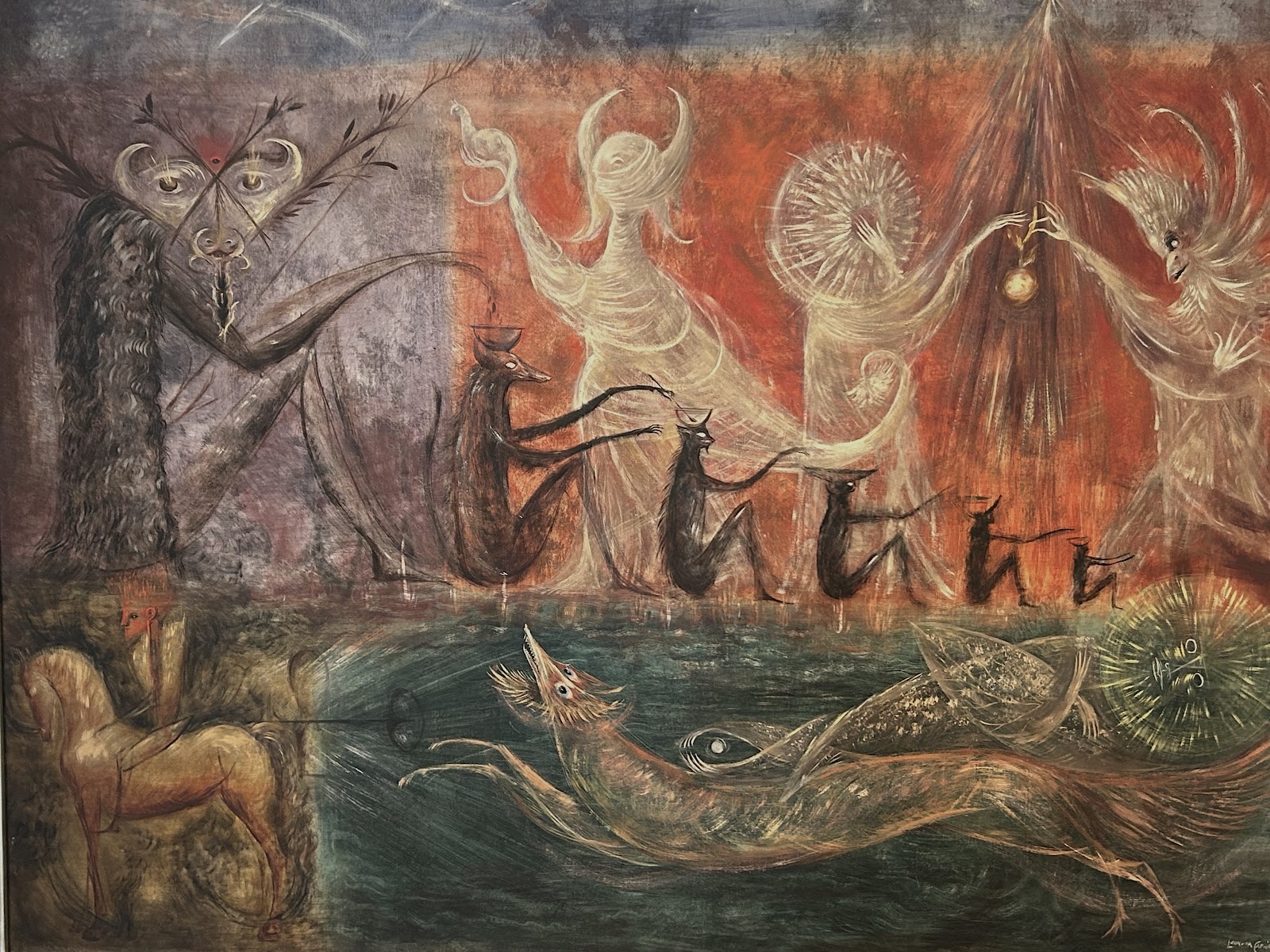
Carrington, The Last Resort (homage to Mexico?)


Leonora Carrington: Dream Weaver

Hugh Hayden: Home Work

Surrealism Then and Now

(All through June 1, 2025)

Rose Art Museum, Brandeis University

415 South Street, Waltham, Massachusetts

Wednesday-Sunday 11-5


I had never been to the Rose Art Museum or the campus of Brandeis University before. Although it’s inside Route 95/128 and is now considered a Boston ‘burb, you pretty have to drive to it as the MTA won’t get you near enough. If you go on a weekend, though, it’s an easy drive back to Alewife where you can stash your car and ride the Red Line into Boston. I took a chance and drove into Harvard Square where, miraculously, I found a parking spot. 


Pastoral 1950. Note the wink to Manet's dejeuner sur l'herbe


The main objective was the see paintings and drawings of Leonora Carrington (1917-2011), who was born in England but spent most of her life in Mexico. She came from wealth but rejected bourgeois society and English culture but, then again, there wasn’t much she did rebel against. She was influenced by German surrealist Max Ernst and upon meeting him, the two became lovers that very night. 


Nephesh as the Soul in a State of Sleep (dreams, the soul, the Kabbala all in one!)


Carrington is often considered that last of the surrealists, though that’s a problematic handle and many consider her more of a symbolist like Paul Gaugin or Odilon Rédon. There’s quite a lot of that in Carrington’s work, her major themes being nature, animals, myth, and the female body. (She would later identify with women’s liberation.) Yet her work also fits surrealist ideas of dreams, emotions, and the subconscious mind with all of its illogic and troubling aspects. Unlike most surrealists, though, she had no interest in Freud; like some of them, she had a psychotic breakdown (treated with electroshock, and barbiturates), and like many sought asylum in Mexico during World War Two. She and Ernst split when he was arrested by the Nazis as a “degenerate.” Peggy Gugenheim got him to the United States and married him! Carrington took up with a poet, whom she married and divorced.


Here are a few more works on display at the Rose. In my mind it doesn’t matter if she doesn’t fit snugly in any art movement. She was fiercely independent and I suspect she was doing her own thing, as we used to say back in the day.


Nunscape at Manzanillo  


Noah's Ark. (He has too many deer!)    


uuuuuuuuuuuuuu uuuuuuuuuuuuuu


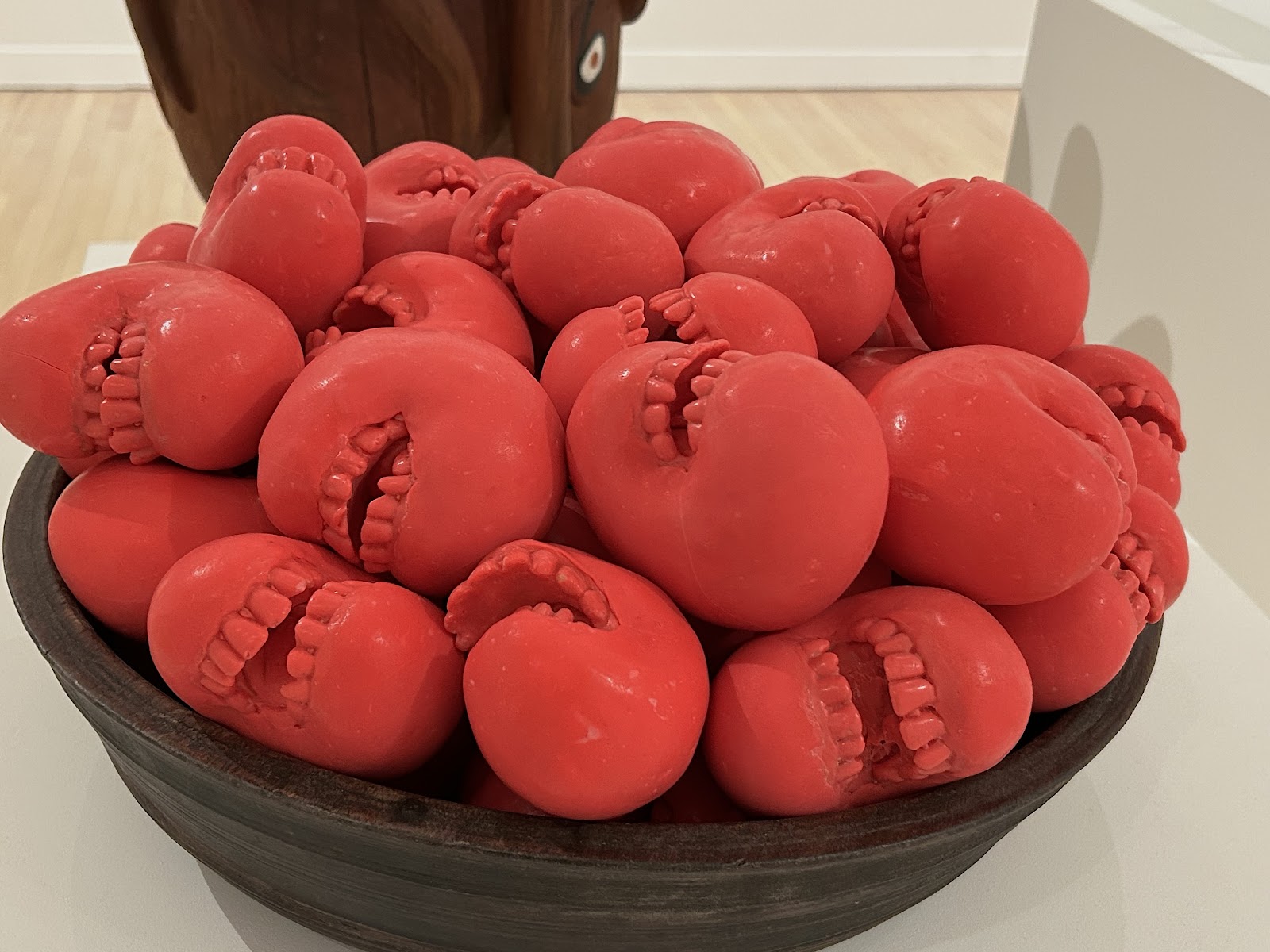
The Rose is, however, spotlighting surrealism in a broad sense. Also on display is the intriguing work of Dallas-born Manhattanite Hugh Hayden (1983-). His acclaimed Home Work series shows him working in his favorite medium, wood. He adorns desks in thorns and branches growing on them and through them as if the desks are the Ur root of a living thicket. Hayden enjoys the irony and whimsy involved in taking familiar objects and transforming them.


He doesn’t always work in wood, though. Another series involves taking cookware and making them into masks, displaying bones as a playful take on “American Gothic,” or make think of Siberia through the use of a small hut and a several big mirrors. I suppose we could label this surrealism, though we might just want to call it clever.  


As a boy he was encouraged to participate in sports, which he hated. I’m pretty sure these works fall into a category best called “revenge!”


uuuuuuuuuuuuuu uuuuuuuuuuuuuu


Surrealism Then and Now seeks to take surrealism out of the past and into the present. It was my least favorite exhibit at the Rose for the simple reason that I found myself spending more time appreciating the old “masters,” if you will than newer works we might read as surrealist. It’s a compact display, but it perhaps doesn’t do justice to hang younger artists in the same gallery as De Chirico, Ernst, Sage, Tanguay, and Kahlo. (For the record, Kahlo never identified as one.)


I get it that curators want to unbind surrealism from a specific moment in time. As a historian rather than an art historian, I think it’s a discussion worth having, but I generally end up feeling that most movements should be placed amidst their historical circumstances. Most of what I saw was trying too hard to be seen as surrealism and hence seemed derivative. But here are several that work. 


Gregory Crewsdon, Ophelia


Rona Podnick, Red Bowl