5/30/25

After the Fog: The Donora Story


After the Fog (2012)

 By Kathleen Shoop

CreateSpace Publishing, 405 pages.

★★★ ½


I grew up in Pennsylvania and have long been fascinated by the town of Donora, though it’s 20 miles south of Pittsburgh and I’ve never been there. My interest in this borough of 4,500 comes from strange places. As a kid I knew it as where baseball great Stan Musial was raised–and more recently Ken Griffey Sr. and Jr.–but the bigger draw is related to a historical event that occurred in 1948, a temperature inversion.


No, I’m not planning a post-retirement career in meteorology. I was in elementary school when I first heard about what happened in Donora before I was born. Donora’s proximity to Pittsburgh and location along the Monongahela River meant that it was once part of the black smoke “Mon Valley” industrial corridor devoted to zinc, iron, and steel; in its case, Donora had a very large wire factory. A temperature inversion can occur when warm air is trapped by a passing upper atmosphere cold front that “seals” the air people breathe. In essence, the black smoke, particulates, coal fumes, and other types of pollution have nowhere to go. Donora then had a population of over 13,000 and the trapped, filthy air killed 20 and sickened 6,000. I suppose one could say that such numbers aren’t a patch on the inversion in London in 1952 that killed more than 10,000 and sent ten times that many to the hospital, but Donora’s 75 percent population decline is a testament to the long-term impact (along with deindustrialization) of the toxic fog. How many places do you know that try to draw tourists to its Smog Museum?


Novelist Kathleen Shoop populates After the Fog with fictionalized characters, but if you read into Donora’s history you will quickly conclude that the book’s cast is a stand-in for real-life personalities. The novel revolves around Rose Pavlesic, a community nurse devoted to helping poor working-class families. She operates as a combination social worker, midwife, free medical care provider, and social statistics collector. She is also mother to two growing children, Magdalena and John(ny), and is the wife of wire worker Henry. Unlike soft-hearted Henry, Rose is as hard as a coil of multi-strand wire. As if she didn’t already have plenty on her plate, Henry’s lazy gambler brother and pampered wife live in the same household.


A reader’s first impression, though, is that Rose is an unsympathetic human being. She’s a nag and complainer who henpecks Henry, tries to map out her children’s futures, and stops at nothing in pursuit of things that she thinks should be. She wants Johnny, the high school football quarterback, to win a sports scholarship to college; never mind that he’d much rather be a musician. She insists on maintaining a moral family life to (over) compensate for her childhood as an orphan, and tries to badger the Sebastian family into underwriting community health services rather than the opera.


Rose is devoted, but like Donora she is rough around the edges. Donora is a tough town loaded with bars (not “taverns”), Catholic churches, gossipers, children wearing hand-me-downs, ethnic families, and rivalries. Even when Rose is right, her persuasion skills left much to be desired. And, as you might expect, she can’t possibly control all the things she tries to command. It doesn’t help that she holds a deep secret.


The weakest part of the novel is the after part of After the Fog. I’m sure the character shifts will please readers who like tidy endings, but I am suspicious of personality turnarounds–even when intervening forces dictate a Plan B. People can and do change, but not quickly. After the Fog ends on notes that seem too upbeat and convenient.


This was book one of Shoop’s “Donora Series.” You should definitely read it before moving onto the next installment. For the record, Rose bears some resemblance to famed public health researcher Mary Amdur (1921-98) if you can picture a less educated and less academic version of Amdur. The rich Sebastian family is a composite of the robber barons who founded U.S. Steel. If you know your history, the sort of folks who ran U.S. Steel were more prone to favor their own kind than to care about a place like Donora.


Rob Weir

5/28/25

Experience the Art of John Wilson at MFA Boston


My Brother


Witnessing Humanity: The Art of John Wilson

Museum of Fine Arts (Boston)

Through June 22, 2025


There is a small portrait at the Smith College Museum of Arts that has long captivated me. It’s titled “My Brother,” a young man named Frederick, whose older sibling was John Wilson (1922-2015). I show it here but if you live in Western Massachusetts and can see it later this summer at Smith, do so. As you can see, the MFA lighting puts a lot of sheen on the painting, a constant problem for museum portraits of black people.


"Nefertiti"


That said, get yourself to Boston in the next month to see Witnessing Humanity: The Art of John Wilson. Wilson spent much of his life in the Roxbury section of Boston depicting black street life, social issues, his family, and self-portraits. As is the case with most black artists, he fixated upon racism, prejudice, and injustices, though his primary goal was always to show–as the title of the MFA show suggests–the humanity of African Americans and the dignity of their everyday lives. 


"Streetcar Scene." This man is on his way to work at the Navy yard.


The MFA show is the largest show yet of Wilson’s work. That’s not to say this is a huge exhibition. Wilson is at long last getting his due as major artist. The MFA spotlights paintings, drawings, book illustrations, and sculptures from his 60 years of making art. Only now is Wilson being considered in the same breath as better known black artists such as Romare Beardon and Jacob Lawrence.


John Wilson was born in Roxbury but his parents were from what was then the colony of British Guiana (now Guyana). They lived a middle-class existence there, as two generations of Wilsons managed sugar refineries. They immigrated to Boston shortly before John was born.


John Wilson had intriguing influences before finding his own style. He studied with surrealist Fernand Léger in Paris and he also developed a deep admiration for the works of Mexican muralist José Orozco. It’s always interesting to see how artists channeled their influences for a time and then gave nods to them in more subtle ways. 


Leger influences  

Wilson, not Leger

"Worker" Note Orozco influences


Given the intractable problems of race in the United States, though, it comes as no surprise that Wilson used his brushes, pens, and chisels to comment upon what, in 1944, Swedish economist Gunnar Myrdal dubbed “an American dilemma.” In the 1940s, Wilson contributed illustrations dealing with racism for the leftist publication New Masses, a communist art and political journal. Please note that, at the time, the Communist Party USA was a legal political party that drew tens of thousands of voters during the Great Depression and World War II when the Soviet Union and the USA were allies. From what we can determine, Wilson’s politics settled into more of a socialist democratic position. 


"Study for Lynching, 1946"


Black Despair 1946

"The Incident" 1952


Racism was all the more personal for Wilson given his marriage to white Bronx College graduate Julie Kowtich in 1951. Suffice it to say that Boston wasn’t the most welcoming city for an interracial couple with biracial children in the 1950s, 60s, and beyond. They often had to drive in separate cars and decamped to Mexico for five years to make art and gain a reprieve from discrimination. Wilson painted his children from time to time and these are some of the more touching works in the show. 


Julie and Erica"

 
MLK (maquette)

Wilson lived to the ripe old age of 93. This means he got to see the flowering of the civil rights movement. His statue of Martin Luther King Jr. graces the U.S. Capitol and a maquette of that work is in the exhibit. Perhaps the best way of thinking of Wilson as a black artist is the show’s largest work, a sculpture often jocularly called “Big Head.” Wilson had a better name that bespeaks the fact that African Americans have endured and aren’t going away: “Eternal Presence.”


"Eternal Presence"


Rob Weir

5/26/25

Rififi the Standard for Heist Films?


 Rififi (1955/2000)

Directed by Jules Dassin

Pathé, 122 minutes, not-rated

Black & white; in English, French, Italian with subtitles

★★★★ ½


Rififi is considered one of the greatest heist films ever made and has been heralded for other reasons as well. It was released in France in 1955, but its director Jules Dassin was an American blacklisted during the Red Scare for refusing to reveal his political views or those of his friends. The film is based on a novel by Auguste Le Breton, but was altered because Dassin felt Le Breton was racist—not to mention there was no way Dassin could depict the novel’s necrophilia. The novel depicted mobsters as Arabs and Berbers; Dassin’s heavy, Pierre Grutter (Marcel Lupovic), is instead vaguely Germanic. Even then Dassin had to make a few cuts to get the script past the censorious Catholic League of Decency, which worried the heist would inspire copycats. Several countries banned it for the same reason.


 “Rififi” means violent show of force and takes its name from a war in the 1920s between Berbers and Spain. Dassin ordered cinematographer Philippe Agostini to shoot only in overcast or foul weather because he wanted the film’s tones bathed in grey in order to show the seedy side of post-World War II Paris. Agostini followed orders brilliantly. Few film noirs use sharp angles, shadows, and contrast as well as Rififi. Paris appears as a mobbed-up city in which a few hustlers have wealth to throw around in nightclubs, but most citizens are living close to the margins. The latter includes Jo the Swede (Carl Mohner), a smalltime thief, who recently endured a five-year stretch in prison and finds his former girlfriend Mado (Magali Noel) is now the paramour of a bigtime crook, Grutter (Lupovic). Jo tries to win back Mado, but in a distressing scene beats her when she tells Jo he can’t keep her in a mink and luxury.


Jo contemplates a smash-and-grab at a jewelry store, as he has few prospects of moving out of his shabby apartment. He contacts aging underworld friend Tony (Jean Servais), who has a better idea: break into the jewelry store, bag really valuable jewels, and fence them through a London contact. They also enlist a master safecracker, Mario Farrati (Robert Manuel), an egotistical Italian with a lust for women. Their problem is that the store has state-of-the-art security.


That dilemma leads to the film’s most innovative half hour. After careful stakeouts, the crew assembles duplicate systems and figures out how to bypass them. The scheme shifts to an overnight job involving an assault of the store from above. There is a half hour of near-complete silence to detail the intricacies of the burglary. After watching it, you can understand why some feared Dassin had provided a how-to guide for a successful theft. Indeed, the plan was brilliant. Almost all the t’s are crossed and all the i’s are dotted.


Another controversial element in Rififi is Jo’s invocation of the criminals’ code of honor, a veritable imperative despite Jo’s reluctance to implement it. Criminality notwithstanding, Rififi was hailed for its “humanity.” It was a huge success and, in Dassin’s mind, a blow that helped erode McCarthyism and the blacklist. Ironically, it also inspired other directors to scour Le Breton’s backlist for story ideas.


Rififi was one of the great noir films. I will caution, though, that it is a period piece in the respect that you are likely to find the nightclub songs and its shadow screen dances rally naff. (You can tell it’s French in that nudity can be inferred in the female dancer!) I’m not sure what Dassin had in mind with these scenes beyond showing the decadence of those with money to burn. To speculate, he might have sought to imbue Rafifi with bit “hipness” at a time in which Beatnik culture was en vogue. If those scenes bug you, go ahead and fast forward them; you’ll not miss anything important.


To add a contemporary footnote, watching this Jules Dassin film is a warning that banning art hurts the censors and the audience they think they are protecting more than a creative mind willing to defy arbitrary power. It was eventually released in North America and the rest, as they say, is history. If you liked Oceans Eleven but don’t need to see “stars” or color on your screen, Rififi is a far better film. That's why it was re-released.


Rob Weir

5/19/25

Sleeping Dogs an Overlooked Thriller


Sleeping Dogs (2024)

Directed by Adam Cooper

The Avenue, R (sexuality, violence), 112 minutes.

★★★★


Sleeping Dogs was one of the biggest duds on 2024 insofar as attracting an audience goes. Not many would expect a Russell Crowe film to make a mere $1.9 million worldwide. I blame this on poor marketing because it’s a very good thriller. Maybe the youth crowd got confused as there is a popular video game of the same name whose creators considered and then sandbagged a movie based on the game.


The film’s title comes from the aphorism for non-interference: “Let sleeping dogs lie.” That’s not advice that Roy Freeman (Crowe) wishes to follow. He’s a retired homicide cop but has Alzheimer’s disease and lives alone in an apartment filled with masking tape instructions for simple things, such as “My name is Roy Freeman” and how to heat frozen dinners safely. He also has two wicked scars atop his shaved head from experimental deep brain stimulation that might help him regain some memory. Now would be a good time for that to occur as he is contacted by a social worker to see Issac Samuel (Pachero Mzembe), a young black man on death row. He confessed to murder of high-profile Professor Joseph Wieder (Marton Csokas) ten years ago, but insists he didn’t do it. He’s only alive because of a delay of his execution.


Roy lost his marbles, but kept his files. Still, he has no memory of anything he reads. He tracks down former partner Jimmy Remis (Tommy Flanagan) who tells him to let it alone; Samuel confessed and his fingerprints were all over Wieder’s apartment. Against his better judgment, Jimmy agrees to help. Roy has a memory snippet of a guy who showed up the day Wieder’s body was removed, his face beaten to a broken, bloody pulp. That’s a real dead end, as he turns out to be Richard Finn (Harry Greenwood) whose body lies in the morgue. So who else was close to Wieder? Quite a few, it seems; Wieder preyed on his graduate student assistants, including Laura Baines (Karen Gillan) who claims she wrote the paper Wieder planned to publish as his. Roy and Jimmy also wonder about her and a handyman named Wayne Devereaux (Thomas M. Wright), one of Wieder’s patients who had undergone one of the professor’s controversial treatments to recover from PTSD from his time in Iraq. And whatever happened Diane Lynch (Lynn Gilmartin), a barmaid who seemed to know all of the principals, some of them in the Biblical sense.


Whew! Try solving all of this with one and half brains. Director Adam Cooper tells all this in the time-tested way of now-then-now. We surmise what Roy cannot; Wieder was a creep, the investigation was fishy, Finn was a bit of a weirdo, and Baines was a hot mess. So, to pose the big question in all mysteries: Who done it? An additional conundrum is why can’t Roy let the sleeping dog lie given his lack of memory?


Sleeping Dogs is not a perfect film. Crowe is often unconvincing as an Alzheimer’s sufferer. He is seen poring over old files and trying to find his cop mojo, but anyone who has seen someone in the thralls of Alzheimer’s will find Crowe too rational and too lucid. Likewise, the deep brain stimulation he undergoes is real, but when it “works,” it merely slows down the advance of the disease; it’s not a cure and it does not reverse preexisting damage. (Where’s Daniel Day Lewis when you need an actor who understands how to show disability?) You might also find that it stretches credulity that it took so long for anyone to realize that a new hotshot in the field of psychology is Baines under a new name. She and her alter ego look identical with only a box of Miss Clairol’s difference.


Of much more relevance, though, is that the film’s resolution is shocking on several levels. By the time it rolled around I was engrossed in a “Holy smokes!” kind of way. So why did it bomb? Theory: It’s billed as an “American crime thriller,” but it’s not. You might detect that you don’t know most of the actors and–to add an air of mystery of my own–the tone doesn’t “feel” American. It was actually made in Australia and none of the actors are from the USA. But don’t let that deter you.


Rob Weir  

5/16/25

The Quiet Librarian Worthy of Its Hype


The Quiet Librarian (2025)

By Allen Eskens

Mulholland Books, 305 pages.

★★★★★


The Quiet Librarian has been highly acclaimed and deservedly so. It is moving, tragic, and deceptively titled. Its main character, Hana Babìc, is indeed a cardigan-wearing cataloger living on a farm outside of St. Paul, Minnesota, but she’s so much more. Her colleagues like Hana and assume she prefers a quiet life, but even that’s not quite right.


This new novel from Allen Eskens takes us back to the 1990s when Yugoslavia dissolved and independent nations such as Bosnia-Herzegovina, Croatia, Macedonia, Serbia, Slovenia, and Srpska emerged. You might think that growing up Yugoslav would bind citizens no matter what flag they flew, but that’s not what happened. The former Yugoslavia exploded amidst sectarian violence defined largely by religion and ethnicity. Some of the worst violence took place in 1995, when Serbia (Eastern Orthodox) abruptly shelled Tuzla in Bosnia (Muslim), and killed 71 people; shortly thereafter the Serbs entered Srebrenica, rounded up more than 1,000 boys and men and slaughtered them. Eskens’ book is a work of fiction, but he adroitly revisits the sorrows of Bosnia thorough a powerful tale with teenager Nura Divjak as his foil. She grew up in a town of both Christians and Muslims, Serbs and Bosniaks. She attended a school that was primarily Serb, but few thought of her as a Muslim. Her little brother Danis’ played with a Serbian boy, Luka. In 1995, though, Bosnia and Serbia were at war and former neighbors Luka, Stanko, and Zorvic return to murder the Divjak family and burn down their home. Only Nura escaped by hiding in a crawlspace, though her arms were badly burned in the fire.


If you think the Serbs were brutal, they came to rue the wrath of Nura. She transforms herself as a veritable teenage Ninja to hunt down her family’s killers. At least that was the plan–before she becomes a spy and solider in a Bosniak unit. Such is her fierceness that she is known as “Night Mora” and a price is on her head. In Slavic mythology, Mora is a dark, beautiful woman who visits men in their dreams and then kills them. You might notice that “mora” is close to the English “mare,” as in nightmare.


Eskens employs an every-other-chapter structure of “Minnesota After Everything” and “Bosnia 1995 (or 1977or 1992).” So what’s all this have to do with a meek Minnesota librarian? Hana is drawn into her own nightmare when her best friend in the world, Amina, falls out of a window to her death. Or was she pushed? One witness says a man was at the window. Hana’s immediate concern, though, is for Dylan, Amina’s grandson, Dylan. Hana always promised to take care of him if anything happened to her. He is too young to remember his mother, who died six years earlier. It’s one thing to be a godmother in the abstract, but the independent Hana has never married and is vague on what raising a pre-teen means. Nor is she psychologically prepared to be drawn into an investigation led by Detective David Claypool.


As I have noted in other reviews, novelists often remind us that wars don’t simply end when a treaty is signed. (And isn’t it a pity that fiction writers understand this better than policymakers, generals, and conscience-challenged soldiers?) In a proverbial flash, Hana faces mourning, substitute motherhood, a creep who might have been Amina’s executioner, developing feelings for a detective, worries about her immigrant identity, and haunted by her own past. If you have read this far and are thinking romance, heart melted by a little boy, and being drawn into a world of violence, that’s not quite right either.


The Quiet Librarian is partly about trust, but it’s also a heart-pounding thriller, a mystery,  and a hall of horrors. Don’t even think of trying to read this book leisurely; it’s more like a two-day obsession, a proverbial page-turner. I suspect this book will be optioned for a movie very soon, but shame on you if you watch the TV version or wait for the movie. If it’s not on the shelf, ask your local (yes!) librarian to score an interlibrary loan copy for you.


Rob Weir

5/14/25


Edvard Munch: Technically Speaking

Harvard Art Museums, Cambridge, MA

Though July 27, 2025


I’ve not made an exhaustive study of this, but I suspect that Edvard Munch (1863-1944) is the most famous painter in Norwegian history. Who does not know “The Scream” (1893) or the slightly less famous “Ashes” (1894) and “Vampire” (1895)?


You’ve probably noticed that in museums these days that you can buy posters, postcards, coffee cups, t-shirts, and all manner of gear bearing images originally created by famous artists. There are those who call such things tacky, but in truth the horse left the barn as soon as it was technically possible to reproduce such works. A current Munch exhibition at the Harvard Art Museums explores the technical aspects of his “branding,” as it were.


Of course, in Munch’s time reproduction was technologically more difficult, no one wore art-shirts, and adorning something as practical as a coffee mug with a famous painting would have been considered crass. That said, if you look at what we do today it shares a characteristic with Munch’s reproductions: the quality varies tremendously in accordance with the materials, machinery, and tools used to create them–not to mention the original source used. (Was it a painting by someone trying to recreate the artist’s style? A line drawing? A copy of a copy in a book?  A chalk study? An earlier work that was altered in the final version?)  


The most common forms of reproduction in Munch’s time were woodcuts and lithographs; that is, one carves a wooden surface, inks the colors separately, and presses it onto another material (paper or linen usually), or etching a stone and doing the same. Each has its virtues–I sometimes like woodcuts better than the painting–but it’s hard to capture the exact colors the artist used with ink or prepare the surface carefully so it doesn’t smudge, run, or dry too fast.


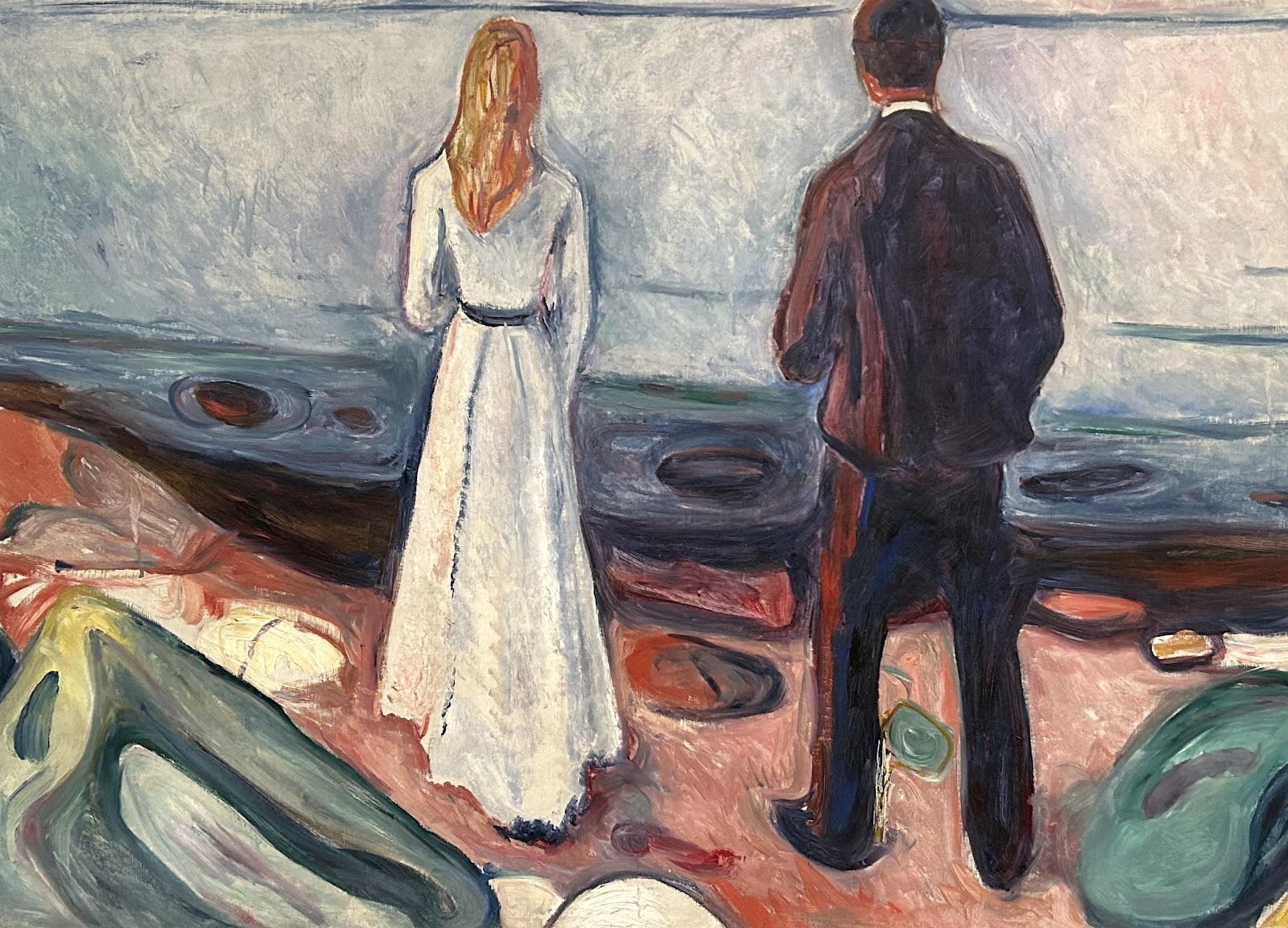
Munch was like a writer who does multiple drafts. Consider “Two Human Beings (The Lonely Ones)” (1906-08). He originally did a painting in 1892 that was printed. The first painting was destroyed and he worked on a new version from 1906-08, but reversed the position of the man and the woman. Scholars believe he did so because he worked from a woodcut of the original. 


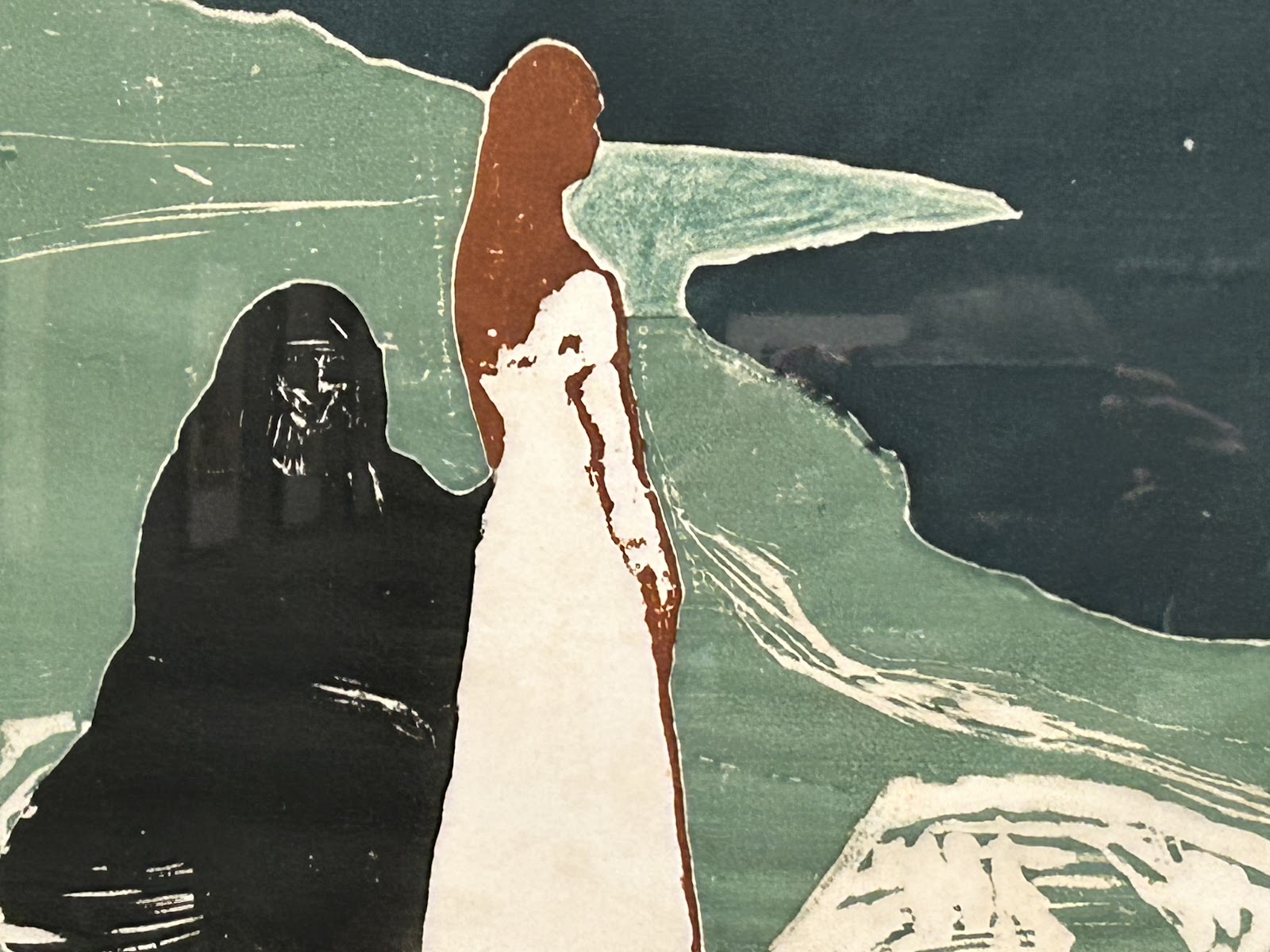
“The Seashore” isn’t one of Munch’s better known works, but if you look up the original you’ll see that it is of an old woman and a younger one on a beach. In the lithograph (probably unfinished) the older woman looks like Death and her features are indistinct. If you’re not sure what a lithograph looks like, here’s one and it’s a substantial chunk of rock. 


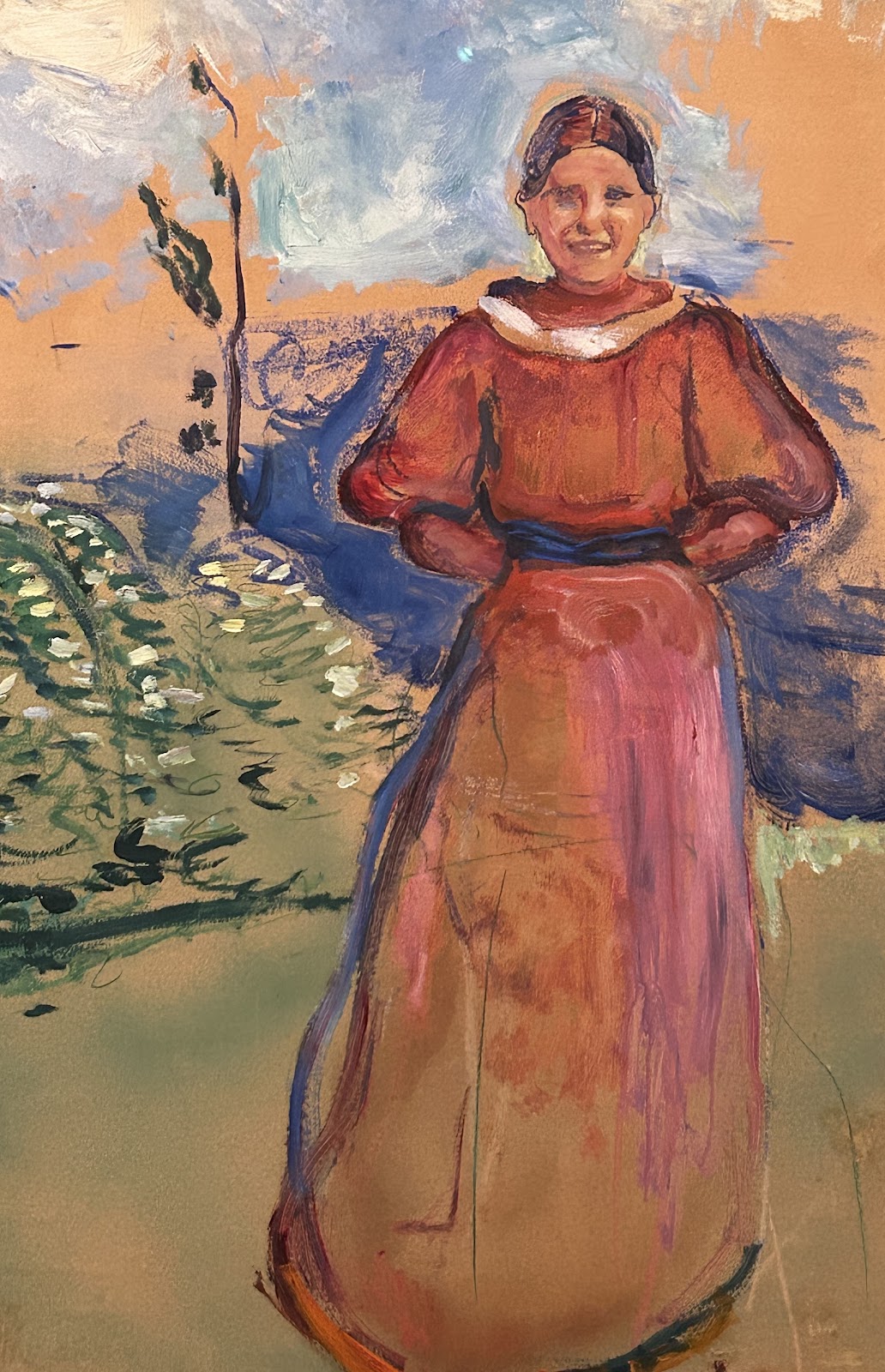
Speaking of rough drafts, Munch did this “Inger in a Red Dress” (1894) on a piece of cheap board. (Inger was a photographer and his youngest sister.) It’s quite different from the final painting. This one was done with wet-on-wet painting and was done when he was just beginning to make prints. You might (sort of) recognize this Munch lithograph. It looks a bit distressing, but the painting was titled “Madonna.” Not all versions of the prints looked all that that divine! Some had the child (embryo?) in the lower left and many did not. Munch made multiple versions as if he were tinkering with mood and subject.  


As x-ray radiology proves, “Winter in Kragero” (1915) was altered numerous times. Is finished? Unclear. Was it intended for some other purpose? Very possibly. It bears similarity to an earlier oil painting, “Old Fisherman on Snow-Covered Coast” (1910-11), though it too has been painted over and the fisherman bears resemblance to a woodcut he did of his neighbor. 


This self-portrait  gives pause for thought as well. It’s a woodcut; Munch did many of himself, but each has an unfinished quality about them. Did he do this for effect? Self-loathing? Did he just lose interest? Because the print would be more dramatic? Again, it’s a conundrum, but cheap reproductions–sometimes called “chromos”–were quite popular among the masses and it’s usually a good idea to follow the money! 


This Munch exhibit reminds us that past technology and that of the present also share similarities of intention and marketplace pressures. We claim that we can do a lot more things today–if we can find the time to do them. I suspect Munch would agree.


Rob Weir

5/9/25

Music for April and May 2025: Michael Rudd, Ron Pope, Grey DeLisle, Mary Bue, Mar Grimalt

Mary Bue


Faithful readers will notice that my posts have been delayed lately. It’s called “being on a book deadline.” Here’s a music column as I didn’t get one written in April. That’s okay, though, as things usually get a little slower in the spring.


One of the better projects I heard was from Michael Rudd. His path has been a bit twisty. He became a teacher and has been in New Mexico, Massachusetts, New Jersey, and back to New Mexico, where he’s now a principal at Acoma Pueblo, an indigenous adobe settlement atop a dusty high mesa. At some point he began to hear songs and tunes in his sleep. His second solo album, Going to the Mountain contains some of the results from his trip to the liminal side of things. The title track is a Western song that bespeaks his twisting path to full humanity. It opens with the words I know where I’m going/’Cause I know where I’ve been but if that sounds pretty tranquil, hang on. It’s also about a guy always searching for something. It’s a very western song; note I didn’t qualify it as “country.” It’s big and open like his gravelly voice and is as honest as a lot “country” is overly processed. “Before the Demon Comes” is in the same vein. He rocks out on The Far Side.” The thing about dream songs is that they take you to unexpected places, so be prepared to travel.


Ron Pope has been around a bit too. He comes to us from Nashville via Georgia with a stop at NYU. He and his wife (Blair Clark) founded Brooklyn Basement Records and, if Pope’s name sounds familiar, he scored big time in 2007 with his platinum hit “A Drop in the Ocean.” He hasn’t slowed down a bit. Pope has released two dozen LPs and EPs, has toured, and he and Blair are raising a daughter. Depending on who is telling the story, his music is either Americana, country, or folk. Pope’s most recent LP is titled American Man, American Music, which is as good a label as any as he’s never quite what you anticipate. “Klonopin Zombies”  suggests social commentary on drug abuse, but it’s actually a personal song about how he was not in a good place after his grandmother passed away just eight days after her husband died. As you can see from the live performance, he’s a hard-working musician who’s unafraid to delve into topics mystical, painful, or sublime. Re: the sublime, Pope gives us “In the Morning with the Coffee On,” a love song centered on joyful small things. In a duet with Taylor Bickett, “I’m Not the Devil” he reminds us that he’s a good guy. Yet he also sings about veering from the straight and narrow on “Mama Drove a Mustang” whose blancmange  of rock, bluegrass, and country is atypical for someone with a voice as robust as his. Good stuff.


Grey DeLisle is a comedian, songwriter, and voice actress (Scooby-Doo! DC Comics, video games, etc.) As a singer she once did a tribute project to June Carter Cash, so it won’t surprise you to hear that her new project The Grey Album is a country album or, that as Los Angeles-based artist, she’s unabashed of having been married and divorced three times. DeLisle tells us rockabilly style, “I Can’t Be Kind.” She also sings “Hello, I’m Lonesome,” “Daddy Can You Fix a Broken  Heart,” “The Last Last Time,” and “I’m a Wreck.” In other words, DeLisle is from the old-fashioned heartache tradition of country music. As you will also hear, her vocal styles are insouciant, saucy, and an independent spirit. Credit her with the verve and nerve that gives us the term moxie. 


Mary Bue is another woman of many talents. She is a yoga devotee, has studied psychology, was hailed in 2020 as the best songwriter in Minneapolis, and has made her own Beatles-like pilgrimage to India. Her recent album The Wildness of Living and Dying is like a musical mind meld of her interests. It has themes of what she calls “world-sorrow” plus eco-awareness, expanded consciousness, and a potpourri of styles ranging from “piano poems” to electric instrumentation. The title track is heavy on dark keys and steady drumming, which make a fine contrast to her lovely voice. “Bedding Down with the Deer” has elements of Joni Mitchell in her younger, earthier days, though Bue takes full advantage of today’s mixing capabilities to backfill it with atmosphere. Be sure to check out “The Bones and the Marrow” video to capture Bue in a whirlwind of kinetic energy. She spends most of the video running and imploring us to stand tall amidst the tall pines within an electric arrangement spotted with sing-song mini raps. Mary Bue has (literal) down-to-earth values but she’s no head-in-the-sand blind optimist who is sure things will self-repair. This is her 9th album and watching the video helps me understand where all her energy comes from.


Mar Grimalt is a vibrant singer from Mallorca, one of Spain’s Balearic islands. Her album Espurnes I coralls translates “Sparks and Corals,” and that song alone shows us that when you have vocal talent to spare you can create magic with nothing more than a melody and a frame drum. Call her voice the spark and the malleted drum its hard coral contrast. She can also pick up a guitar and pick out “Cançò Final,” a cançò being a folk song in a style linked to 13th century troubadours. Grimalt sings as a woman sews in the background. Mar Grimlat won’t floor you with power or flashy technology. She has been quoted as saying that we often fail to appreciate what we have because it “weighs us down like tons and tons of concrete.” She should know; her family operates a concrete factory. She’s so retro that that “Reculls des versos” is again voice and frame drum and all the echoes and synth you hear were added in post-production.


Rob Weir