8/10/22

The Card Counter: Disturbing and Brilliant


THE CARD COUNTER (2021)

Directed by Paul Schrader

Focus Features, 112 minutes, R (language, nudity, violence, drinking, drugs)

★★★★★


This is a brilliant and stylish film seen by few. It is disturbing and reminiscent of Martin Scorsese’s 1976 masterpiece Taxi Driver. That’s not coincidental; Paul Schrader wrote the screenplay for Taxi Driver and Scorsese is the executive producer for The Card Counter. The latter is also violent and has rough language, nudity, and substance abuse, but that’s not why audiences avoided it. Word got out that it committed a far greater sin by taking down cherished American myths.


The first of these is that Americans are global good guys; the second is American soldiers are heroes. Abu Ghraib provides the deep background for a film that is also about games of chance. The odds are much better, though, for William Tell who sees cards, remembers them, and calculates odds with computer-like probability. It’s illegal to count cards in casinos, but Tell knows that the key to avoiding scrutiny is to balance losing a little and only winning modest amounts. Do that repeatedly and you can make a lot of money.


Schrader both directly and indirectly blows the cover off another myth. When things go awry, many find it comforting to pretend all is well, but bad people take advantage. In Schrader’s world, we reap what we sow. Once upon a time, the only place one could “cheat” a casino was Las Vegas. Then came Atlantic City and the opening of the floodgates. Tell stays off radar screens by never staying in casino hotels and working casinos from coast to coast. He and others like him aren’t gaming the system; the system created them.


How does one learn to count cards? It helps to have a lot of time on your hands and “Tell”–actually William Tillich–spent 8 ½ years in a military prison and came to enjoy its regimen. His crime? He was one of the guards at Abu Ghraib whose faces were caught in photographs. They were the ones who were charged when the shit hit the fan instead of being smeared on Arab bodies. The officers who gave the orders and egged them on got off scot-free. When World War Two ended, numerous lower-ranked Nazis claimed they were just following orders. That didn’t fly, but Tillich/Tell can identify. He was selected by Major John Gordo (Willem Dafoe) to break Abu Ghraib prisoners and became so expert at torture and “enhanced” interrogation that he too was broken and became a monster.


Now he is a calm man who lives an aesthetic life and bilks casinos and poker players. Two unexpected individuals come into his life, the first a slacker named Cirk Baufort (Tye Sheridan), who finds Tillich because he served with his father at Abu Ghraib, before becoming a druggie and killing himself. Cirk wants Tell to help him take revenge on Gordo. Till has other ideas, mainly saving Cirk from himself and rescuing him from his rootless lethargy. Till is also spotted by the alluring La Linda (Tiffany Haddish) who knows he’s a card counter. She runs a “stable” that wagers money fronted by wealthy backers who use gamblers as a low-risk way to increase their riches.


The Card Counter has been called a “revenge” film, but that’s way too simple. It could just as easily be called a redemption film, or one poised between salvation and perdition. Schrader pulls out lots of Taxi Driver stops: people caught up in things bigger than they, wet streets and lights that dissolve into pixels on steroids, moral ambiguity, the glitter-disguised trappings of seediness, neon piercing nighttime skies, and time fragmented via a mix of torpid scenes and those at time-lapse speed. When Abu Ghraib memories are spliced in, they are made more nightmarish via fisheye lenses and hazy shots that give the illusion they’ve been captured by spy cameras. Schrader also interjects subtle propaganda, like a Ukrainian poker player whose gang chants “USA! USA! USA!” whenever he wins.


I won’t try to tell you that The Card Player is anything other than a tough film. I will say, though, that feeling shattered is redemptive if you cogitate upon the moral lessons Schrader is trying to convey. We’d like to believe all broken things can be fixed. Maybe.


Rob Weir

8/8/22

Verity is Truly Bad!


VERITY (2021)

By Colleen Hoover

GCP Hachette Group, 314 pages.


Verity is the sort of book you rip through but feel guilty for liking. My conscience is clear. I hated it! It’s what you might come up with if you pulped Jane Eyre in your blender with some trashy 21st century Harlequin romances and Fifty Shades of Grey. You could, though, amuse yourself by enumerating the number of contrivances and cliches that appear upon its pages. 


An unknown writer, Lowen Ashleigh, is called upon to “collaborate” with Verity Crawford, a hugely popular author. Like that would happen. The collaboration is a ruse as Verity lies in a vegetative state in the Vermont lakeside home she shares with her husband and their son Crew, their only surviving child. Their twin daughters died in separate accidents and Verity is probably brain dead from a car accident. Or, is she? What’s true and what’s not lies at the heart of the book.


Well... maybe that’s not right either. Much of the book is devoted to what appears to be an autobiography/confessional from Verity unearthed by Lowen. A lot of it consists of graphic descriptions of Verity’s sex life with Jeremy. She’s apparently quite adept at oral sex and Jeremy has such porn star endurance that Verity’s teeth marks are on the master bedroom headboard. Which, of course, is why a grieving father/husband would invite a stranger to use that space as a guestroom as she seeks out notes Verity might have left behind concerning the next three installments of her book series. Lowen—an unknown, I remind you—has a half million good reasons to do a good job. That’s her payout if she delivers Verity-like novels before the world discovers Verity is actually a potted plant.


Still another device: Lowen is a mess who has been evicted from her New York City apartment, lacks self-confidence, is a recluse, and spends her days imagining it is she who is enjoying Jeremy’s sweaty bod. Oh, and she’s a city girl in Vermont and during her time in the Crawford home is so out of place that she welcomes a trip to McDonald’s. (For the record, both Grubhub and DoorDash know where Vermont is located.)


During Lowen’s time in the Green Mountain State she never writes so much as a sticky note. She does, however, have either a very vivid imagination or something exceedingly creepy is happening in a McMansion that really ought to have a few Queen Anne turrets, preferably one or two scorched by lightening bolts. Lowen has a history of sleepwalking because, of course, she does. She is sure, though, that she has seen Verity out of her bed staring at her, once with a knife. Lowen is also sure that Verity offed one of the twins.


I’ll bet you know what happens between Lowen and Jeremy. Was this book approved by the American Dental Association? Are headboards particularly good for incisors? Maybe. Seems to work for beavers.


The novel’s central mystery hinges on whether what we read is what happened or merely a novelist’s exercise called antagonistic journaling. Everything is revealed in a from-the-grave letter. If you’re curious, you could easily skip the entire book and head for that last chapter. Short of recycling, I’d recommend that.


Hoover’s style practically begs for descriptors such as histrionic, overwrought, implausible, and prosaic. The book blurbs tell us that Hoover is a New York Times #1 best-selling author. From this we can only deduce that New Yorkers aren’t nearly as sophisticated as they think they are.


I’ll give Verity credit for one thing, though; it has high camp value. But if it’s ever assigned in a literature class it is my fervent hope that the professor is denied tenure.


Rob Weir 

8/5/22

Young Mungo is Powerful (though derivative)


YOUNG MUNGO (2022)

By Douglas Stuart

Grove Atlantic, 398 pages.

★★★ ½  


What do you do for a second act when your debut novel wins the Booker Prize? In Young Mungo, Douglas Stuart returns to similar turf as his 2020 stunner Shuggie Bain. Critics are slavering over his newest novel but, in my estimation, its first half hews a bit too closely to Shuggie Bain.


Stuart grew up in the Glasgow Springhill public housing scheme spotlighted in Shuggie Bain. Young Mungo’s tenements lie nearby. Stuart also returns to Scotland’s post-Margaret Thatcher 1990’s economic ruination and writes in an uncompromising (and untranslated) Glaswegian patter that is long on verisimilitude but challenging for the Scots-impaired. (Keep your cellphone open to a dialect translation guide as you read Young Mungo.)


Should you read it? Early on I would have said you could give it a miss, but Stuart won me over. The dysfunctional family he spotlights is semi-autobiographical. The Hamiltons are headed by Maureen–called Mo-Maw by her kids (weans or bairns in Scottish)– a single mother who bears the last name Buchan because she never married the departed father of Hamish (19), Jodie (16), and Mungo (15). Mo-Maw is only 34, so do the math and you begin to see the problem. Even were she not a hopeless alcoholic, she has the emotional maturity of a teenager and the equivalent indifference to adult responsibility. Hamish has been feral for years and though he has a flat of his own for his 15-year-old wife and wean, he basically lives on the streets. Jodie despises her mother for forcing her to become the de facto caregiver for Mungo.


Jodie loves Mungo dearly, but Mo-Maw thinks nothing of disappearing for weeks on end to pursue a boyfriend du jour–food, rent and household costs be damned. Her kids call her a Tattie-Bogle, a scarecrow and a heartless one at that. The sandy-haired Mungo, whose name derives from the nickname for Kentigern, Glasgow’s patron saint, is a sweet lad that all women want to mother. That’s especially so when they observe a bad rash on one of his cheeks, a result of constantly scratching it and an indication of his internalized anxiety. Another telling trait is his child-like (and sometimes inappropriate) devotion to Mo-Maw.


NPR has called Young Mungo a novel soaked in “toxic masculinity,” an apt way of describing it. Mungo is named for a saint, but he’s a “Proddie” (Protestant) whose tenement lies on one side of a motorway bridge with equally seedy Fenian (Catholic) flats on the other. The gang violence is analogous of that of Belfast. The Proddies are led by Hamish, a crude, bullying, vicious man who carries (and uses) a homemade tomahawk. He demands that Mungo join him in bloody punch-ups and raids against the Fenians. The only thing the two sides agree upon is that they hate “poofters” (gays).

Poverty rules in both tenements and each harbors a hatred for Thatcherism, so you might wonder why the sectarian violence. When Mungo asks his hot-headed brother that question, Hamish can’t articulate a reason other than “it’s an honour thing, I guess.” Wonder what might happen if a Proddie boy fell in love with a Fenian boy? Read Young Mungo.


Stuart has two parallel stories going. The first is Mo-Maw’s feeble attempt to make a “man” of Mungo by sending him off on a fishing trip to a rural loch with two older men. Memo: Don’t send your kid off with two guys you met at an AA meeting who have been in prison for sexual offenses. The second narrative is in Glasgow and involves the burgeoning relationship between Mungo and James Jamieson, a Catholic. One is a tale of abuse; the other is tender but problematic in a culture in which difference makes a difference.


Mungo is a lovable character for whom we root, but Young Mungo is like Shuggie Bain in that it is a “tough” book spotlighting struggles that are not easily overcome. Mungo’s face rash is symbolic of how society scars innocence. Rashes heal, but will Mungo? Or James? Jodie? Mo-Maw? How far can good intentions take you amidst squalor, hatred, and violence?


Young Mungo is powerful, but I again wonder whether if Stuart’s take is Shuggie Bain in new guise. Stuart is a wonderful writer and I will try anything he pens. Here’s hoping his next novel tills new soil. 


Rob Weir


8/3/22

Night Comes With Many Stars Fails to Shine


NIGHT COMES WITH MANY STARS (2021)

By Simon Van Body

Godine, 294 pages.


Set in Kentucky, this tale of drinking, gambling, poor decisions, and bad behavior reads like a hillbilly spinoff of The Mayor of Casterbridge. Except that Simon Von Body is no Thomas Hardy and none of his characters rise to distinction, even belatedly so. It spans the years 1933-2010. Readers might expect that someone would break the above cycle within a three-generation span but for the most part, sympathetic characters end up as victims and the circle remains unbroken.


Carol Clay is an illiterate, developmentally delayed girl whose sole consolations in life are a ragged doll she names Mary Bright and a patch of yellow table cloth that’s all she has left of her mother. She is “sold” by her abusive, alcoholic father to cover a gambling debt. (She’s actually sort of a loaner.) She’s fed better, but she’s also sexually abused and impregnated. Having fun yet? She is eventually spirited away by a Cherokee man who despises her father and deposits her with an African-American woman who lives with a White woman of Polish ancestry. Are they lovers? Who knows?  


Move ahead a generation and we find that Carol’s unfortunate first child, Rusty, is a happy-go-lucky mentally challenged kid who loves all things that have a Coca-Cola logo. Carol will be taught to read by Joe, nicknamed “Big Head,” who was raised by an African-American couple that took him in as he roamed semi-wild when his father was in jail. Joe is kind, marries Carol, and is as much her caregiver as a husband. He helps raise Rusty, and he and Carol eventually have a daughter, Alfreda. Joe’s not the sharpest tool in the box either, but an older neighbor couple helps out until Joe and Carol get a home of their own.


Alfreda becomes a teacher. She and her husband Randy have a son, Samuel, who pals around with Eddie, still another physically and socially damaged kid. Samuel is smart, but is better at gambling than school. While horsing around, Eddie nearly blinds Samuel and his funny-looking eye becomes a major part of the narrative. Samuel makes it through one semester at Western Kentucky State University before he decides it’s not for him. Both he and Eddie will struggle, though Samuel’s more stable family at least keeps him out of jail.


I give all this detail because I’d hardly blame you if you decide to give this novel a miss. I’ve not even mentioned murders, divorces, additional broken homes, more alcoholism, or a father who thinks that taking his son to a whorehouse will help him grow up. Or that setting up a business funded by a gambling windfall is cause for parental pride.


By now you can probably tell I disliked this book. Joe and Rusty are good-hearted, but not many nice things happen to good people. I’m not sure what the point of this novel might be. Is it the cycle of poverty? Well, Samuel’s folks aren’t rolling in dough but Alfreda and Randy are way better off than Carol’s parents, Joe and Carol. Are Samuel and Eddie supposed to be Appalachian versions of Tom Sawyer and Huck Finn? Tom and Huck were mischievous and got into trouble, but they also had roughhewn charm that eludes Samuel and Eddie. At times it seems that Van Body wants to flash freeze Depression-era Kentucky and have us believe it’s still thawing out 70+ years in the future. This makes Van Body’s attempts to tick a few PC boxes seem like contrivances.


Night Came With Many Stars does Kentucky no favors. Unless you think rehabbing a house where unspeakable violence occurred is redemptive. I don’t.


Rob Weir


8/1/22

Imagine That! Art and Children's Books


IMAGINE THAT! THE POWER OF PICTURE BOOKS

Portsmouth Historical Society

10 Middle Street, Portsmouth, NH

Through September 25, 2022


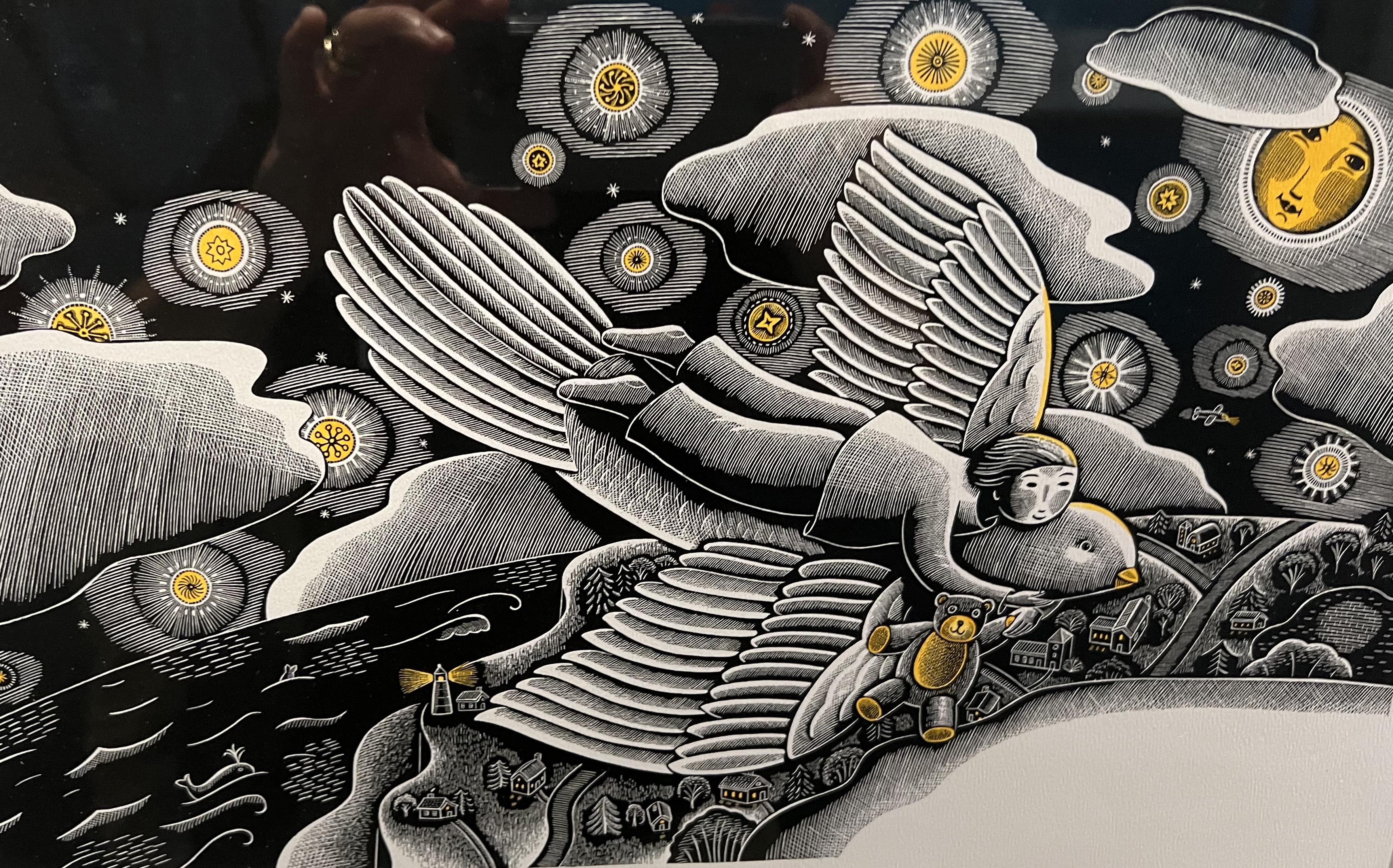
I often joke that I’m finally ready for an elementary school education. After seeing a magical display of the art found in children’s books at the Portsmouth Historical Society, I’m anxious to test my thesis. Today’s toddlers and pre-adolescents have access to creative teachers, cool toys, amazing playgrounds, and marvelous books that make me want to take a mulligan for my own childhood. If you’re anywhere near Portsmouth, New Hampshire before September 25, pop in to the Imagine That! exhibition and join my pity party.


My childhood books seemed old even then: Golden Storybooks, Mother Goose, bowdlerized Grimm’s Fairy Tales, and such like. I never even read or heard Winnie the Pooh because it was English and that simply wasn’t on the American radar in the late1950s. Is it any wonder my mind was blown when I first read The Lord of the Rings trilogy in high school? 


Ekua Holmes


Imagine That! showcases images from children’s books. Let’s get this straight. You can call it illustration, graphic design, or doodling if you wish, but it deserves a more dignified label: art. Some of it is as expertly done as stuff you find hanging on fine arts museum walls and, if capturing the imagination is the goal, far more compelling to contemplate. 


I wonder if Ian McKellen used Wyeth's Merlin for his Gandalf


The Portsmouth show rightly identifies several progenitors of today’s children’s book artists. This is especially the case of those whose work got reproduced in some of the books from my childhood. Howard Pyle, Maxfield Parrish, H. A. Rey, Dr. Seuss, and N. C. Wyeth were among those who made folk tales and yarns spring to life visually. Each had a gift for supplying enough detail to supply mental pictures for the stories at hand, yet leave enough space for young minds to imagine new narratives involving the same cast of characters. To pick a few examples, Wyeth’s illustrations for Treasure Island became the way pirates or the magician Merlin were conceived.


Beth Krommes     


Mo Willems


Most of the show is given over to those who have more recently delighted youth including:  Chris Van Allsburg, Chris Van Dusen, Ryan Higgins, Ekua Holmes, Beth Krommer, David McPhail, Bob Staake, and Matt Tavares. It made my Western Massachusetts heart swell with pride to see works from those who lived and/or studied in the region: Holmes (UMass MAT), Eric Carle, Barry Moser, Mo Willems….


I adored this show and kept snapping away. Confession: I also had a relatively new lens with which I wanted to play. Hey, if I can’t play amidst children’s art there ain’t no justice! I would probably blow out the server if I uploaded all of my shots, so enjoy my sampling. 


Bob Staake 


Bob Staake


Chris Van Allsburg


Ekua Holmes

Chris Van Dusen


Ben and Jerry’s Ice Cream used to sell a t-shirt emblazoned with the slogan “Be Ten Again.”  Make your way to Portsmouth and you can leave the shirt at home.


Rob Weir


7/29/22

House of Hamill: July 2022 Album of the Month


 HOUSE OF HAMILL

Folk Hero


Earlier in July I partook of a “Watermelon Wednesday” concert at the West Whately Chapel. The featured act was a young trio called House of Hamill. I’ve no idea why they are called that, but this ensemble consists of three superb performers: Caroline Browning (bass, harmony vocals, and mandolin); Brian Buchanan (acoustic guitar, second fiddle, banjo, foot percussion, and vocals); and Rose Baldino (first fiddle, vocals, and banjo).


If Buchanan’s name is vaguely familiar, he’s a longtime mainstay of the Canadian folk rock ensemble Enter the Haggis in which he mostly plays first fiddle and sings. House of Hamill, though, is definitely anchored by the dynamic Baldino, Buchanan’s wife. The trio is a 21st century group in more ways than one. Buchanan plays a lot in Canada, but he and Baldino live in Pennsylvania, and Browning makes her home in North Carolina. They also embody the genre-mixing penchant so prevalent these days. Their music is Celtic, but the tunes they use for songs such as “Lord Randall” and “William Taylor” are original rather than traditional and end much better for women than they do in Child ballads. (Ironically, Rose did not know much about Child ballads until we chatted!) They also do a cover of Dougie Maclean’s “Turning Away” whose tempo is accented differently than Dougie’s. In another nod to how things are done these days, the song “The Bully of Skidmore Town” is a Celtic/bluegrass hybrid.


The songs on Folk Hero, their latest recording, are solid but their instrumentals are stunners. Baldino is a dynamo on the fiddle, a delicious blend of virtuosity and attacking her instrument until it smokes. (Her style reminds me a lot of Liz Carroll.) Like a lot of Celtic fiddle tunes those of House of Hamill carry whimsical titles such as “Superb Owl,” “Cat Bacon,” and “The Sneezing Loon,” not to mention “Quarantine Reel,” which is part of the “In the Dark” set. Baldino will get your heart pumping, but then there’s the gorgeous “Canyonlands,” a reflective, and bittersweet composition. “The Stone Row” is another original that stands out.


This is a really fine album that impresses more with each listening. It’s almost as good as seeing them live, but only the latter can truly capture Baldino’s energy and the band’s synergy. You should hear what they do on stage with a cover of “Bohemian Rhapsody!”


Rob Weir

7/27/22

Spectacles on Display at Shelburne Museum


EYESIGHT & INSIGHT: LENS ON AMERICAN ART

Pizzagalli Center for Art and Education (PCA&)

Shelburne Museum, Shelburne, VT

Through October 16


I confess that the fanfare for this small show at the Shelburne Museum induced something less than enthusiasm. Call mine an error of judging an exhibit by its title. It is, if I might, a sharply focused and clever idea for a humble-sized art showcase.

If you’re like me, spectacles are a necessary evil I equate with lost youth. I don’t give them a second thought other than the annoyance of wondering wherever on Planet Earth I might have plopped them down. The PCA&E’s downstairs gallery makes one realize how often and in how many ways eyeglasses show up in art. We quickly learn that more people through the ages have appreciated the utility of their glasses than those who have sworn at them.


In case you’re wondering, they have been a corrective accessory in Western culture
since at least 1290 and are thought to have first appeared in Italy. Prior to that, a 
small number of scientists –usually Catholic clerics–experimented with optics, but it
 was quite a breakthrough for weak and aged eyes when someone got the brilliantly 
simple idea of sticking a few lenses in a frame, fashioning a way to rest them on the 
bridge of the nose, and inspiring future generations to cry out, “dove ho lasciato i 
miei stupidi occhaili?” (“Where did I leave my stupid glasses?”) 
 

The Shelburne Museum show confines itself to American art from the 18th to the 
21st centuries. It draws upon materials in the permanent collection and a few 
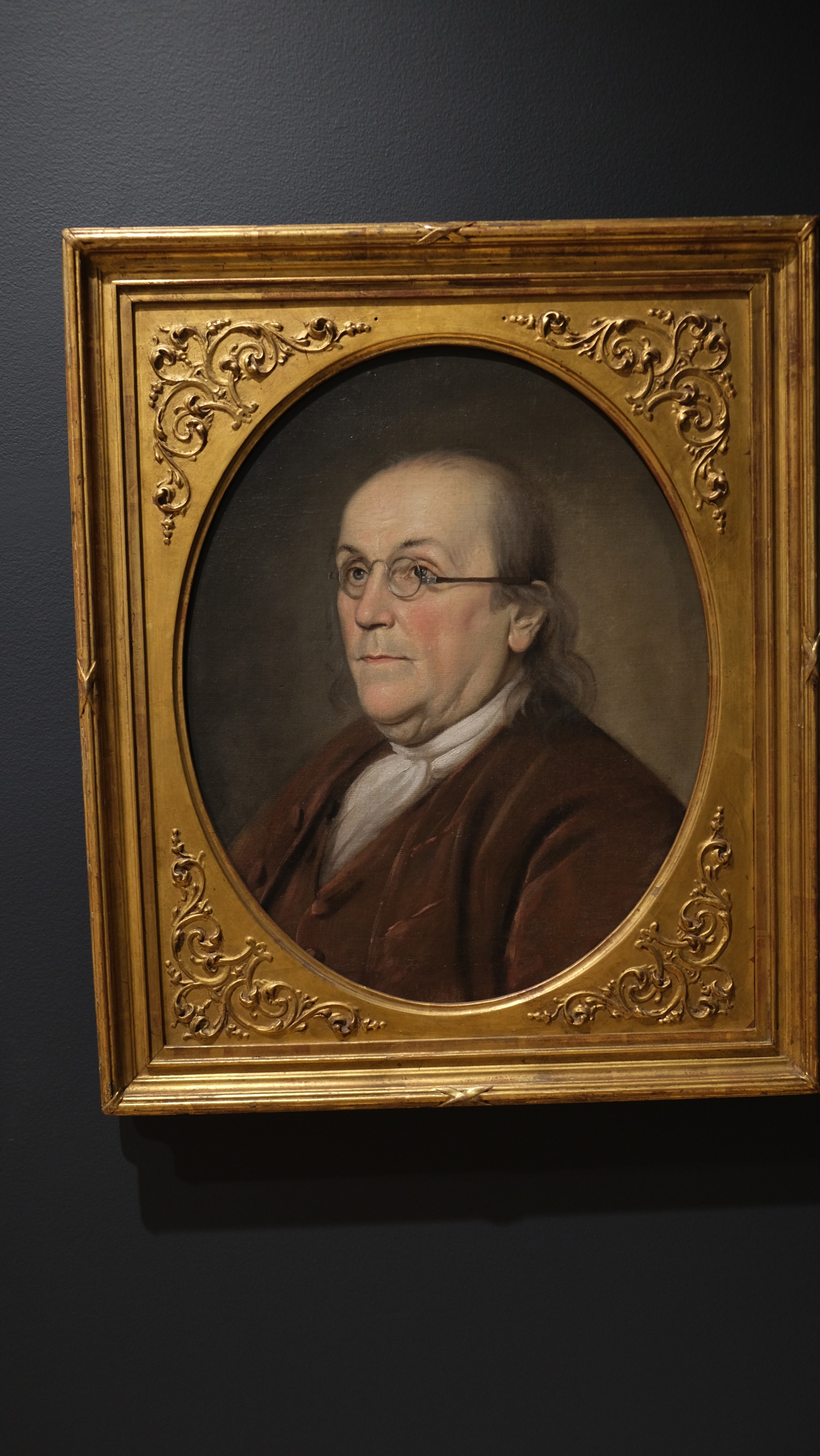
well-curated borrowed works. Charles Willison Peale appears twice, once in a 
self-portrait and again with a famous look at Benjamin Franklin, peering at us like 
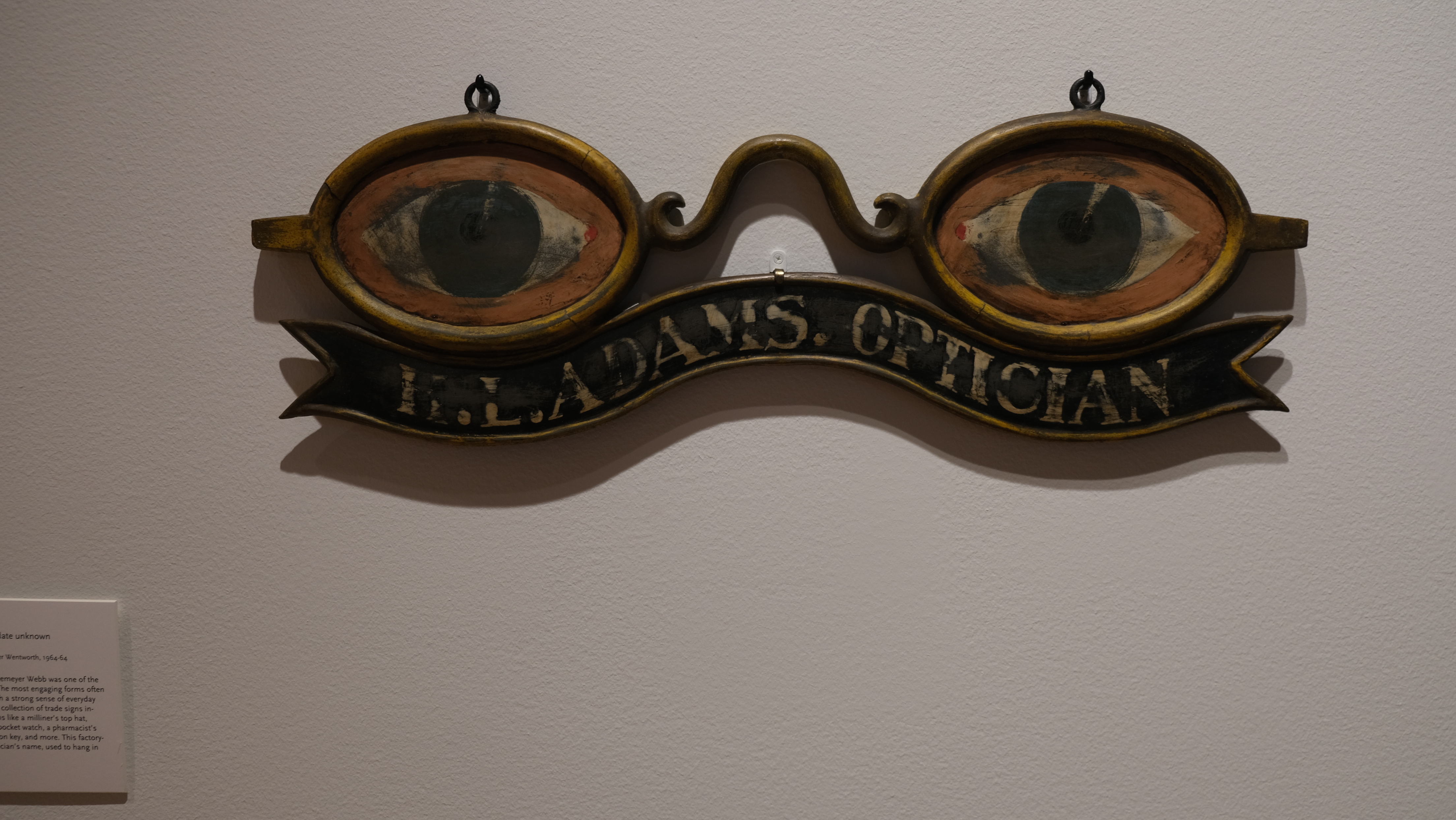
he’s about to begin a lecture. We also see several optometrist trade signs from 
the 19th century.  


  The PCA&E exhibit shows the utility of eyewear, but also has the sense to be playful 
and whimsical. There is, for instance, a 1983 photograph from Tseng Kwong Chi 
that’s a backdoor nod to Richard Nixon’s 1972 visit that thawed relations between 
the US and Red China. Tseng lives in Vancouver, but he dressed himself in a Mao 
suit and sunglasses in the guise of a diplomat. And that’s not even close to being 
the most puckish depiction of specs. There is a droll surrealist-style skeletal 
sculpture, but the Grand Nosepiece Award is a tossup between a 1952 
Life Magazine shot from the appropriately named J. R. Eyerman, and a 
Cindy Sherman image from 2016. Look closely at what Sherman has done; 
every person in the frame is she.  


  You will also find work from William Wegman, Howardeena Pindell, and the 
underappreciated Edwin Romanzo Elmer. But let’s go for humor once again; 
Richard Caton Woodville’s 1851 “Magic Glasses” tickles funny bones for several 
reasons. First, the figures in the painting are oddballs and the man in the dark 
glasses (which would have been rare back then) looks like some madcap 
Sherlock Holmes trying to blend into the woodwork. Maybe he is. Check out
the name of the publication he’s reading.
 
 
I recommend dropping into this show, which can be viewed in 15 minutes or fewer. 
Of course, that’s assuming you remember where you left your glasses.


Rob Weir