11/20/10

Winter's Bone a Bleak Masterpiece


Winter’s Bone (2010)

Directed by Debra Granik

100 mins. Rated R (language and violence)


Winter’s Bone isn’t knocking anyone dead at the box office for several reasons: it’s an independent film, it has no star power, it lacks a major distributor, and its story line is bleak and depressing. But make no bones about it--it’s the best American film of 2010.


Winter’s Bone guts the American Dream like an illegally jacked deer. Its protagonist is Ree Dolly, Jennifer Lawrence in a performance that makes all the other Oscars hopefuls look like poseurs. Ree is a girl with deep troubles, not the least of which is that she’s seventeen and doesn’t have the luxury of being an adolescent. She lives in a ramshackle Ozarks cabin with a catatonic mother and two young siblings for whom she’s the de facto caregiver. Her daddy is AWOL and (apparently) a bail jumper who used the cabin to secure freedom before his court appearance. Ree needs to find him and make sure he keeps that date, or she, her brother, her sister, and her crazy mother will lose the cabin. Her journey through the Ozarks backwoods in search of her father makes Dante’s Inferno seem like a stroll through a tulip farm.


Director Debra Granik, who also co-wrote the screenplay with Anne Rosellini, shows us an America most people would rather pretend doesn’t exist. Think lawless Appalachia, mountain poverty, and blood feuds are relics of the past? Replace the moonshine stills of yesterday with meth labs, and the 19th century Ozarks become a 21st century nightmare where the code of the hills prevails, and where folks would rather mete out mountain justice than ask the local sheriff so much as the time of day. It’s just the way things are and people like Ree don’t get to have prolonged childhoods; their futures are dictated by circumstance, not dreams.


Jennifer Lawrence is stunning, a woman-child who must swallow pride, stare horror in the face, and grow up faster than anyone should. She strikes a perfect balance between steely resolve, resignation, sorrow, and fear. Almost as good is John Hawkes as her uncle Teardrop, the brother of Ree’s missing father. He has a tender side, but he’s as incendiary as dry straw in a blowtorch factory. One of the film’s open questions is whose side he’s on.

Open questions are among the many things that make this film special. Looking for easy-to-digest answers? Don’t. Looking for nostrums? None here. Want a tidy resolution? Sorry, life isn’t like that--especially for those who are dealt cards from the losing middle of a stacked deck. This is not an easy film to watch, but view it you should. It will leave you shattered, outraged, and perhaps horrified. But I will guarantee you will not forget it. Call this one a dark masterpiece. Find out why this adaptation of Daniel Woodrell’s novel won the Grand Jury Prize at Sundance.

11/16/10

Emmylou Harris Thrills Sold-Out Crowd


Emmylou Harris

November 11, 2010

Calvin Theater

Northampton, MA


Emmylou Harris performed before a sold-out Calvin Theater on Thursday November 11 and once again demonstrated why she’s an American treasure. It’s not easy to turn a thousand-seat auditorium into a living room, but she managed it.


At 63 Harris has lost surprisingly little of the power or range of her youth, and the most visible effect of all the years on the road is that she’s more graceful and gracious than ever. She certainly looked the part of the reigning queen of cerebral country folk music as she stood center stage, perfectly coiffed and sporting an elegant gold necklace that accented a spangly flowing skirt, black top, and—of course—finely tooled boots. Watching her work with her four-piece band—which included longtime touring partners Stuart Duncan (mandolin, fiddle) and Phil Maderia (accordion, keyboards)—makes you understand instantly why other musicians love working with Harris. It’s always about the song with Harris. As singular as her voice is, she’s never afraid to allow a thick aural ambience to envelop it, nor does she need to hog the spotlight. In fact, she spent a considerable amount of time walking out of it, turning her back to the front, and jamming with the band. Every now and then you get the impression that she’d be quite the whiz on the dance floor. The songs demanded that she not stray far from the microphone, but she usually made her back with sashays suggestive of waltzes and two-steps.


Harris thrilled the crowd with a lot of familiar material, in part because she hasn’t had a solo release since All I Intended to Be in 2005. That title is a great metaphor for Harris in late career. As she told the audience, “I never wanted to be anything but a folk singer and now here I am.” Let’s first send a virtual hug to a singer who hasn’t run from the “f” word by inventing new terms to avoid saying “folk music.” With that out of the way we can say that there probably isn’t a genre that totally contains Harris. Yes, there are sweet folk songs—and has there ever been a sadder one than her cover of Steve Earle’s “Goodbye,” or one that blows the lid off the American Dream like “Red Dirt Girl”?—but Harris’s repertoire is also filled with country, Appalachian, and pop songs, and since her initial collaboration with Daniel Lanois more than a decade ago, the arrangements are multi-layered and sophisticated. But when she needs to, she can still peel away those layers and use stark simplicity in ways that astonish. At one point near the end of the show a microphone failed and a horrendous electronic crack ripped across the auditorium. Unfazed, she stepped to the front of the stage with Duncan and Medeira and delivered an a capella unamplified gospel song and you could hear every note, even up in the nosebleed seats. She came back for her encore with her two dogs in tow, both of whom soaked up some loving from the front two rows. Harris is a long-time animal rights activist and gave a plea for folks to adopt shelter dogs before launching into the finale, a cover of “Pancho and Lefty.” Smiles as wide as the prairie were upon the faces of the audience as they poured out upon the street. Many seemed to meander, as if dazed and not ready for the evening to end. Well, yeah….


A plug also to the evening’s opening act, a young quartet from Rhode Island who call themselves The Low Anthem. Let’s just say there are no categories for this band. Reedy-voiced lead singer and songwriter Ben Knox Miller sounds a bit like a young John Prine, but the music is another thing altogether. What label would you apply to a piece arranged for two oboes, a pump organ, a French horn, a harmonica, and a musical saw? The four musicians spent stage time passing off turns on the dozen or so instruments on stage. Although their set contained some songs that might comfortably fit in a folk or country box, most of it did not. In fact, lots of it was a meditative mash-up of psychedelia, trance, and four-part harmony singing. It’s hard to say if this music would be enjoyable out of its live context—but The Low Anthem is certainly a fascinating group to catch live. We’ll weigh in on their recording Oh my God, Charlie Darwin when we’ve had a chance to listen, but the title alone clues you that orthodoxy isn’t in the offing.

11/11/10

The Social Network is Creepy and Fascinating


The Social Network (2010)

Directed by David Fincher

PG-13, 121 mins. (Sexuality, nudity, language)

* * * *

Mark Zuckerberg is the smartest guy in every room he enters. The problem is that he knows it and he’s also either suffering from Asperger Syndrome or is a full-blown sociopath. As such, Zuckerberg has the sensitivity of a two-year-old, the morals of a sadist, and the self-control of a Turret’s patient. And he’s not even the most unlikable figure in the film. That dishonor would go to Jason Timberlake playing Napster creator Sean Parker, who packs more crude than the Gulf oil spill.


Be forewarned; seeing this (barely) fictionalized account of how Facebook came into being will make you immediately want to do five things: trash your Facebook account, kill Zuckerberg, assassinate the founder of Napster, call for a federal investigation of Harvard, and start a class war. Is The Social Network real? Technically it’s fictional and is based on the Ben Mezrich novel The Accidental Billionaire. Zuckerberg says it’s fanciful, Parker (Sean Fanning in real life) hasn’t said much, and several of the litigants who claimed Zuckerberg bilked them are silent because they signed non-disclosure agreements. But the fact that no defamation lawsuits have been brought against Mezrich, Fincher, or script writer Aaron Sorkin suggests that none of the villains of this piece--and there are precious few good guys--feels confident enough to air their views of the truth in public. (Sorkin insists the film is pretty close to reality.)


The film opens at Harvard in 2003. Zuckerberg (Jesse Eisenberg) has just been dumped by his girlfriend (Rooney Mara) and retreats to his room to slander her on his very-public blog, get drunk, hack into Harvard data bases, and set up a Website that allows testosterone-poisoned Harvard males to rate the relative “hotness” of Harvard coeds. This was the genesis of Facebook. Without giving away too much, getting to the Facebook of the present also involved Zuckerberg double-crossing a trio of secret society lads (including the smug Winklevoss twins, both played by Armie Hammer); putting the screws to Eduardo Saverin (Andrew Garfield), his only friend; and coming under the Svengali-like influence of Sean Parker/Fanning. The unindicted coconspirator is Harvard, a fetid cesspool of arrogance, self-indulgence, sexism, bad behavior, and contempt for everyone who lacks the social privileges enjoyed by the Crimson-clad spawn of Satan. Among the many questions raised in the film is why rich kids are allowed to get away with actions--sexual harassment, hacking, invasion of privacy, lewdness, drug dealing--that would land a public university student in prison. (Still another question is how this film managed to wrangle a PG-13 rating.)


The Social Network is like watching a horror flick; we don’t want to look but we do. Credit Fincher’s focused direction, Sorkin’s acidic script, and superb performances all around, especially that of Eisenberg, who keeps our eyes glued on a character who is essentially a monster, and an unsympathetic one at that. The movie unfolds at a crisp pace and deftly handles a task that is hard to capture on film: the creative process. For all of his faults, Zuckerberg was/is a genius and to watch him build Facebook’s architecture and envision its potential miles ahead of everyone else is reminiscent of the scenes in Amadeus in which Mozart dictates scores from his sick bed while poor Salieri struggles to keep up.


I‘m not sure if we can call this a “good” film, as there just isn’t much social redemption to be found. It is, however, an endlessly fascinating one. See it, and then go home and take a shower. Trust me--you’ll definitely feel like you need one.

Tax Cuts for the Rich and Endless Toil for the Masses


Are you kidding me? Was Barack Obama kidnapped by aliens and replaced by an evil replica? Or is he just so friggin’ stupid that we should just give up on him?


From Washington, DC comes startling news. First, President Obama has offered an olive branch to the Republicans by saying he’ll consider an extension of tax cuts on the rich. For the love of Pete, the tax increase was only going to affect those making over $250,000 and he’s going to cave in?


There’s so much wrong with this that one hardly knows where to begin. First of all, we have the pathetic case of Democrats behaving as if they are the minority party. I grant that they’re quickly mismanaging themselves to that status, but…hello! Democrats still control the Senate and the White House. That’s one-third more than Ronald Reagan had when he was first president, but he had the guts to fight for his agenda. An inability to govern has plagued Obama from day one. Remember the renting of garments that Democrats lacked the super-majority to prevent filibusters? I’m sick of listening to Democrats whine. So here is a series of call-outs to President Obama.


First, govern or get out! Want something? As the British say, put a bit of stick about. As chief executive, Mr. President, you have the power to dole out and withhold goodies. Lyndon Johnson took on Congress when he wanted the Civil Rights Act passed. Among his tactics was a threat to veto every bill that came onto his desk until it was passed. Withholding highway funds finally turned the trick. Get a spine, Mr. President.


Right after you’ve grown a spine, get your ears cleaned out because apparently you’re not hearing Republicans who shout that their number one objective is to make you a one-term president. Helping this lot is like lending your pocketknife to a man who vows to slit your throat. Or maybe you don’t care that the GOP wants to give the country back to the thieves who screwed it up in the first place.


Or maybe it’s courage you need, though one wouldn’t think it would take a lot to point out that a person making a quarter of a million dollars ought to repay the nation that enriched him. Who will pay if the Bush tax cuts aren’t renewed? Individuals making five times more than the average family income. You know what? If you make that kind of bread you shouldn’t be whining about your tax bill; you should be on your knees and grateful. C’mon Mr. President--tell these greedy bastards to shut up and pay up. Who knows? You might actually convince someone you have leadership skills if you fight that battle.


If all of this isn’t enough, we get today’s news that once again the GOP is targeting Social Security. If they get their way, the age for full benefits will rise to age 69. Here’s another issue I’m sick of hearing about. Everyone who has a calculator knows how to make Social Security solvent--remove the income cap. As it now stands individuals stop paying Social Security on income above $106,800. Why, for heaven’s sake? Once again, if you’ve that kind of money you can afford to pay another 6.2% tax on it. A lot of us pay higher rates than that in sales taxes. But what’s the message here? More for the rich even if the rabble has to work until they drop? Tell the rich that they need to help secure the future of the elders. And tell young people moaning over SSI taxes that if they aren’t willing to pay there simply won’t be jobs of them--the geezers will have them all.


So I’ve attached an old cartoon from the Industrial Workers of the World. It shows how IWW members thought the world operates. One doesn't have to be as radical as the IWW to think that maybe it was onto something. As the old labor song put it, Mr. President, which side are you on? If it’s with the lot on the top layers, then I couldn’t care less if you lose in 2012.

11/4/10

Business Speak is for Idiots


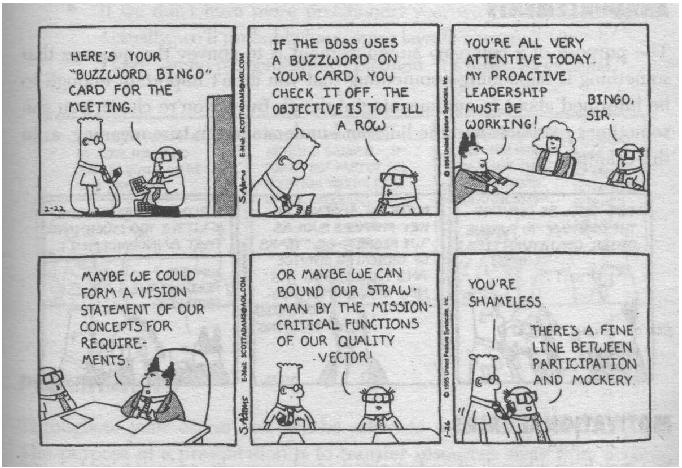
When someone asks if they can conference with me I reply: “No. We can have a meeting. We can hold a discussion. We could engage in debate. But we can definitely cannot make a noun into a verb.” If pressed I also advise that at no point in our conversation will we incentivize, prioritize, interface, or benchmark. Nor will we construct a matrix, make a list of doables, or pick any low-hanging fruit.


If you have ever used any of the above phrases in anything other than an ironic context, repent! If you are currently using them, for the love of God, stop! If you use them and harbor the illusion that subordinates are doing anything other than laughing behind your back, seek help.


Think I’m kidding? Check out the BBC’s new list of annoying business phrases: http://news.bbc.co.uk/2/hi/7457287.stm If you haven’t gone to management school you’ll find this hysterical. If you have, you probably won’t get it. The truly hopeless will believe that their personnel finds their business techniques useful because employees have demonstrated “buy in” during staff meetings. They are so clueless that they cannot recognize feigned interest, the desire of staff to keep their paychecks, or playing mind games to stave off boredom.


Some people dream of utopia. Me too. But for now I’d settle for MBA programs that aren’t run by morons that graduate imbeciles who will make the lives of their future staffs miserable by insulting their intelligence.

11/2/10

Remembering Kate Wolf


Some performers wow you with their dynamism and/or their larger-than-life personalities. This month, though, let’s honor a gentle departed soul who knocked you over with a feathery approach: Kate Wolf.

Kate Wolf was born in San Francisco in 1942, and passed away in December of 1986, after a bitter bout with leukemia. She was just 44. Wolf was seldom dramatic, her voice was rock steady, and her musicianship framed songs rather than seeking to be a separate canvas. In fact, Wolf was a lot like northern California, where she spent most of her life--she was open, laid back, and unhurried. At first listening, it was easy enough to let Kate Wolf disappear into the expanse. Her voice was warm and comfortable, but much in the same way that an old sweater feels. Then one day you heard one of her records in the background and you suddenly couldn’t get her voice out of your head. You listened harder and that voice became the breeze that swept across the Great Divide on its way to the Pacific, the hawk riding the air currents like a sky-bound Zen surfer, and the twilight as the sun was setting. As a lifelong Easterner who has only sojourned in California, I think it was Kate Wolf who first made me understand how Westerners cope with the scale of the land. Everything out there is big--the mountains, the waves, the waterfalls, the fauna, the winter snowfall-everything that is, except humankind. You can’t compete with it, you can’t conquer it, you can’t sing over it, and Kate Wolf had the wisdom not to try.

Wolf made seven albums in her brief lifetime, and five more were issued posthumously. A personal favorite is Give Yourself to Love (1986), which is also the name of one of most-beloved songs. She was taken too soon, but the list of those who have covered her songs and/or have drawn inspiration from her is a testimony of the impact she made. It includes Emmylou Harris, Kathy Mattea, Greg Brown, Lucinda Williams, Dave Alvin, and Nanci Griffith. If you’re listening to Kate Wolf for the first time, don’t rush things. Let her songs envelop you like--well, that old sweater you drag out when the nights are cool, you’re feeling a little melancholy, and you just need something familiar and warm.

Listen to Kate sing "Red Tailed Hawk." (Nina Gerber on harmonica) and again on the achingly beautiful "Sweet Love."

Nanci Griffith's superb cover of Kate's "Across the Great Divide."

10/31/10

The Grocer's Son Delivers


The Grocer’s Son (Le fils de l’épicier)

Directed by Eric Guirado

96 mins. In French with subtitles, NR (Brief nudity)

****

This 2008 French film is enjoying a very small run in theaters--so small in fact, that’s it unlikely to show up in your neck of the woods unless you have a thriving art cinema near by. Luckily, it’s on DVD and you’d do well to put this one near the top of your Netflix queue.


It’s essentially a modern-day retelling of the Prodigal Son parable, except that this son, Antoine Sforza (Nicolas Cazalé), has no desire to be welcomed home. On the contrary, even though he’s living is a down-market flat in Lyon and is between jobs, he’ be happy if he never had to see either of his parents again, let alone set foot in his Rhône-Alpes village hometown. But when his tyrannical father (Daniel Duval) suffers a debilitating heart attack, Antoine’s desperate mother (Jeanne Goupil) convinces Antoine to return home to run the family grocery concern until the old man is back on his feet. In this part of France, a mountainous region adjacent to Provence, as often as not, grocers go to their clients rather than sitting in the shop waiting for trade.


Antoine is able to convince a neighbor, Claire (Clotilde Hesme) to accompany him to the boonies. Claire has had some bumps of her own and hopes to return to college to get our life back on track. She sees the trip as an opportunity for some study solitude as she prepares for her entrance exam, and she’s so focused she doesn’t see that the shy Antoine is in love with her. As you might expect, Claire’s solitude will be interrupted by the unfolding Sforza family drama.


You could pretty much write the script from here. The Grocer’s Son won’t win any prizes for originality, but it is--as the French say, charmant. The surly Antoine finds himself behind the wheel of a creaky van driving from village to village, where old folks come out to buy food a single egg or can of peas at a time. The story is pretty much one of redemption in which the grocer’s son, his family, Claire, and the business itself are transformed. Of special delight are two delicious roles played by older actors. Paul Crauchet plays an elderly widower whose mind, eyes, body, and property are failing, but he does so with such tenderness that he could melt a stone. But even he is upstaged by Lilliane Rovere as Luciene, a former coquet who now reigns as the region’s opinionated and acidic queen of eccentricity, infuriation, and outlandishness. When she’s on the screen, one can look nowhere else. Luciene is the sort of person you’d want to invite to tea, just so you can wring her neck!


The Grocer’s Son is populated by people with hard edges and soft insides. As a film it’s akin to the twisty mountain roads Antoine drives--from afar you can see everything that’s coming, but it’s all so darned nice that we want to go there anyhow. And when you arrive, you’ll smile and be glad you took the trip.