2/3/17

Well-Digger's Daughter: Video Treasure

THE WELL DIGGER'S DAUGHTER (2011)
Directed by Daniel Auteuil
Pathé, 107 minutes, Unrated, in French with subtitles.
★★★★

Novelist, playwright, and film director Marcel Pagnol (1895-1974) was one of the most respected names in 20th century French culture. Jean de Florette and Manon des Sources were published collectively in 1963 as L'eau des Collines (Water of the Hills) and attained instant classic status. Few know that Pagnol also made twenty films and was his nation's first filmmaker elected to the Académie française.  Among his titles was 1940's La fille du puisatier (The Well Digger's Daughter). It was remade in 2011, directed by renowned actor Daniel Auteuil, who also stars in it. Auteuil (b. 1950) does Pagnol proud and his film rates as an overlooked gem.

Pagnol was prescient in his anticipation of World War Two. This film opens in the summer of 1939. Whispers of war are in the air, but the pace of life in Provence–the film's physical setting–unfolds according to time-honored rural patterns. Pascal Amoretti (Auteuil) is the titular well digger– a humble, honest, and exceedingly proud man who works hard at his craft. His is an important job in Provence, which is blessed with beauty and a Mediterranean climate, but cursed by exceedingly dry summers. At age 56, Pascal a bit long in the tooth for excavation work done mostly with pick and shovel–with assists from a bit of dynamite and a good-natured assistant named Félipe (Kad Merad). But what choice does he have? He's a widower with six daughters and only one has reached the age of majority: 18-year-old Patricia (Astrid Bergès-Frisbey). She is Pascal's pride and joy–a considerate, comely lass who went finishing school in Paris, but returned to tend to Pascal and her sisters.

Bergès-Frisbey plays Patricia with a beguiling mix of sophistication and innocence. Her Parisian accent seems exotic to Provence locals, most of whom speak patois, yet she remains a Provençal rustic in all other ways. She is naively unaware of her natural beauty, or that she has acquired just enough polish to charm 26-year-old pilot Jacques Mazel (Nicholas Duvauchelle), the son of a merchant family. In village terms, the well-to-do Mazels are the equivalent of gentry, which places them well above the Amorettis on the social ladder. After just two meetings, Patricia surrenders her virginity to Jacques and finds herself pregnant.

As you can imagine, this complicates things. So too does the calendar. By October, France and Germany are at war and nobody knows what to expect. (For history buffs, the period between October 1939 and April of 1940 was a bit of cat-and-mouse jockeying sometimes called the "Phoney [sic] War." France will fall in June and Provence will eventually be under the Nazi collaborator Vichy government.) But one thing is certain: pilots like Jacques must report for duty–before he even knows about Patricia's condition, as it transpires. And let's not forget about Pascal's self-identity. It is 1939, after all, and an unwed mother-to-be is a synonym for whore. Who will save Pascal's pride? Maybe Félipe? Maybe not.  What ensues is a quintessential clash of wills–between the Amorettis and the Mazels, between Pascal and his equally pigheaded sister Nathalie (Marie-Anne Chazell), and between Pascal and himself. Further complications: Félipe also has his eyes on younger sister Amanda (Émilie Cazenave) and perhaps Patricia has ideas of her own. Plus, there's that pesky war to consider!

If this sounds like a typical French relationship film involving knots and naughtiness, rest assured that this one is a cut above. In some ways it plays like a mash between Far From the Madding Crowd and Ryan's Daughter, yet it's more innocent and playful than either. Although you might not know any of the actors other than Auteuil, it's very nicely acted all around. Auteuil makes us admire his principles one moment and wish to throttle him the next. Bergès-Frisbey deftly walks the tightrope between strong-willed and inexperienced, Cazenave is Auteuil's stubborn equal, and Rambert adds Falstaffian comic relief. Moreover, The Well Digger's Daughter is surprisingly sunny for a film about pride, ruination, betrayal, and war. Or maybe it's those sun-dappled, red-poppy saturated Provençal countryside. That alone makes this a worthy rental/download for a dark winter's night.

Rob Weir


2/1/17

Hanna-Barbera at the Norman Rockwell Museum

HANNA-BARBERA: THE ARCHITECTS OF SATURDAY MORNING
Norman Rockwell Museum, Stockbridge, MA
Through May 29, 2017.

Remember the playground cartoon wars: Disney or Warner Brothers? It was a false debate, as those weren't the only two choices. "Woody Woodpecker" came from Walter Lantz Studios, Terrytoons cranked out  "Mighty Mouse" and Heckle and Jeckle," and the first important TV 'cartoon was "Crusader Rabbit" from Jay Ward (who morphed Crusader and Rags into "Rocky and Bullwinkle"). Back then, I swallowed the duality and fiercely supported the superiority of Warner Brothers (Looney Tunes/Merrie Melodies) and I still insist that Bugs, Daffy, Road Runner, and Tweety kick the collective butts of Mickey, Donald, Goofy and other saccharine Disney offerings.

In truth, though, my childhood was shaped by Hanna-Barbera, as a new exhibit at the Norman Rockwell Museum reminded me. It's subtitled "The Architects of Saturday Morning" and that's fairly accurate. Classic Disney and Warner Brothers productions were made for movies, not television. "Crusader Rabbit first aired in 1948, but fewer than half of American homes had a television until 1954. In 1956, Hanna-Barbera began airing cartoons aimed at Baby Boomers and ended up fashioning the Saturday morning experience of an entire generation.

William Hanna (1910-2001) and Joseph Barbera (1911-2006) came through the usual ranks–training as artists, working in studio animation units, and serving apprenticeships under the great Tex Avery–but they were also the Odd Couple of sketchpads and gel cells. Hanna was as plodding and unpretentious as Wally Gator, whereas Barbera was as plotting and flamboyant as Top Cat. Their partnership began on the silver screen with a short titled "Puss Gets the Boot," from whence Tom and Jerry emerged. They jumped ship just as the small screen went viral, but soon discovered that movie studios were better staffed than 1950s television. The Rockwell exhibit displays many of the original hand-drawn cartoon cells. It also reminds us that, at 24 frames per second, it took 10,000 cells for a single seven-minute cartoon! Watch some old 'toons and notice that backgrounds and chase scenes are often static or redundant. To hand draw changing backgrounds for each cell would have been a herculean task.

 
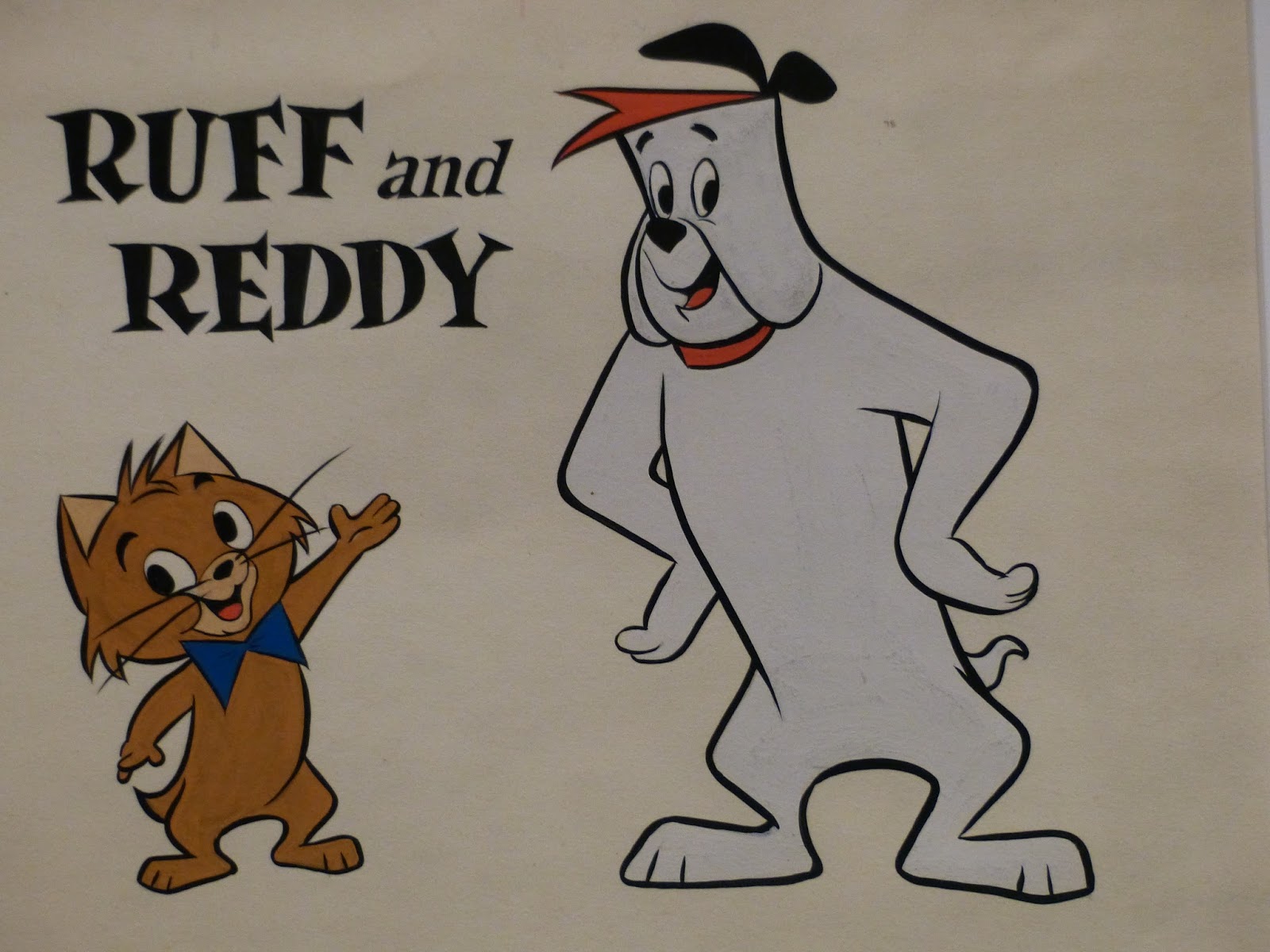
Suggestion: Look at a few cells and then do a fast walk through of the exhibit to get a sense of the scope of the Hanna-Barbera output. Here's a short list: Auggie Doggie, Atom Ant, The Flintstones,  Huckleberry Hound, the Jetsons, Johnny Quest, Lippy the Lion, Magilla Gorilla, Quick Draw McGraw, the Pink Panther, Ruff and Reddy, Scooby-Doo, the Smurfs, Snagglepuss, Snooper and Blabber, Top Cat, and the immortal Yogi Bear (and Boo-Boo too). Then spend time with your favorites and play with a cool interactive screen that gives data, short clips, and little known facts on the various characters.

Take a close look at the artwork and you'll notice deep similarities between characters such as Yogi, Ranger Smith, George Jetson, Huckleberry Hound, and many others. (Look closely as their jaws, muzzles, noses, five o'clock shadows, and eye alignments.) If it looks as if it might have been akin to assembly line production, you're on the right track. Past animation was the opposite of today's razzle- dazzle visuals that render storylines secondary. The Hanna-Barbera formula was to develop iconic characters and storyboard a compelling narrative, which gave them a witty, clever vibe that's hard to top. They were also sharper and more vivid. Digital technology is more flexible and (perhaps) more realistic, but it's not necessarily better art.

Seeing this exhibit is the most fun you're likely to have in a museum all year. There is also poignancy and sadness on display as well. Warner Brothers absorbed Hanna-Barbera in 2001, and Saturday morning cartoons officially died in 2016, though they had been terminal since the 1990s. The 'toons fell prey to misguided attacks on children's television, unwise content shifts in the cartoon industry, and diminished imagination.

You might recall Peggy Charren and Action for Children's Television. From 1968 on, there were relentless attacks on cartoons that yielded regulations. (Remember how "Road Runner" was deemed too violent?) Some of the new rules were wise (like banning direct advertising aimed at kids), but by 1973, children's programming was pared to just 12 minutes per hour; by 1996, all the networks combined could have no more than 36 hours per week. Must have been all those kids running off of cliffs like Wile E. Coyote! Or was it serious people ruining our world? (I'm gong with the second option.)

Cartoonists also bear some blame for forgetting that animal characters are time-tested; they are fabliaux on a gel cell. Making characters more "realistic" wasn't the best idea. "The Jestons" was beloved, but it was just a family sit-com set in the future. (It was also spawned the derivative "Flintstones," which exchanged the imagine future for a mythical past.) I know loads of Gen Xers loved "Scooby-Doo," but it too flunked the imagination sniff test. And then there was dreck like "Powder Puff Girls," "The Banana Splits," "Teen Titans," and "The Space Kidettes." The more "real" cartoons became, the less interesting they became. Kids watched 'toons because they were unrealistic; not because they wanted to work out anxieties or improve self-esteem.

The final blow came when cartoons ceased trying to be original. Many became cartoon versions of live shows (e.g. "The Partridge Family," "Bewitched"), extended advertisements ("G.I. Joe," "The Transformers"), or baby versions of older cartoons and were so inane they bored toddlers out of their diapers. By the late 1990s, the homogenized Disney worldview was triumphant and the salad days of Saturday morning existed only on cable Cartoon Network and not so much there either. It was fun while it lasted. I'm glad to relive those days, though I'm sad it was in a museum.

Rob Weir

1/30/17

Peter Paul and Mary Retrospective a Balm for Troubled Times

-->
50 YEARS WITH PETER PAUL AND MARY (2016)
Directed and produced by Jim Brown
MVD Visual, 78 minutes, Unrated.
★★★★★

Let's start 2017 off right. My album and movie of the month are the same: 50 Years with Peter Paul and Mary. Feeling dispirited about life in modern America? Take a 78-minute dose of this outstanding documentary and you won't need to call me in the morning. This one is filled with all of the classic PP & M hits, a veritable potpourri stretching from "Blowing in the Wind" to "Wedding Song."

The film is a love letter to the trio and I will grant that it's an expurgated missive–one that only hints at downsides such as Mary Travers' four marriages, or Peter Yarrow's alcoholism battle and his 1970 conviction for making sexual passes at a 14-year-old girl. Mainly it deals with unpleasantness by showing the group's meteoric and confusing rise; and by placing them within the chaos of the era in which it occurred. The trio presaged other PR-created bands such as The Monkees and The Sex Pistols. If you never thought you'd see PP & M in the same sentence with such company, read on. Producer Albert Grossman created Peter Paul and Mary from nothing in 1961. Mary Travers (1936-2009) was a Red Diaper baby who was weaned on Pete Seeger, Paul Robeson, and union activism. She dropped out of high school to become a member of a group called the Song Swappers but, by 1961, was seen as talented but too independent; Grossman's first choice, Carolyn Hester, turned him down. Peter Yarrow was a minor solo artist at the time, and. Grossman originally wanted Dave Van Ronk, but chose Stookey–an unknown–when he decided Van Ronk wasn't commercial enough. Originally, being commercial was what it was all about. The Folk Revival was near its peak and acoustic music was white hot. Thus was born Peter Paul and Mary, a name chosen for its Christian/Biblical suggestiveness, though two of its central figures were Jews (Grossman and Yarrow) and Paul was only Stookey's middle name.

Grossman was such a brilliant promoter that PP & M were "stars" from the get-go­; their 1962 debut album contained two songs that charted: "Lemon Tree" (# 35) and "If I Had a Hammer" (#10). Word of mouth and glowing reviews led to a second album, Moving, in 1962 and a #1 single: "Puff the Magic Dragon." (As the video notes, it was just a cute song and the anachronistic pot metaphors are simply folklore.) The rest, as the saying goes, is history. From "Puff" onward, the trio recorded eight more albums and charted with 17 other singles. Their 1963 cover of Bob Dylan's "Blowin' in the Wind" reached # 2; Dylan's original didn't chart! (Little known fact: Dylan has never had a # 1 hit.) 1969, PP & M topped the charts once again with "Leaving on a Jet Plane." Peter Paul & Mary were the ultimate cover band; they only wrote a handful of their own songs: "Puff," "Day is Done," "I Dig Rock and Roll Music," and "Wedding Song" among them. Instead they performed what many listeners came to see as "definitive" versions of songs from others: "Jet Plane" (John Denver), "Early Morning Rain" (Gordon Lightfoot), "The First Time Ever I Saw Your Face" (Ewan MacColl), "Where Have All the Flowers Gone?" (Pete Seeger), "There But for Fortune " (Phil Ochs), "Don't Think Twice" (Dylan)….

If you wonder why, the video answers with its glorious concert footage. PP & M made the successful transition from beatnik bohemianism to political folk and pop stars through sheer talent and evolving values. If PP & M strike you as sedate and overly packaged, watch and listen carefully. First, consider those amazing three-part harmonies. (If you think they're easy, you try harmonizing with Mary Travers!) Both Stookey and Yarrow were far better guitar players than most realize, each wielding their instruments with verve, command, and driving energy. And there is a reason why Ms. Travers gets credit for inspiring generations of female musicians. Watch it for yourself. Give Mary Travers a song in 4/4 and watch her sock the first beat with a right uppercut and nail it the floor with a left hook on the three. She has been oft imitated, but seldom matched. Say what you want about how they cleaned up songs, tamed Dylan's rebellious spirit, or made pretty music that was supposed to be angry. Say it, because you'll find yourself singing along and smiling the whole way through the video.

Whatever you do, don't label PP & M a bunch of commercial phonies. The video captures wonderfully the trio's political evolution–their work with Central American campesinos, their commitment to civil rights and peace movements, Stookey's deepening spirituality, Yarrow's redemption, and Travers' discovery of feminism. Name your cause–PP & M walked in the footsteps of musician activists such as Seeger, Ochs, and Joan Baez. After musing upon the chaos of the 1960s and 1970s, think also upon the grace they achieved moving forward. Try to stay dry-eyed as Yarrow and Stookey reflect upon Travers' death from leukemia in 2009.   

This is an uplifting video that blends interviews, anecdotes, recollections, and concert footage. Idealism is the glue that holds together changing styles, ideals, and the passage of time. It made me nostalgic, but also hopeful. Lord knows we can use all the hope we can get.

Rob Weir

1/27/17

Tess Hadley's The Past is What Patchett's Commonwealth Could Have Been!

-->
THE PAST  (2015/16)
By Tessa Hadley
HarperCollins, 311 pages.
★★★ ½


Tessa Hadley's The Past invites comparisons to Ann Patchett's Commonwealth, as both novels deal with deeply dysfunctional families–the first set in England and the latter in the United States. Of the two, Ms. Hadley's book is far more interesting. That's ironic given that The Past deals with stereotypically English folks who think all manner of things but never dare to express them openly. It's doubly ironic in the sense that Patchett's book is sweeping in its coverage, but Hadley compresses her action into a single three-week timeframe. She succeeds where Patchett fails, however, because her dysfunctional family suggests themes that extend beyond personal narcissism. 

Not that there isn't plenty self-absorption on display within the Crane family at the center of Ms. Hadley's novel. It follows four siblings, partners, and hangers-on who gather for the family's yearly sojourn to their family homestead: Kington, a rambling cottage in the English countryside that they (fail to) maintain as a second home in the country several hours from London. It came to the family via their grandfather, the Rev. Grantham Fellowes, the imperious poet/intellectual who was once the village vicar of a now faded Victorian seaside resort.

Hadley's novel has been praised for its Chekov-like touches–especially its portrait of how small personal tremors elevate to what appear to protagonists to be earthquake proportions. The Past is a simple title, but it's also what they novel is about–in this case how the past is the uninvited and omnipresent guest at Kington. The Cranes are people who are so stuck in patterns they simultaneously replicate and dislike. In the very worst English style, they are people who think of changing their lives, opt to muddle through, and call it tradition. Harriet is a burnt-out activist working with asylum seekers and dressing like what she is: an ageing and lonely Tree Hugger. Alice is also fading–a failed actress but active drama queen whose forced optimism drives everyone crazy, as does her refusal to confront her age-inappropriate coquettishness. It is its own statement that she brings with her to Kington a Pakistani twenty-year old named Kasim. They're not lovers; he's the son of her ex-lover and no one can fathom why she brought him. (Kasim is also out of sorts, but he's not sure why he's there either!) Then there's Franny, with her two children: sweet, gullible Arthur, aged six; and eleven-year-old Ivy, a monstrous spoiled princess the likes of which you'd like to lose in the woods. Franny might be called the most "sensible" of the Cranes, except that she's married to rock n' roller Jeff, who is usually physically and emotionally absent. By default, well-heeled businessman Roland is seen as the most successful, though he comes with his third wife, Pilar–an exotic Argentine émigré–and Molly, his sixteen-year-old daughter to his first marriage. 

Do these sound like people with whom you'd like to hole up for three weeks? The only things they have in common is angst, a propensity for making a hash of their lives, an inability to make hard decisions, and an endless capacity to fret over everything! What are the odds of spending three weeks in idyllic tranquility? In what functions as an intercalary section, we also learn that the siblings' parents weren't very good at taking control of their lives either. All of this has the potential to be as frustrating as one of those interminable novels from one of the Brontes where Fate and Desire are no match for Duty, were it not for Hadley's clever use of metaphor.

Pilar and Kasim are outsiders and is often the case, it takes such people to shed light on personal foibles and customs that are simply old, not time-tested. They can see what the Cranes cannot: that Kington is a moldy pile of rubble that's as past its prime as the adjacent resort. In like fashion, Molly and Kasim heighten the clash between past and present and highlight how old patterns are crumbling like dry English biscuits in the face of technology and postmodernity. 

The Past isn't always gripping reading, but Hadley does a fine job of making us feel the weight of boredom, the inner workings of conflicted minds, and the capacity for self-deception and denial. Not much happens in these three weeks and that's the point–with lives in stasis, a nudge can feel like a right cross to the jaw, and a spontaneous expression of emotion or desire can become a crisis of epic proportions. I won't promise that you'll like the Cranes–though you might pity them–but I can say that they represent types that invite self-assessment and cultural analysis. Are our patterns what sustain us, or are they like Kington's loose wallpaper: held up by hope and temporary patches?

Rob Weir

1/25/17

20th Century Women a Surprise Delight

-->

20TH CENTURY WOMEN (2016)
Directed by Mike Mills
A24, 118 minutes, R (language, sexuality)
* * * *

I often rail against movie trailers because they tell us so much of the film that we’ve essentially already seen it by the time we plop ourselves down in the theater. The trailer for 20th Century Women suffers from a different shortcoming: it suggests a frothy lightweight comedy for a movie that is actually far weightier.

Annette Bening’s name has been bandied about for an Oscar nomination for her role as Dorothea Fields and it would be well deserved if she gets one. It's 1979 and Dorothea is  55-years-old and dwelling in a slightly-more-than-a-fixer-upper Victorian in Santa Barbara, California. She’s also the single mother of 15-year-old Jamie (Lucas Jade Zumann) and their semi-bohemian existence is kept afloat by Dorothea’s design job and the rent/sweat equity of two boarders: William (Billy Crudup), a forty-something former mechanic/commune dweller, and 23-year-old Abbie (Greta Gerwig), a photographer compensating for depression induced by hard knocks through immersion in the punk rock scene. Our final principal cast member is 17-year-old Julie (Elle Fanning) who, though a few years older, has known Jamie since grade school and considers him her best friend and Platonic lover and sneaks into his bed—to talk and sleep. This is a terrific ensemble and sets the stage for all manner of generational misunderstanding, especially of the tweener kind. Dorothea was born in the Jazz Age, came of age during the Depression, became a woman in the shadow of Rosie the Riveter, and experienced the Beat generation firsthand. She's a not-always-comfortable in her own skin mix of swing, sultry jazz, Birkenstocks, chain-smoking nonchalance, and parental worry. How does a single woman on the cusp of old age teach her teenage son how to become a man when his youth was that of the Vietnam War, the end of Flower Power idealism, and the emergence of stagflation angst? Her plan—as ill-conceived blueprints often are—seems logical: enlist the aid of an ex-hippie (William), a Gen Xer (Abbie), and a slightly older tweener (Julie) to help Jamie's transition. What could go wrong—other than the fact that Jamie hasn’t requested any intervention, or that maybe Jamie’s erstwhile role models have their own baggage to haul? Or the possibility that maybe Dorothea isn’t as well adjusted as her son?

There are a few very silly and trite sections of the film, but when Director Mike Mills, who also wrote the script, is on the top of his game, 20th Century Women offers superb slices of history and zeitgeist. The film makes very smart use of period music and newsreel footage to flesh out characters and their worldviews. Kudos also for the most effective use of voice-over montage since Amelie and for stylish Instagram-like camera work that uses light streaks and kaleidoscope effects to turn road trips into psychic journeys. Mills succinctly grounds his characters and is very adroit at capturing the chaos and confusion of the late 70s, right down to splits within the punk community between hardcore DIY devotees of Black Flag and cerebral “art fags” who idolized the Talking Heads. Check out a tone-perfect capture of 70s schizophrenia in a scene in which a group f people gather to watch Jimmy Carter’s 1979 “Crisis of Confidence” speech. “That was beautiful,” proclaims Dorothea. “He is so screwed,” replies everyone else. Cut to a clip of Reagan.

Bening is terrific in this film: unflappable, opinionated, stubborn, and witty on the surface, yet vulnerable, clueless, and uncertain inside. Gerwig is superb as a lost young adult who isn’t sure if she wants to be cuddled like a child, or kick out the jams in sullen rage. Young Zumann bears watching, if for no other reason that he wasn’t completely overshadowed by the amazing Elle Fanning, a force of nature who maintains her cool exterior and sparingly doles out hints of her deeper self. She too deserves Oscar consideration. Ignore the trailer and enjoy this one, folks. Lots to think about!

Rob Weir


1/24/17

A Survivors' Guide for the Trump Years: Sanity and Strategy


-->
Saturday saw ebullient push-back against the roll-back-the-clock Trumpeteers. Now comes the challenge of keeping up the pressure, lest last weekend turn into flame-less smolder. Some thoughts on what to do next:

Chill a Bit

Righteous anger inspires but without time outs, burnout will occur before the first daffodil blooms in Boston. Four ways to do this:

            1. Find your peeps and embrace the bubble. I marched with more 10% of my town on Saturday and it was only that low because another 10% was watching and at least that many were elsewhere. We felt lucky to live in a place of so many like-minded people. Critics would say I live in a "bubble," as if that's a bad thing. Nope! In these times you need a bubble where you feel validated and supported. The goal is to expand the overall number of bubbles across America. Ignore those who call you "out of touch." That shouldn't be hard. Do you want to live in their alternative?

            2. Turn off your TV and unplug your radio:  Swearing at your TV and shouting at your radio? Turn them off. Read more. I did this during G. W. Bush's Reign of Stupidity. It improved my attitude and made me better informed. If you can't stand the very sight or voice of the latest POTUS by Chicanery, reading is an emotional distancing tool. Plus, do you really need me to tell you that TV news is as shallow as an Arizona creek in August? Sadly, as sacred as NPR is for some, the fact remains that this is not the liberal NPR of your youth. Since the 1994-96 Newt Gingrich reign of terror, NPR has run scared, ever fearful that a conservative Congress will yank its funding. Don't watch. Don't listen. Read—but stay away from the Internet discussion boards, which will also make you nuts.

            3. Don't Give Trump the Attention He Craves:

Think it through. We know that King Donald of Orange doesn't give two toots of a broken horn for anyone other than himself. He is the living proof of Oscar Wilde's witticism, "The only thing worse than being talked about is not being talked about." So don't talk about him publicly. Oppose policies, but make Trump a walking dead man. Say "I oppose the plan to dismantle the Affordable Care Act" but not, "I oppose Trump's plan." Never say, "President Trump." Don't put his name on your protest signs. Don't patronize anything that has He Who Shall Not Be Named's face on it. If asked about him, shrug your shoulders and say, "Who?" You can also hurt the Trump brand via disinvesting and/or boycotting companies and celebrities that support him. Grab Your Wallet updates such a list regularly. 

            4. Ignore the White Trashlash: This is my term, but feel free to appropriate it.. Identify the Deplorables and isolate them. Among those unworthy of breath expenditure are: racist hate-mongers, Confederate wannabes, the keep-away-from-my-Uzi crowd, the dig-and-drill set, anti-science lunatics, bomb-the-Third World imperialists, and those who'd feed the poor to the dogs if it meant their taxes went down.

You won't sway them; don't waste energy trying. Take solace that the trashlash is on the wrong side of history. The Census Bureau estimates that by 2044, just 27 years hence, the US will be a minority-majority nation. Future historians are likely to interpret the 2017 election as the political Battle of the Bulge for White America monoculturalists. One popular weekend slogan held, "Make America Think Again." Let's call out willful stupidity and not worry about hurt feelings. This is America, not an episode of Mr. Rogers. These people are not your friends

Win Some New Allies

It is, though, a very bad idea to assume that every white person is part of the trashlash! A yuge hole can be poked in the Orange Crush if more attention is paid to the working class. You know Trump doesn't give a rat's elbow about these folks, but neither do most Democrats. Both parties are controlled by the pampered: the GOP by an economic elite and the Democrats by professionals and intellectuals. To recapture wage earners Democrats need to stop looking at how globalism swells their stock portfolios and pay attention to how job loss and sinking wages affect people in the parts of town where they never hang out. Building allies with labor, community advocacy groups, and working people is the first step in isolating the trashlash.

Less Clinton and more Sanders is the ticket. Start talking to blue-collar folks—dialogues, not lectures! Validate their anger, but challenge how they've directed it. How hard is it to make workers distrust their bosses? Put some faces on the bosses behind the bosses and the people who ship their jobs overseas.

Rethink and Link, or Sink

Reframe the game. It is (way) past time to put identity politics to rest. Practice this phrase until you can say it without stammering: "The rights of all Americans." Good! Now STFU about your pet cause because what many people hear is: "I want special privileges for me and mine; to hell with you and yours."  People on the Left can't get out the way of their own rhetoric. As a result, for millions have come to think that Affirmative Action means "anti-white;" feminism is "anti-male," LGBTQ is "anti-straight," etc. None of that is true, but particularism is the path to stereotyping and backlash. If you cherish your cause but don't link it, it will perish. Think I exaggerate? How the hell did anti-abortion activists became "pro-life" rather than "anti-choice?"

Start talking in broader categories. Link reproductive rights, marriage, and sexual identity to the broader issue of privacy. Lots of people uncomfortable with transsexuals are even more uncomfortable with the government regulating Internet access or regulating  "private family matters." How about bundling women's equality, a workers' bill of rights, health care, a living wage, and minority civil rights under the broader umbrella of fairness for all Americans?  See the difference? (You'd better, or you're talking only to yourself.)

Only Fight Battles you Can Win

Another vocab word to learn: compromise. Sanity begins with accepting that some things are going to change. For example, there will be changes in immigration policy, so get over it. The good news is that there is plenty of wiggle room between draconian Deport/Build the Wall and the fantasy Lalala Welcome Them All camps. Aside from Argentina, almost no one has an accept everyone policy (and even Argentina has some restrictions). The World Court recognizes that nations have the right to set and enforce immigration policy, which is exactly what is done.

I admire the big hearts of the Sanctuary movement but though it might be sad commentary, the United States already has one of the world's most liberal immigration policies. Don't believe me? Pick three of four places, research what you'd have to do to immigrate there, and explore what would happen if you were detained as an illegal. U.S. policy is a mess in many ways, but not many nations ignore illegal immigration to the degree we do. We need something like the Dream Act to address past inadequacies of the law, but it's not unreasonable to assert that a reformed law should be enforced. It is, however, unreasonable to think the public will accept blind acceptance of anyone–be they immigrant, refugee, or tourist. So compromise a little instead of expending anguish over fantasy. 

Think Globally Act Locally

Your local and state leaders can be pressured, even if they are Republicans. Many are just as nervous as you about D.C. firebrands on issues like health care. If Congress dismantles the ACA, millions will lose coverage immediately and tens of millions more will follow when price caps disappear and insurance premiums skyrocket. Guess who will bear the brunt of figuring out what to do with patients without insurance? Hint: It won't be the US Congress. Think locally and make sure those concerns reach Washington faster than the Acela.

Also make certain local reps hear your concerns. Start now—the entire House of Representatives is up for reelection in 2018. Let reps know they won't have your vote for a regressive agenda. Put pressure on the Senate as well. Republicans will need 60 votes to avoid filibusters and the only way they can get them is to flip at least eight Democrats. If you have a Democratic senator, hold that person accountable. If not, badger Minority Leader Chuck Schumer to crack the whip and maintain party discipline.

Millennials Must Lead

This will be hard for seasoned activists, but recruit and cede control to youth. Message to Millennials: Put on your Big Boy/Girl/Whatever Pants and lead; this is your hunt more than anyone's. If you want reproductive rights, get organized. If you hope to see a Social Security check, make noise now or there won't be any cymbals to crash when you start turning gray. Maybe you're in great health right now, but if you think you'll ever get sick, you'd better care about the health care system. Infrastructure? Ponder the fact that many cities use sewer and water treatment facilities built in the 1930s! Scores of Flints are on the verge.

See "Rethink and Link" above, or your concerns will be buried one by one. Sorry, but you need to stop worrying about micro-aggression because you're facing  macro now. There's a bigger storm raging than campus debates over who gets to use which bathroom, what gender adjectives are acceptable, and dining hall offerings. If it seems like I'm being mean, toughen up because you ain't seen nothing yet. Start a Millennial new New Left. Opposing the Orange Snollygoster needs Millennial energy and commitment.  

Don't Forget to Laugh

In the difficult days to come, joy and laughter will keep us in touch with our better angels. Enough said. 

1/23/17

Ann Patchett Commonwealth: Less Than the Hype

COMMONWEALTH (2016)
By Ann Patchett
HarperCollins, 322 pages.
★★

A few weeks ago, I noted in a Richard Russo review that he was one of the few writers whose work has never disappointed me. Ann Patchett was on that list as well–until I read her highly touted but overrated Commonwealth.

One of the most quoted passages in literature comes from Anna Karenina. Tolstoy wrote, "Happy families are all alike; every unhappy family is unhappy in its own way." Patchett's contribution to this adage is to modernize Tolstoy by showing us an unhappy blended family, largely through the eyes of six stepsiblings. It's a sprawling novel that covers 50 years, but opens in 1971, when a lawyer named Bert Cousins crashes a christening party at the home of Fix Keating, a cop he barely knows. Soon, though, it's not baby Franny that transfixes Bert–it's Fix's gorgeous wife, Beverly. Patchett recounts this very unorthodox christening in a 32-page opening sequence that sets the table for the dissolution of both the Keating and Cousins marriages and the knitting of the two Keating and four Cousins offspring into two dysfunctional units–the one headed by Fix in California, the other by Bert in Virginia. Tragedy and unhappiness eventually pass to a third generation–along with reflection, guilt, and hints of minor redemption.

Commonwealth has been praised to the skies–perhaps because we're supposed to think that anything that deals with relationships is automatically weighty. Sorry, but I was bored out of my skull. The opening sequence put me in mind of the kind of literature Katherine Mansfield (1888-1923) used to write and I tried (and failed) to appreciate: the mundane as high drama. Patchett's novel is semi-autobiographical. I don't wish to belittle her personal pain, but there is often a tendency for individuals to think that their families are more fascinating than they really are. Tolstoy is so often quoted because his remark rings true, but you'll note that he did not say that every unhappy tale needed to be told.

If anyone could make us care about the Keating and Cousins clans, it would be Patchett. She is an enormously talented writer and there are passages of Commonwealth that are so finely crafted that one can't help but admire them. The problem isn't the prose; it's the material. I get her riff on commonwealth: Virginia the old ideal of gentility and manners, California the golden land of opportunity and reinvention. I also get that Virginia is a metaphor for when appearances are more performance than substance, and that California reminds us that the things that glisten are frequently gilded, not gold. I'll even concede that it was clever to situate the Keating-Cousins drama within that framework. Perhaps we could even see Commonwealth as a sort of unmasking: families as they are rather than the postcards they're supposed to be.

Okay, but I simply didn't care. Put plainly, there wasn't enough virtue in the characters to make me feel that they deserved much happiness; nearly all of them were consistently unlikable. Where I was supposed to see family dynamics, I saw narcissism; where I was supposed to empathize with the characters, I felt deep impatience of the "Oh-for-heaven's-sake-get-over-yourself" variety. It returns, in my view, to that Mansfield-like opening. Tolstoy drew us into the not-so-nice Oblonsky/Karenina families the same way that Edith Wharton did with the Archer/Olenska romance in The Age of Innocence–by sketching characters with enough external glamour and uniqueness to make them memorable. Ms. Patchett has done this in the past–the inmates in the home for unwed mothers in The Patron Saint of Liars; the thrown-together hostages of Bel Canto; the gay necromancer in The Magician's Assistant; the tropical locales of State of Wonder….

I suppose one could read Commonwealth as a thoroughly contemporary novel and praise its verisimilitude. Yet its central banality remains. Count me among those who read to be transported somewhere far more interesting than suburbia or that den of mediocrity and self-pity called the American middle class. If I wanted to contemplate ordinary misery, I'd muse upon scenes from own biography.

Rob Weir