2/10/17

Hidden Figures: Worthy Subjects, Uneven Direction

-->
HIDDEN FIGURES (2016)
Directed by Theodore Melfi
20th Century Fox, 127 minutes, PG (racist themes)
★★★

Want to blow your mind? Take out you cell phone and open any app. If it seems slow to load, chill out. No matter how long it takes, it will be 32,600 times speedier than the IBM computers used to send Apollo 11 to the moon in 1969. Yep—that little gadget in your hands has roughly 1,300 times more processing power than NASA had. Back in those days, a “computer” might be an IBM, or it might be a math whiz wielding a protractor. Someone like Katharine Johnson, though probably not—Ms. Johnson is black. But without her, it would have taken NASA longer to catch up the Soviet Union and astronauts would have been sacrificed in the process.

Hidden Figures is a clever title for a film about three unsung black sheroes whose brains supercharged the space program: mathematician/computer Katharine Goble Johnson (Taraji Henson), mathematician/supervisor Dorothy Vaughan (Octavia Spencer), and engineer Mary Jackson (Janelle Monáe). After a prologue in which we see Goble as a child math savant, the action shifts to 1961. The Soviets had already beaten the U.S. in the satellite race with its 1957 launch of Sputnik and NASA is again red-faced, as the Ruskies have just sent Yuri Gagarin into space. The heat is on Langley Research Center to respond, but the science simply isn’t there and that includes the IBM, which no one can figure out how to get into the building, let alone use. Space Task Force head Al Harrison (Kevin Costner) wants answers and he’s willing to bring talent over from the segregated lab to get them. Enter Katherine Goble.

Henson does a very fine job of displaying the awkwardness, the passive-aggressive racism, and the patronizing attitudes she encounters as the only black person in a literal sea of white—both the faces and the ubiquitous white shirts of serious people in those days. She is forced to coauthor every study with chief engineer Paul Stafford (Jim Parsons) even though he’s a racist/sexist jerk and she’s way smarter than he, and to endure the racism-posing-as-maternalism of supervisor Vivian Mitchell (Kirstin Dunst). Plus, there’s the logistical problem that Langley is in Jim Crow Virginia, so the simple act of using the toilet involves a half-mile round trip jaunt to the segregated facility. Her friends Mary and Dorothy have their own burdens: Mary needs to get into a whites-only school to finish courses to become a full-fledged engineer; Dorothy is supervising an entire unit, but doesn’t bear the title or pay-grade commensurate with her duties.

Some films are claustrophobic and need to get out more; Hidden Figures is hampered by needing to stay closer to home. Because of the way the film is structured, we pretty much know we are watching a triumph-in-the-face-of-adversity tale in which our three figures will do marvelous things. I understand the impulse to flesh out the characters through back stories, but there are marked tonal shifts when we watch Katherine being wooed by Jim Johnson (Mahershala Ali), Dorothy playing matchmaker, or Mary sitting in a classroom (which didn’t actually happen). There’s a sense that Melfi didn’t trust that the central narrative was strong enough, so he decided to “pad” with Hollywood tricks: romance, witty banter, biographical invention, and a repeated segregation trope that (alas!) becomes more of a “gag.” I could have also done without Hans Zimmer’s score, which is so overbearing that it sounds like he wants to be John Williams when he grows up.

Luckily the story can stand on its merits and the acting is very strong. Henson plays Johnson with a controlled balance of geekiness, kindness, and determination; and Ms. Monáe shows she’s more than a pop star--she portrays Jackson as a simmering ball of fierceness. Dunst dons her Janus face with aplomb, and even Costner is subtle. (Maybe Hollywood has figured out he’s a better character actor than a lead.) Oddly, the weakest link is Spencer—though she’s the one who garnered an Oscar nomination. She’s perfectly competent; it’s just that we’ve seen her do the same things many times: the wry humor, bulldog determination, furtive assertiveness, and that glance that might be bemusement or might be a challenge. Her arched eyebrow expression rivals that of Mr. Spock!

To set the record straight, not all that you see on the screen is literally true. The scenes between John Glenn and Goble/Johnson are greatly exaggerated, and Mary Jackson was not on a temporary assignment with NASA pending completion of her engineering degree—she already had one, was made permanent in 1953, and assumed the title of engineer in 1958. Most egregiously, Dorothy Vaughan was promoted to a supervisory role in 1949 and, in 1958, was made part of an integrated NASA unit. And there’s the very odd decision to invent composite characters such as Al Harrison, Paul Stafford, and Vivian Mitchell.

It’s telling that a film dealing with racism is rated PG. Director Melfi is white and my take is that he, like his Vivian Mitchell composite, wanted to do the right thing but couldn’t quite get out of his own way. The film’s Disneyesque triumphalism diminishes the very real achievements of three remarkable women. In the name of overcoming racism, though, Melfi whitewashes it. By all means see Hidden Figures. Everyone should celebrate Johnson, Jackson, and Vaughan. Be wary of the hype, though. This film lifts off, but it never quite achieves orbit.
Rob Weir  

2/8/17

Even Dogs in the Wild a Thrilling Twisty Mystery

Even Dogs in the Wild (2016 U.S. publication)
By Ian Rankin
Orion, 352 pages.
★★★★

Scottish novelist Ian Rankin is the master of what I call the "twisty mystery," the ones that take various turns and have more red herrings than a trawler crashing into a dye factory. This is Rankin's twentieth book in which grizzled Detective Inspector (DI) John Rebus plays a central role, though now he's retired, bored, and even crankier. But you won't need to have ever read a page of Rankin to appreciate the part Rebus plays in Even Dogs in the Wild. The title, by the way, comes from a song line from Associates, a defunct Scottish punk/New Wave band. Dogs factor into the story, though probably not in the way you imagine as you are reading.

"Not in the way you imagine" is exactly the quality that makes Rankin a master of his craft. This murder mystery centers on several Edinburgh murder victims, the highest profile of which is Lord David Menzies Minton, a retired lawyer and a member of the House of Lords. (There's a subtle Scots joke in this: Menzies is a common Scottish name, but it's also a large corporation, a retailer, and a news agency.) As in the United States, bump off a no-account and the nation yawns; kill a bigwig and the powers that be stir. Two Scottish Police districts investigate, but so too does Gartcosh, a Scottish investigative campus that's allegedly going to bring crime solving into the 21st century. They send a special six-member unit headed by the secretive and obnoxious Ricky Compston, who commandeers office space and throws his considerable weight about. Call this one a computers-and-special-ops-meets old-fashioned legwork mystery. Rebus finagles a detective consultant role, thanks to his protégé DI Siobhan Clarke. (That's shee-von' for non-Scots speakers!) That's also welcome news to DI Malcolm Fox, who works across town, was also tutored by Rebus, and is good friends (but more?) with Clarke. Here's what anyone has to go on: Minton's murderer left a note: 'I'M GOING TO KILL YOU FOR WHAT YOU DID." The m.o. is similar to that of the murder of lottery winner Michael Tolland, but he wasn't a guy who moved in Minton's circles. Even stranger, (semi-) retired crime boss Morris "Big Ger" Cafferty also got a note like that, and someone just fired a 9mm pistol through his and narrowly missed him. (That gun caliber is unusual in Scotland.)  Cafferty suspects the Starks, a Glasgow syndicate, might have something to do with it, or perhaps local punk-with-ambition Darryl Christie, but the style doesn't mesh with either of them.

Rankin throws lots of stuff at us: police in-fighting, secrecy in high places, unholy alliances, missing people, family relationships, pub life, autopsy scenes, shake-downs, and (yes) even dogs. It's a thrilling read that I consumed in a single snowy evening and it left me considerably more satisfied than the prospect of shifting snow in the morning! The book, on a deeper level, is commentary on dying worlds (that of Rebus and Big Ger), but new ones not yet born. There are numerous hints that it's also commentary on Scotland's post-independence vote and, by extension, visions and relationships that may not be as dead as they seem. Rankin certainly seems to be setting himself up for a series reboot with Clarke and Fox, but even if you never read another Rankin novel, this one's as tasty as a fine single malt.

Rob Weir

2/7/17

UMass: The Place for Pioneer Valley Art in February


Most art fans visiting the Pioneer Valley make a beeline to the Big Three: the Smith College Museum of Art, the Mount Holyoke College Art Museum, or Amherst College's Mead Art Museum. If the kiddies are along, a stop at the Eric Caryle Museum is de rigueur. It may come as a shock–and no slight is intended to those other fine institutions–but the place to be for February art treasures is the campus of the University of Massachusetts Amherst. Three fine shows now grace gallery walls.

Run; don't walk, to see Direct Action Comics: Politically Engaged Graphic Novels. And make haste—it's hanging in the Herter Art Gallery and ends on February 22. Why such a short run for a show that only opened on February 2? The Herter Gallery is designed to attract students, their work, and their curation, hence the turnover is quick.UMass Comparative Literature Professor Chris Couch curates this show, along with recent UMass graduate Alex Chautin,* and I do not exaggerate when I say that it's unlikely you will see a better exhibit on graphic novels this year.

Think comics are just for kids? You're decades out of date and need to see what you've been missing. There's very little about this exhibit that would be of interest to or appropriate for children. It is exactly as advertised: agit-prop, identity formation, and social justice art–mass produced, to be sure, but well out of the mainstream. You will encounter now iconic names in this exhibit–Vaughan Bodé, Max Brooks, Will Eisner, Alan Moore, Frank Miller, Harvey Pekar, Art Spiegelman–but also many newer names. What links all of them is a deep commitment to telling the stories of socially disempowered or marginalized people and groups. In that spirit, one of the first things that you encounter is Gary Hallgren's iconic image of Nancy and Sluggo discovering that the social construction of gender begins with what's in the undies.

If you've wondered what happened to politically charged art in an age in which rock music sells beer, film is paint-by-the-numbers, and theatre operates too close to the margins to take chances, Direct Action Comics will direct you to where provocation is alive, well, and deeply grounded in history. You'll find recent musings and manifestations of the Industrial Workers of the World, Emma Goldman, World War II Japanese internment, the civil rights movement, and Margaret Sanger. I'd make the case that there are very few one-volume surveys of Latino history as good as Lalo Alcarez and Ilan Stavans' graphic book Latino USA. You can also discover the deep history and roots of modern identity movements in works such as Wimmen's Comix, Howard Cruse's groundbreaking gay-themed Wendel, Art Spiegelman's Fagin the Jew, and other such works. No oppressor gets off the hook, and that includes the Islamist butchers who attacked Charlie Hebdo. Pay attention to the labels; they are informative and engagingly written. A final note: I've heard people say that young people don't read anymore. Wrong! They devour graphic novels and they can astound you with what they see in each drawing. Educators now speak of the need to teach visual learning. About time!


Tela McInerey
Vonnegut, "Double Wedding"
You'll have even less time to take in Stories: Past, Present, and Future, which is installed in the Hampden Gallery on the main floor of the Hampden Dining Common in the Southwest Residential area of UMass. It closes on February 17. This gallery is generally devoted to the works of local artists–in this case, eight women associated with the Zea Mays Printmaking Collaborative in my town of Florence, MA (a section of Northampton). All eight artists intrigue, but I was partial to a video installation by curator Lynn Peterfreund that stitched together hundreds of still images and animated them in a short, but mesmerizing pastiche. I also liked the work of Anne Beresford, who takes copies of old engravings—for instance, a 16th century Italian print of the Muse of Beauty–and enhances them with overlays of her own designs and slashes of color Nanette Vonnegut (daughter of Kurt), whose puckish sense of humor is on display; and the deeply interior monoprints of Tekla McInerney.


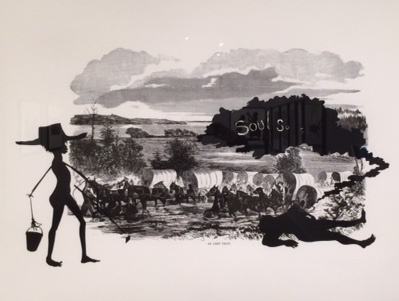
The current star attraction at UMass, though, is Emancipating the Past: Kara Walker's Tales of Slavery and Power, which is on display at the University Museum of Contemporary Art inside the Fine Arts Center through April 30. There are few contemporary artists that inspire as much respect and/or ire as Kara Walker (b. 1969). Hers is a no-apologies-no-punches-pulled look at slavery and its legacy. Her images are often sexualized–to make a point, says she and her admirers; to sensationalize, charge her critics. She usually paints in silhouettes, her large dark figures suggesting the tragedy, but also the hidden power lurking within black bodies. Once again, it's open to interpretation whether the silhouettes deracialize, are forms of reverse racism, are screams of black anguish, or are in-your-face displays of black rage and revenge. In the UMass exhibit, though, there's little doubt that several of Walker's images are meant to challenge white constructions of race and bury white sins. She takes on the idea that the Civil War was about preserving Union by superimposing large black bodies on woodcuts from Harper's Weekly's Pictorial History of the Civil War series. Those bodies—in arrays ranging from detached observation to immediate peril–literally change the frame through which we view the war. In essence, it's no longer a white spin on what matters.

Even more powerful are her scenes from The Emancipation Approximation, the very title suggesting she intends to challenge traditional narratives. And challenge she does. She uses the Greek myth of Leda and the Swan–in which Zeus assumed the form of a white swan to rape and impregnate the beautiful mortal Leda–but Walker's Leda is Everyblackwoman, and the master class the white swans. We see Leda being violated in various ways by whites–either directly or as voyeurs. She also hurls a potent challenge to the very essence of race. The same whites that passed anti-miscegenation laws are, in fact, the ones who made mockery of those laws–a point she makes by superimposing black heads on white swans–an "approximation" of emancipation indeed.


I don't buy the slams on Walker, but I sure can see why she makes a lot of people–black and white–nervous. She dabbles in minstrelsy and that's always a landmine-filled terrain. There is also an overt sexiness in her work that skirts the border between exploitation and appropriation. As for whites, her work is a one-woman destruction of the Lost Cause myth. Plus, it's never comfortable to revisit the sins of one's forefathers–especially when the evening news shows that Old Massah is more alive than dead.

Rob Weir

*Alex Chautin is a former student of mine. I'm a bit biased, but I think Alex's work stands on its own and I had little part of advancing his expertise in graphic novels, though he claims I did turn him on to Industrial Workers of the World graphics. I'll take that with a, "Wow! Cool!"

2/6/17

Strange History: From the Bathroom to the Classroom?


STRANGE HISTORY (2016)
Jay Newman, editor
Portable Press, 416 pages
★★ ½

Have you ever seen Chuck Shepherd's quirky "New of the Weird" columns? If so, you can imagine the content of Strange History. In editor Jay Newman's words, it's a "smorgasbord of oddities: kings, queens, commoners, criminals, gladiators, aliens, ghosts, monsters…." You can add to that list: anecdotes, bloopers, origin stories, fads, riddles, and descriptions of made-up languages. Newman marshals a bevy of writers collectively known as the Bathroom Readers' Institute. Give credit for truth in advertising; this is indeed the sort of book one might find residing in the loo nestled amidst the extra TP–a collection of breezy selections meant to be read in short, non-taxing snippets. So is there any reason to pay attention to it? Maybe.

Like all such projects, this one is less than the sum of its parts, but the bits and pieces are individually delightful. I used to mine books like this when I was a public school teacher for bizarre little curiosities to spring upon students to give their minds a break and enhance my reputation for being unpredictable. Alas, they were often the things students remembered long after they brain dumped the important stuff. Well, at least I taught them something!

There is no rhyme or reason to the structure of Strange History and that's part of its charm. Did you know that Mao Zedong was a librarian before he was a revolutionary, or that Idi Amin cooked for the British army before he terrorized Uganda? You can learn this from Strange History, as well as the first jobs of other famous and infamous people. The book makes no pretense of being anything other than random facts and factoids. I made my way through this book with an eye toward categorizing detail into categories of potentially useful versus mere trivia.

For example, a sociology or popular culture instructor might find it useful to note that elders have been complaining about youth since at least 427 B.C., or that fads have always been edgy. How about crotchless tunics in medieval England, phrenology, Gerber's attempt to sell baby food for adults, 16th century tooth dyeing, or hiring professional "hermits" to reside upon one's estate? Students might find it reassuring to consider that the present has no monopoly over bad decision-making. Did you know that the first person to add sugar to chewing gum (1869) was a dentist? Or, more poignantly, that Adolph Hitler told the first Polish jokes? There are loads of intriguing things for computer scientists discussing computers before computing, including a mechanical wooden robot that dates to fourth century B.C. Greece. Theater and literature lessons can be spiced by all manner of anecdotes, such as a long list of the misfortunes that befell those directing or acting in Macbeth, a list of one-legged actors, the possible origins of werewolf tales, or the inspiration for Mary Shelley's Frankenstein. (Either the 17th century German alchemist Jonathan Dippel, or the 18th century Italian naturalist Spallanzani are good suspects for the latter.) The book also contains tons of origin theories, including theories about unicorns, the evolution of King Arthur tales, how zoos emerged from the private menageries of aristocrats, and how Druids gave us the phrase "tying the knot" for newlyweds.     

On the other hand, when would we ever need a recipe for making shrunken heads? Why should we care that TripAdvisor.com travelers consider Brussels the world's most boring city? (Did any of them drink the beer there?) What can we learn from Joey Mellen, who drilled a hole in his own head in an attempt to achieve a perpetual high, other than the fact that he was an idiot? Do we need a list of lame insults gleaned from the Internet?  

In short, Strange History is a book containing gems and garbage. Maybe the bathroom is where it ought to reside, but I suspect teachers, barroom orators, and trivia aficionados will find plenty of useful things. A personal favorite came from a list of alleged presidential deathbed utterances. James Buchanan supposedly proclaimed, "History will vindicate my memory." When you consider that many scholars consider Buchanan the worst president in U. S. history, you could use that remark to teach the concept of hubris.

Rob Weir

2/3/17

Well-Digger's Daughter: Video Treasure

THE WELL DIGGER'S DAUGHTER (2011)
Directed by Daniel Auteuil
Pathé, 107 minutes, Unrated, in French with subtitles.
★★★★

Novelist, playwright, and film director Marcel Pagnol (1895-1974) was one of the most respected names in 20th century French culture. Jean de Florette and Manon des Sources were published collectively in 1963 as L'eau des Collines (Water of the Hills) and attained instant classic status. Few know that Pagnol also made twenty films and was his nation's first filmmaker elected to the Académie française.  Among his titles was 1940's La fille du puisatier (The Well Digger's Daughter). It was remade in 2011, directed by renowned actor Daniel Auteuil, who also stars in it. Auteuil (b. 1950) does Pagnol proud and his film rates as an overlooked gem.

Pagnol was prescient in his anticipation of World War Two. This film opens in the summer of 1939. Whispers of war are in the air, but the pace of life in Provence–the film's physical setting–unfolds according to time-honored rural patterns. Pascal Amoretti (Auteuil) is the titular well digger– a humble, honest, and exceedingly proud man who works hard at his craft. His is an important job in Provence, which is blessed with beauty and a Mediterranean climate, but cursed by exceedingly dry summers. At age 56, Pascal a bit long in the tooth for excavation work done mostly with pick and shovel–with assists from a bit of dynamite and a good-natured assistant named Félipe (Kad Merad). But what choice does he have? He's a widower with six daughters and only one has reached the age of majority: 18-year-old Patricia (Astrid Bergès-Frisbey). She is Pascal's pride and joy–a considerate, comely lass who went finishing school in Paris, but returned to tend to Pascal and her sisters.

Bergès-Frisbey plays Patricia with a beguiling mix of sophistication and innocence. Her Parisian accent seems exotic to Provence locals, most of whom speak patois, yet she remains a Provençal rustic in all other ways. She is naively unaware of her natural beauty, or that she has acquired just enough polish to charm 26-year-old pilot Jacques Mazel (Nicholas Duvauchelle), the son of a merchant family. In village terms, the well-to-do Mazels are the equivalent of gentry, which places them well above the Amorettis on the social ladder. After just two meetings, Patricia surrenders her virginity to Jacques and finds herself pregnant.

As you can imagine, this complicates things. So too does the calendar. By October, France and Germany are at war and nobody knows what to expect. (For history buffs, the period between October 1939 and April of 1940 was a bit of cat-and-mouse jockeying sometimes called the "Phoney [sic] War." France will fall in June and Provence will eventually be under the Nazi collaborator Vichy government.) But one thing is certain: pilots like Jacques must report for duty–before he even knows about Patricia's condition, as it transpires. And let's not forget about Pascal's self-identity. It is 1939, after all, and an unwed mother-to-be is a synonym for whore. Who will save Pascal's pride? Maybe Félipe? Maybe not.  What ensues is a quintessential clash of wills–between the Amorettis and the Mazels, between Pascal and his equally pigheaded sister Nathalie (Marie-Anne Chazell), and between Pascal and himself. Further complications: Félipe also has his eyes on younger sister Amanda (Émilie Cazenave) and perhaps Patricia has ideas of her own. Plus, there's that pesky war to consider!

If this sounds like a typical French relationship film involving knots and naughtiness, rest assured that this one is a cut above. In some ways it plays like a mash between Far From the Madding Crowd and Ryan's Daughter, yet it's more innocent and playful than either. Although you might not know any of the actors other than Auteuil, it's very nicely acted all around. Auteuil makes us admire his principles one moment and wish to throttle him the next. Bergès-Frisbey deftly walks the tightrope between strong-willed and inexperienced, Cazenave is Auteuil's stubborn equal, and Rambert adds Falstaffian comic relief. Moreover, The Well Digger's Daughter is surprisingly sunny for a film about pride, ruination, betrayal, and war. Or maybe it's those sun-dappled, red-poppy saturated Provençal countryside. That alone makes this a worthy rental/download for a dark winter's night.

Rob Weir


2/1/17

Hanna-Barbera at the Norman Rockwell Museum

HANNA-BARBERA: THE ARCHITECTS OF SATURDAY MORNING
Norman Rockwell Museum, Stockbridge, MA
Through May 29, 2017.

Remember the playground cartoon wars: Disney or Warner Brothers? It was a false debate, as those weren't the only two choices. "Woody Woodpecker" came from Walter Lantz Studios, Terrytoons cranked out  "Mighty Mouse" and Heckle and Jeckle," and the first important TV 'cartoon was "Crusader Rabbit" from Jay Ward (who morphed Crusader and Rags into "Rocky and Bullwinkle"). Back then, I swallowed the duality and fiercely supported the superiority of Warner Brothers (Looney Tunes/Merrie Melodies) and I still insist that Bugs, Daffy, Road Runner, and Tweety kick the collective butts of Mickey, Donald, Goofy and other saccharine Disney offerings.

In truth, though, my childhood was shaped by Hanna-Barbera, as a new exhibit at the Norman Rockwell Museum reminded me. It's subtitled "The Architects of Saturday Morning" and that's fairly accurate. Classic Disney and Warner Brothers productions were made for movies, not television. "Crusader Rabbit first aired in 1948, but fewer than half of American homes had a television until 1954. In 1956, Hanna-Barbera began airing cartoons aimed at Baby Boomers and ended up fashioning the Saturday morning experience of an entire generation.

William Hanna (1910-2001) and Joseph Barbera (1911-2006) came through the usual ranks–training as artists, working in studio animation units, and serving apprenticeships under the great Tex Avery–but they were also the Odd Couple of sketchpads and gel cells. Hanna was as plodding and unpretentious as Wally Gator, whereas Barbera was as plotting and flamboyant as Top Cat. Their partnership began on the silver screen with a short titled "Puss Gets the Boot," from whence Tom and Jerry emerged. They jumped ship just as the small screen went viral, but soon discovered that movie studios were better staffed than 1950s television. The Rockwell exhibit displays many of the original hand-drawn cartoon cells. It also reminds us that, at 24 frames per second, it took 10,000 cells for a single seven-minute cartoon! Watch some old 'toons and notice that backgrounds and chase scenes are often static or redundant. To hand draw changing backgrounds for each cell would have been a herculean task.

 
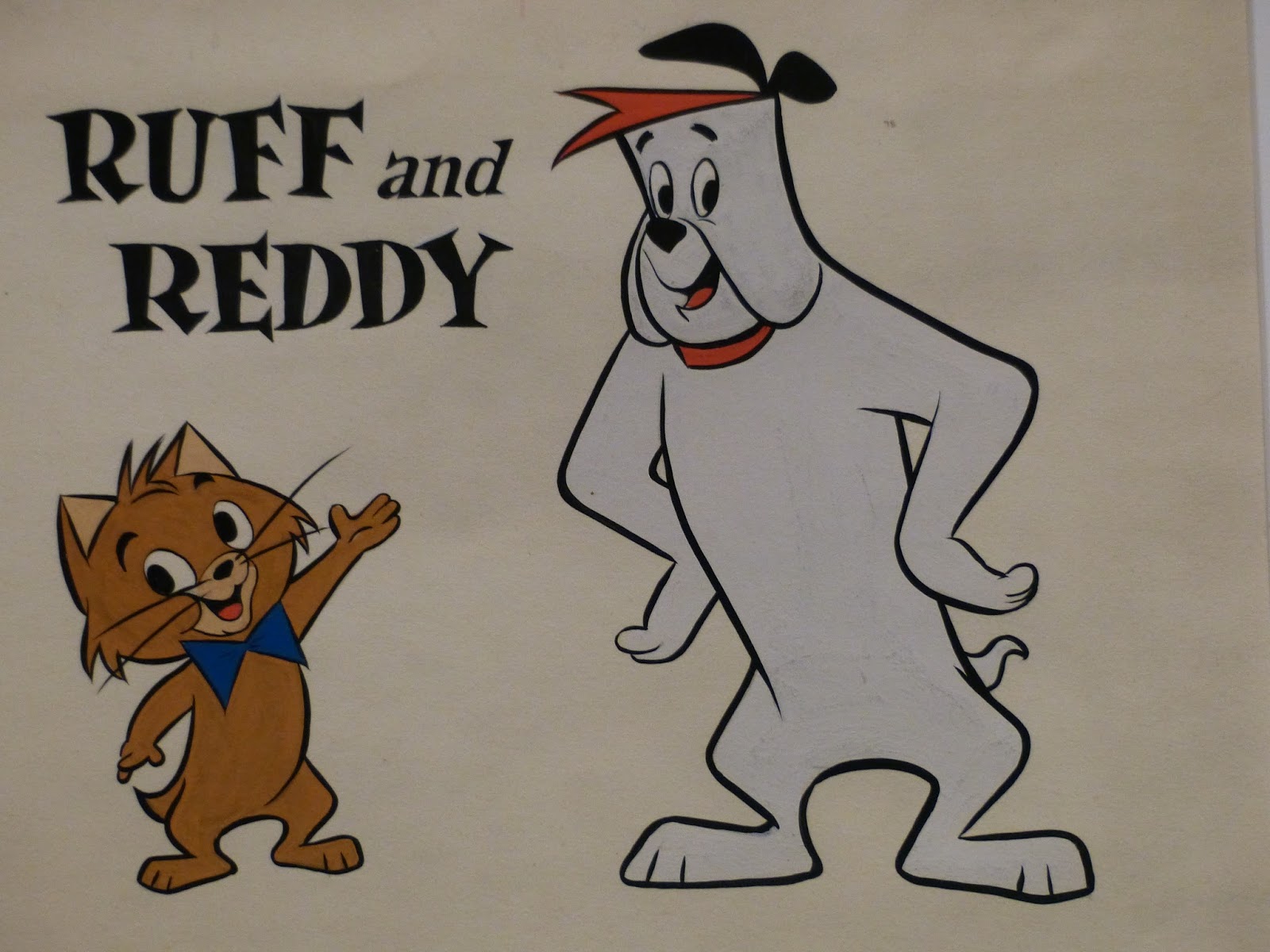
Suggestion: Look at a few cells and then do a fast walk through of the exhibit to get a sense of the scope of the Hanna-Barbera output. Here's a short list: Auggie Doggie, Atom Ant, The Flintstones,  Huckleberry Hound, the Jetsons, Johnny Quest, Lippy the Lion, Magilla Gorilla, Quick Draw McGraw, the Pink Panther, Ruff and Reddy, Scooby-Doo, the Smurfs, Snagglepuss, Snooper and Blabber, Top Cat, and the immortal Yogi Bear (and Boo-Boo too). Then spend time with your favorites and play with a cool interactive screen that gives data, short clips, and little known facts on the various characters.

Take a close look at the artwork and you'll notice deep similarities between characters such as Yogi, Ranger Smith, George Jetson, Huckleberry Hound, and many others. (Look closely as their jaws, muzzles, noses, five o'clock shadows, and eye alignments.) If it looks as if it might have been akin to assembly line production, you're on the right track. Past animation was the opposite of today's razzle- dazzle visuals that render storylines secondary. The Hanna-Barbera formula was to develop iconic characters and storyboard a compelling narrative, which gave them a witty, clever vibe that's hard to top. They were also sharper and more vivid. Digital technology is more flexible and (perhaps) more realistic, but it's not necessarily better art.

Seeing this exhibit is the most fun you're likely to have in a museum all year. There is also poignancy and sadness on display as well. Warner Brothers absorbed Hanna-Barbera in 2001, and Saturday morning cartoons officially died in 2016, though they had been terminal since the 1990s. The 'toons fell prey to misguided attacks on children's television, unwise content shifts in the cartoon industry, and diminished imagination.

You might recall Peggy Charren and Action for Children's Television. From 1968 on, there were relentless attacks on cartoons that yielded regulations. (Remember how "Road Runner" was deemed too violent?) Some of the new rules were wise (like banning direct advertising aimed at kids), but by 1973, children's programming was pared to just 12 minutes per hour; by 1996, all the networks combined could have no more than 36 hours per week. Must have been all those kids running off of cliffs like Wile E. Coyote! Or was it serious people ruining our world? (I'm gong with the second option.)

Cartoonists also bear some blame for forgetting that animal characters are time-tested; they are fabliaux on a gel cell. Making characters more "realistic" wasn't the best idea. "The Jestons" was beloved, but it was just a family sit-com set in the future. (It was also spawned the derivative "Flintstones," which exchanged the imagine future for a mythical past.) I know loads of Gen Xers loved "Scooby-Doo," but it too flunked the imagination sniff test. And then there was dreck like "Powder Puff Girls," "The Banana Splits," "Teen Titans," and "The Space Kidettes." The more "real" cartoons became, the less interesting they became. Kids watched 'toons because they were unrealistic; not because they wanted to work out anxieties or improve self-esteem.

The final blow came when cartoons ceased trying to be original. Many became cartoon versions of live shows (e.g. "The Partridge Family," "Bewitched"), extended advertisements ("G.I. Joe," "The Transformers"), or baby versions of older cartoons and were so inane they bored toddlers out of their diapers. By the late 1990s, the homogenized Disney worldview was triumphant and the salad days of Saturday morning existed only on cable Cartoon Network and not so much there either. It was fun while it lasted. I'm glad to relive those days, though I'm sad it was in a museum.

Rob Weir

1/30/17

Peter Paul and Mary Retrospective a Balm for Troubled Times

-->
50 YEARS WITH PETER PAUL AND MARY (2016)
Directed and produced by Jim Brown
MVD Visual, 78 minutes, Unrated.
★★★★★

Let's start 2017 off right. My album and movie of the month are the same: 50 Years with Peter Paul and Mary. Feeling dispirited about life in modern America? Take a 78-minute dose of this outstanding documentary and you won't need to call me in the morning. This one is filled with all of the classic PP & M hits, a veritable potpourri stretching from "Blowing in the Wind" to "Wedding Song."

The film is a love letter to the trio and I will grant that it's an expurgated missive–one that only hints at downsides such as Mary Travers' four marriages, or Peter Yarrow's alcoholism battle and his 1970 conviction for making sexual passes at a 14-year-old girl. Mainly it deals with unpleasantness by showing the group's meteoric and confusing rise; and by placing them within the chaos of the era in which it occurred. The trio presaged other PR-created bands such as The Monkees and The Sex Pistols. If you never thought you'd see PP & M in the same sentence with such company, read on. Producer Albert Grossman created Peter Paul and Mary from nothing in 1961. Mary Travers (1936-2009) was a Red Diaper baby who was weaned on Pete Seeger, Paul Robeson, and union activism. She dropped out of high school to become a member of a group called the Song Swappers but, by 1961, was seen as talented but too independent; Grossman's first choice, Carolyn Hester, turned him down. Peter Yarrow was a minor solo artist at the time, and. Grossman originally wanted Dave Van Ronk, but chose Stookey–an unknown–when he decided Van Ronk wasn't commercial enough. Originally, being commercial was what it was all about. The Folk Revival was near its peak and acoustic music was white hot. Thus was born Peter Paul and Mary, a name chosen for its Christian/Biblical suggestiveness, though two of its central figures were Jews (Grossman and Yarrow) and Paul was only Stookey's middle name.

Grossman was such a brilliant promoter that PP & M were "stars" from the get-go­; their 1962 debut album contained two songs that charted: "Lemon Tree" (# 35) and "If I Had a Hammer" (#10). Word of mouth and glowing reviews led to a second album, Moving, in 1962 and a #1 single: "Puff the Magic Dragon." (As the video notes, it was just a cute song and the anachronistic pot metaphors are simply folklore.) The rest, as the saying goes, is history. From "Puff" onward, the trio recorded eight more albums and charted with 17 other singles. Their 1963 cover of Bob Dylan's "Blowin' in the Wind" reached # 2; Dylan's original didn't chart! (Little known fact: Dylan has never had a # 1 hit.) 1969, PP & M topped the charts once again with "Leaving on a Jet Plane." Peter Paul & Mary were the ultimate cover band; they only wrote a handful of their own songs: "Puff," "Day is Done," "I Dig Rock and Roll Music," and "Wedding Song" among them. Instead they performed what many listeners came to see as "definitive" versions of songs from others: "Jet Plane" (John Denver), "Early Morning Rain" (Gordon Lightfoot), "The First Time Ever I Saw Your Face" (Ewan MacColl), "Where Have All the Flowers Gone?" (Pete Seeger), "There But for Fortune " (Phil Ochs), "Don't Think Twice" (Dylan)….

If you wonder why, the video answers with its glorious concert footage. PP & M made the successful transition from beatnik bohemianism to political folk and pop stars through sheer talent and evolving values. If PP & M strike you as sedate and overly packaged, watch and listen carefully. First, consider those amazing three-part harmonies. (If you think they're easy, you try harmonizing with Mary Travers!) Both Stookey and Yarrow were far better guitar players than most realize, each wielding their instruments with verve, command, and driving energy. And there is a reason why Ms. Travers gets credit for inspiring generations of female musicians. Watch it for yourself. Give Mary Travers a song in 4/4 and watch her sock the first beat with a right uppercut and nail it the floor with a left hook on the three. She has been oft imitated, but seldom matched. Say what you want about how they cleaned up songs, tamed Dylan's rebellious spirit, or made pretty music that was supposed to be angry. Say it, because you'll find yourself singing along and smiling the whole way through the video.

Whatever you do, don't label PP & M a bunch of commercial phonies. The video captures wonderfully the trio's political evolution–their work with Central American campesinos, their commitment to civil rights and peace movements, Stookey's deepening spirituality, Yarrow's redemption, and Travers' discovery of feminism. Name your cause–PP & M walked in the footsteps of musician activists such as Seeger, Ochs, and Joan Baez. After musing upon the chaos of the 1960s and 1970s, think also upon the grace they achieved moving forward. Try to stay dry-eyed as Yarrow and Stookey reflect upon Travers' death from leukemia in 2009.   

This is an uplifting video that blends interviews, anecdotes, recollections, and concert footage. Idealism is the glue that holds together changing styles, ideals, and the passage of time. It made me nostalgic, but also hopeful. Lord knows we can use all the hope we can get.

Rob Weir