2/17/17

M.I.T. for Art? You Bet!

-->
M.I.T. For Art Lovers?

The words "art "and "M.I.T." are seldom uttered in the same sentence. Yet recently I found myself at the Massachusetts Institute of Technology reveling among delights both technological and aesthetically pleasing.

One enters the museum through a display of robots large and small, complex and simple. Given my own right-brained propensity for the humanities, I was more fascinated by robotic design than function–my favorites being those whose features appealed most to my whimsical and human sides. Don't ask me how any of them work, but I liked the cartoon and sci-fi-looking ones and those that had a mad scientist feel about them, like one that reminded me of Frankenstein's dog.  

The occasion for going to M.I.T. was its recent reopening of a gallery featuring the work of Arthur Ganson (1955-). It originally opened in 1995, year one of Ganson's four-year artist-in-residence term with the Mechanical Engineering Department. If mechanical engineering and artist sound like a contradiction, get thee to M.I.T. and see the reconfigured exhibition space titled Gestural Engineering: The Sculpture of Arthur Ganson. Ganson is something of a geek Renaissance man­–a sculptor, inventor, musician, and engineer. I liken him to a more sophisticated version of Rube Goldberg. His creations have all of Goldberg's whimsy and devotion to because-I-can impracticality, but Ganson could (if pressed) explain the science behind his machines. After all, you need to be able to do some serious math to create a simply row of interlocking gears calibrated such that it will take 13.7 billion years for the last gear to make one rotation. It also takes contemplation to make fascinating an installation that is little more than a scoop bucket that gathers motor oil and dumps it in a thick light-refracting cascade. His title? Machine with Oil–and it doesn't come with a pretentious artist's statement claiming it to be a metaphor for anything! Ditto Cory's Yellow Chair, which is a miniature chair perched precariously upon a stone and dodging a small plastic cat.
 
Ganson's kinetic sculptures are also driven by moxie. Another creation fascinates though it is little more than a gearbox that moves set of slender rods topped by thin slips of paper. The gears and small jets of air cause the paper to move like clouds. I stood before it mesmerized, though even I could see it was a dead simple machine. Other Ganson wonders such as Small Towers of 6 Gears are more overtly sculptural and delicate and others–such as one that looks as if a wishbone man is pulling a post- apocalyptic locomotive are deliciously. Ganson is also fixated on how things come to gather and apart. Another small yellow chair exhibit is a wall installation in which a yellow chair is prised apart by a gear arrangement that takes those parts to star points and then snaps them back together at the blink of an eye. It's akin to a scientist's version of a sand mandala, except that it repeatedly constructs, deconstructs, and reconstructs. Go see this exhibit and repeat this mantra: "M.I.T. It's not just for geeks."

While you're there, check out a small exhibit devoted to holography. M.I.T. professor Stephen Benton is often credited with developing the first true hologram—for Polaroid in 1968, but this exhibit sheds some light—if I may!–on the prehistory and subsequent  development of holography.

My humanist brain was entertained even more by a gallery devoted to M.I.T. pioneers in the field of photography. It includes two of my favorites: Harold "Doc" Edgerton (1903-90) and Berenice Abbott. Is there anyone who doesn't know Edgerton's famed photo of a milk splash rising like a white crown? Yeah–but do you know how he did it? You can both learn about the techniques of strobe lighting and experiment with making you own images. Pretty cool! 

Berenice Abbott (1898-1991) is among the more famous names in photographic history and any museum worth its salt has a few of her images in its collection. She is known for her large format camera work, especially architectural detail, cityscapes, and Depression Era urban social documents. Lesser known, but just as important, are Abbott's photos used in science textbooks, especially works bordering on abstraction that demonstrate physics principles.

This gallery is full of marvels for anyone who has pointed a lens at a subject and wondered what happens to produce the images. It's small, but choice and a stroll through photographic milestones from Eadweard Muybridge's slow-motion shots to the present.

So…the next time you're in Cambridge, Massachusetts, take the Red Line to Kendall and check out the M.I.T. Museum. M.I.T. for Art? You Bet!

2/16/17

Clueless Thy Name is Democrat

-->

Just about the time I think the Democratic Party can’t get any more out of touch, it proves me wrong. Headline from Sunday’s Boston Globe: “Anti-Trump wave lifts and worries Democrats.” Worries!!!??? Some party leaders fret that the leftward tilt of the Warren-Sanders “base” will be a turn-off to “moderate” voters in the Rust Belt. Or so says Ohio’s Tim Ryan.

Okay, so much wrong with that, starting with the obvious: any party ignoring its “base” will crumble like a randomly stacked pile of stones. Worse, Ryan’s sentiment is more of the all-bullshit-no-beef posturing of Hillary Clinton and many of her doe-eyed middle class supporters. Need I remind you how that turned out? Can we revisit the question of why so many Sanders supporters did not vote for Clinton? Wrong answer from Democratic elites: "These delusional fools are responsible for putting Trump into the White House." Real answer: Clinton never connected with palpable economic and social concerns, excited far fewer than voted for her, and resonated best with educated elites.  (Spare me the, “She got three million more votes” line. I agree the Electoral College is a travesty but, for now, it exists.)

Moderates? Try this definition: Those who lack the courage, the commitment, the compassion, and/or the incentive to make up their minds. Ryan and others who worry that the anti-Trump movement will push the Democratic Party too far to the left are drawing the wrong conclusion. The goal isn't to become more like Trump; it's to push the “moderate” electorate leftward. The "center" is a myth. Stop thinking of wage earners as inherently racist, sexist, and conservative. Many are, but that’s true of the vaunted middle class as well—especially suburban whites, the only difference being that the latter dissemble in politeness. (That’s why Martin Luther King Jr. feared white "moderates" more than overt bigots.) Here’s a short history lesson: The American working class has been far more liberal and activist than the middle class. This is the class of the labor wars, unions, civil rights marches, NOW*, Vietnam Veterans Against the War, anti-globalization protests, etc. It is the class that taught the middle class how to protest.

I weary of hearing about the woes of the middle class—a den of privilege and plenitude that behaves like they are paupers. (Yes, I am now a member of its intellectual elite.) Here’s a small guide for the misguided who conflate the working and middle classes. Take it to heart; the Democratic Party cannot speak to the first if it carries the assumptions of the latter. ( MC= middle class  WC = Working class)

1. Housing: You are MC if you worry about affording a mortgage. Many in the WC fear not being able to scrape up rent money.

2. Making your income meet needs: You are MC being "strapped" means Johnny’s orthodontics have to wait, if you are forced to forgo a new cell phone, or carry some debt on credit cards. Many in the WC must choose between which bills to pay immediately, still have a landline, and their cards are maxed out.

3. Food: Pretty simple: If you’ve never known hunger—real hunger, not gluttonous desire—you’re MC.

4. Clothing: WC is patch and pass down; MC is pitch and keep up with fashion.

5. Paycheck: MC draws a salary; WC gets paid by the hour. The size of the paycheck matters less than its security. Contract workers must be paid for the length of that document. No such net for hourly employees.  

6. Cars: The MC worries about car payments. So does the WC, but it truly fears unexpected repair bills. No one from my WC family has ever used Uber.

7. Education: The MC worries about how to pay Buffy’s tuition to Stanford; the WC fears its smart children won't have enough to go to a local state school or community college. The WC fixates on what kind of job their kids will get; the MC wants its kids to develop their minds.

8. Mindsets: Before you tell me how much more electricians make than teachers, I know! But the MC misses the point when it measures everything in monetary/property terms—as if they were Marxist materialists! If you don’t get the whole intellectual versus manual labor thing, you’re clueless—the difference resonates in how worldviews are formed, including thoughts on economics and politics. Don’t tell the WC that globalism helps the economy or generates investment wealth; it's fixated on well-paying jobs—in the USA and now. The MC also needs to be less particularistic and more universal, because every time it uses group-specific terms, the WC thinks, “Special privileges. What about us?” And they’re right!

If the Democrats actually want to win elections, it needs to shut down the Tim Ryans of the party and listen harder to Warren and Sanders on how to re-radicalize the working class--at least in the North and Midwest. (Much of the South might be hopeless!) Think big, not small: free health care, cracking down on Wall Street pirates, job creation, protectionism, equal opportunity, higher taxes on the wealthy, improving public education, deregulating individuals, and securing the blessings of the Bill of Rights for all Americans—not just elites. That’s true populism, not Clintonian triangulation.
------------------------------------------------------------------------------------------
*Sadly, we tell the story of feminism from a middle-class perspective. Women from the United Auto Workers co-founded NOW.

2/15/17

The Handmaiden: Male Gaze Dressed Up as Art?


-->
THE HANDMAIDEN (20160)
Directed by Park Chan-wook
CJ Entertainment, 145 minutes (in Korean and Japanese with subtitles)
Not rated (graphic sex, S & M, violence)
* *

This film has made quite a few top films of 2016 lists. It won’t make mine. This is a male gaze film stylishly dressed and undressed to disguise the fact that it’s actually just porn with a bigger budget.

It has an intriguing concept: take Welsh author’s Sarah Waters’ bodice-ripper Fingersmith and replace her Victorian England setting with that of Korea under World War II Japanese occupation. This was an interesting and traumatic time in Korean history. Korea was not yet an industrial powerhouse and many of its better-heeled citizens saw it as a backwater, with Japan holding allure analogous to the fascination that Paris might hold for a remote Piedmont count. Some Koreans sought to “pass” as Japanese; others surrounded themselves with ostentatious opulence. Into the second category place Kouzuki (Cho Jin-woong), who resides in a three-building complex that's a graft of an English country estate, a traditional Japanese house, and an annex with a sprawling library. The black-tongued Kouzuki licks his pen and rules the roost, but most of the money is actually that of his niece Lady Hideko (Kim Min-hee) whom he holds a veritable prisoner, as he had her aunt (Moon So-ri) before her. Because she cannot leave the grounds, young Lady Hideko has the body of a voluptuous woman but the mind, naiveté, and doll-clutching habits of a child. Maybe.

Enter a Korean con man (Ha Jung-woo) posing as Count Fujiwara of Japan. He’s really the head of a bandit’s roost of pickpockets and thieves, but he has a grand scheme: plant one of his minions in Lady Hideko’s household as her handmaiden, have her sing the count’s praises, and pave the way for his wooing—the ultimate plan being to marry Hideko before her uncle does, drive her insane, send her to an asylum, gain control of her fortune, and pay off his minion. How very, very Victorian! Sook-hee (Kim Hae-sook) is chosen and she is soon ensconced in the household as Tamako. But the Count didn’t plan on her seducing Hideko. Or did he?

The film is divided into three parts, the first being the set up, the second delving more into the back story and the revelation that Kouzouki’s library is full of erotic books and that he stages periodic dramatic readings from them for the benefit of randy Korean aristocrats. Part three is the reveal and conclusion. It’s essentially a tease as to whether we are watching a grift, a double cross, a triple cross, or just kinky debauchery. 

Some of this holds promise. The sets are rich, the colors are eye-popping vivid, the narrative closely parallels Waters’ novel, and I’m told that the director and actors are highly regarded in South Korea. But shall we be honest here? This film is about two beautiful women getting naked and having very graphic sex with each other. Can we not pretend that this is a psychological thriller and just call it a high-class male masturbatory fantasy? Mine is not an anti-porn crusade. It’s really up to you to determine where to draw the line between sexuality and exploitation, but it is telling that it’s mostly (but not entirely) male reviewers singing the praises of The Handmaiden. But allow me to be righteous on this point: I object to pure voyeurism pretending to be art. I’m open to the idea that the two can be complementary, but Gustave Courbet this isn’t!

Rob Weir           

2/13/17

Free State of Jones: Overlooked Gems

-->
THE FREE STATE OF JONES (2016)
Directed by Gary Ross
STX Entertainment, 140 minutes, R (violence and extreme gore)
★★★

The next time some good ole' boy trots out Lost Cause bullshit, ask if any of his ancestors fought for the Confederacy. If they didn't, chances are pretty good that ancestor was a slaveholder; if they did, there's a 50-50 chance his glorious kinfolk were Civil War deserters.

The Free State of Jones bombed at the box office, returning just half of its $50 million budget. It's not a great movie, but its financial shortcomings have less to do with its artistic merit than with the fact that it blows the lid off any notion that the Confederacy was any sort of noble cause, or that the Civil War took place over abstractions such as states' rights. In a word, it was about slavery, specifically the right of rich slaveholders to use poor boys to defend their assets. There was great doubt from the outset. Slave states such as Delaware, Kentucky, Maryland, and Missouri stayed out of the Confederacy and the 41 western  counties of Virginia seceded and became the Union state of West Virginia. Any claim to Southern morality disappeared when the South enacted a conscription law in 1862 that allowed the wealthy (aged 18-35) to hire substitutes—even those underage–to fight for them. In October of 1862 , they amended the law to expand the draft age and put into place the Twenty Negro Law, which automatically exempted anyone owning or overseeing more than 20 slaves. No one knows exactly who first uttered the phrase "a rich man's war and a poor man's fight," but thousands of po' boys voted with their feet and went AWOL. So many walked away that manpower needed on the lines was diverted into hunting down deserters and runaway slaves. By 1864, the desertion rate was over 60% in some areas.

The Free State of Jones opens in 1862, the month the Twenty Negro Law was enacted. We meet Newton Knight (Matthew McConaughey) at the bloody Battle of Corinth, where he works with Confederate medical units bringing in the wounded and hauling away corpses, body parts, and viscera.  These scenes are so gruesome they dispel all romantic nonsense about war. Newton already had grave doubts, but when his barely teen-aged conscript nephew Daniel (Jacob Lofland) meets a senseless end, Knight deserts and takes Daniel's body back to Jones County, Mississippi. While there he finds that CSA troops under the command of Elias Hood (Thomas Francis Murphy) are looting hardscrabble farms while local plantations remain enclaves of luxury. Newton will hang if found, so he abandons his wife Serena (Keri Russell), launches a guerilla rebellion of the poor, and hides out in the swamps with runaway slaves. There he strikes up a friendship with Moses Washington (Mahershal Ali) and finds himself increasingly attracted to Rachel (Gugu Mbatha-Raw), the house slave who secretly provisions the runaways. Soon, local poor whites and AWOL soldiers seek out Knight's guerilla band. After the 1863 siege of Vicksburg, all pretenses are dropped, the county secedes from Mississippi, and the biracial Free State of Jones is proclaimed. But can such a rebellion succeed? And what of Knight's relationship with Rachel, which is doubly problematic because he's already married and Rachel is black. Knight is making advances militarily, but who will arrive first, the Southern Patrol or General Sherman? Is Knight's biracial imagination too much for mid-19th century Southern values?

Ross' film is overly ambitious. Ross extends it to depict Reconstruction, the rise of the Ku Klux Klan, the end of Reconstruction, and scenes from 1947, when Knight's great-great-great grandson is facing the problem that he might be 1/8 black and his marriage might violate Mississippi's Jim Crow miscegenation laws. Ross' motives are admirable, but it's simply too much for one film. Thorny postwar issues can only be glossed and even then, at 140 minutes, it's a very long film. It would have made for a more coherent film had Ross ended with the war's completion and added explanatory text-over-photo postscripts.

I suspect he didn't because he wanted viewers to smell racism's full fetid stink. He also ran afoul of painting such strong characters that he felt compelled to show us what happened to Knight, Rachel, Serena, and Moses. A word about Matthew McConaughey: Hollywood tried its best to make him into a star and he opted to become a serious actor instead. (See his recent work in films such as Interstellar, Mud, and Dallas Buyers Club). McConaughey is sterling as Newton Knight, whom he plays with piercing steely-eyed resolve. His is a charisma that spreads slowly and soon we are engulfed in it. It is one of the better performances in a film few have seen. The Free State of Jones is well worth a download–not a great film, but a good one, and a timely one given the sorry state of black/white relations in contemporary America.

Rob Weir

Postscript: Historians are divided as to whether the Free State of Jones was a viable entity, a symbol of the war's chaos, or merely a bit of quixotic bombast. It's also ambiguous whether Knight's motives were Robin Hood-like or merely personal. Let's just say there's more nobility to Knight than to the Confederacy.


2/10/17

Hidden Figures: Worthy Subjects, Uneven Direction

-->
HIDDEN FIGURES (2016)
Directed by Theodore Melfi
20th Century Fox, 127 minutes, PG (racist themes)
★★★

Want to blow your mind? Take out you cell phone and open any app. If it seems slow to load, chill out. No matter how long it takes, it will be 32,600 times speedier than the IBM computers used to send Apollo 11 to the moon in 1969. Yep—that little gadget in your hands has roughly 1,300 times more processing power than NASA had. Back in those days, a “computer” might be an IBM, or it might be a math whiz wielding a protractor. Someone like Katharine Johnson, though probably not—Ms. Johnson is black. But without her, it would have taken NASA longer to catch up the Soviet Union and astronauts would have been sacrificed in the process.

Hidden Figures is a clever title for a film about three unsung black sheroes whose brains supercharged the space program: mathematician/computer Katharine Goble Johnson (Taraji Henson), mathematician/supervisor Dorothy Vaughan (Octavia Spencer), and engineer Mary Jackson (Janelle Monáe). After a prologue in which we see Goble as a child math savant, the action shifts to 1961. The Soviets had already beaten the U.S. in the satellite race with its 1957 launch of Sputnik and NASA is again red-faced, as the Ruskies have just sent Yuri Gagarin into space. The heat is on Langley Research Center to respond, but the science simply isn’t there and that includes the IBM, which no one can figure out how to get into the building, let alone use. Space Task Force head Al Harrison (Kevin Costner) wants answers and he’s willing to bring talent over from the segregated lab to get them. Enter Katherine Goble.

Henson does a very fine job of displaying the awkwardness, the passive-aggressive racism, and the patronizing attitudes she encounters as the only black person in a literal sea of white—both the faces and the ubiquitous white shirts of serious people in those days. She is forced to coauthor every study with chief engineer Paul Stafford (Jim Parsons) even though he’s a racist/sexist jerk and she’s way smarter than he, and to endure the racism-posing-as-maternalism of supervisor Vivian Mitchell (Kirstin Dunst). Plus, there’s the logistical problem that Langley is in Jim Crow Virginia, so the simple act of using the toilet involves a half-mile round trip jaunt to the segregated facility. Her friends Mary and Dorothy have their own burdens: Mary needs to get into a whites-only school to finish courses to become a full-fledged engineer; Dorothy is supervising an entire unit, but doesn’t bear the title or pay-grade commensurate with her duties.

Some films are claustrophobic and need to get out more; Hidden Figures is hampered by needing to stay closer to home. Because of the way the film is structured, we pretty much know we are watching a triumph-in-the-face-of-adversity tale in which our three figures will do marvelous things. I understand the impulse to flesh out the characters through back stories, but there are marked tonal shifts when we watch Katherine being wooed by Jim Johnson (Mahershala Ali), Dorothy playing matchmaker, or Mary sitting in a classroom (which didn’t actually happen). There’s a sense that Melfi didn’t trust that the central narrative was strong enough, so he decided to “pad” with Hollywood tricks: romance, witty banter, biographical invention, and a repeated segregation trope that (alas!) becomes more of a “gag.” I could have also done without Hans Zimmer’s score, which is so overbearing that it sounds like he wants to be John Williams when he grows up.

Luckily the story can stand on its merits and the acting is very strong. Henson plays Johnson with a controlled balance of geekiness, kindness, and determination; and Ms. Monáe shows she’s more than a pop star--she portrays Jackson as a simmering ball of fierceness. Dunst dons her Janus face with aplomb, and even Costner is subtle. (Maybe Hollywood has figured out he’s a better character actor than a lead.) Oddly, the weakest link is Spencer—though she’s the one who garnered an Oscar nomination. She’s perfectly competent; it’s just that we’ve seen her do the same things many times: the wry humor, bulldog determination, furtive assertiveness, and that glance that might be bemusement or might be a challenge. Her arched eyebrow expression rivals that of Mr. Spock!

To set the record straight, not all that you see on the screen is literally true. The scenes between John Glenn and Goble/Johnson are greatly exaggerated, and Mary Jackson was not on a temporary assignment with NASA pending completion of her engineering degree—she already had one, was made permanent in 1953, and assumed the title of engineer in 1958. Most egregiously, Dorothy Vaughan was promoted to a supervisory role in 1949 and, in 1958, was made part of an integrated NASA unit. And there’s the very odd decision to invent composite characters such as Al Harrison, Paul Stafford, and Vivian Mitchell.

It’s telling that a film dealing with racism is rated PG. Director Melfi is white and my take is that he, like his Vivian Mitchell composite, wanted to do the right thing but couldn’t quite get out of his own way. The film’s Disneyesque triumphalism diminishes the very real achievements of three remarkable women. In the name of overcoming racism, though, Melfi whitewashes it. By all means see Hidden Figures. Everyone should celebrate Johnson, Jackson, and Vaughan. Be wary of the hype, though. This film lifts off, but it never quite achieves orbit.
Rob Weir  

2/8/17

Even Dogs in the Wild a Thrilling Twisty Mystery

Even Dogs in the Wild (2016 U.S. publication)
By Ian Rankin
Orion, 352 pages.
★★★★

Scottish novelist Ian Rankin is the master of what I call the "twisty mystery," the ones that take various turns and have more red herrings than a trawler crashing into a dye factory. This is Rankin's twentieth book in which grizzled Detective Inspector (DI) John Rebus plays a central role, though now he's retired, bored, and even crankier. But you won't need to have ever read a page of Rankin to appreciate the part Rebus plays in Even Dogs in the Wild. The title, by the way, comes from a song line from Associates, a defunct Scottish punk/New Wave band. Dogs factor into the story, though probably not in the way you imagine as you are reading.

"Not in the way you imagine" is exactly the quality that makes Rankin a master of his craft. This murder mystery centers on several Edinburgh murder victims, the highest profile of which is Lord David Menzies Minton, a retired lawyer and a member of the House of Lords. (There's a subtle Scots joke in this: Menzies is a common Scottish name, but it's also a large corporation, a retailer, and a news agency.) As in the United States, bump off a no-account and the nation yawns; kill a bigwig and the powers that be stir. Two Scottish Police districts investigate, but so too does Gartcosh, a Scottish investigative campus that's allegedly going to bring crime solving into the 21st century. They send a special six-member unit headed by the secretive and obnoxious Ricky Compston, who commandeers office space and throws his considerable weight about. Call this one a computers-and-special-ops-meets old-fashioned legwork mystery. Rebus finagles a detective consultant role, thanks to his protégé DI Siobhan Clarke. (That's shee-von' for non-Scots speakers!) That's also welcome news to DI Malcolm Fox, who works across town, was also tutored by Rebus, and is good friends (but more?) with Clarke. Here's what anyone has to go on: Minton's murderer left a note: 'I'M GOING TO KILL YOU FOR WHAT YOU DID." The m.o. is similar to that of the murder of lottery winner Michael Tolland, but he wasn't a guy who moved in Minton's circles. Even stranger, (semi-) retired crime boss Morris "Big Ger" Cafferty also got a note like that, and someone just fired a 9mm pistol through his and narrowly missed him. (That gun caliber is unusual in Scotland.)  Cafferty suspects the Starks, a Glasgow syndicate, might have something to do with it, or perhaps local punk-with-ambition Darryl Christie, but the style doesn't mesh with either of them.

Rankin throws lots of stuff at us: police in-fighting, secrecy in high places, unholy alliances, missing people, family relationships, pub life, autopsy scenes, shake-downs, and (yes) even dogs. It's a thrilling read that I consumed in a single snowy evening and it left me considerably more satisfied than the prospect of shifting snow in the morning! The book, on a deeper level, is commentary on dying worlds (that of Rebus and Big Ger), but new ones not yet born. There are numerous hints that it's also commentary on Scotland's post-independence vote and, by extension, visions and relationships that may not be as dead as they seem. Rankin certainly seems to be setting himself up for a series reboot with Clarke and Fox, but even if you never read another Rankin novel, this one's as tasty as a fine single malt.

Rob Weir

2/7/17

UMass: The Place for Pioneer Valley Art in February


Most art fans visiting the Pioneer Valley make a beeline to the Big Three: the Smith College Museum of Art, the Mount Holyoke College Art Museum, or Amherst College's Mead Art Museum. If the kiddies are along, a stop at the Eric Caryle Museum is de rigueur. It may come as a shock–and no slight is intended to those other fine institutions–but the place to be for February art treasures is the campus of the University of Massachusetts Amherst. Three fine shows now grace gallery walls.

Run; don't walk, to see Direct Action Comics: Politically Engaged Graphic Novels. And make haste—it's hanging in the Herter Art Gallery and ends on February 22. Why such a short run for a show that only opened on February 2? The Herter Gallery is designed to attract students, their work, and their curation, hence the turnover is quick.UMass Comparative Literature Professor Chris Couch curates this show, along with recent UMass graduate Alex Chautin,* and I do not exaggerate when I say that it's unlikely you will see a better exhibit on graphic novels this year.

Think comics are just for kids? You're decades out of date and need to see what you've been missing. There's very little about this exhibit that would be of interest to or appropriate for children. It is exactly as advertised: agit-prop, identity formation, and social justice art–mass produced, to be sure, but well out of the mainstream. You will encounter now iconic names in this exhibit–Vaughan Bodé, Max Brooks, Will Eisner, Alan Moore, Frank Miller, Harvey Pekar, Art Spiegelman–but also many newer names. What links all of them is a deep commitment to telling the stories of socially disempowered or marginalized people and groups. In that spirit, one of the first things that you encounter is Gary Hallgren's iconic image of Nancy and Sluggo discovering that the social construction of gender begins with what's in the undies.

If you've wondered what happened to politically charged art in an age in which rock music sells beer, film is paint-by-the-numbers, and theatre operates too close to the margins to take chances, Direct Action Comics will direct you to where provocation is alive, well, and deeply grounded in history. You'll find recent musings and manifestations of the Industrial Workers of the World, Emma Goldman, World War II Japanese internment, the civil rights movement, and Margaret Sanger. I'd make the case that there are very few one-volume surveys of Latino history as good as Lalo Alcarez and Ilan Stavans' graphic book Latino USA. You can also discover the deep history and roots of modern identity movements in works such as Wimmen's Comix, Howard Cruse's groundbreaking gay-themed Wendel, Art Spiegelman's Fagin the Jew, and other such works. No oppressor gets off the hook, and that includes the Islamist butchers who attacked Charlie Hebdo. Pay attention to the labels; they are informative and engagingly written. A final note: I've heard people say that young people don't read anymore. Wrong! They devour graphic novels and they can astound you with what they see in each drawing. Educators now speak of the need to teach visual learning. About time!


Tela McInerey
Vonnegut, "Double Wedding"
You'll have even less time to take in Stories: Past, Present, and Future, which is installed in the Hampden Gallery on the main floor of the Hampden Dining Common in the Southwest Residential area of UMass. It closes on February 17. This gallery is generally devoted to the works of local artists–in this case, eight women associated with the Zea Mays Printmaking Collaborative in my town of Florence, MA (a section of Northampton). All eight artists intrigue, but I was partial to a video installation by curator Lynn Peterfreund that stitched together hundreds of still images and animated them in a short, but mesmerizing pastiche. I also liked the work of Anne Beresford, who takes copies of old engravings—for instance, a 16th century Italian print of the Muse of Beauty–and enhances them with overlays of her own designs and slashes of color Nanette Vonnegut (daughter of Kurt), whose puckish sense of humor is on display; and the deeply interior monoprints of Tekla McInerney.


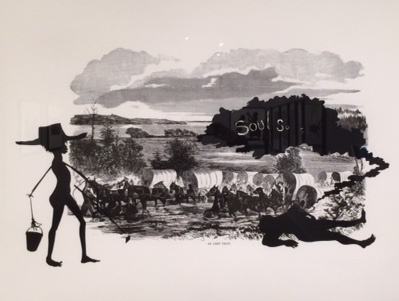
The current star attraction at UMass, though, is Emancipating the Past: Kara Walker's Tales of Slavery and Power, which is on display at the University Museum of Contemporary Art inside the Fine Arts Center through April 30. There are few contemporary artists that inspire as much respect and/or ire as Kara Walker (b. 1969). Hers is a no-apologies-no-punches-pulled look at slavery and its legacy. Her images are often sexualized–to make a point, says she and her admirers; to sensationalize, charge her critics. She usually paints in silhouettes, her large dark figures suggesting the tragedy, but also the hidden power lurking within black bodies. Once again, it's open to interpretation whether the silhouettes deracialize, are forms of reverse racism, are screams of black anguish, or are in-your-face displays of black rage and revenge. In the UMass exhibit, though, there's little doubt that several of Walker's images are meant to challenge white constructions of race and bury white sins. She takes on the idea that the Civil War was about preserving Union by superimposing large black bodies on woodcuts from Harper's Weekly's Pictorial History of the Civil War series. Those bodies—in arrays ranging from detached observation to immediate peril–literally change the frame through which we view the war. In essence, it's no longer a white spin on what matters.

Even more powerful are her scenes from The Emancipation Approximation, the very title suggesting she intends to challenge traditional narratives. And challenge she does. She uses the Greek myth of Leda and the Swan–in which Zeus assumed the form of a white swan to rape and impregnate the beautiful mortal Leda–but Walker's Leda is Everyblackwoman, and the master class the white swans. We see Leda being violated in various ways by whites–either directly or as voyeurs. She also hurls a potent challenge to the very essence of race. The same whites that passed anti-miscegenation laws are, in fact, the ones who made mockery of those laws–a point she makes by superimposing black heads on white swans–an "approximation" of emancipation indeed.


I don't buy the slams on Walker, but I sure can see why she makes a lot of people–black and white–nervous. She dabbles in minstrelsy and that's always a landmine-filled terrain. There is also an overt sexiness in her work that skirts the border between exploitation and appropriation. As for whites, her work is a one-woman destruction of the Lost Cause myth. Plus, it's never comfortable to revisit the sins of one's forefathers–especially when the evening news shows that Old Massah is more alive than dead.

Rob Weir

*Alex Chautin is a former student of mine. I'm a bit biased, but I think Alex's work stands on its own and I had little part of advancing his expertise in graphic novels, though he claims I did turn him on to Industrial Workers of the World graphics. I'll take that with a, "Wow! Cool!"