9/29/17

Sam Gleaves and Tyler Hughes: September 2017 Album of the Month


Sam Gleaves and Tyler Hughes
Community Music

The unpretentious title of this album is also its dominant mood. This is Appalachian music featuring warm, inviting vocals and fancy pickin’ that never sounds like showing off. Sam Gleaves made a splash a while back with his admission that he’s gay and proud. That wouldn’t raise an eyebrow in much of the urban Northeast, but it was an act of courage in the backwoods part of Virginia from which he hails. Here’s the deal, though. A confessional such as his will get huzzahs from the LGBTQ community and its allies, but you still need to be good if you want applause from music fans. So get this in your head: he’s not just good, he makes mountain music the way it ought to be made. This record, a collaboration with a fellow Virginian, Tyler Hughes, is the sort you’ll dust off any time you feel like you need to get back in touch with things fundamental and time-honored. One listen to “Living with Memories” will remind you you’re hearing the real deal, not a bunch of studio enhancements. It’s an elemental sort of country weepy, but there's not a false note to be heard. It made me think back to the days in which music was supposed to connect on the personal level, not make you stare at the musicians like they were gods. Is it a bit corny? Sure, but it also invokes walking by a neighbor's house when he looks up and says, "Hey--want to hear an old song my grandfather used to play?"

Gleaves and Hughes are equally sublime on the delicate harmonies of the wholesome “When We Love,” the breakout solos and forays into the minor key of “Georgia Row,” and “Mister Rabbit,” an Appalachian children’s song popularized by Burl Ives that is rendered here in a more folkloristic style. Gleaves and Hughes also give us a pastoral remake of “I Can’t Sit Down” to make Sister Rosetta Tharpe smile from the Beyond. (I caint sit down/I caint sit down/Just got to heaven and I’ve got to walk around.] They give a spiritual twist to “I Washed My Face in the Morning Dew” and make “Lonesome Homesick Blues” sound like we tuned in the Wheeling Jamboree on Sunday afternoon. Two soothing high tenor voices and enough instruments to fill a music shop: guitar, fiddle, autoharp, mandolin, banjo, dulcimer…. These are songs and tunes that scurry and circle, slow down and crawl, give a swift kick and lift your soul to the clouds. It such fun that it’s easy to overlook just how accomplished it is. Call it honest, earnest music that will melt the stony heart of a flinty cynic.

Rob Weir

9/27/17

Scorces's Silence an Overlooked Masterpiece


SILENCE (2016)
Directed by Martin Scorsese
Paramount, 161 minutes, R (violent images)
★★★★★


If I told you that a really long, slow, and frequently gruesome movie about 17th century Portuguese missionaries to Japan might be the best film you’ll see all year, would you believe me? You should.

Silence joins The Last Temptation of Christ and Kundun to complete Martin Scorsese’s trilogy about faith, the need for tolerance, and the limits of the latter. It’s the movie he’s wanted to make his whole life, or at least since 1990, when he first tried to bring Shūsaku Endō’s novel to the screen. Scorsese, like many Roman Catholics in a secular age, has long struggled with church doctrines fashioned in the Middle Ages that make sweeping demands on believers, but are often rooted more in custom, archaic power structures, and the arcane reasoning of theological tribunals than in Biblical commands or the needs of followers. Scorsese also ponders deeper eschatological mysteries: life’s meaning, eternity, and the nature of God. He concludes that faith and reason are often incompatible lovers.

This is especially the case when it comes to God. One of the greatest conundrums is whether God hears our prayers. If so, why does it often seem as if we are alone in the universe? If you think about it, all organized religions are rooted in a monstrous conceit. Each poses an omnipotent, ineffable god yet insists that theirs is the only true deity—as if somehow they alone among finite beings comprehend the infinite.

In Silence, Fathers Rodrigues (Andrew Garfield) and Garupe (Adam Driver) add another layer of irony. Their self-claimed task is to smuggle themselves into Japan, minister to the scattered faithful, and find Father Ferreira (Liam Neeson), one of the few priests not reported killed in the wake of the Shimbara Rebellion (1637-38), a revolt against Tokugawa shoguns widely (and conveniently) blamed on foreigners. So our two fathers leave Portugal, where the Inquisition remains in full force and non-Catholics meet fates similar to those suffered by Japanese Catholics! As they seek Father Ferreira, think a 17th century version of the search for Dr. Livingstone meets Heart of Darkness. They find small bands of faith-starved Christians, but also hair-curling persecutions: burnings, drownings, beheadings, and a few tortures not even Europeans had considered. Through it all, the question persists: Why is God silent?

Rodrigues and Garupe also meet a different kind of inquisitor, Inoue Masashige (Issey Ogata). He’s like Torquemada meets Marcus Welby—calm, reasoned, and a strange blend of mercy and unspeakable cruelty. He’s quite willing to forgive those who apostatize by trampling on an image of Jesus—something the professed devout believer Mokichi (Shinya Tsukamoto) does repeatedly to save his neck—and then promptly begs priests for forgiveness. There is a scene between Rodrigues and Inoue that is at once a masterful parry of rhetoric thrusts and a portrait of chilling psychological terror. Again the big questions: What is the duty of the faithful? It is easy to despise Mokichi, a Japanese mash up of Judas and Peter in the Garden of Gethsemane, but would you renounce your faith if by doing so you saved others? What if the cost of doing so meant that you and your flock would be forever lost? Would you save them, or bear the guilt that you let them perish? At what point does doubt overwhelm faith and fervor? How do you live with yourself if you turn your back on God? And what if God speaks in the silences, not during self-perceived acts of faith?

The film reaches surprising conclusions that, like Inoue’s demeanor, evolve with—mixed metaphor intended—explosive quietude. Silence is beautiful to watch and its locations (in Taiwan) are sumptuous and Zen-like. Garfield is wonderful as a devotee torn between desire to emulate Jesus and the fear he's not up to the task. Driver has a lesser role, but is also superb in his battle between reason and moral impulses of potentially disastrous consequence. Both are outdone by Tsukamoto and Ogata. Tsukamoto's Mokichi takes his place among Uriah Heap, Gollum, Francis Urquhart, and Peter Baelish as one of fiction's greatest obsequious, treacherous characters. For his part, Ogata stuns. Watch how he uses his seated body to collapse like a trapped toad, only to slowly inflate and assume a Yoda-like counselor's position. When he does this, he is about to puff again and mete out monstrous fates—all with a Mona Lisa smile upon wan lips. 

Does Scorsese solve the riddles of faith, tolerance, and the nature of God? Of course not, but you will never think of such issues the same way again. They will probably haunt you in your solitude.

Rob Weir

#silence

9/25/17

Richard Russo's Trajectory Hits the Target


TRAJECTORY (2017)
By Richard Russo
Alfred A. Knopf, 243 pages.
★★★★

Readers of this blog know that I am a big fan of author Richard Russo. They also know I am not a fan of short fiction. This raises the question of how I’d feel about a collection of short stories from Russo. Answer: Pretty good. Russo is such a gifted writer that I suspect he could generate interest if he penned the ingredients in haggis.

It certainly helps that the tales in Trajectory are closer to novellas than to conventional short stories. There are just four spread across 243 pages, which affords Russo more space for his characters to breathe and develop. But first, let’s muse on the title. The hardcover dust jacket sports a single archery target set against a wooded backdrop. The implication is that a well-drawn arrow fired toward the target will either land in or around the bull’s-eye, but that an errant shaft has a good chance of being lost in the forest. As any archer knows, the slightest quiver, twitch, or loss of focus alters the outcome. Sometimes, so does luck. These are precisely the scenarios played out in Trajectory. Complexity is layered into the narratives via protagonists who occupy a middle position between contrasting characters whose trajectories direct them toward success or failure.

“The Horseman” juxtaposes a smart but inhibited play-it-safe English professor between a student caught plagiarizing, family pressure, and a burnt-out colleague on one hand, and her imposing but misunderstood former mentor on the other. It is one of the better looks at academic insecurity I have ever read. To add a personal note, every professor I’ve ever respected has felt like a fraud at some point—and it’s a fear I certainly experienced.

“Voice” follows a different scholar to Venice, where he must confront a mistake, ageing, a resentful brother, a sad widower, and two enigmatic women. Is there a better place to explore feeling lost than labyrinthine Venice?

The sands of time also get a workout in the remaining stories. “Intervention” is set amidst the wreckage of the housing market collapse and manages to connect that debacle to deep family dynamics, sidetracked dreams, failed expectations, and successes that feel like failures. “Milton and Marcus” finds an unnamed writer torn between the thrill of the chase and his own grasp on reality when Hollywood courts him as a script doctor for a proposed blockbuster. He is appropriately anonymous as the writer is a bit player in a game he knows he can’t win: “It’s all bullshit and you know it, just as you know that in due course you’ll be fired, though probably not by the people flattering you now.” He’s also caught between the demands of a prima donna director and the memory of a deceased friend: an actor for whom he wrote the first treatment of the script in question a decade earlier. This one comes off as a cautionary allegory and serves as a devastating takedown of the vacuity, amorality, airbrushed mountebanks, and flea-like attention span of modern celebrity. But would you join the Big Dance of money, posturing, and positioning?

Many of the things that make Russo a great writer are on display in Trajectory: his poignancy, his facility with stripping emotions to their core and conveying them in ways that hit home, the manner in which he universalizes individual drama, and the skill with which he presents pathos and pulls back before it becomes bathos. There’s always a tinge of hope amidst the darkness in a Russo tale. Also humor, but of the nuanced kind that makes you chuckle just before you say, “Ouch!” Russo is like that—sort of like taking a stroll in a tranquil glade just before a wayward arrow whizzes past your head.

Rob Weir

#richardrusso 

9/22/17

Ocean Liners and Monsters at Peabody Essex Museum


 Ocean Liners: Glamour, Speed, and Style
                        (through October 8, 2017)
It's Alive: Classic Horror and Sci-Fi Art from the Kirk Hammett Collection
                        (through November 28, 2017)
Peabody Essex Museum, Salem, MA


The Peabody Essex Museum (PEM) wants to become New England's second leading art museum. Until recently, PEM was mostly a memorial to Salem's 18th and 19th century maritime glories, which it honored with a cabinet of curiosities assemblage of all things watery. This means that it lacks a sizable permanent collection of paintings and objects that make art critics and curators swoon. Solution: If you can't beat the Boston Museum of Fine Arts, launch exhibits outside of the venerable MFA's métier.  

Ocean Liners is a perfect PEM exhibit—one that's simultaneously right in its saltwater tradition, yet innovative and unique. Prior to the 1960s, high-speed transportation across oceans conjured ocean liners, not airplanes. * From the mid-19th century until well into the 1950s, "speed" meant New York to London in under a week and those who could afford it, went in "style." The PEM exhibit is the stuff of enchanting mid-century Hollywood films in which classy passengers donned formal-wear for dinner. There were, of course, those traveling on the cheap—below-decks budget travelers and immigrants in steerage—and the PEM show gives a nod to those with fewer means, but the ballroom set dominates. Think Cary Grant and Deborah Kerr in an Affair to Remember, a clip from which is part of the show. (So too is one of my all-time favorites, the hilarious Marx Brothers "stateroom" scene from A Night at the Opera.)


The breadth of the exhibit surprised me—more than 200 objects in all. There are numerous advertising posters from the golden age of steamship travel and these should be viewed as masterpieces of graphic design. Even smaller objects—such as dinner menus and hard-colored postcards—are exquisitely done. In fact, the word "glamorous" often seems inadequate, as well-apportioned ocean liners were floating mansions sporting carved oak paneling, detailing from masters in the decorative arts, Arts and Crafts furniture, and fine dining for 750 at tables outfitted with linen, gleaming silverware, fine china, and delicate crystal. Wallpaper, pianos, Art Deco tea services, lighting, fixtures, paintings, and decorative sculpture—you name it and it was done with upscale polish. Well-chosen costumes—of both passengers and crew—add to the ambience. It took a village to service what was, in essence, a floating small town. 

 
I longed for more on the below-decks crowd, but one of the more interesting things is how the ships were mirrors of social change. This is especially the case in observing  ways in which 1950s versions of modernism and 1960s trends tamped down the elegance. Seeing the well heeled in designer mini skirts, casual wear, and broad-lapeled suits reminds me that the upper crust simply can't do hipster without looking like poseurs. You can literally see Cary Grant-like sophistication losing out to the faux mod vibe of Sean Connery as James Bond. 

* Jet aircraft engines were developed in the 1920s, but World War II first demonstrated their potential. There were no commercial jet flights until 1952 and they were few in number because early "turbojet" technology led to catastrophic metal fatigue. "Turbofan" modifications moved mechanical energy away from, rather than through, the turbines and solved most turbojet problems. But jet engines didn't displace long-distance propeller planes until the late 1960s.  


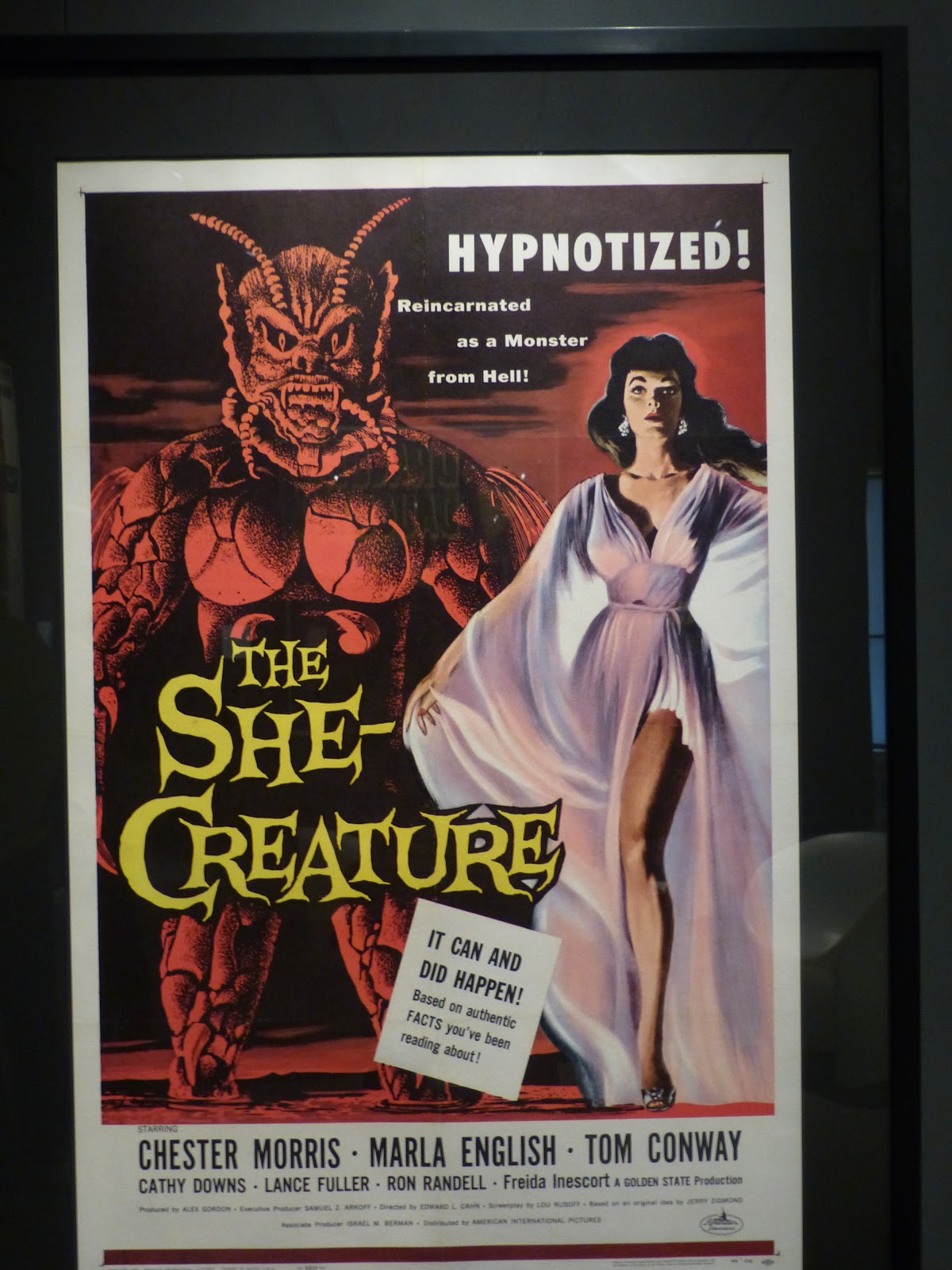
It's Alive is the other end of the spectrum. It is 90 movie posters and objects from Kirk Hammett's personal collection of the era of classic horror and sci-fi, mostly the 1920s into the 1970s. If Hammett's name doesn't ring immediate bells, he has been the lead guitarist for Metallica since 1981. If you're a metalhead, you know that he usually wields guitars with movie scenes painted upon their bodies—almost always reproductions from posters he owns. I'll bet legions wish we had emulated what Hammett did and kept our childhood ephemera in mint condition.

There is, of course, a Gothic, ghoulish vibe to all of this, but because Hammett's stuff comes from the earlier era, it is more psychological horror than the blood-splattered graphic stuff of today. In a video, Hammett (b. 1962) speaks of how these old films and images were strangely comforting for an unorthodox and shy kid coming of age in the Bay Area in the 1970s. To this day he says he tries to play out horror film scenes on his guitar. Again, though, we're talking Frankenstein and Day of the Triffids, not Texas Chainsaw Massacre. Although his collection includes posters for two of the scariest films I've ever seen, Nosferatu (1922) and Psycho (1960), these films must be seen to induce nightmares. This is true of nearly everything you'll see. There's a goofy charm to Cold War sci-fi films such as The Day the Earth Stood Still, Japanese monster movies like Godzilla, and the various Frankenstein and Dracula offerings.

I pre-scouted this exhibit for friends wondering if it would be okay for their eight-year-old. Although you might want to steer clear of a creepy oversized projection from The Mummy, most kids will be fine—especially if they are in the midst of their dinosaur/monster phase. The eight-year-old in question loved the show. You will too if you just channel your own dinosaur/monster childhood.

The final takeaway is the irony of a guy from Metallica resurfacing as an art curator. It just goes to prove an old adage: live long enough and you too have a shot at obtaining respectability!

Rob Weir
  

Just can't trust 'fake news'


#PeabodyEssexMuseum

9/20/17

Road Trip: Puppets and Fine Art in Storrs, CT

-->

Did you know that the University of Connecticut is the only place in the nation where you can get a masters degree in puppetry? Neither did I. If you’re in the vicinity and are looking for a quirky side trip, drop into the Ballard Institute and Museum of Puppetry. It won’t take long, as the museum is just two rooms with a connecting corridor.


The lobby fronts the room that holds the permanent collection, a Puppetry 101 survey. There you will find everything from Balinese shadow puppets to Howdy Doody, Jiminy Cricket, Lamb Chop, Pinocchio, and classic Punch and Judy figures. You will also find works from famous designer/puppeteers such as Frank Oz, Bill Baird,  Buffalo Bob Smith and, of course, Jim Henson. I found the historical and international puppets more intriguing, but Henson’s works are great fun for the insight they shed on the spells a great puppeteer can cast. When you actually see iconic figures such as Kermit the Frog, Fonzie, or Grover, you notice right away that there’s not much to them aside from some fleece, flannel, and buttons. Puppets are an art form, but the real artistry lies with the performances that transform humble materials into characters that magically become “real.” 


The rest of the Ballard is devoted to changing exhibitions. I saw a display of works from the Puppeteers Collective that were mostly agitprop figures in the traditions of the San Francisco Mime Theater and Peter Schumann’s Bread and Puppet Theater. The Ballard is located at 1 Royce Circle in “downtown” Storrs. There’s not a lot to the town of Storrs, but you will certainly notice its central core of shops, cafes, and tidy apartment blocks. Most of the businesses cater to students, so the area is as dead as a marionette with broken strings when UConn is on break, but you’ll have no trouble finding a quick bite to eat or a decent cup of coffee.


Rand

If you can extend your visit, the campus is just across the street from the Ballard. If you venture up past the pond and fountain, you’ll come to signs directing you to the university’s William Benton Museum of Art (245 Glenbrook Road #2140). It won’t overwhelm you with masterpieces, and that’s a good thing as it affords opportunities to discover artists you might otherwise breeze by on your way to view works you’ve been conditioned to think you must view to boost your cultural capital. I was quite taken by works from Ellen Emmet Rand (1875-1941), who was one of the few female artists of her day to cop major donor work from the rich and powerful. Most of her work, though, has a way of capturing the inner essence of her subjects—many of them women. 

McFarlane

Other personal discoveries included Ministry of Salvation, a sculpture from Alex McFarlane that is a wry but poignant commentary on the link between religion and power; Barbara Takenaga’s patterned abstractions painted directly onto rose petals; and Lien Truong’s “Family Sitting #2,” which invites speculation on the nature of the nuclear family. There was also a nice (and perhaps sexualized) work from Judy Chicago, a visit to the gaudy world of Coney Island from Reginald Marsh, and “Portrait of the Poet Jan Vos” from second-tier 17th century painter Jan De Bray. I was educated by taking in a harbor scene from Dwight Tryon; he used to teach at Smith and has a gallery named for him, but I don’t recall actually having seen his work before.

Storrs seldom shows up as a daytrip for anyone not attending a basketball game, but you can easily wile away the morning there. That will leave plenty of time to get to Hartford to do what you may.

Tryon
 Rob Weir


9/18/17

Local Art and Local Food at Art in the Orchard

-->

Art in the Orchard
Through November 26, 2017
Park Hill Orchard, 82 Park Hill Road
Easthampton, MA

Kermit the Frog wasn't talking about farming when he said, "It's not easy being green," but he could have been. Maybe a 127 acres sounds like a lot to you, but imagine how many peaches, raspberries, and apples you'd need to sell to compete with corporate giants like Dole, Kraft, or Smucker's. We can wax nostalgic about family farms, but these days it's Goliath against David with a busted slingshot. If you want to survive, you'd better be creative about it. Perhaps art and apples sounds like one hungry man sharing one sandwich yet against all odds, it seems to work.

Each summer and fall, Alane Hartley and Russell Braen, owners of Easthampton's Park Hill Orchard transform part of their farm into an outdoor sculpture garden—mostly for local and regional artists. Much of what is on display for 2017 is quirky, some of it is a better concept than finished piece, and a lot is magical. All of it is a great excuse to buy fresh, non-commercial fruit, stroll amidst beautiful fields in the shadow of Mt. Tom, and converse with friends—the more the merrier. Here are a few of my favorites.


I'm often impressed by junk metal parts assemblages, though I seldom "like" them in the sense of thinking they are great art. But Wade Clement's Superweed really works because it is well situated. It springs from a pumpkin field like some sort of mad science project and it's hard not to think about the chemical crap Monsanto and its ilk pump into the food chain to induce largeness without wholesomeness.

Bob Turan imagines post-industrialism in his Geode Time Capsule. It put me in mind of a larger version of religious work from the Middle Ages in which pious artists meticulously carved scenes inside of nuts or small balls of ivory.


One of the strongest works is Through the Looking Glass by Eileen Jager. It's simple in concept—paneled mirrors and glass strung between two points—but the wind and light constantly change our perspective. Sometimes we peer through, sometimes we see refracted images, and often part of our vision is simultaneously crystal clear and distorted. The lesson of this is obvious, but poignant.

Michael Melle has gained well-deserved praise for his burlap, wood, straw, and wire figures. Some might have encountered his outdoor tableaux of figures from the paintings of Camille Pissarro that accompanied a 2011 retrospective of Pissarro's work at the Clark Institute of Art, or as installations at the Three Sisters Sanctuary in Ashfield. Easthampton has his powerful Refugees—a family fleeing with its meager possessions toward an uncertain destination. It could be any group at any time, though it certainly evokes various Irish Famine sculptures throughout North America.

It's not my favorite work overall, but I liked bits of Sheena: At the Fight Over the Last Fish by Mark Fenwick. It's based on a graphic novel, but I was most drawn to Sheena's face and its ice-blue eyes, all framed by a wreath of red flowers and a shell necklace.

Kudos to the youngsters from the Four Rivers Charter Public School in Greenfield for understanding the idea of "organic" art better than anyone else. Their Bumble Bee/Barn is a bunch of boxes attached to posts at various angles and filled with bamboo and wooden tubes suggestive of birdhouses and beehives. They are painted in lavender and set perfectly by a field of wildflowers alive with honeybees, butterflies, and birds hard by a working beehive. 

Slim is a holdover from last year and Michael Tillyear's wacky band is a whimsical delight. Were it not for Grommit, Tillyear's wooden pooch would be a serious candidate for the cutest canine in art award.

The hillside nearest the fruit stand is alive with wire, glass, and steel outlines of Our Tribe, Michael Poole's reflection on the various types of people who make up a community.


Chris Woodman has produced the most imposing (in a good way) piece in this year's art crop. His A2 soars into the heavens with such might that, on a sunny day, it rivals the blue skies and clouds in majesty. It's a riveted steel piece that invokes ship figureheads and the art deco ornamentation of streamlined trains and 1940s automobile hood ornaments.


I'm a sucker for masks and faces and Beckie Kravetz has been a mask maker. Her Reunion is a grouping of freestanding faces fashioned from clay that look like a jocular Easter Island update.

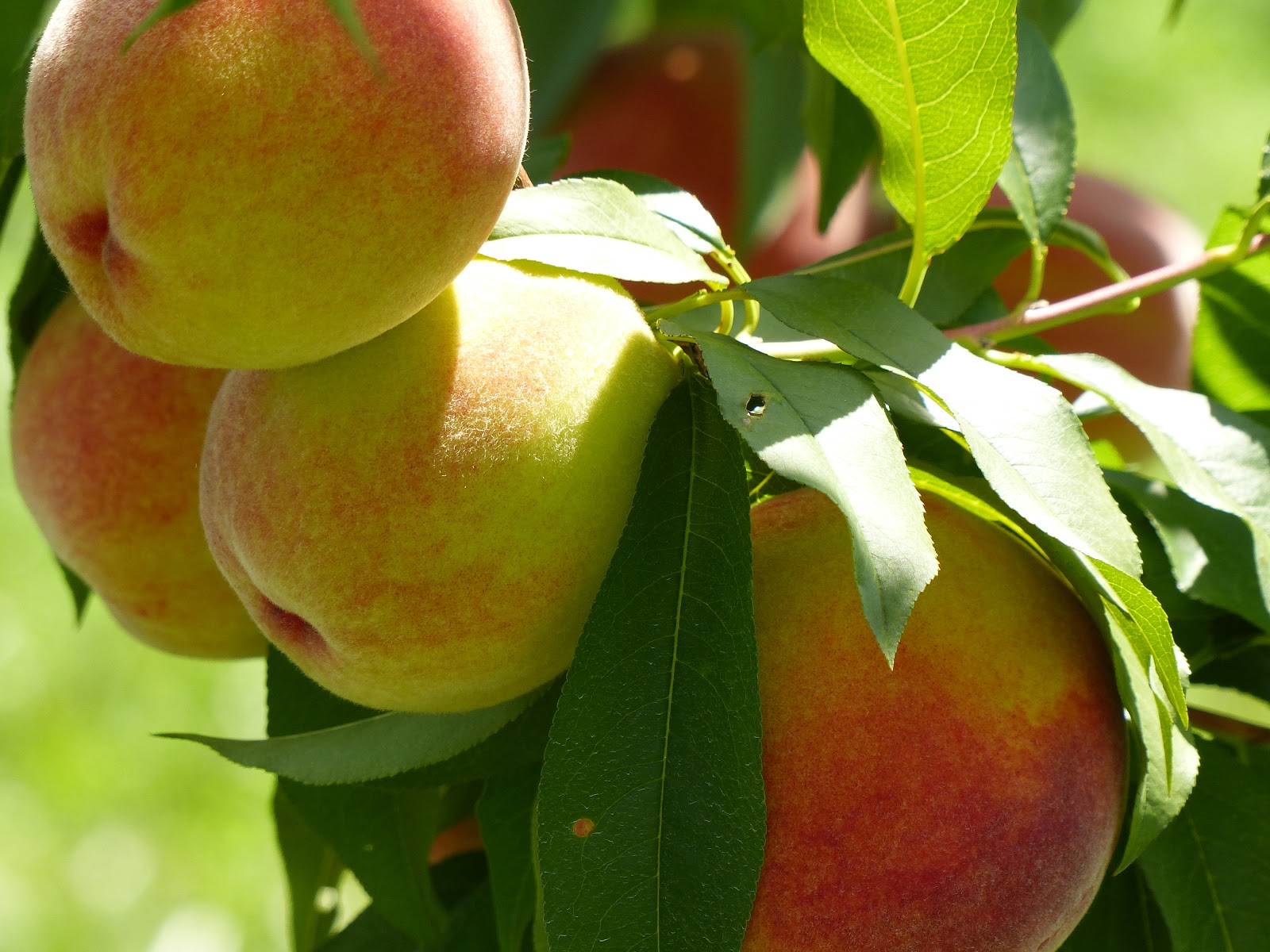
I can also tell you that this year's peaches are works of art and that the slushies are reliably good. Local food, local art—what's not to like?

Rob Weir

#artintheorchard
#parkhillorchard
#bigredframe

9/15/17

Bad Ideas: September Edition

-->

Why is lunacy so rampant? Here's another installment of head-scratching stuff.

And a sleeping driver accomplishes both.
1. Topping the list is the Trump administration's decision to cancel an Obama executive order that would require periodic sleep apnea testing for people involved in mass transit and long-distance trucking. The same rule would apply to pilots and railways engineers. Call me crazy, but somehow or other it seems like a good idea to make sure that the person behind the wheel of a loaded 70,000 pound truck isn't likely to fall asleep at the wheel. This shouldn't be a political issue—it's just commonsense. That's the position taken by the National Transportation Safety Board, the folks whose recommendation Obama took. But not Trump.

Such reflexive aversion to all regulations is bereft of logic, morally bankrupt, and dangerous. I expect no less from the Snollygoster in Chief, but are there any other adults in the room? Apparently not in the American Trucking Association, which lobbied hard to have Obama's order reversed despite the fact that one in eight fatal accidents involves a long-distance truck. The ATA is the last group that ought to oppose this—unless it simply sees drivers as single servings of meat. Somehow I don't foresee a lot of sympathy coming their way in the very immediate future when self-driving vehicles and investment in light rail decimates trucking as we know it.

Not on this planet!
2. A close runner-up was the decision of K A Design to market the New Swastika shirt. The 5-watt light bulb went off somewhere in the firm that made it think it could reclaim the swastika's ancient Sanskrit meaning of good luck and prosperity. While it's true that the symbol has appeared in many cultures, including ancient Babylonia, India, and early Christianity, can we just say that the ship has sailed on how just about everybody in the world who doesn't work for K A Design perceives it now? I wonder if the firm will even survive this harebrained scheme. Whether or not it's true, it really looks like a backdoor effort to legitimize fascist genocide.


Can you find sexism with Google glasss?
3. There have been mishandled rumblings inside Google and Facebook . Google stumbled in firing the author of a long internal sexist memo that justified the testosterone-fueled culture of Google. I'm not defending the little oinker who wrote it, but there are two PR problems here. First, it was not supposed to be a public document, so there's a bigger security problem inside HQ. The bigger issue, though, is that it's one of the worst kept secrets in the world that Google has a severe gender problem. Unless a comprehensive program to redress sexism inside Google swiftly accompanies this firing, it will smack of tokenism and add fuel to smoldering resentments about to flame.

That's the official story!
It comes as little shock to hear charges that Mark Zuckerberg stands accused of manipulating algorithms that push conservative content to the top of Facebook postings. Some think he's positioning himself for a run for something, though he's just 33, and would just meet the constitutional age threshold in 2020. Besides, most indications suggest he's prone to libertarianism of  its more paranoid permutation. If the allegations are in any way true, his decision is a weird one. If any company's business plan is dependent upon not pissing off people, it's Facebook's. It allegedly has two billion subscribers and I'm pretty sure not all of them are conservative or libertarian. Put another way, angering FB users might actually create a real challenge to its dominance. At present Google+ and upstarts like Diaspora and Ello are mere pretenders, but that reckless disregard for users could change that. These days people are quite testy when it comes to politics.

And therein lies a tale.
4. This is not a defense of the Teamsters per se, but if you've followed the Top Chef trial in which union leaders are accused of trying to extort jobs from the show's producers by harassing some of its personalities, you've got to wonder why the TV crew thought it could go into a union town like Boston without negotiating with the pro-labor mayor, the Teamsters, or other organized bodies. It concerns me that rough language is now lawsuit material. Again, this isn't a defense of violence or for-real threats, but I worry we've lost our ability to distinguish between anger and actual threats It's basic: If you hone in on people's livelihood, they are going to take offense. I've been on a few picket lines, and I know that tempers rise. Lots of "we oughta" scenarios arise—almost none of which are more than blowing off steam.

A jury decided the case in favor of the Teamsters, though a civil suit remains. However it comes out in the end, I think it's time that we realize that bullying and unpleasantness are what happens in a society in which organized labor doesn't have many other resources at its command. We have stripped away the very idea of countervailing forces and have given moneyed interests the upper hand. That's a bad idea.