11/19/21

See Quilts and Ekua Holmes at the MFA

FABRIC OF A NATION: AMERICAN QUILT STORIES

            Through January 17, 2022

PAPER STORIES, LAYERED DREAMS: THE ART OF EKUA HOLMES

            Through January 23, 23, 2022

Museum of Fine Arts, Boston


It had been 18 months since we last entered the Museum of Fine Arts in Boston and for our first trip back, we decided to concentrate on just a few shows. So, let’s cut to the chase.  


Bisa Butler


Cut is a good segue to Fabric of a Nation: American Quilt Stories, a look at what sewing projects tell us about our past and ourselves. Some of the quilts were “folk art” and others might be classified as “fine art.” I’ve never cared much for such distinctions. Some of the quilters are known in the stitcher community. One is Bisa Butler, whose To God and Truth (2019) depicts the Morris Brown College baseball team. She makes us see the hues among African-Americans by rendering “black” faces in vibrant colors. 
 

Faith Ringgold


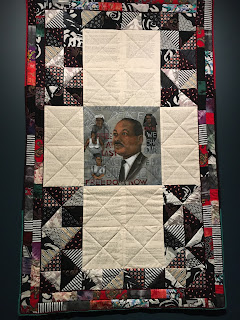
Another well-known artist (in numerous media) is Faith Ringgold. Her Martin Luther King and the Sisterhood is self-explanatory. Some might also know the name Lillie Mae Pettway, a link to the Gee’s Bend, Alabama quilters whose work has gotten a lot of belated recognition. 

Housetop is a 12-block pattern with variations. 

 

Lillie Mae Pettway


The MFA exhibit samples three centuries’ worth of quilts that indeed tell tales. The show is strongest in highlighting people of color and LGBTQIA communities. This is revelatory given that many of the quilters are unknown or forgotten. One quilt points us to reasons to recover their stories, as it depicts various ways in which those outside the mainstream have been (mis)represented. Still others make statements through the sheer skill that went into creating such meticulous work, including one from an unknown Amish stitcher and one from Celestine 

Bacheller titled Pictorial Quilt (c. 1880).

 

Celestine Bacheller


World’s fairs occasionally spotlight the work of those on the social margins. Some of that has been a sly dance of tokenism, a way to trumpet American progressivism without actually being progressive, yet the art speaks for itself. Edith Morrow Matthews contributed The Spectrum, a trippy quilt that presaged op-art at the 1933 Chicago fair.  Richard Rowley quilted the fair’s map in fabric: A Century of Progress.



Matthews above/Rowley below


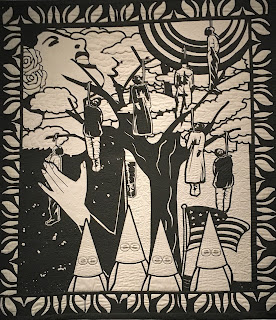
There are a surprising number of men represented at the MFA show, including the well-known Sanford Biggers, though his work pushes the boundaries of what we think of as a quilt. Most visitors will probably relate best to overtly political works that require little explanation to (if you will) unravel. Carolyn Mazloomi mused upon a famous song about lynching for her Strange Fruit II and Sylvia Hernandez put thread to needle to ask the question about gun violence that rests upon many lips: How Many More? Edward Larson and Fran Soika cram a lot of troubled politicians into a 1979 work titled Nixon Resigns. 
 

Carolyn Mazloomi


Sylvia Henandez


Two intriguing works caught my eye. Sabrina Gscwandtner’s Camouflage lives up to its title. Those in a hurry could walk right past it without realizing it is made of discarded 16mm film strips. The most in-your-face work belongs to Agusta Agustsson whose Blanket of Red Flowers makes tangible the phrase “banned in Boston.” It was removed from its first viewing in 1979, as it represents alternating blocks of male and female genitalia. Note the date. It came at the dawning of the AIDS crisis, though its meaning is broader than that. 



Camouflage


Banned in Boston!


If works on paper haven’t caught your attention before, check out a retrospective culled from book projects illustrated by Roxbury artist Ekua Holmes (b. 1955). She celebrates the positivity of blackness in various ways: play, black history, ordinary people, poetry, children’s stories, and the connections that occur in unlikely ways in unlikely places. Her energy is infectious, her colors bold, and her ability to bring a smile to your face a rare and beautiful thing. Kudos to the MFA for allowing teens in its Curatorial Study Hall to write the wall text. Read: You can actually understand what is being said! 



_________________________________________________________________


We vowed to ease back into the viewing groove rather than trying to take in everything. Nice try! We ended up dipping into several other shows, including a good one on Monet that has already closed and two others that were disappointing. “Masterpieces of Egyptian Sculpture” was billed as a total revamp of the MFA’s holdings. It’s not really–more like rearranging the den chairs and sofa. “Collecting Stories: The Invention of Folk Art” was an example of how museums should have the courage to fold their cards when they don’t have a matching pair. It’s really about collectors, not the art, plus the MFA’s folk art collection is so painfully thin it should offload it to an institution that knows the genre.


Rob Weir


11/17/21

WISH IT LASTED FOREVER: LIFE WITH THE LARRY BIRD CELTICS

By Dan Shaughnessy

Scribner, 256 pages.

★★★★


Were the 1985-86 Boston Celtics the greatest team in National Basketball Association history? Such questions are pointless because sports–rules, equipment, players–evolve. Few analysts, though, take umbrage with saying that the Celtics front court of Larry Bird, Kevin McHale, and Robert Parrish–with Bill Walton coming off the bench–defined the adjective dominant.


Boston Globe sportswriter Dan Shaughnessy revives memories of the 1980s. He was a newbie at Globe in 1981, the year after Larry Joe Bird was the NBA’s 1980 Rookie of the Year.  The epic battles between Bird’s Celtics and Magic Johnson’s Los Angeles Lakers in the years 1980-87 redefined the NBA and brought it into national prominence.


Perhaps you wonder about the showdowns in the 1950s and early 1960s between the Bill Russell-led Celtics and Wilt Chamberlain’s Philadelphia Warriors. Today, the NBA is a global product and the second-most popular team sport in North America. When Russell was a rookie in 1956, he and Chamberlain shed light on a 10-year-old league that played in crummy gyms and had franchises in places like Cincinnati, Fort Wayne, Rochester, and Syracuse. The Lakers were in Minneapolis and the Warriors in Philly. Russell helped define the NBA. It grew from the mid-60s on, but didn’t become a media-fueled juggernaut until Bird, Magic, Kareem Abdul Jabbar, Julius Erving, and others broadened TV viewership and gained sponsors.  


The best parts of Shaughnessy’s book deal with change, not just in the game but also in the media and social mores. Shaughnessy was dubbed “Scoop” by Celtics players and it wasn’t endearing. He was part of a new wave of sportswriters whose perspective was investigative and (in many cases) combative. Consider, for example, that Boston Herald writer Mike Carey had been so chummy with players that he lent them his car and acted as their agents. Today that would be conflict of interest. Bloody on-court fisticuffs would yield lengthy suspensions; in the 1980s, they didn’t always lead to technical fouls. Bill Walton reveals that he knew he loved new coach when K. C. Jones when he put the Lakers’ James Worthy into a headlock during a melee.


Shaughnessy was in the seam between the chummy old-style NBA and the emergent; he wanted access to players, but because he didn’t write fluff, he often ruffled feathers. He had a hot/cold relationship with Bird and Parrish refused to talk to him at all. Diehard basketball fans might wish to skim the parts of the book that rehash the long familiar: Red Auerbach’s iron-fisted management style, coach Bill Fitch’s abrasive egoism, Parrish’s sullenness, and Bird’s cockiness. (Bird took trash-talk to the next level. He once defended BYU grad/teammates Danny Ainge and Greg Kite by saying nobody would have heard of Utah without them–and murderer Gary Gilmore!)


Bird was the pivot piece, but Auerbach’s unsentimental roster retooling was the lever. During Bird’s peak years he was league MVP three years in a row and the Celtics won the NBA title in 1980-81 and 1983-84, lost the finals in 1984-85, and won again in 1985-86. Auerbach had no problem jettisoning popular players he felt were no longer useful, such as Cedric Maxwell, Quinn Buckner, or Rick Robey. (He robbed Seattle by trading Gerald Henderson for Dennis Johnson.) He also felt (rightly) that the Celtics lost in 1984-85 because the players despised Fitch. Enter K. C. Jones and a magical season.


You may never see another team like it. The roster had eight white players, just four African Americans, a black coach, and not a hint of racial tension. (Bird called Jones “the nicest man I ever met.”) Walton claimed that coming to Boston saved his life. That’s hyperbolic, but the Celtics played with infectious joy. McHale set a team record by scoring 58 points, which fell the very next game when Bird poured in 60. They were so cohesive that they went 37-1 at home, wrapped up their division so early they didn’t bother to try for an NBA victory record, and won their final game by playing only the bench. There was no partying when they won the conference title; as Bird insisted, celebrations only came after titles. He also proved that a slow white dude who didn’t jump well could become a hoop god through hard work and a high court IQ. (Shaughnessy advises skepticism re: the “Hick from French Lick” guise; Bird knew how to conjugate verbs!) 


Wish It Lasted Forever has eyeopeners, including pranks that wouldn’t fly today, like putting an M. L. Carr jersey on a car lot’s advertising gorilla. Casual sexism was also a thing. We laugh when Shaughnessy loses $160 in a free throw challenge with Bird, who taped his entire hand and thumb. Shaughnessy also gets another booby prize for leaving the basketball beat in the spring to cover the Red Sox, then the city’s biggest sports attraction. (Today, they might be number four.) We appreciate Bird’s color-blind judgments, including his prediction that Michael Jordan would become the NBA’s greatest player. (M.J. transformed the game a third time.) Alas, nothing lasts forever. Injuries took their toll and it would be 22 years before the Celtics hoisted another championship banner.


Rob Weir

11/15/21

Go Set a Watchman is no To Kill a Mockingbird


GO SET A WATCHMAN (2015)

By Harper Lee

HarperCollins, 278 pages.

★★ ½


I didn’t rush to read Go Set a Watchman. The initial reviews were damning, though they gave way to others declaring it a brilliant lost gem. Which is it? In my estimation, neither. I’d call it a prosaic effort that wouldn’t have ever seen the light of day had not Harper Lee (1926-2016) published To Kill a Mockingbird in 1960.


Go Set a Watchman is an oddity in Lee’s total output of two novels. It was supposed to be her first novel. She penned it around 1957, began revisions, and then locked it away. To Kill a Mockingbird went on to win a Pulitzer Prize and was made into a hit movie in 1962 that won three Academy Awards. Lee either never got around to finishing revisions of Go Set a Watchman, or deemed it beyond repair. It was thought to be lost until it surfaced in a lockbox and, in 2015, Lee was persuaded to allow its publication. This was controversial, as some critics alleged elder abuse on the part of Lee’s conservators.


It’s a pointless debate given that the novel was ultimately released. What we have is a first book sequel to a book that was released before it– a sequel to a prequel, if you will. If only that were the most problematic thing about it. Before diving into this, a quick note on the title. It’s from the Old Testament Book of Isaiah: “Go set a watchman, let him declare what he seeth.” (It’s from Chapter 21 and the next line gave rise to a famed song: “Babylon Has Fallen.”)


In Go Set a Watchman Jean Louise Finch (“Scout”) is a 26-year-old woman who has been living in New York City. Each year she spends two weeks with her father, Atticus, in Maycomb, Alabama. Atticus is now 72 and slowing down a bit. He still has his law practice, but most of the work has been turned over to his protégé, Henry “Hank” Clinton, who comes from a humble background, but is seen by Jean Louise as the man she’ll probably marry. Her brother Jem is dead from the same weak heart that killed their mother and their African American maid Calpurnia has retired.


One wonders if Lee was channeling Thomas Wolfe’s novel You Can’t Go Home Again. Jean Louise is a young woman who is too Southern for New York and too New York for Alabama. She loves Atticus, her Uncle Jack, and her Aunt Alexandra, but the latter two drive her batty. The learned Jack, a retired doctor, tells circuitous stories and utters remarks obscure even by his standards and the heavily corseted Alexandra is obsessed with propriety, religion, and getting Jean Louise married off. She’d be okay with the latter, but New York has made her too independent for the traditional role expected of her, she’s not at all sure she wants to move back to Maycomb, and Hank wants to stay. Gossip seems to follow Jean Louise around like a shadow. Go Set a Watchman is at its best in revealing Alabama as a time warp challenged by post-World War II social changes.


The novel’s crisis comes from those changes. When Calpurnia’s grandson runs over an elderly drunken pedestrian, it scarcely matters that it’s not his fault. The accident reveals racial fault lines in the Deep South just a few years removed from Brown v. the Board of Education. Suffice it to say, the NAACP is not popular among Maycomb whites and African Americans are beginning to sluff off their subordinated skin and with it the fiction of easygoing racial relations.


Social friction gives way to personal trauma when Jean Louise catches wind a meeting of the all-white Citizen’s Council and finds that both Hank and Atticus are members of it and the Ku Klux Klan. She is outraged and explodes at each of them. The open question is whether they are infiltrators or collaborators. Uncle Jack helps bring the book to what I’d call a compromised conclusion that certainly will not please those weaned in the age of wokeness.


The last point aside, Go Set a Watchman is a wildly uneven novel that reads like what it probably was: an insufficiently revised work. Numerous To Kill a Mockingbird devotees expressed their displeasure at the depiction of Atticus Finch, whose morality is at best ambiguous in Go Set a Watchman. Other detractors have called the novel an apologetics for whiteness, though one could just as easily make a case that it is a more realistic portrait of race than one gets from To Kill a Mockingbird. I hold the view that it’s simply a subpar book.


Rob Weir

11/12/21

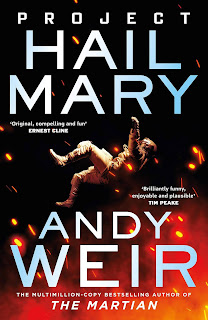
Project Hail Mary: Complete and Incomplete Passes


PROJECT HAIL MARY (2021)

By Andy Weir

Random House, 496 pages.

★★★


Andy Weir (no relation) scored so big with his 2011 debut, The Martian that Hollywood came calling. His second book, Artemis (2017), is “in development,” a phrase that could mean anything from “about to go into production” to “thanks for letting us work up a script, Andy; here’s some money, now go away.”  In both previous books, Weir went off world and he stays in space for Project Hail Mary­–deep space.  


There is much speculation over whether humankind can save itself. In Weir’s novel, though, climate change isn’t the culprit. Something is sucking energy from the sun and if something isn’t done to stop it, Old Mr. Sol will die 5.5 billion years early. The villain is astrophage, a space virus that extracts energy from the sun and light from Venus. Step one is capturing some of the beetle-like little devils. If harnessed, astrophage could power a space ship in ways that aren’t quite warp drive, but would certainly be superior to any current fuel source. That’s needed because, unless a team can trace the source of the astrophage and figure out how to stop its path, Earth has just decades before it becomes a lifeless hunk of space ice.


Probes secure some astrophage, but a lot of it must be bred to provide fuel for what will certainly be an out-of-the-galaxy space voyage. That’s where Ryeland Grace comes in– to his surprise and chagrin. In graduate school, he explored a theory of replicating space viruses that met with derision and hurled him toward a very different profession than he once envisioned: junior high school science teacher. He’s very good at it, though, and has no desire to reopen a topic that made him an academic joke.


Not that he has a choice in the matter. Public calm is holding, but world powers know the real score and for once, China, India, Japan, Russia, and the United States are on the same side. They’ve even handed global dictatorial power to Eva Stratt to “draft” anyone who doesn’t volunteer to do research or be part of a space team whose mission is surely suicidal. Ryeland is spirited to a lab to work on replicating astrophage and it doesn’t matter if he wants to do it or not. When I say Stratt is all-powerful, I mean she has the authority to buy Earth more time by melting Antarctica so it can release methane gas and create a greenhouse effect that delays Earth’s rendezvous with icy lifelessness.


If you know Weir’s work, you know there are two constants. First, he loves geeky stuff. There is a lot of math and science in the novel–some that’s highly speculative. You know also that Weir likes to pit a single individual against seemingly impossible odds. Ryeland thinks he has done his bit when he actually creates astrophage via ideas pooh-poohed by those with fancier pedigrees. Imagine his reaction, though, when Stratt next informs him he’s going to be a no-return astronaut to Tau Ceti in a different solar system. He refuses, but Stratt gives him the choice to “volunteer,” or be taken to the ship in shackles. She assures him he won’t know much, because the crew of four will be in suspended animation until the ship is ready to collect data and send a “solution” back to earth. Ryeland wakes up, but that’s more than can be said of his three colleagues.


Ryeland has no choice but to improvise everything—repairs, food, water, leaking astrophage, or what have you. Imagine being alone among the stars. He won’t be for long, as he makes first contact with an Eridian sharing his fate. So, how do you communicate with a blind spider-and-stone-like alien whose planet has an atmospheric pressure (and spaceship) 8 ½ times greater than that of Earth? Soon, though, Ryeland and “Rocky,” as Ryeland dubs him, cooperate in trying to save their respective planets. (Rocky’s comrades also perished.) Thus begins a race against time that involves lots of physics, math, and trial-and-error. 


I enjoyed, but didn’t love, Project Hail Mary. At its best, the novel is a gripping thriller that sucks in readers, though we’re pretty sure something good will happen. In its weaker junctures, it’s as if Weir is channeling Michael Crichton, with echoes of an old Star Trek (Original Series) show involving a critter called a Horta. (The episode is titled “The Devil in the Dark,” if you’re keeping score.) Depending upon which side of your brain you use the most, the calculations, science, and science fiction in Weir’s novel will either excite your Inner Nerd or send you running for the Aspirin bottle. I experienced both sensations and I also didn’t think much of the tacked-on sappy ending. Call Project Hail Mary a satisfying but bumpy ride.


Rob Weir

11/10/21

The Lost Weekend: Innovative for 1945


THE LOST WEEKEND (1945)

Directed by Billy Wilder

Paramount, 104 minutes, NR (pre-ratings system)

★★★★


The Lost Weekend cleaned up at the 1946 Oscars. It got seven nominations and won four: Best Picture, Best Director (Billy Wilder), Best Actor (Ray Milland), and Best Adapted Screenplay (Wilder and Charles Brackett). It would have won a fifth for Best Original Score, except that Miklós Rózsa lost–to himself! (Rózsa also scored Spellbound and won for that film instead.) The Hungarian-born Rózsa is no longer a household name, but few rivaled him for scoring films whose subjects begged for tension-laden music. But, The Lost Weekend was really Ray Milland’s moment in the sun.


Perhaps I should say Milland’s moment in the murk. His was once considered the portrait of an alcoholic. Milland is Don Birnam, a New York-based critic/writer who has struggled with the bottle, despite the efforts of his brother Wick (Phillip Terry) to keep him sober, and support from his attractive girlfriend Helen St. James (Jane Wyman). Don met Helen when their coats were mixed up at an opera house. The Lost Weekend leads with that and tells its tale in reverse.


That was one of several innovative things that led to Billy Wilder’s Oscar. Back-to-front scripts are now so common that today’s directors often dispense with any sort of linear plot. Wilder didn’t invent reverse narratives, but his was a superior take on the device. He also added edginess by having Milland walk/stumble the streets with everyday New Yorkers while hidden cameras filmed him. Wilder also got permission to film inside an alcohol ward of Bellevue Hospital, which added another layer of verisimilitude.


Wilder wasn’t showing off. Don Birnam is the very embodiment of character disorder. Drunks do horrible things, but most of the damage they inflict upon those who care is the equivalent of a daily dose of paper cuts, not any one (or two, or three, or…) blow-up moments. If you see a film in which the latter happens more than once, you know that the script writers are more in love with melodrama than fact-gathering. In essence, the cumulative toll of most alcoholic behavior unfolds slowly and is hard to portray on film, let alone lend itself to being encapsulated in a single “lost weekend.”


Don’s crisis coincides with Yom Kippur, not because Don is Jewish but because most of New York’s pawnshops were once operated by Jews. That’s inconvenient for an alky who wants to pawn his typewriter (again!) to buy rotgut. He will manage to get a few drinks on tab at Nate’s Bar, until Nate (the vastly underappreciated Howard DaSilva) cuts him off with a lecture on how shabbily he treats Helen. Message sent, but not received. Don cons an ex-girlfriend (Doris Dowling) out of some dough, drinks to oblivion, and wakes up in a Bellevue drunk tank overseen by cynical ward nurse/counselor Bim Nolan (Frank Faylen, in an acidic turn). Don manages to bust out and not take the cure. All of this leads to a crisis point when he does find an open pawnshop, but uses his gain to buy a gun to put an end to his woes. Does he do it? Watch and find out.


The Lost Weekend was bold on other levels. The Hollywood Code was still in effect and had strict rules about how to portray tough subjects. The usual standard was that your subjects had to experience comeuppances or land in a net when they fell from the wire. Some studios, especially Warner, pushed the envelope because they owned theaters and could ignore pressure on distributors. (That would change in 1950.) By 1945, the Code was weakening, Paramount had its own screen network, and it needed the big hit The Lost Weekend provided. (Paramount was in receivership from 1931-40.) Another gutsy thing Wilder snuck in was that Birnam was modeled on one of his friends, crime fiction writer Raymond Chandler.


The Lost Weekend occasionally feels naïve and old-fashioned. That’s because we know a lot more about alcoholism today. Suffice it to say that in 1945, alcoholism was viewed as a moral or psychological failing, not a disease. Remember also that Freud was once the gold standard for disorders. The film’s glancing forays into dual personalities is a nod to Freud. All of this said, no matter what lens you bring to your living room chair, The Lost Weekend is a poignant reminder of the bottle and the damage done. Treatment modalities have changed, but the problem remains.


Rob Weir   


11/8/21

Enter the Aarvark is both Weird and Weighty


ENTER THE AARDVARK (2020)

By Jessica Anthony

Little, Brown and Company, 179 pages.

★★★★


When I began reading Enter the Aardvark, my first reaction is that it was weird for no apparent reason. As I read, though, I surrendered to its quirkiness and realized there is more to it than meets the eye. But, yes, an aardvark really is the pivot around which the novel rotates. 


The obvious part of the book is its circular structure. It toggles back and forth between a story set in the 19th century and a parallel in 2020. Let’s meet the insectivore in question. In 1875, taxidermist Titus Downing receives a heavy shipment from Namibia from his friend and sometimes lover Sir Richard Ostlet. (Both are closeted and if you wonder why, Google what happened to Oscar Wilde.)  Few in Britain had the slightest idea of what an aardvark looked, including Downing. His job is to stuff and present a beast quite unlike any he had ever tackled. Gaze upon the critter and you’ll see why. It’s what you might get if you mixed a rabbit, a pig, an anteater, a giant opossum, and something that survived the age of the dinosaurs. Downing is pleased with his work, except for the eyes and ordinary beads won’t cut it. His eventual solution is both biologically incorrect and unorthodox.


The 21st century story involves the thoroughly unlikable Representative Alexander Paine Wilson, a Republican from Virginia. Like the aardvark, Wilson is suggestive of a hybrid. He worships Ronald Reagan to the point of emulating his wardrobe, stocking his home with Reagan memorabilia, and believing he too will be president one day. Yet he’s also an obnoxious and corrupt Yuppie who knows the cost of everything–$6,000 kitchen tiles, $4,125 showerhead, $4,560 Armani suit, $339 Hermes bath towel–but the value of nothing. He is contemptuous of the public and has no trouble behaving like TV evangelists who rely on supporters to keep themselves in the manner to which they’ve become accustomed. His descent into hubris begins the same way Downing’s does. He’s also a closeted gay, though he denies this even to himself: “You know you are Not Gay, and Greg Tampico is Not Gay;” just two guys who like to have oral sex with one another and like to fondle naked in bed. (This reminded of the chilling scenes involving Roy Cohn in Angels in America.) Tampico happens to be of Namibian descent and sends a Fed Ex package to Wilson’s Georgetown home just before he unexpectedly dies. Guess what’s in it.   


I am revealing nothing here, as you learn all about this before you’ve even unraveled who’s who. The novel’s crises points involve the aardvark’s eyes and who owned it between the years in which Downing stuffed it and it shows up at Paine’s home. As you might anticipate, it involves poorly kept secrets.  Enter the Aardvark is hysterical, surreal, political, and backdoor spiritual. If this sounds an unlikely combination of qualities, it probably has a lot to do with Anthony’s unlikely life. She lives in Maine now and writes novels, but as her bio informs us, she’s also been an unlicensed masseuse in Poland, an Alaskan butcher, a guard on a bridge between Slovakia and Hungary, and a secretary. In other words, her life has been as improbable as the plot to her novel.


The surface structure of Enter the Aardvark is so deceptively straightforward that it takes a few moments to discern the other things going on. It involves numerous contrasts and dualisms: ego and hubris, cynicism and morality, masked selves versus the natural selves, (mere) desire versus authentic passion, blindness and sight, cowardice and courage, fantasy and cold reality…. Nothing is wasted in a short work in which camphor, ghosts, Nazis, the Herero people, lavender marriages, and the transference of souls make appearances. When the aardvark enters, something is about to happen; when it exits, it’s time to reckon with consequences. In many ways, the concept of jiva is the novel’s glue. Like many Sanskrit terms, its English translation is more analogical than precise. It (sort of) means essence and/or living soul. Anthony uses it to raise issues of authenticity and what has a soul and what doesn’t.


Aardvarks are funny looking, but who knew they packed so much profundity in their schnozzes? You may or may not share my enthusiasm for this book, but either way you’ll have to tip your hat to its originality.


Rob Weir

11/5/21

Oslo August 31: Well-Made but Dull


OSLO AUGUST 31 (2011)

Directed by Joachim Trier

Strand Releasing, 95 minutes, Not rated.

In Norwegian with English subtitles.

★★


"Genius" is not a word I'd use


 Can a film about an important subject be made well, captured perfectly, and still be as dull as dishwater? Oslo August 31 that can be the case, even though that some critics hailed it an overlooked gem.


Anders (Anders Danielson Lie) is an addict trying to make the pain stop. He has tried suicide and rehab, failed at first, and is hollowed out by the second. At some point, even rehab must end. Anders has two weeks left in his rural residential treatment program, and is sent back to Oslo for a job interview and an overnight to test his ability to cope.


An opening voiceover gives a snippet of Anders’ pre-treatment life. We gather that he was the one-time golden boy of a well-to-do family. As we time travel through the Oslo of his boyhood, then cut to the present, we see the city hasn't changed that much.


At 34, Anders is older, but is he wiser? Before his job interview, he visits an old friend Thomas (Hans Olav Brenner), a researcher and scholar, and his family. Thomas is more comfortable quoting philosophers than dealing with damaged psyches, especially since he and Rebekka (Ingrid Olava) have their own crosses to bear. Few people do angst as well as Scandinavians, and that's true of others in Anders’ orbit–an old friend Mirjam (Kjaersti Odden), who is depressed by her birthday and childless state, people he meets at her party, and even a guy at the bar who dated his ex-girlfriend Iselin that Anders seeks to forgive. Instead, Anders suffers through a blistering lecture about a louse he is. Just what he doesn't need. Nor does it help that Iselin won't answer his calls, or that his own sister declines to see him. You might wonder what a junkie is doing at a bar. Or a rave, or an all-night party. You might also wonder why he can't find solace in Renate, an attractive young woman who is willing to be a sexual conquest. She's there for the taking, but Anders can't muster interest in her or anything else.


Danielson Lie is in control of his craft. It's tempting for actors to go over the top when portraying damaged individuals. Lies’ Anders is as it should be, a man who has hit rock bottom and sees no ladder out of the hole he has dug. Unlike many movies about addiction and depression, Oslo August 31 avoids sentimentalism and cheap triumphalism. Director Joachim Trier gets high marks for verisimilitude. More than half of all addicts wash out of rehab. It's even worse for opioid and alcohol abusers, who have failure rates in the 80-90% range. One can only applaud Trier’s disinclination to cue orchestral strings to score a weepy overcomes-all-obstacles miracle.


Another good thing is the cinematography of Jacob Ihre. He bathes Oslo in everything except sunshine, which he parses out like a dealer weighing heroin. Ihre depicts Oslo in grainy stock for flashbacks, and uses grays and blacks for the present. The streets are so empty we wonder where the city’s 634,000 people are hiding. Ihre does this to highlight Anders’ lack of connection to his past, present, or future. Is Oslo really this bland? I've never been there, but the film doesn’t encourage one to book a visit.


Mostly, though, the film hits off-key notes. Oslo August 31 gets ennui and depression right, but there isn't anything inherently cinematic about them. When coupled with a main character who lacks the will to act and surrounds him with others who seem similarly disinclined, we are left with a film in which nothing really happens. We feel bad for Anders.  End of story. Roll the credits. It’s a mercy when that happens. The film is just 95 minutes in length but feels much longer. Apparently, the Academy thought so too. This film was submitted for consideration for a Best International Film Oscar but failed to get a nomination.


If you want an honest look at the ravages of addiction, Oslo August 31 will do the trick. But I’d not blame you for switching it off once you know the score.


Rob Weir