3/18/22

Brighton Rock: Quite a Find


BRIGHTON ROCK (1948)

Directed by John Boulting

Pathé Pictures, 92 minutes, Not-rated.

★★★★★
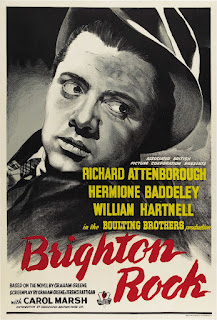


Unless you’re a film noir junkie you’ve probably never heard of Brighton Rock. This British-made movie never got much of a U.S. release, but it’s now available in DVD and on streaming platforms. Brighton Rock is a taut and unusual slice of film noir. It’s based on a 1938 Graham Greene novel, but I doubt even he could paint in words what director John Boulting brought to the screen.


The setting is the seaside town of Brighton, England, and “rock” refers to a stick of hard candy some believe first appeared there. That’s probably apocryphal, but it’s the sweetness aspect that comes into play. Think of Brighton as a cross between Coney Island and Atlantic City during its early 20th century glory days–a mix of class and crass. The story involves two crime gangs, one established and another of neophytes headed by Pinkie Brown (Richard Attenborough) looking to up its profile. Pinkie is a young punk who is about 90% as smart as he thinks he is. It’s that missing 10% that leads to the kind of trouble he doesn’t want.


The year is 1935, one of Pinkie’s gang members has been killed, and he blames Fred Hale (Alan Wheatley) for the hit. It’s never established if Hale was guilty, but he finds himself at the wrong place at the wrong time. Brighton is running a promotion involving “Kolley Kibber,” a reference to an obscure 18th century poet/playwright. Hale’s face is plastered on advertisements and anyone in Brighton who approaches him gets cash prizes. Alas, Hale’s legitimate job overlaps with a time in which Pinkie is hatching plans in Brighton. Hale meet his ends in a funhouse ride, where Pinkie strangles him. If only Fred hadn’t encountered busybody Ida Arnold (Hermione Baddeley), everything might have worked out l for Pinkie. The police think he died of a heart attack or suicide, but Ida insists he was offed.


Pinkie and gang members need alibis to “prove” they were nowhere near the amusement park when Hale died. Pinkie sends Spicer (Wylie Watson) to distribute Kibber cards incognito so it will look like Hale had been active until his death, but Spicer accidentally left one in a café where he was probably seen. Pinkie marches off to collect the card, but it’s gone. He does, however, meet an innocent waitress who worked that table. To cover his rear, Pinkie woos 16-year-old Rose Brown (Carol Marsh) and gets forged documents allowing the two underaged “lovers” to marry; under British law a spouse cannot testify against a partner. Rose is the rock candy. After briefly treating her like a queen with no money–including making a recording of his voice–Pinkie returns to his rough hoodlum ways. Rose, though, is both a good Catholic girl and so green that she assumes Pinkie’s surliness is her fault.


Pinkie’s dilemma is essentially that of Icarus. He and is diminishing gang–a few are put out of commission–have been involved in smalltime rackets, but Pinkie’s aspirations put him on a collision course with Colleoni (Charles Gardner), the Big Fish. Getting him to bite isn’t easy as Colleoni recognizes Pinkie as a lowlife loser. As Pinkie grows more desperate, things rocket out of control. The record’s content factors into the plot, as does the fact that Rose doesn’t own a gramophone. So too will a gun, Ida’s meddling, and Rose’s Catholicism. Brighton Rock hurtles toward a surprising ending that both chills and touches.


Among the things that make this film stand out are sequences, especially at the fun house and on a dark pier, that are as surrealistic as a Man Ray photograph. Cinematographer Harry Waxman manipulated light and dark so brilliantly that they illumine one of the film’s themes: sin versus redemption. Overall, Waxman’s use of light is so good that were this not a black and white film I’d be tempted to apply adjectives such as vivid and lurid. The movie is carried, though, by Marsh and Attenborough. They both play teens–Marsh was actually 21 and Attenborough 25­–and their baby faces enhance the dance between inherent innocence and its corrupted variety. If you can get past the dated aspects of this 74-year-old project, you will be treated to a superb underappreciated film noir gem. Dare I call it “eye candy?”


Rob Weir


3/16/22

D'Amour Show a Walk Through Late 20th Century Music


FRONT ROW CENTER: ICONS OF ROCK, BLUES, AND SOUL

D’Amour Museum of Fine Arts, Springfield, MA

Through May 1, 2022


All of a sudden there has been renewed interest in photographic depictions of pop, rock, blues, and soul icons of the 1960s and 1970s. First came the online exhibit of works from the late Don Hunstein and now the D’Amour in Springfield is featuring images from Larry Hulst. It’s as if the Baby Boomer Magical Mystery Tour is mutating into the Baby Boomer Senior Citizen Bus Tour.


Hulst (b. 1946) might not pop instantly to mind, but you have probably seen his images on album covers or in Rolling Stone Magazine. He began shooting rock shows when he returned to the States in 1969, after serving a tour of duty in Vietnam. In his words, “I want to be where the action is. After all, the ‘show’ is projected out into the audience. I want to be in the audience.”


That last sentence is slightly disingenuous, as he usually worked on special commissions. This gave him access to performers that ticket-buying audience members did not have, but Hurst certainly knows a good shot when he sees it. There are more than 70 photos on display at the D’Amour that cover the period 1970-99. Many of the photos are accompanied by sound spots on which you can stand to hear music from the spotlighted musicians.


The l999 date is pretty much confined to shots of Lauryn Hill. In the sampling below I have concentrated on the 1970s into the 1980s. That’s the bulk of what is on display, plus I confess that my musical tastes shifted in the 1980s–from rock to Celtic and folk–because I couldn’t stomach hair bands, glam rock, or disco. I make no judgments about those styles; they simply weren’t my thing. If they are yours, you’ll feel represented by the D’Amour show, but here is my curated Magical Nostalgia Tour.


I’ll lead with my favorite shot. It’s of Bob Dylan. Or is it? Nope! It’s Joan Baez spoofing her old lover.


Here’s a shot of the actual guy alongside Tom Petty. It’s a good time to add a small note of criticism to the show. This one and others has reflections–I took out what I could–because many museums struggle with the lighting for photographs. That is sometimes the case for the D’Amour. Several of my favorite Hulst shots, including one of Grace Slick at a “Black and White” party dressed as a nun, had too much reflection to see them well. (Any shots in this article that are not crisp or as Hulst shot them are a combination of cropping, uneven lighting, and/or the algorithms in my iPhone.)


One of my great heroes was and is Neil Young, so here is one of himself alone and another when he was part of Crosby, Stills, Nash and Young. Stills is absent from the second photo. By the way, though it might seem un-PC today, a lot of counterculture folks used Native American imagery in an "America needs Indians" campaign supporting indigenous rights.


And here are my top two guitar heroes: Eric Clapton and Jimi Hendrix. A lot of people think Hendrix is the greatest ever. I mean no disrespect to Hendrix, but I much prefer Clapton’s fluidity to Hendrix’s noodling and improvisations. But if you flipped a coin, who could argue with the result?


I was never a Deadhead, but I did teach courses with the band at the center of an exploration of American culture. Here’s Jerry Garcia. Note the missing digit–the result of a wood-splitting accident when he was four.


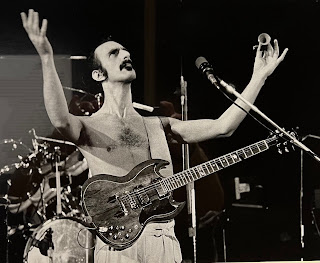
And why not give it up for a guy who made weirdness into art? Frank Zappa was not the freak people thought he was, nor did he use drugs or tolerate drunkenness. But he sure could get sounds out of his instruments that stretched boundaries. 


Has there ever been a better Texas electric blues player than Stevie Ray Vaughan? Don't think. The answer is no. 


I was really into the British Invasion bands, but if I had to pick a favorite not named Cream or The Beatles, I’d be tempted to go with Jethro Tull. Here’s a pensive Ian Anderson, the band’s flautist and lead vocalist.


The final shot is of Kiss. I didn’t like them very much, but this is a wonderful shot that captures the spectacle that made them into a favored metal-meets-Big Hair band. There must have been a sale on aluminum foil. Kiss, though, is about where I jumped musical ship.


There’s probably no need for me to say this, as the work shows it, but Hulst succeeded in his quest to show the action, be it a moment of electricity or one of contemplation and concentration.


Rob Weir


3/14/22

Mank a Lousy Film


MANK (2020)

Directed by David Fincher

Netflix, 131 minutes, R (language, alcoholism)

★★


Herman J. Mankiewicz (1897-1953) was brilliant, erudite, and a talented writer who could crank out and/or fix scripts faster than Billy the Kid could draw a six-gun. He was also egotistical, stubborn, and a sloppy alcoholic who drank himself to an early grave. The Marx Brothers once delivered Paramount an ultimatum: If Mankiewicz was part of any of their future productions, they were done with movies.


Mank looks at the controversial Mankiewicz (Gary Oldman) in three moments of his professional life: 1930, 1934, and 1940. The last of these the year that he co-wrote with Orson Welles–or completely wrote as he often claimed–the script for Citizen Kane, a film often cited as the greatest American film ever made. Alas, neither Director David Fincher nor his screenwriter father, the late Jack Fincher, chose to order their material in any sort of sequential order. That’s fashionable these days, but Mank is a bit like Wordle in that you have to take the small pieces you are given as the movie flits back and forth in time, then try to arrange them into a coherent whole. Most viewers didn’t bother, which is why Mank was one of the biggest box office duds of recent history; it earned back just over $122,000 of its $25 million production costs.


In other words, Mank is a rotten movie devoid even of being good camp. It would have gotten zero stars had it not been for its strong performances and its production design. The latter won numerous awards, including an Oscar for stylish black-and-white backdrops that subtly evoke Depression Era Hollywood. Inexplicably, cinematographer Erik Messerschmidt also won an Oscar, though much of his camera work looks fake.


Oldman is outstanding, but his performance was wasted as there’s not enough background information to make sense of the major players or their crisis points. The Finchers forgot that audiences can be a film fans without being film historians. If you don’t know already know about people such as S. J. Perlman, John Houseman (Sam Troughton), Marion Davies (Amanda Seyfried), or Irving Thalberg (Ferdinand Kingsley), add those blanks to your script Wordle. Throw in a few invented characters and you’ve got a thin and unappetizing hobo stew.


It's too bad, as we are left with a good-looking movie set in a dangerous and fascinating times–the Depression, the rise of fascism, California’s 1934 gubernatorial election–and imperious characters, but we spend too much time trying to work out who’s who and what’s what. The film dips into Mankiewicz’s life as he reconnects with an old friend, actress Marion Davies; befriends her sugar daddy, publishing magnate William Randolph Hearst (Charles Dance); matches wits with Louis B. Mayer (Arliss Howard), the tyrannical head of MGM; wins the respect of his personal secretary Rita Alexander (Lilly Collins); plays dueling egos with Orson Welles (Tom Burke); and manages to hold on to his long-suffering wife Sara (Tuppence Middleton). Each actor is quite good, though you’ll probably wonder to what, when, and where their performances are supposed to be connected.


If you are tempted to watch Mank, the film’s many jumps are between three junctures of Mankiewicz’s life. The first was getting his foot in the MGM door in 1930–he was hired and fired from studios on a regular basis–via Davies and Hearst. In the second, Mank strains his relationships with Mayer and Hearst over the 1934 election in California that pitted conservative Republican Frank Merriam against socialist upstart and novelist Upton Sinclair (“Science Guy” Bill Nye in a cameo). Mankiewicz was a Sinclair supporter who knew the difference between socialism and communism, whereas Hearst and Mayer were right-wingers who plotted to undermine Sinclair. Finally, the 1940 sequences are of Mank recuperating from a broken leg, getting plastered, burning his MGM bridges, and completing the Citizen Kane script for RKO Studios. There’s also a subplot of Mank’s relationship with his younger brother Joe (Tom Pelphery). Trust me, though, when I tell you I have just made more sense of the film than the script managed to do.


Ultimately Mank is a what-were-they-thinking? movie. In more ways than one Mank reminded me of a line from the classic film On the Waterfront: “I coulda been a contender. I coulda been somebody, instead of bum, which is what I am.” That’s nicer than saying Mank stank.


Rob Weir  

3/11/22

Gorgo: It Came from 1961


GORGO (1961)

Directed by Eugène Lourié

MGM (Britain), 78 minutes, not-rated

(filmmaking) ★★★ (campiness)


People often get nostalgic on their birthdays. Since it’s mine today, I’m visiting the Movie Wayback Machine for a new look at a flick I saw as a kid. In the early Sixties helicopter parents weren’t a thing. Mothers routinely slipped kids a buck and told them to walk downtown to see­ a movie. (Anything to get them out of their hair.)


I was fond of monster pictures like Godzilla and Gorgo, the latter an attempt to cash in on cheesy Japanese sci-fi. As a film Gorgo is a cave full of cheddar, but the production team knew that and didn’t try to dress it up as a warning against atomic weapons or scientists gone mad. It has an all-male lead cast, which was how most monster movies were made. It stars Bill Travers, William Sylvester, Vincent Winter, and Martin Benson. Never heard of them? That’s a tipoff that you are in the presence of a low-budget picture. Gorgo cost $650,000 to make, which wasn’t chump change—about $6.1 million today—but still wasn’t much. Apparently most of it was spent on rubber suits and Styrofoam.


The plot line involves pearl divers near Ireland’s “Nara” Island—an anagram of Aran—whose rust bucket trawler nearly capsizes when an underwater volcano erupts and sends huge waves across stern and bow. When Captain Joe Ryan (Travers) and First Officer Sam Slade (Sylvester) take a dingy ashore to Nara, a furtive harbormaster tells them they cannot dock for repairs. Why? An orphan lad named Sean spills the beans; there is Viking gold in the waters and sharing isn’t on the agenda.


Until, that is, an eruption-aroused monster stirs from the sea bottom and takes out several islanders. Ryan and Slade cut a deal—some of the gold in exchange for killing it. It occurs to them, though, that such a creature taken alive would be worth its weight in treasure. They proceed to net, chain, and haul it aboard, where several Irish professors pronounce the critter as prehistoric (duh!). They assure Ryan and Slade that the government in Dublin will “compensate” them for their efforts. Instead, they head for London, where Andrew Dorkin (Benson), a Barnum-like circus impresario, offers top-dollar to display “Gorgo,” a backdoor reference to the nickname of the Greek gorgon Medusa. 


Tower Bridge is falling down/Falling down...


What could go wrong with placing a large red-eyed, pointy-toothed creature in a deep concrete pit surrounded by electric wire? Gorgo’s mother, for one. When she can’t find junior, she flattens Nara, sinks a British destroyer, and is unfazed by bullets, shells, and depth charges. Mama is ripped and on her way to London. It’s naff fun to watch her destroy vast swaths of London, including Tower Bridge, Big Ben, and loads of Georgian townhouses and apartment flats—if you watch carefully, it’s the same footage recycled in many cases—and there’s nothing the British military can do to stop her. There’s some wry humor of a general telling aides they must “bother” the prime minister to authorize more extreme measures. The ending, though, is not a military solution.


Gorgo is camp on par with cult films like Plan 9 from Outer Space. The special effects reflect the film’s budget. The monsters were done via “suitmation,” meaning actors were placed in scaly, clawed, gape-mouthed rubber suits and sets were built around them. When London falls it’s pretty obvious that it’s a model built of Styrofoam, balsa wood, plastic, and other such materials. Is there a point beyond cheap thrill? Call its morals very Cold War: Don’t seek to destroy what you don’t understand, don’t assume big guns will save you, and don’t screw with Mother Nature. Oddly, though, the bargain basement effects leave more room for imagination than today’s CGI f/x. (Gorgo is better than the sandworm in Dune!)


If you can believe it, chums and I used to argue over who would win a fight between Gorgo and Godzilla. (Director John Carpenter made such a short film, but he’s never allowed it to be seen!) I held out for Gorgo. After all, all Godzilla had was burning atomic breath, but if you can’t stop Gorgo with an army of flamethrowers or four million volts of electricity, Godzilla should take a breath mint and get out of the ring!


Rob Weir 


3/9/22

Black Widow: For Fanboys Only


BLACK WIDOW (2021)

Directed by Cate Shortland

Marvel/Disney, 134 minutes, PG-13

★★


In some circles, there’s been an angry backlash against the Academy of Motion Picture Sciences because Black Widow was blanked in Oscar nominations. If you hadn’t noticed, it’s probably because you’re neither a teenaged fanboy nor an adult suffering from delayed development. Heaven knows there are plenty of reasons to be critical of the Oscars but for once its snub was a good call.


Black Widow is the 24th edition of the Marvel Universe and that train ran out of creative steam long ago. It should tell you everything you need to know that this film is distributed by Disney. Read into this that all subversive edges have been filed to rounded corners to accommodate values that don’t push the envelope much further than presenting an unorthodox nuclear family.


Black Widow is at heart a Cold War movie that’s set in the years 1995-2016. Umm…. the Cold War ended in 1991. Okay, it’s a comic book but this is a glaring misstep even for Marvel, which loves alternative timelines and parallel universes. The opening sequences are set in Ohio (Georgia, actually), where a family living undercover makes a mad dash to an airport with police and intelligence officers in hot pursuit. See police cars go flying through the air. Hear loud explosions. Watch paterfamilias Alexi Shostakov (David Barbour) hurl himself onto the wing of a small plane and trade assault rifle fire with members of S.H.I.E.L.D. (an intelligence agency) who couldn’t hit a target with a bazooka from 3 feet away, though Alexi is capable of shooting his gun and hang on after takeoff. They land in Cuba where the wounded fake mom, Melina Vostokov (Rachel Weisz) is rushed into surgery, and her two young “daughters,” Natasha and Yelena are separated. We learn later that, against their will, they are transported to the Red Room to be trained as Black Widows, assassins under the control–vials of red chemical gasses factor into this–of Dreykov (Ray Winstone), a Russian general with his own agenda.


When we pick up the tale years later, Alexi is in a Russian prison, Natasha (Scarlett Johansson) has defected to S.H.I.E.L.D., has allied with the Avengers, and hasn’t seen Yelena (Florence Pugh) since Cuba. Natasha thinks she has killed Dreykov and his daughter, but that’s not the case. Too bad; we could have ended the movie right there. Instead, we have to reunite our Disney family, blow up a lot of things, watch ScarJo run from many, many bullets, always in a straight line–the better to see her tight-fitting outfit–but not get shot when she busts Alexi out of a maximum-security facility. (Isn’t the point of automatic weapons that you can’t miss?)


After that it’s track Dreykov who is, in turn, tracking Alexi, Natasha, and Yelena with Melina’s help (or not). Can they save the world? Can Alexi fit into the uniform that makes him look like he washed out of Human Cannonball school? Did I mention that lots of things blow up? Can Natasha’s lovelorn admirer Rick Mason (O-T Fagbenle) get a rise out of her? What is the Lycra tension of ScarJo’s white uniform? Do you care?


Black Widow was a classic summer movie–loud, high on thrills, and low in logic, character depth, or background development. It presumes that viewers have faithfully followed the Avengers series and its various offshoots; if you’ve not, you might well wonder what in the name of red chemicals is going on. You’ll probably assume, though, that the world will be saved and that the titular character will live to save it again in the future.


Am I being too hard on this movie? Maybe, but you need not take my word for it. It’s made a lot of money–there are a lot of fanboys out there–and it’s good that it did rake it in because it costs a lot of lucre to destroy things. If you check out other critics, though, you’ll see that many of them were underwhelmed. Black Widow’s weighted score is 67%. In the Grade Inflation Alt-Universe, that’s like passing someone with a D-. Fanboys gave it an A-. Make of that what you will.


Rob Weir


3/7/22

The Asphalt Jungle: John Huston Goes Noir


THE ASPHALT JUNGLE (1950)

Directed by John Huston

Loew’s, 112 minutes, not-rated

★★★★


You can count on the fact that any film in the Criterion Collection or directed by John Huston will be worthwhile. That’s certainly the case of Asphalt Jungle, which ticks both boxes.


It’s a classic crime drama from the tail end of an era in which crime wasn’t allowed to pay. At its heart is Dix Handley (Sterling Hayden), a guy with more brawn than brain. He’s a down-on-his-heels tough guy trying to get his life in order, but his major virtue is his girlfriend “Doll” Conovan (Jean Hagen). Her biggest problem is that she puts up with Dix’s antics, his silent treatment, and his explosive temper. Yeah, that’s another trope, though one (sadly) borrowed from real life: the gal who thinks she can save her bad-boy man.


Another trope is the criminal mastermind who takes the harebrained scheme of local thugs and makes them “foolproof.” In this case, that role falls upon “Doc” Riedenschneider (Sam Jaffe), who assembles a team to tunnel under and into a building, blow a safe, and pull off a jewel heist. Dix needs money, as he dreams of getting out of Chicago and buying back the Kentucky horse farm that once belonged to his family. He’s the muscle, with Louie Ciavelli (Anthony Caruso) the safecracker, Gus Minissi (James Whitmore) the getaway driver, bookmaker Cobby (Marc Lawrence) the guy who cooked up the scheme, and sleazy lawyer Alonzo Emmerich (Louis Calhern) getting a cut for serving as legal backup if any suspicion should befall the den of thieves. Still another trope: In movies such as this it’s rare for anyone to wonder why a “mastermind” like Doc has just gotten out of jail!


You can bet that not everything will go as planned, or otherwise you’ve got a mighty short movie. Plans are laid, rehearsed, and there’s an alternative workaround for every contingency that comes to mind. Of course, it’s the ones that don’t come to mind that’s the problem. The Asphalt Jungle is filled with double crosses, corruption on both sides of the law, broken hearts, and broken people. It literally stumbles to a tragic ending.


As I intimated, this is not a film in which the bad guys are allowed to prosper. The open questions are who the good guys are and whether one or more of the bad guys can be redeemed. It’s gritty, if predictable, but is carried by superb performances. Hayden excels as a big, dumb lug who suspects he’s out of his depth but can’t think of any other way to get back to Kentucky. Whitmore has a lesser role, but you get to see him play a hunchback, and Jaffe puts on a very convincing German accent as Doc Riedenschneider. Why is he German? The film was made just five years after the end of World War II. Although he’s not depicted as an ex-Nazi, there remained a whiff of anti-German sentiment in 1950, which made him a perfect villain, albeit a mild-mannered one. 


NOT a Marilyn Monroe Movie


Don’t be fooled by posters that prominently plaster Marilyn Monroe’s body across a color backdrop. First of all, The Asphalt Jungle is in black and white. Secondly, she has only a bit role and is not central to the plot. She got some notice for this film­–she plays Emmerich’s mistress–and was on the cusp of stardom, but hadn’t yet arrived. Several films from the late 1940s through 1953 were given a second life by studios implying Monroe had a bigger role than she did. Huston initially wanted to dump Monroe, as he wasn’t impressed. She only got the part because his first choice was unavailable.


The Asphalt Jungle is considered a mature film noir picture. It is also tagged as a neorealist film, which in this case meant that Huston, an art fan, preferred stillness to non-stop motion and turmoil. Huston gave cinematographer Harold Rosson the greenlight to linger in places where other directors would edit for quick cross cuts to maximize lurid action. A lot happens in the film, but Huston Asphalt Jungle to play out in a more naturalistic fashion. It’s dated, but it works.


Rob Weir


3/4/22

Dave Eggers Thinks Amazon is An Existential Threat!


THE EVERY (2021)

By Dave Eggers

Penguin Random House, 608 pages.

★★★★


The Every opens with these words:


This story takes place in the near future. Don’t try to work out when. Any anachronisms of time and physics occur on purpose. All errors pertaining to technology, chronology, or judgment are intentional and exist to serve you better.


If you recall The Circle (book or film), this is its sequel. For once, the second act is superior.  The Circle was a Google/Not Google/Microsoft/Not Microsoft/Amazon/Not Amazon dystopia. Dave Eggers pulls no such punches in The Every; his corporation bent upon global control is Amazon. As we come in upon The Every, it is busy acquiring three companies a week for the sole purpose of stripping them of any value and destroying them—all in the name of “saving” humankind from the horrors of competition, inefficiency, waste, and crippling choice. Moreover, it claims to be saving the planet. Its main campus on Treasure Island in San Francisco Bay has banned plastic, has mandatory recycling of virtually everything, is scent-free, and vegetarian.


Think of The Every as Orwell crossed with a take-down of cancel culture and seemingly benevolent fascism. One of its (many) mottos is “sharing is caring.” In that spirit, every employee is perpetually connected  to devices and various apps that make all their medical data available, advise when to drink, when to exercise, and when to sleep. Anything that can’t be measured is deemed worthless and the ovals worn on the form-fitting lycra of Every employees rates all activities, including positive green flashes for using multi-syllabic words or giving low scores for not posting enough content each day. (It doesn’t matter what.)


 Its founder, the Bezos-like Eamon Bailey, has given over the company reins to Mae Holland. (They are holdovers from The Circle.) Holland, though, is rumored to be on shaky ground as she hasn’t had a new idea in ages (whatever that might mean in such an instant feedback world). The company’s reach has become so universal that only a few “trog” pockets exist and even they are under heavy surveillance. (Motto: “peace through surveillance.”) Since almost everyone is connected, why not harvest data to “improve” the world? Another motto: “clarity is objectivity.” The data is “clear,” for instance, that Norman Rockwell is the greatest artist who has ever lived. FictFix can clean up old novels and removal material that might distress a reader.Does such a world scare you?


It scares Delaney West, a young woman from Idaho now sharing a San Francisco trog apartment with odd duck Wes Makazian. She’s very smart and wants to take down Every, but as a lit major she needs Wes’ tech savvy. The idea is to secure a job at the main campus, learn its vulnerabilities, and create apps that are so outrageous that the masses will stir rise up in anger to destroy the global monolith. How about an app that allows anonymous employees to report on the micro aggression of someone else?  Or one that uses Alexa-like devices to listen for words or angry voices and report them to the police so they can intervene to prevent a crime before one happens?  What else can be promoted in the name of making people feel “safe?” AuthentiFriend measures who really cares about you, another assures voting rights for Every account holder, and still another makes consumer choices so you won’t make a mistake. StayStïl allows you to “travel” without leaving the Every, thereby reducing the carbon footprint and saving possible discomfort such as observing animals harming each other.


There are rumblings in the air. Is Holland the target of a palace coup? Are there other trog sympathizers on Treasure Island? What can Delaney come up with that would be the proverbial final straw? Can she hide without disconnecting and thereby calling attention to herself? Then again, who can’t be co-opted in a globe full of sheeple? Is Delaney or anyone else fooling anyone? And the ultimate question: What if most of the world likes being told what to do? 


If you’re a trog, The Every is a chilling look at a dehumanized future brought on by its very victims. One wonders whether Eggers’ opening comments are meant to be smug, cautionary, or ironic, though that is essentially a debate over each of his books. He is open to the charge of launching a personal vendetta against Amazon, but that doesn’t necessarily make him wrong. If you enjoy irony embedded in irony, though, you can buy The Every on Amazon!


Rob Weir