3/25/22

Beautiful World Where Are You a Mess


BEAUTIFUL WORLD WHERE ARE YOU? (2021)

By Sally Rooney

Farrar, Straus, and Giroux, 352 pages.

★★


If you have trouble with novels about people in their 30s who are trapped in perpetual adolescence, avoid Beautiful World Where are You? As you will probably infer from the title, this book centers on people in search of something. What, exactly, is the question.


Its major character is Alice Kelleher, another in the (too long) line of fictional characters who have written their way to renown and financial security. Yeah, like that like happens to so, so many novelists. Not! Alice had a breakdown (of a barely explained sort) a few years earlier and she’s still a bit loopy. She goes on a blind date with Felix Brady and by all accounts, it’s a bust. So, naturally, they will end up going on more, she will take him on one of her book tours, and they still don’t like each other very much, though Alice enjoys having sex with Felix. It makes as much sense as Alice’s best friend Eileen Lydon, who decides to sleep with the hunky Simon Costigan, a really nice guy though he’s more like a big brother and has a steady girlfriend. Not creepy enough for you? It seems as if the entire circle of people in Alice’s circle are bonking each other, though nothing seems to last longer than it takes to change the sheets. They are all competent in using technology and assuming affected hipness, but they are clueless about adulting or long-term relationships.


Alice doesn’t even do tech or hip; all she knows is books. So of course, she keeps sleeping with bad boy Felix, an inarticulate warehouse worker with debts, a taste for drugs and booze, and an abiding hatred for his brother. Simon is religious; Eileen is a drama queen and editorial assistant who knows a lot about art, but is seeking a “central principle.” She loves Simon but fears getting deeply involved with him because what if (gasp!) they got together and then broke up? Then he’d not be in her life. Duh!


There are more serious themes yearning to break out, if you call comments on celebrity culture weighty. Or an attempt to piggyback on the Covid pandemic. Alice writes, “It makes me wonder whether celebrity culture has sort of metastasized to fill the emptiness left by religion. Like a malignant growth where the sacred used to be.” To be hip about that question, isn’t the answer obvi? But wait, there’s more. There is the question of whether having a baby is the right thing to do in a world threatened by Covid and climate change. I don’t know, but shouldn’t one actually pay some attention to maturing before even making such queries?


The title comes from both a poem by Friedrich Schiller and a biennial art exhibition Rooney attended in Liverpool. Schiller’s poem was titled “The Gods of Greece” and is a lament for the loss of paganism, the coldness of Christianity, and nature’s lost magic. I’m not sure how this fits in Rooney’s novel. I suppose the biennial factors into Eileen’s love of art. At heart, though, there aren’t many true-sounding chords struck in Beautiful World Where are You?


 Ireland’s Rooney has been lucky; at 31 she actually has won a bit of acclaim. I liked her 2018 novel Normal People, but my view of Beautiful World is that it’s a freaking mess. Get back to me with these characters when they’ve got something to say.


Rob Weir


3/23/22

Black Angel Reconsidered


BLACK ANGEL (1946)

Directed by Roy William Neil

Universal Pictures, 81 minutes, Not Rated.

★★★  


Black Angel has long been considered a second-tier film noir, though lately its reputation has trended upward to the point that it’s now viewed as underappreciated. Watching it now suggests that both views are valid.


It’s one of those did-he-or-didn’t-he movies that will leave you guessing until the end. Catherine Bennett (June Vincent) is married to Kirk (John Phillips), a two-timer who is being blackmailed by his blonde bombshell lover, nightclub singer Mavis Marlowe (Constance Dowling), Things go considerably more than wrong when Marlowe is murdered in her swank apartment and Kirk is arrested for the slaying. The evidence is airtight, but although Catharine knows that her hubby done her wrong (as thugs might say) she doesn’t believe he’s capable of homicide. If she doesn’t prove that, Kirk will fry in the electric chair.


So, who else would you enlist to help you find the “real” killer other than Mavis’s ex-husband, a broken-down alcoholic pianist? That’s where Martin Blair (Dan Duryea) comes into play. He’s cynical about most things, but he has a soft spot for a sob story. Or is it the shapeliness of Catherine’s legs and her décolletage? The cops have Kirk dead to rights, though, and Captain Flood (Broderick Crawford) pooh-poohs Catherine’s insistence of his innocence. The more Martin and Catharine investigate, the more she is convinced that the real murderer is a guy named Marko (Peter Lorre), a former sleazy thug who now poses as a legitimate nightclub owner. Martin doesn’t like sticking his neck out for anybody, but he doesn’t have much to lose and the more time he spends with Catharine the more he finds himself falling for her. What ensues is a cat-and-mouse story that hinges on a brooch. 


There’s a lot to like here. Both Vincent and Dowling were knockouts, both of whom were also successful models. Then we have two guys born for the roles they played. Crawford as a flatfoot? The man made his living playing one and he was always convincing in doing so. Of course, there’s Peter Lorre, who is like a ferret come to life and seemingly as furtive as one. (Would you trust Peter Lorre?) Duryea is also superb. He was a malleable actor who could played a world-weary loser as he does in this film, a chiseler, a cowboy, or a romantic lead. He was also a very talented dancer.


Then we get to the head-scratching stuff. If you were trying to prove that a wise guy was guilty of a murder, how would you go about investigating him? Why you’d form a lounge act, naturally. Martin can tickle the ivories and it turns out that Catharine can pass as a sultry torch singer. Now all she has to do is get the act booked at Marko’s club, catch Marko’s eye, gain his confidence, and find some evidence without being fingered herself. She also has an odd motive for all of this. We can sympathize with her desire not to see an innocent man die–if indeed Kirk is innocent–but what’s with her professions of love for the man who jilted her? At some point, we wonder also why Martin continues his dangerous subterfuge. Maybe he does like the cut of Catharine’s jib, but all Martin can really foresee is the likelihood that he’ll be left in the lurch if Kirk is sprung. All indications are that Catharine will take the big lug back.


Sometimes one looks at an 81-minute film and proclaims it taut. In this case, more background into the evolving relationship between Catharine and Martin would help the ending make more sense. Nonetheless, Black Angel is often stylish and it holds together okay, even if not brilliantly so. Call it a B level noir that with a little extra credit could rise to a B+.


Rob Weir

3/21/22

Farmageddon in Bad Need of a Script Doctor


A SHAUN THE SHEEP MOVIE: FARMAGEDDON (2019)

Directed by Richard Phelan and Will Becher

StudioCanal and Netflix, 87 minutes, G

★★


I am a fan of both Nick Park and Shaun the Sheep. Alas, Farmageddon is more of a waste of clay than another Wallace and Gromit. As most know, Park’s Aardman Animations creations are done with molded figures that are meticulously manipulated through stop-motion placements. These cast the illusion of continuous motion akin to the hand-drawn individual cells in classic animated films.


Farmageddon has moments of inspired silliness, but this Shaun the Sheep feature will remind you of saccharine Disney/Pixar collaborations. It doesn’t help that it features an alien that looks like a cross between a rabbit and Maggie Simpson.


Plot is generally incidental in an Aardman movie. This one is no exception, though one wonders if Farmageddon would have been sharper had Park directed it rather than Richard Phelan and Will Becher. Shaun and his fellow sheep are hungry and bored, but are constantly on their guard, as farm dog Bitzer runs the grounds like a Marine drill sergeant on behalf of his master, Farmer John. Shaun, being a clever sheep, decides to order pizza, Bitzer confiscates it, but the boxes are empty. We learn that the culprit is Lu-La, an alien who has crash-landed in a field near the village center, has cloaked the ship, and is ravenously hungry. Lu-La has no idea where it is, but has a few powers to aid in being furtive, including the ability to imitate sounds. (There is no actual talking in the film; adults make gibberish sounds like adults in Peanuts creations.) Lu-La’s ramblings will eventually take him to Farmer John’s place, where Shaun befriends the visitor after both get involved in mayhem.


Farmer John thinks all the scuttlebutt about aliens is nonsense, but he senses a way to make a few pounds–this is a British production, dahlings–and constructs a cheesy, makeshift Roswell-like theme park, the film’s namesake Farmageddon. Meanwhile, Agent Red of M.A.D. (Ministry of Alien Detections) takes things more seriously. She’s a commanding sourpuss whose belief in aliens made her the target of ridicule as a child and she’s bent on proving her detractors wrong.


You can probably write the script from here. It’s part E.T., part 2001: A Space Odyssey part Night at the Opera with Farmageddon as its setting, and part caper film as Shaun tries to stop Lu-La from appropriating food from village stores. There are nods to other films, including Close Encounters, Alien, RoboCop, and Wall-E. These and Shaun’s travails are the best parts of the film. If only everything else was half as clever.


Farmageddon goes hypoglycemic when we learn that Lu-La is actually a naughty child who accidentally took the family flying saucer for a spin. I’m sorry, but we don’t need a Hallmark-like family values can Lu-La get back home family values saga. These parts are gag-me sweet and we know how things will turn out once we learn about Ub-Do and Me-Ma, Lu-La’s parents. (Me-Ma? Really?) Can Shaun and Lu-La get to the top of the rickety Farmageddon tower in time to send a tracker message with Bitzer and Agent Red in hot pursuit? No way. Lu-Lu is captured and made into a chicken pie. Oh wait, that was Chicken Run.


Farmageddon frustrates is an out-of-balance movie. Aardman Animations movies are generally at their best when they are as much for adults as for kids; this one tips the scales way over toward the age 7 and younger crowd. That’s fine in theory, but then why bother with all the homage or snark? It also might have helped to have an alien more convincing than Lu-La. And then there is the worst soundtrack I’ve heard this century. It features Nadia Rose, The Vaccines, and Kylie Minogue. You will not believe Minogue is a pop star; her singing is dreadful. Not that it matters, as none of the music enhances the film or builds connective tissue to it. Why is it there? Write me if you have the faintest idea.


Shaun is always fun and the stop-motion effects are remarkable, but Farmageddon made me want to scream, “Get me a script doctor.”   


Rob Weir

3/18/22

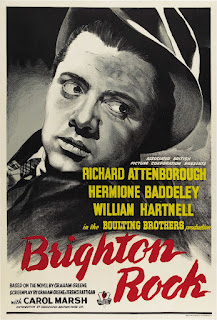
Brighton Rock: Quite a Find


BRIGHTON ROCK (1948)

Directed by John Boulting

Pathé Pictures, 92 minutes, Not-rated.

★★★★★


Unless you’re a film noir junkie you’ve probably never heard of Brighton Rock. This British-made movie never got much of a U.S. release, but it’s now available in DVD and on streaming platforms. Brighton Rock is a taut and unusual slice of film noir. It’s based on a 1938 Graham Greene novel, but I doubt even he could paint in words what director John Boulting brought to the screen.


The setting is the seaside town of Brighton, England, and “rock” refers to a stick of hard candy some believe first appeared there. That’s probably apocryphal, but it’s the sweetness aspect that comes into play. Think of Brighton as a cross between Coney Island and Atlantic City during its early 20th century glory days–a mix of class and crass. The story involves two crime gangs, one established and another of neophytes headed by Pinkie Brown (Richard Attenborough) looking to up its profile. Pinkie is a young punk who is about 90% as smart as he thinks he is. It’s that missing 10% that leads to the kind of trouble he doesn’t want.


The year is 1935, one of Pinkie’s gang members has been killed, and he blames Fred Hale (Alan Wheatley) for the hit. It’s never established if Hale was guilty, but he finds himself at the wrong place at the wrong time. Brighton is running a promotion involving “Kolley Kibber,” a reference to an obscure 18th century poet/playwright. Hale’s face is plastered on advertisements and anyone in Brighton who approaches him gets cash prizes. Alas, Hale’s legitimate job overlaps with a time in which Pinkie is hatching plans in Brighton. Hale meet his ends in a funhouse ride, where Pinkie strangles him. If only Fred hadn’t encountered busybody Ida Arnold (Hermione Baddeley), everything might have worked out l for Pinkie. The police think he died of a heart attack or suicide, but Ida insists he was offed.


Pinkie and gang members need alibis to “prove” they were nowhere near the amusement park when Hale died. Pinkie sends Spicer (Wylie Watson) to distribute Kibber cards incognito so it will look like Hale had been active until his death, but Spicer accidentally left one in a café where he was probably seen. Pinkie marches off to collect the card, but it’s gone. He does, however, meet an innocent waitress who worked that table. To cover his rear, Pinkie woos 16-year-old Rose Brown (Carol Marsh) and gets forged documents allowing the two underaged “lovers” to marry; under British law a spouse cannot testify against a partner. Rose is the rock candy. After briefly treating her like a queen with no money–including making a recording of his voice–Pinkie returns to his rough hoodlum ways. Rose, though, is both a good Catholic girl and so green that she assumes Pinkie’s surliness is her fault.


Pinkie’s dilemma is essentially that of Icarus. He and is diminishing gang–a few are put out of commission–have been involved in smalltime rackets, but Pinkie’s aspirations put him on a collision course with Colleoni (Charles Gardner), the Big Fish. Getting him to bite isn’t easy as Colleoni recognizes Pinkie as a lowlife loser. As Pinkie grows more desperate, things rocket out of control. The record’s content factors into the plot, as does the fact that Rose doesn’t own a gramophone. So too will a gun, Ida’s meddling, and Rose’s Catholicism. Brighton Rock hurtles toward a surprising ending that both chills and touches.


Among the things that make this film stand out are sequences, especially at the fun house and on a dark pier, that are as surrealistic as a Man Ray photograph. Cinematographer Harry Waxman manipulated light and dark so brilliantly that they illumine one of the film’s themes: sin versus redemption. Overall, Waxman’s use of light is so good that were this not a black and white film I’d be tempted to apply adjectives such as vivid and lurid. The movie is carried, though, by Marsh and Attenborough. They both play teens–Marsh was actually 21 and Attenborough 25­–and their baby faces enhance the dance between inherent innocence and its corrupted variety. If you can get past the dated aspects of this 74-year-old project, you will be treated to a superb underappreciated film noir gem. Dare I call it “eye candy?”


Rob Weir


3/16/22

D'Amour Show a Walk Through Late 20th Century Music


FRONT ROW CENTER: ICONS OF ROCK, BLUES, AND SOUL

D’Amour Museum of Fine Arts, Springfield, MA

Through May 1, 2022


All of a sudden there has been renewed interest in photographic depictions of pop, rock, blues, and soul icons of the 1960s and 1970s. First came the online exhibit of works from the late Don Hunstein and now the D’Amour in Springfield is featuring images from Larry Hulst. It’s as if the Baby Boomer Magical Mystery Tour is mutating into the Baby Boomer Senior Citizen Bus Tour.


Hulst (b. 1946) might not pop instantly to mind, but you have probably seen his images on album covers or in Rolling Stone Magazine. He began shooting rock shows when he returned to the States in 1969, after serving a tour of duty in Vietnam. In his words, “I want to be where the action is. After all, the ‘show’ is projected out into the audience. I want to be in the audience.”


That last sentence is slightly disingenuous, as he usually worked on special commissions. This gave him access to performers that ticket-buying audience members did not have, but Hurst certainly knows a good shot when he sees it. There are more than 70 photos on display at the D’Amour that cover the period 1970-99. Many of the photos are accompanied by sound spots on which you can stand to hear music from the spotlighted musicians.


The l999 date is pretty much confined to shots of Lauryn Hill. In the sampling below I have concentrated on the 1970s into the 1980s. That’s the bulk of what is on display, plus I confess that my musical tastes shifted in the 1980s–from rock to Celtic and folk–because I couldn’t stomach hair bands, glam rock, or disco. I make no judgments about those styles; they simply weren’t my thing. If they are yours, you’ll feel represented by the D’Amour show, but here is my curated Magical Nostalgia Tour.


I’ll lead with my favorite shot. It’s of Bob Dylan. Or is it? Nope! It’s Joan Baez spoofing her old lover.


Here’s a shot of the actual guy alongside Tom Petty. It’s a good time to add a small note of criticism to the show. This one and others has reflections–I took out what I could–because many museums struggle with the lighting for photographs. That is sometimes the case for the D’Amour. Several of my favorite Hulst shots, including one of Grace Slick at a “Black and White” party dressed as a nun, had too much reflection to see them well. (Any shots in this article that are not crisp or as Hulst shot them are a combination of cropping, uneven lighting, and/or the algorithms in my iPhone.)


One of my great heroes was and is Neil Young, so here is one of himself alone and another when he was part of Crosby, Stills, Nash and Young. Stills is absent from the second photo. By the way, though it might seem un-PC today, a lot of counterculture folks used Native American imagery in an "America needs Indians" campaign supporting indigenous rights.


And here are my top two guitar heroes: Eric Clapton and Jimi Hendrix. A lot of people think Hendrix is the greatest ever. I mean no disrespect to Hendrix, but I much prefer Clapton’s fluidity to Hendrix’s noodling and improvisations. But if you flipped a coin, who could argue with the result?


I was never a Deadhead, but I did teach courses with the band at the center of an exploration of American culture. Here’s Jerry Garcia. Note the missing digit–the result of a wood-splitting accident when he was four.


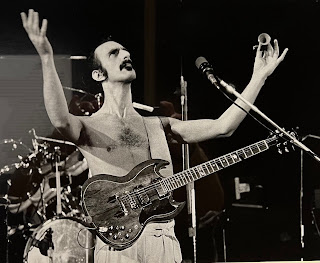
And why not give it up for a guy who made weirdness into art? Frank Zappa was not the freak people thought he was, nor did he use drugs or tolerate drunkenness. But he sure could get sounds out of his instruments that stretched boundaries. 


Has there ever been a better Texas electric blues player than Stevie Ray Vaughan? Don't think. The answer is no. 


I was really into the British Invasion bands, but if I had to pick a favorite not named Cream or The Beatles, I’d be tempted to go with Jethro Tull. Here’s a pensive Ian Anderson, the band’s flautist and lead vocalist.


The final shot is of Kiss. I didn’t like them very much, but this is a wonderful shot that captures the spectacle that made them into a favored metal-meets-Big Hair band. There must have been a sale on aluminum foil. Kiss, though, is about where I jumped musical ship.


There’s probably no need for me to say this, as the work shows it, but Hulst succeeded in his quest to show the action, be it a moment of electricity or one of contemplation and concentration.


Rob Weir


3/14/22

Mank a Lousy Film


MANK (2020)

Directed by David Fincher

Netflix, 131 minutes, R (language, alcoholism)

★★


Herman J. Mankiewicz (1897-1953) was brilliant, erudite, and a talented writer who could crank out and/or fix scripts faster than Billy the Kid could draw a six-gun. He was also egotistical, stubborn, and a sloppy alcoholic who drank himself to an early grave. The Marx Brothers once delivered Paramount an ultimatum: If Mankiewicz was part of any of their future productions, they were done with movies.


Mank looks at the controversial Mankiewicz (Gary Oldman) in three moments of his professional life: 1930, 1934, and 1940. The last of these the year that he co-wrote with Orson Welles–or completely wrote as he often claimed–the script for Citizen Kane, a film often cited as the greatest American film ever made. Alas, neither Director David Fincher nor his screenwriter father, the late Jack Fincher, chose to order their material in any sort of sequential order. That’s fashionable these days, but Mank is a bit like Wordle in that you have to take the small pieces you are given as the movie flits back and forth in time, then try to arrange them into a coherent whole. Most viewers didn’t bother, which is why Mank was one of the biggest box office duds of recent history; it earned back just over $122,000 of its $25 million production costs.


In other words, Mank is a rotten movie devoid even of being good camp. It would have gotten zero stars had it not been for its strong performances and its production design. The latter won numerous awards, including an Oscar for stylish black-and-white backdrops that subtly evoke Depression Era Hollywood. Inexplicably, cinematographer Erik Messerschmidt also won an Oscar, though much of his camera work looks fake.


Oldman is outstanding, but his performance was wasted as there’s not enough background information to make sense of the major players or their crisis points. The Finchers forgot that audiences can be a film fans without being film historians. If you don’t know already know about people such as S. J. Perlman, John Houseman (Sam Troughton), Marion Davies (Amanda Seyfried), or Irving Thalberg (Ferdinand Kingsley), add those blanks to your script Wordle. Throw in a few invented characters and you’ve got a thin and unappetizing hobo stew.


It's too bad, as we are left with a good-looking movie set in a dangerous and fascinating times–the Depression, the rise of fascism, California’s 1934 gubernatorial election–and imperious characters, but we spend too much time trying to work out who’s who and what’s what. The film dips into Mankiewicz’s life as he reconnects with an old friend, actress Marion Davies; befriends her sugar daddy, publishing magnate William Randolph Hearst (Charles Dance); matches wits with Louis B. Mayer (Arliss Howard), the tyrannical head of MGM; wins the respect of his personal secretary Rita Alexander (Lilly Collins); plays dueling egos with Orson Welles (Tom Burke); and manages to hold on to his long-suffering wife Sara (Tuppence Middleton). Each actor is quite good, though you’ll probably wonder to what, when, and where their performances are supposed to be connected.


If you are tempted to watch Mank, the film’s many jumps are between three junctures of Mankiewicz’s life. The first was getting his foot in the MGM door in 1930–he was hired and fired from studios on a regular basis–via Davies and Hearst. In the second, Mank strains his relationships with Mayer and Hearst over the 1934 election in California that pitted conservative Republican Frank Merriam against socialist upstart and novelist Upton Sinclair (“Science Guy” Bill Nye in a cameo). Mankiewicz was a Sinclair supporter who knew the difference between socialism and communism, whereas Hearst and Mayer were right-wingers who plotted to undermine Sinclair. Finally, the 1940 sequences are of Mank recuperating from a broken leg, getting plastered, burning his MGM bridges, and completing the Citizen Kane script for RKO Studios. There’s also a subplot of Mank’s relationship with his younger brother Joe (Tom Pelphery). Trust me, though, when I tell you I have just made more sense of the film than the script managed to do.


Ultimately Mank is a what-were-they-thinking? movie. In more ways than one Mank reminded me of a line from the classic film On the Waterfront: “I coulda been a contender. I coulda been somebody, instead of bum, which is what I am.” That’s nicer than saying Mank stank.


Rob Weir  

3/11/22

Gorgo: It Came from 1961


GORGO (1961)

Directed by Eugène Lourié

MGM (Britain), 78 minutes, not-rated

(filmmaking) ★★★ (campiness)


People often get nostalgic on their birthdays. Since it’s mine today, I’m visiting the Movie Wayback Machine for a new look at a flick I saw as a kid. In the early Sixties helicopter parents weren’t a thing. Mothers routinely slipped kids a buck and told them to walk downtown to see­ a movie. (Anything to get them out of their hair.)


I was fond of monster pictures like Godzilla and Gorgo, the latter an attempt to cash in on cheesy Japanese sci-fi. As a film Gorgo is a cave full of cheddar, but the production team knew that and didn’t try to dress it up as a warning against atomic weapons or scientists gone mad. It has an all-male lead cast, which was how most monster movies were made. It stars Bill Travers, William Sylvester, Vincent Winter, and Martin Benson. Never heard of them? That’s a tipoff that you are in the presence of a low-budget picture. Gorgo cost $650,000 to make, which wasn’t chump change—about $6.1 million today—but still wasn’t much. Apparently most of it was spent on rubber suits and Styrofoam.


The plot line involves pearl divers near Ireland’s “Nara” Island—an anagram of Aran—whose rust bucket trawler nearly capsizes when an underwater volcano erupts and sends huge waves across stern and bow. When Captain Joe Ryan (Travers) and First Officer Sam Slade (Sylvester) take a dingy ashore to Nara, a furtive harbormaster tells them they cannot dock for repairs. Why? An orphan lad named Sean spills the beans; there is Viking gold in the waters and sharing isn’t on the agenda.


Until, that is, an eruption-aroused monster stirs from the sea bottom and takes out several islanders. Ryan and Slade cut a deal—some of the gold in exchange for killing it. It occurs to them, though, that such a creature taken alive would be worth its weight in treasure. They proceed to net, chain, and haul it aboard, where several Irish professors pronounce the critter as prehistoric (duh!). They assure Ryan and Slade that the government in Dublin will “compensate” them for their efforts. Instead, they head for London, where Andrew Dorkin (Benson), a Barnum-like circus impresario, offers top-dollar to display “Gorgo,” a backdoor reference to the nickname of the Greek gorgon Medusa. 


Tower Bridge is falling down/Falling down...


What could go wrong with placing a large red-eyed, pointy-toothed creature in a deep concrete pit surrounded by electric wire? Gorgo’s mother, for one. When she can’t find junior, she flattens Nara, sinks a British destroyer, and is unfazed by bullets, shells, and depth charges. Mama is ripped and on her way to London. It’s naff fun to watch her destroy vast swaths of London, including Tower Bridge, Big Ben, and loads of Georgian townhouses and apartment flats—if you watch carefully, it’s the same footage recycled in many cases—and there’s nothing the British military can do to stop her. There’s some wry humor of a general telling aides they must “bother” the prime minister to authorize more extreme measures. The ending, though, is not a military solution.


Gorgo is camp on par with cult films like Plan 9 from Outer Space. The special effects reflect the film’s budget. The monsters were done via “suitmation,” meaning actors were placed in scaly, clawed, gape-mouthed rubber suits and sets were built around them. When London falls it’s pretty obvious that it’s a model built of Styrofoam, balsa wood, plastic, and other such materials. Is there a point beyond cheap thrill? Call its morals very Cold War: Don’t seek to destroy what you don’t understand, don’t assume big guns will save you, and don’t screw with Mother Nature. Oddly, though, the bargain basement effects leave more room for imagination than today’s CGI f/x. (Gorgo is better than the sandworm in Dune!)


If you can believe it, chums and I used to argue over who would win a fight between Gorgo and Godzilla. (Director John Carpenter made such a short film, but he’s never allowed it to be seen!) I held out for Gorgo. After all, all Godzilla had was burning atomic breath, but if you can’t stop Gorgo with an army of flamethrowers or four million volts of electricity, Godzilla should take a breath mint and get out of the ring!


Rob Weir