4/8/22

Buster Keaton Cheats Death in Two Classic Films


OUR HOSPITALITY/SHERLOCK HOLMES JR. (1923/1924)

Directed by Buster Keaton & John Blystone; Keaton

Metro Pictures/MGM

74 minutes; 45 minutes; Not Rated


A recent NPR Fresh Air interview with author Dana Stevens prompted me to buy Camera Man, Stevens’ new book on silent film icon Buster Keaton. In his day, only Charlie Chaplin and Harold Lloyd matched Keaton’s fame. Each pioneered forms of physical comedy that transformed movies from curiosities to mass entertainment. Keaton also directed many of his films. Our Hospitality and Sherlock Jr. are packaged on the same disc for those who have DVD players, though you can stream them separately. Each spotlights Keaton in front of and behind the camera.


Our Hospitality could have inserted the word “Southern” in the middle of its title. It riffs off the infamous Hatfield/McCoy feuds of the late 19th century. For Keaton it was a family affair. His son, Buster Keaton Jr. plays one-year-old Willie McKay, Keaton is the adult Willie, his love interest, Natalie Talmadge, was his first wife, and his father Joe appears as locomotive engineer. It opens in a scene in which the infant McKay’s father and a Canfield assassin kill each other. His mother knows that the Canfields will seek to kill all the McKays, so she trundles Willie off to New York, where he grows up in ignorance of the feud.


Years later, Willie learns he has inherited the old McKay “mansion” and ventures southward to claim it, with a stern warning not to tell anyone his last name. There are two very funny transportation scenes, one of Keaton riding an early bicycle, but of the push and glide variety rather than one that is pedaled. Funnier still is the journey on an early train–basically rolling stage coaches–in which the rails are placed on the terrain as it is rather than levelled. On the trip he meets a woman named Virginia (Talmadge), who invites him have dinner with her family. He has no idea who they are, but word soon gets out that he is a McKay and the roly-poly Canfield paterfamilias tells his two strapping sons that “honor” demands McKay be killed. Everything that can go wrong does and Willie shows up at the door, still ignorant that he is about to sup with Canfields bent on homicide.


Lucky for him that “honor” also demands that a Canfield cannot kill a guest as long as he’s inside the house. Imagine all the ways in which Willie manages to be inside when he learns he is a target and Keaton pulls off several you probably hadn’t conjured. He’s good at avoiding being shot outside as well. A classic scene sees him battle a raging river, avoid going over a waterfall, and rescuing Virginia. Love triumphs. The river scenes are all the more remarkable in that Keaton did his own stunts decades before special effects.


For me, Sherlock Jr. was the funnier of the two films, though it’s more crudely made. Keaton is a distracted movie projectionist and theater cleaner who needs money to impress a young woman (Kathryn McGuire) who is also being pursued by a dandy (Ward Crane). Every windfall ends badly and all he has is $1, which he uses to buy a box of chocolates. On a whim, he changes the 1 to a 4, which trumps the $3 candy purchased by the dandy/villain. But the villain steals the watch of the girl’s father (Joe Keaton), pawns it, and sneaks the pawn ticket into Keaton’s pocket who retires in unjust disgrace.  


The title comes from the forlorn Keaton’s dream as he falls asleep in the projection booth. He imagines himself as a suave detective who cracks a theft case involving Crane. That’s not how it goes down when he awakens, but Crane is exposed as a thief and a cad, the girl is again smitten, and Keaton backs her away from the movie being projected so he can take wooing cues from the dashing man on the screen. The scenes that most impress, of course, are the fantasy dream sequences. They are half pre-James Bond–the restored print even uses Bond music on the soundtrack–and they again make you wonder how Keaton didn’t kill himself. One involves a driverless motorcycle with Keaton riding on the handlebars. It must be seen to be appreciated.


These are silent films and, by today’s standards, seemingly unsophisticated. Don’t despair if you think I’ve given away the story. In early features–these two are seven and five reels respectively–you really couldn’t easily tell an overly complex story as the only dialogue appeared on intertitle cards. The films are really about sight gags and the acrobatic ways Keaton carries himself. The man was a veritable one-man Cirque du Soliel.


Rob Weir


4/6/22

Ceremony a Native American Classic

CEREMONY (1977/2006)

By Leslie Marmon Silko

Penguin Classics, 242 pages.


It would be insulting to “rate” this pathbreaking book. Leslie Marmon Silko is of New Mexico’s Laguna Pueblo nation and one of the guiding lights of literature’s Native American Renaissance.


Ceremony is often viewed as Silko’s masterwork novel, though N. Scott Momaday (Kiowa) more accurately called it a “telling,” as it violates numerous rules whites associate with fiction. My recent review of The bone people may be a measure of how much Native history has been buried; I actually know more about Maori than I do Pueblo peoples.


On the surface Ceremony is about the post-World War II travails of Tayo, a “mixed blood” individual who is half Laguna and half white. That alone places him in cultural limbo, but he’s also a survivor of the infamous Bataan Death March and could not save his cousin Rocky from being callously slain by their Japanese captors. Tayo carries guilt for Rocky’s death in ways we’d today associate with severe PTSD, though no such diagnosis existed in the 1940s. He spent time in the psych ward of a Los Angeles hospital after the war, where he came to believe he was encased in a white shell. Doctors sent him home thinking it would help him heal.


That was both correct and wrong. Tayo is listless, adrift, and spends a lot of time drinking with war survivors Harley, Leroy, Emo, and Pinkie–unaware that Emo hates him and that Pinkie follows Emo’s lead. What Tayo mainly does is ponder power and identity amidst the poverty and drought of the reservation. He’s a mess and even comes to blame himself for the drought. The book’s “ceremony” is a healing intervention, first by a medicine man named Ku’osh who is out of touch with Indian soldiers, and then by Betonie, who mixes the old ways with the new. Tayo comes to understand that, “The people had been taught to despise themselves because they were left with barren land and dry rivers. But they were wrong. It was the white people who had nothing; it was the white people who were suffering as thieves do, never able to forget that their pride was wrapped in something stolen … and could never be theirs.”


That’s a good insight, but it doesn’t help Tayo cope in the here and now. To put it in Christian terms–and Rocky’s mother is a Roman Catholic convert–you have to understand how lost you are before you can be found. Don’t expect any sort of come-to-Jesus moment. Betonie leads Tayo to see that “witchery” is at work in mystical realms that are not part of white belief systems. Tayo’s spiritual journey is filled with wonders and perils, not to mention physical threats that unfold within the shadow of the Trinity atomic test site.


Ceremony delves into many things, some of which I grasp in their rudiments and many of which I do not. Racism is at play, both from whites but also from Mexicans and pure blood Pueblos. Matters are further stratified into Natives who admire whites, those who wish to recover traditionalism, and those like Betonie and Tayo who mix and match. Yet, it’s more complicated still. All live in a world in which the barriers between the natural and supernatural are thin. Why, for instance, place a deer carcass on the ground so that others can sprinkle corn meal on its nuzzle? Answer: So it can die again in the future to feed its slayers. Nor is a healing ceremony a psychological tune-up. It involves travels to the 4th World.


Silko overlays her conventional story with the myth of Hummingbird and Green Fly. She parallels it with Tayo’s plight in ways that often make us consider if some characters are actually avatar/teachers from the 4th World; we also wonder if we are in a worldly or an alt.New Mexico. Metaphor and reality blend so seamlessly that it’s hard for a white guy like me to sort them. For instance, is Tayo really being pursued by government agents who want to re-hospitalize him, or are they manifestations of internal demons he’s trying to vanquish?  


I was often bewildered when reading Ceremony, but I can’t stop musing upon it. As you read this, I will be in New Mexico. I will be carrying Silko’s timeless “telling” with me.


Rob Weir


4/4/22

Body Heat: Turn Up the Temperature


BODY HEAT (1981)

Directed by Lawrence Kadan

Warner Brothers, 113 minutes, R (nudity, language, violence)

★★★★★


A friend recently asked me about my favorite films of 1981 as part of an ongoing discussion of movies in the 1970s and early 1980s that many, including me, consider Hollywood’s second golden age. High on that list is director Lawrence Kasdan’s explosive debut, Body Heat. In addition to being a gripping film, you should consider it for a more somber reason; one its principals, William Hurt, just passed.


Body Heat is billed as an erotic thriller and that’s a superb handle. Body Heat focuses on the steamy relationship between Ned Racine (Hurt), a crooked and incompetent lawyer, and Matty Tyler Walker (Kathleen Turner), a dissatisfied married woman. Steamy is the right adjective for Ned and Matty. Body Heat pretty much made Turner’s career for as long as she could take her clothes off and excite audiences (male and female, I’m told) in doing so.


In short, Matty is married to Edmund Walker (Richard Crenna), a very wealthy man who keeps her in nice threads, fancy cars, and a rolling estate complete with its own lake and boathouse. Edmund is no dummy; before he and Matty tied the knot he secured a prenuptial agreement stipulating that if she files for divorce, she gets virtually nothing out of him. If, on the other hand, she’s his widow, she gets a healthy cut of his estate. Better yet, what if there’s a new will leaving everything to Matty? Then she and Ned could have as much sex as they want whenever they want and Ned will never have to screw up another legal proceeding. All they need to do is pull off the perfect murder and establish airtight alibis.


Remember that this is a 1981 film, not one from the days of the Hollywood Code, so there’s no longer any stipulation that you can’t get away with murder. That’s not to say, though, that Kasdan tossed out the old crime drama formula of cross, double cross, rinse, and repeat. What makes Body Heat such an intellectual treat in addition to a visual one is its is-anyone-who-they-seem-to-be? angle. Is Ned really incompetent, or just lazy? Can Matty be trusted to keep a secret? More to the point, can bombmaker Teddy Lewis (Mickey Rourke) keep his mouth shut? He’s a formal client of Ned’s and the guy he goes to for an incendiary device on burning down the building where he intends to dispose of Edmund’s corpse.


Body Heat is a terrific film with a conclusion that smacks you in the face. Before you get there, you are treated to three sparkling performances. Hurt is a hard-drinking, hard-loving, cigarette-puffing cynic. Turner, in addition to being striking and sexy, is every bit simpatico on the cynicism score. She slinks across the screen in ways that make us think we shouldn’t trust her, but we’re not certain why. Mickey Rourke as a mad bomber with a criminal record? Yeah, that’s believable.


What a debut for Lawrence Kasdan! This film is in color, but in many ways it’s a film noir given the use of light. Some scenes sport lurid contrasts–Turner in a stark white blouse and a tight red skirt, she and Hurt dressed in white standing outside at night in front of a neon-lighted storefront–and sometimes the screen might as well be in black and white as they cavort in near darkness. Kasdan also mastered dappled light, as in ambient light slanting through bedroom blinds, faces half lit, backlighting that captures Turner’s limbs beneath her dress, and smoke wafting through darkness. Kasdan and cinematographer Richard H. Kline even use Hurt’s bad 1970s hair and cheesy mustache to good effect.  


Body Heat is often compared to the great classic film Double Indemnity and that’s apt. Kasdan’s next film was also a 1980s classic, The Big Chill. Alas, he never again directed anything that captured the critical acclaim of those two. Later, though, he did pretty well as a screenwriter for Raiders of the Lost Ark, several of Star Wars prequels, and The Bodyguard. None of those are my bag of popcorn and I’ve often wondered how he lost his directorial mojo. Well, at least we have Body Heat and it scorches.


Rob Weir

4/1/22

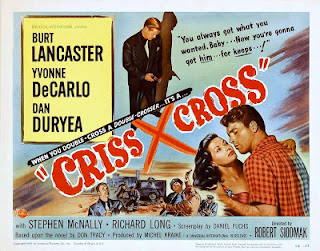
Criss Cross: Who's in the Cross Hairs?


CRISS CROSS (1949)

Directed by Robert Siodmak

Universal Pictures, 88 minutes, Not-rated

★★★


Criss Cross is film noir with a lead that many people forget made such films: Burt Lancaster. It’s easy to fathom why, as in both atmospheric noir and big budget films Lancaster played what we might call a semi-tough guy; that is, one with the brawn to muscle up in bad situations, but reluctant to do so because at heart he’s a doofus.


Lancaster is Steve Thompson, a down-on-his-luck guy who is trying to get over his ex-wife Anna (Yvonne De Carlo) and takes a job driving an armored truck. When Anna comes back into his orbit, that doesn’t do much for his mental health, though it’s physical health that’s in the most-immediate danger. It’s seldom good to dally with an ex-wife, especially when she has remarried, and extra especially if her new husband is a mobster. It’s also not the best of ideas to unwittingly involve family members in harebrained schemes.


 Anna, though, is Steve’s Achille’s heel. His rational brain thinks she’s an unreliable tramp, but he’s obsessed and can’t bear the idea of her being with another man. Things become muddy when he begins to encounter her in a cocktail lounge. One thing leads to another and Anna tells Steve she wants him, not new hubby Slim Dundee (Dan Duryea). That should be the sort of red flag you don’t want to wave in front of a bull, but that would require reason-over-passion thinking. Unluckily for Steve, he’s more bullheaded than an actual bovine.


As the film’s title suggests, this is a saga of double crosses in which it’s never quite certain who is playing who. DeCarlo is a femme fatale, but who’s side is she on? Detective Lt. Pete Ramirez (Stephen McNally) tries to keep Steve on the straight and narrow, but who are you going to believe, a copper or your hormones? Is Anna legit? What about her mobster husband? Is anyone going to get what they want? Can Steve play the part of a hero?


As I remind viewers of film noir from time to time, under the old Hollywood Code criminals were not allowed to prosper. Criss Cross intrigues partly because we are kept on our toes trying to figure out who all of the criminals might be and if any of them can go straight before it’s too late. A caper is involved and if you reckon things won’t go according to plan, you are correct. Again, though, Criss Cross is well enough constructed that we don’t know who gets over and who doesn’t until the last siren.


Lancaster is very good as a man consumed by smoldering rage. He’s like the proverbial trope of the guy with an angel on one shoulder and a demon on the other. Lancaster winds Steve so tightly that we never know if he’s going to throw a punch or simply slam down his drink and walk away. De Carlo’s Hollywood breakthrough came when she played the seductress Salome and, in many respects, she continued to present as a latter-day vamp until she aged out of the role. (Some might recall her as Lily in the campy TV show The Munsters.) In Criss Cross she echoes Salome in that she’s a woman who knows what she wants, even if those around her are uncertain about what that might be. Dan Duryea always makes a good heavy. In this one he is one part weasel and one part sharp-eyed hawk.


Aside from the score by Miklós Rózsa–one of classic Hollywood’s finest composer/arrangers–Criss Cross won’t dazzle you with its production values. Of course, most film noirs are essentially character studies and this one pivots around three superb actors. Each is dipped in cynicism. The thing about a crisscross is that a target forms where the lines intersect. You need to watch to see if anyone ducks a bullet.


Rob Weir


3/30/22

MLB's Blown Circuits


Tomorrow was supposed to be Opening Day of the Major League Baseball (MLB) season, but the impasse between owners and the players’ union (MLBPA)  delayed matters. It’s fashionable to blame owners, but if it’s ever appropriate to call down a curse on both houses, this is it. MLB is badly broken but all that happened is that two fat boys argued over who gets the biggest slice of pie.


I’m not sad the season won’t open on March 31. Baseball makes zero sense any place north of Atlanta until mid-April. I’m in favor of getting rid of gimmicky interleague play—especially now that there will be a designated hitter in the National League—and returning to a 154-game season. Here are some other things that need to be abandoned or altered.


1. No to seven-inning doubleheaders. MLB isn’t Little League.


2. Absolutely no to beginning extra inning games with a runner on second. What next, a homerun derby analogous to hockey’s ridiculous shootout? Or maybe like soccer’s corner kicks, the winner is the team that strikes out the least? Ugh!


3. No to expanded numbers of playoff teams. MLB should not emulate hockey’s every kid gets a gold star except for the intellectually challenged (who get high draft picks). In 1954, the Yankees won 103 games and didn’t even make the World Series (no playoffs then) because Cleveland won 111. That’s the way it should be. There are more teams today, so I’m okay with one playoff round, but it should be between the four teams in each league with the best winning percentage, even if that means a division winner is left out in the cold.


4. Raise player minimum salaries, but rework the arbitration system. It’s no such thing. Players get automatic raises no matter how lousy they’ve played. Wouldn’t you like to be Gary Sanchez and get a raise to $8 million for hitting .204 and being such a horrible backstop that you couldn’t catch a one-legged dog with a trawling net? I'm happy the Yankees shuttled him off to Minnesota.


5. Eliminate service time contracts. If a player stinks, he can be sent to the minors at any time, with the team on the hook only for the money stipulated in the contract. If some young player comes along and takes his job, the team should have the option of releasing the player to any team willing to pick up the remainder of his contract. I’m sick of non-talents clogging up rosters because of guaranteed MLB slots. Eliminating automatic roster spots would do more to help young players than anything the MLBPA proposed.

6. Eliminate the team salary cap and institute a salary floor. The cap is based on the false premise that it helps “small-market” teams. Nonsense! Only billionaires own MLB teams, but too many of them are tightwads. A salary floor would do more to force those teams to be competitive than penalizing large-market teams and putting the money into the pockets of those who don’t improve their teams. MLB practices trickle-down economics, the biggest load of hooey in the history of economic theory.

      The cap is also dumb in the respect that it puts large-city teams at a disadvantage. Has MLB ever heard of cost-of-living? I’m not crying Argentina for overpaid MLB stars, but if someone is going to write you a big check to play baseball, it sure will go a lot further in Kansas City than in New York, LA, or Boston, where a month’s rent would buy you a block of KC or Milwaukee.


7. Reinstitute the old strike zone (breastbone to top of the knees) to reduce walks. It would also get hitters to stop swinging for the fences on pitcher-friendly counts and might actually lead to more balls in play. My goodness, it might even bring back drag bunts, stolen bases, and the hit-and-run.

       Baseball has become really dull–almost as boring as football, where the ball is in play an average of just 11 minutes. (The rest of the time is swaggering quarterbacks barking numbers like little boys playing army, or patting each other on the butt so often that Freudian folklorist Alan Dundes once claimed that football is a closeted homosexual ritual.) For the record, both NFL and MLB games take the same amount of time to play, but MLB actually has about 7 minutes more action.


8. Ban analytics and hire scouts. I stop reading any article that plunges into Rosicrucian-like sabermetrics. These people are fraudulent number-crunchers with no love of sports and have made baseball roughly as interesting as reading actuarial tables. It would be one thing if they produced results, but they don’t. The much-hyped Moneyball followed the Oakland As 2002 season. In the past 20 years, Oakland has missed the playoffs 11 times and hasn’t been to the World Series since 1990, 12 years before sabermetrics hijacked MLB. Analytics cannot predict the vicissitudes of an MLB season (injuries, off years, Covid, trades, poor field conditions, mistakes, etc.). They can’t even assure that teams will be competitive.

       It takes good baseball minds to find and sign talent outside of the draft. The latter is hope and hype over experience; just 32% of drafted players ever make the majors.


9. Subtraction is addition. There are simply too many teams to produce exciting races. That’s to be expected when there are players who should not be in MLB in the first place. Instead of expansion, contraction with a dispersal draft is in order. These things should be done:

·      The Rays should be moved from Tampa to Montreal.

·      Miami should lose its franchise, as should Oakland. Arizona, Cleveland, Detroit, and Pittsburgh should be put on notice to improve their teams and attendance or they too will be slated for contraction. Two 12-team divisions would spotlight much better baseball.


10. Rod Manfred should be fired and the new commissioner should be independent of owners.


11. I’m in favor of one kind of salary cap: an upper limit on star contracts. Twenty-five million per is enough for anyone and would dissuade agent-induced team-jumping. It would also relieve franchises of the bind of needing 22 stiffs to pay for two great players.


12. Ticket prices should be slashed by 20% across the board. It would cost you at least $500 for a seat behind home plate at Yankee Stadium and the average cost for four people to attend one MLB game (with cheap seats factored in) is a whopping $253. It’s way more in Boston, the most expensive place to see a live game. For heaven's sake, this is the age of MLB.com and cable. I’m shocked anyone pays this kind of coin to sit in nosebleed discomfort when they can see a game better in the comfort of their home.

     Play more day games with further reduced ticket prices so the kids come back to baseball. If they don’t, start writing MLB’s epitaph.


Rob Weir


3/28/22

Oscars 2022: Do We Really Care?

Oscars 2022


This is the time of the year in which fellow movie fans ask me what I thought of the Oscars. Answer: I didn’t think about them and wasn’t tempted to watch. I’m only surprised when Oscars go to the right people because Oscars are mostly about Hollywood. Its exalted view of itself notwithstanding, Hollywood simply doesn’t matter anymore unless your idea of a good movie is a trip to the mall to sit in soda-splattered stickiness with a 100-decibel soundtrack pounding in your ears.


Everything I know about the Oscars came from my morning news feed. There is no point in watching hours of gushing over movies we’ve never seen and probably never will. I have no opinion about Best Documentary, Short Film, or Short Subject. Didn’t see any of them. I didn’t even see the animation this year. Were I redoing the Oscars, these awards would go with the clips of the technical awards that are shown as a two-minute highlight reel. Add the Best Original Song to that too. Please! There’s only so much schmaltz the human soul can endure.


I couldn’t care less about Hollywood’s self-proclaimed celebrities cavorting on the red carpet. The men all look like maître-des at cheesy restaurants and the women wear gravity-defying dresses that suggest a busload of Vegas showgirls took a wrong turn. No one wears this stuff in real life, nor could they; it would require a fortune in double-sided tape, wire, and polyester. Not to mention a bail bondsman to cover the public obscenity charges.


I only saw a clip, but does anyone else smell “stunt” regarding the Will Smith slap of Chris Rock? If it’s not a stunt, Chris Rock ought to be talking to lawyers.


Let me skip to the awards people do care about. I’ll start by saying that I thought CODA was a sweet and enjoyable film. Still, it is not the Best Picture. It’s not the joke Rocky was back in 1977 when it defeated Network and Taxi Driver, but there is an analogy. Is Rocky taught in film classes? Of course not! Is Taxi Driver? If not, drop that class, kiddos, because the prof is off the rails. Don’t think for a second that Martin Scorsese’s 2007 Best Director award for The Departed is because it really was his best effort. He won because in retrospect he was jobbed when he didn’t win for Taxi Driver, Raging Bull, or The Last Temptation of Christ. 


This brings me to this year’s outrage. I don’t care who thinks it was too long or off-putting, The Power of the Dog is so superior to any other film that it’s hard to imagine Academy members have a collective brain between them. I do not exaggerate when I say it’s a contender for the best film of the 21st century thus far. Why didn’t it win? Well New Zealand director Jane Campion did, but her film also uncomfortably challenged American mythology about cowboy culture, a phenomenon in which Americans believe though most of it never happened.


Since I’m on my bucking high bronco, how can anyone take the Oscars seriously when a film like The Power of the Dog wins one award and Dune wins five and The Eyes of Tammy Faye wins two? Dune isn’t awful, but it’s not very good either; The Eyes of Tammy Faye is, however, as trashy as its subjects, Jim and Tammy Faye Bakker. I think Jessica Chastain is a decent actress, but to give her a statue for this is like saying “Nice shoes!” to Bozo the Clown.


Now for the flat-out dumb. Dune for cinematography? That’s risible. Visual Effects, sure, but you can take any 30-seconds of The Power of the Dog and it’s more majestic and artistic than all of Dune. All Ari Wegner did in Power of the Dog is make you think New Zealand’s South Island is Montana in 1925. Gaze upon the fading wooden mansion with the hills and mountains of Otago as a backdrop and tell me Dune had better cinematography. I know good therapists. You can be helped.


Let me flame Dune one more time. I thought we were done with overblown Star Wars-like scores. John Williams has apparently passed his histrionic baton to Hans Zimmer. A great score enhances a film by setting moods unobtrusively; if you notice the score, it’s inappropriate. You often only appreciate quality work in retrospect, not because your ears hurt as you watch. Jonny Greenwood should have won for Power of the Dog.


If you’re wondering if anything met with my approval, the answer is yes. Jane Campion absolutely deserved to win, though I still think Best Director and Best Picture should be one award. (Does a Best Picture direct itself?) Tony Kotsur was terrific in CODA and I was delighted he won in what will likely be the role of a lifetime. Carpe diem, Tony! I’m okay with a Visual Effects win for Dune, which is all it should have gotten. Kenneth Branagh was deserving of Best Original Screenplay for Belfast.


The rest? I can’t say much. I’ve not yet seen West Side Story, King Richard, Licorice Pizza, or Drive My Car, which are on my list. Not much of the rest holds any interest. I saw The Lost Daughter and found it creepy in a bad way; Parallel Mothers? Almodóvar is Spanish for Woody Allen.


Rob Weir


March 2022 Reviews: David Franz ELDR Roger Friedman Myles Travitz DLU


David Franz is a Berklee School of Music grad, but he’s a California dude and it’s from there that he makes and produces music. His own material plumbs electric traditions such as blues, blue-eyed soul, desert rock, and psychedelia. “Baby Please” is pleading electric blues: Baby, baby please/Don’t let me miss out on your mystery. Call it the semi-optimistic bookend to “For My Own Health,” which is a growling Bad Boy admission: I’m beginning to think my optimism is a disease. That would be about right for the desperado into whose skin he crawls. “The Unknown” is written as a self-explanatory confessional with a soulful tune faintly reminiscent of the Classic IV’s hit “Spooky.” Franz impressively switches hats. “Nothing Is Meant to Last” has the sonic explorations of an acid rock jam band. Like “Tree Pose,” the vocals are subsumed in the mix, though the latter is hardly for the yoga crowd with its dramatic swoops that intentionally veer toward a retro early 60s film score direction. Franz is an impressive hombre and apparently others agree. Some of the guests on his tracks have connections to acts such as John Mayer, Supertramp, Sting, and Wilco.


Jameson Elder and his wife Hannah Rae are your classic cute couple. As ELDR they’ve released their debut recording My Love Looks Good on You. The title track is typical of their straight-ahead folk approach to the love songs that dominate the collection. It’s a pledge of eternal bonds: One day our bones won’t hold the weight they used to/The lines around our eyes will start to show through/But the words I’ve always spoken will still ring through/My love looks good on you. This is duo music in the truest sense in that they trade lead lines. Rae’s voice is higher than my usual taste, but she balances with Elder’s voice, which has more bottom. Most of the songs spotlight acoustic guitar, but Elder also plays electric, bass, keys, and synth. “Coming Undone” is about how love’s sudden blossom is an undoing if ever there was one. My favorite track, though, is “Safe with You,” for its catchier melody and cadence. At some point their repertoire will need more variety, but this will do just fine for now. ★★★ ½


Roger Street Friedman hangs out in Nashville these days, a place not known for subtlety. It helps, though, if you get Larry Campbell to co-produce an EP like Come What May. Instead of the glitz of the bright lights, Friedman retreated to his home studio to make a homespun record. It’s spare, but not barebones; Friedman accompanies his voice with mandolin, squeeze boxes, harmonium, and acoustic, baritone, and electric guitars, plus he invites some friends to join in. Musicians have tons of on-the-road songs, but Come What May is about love, healing, and coming home. The other original is cut from a different cloth. “Big Truth” is about Big Lies, the ultimate fake news: I see your color rise as you growl and rage/When history chooses sides you’ll go down in flames/You say that 2 plus 2 make 3/When big lies spread like a virus through the air/Big truth cures the disease. You might recognize Teresa Williams and Lucy Kaplansky adding harmonies. He also covers Bruce Hornsby’s “Mandolin Rain” and Shawn Colvin’s “Cry Like an Angel.” Each is quieter than the original. What I really like about Friedman is that he stays within himself. He has a strong voice, but knows when to add power, when to tamp things down, and when a little bit–like the dab of falsetto in his Colvin take–is enough.  ★★★★


I couldn’t help contrast Mother Moon, an EP from North Carolina native Myles Travitz with Friedman’s lighter touch. Travitz used to produce electronic dance music and counts among his musical heroes Mumford & Sons, The Lumineers, Cold Play, and Billy Joel. Those are not necessarily compatible influences. The Billy Joel connection comes when Travitz puts down his guitar and sits down at the piano. You’ll hear his keyboard in “Glow” and again on the title track, on which he also mans an acoustic guitar. I liked Travitz, but I think maybe his heart is still more Cold Play than Mumford & Sons. Travitz has a big voice, but at times it’s too big for the song. “Mockingbird” doesn’t need a Cold Play arena rock voice to carry it, whereas it works really well on “To Happiness,” on which really does rock. More control would give his quieter songs far more impact than belting them out. ★★★


I wanted to love Moch from the Scottish sextet DLÙ (Dawning). Moch lives up to its Gaelic term for a tight weave, but the music is all over the place–in good ways and bad. The heart of the band is fiddler Moilidh NicGriogair and accordion artist Zach Ronan, but the two tracks that most impress come from guest vocalist Joseph McCluskey: “Ràcan” and “Bràighe Loch lall.” These are more traditional and less tarted up with attempts to sound hip. The plucked fiddle strings evocative of a ukulele of “Am Politician” (the name of a pub) give way to accordion, but does a café-style tune need a full drum kit and electric guitar or detract from it? The latter, IMHO. In like fashion, the fiddle and guitars of “Anthem” are like oil and water in that the strings set a misty tone and Aidan Spiers’ wah-wah and Jack Dorrian’s bass pull it in a cacophonous direction. “Donalda’s” is upbeat and fun, but again there is more going on than needed and it makes the tune feel cramped. Don’t get me started on the disco opening of “Blue Reef;” it’s the wrong mood for what is at heart an introspective composition. "Moch" is another that’s bifurcated. It steers us through melancholy seas but plunges us into because-we-can rough waters, then sets us adrift with a pounding beat and sprayed accordion notes before docking with another loud passage that’s on-melody but out-of-synch with the overall composition. There is talent here, but right now DLÙ is too much of a young-folks-mucking-about band. Unplug, hand Spiers an acoustic axe, Gossart a goatskin, and build tunes to last, not hopped up for hipsters. ★★


Rob Weir