5/13/22

The Darkest Game: Weak Title, Smart Book


THE DARKEST GAME (2022)

By Joseph Schneider

Sourcebooks/Poison Pen Press, 354 pages

★★★★


We are told not to judge a book by its cover. Still, were I involved with Joseph Schneider’s Tully Jarsdel mystery, I’d change the title. It’s certainly plenty dark, but so many books with “dark” and “darkness” in the title are paint-by-the-numbers offerings.


There’s little that’s formulaic about The Darkest Game. How many detectives do you know who speak Farsi (and is working on his fifth non-English tongue), dropped out of a history Ph.D. program, has two fathers, and can recognize valuable sculptures at a glance? We find Tully teamed with Oscar Morales in what is certainly the odd couple of detectives. Oscar is Tully’s hardboiled opposite, a heavyset Latino family man whose idea of culture is television. He’s also at ease with cop banter, protocol, grab-and-go cuisine, and mugs of beer. Tully was raised by two professors–his biological father is ill with lung cancer–who have never made peace with his decision to become a homicide detective but schooled him in proper grammar, academic research, wine, film, and upper-middle class values. They only thing they haven’t taught him is the circumstances under which his “Baba,” Professor Darius Jahangir, left Iran after the Islamic revolution of 1979.  


Tully and Oscar investigate the murder of Dean Burken, a museum conservator also in charge of deaccessioning for the prestigious Huntington Library and Museum in Greater Los Angeles. A lot of Burken’s colleagues disliked him, but that doesn’t make them killers. As Jarsdel applies logic and Morales more conventional police legwork, a prime suspect emerges, no thanks to the Huntington staff which seems far more interested in the institution’s reputation than solving Burken’s murder. One small problem: The suspect also becomes a corpse. On Santa Catalina Island, no less, some 22 miles offshore.


Jarsdel and Morales are sent to Catalina to investigate if there is a link between the two murders. They initially treat it as an expense-account vacation because it’s a proverbial longshot that there’s any connection between Burken’s brutal murder and the suspect’s death. Still, some things are weird in Avalon, the town that contains 3,700 of the island’s population of less than 4,100. The local sheriff, Captain Ken Oria, is cloyingly welcoming and he and his assistant Ledbetter, who plays the bad cop role, are intent on blaming everything that goes wrong locally on a weird bunch called the Natty Boys, a mashup of Pirates of the Caribbean, survivalists, libertarians, and a rough-stuff motorcycle gang. Plus, there’s Pruitt, the island’s resident developer/club owner/restaurant proprietor, who strikes Tully as a pompous jerk.  


This may sound like a variant of a standard mystery cast but if anything, Schneider’s plot suffers from being overly complex. Before the two central deaths are resolved and a third occurs, The Darkest Game delves into things such as the whereabouts of a 19th century diary, the disposition of art works, a perplexing map, a real estate plan, detours into California history, half-truths and lies, a Ruger .38, a musket ball, and a show down.


Schneider overlays the action with the sometimes-tense interactions between Jarsdel and Morales, plus Tully’s quest to unravel his Baba’s life in Iran. The latter could have been saved for another book and somehow woven into a plot. Though it adds depth to Tully’s character, it isn’t germane to an ideas-packed narrative and slows a novel that’s already leisurely paced. Some readers might also think that Schneider drops in too many red herring suspects. It’s not a bad idea to jot down some notes to help keep characters straight, but I’d rather read a book open to charges of being too complicated than one that’s as obvious as a hobo at a black-tie dinner. I did work out the murderer, but Schneider led me places I did not expect to visit.


Thanks to #NetGalley and #PoisonedPenPress for an advance copy of this book.


Rob Weir

5/11/22

Going in Style: For a Tired-Brain Night


GOING IN STYLE (2017)

Directed by Zach Braff

Warner Brothers, 96 minutes, PG-13 (language, drug use)

★★★


We were riding out our Netflix subscription–Hint: Dust off your DVD player as you can request any disc you want through your local interlibrary loan system–because we were fed up with its paltry streaming of movies, TV shows, and documentaries we didn’t want to watch. Before we joined the 200,000 + who recently dumped Netflix we picked out a few movies we had vague interest in seeing, including Going in Style.  


It is loaded with elements I generally dislike; it oozes sentimentality, the comedy is as broad as the Mississippi during flood season, and it’s a remake of a pedestrian 1979 film that starred George Burns, Art Carney, and Lee Strasberg. You can add to this that it’s a pastiche of other genres such as buddy films, capers, and corporate revenge fantasies. For all of that, it has a goofy charm that places it in that ambiguous category of “not too bad.”


It works because its principals–Alan Arkin, ­Michael Caine, and Morgan Freeman–are terrific together in ways that make you think they must have had a ball working on such a trifling project. They are so good that they elevate the movie to levels it has no right ascending. Willie (Freeman) moved in with Albert (Arkin) since his divorce many years earlier and Joe (Caine) is about to lose his home to oily banker Chuck Lofton (Josh Pais) who condescendingly explains why he misled Joe about his adjustable-rate mortgage. Our three senior citizens are former factory workers who gather regularly for breakfast and banter reminiscent of that from the 1982 Barry Levinson classic Diner. They’ve got a lot to discuss. Joe is at his bank making a withdrawal when it’s robbed and he sees the tattoo of one of the crooks. He shares that information with FBI agent Hamer (Matt Dillon), but the robbers make a clean getaway.


Then a different type of robbery occurs. The factory from which the three old friends retired has been sold to a foreign firm. It promptly takes over the company’s pension fund and cuts off the workers without a dime. Like that could happen. Oh, wait! When Joe learns that the bankruptcy protection plan has been structured by his own bank, he thinks someone should rob the bloody thing a second time. Why not the three of them? Well, for starters they are old. Secondly, they haven’t the foggiest idea of how to pull off a heist. Enter Joe’s ex-son-in-law Murphy (Peter Serafinowicz) who knows a guy, Jesús (John Ortiz), who will school them for a cut if they are successful and disavow ever knowing them if they are caught. Hey, why not? What’s a lot of jail time for geezers if they fail?


The lads assemble alibis–one of which involves a senile acquaintance played by Christopher Lloyd­–get their gear together, and seek to outwit Agent Hamer. You won’t need much more than an 8th grade education to follow any of the plot, nor a degree in philosophy to debate the film’s magical thinking ethics. You might need a handy barf bag for some of the subplots such as teaching Murphy to be a good father, Albert’s solid to Willie, or a burgeoning romance between Albert and man-hunting grocery clerk Annie (Ann-Margaret). In other words, Going in Style is a feel-good movie that bears as much resemblance to reality as Snow White and the Seven Dwarfs.


The best way to enjoy Going in Style is to watch it on a tired-brain night and just go with it. You could ask questions such as why Murphy bears the same surname as Joe if he’s an ex-son-in-law but if you do, your brain isn’t tired enough. Just call it an escapist film, laugh when it’s funny, roll your eyes when it’s insipid, and put it back in the box when it’s over in an hour and a half. It made me smile, but it didn’t make me rethink canceling my Netflix subscription.


Rob Weir 

5/9/22

The Devil May Dance: The Rat Pack in a Murder Mystery


THE DEVIL MAY DANCE (2022)

By Jake Tapper

Little, Brown and Company, 315 pages.

★★★★


Jake Tapper is a CNN journalist. I’ve never seen him, nor have I read his other books, but he has hardboiled detective fiction down pat. For those uncertain what that means, the genre is gritty, sordid, sprinkled with innuendo and actual sex, and has snappy dialogue heavy on sarcasm and argot. Tapper’s drink is an old fashioned, an approach more akin to that of a Robert Ludlum or a Michael Connelly than many of today’s nuanced crime writers.


The Devil May Dance is also an imagined historical novel involving real people from the 1950s and 1960s, though his central characters Charlie and Margaret Marder are inventions. Charlie, a World War II vet, is a first-term Congressman from Manhattan who gets a rude initiation into the ways in which politics, crime, and celebrity overlap. The novel is set in Hollywood and New York. In what I learned is the sequel to Tapper’s The Hellfire Club, Charlie and Margaret are recruited, or should I say blackmailed, by Attorney General Robert Kennedy into investigating Frank Sinatra. It’s not really a choice; Charlie’s bad-company-keeping father is in jail and his only ticket out is Congressman Marder’s cooperation. So, it’s off to Los Angeles to be a “consultant” for a new Sinatra film, The Manchurian Candidate. Charlie and Margaret are charged with ingratiating themselves to Sinatra with the goal of spying on him and other Rat Pack members such as Dean Martin, Shirley MacLaine, Sammy Davis, Jr. and Peter Lawford, the latter of whom is married to Patricia Kennedy.


The Manchurian Candidate (1962) is hailed as classic and Tapper mines its plot to make parallels to its web of deception. The movie (and the Richard Condon novel upon which it is based) is a quintessential Cold war story of a Korean War vet captured by communists, brainwashed, and used as a spy and potential assassin. Is Bobby Kennedy’s assignment really a matter of national security? Tapper keeps us guessing in a fast-paced tale of murder, double dealing, and sleaze. It’s often hard to detect who is crooked, who is an infiltrator pretending to be a wise guy, who can be trusted, and who is a skilled actor. There is a subplot involving a Harvey Weinstein-like character running a sex trade ring specializing in, shall we say, jail bait. (Tapper was no doubt influenced by Sue Lyon, the 14-year-old lead actress in Lolita and the love interest of 53-year-old James Mason.)


There is a lot going on in The Devil May Dance. There are mobsters such as Sam Giancana and Johnny Rosselli; film director John Frankenheimer; scandal rags; Disneyland; internal struggles between the CIA and J. Edgar Hoover’s FBI; the rise of Scientology; and Fidel Castro. It’s no secret that many of the people in the novel were creeps in real-life–Hoover and L. Ron Hubbard, for instance–or bores (Bob Hope). Nor is a secret that the now-sainted Bobby Kennedy was a real S.O.B. when he was Attorney General. The big question in Tapper’s novel is the which-side-are-you-on role of Sinatra. He could be a brutal and crude man, but is he really what he appears to be in the book, a man wounded by his divorce from Ava Gardner? Hollywood is nicknamed Tinseltown for a reason; in its own way it’s every bit as illusory as Disneyland and just as powerful. As the book blurb puts it, “corruption and ambition form a deadly mix….” In such a milieu, nothing is beneath those holding onto power and privilege–not even stuffing a corpse into a congressman’s trunk. No wonder Bobby Kennedy wonders if it’s safe for his brother, President John F. Kennedy, to stay at Sinatra’s house during a West Coast fundraising trip. (Can even a president turn down an invite from Old Blue Eyes?)


You might that Tapper’s speculation rings entirely true. Conversely, you might find the entire thing a tank of banana oil. Either way, though, if you are a fan of thrillers, The Devil May Care is (if I might) a thrilling read.


Rob Weir  

5/6/22

King Richard: Too Much Richard, not Enough Venus


KING RICHARD (2021)

Directed by Reinaldo Marcus Green

Warner Bros. Pictures, 145 minutes, PG-13 (language, violence, sexual reference)

★★★


Before the slap heard ‘round the world, Will Smith starred in the biopic King Richard. As you no doubt know, he won an Oscar for that performance. It might renew interest in a movie that flopped badly at the box office. Should it? I have mixed feeling about that.


Smith assumed the role of Richard Williams, the father of tennis champions Venus and Serena Williams, played by young actresses Saniyya Sidney and Demi Singleton respectively. The movie only takes us through 14-year-old Venus’ professional debut in 1994 and her second-round loss to Aranxa Sánchez Vicario (Marcela Zacharías), who resorted to dirty tricks to get back into a match she was losing. The subsequent rise of Venus and Serena to the top of tennis world is relegated to a postscript.


The movie has been criticized for being too much about Richard, shortchanging the coaching done by his then-wife Oracene (Aunjanue Ellis), and portraying the skills of his daughters as his own doing. These are valid complaints. King Richard is at its best in capturing the Zeitgeist of the 1980s when race was an obstacle the entire Williams family had to hurdle. In the 1950s, Althea Gibson starred, but she dented rather than knocked down racial barriers and quit competitive tennis for golf. Women’s tennis remained predominantly lily white until the emergence of the Williams sisters.


The tennis establishment was reluctant to accept that two Black kids from the Compton section of Los Angeles drilled and coached by their parents could compete with well-heeled and extensively-trained white kids. A lot of sports films suffer from Hoosiers syndrome, the big buildup in which adversity yields to triumph; King Richard is no exception, though it gets the racism right. We see Richard meet polite rejection–racism with a smile–as he sought professionals to help his daughters receive the same advantages as white girls. We watch Richard try hard to keep himself and his family safe and out of trouble in a neighborhood marked by drugs, gangs, and guns. Rick Macci (Jon Bernthal) took a chance, sponsored their move to Florida and into a new life. You know the rest.


The film skirts or merely mentions a lot of controversy. It shows Richard as obsessed and pigheaded, which most insiders say was so. He also thought he knew better than anyone else. He deserves kudos for making sure his brood–Venus and Serena were his biological daughters but he also helped raise three that Oracene had with her first husband–got to be kids first. I can’t comment on the veracity of those who said he wasn’t the coaching genius he fancied himself or that he wasn’t the shrewd bargainer the film depicts. The film hints that Oracene was more instrumental in the latter.


If Althea Gibson was the Jackie Robinson of tennis for Black women, Venus Williams was its Michael Jordan. Her success made from age 14 on made it cool and possible for other Black girls to bring color to center court. She has won 49 titles to date, though at age 41 and many injuries she is now ranked #407 in a sport in which most tour players are about half her age. With 23 Grand Slam titles, Serena is arguably the greatest female tennis star in history. * (At age 40 she is ranked #224, but she picks her tournaments and thus doesn’t rack up ranking points.)


It's a wonderful story, but merely a middling film. I’ll just come and say that Will Smith gave a good performance, but not one worthy of the Best Actor Oscar he was given. Both Ellis, who was nominated for Best Supporting Actress, and young Sidney were far more deserving of honors than he. In my view, Smith didn’t warrant a nomination let alone the hardware.


At 145 minutes King Richard suffers from being too long. Zach Baylin’s script sheds too much light on Richard and comes close to deifying him. His role was important, but let us not forget that his was reflected glory. Serena is a near afterthought and the inference is that she was several years, not one, younger than Venus. I can’t help but think that a film titled The Williams Sisters with Richard in a supporting role would have been a much stronger film. Credit, though, to cinematographer Robert Elswit for making the tennis look like actual tennis, even if the power of pre-teen Venus was enhanced a bit.


Overall, King Richard is a quintessential 3 of 5 movie, worthwhile but not a classic.


Rob Weir


*FYI, the debate is whether the greatest female tennis champion is Serena or Martina Navratilova. Flip a coin.  

5/4/22

Bewilderment: Too Grim?


BEWILDERMENT (2021)

By Richard Powers

W. W. Norton, 278 pages.

★★


I admire the zeal of Richard Powers and enjoyed immensely his 2019 novel The Overstory, which won the 2019 Pulitzer Prize for fiction. Alas, his newest novel, Bewilderment, is, well, bewildering. It’s not that I don’t agree with Powers that climate change and political chaos are existential threats. As a work of literature, though, the truth an author speaks is no excuse for a lack of nuance and a jejune style.


The storyline involves widower Theo(dore) Bryne and his son Robin, aka/ “Robbie.” Both are adrift after the tragic death of Aly(ssa), the glue who that kept everything together. That took some doing, as Theo is a busy University of Wisconsin astrobiologist looking for life signatures in outer space and Robbie has been diagnosed as autistic. In the book’s most astute passage Theo notes that he has been told that Robbie is “on the spectrum” and muses, “Aren’t we all on the spectrum?”


Good line, but that doesn’t help Robbie whose lashing out and poor impulse control are definitely a handful for his teachers, though they also agree he’s creative and smart. At age 9, though, I doubt he’s smart enough to hold the complex science discussions he has with his father in their camping sojourn to the Great Smokies. I also doubt that a professional educator would pull his special needs kid from school for a week to bond in the boonies. Especially one already on the radar of Child Protectors.


Those science discussions–which occur throughout the book–are among the places where Bewilderment grows ponderous. Far too often potentially genuine father/son emotions give way to mini lectures. Powers knows his stuff, but these make for striking tonal breaks and give the novel the feeling of having been scotch-taped together. This is true also of attempts to give his narrative contemporary relevance via stand-in references. For example, Inga Adler is Greta Thunberg and there are nods to threats from a rightwing president. I can’t imagine whom that could be! Madison has Ted-like talks that are called COG talks; reverse the letters. Theo’s NexGen project is SETI with a fake moustache. Again, pretty ham-handed. If we toss in flights into science fiction–Theo loves the stuff and Robbie likes comic books–the lines between science and speculation blur Powers’ thesis that humankind is on a one-way street to extinction, Bewilderment is thus a very depressing novel. Even if Powers is right–and he may be–what are we to do with all of this? 


More to the point, why bother with subplots? Theo is trying his best but failing to keep up with his research, recover from Aly’s death, or raise a kid with emotional and social adjustment problems. Temporary hope appears from an unlikely source: Martin Currier, a colleague that Theo distrusts because he once held a torch for Aly. Martin is working on an artificial intelligence neurofeedback program that uses a specialized scanner (fMRI). Robbie becomes both a subject and a boy transformed into an activist, artist, and empath. Even some of his wildest autistic dreams appear feasible. The deal is, though, Theo wants Robbie’s identity to be completely anonymous lest he become part of a media circus.


Powers would have it that he who lives by AI dies by AI. AI exposes Robbie’s identity. Let the circus begin in front of Congress and in the dark light of a president who is successful at overturning an election. Two steps forward, four steps back. Everything spirals out of control and the only open question is whether a pandemic, climate change, or civil war will hasten the end. If it’s all over now Baby Blue, does the fate of any individual matter? It answers Theo’s question: “Was the mind of God inclined toward life, or did we Earthlings have no business being here?”


Powers is not the first to write a dystopian novel, nor will he be the last. Most who pen one avoid the sermon, leave readers with a glimmer of hope, or simply write with more elegance. Because Powers does not I must return to an earlier question of my own. What does he want us to do with all of this?


Rob Weir

5/2/22

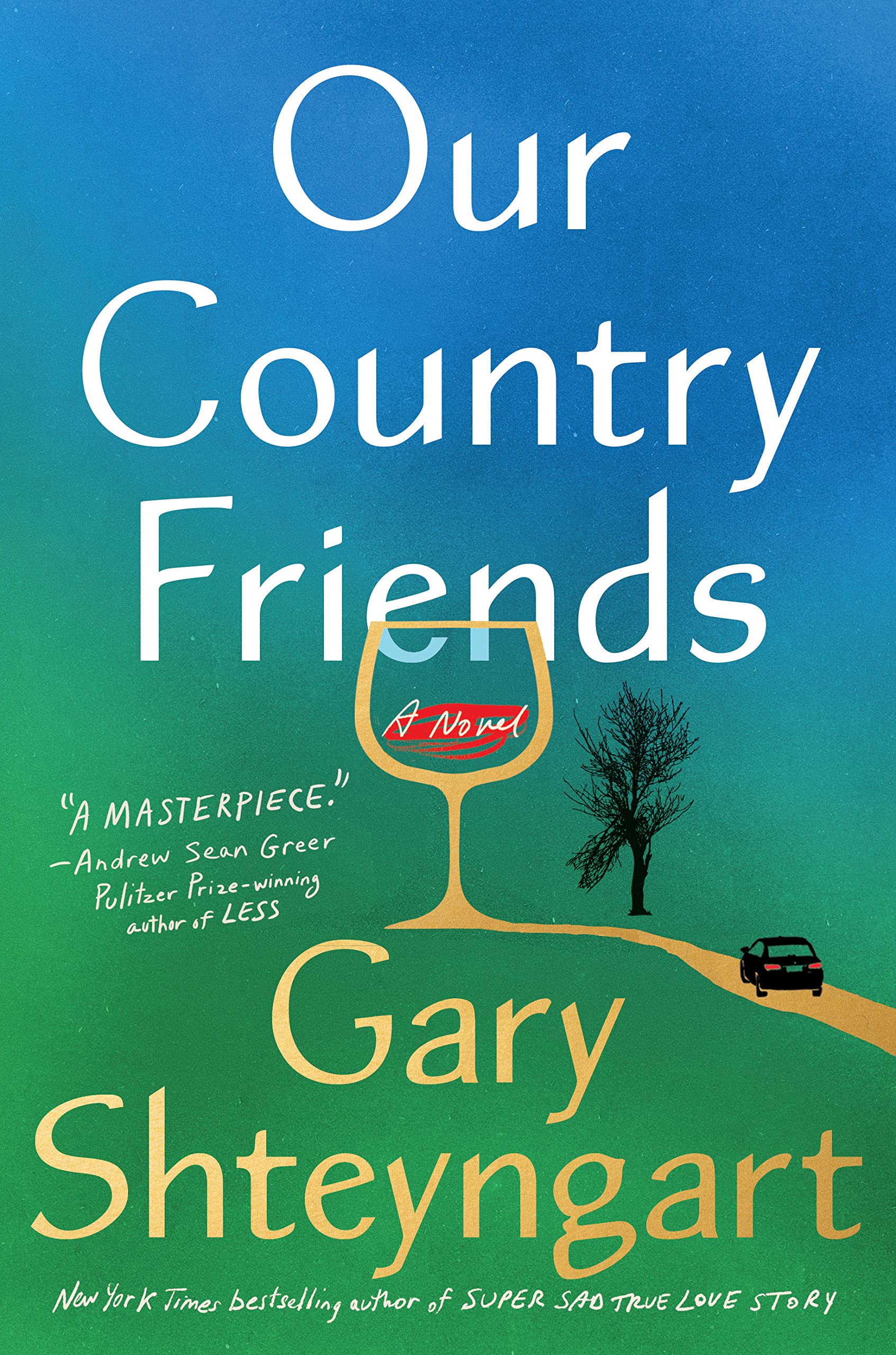
Our Country Friends a Covid Black Comedy


OUR COUNTRY FRIENDS (2021)

By Gary Shteyngart

Random House, 336 pages

★★★


Remember how there was a spate of novels about 9/11 once the shock and mourning faded? (My favorites were by Don DeLillo, Jonathan Safran Foer, and Jess Walter.)  It may or may not be time for a Covid fiction now, but Gary Shteyngart has weighed in with Our Country Friends. It takes us back to the pandemic’s early days when fear was high and precise information was spotty. Shteyngart gets credit for a unique twist on matters–including large doses of black humor–though in my estimation his novel falls short of being a great one or equal to his past efforts such as Lake Success (2018) or Super Sad True Love Story (2010).


Shteyngart was born in the former Soviet Union and perhaps writes a bit of himself into lead character Sasha Senderovsky, a New York City-based script writer in his 50s who is in desperate need of revitalizing his flagging career. His plan is an unusual one; he and his wife Masha, a psychiatrist, and their precocious adopted Chinese daughter Natasha–who wants to be called “Nat”–flee the city when Covid hits and invest in a cluster of cabins in the Catskills with the notion of establishing a retreat for creative people. (I envisioned something along the lines of New Hampshire’s MacDowell Colony.) Sasha’s ulterior motive is to lure an acquaintance identified only as “The Actor” to stay there and convince him to rework one of Sasha’s old (and unsold) scripts into a TV comedy. He also invites his best friend Vinod Mehta, a former professor; social media influencer, essayist, and blonde knockout Dee; aging good-time playboy Ed Kim; and Korean-American app developer Karen Cho, a remote cousin of Ed.


It is typical of Sasha to impose upon those in his inner circle, as he’s at heart an egoist who uses people for his own aggrandizement. Dee is a former acting student of Sasha’s, for instance, and he’s so jealous of a book Vinod wrote that he told his putative “brother” that it was unpublishable. Sasha certainly has no clue about country living or anything as practical as a sensible budget. Locals know to smile when he buys expensive comestibles, gouge him for repairs, and stay off the highway when he’s behind the wheel, if one can dignify his high-speed weaves along county roads with the term driving. Sasha is convinced that he’s a popular guy, but the locals dislike him so much that seemingly threatening things occur.  


Masha is the resident virus-worrier even though everyone insists, “I don’t have it.” “It” is an appropriate term; if you recall, no one was sure was “it” was when it first appeared. As a literary device, though, you can pretty much predict that someone will have “it.” Plus, things go very wrong when Karen dusts off “Tröö Feelings,” allegedly a tool to help people figure out their attractiveness to each other, but which ends up being more of an aphrodisiac than an app. Try maintaining social distancing with that floating around.


Bet on hurt feelings, musical beds, personality clashes, discomforting revelations, and lots of stuff that goes wrong. Our Country Friends plays off various clashes–urban versus rural, immigrant versus native-born, art versus popular culture, and well-heeled snobs versus redneck, white, and blue-collar locals. The creatives and their circle are so out of place that their inherent flaws spin out like drunken tops. Even Nat has issues. She’s sullen, furious with her parents, is obsessed with K-pop, wants Karen to teach her Korean, and might be on the spectrum. Shteyngart overlays his modern morality play with references and parallels to Chekov, especially Uncle Vanya, and to The Decameron, Boccaccio’s 14th century collection of Black Death stories.  


Shteyngart’s novel is often quite funny, though perhaps not everywhere he thinks it is. There are plot devices that, depending upon your proclivities, are either deeply ironic or incredulity-stretching contrivances. I lean toward the second, especially when it comes to Tröö Feelings and a setup involving Steve the Groundhog. I’d call Our Country Friends an entertaining read, but an uneven one. I’ll leave to you to decide if that’s because it’s too soon for a comedy of manners about Covid.


Rob Weir

4/29/22

Go Online to See The Trial of Chicago 7


THE TRIAL OF THE CHICAGO 7 (2020)

Directed by Aaron Sorkin

Netflix, 130 minutes, R (language, drugs, bloodshed)

★★★★★


Like it or not–and I don’t–movies have been decoupled from cinemas. A while back, a friend told me I should see The Trial of the Chicago 7. I paid little heed because it was only available on Netflix Streaming, a platform I didn’t then have. He was right.  


If you doubt what I said about the declining importance of cinemas, consider that the above film made a measly $115,000 at the box office. Given that it cost $35 million to make, Chicago 7 is the biggest bombs in movie history, right? Wrong! It’s near the top of most-watched movies on Netflix. My friend also told me that Sacha Baron Cohen was superb in the film. I couldn’t imagine that, but he was right about that as well.


Chicago 7 is neither a documentary nor a faithful depiction of the days of Rage outside the Chicago Democratic National Convention in August 1968 or the five-month trial of dissidents that took place between September 1969 and February 1970. Anyone wishing to poke holes can do so. The opening montage shows events disconnected in time, the undercover agent tempting Jerry Rubin is fictional, women did not burn bras, the gentle giant Dave Dellinger never slugged anyone, defense attorney William Kunstler was more strident than depicted, Fred Hampton was murdered a month after Bobby Seale’s mistrial, and it was Dellinger, not Tom Hayden, who tried to read the names of Americans who died in Vietnam War during the trial.


The Trial of the Chicago 7 is a “dramatization.” Surprisingly, by taking a few liberties, it communicates a kind of truth better than had it not. It encapsulates the good and bad about this period of American history. On the plus side, it’s a reminder of the youthful energy and idealism of the counterculture, not to mention its courage in confronting injustice, State-sanctioned violence, and the inherent stupidity of the Vietnam War. Yet it also shows the soil being tilled for a brand of American fascism embodied by Nixon and his thugs that ultimately yielded the reactionary social views of Ronald Reagan and the thuggery of Donald Trump and his deplorables who would tear down America rather than embrace multiculturalism.


The story arc stays close to reality. Bands of antiwar protestors descended on Chicago and Mayor Richard Daley, the spiritual father of Trump, ordered his minions to deny rally and camping permits. He also unleashed the Chicago Police–who earned their reputation for being Cossacks–to break heads. That, by the way, was the judgment of former Attorney General Ramsey Clark (Michael Keaton), not some Yippie. Chicago was a bloodbath that didn’t need to happen, but someone had to be blamed. Eight “co-conspirators” went on trial: pacifist Dave Dellinger (John Carroll Lynch); SDS leader Tom Hayden (Eddie Redmayne); peace activists Rennie Davis (Alex Sharp), Lee Weiner, and John Froines; Black Panther Bobby Seale (Yahya Abdul-Mateen II); and Yippies Abbie Hoffman (Cohen) and Jerry Rubin (Jeremy Strong). Seale’s case was decoupled when his angry outbursts led Judge Julius Hoffman (Frank Langella) to order him bound and gagged.


It was a put-up job, as Kunstler (Mark Rylance) continually pointed out as he racked up many of the 175 contempt citations Judge Hoffman handed down. There was no conspiracy. Several of the defendants didn’t even know the others; others passionately disliked each other. The film does a good job of showing divisions within the New Left, especially those between politicos and self-styled revolutionaries. Judge Hoffman was a disgrace who was quietly put out to pasture after the trial; all of the convictions were eventually tossed. If the goal was to preserve the Establishment, the Chicago 7/8 case did more to undermine it than the Yippies could have ever done.


I again remind you that this film is not a faithful account. Defendants Hoffman, Rubin, and Seale were indeed disruptive, Judge Hoffman was worse than we see, assistant prosecutor Richard Schultz (Joseph Gordon-Levitt) wasn’t as innocent as shown, etc. Nonetheless, the film’s sprawling cast was really topnotch. Sacha Baron Cohen was really good as Abbie Hoffman, a complicated mix of the clowning, defiance, and bursts of intelligence and depression. If I tell you that what actually happened was far worse than what is shown in the movie, you can imagine you witnessed Act One of America coming apart at the seams. You wouldn’t be wrong.


Rob Weir


PS: Can we please stop already with anachronistic outro music. The stuff from Celine is utter rubbish!