2/4/12

The Artist is a Cinematic Masterpiece

Everyone will soon know who she is!

THE ARTIST (2011)

Directed by Michael Hazanavicius

La Petite Reine, PG-13, 100 minutes

* * * * *

This film has everything that American movie audiences allegedly hate­–it has no American stars, it’s a foreign film, it’s in black and white, there’s no discernible sex or violence, and to top it off, it’s silent. That’s right--silent. And if you duck it, you’ll miss the best film of last year, this year, and any year in recent memory. I can’t remember the last time the entire movie audience applauded a film, but that’s the precisely what happened when “The End” flashed on the screen at Amherst Cinema.

Writer/director Michael Hazanavicius is French, but he clearly has an abiding love for American silent movies. His main character, George Valentin (Jean Dujardin), is a mash between Rudolph Valentino and Douglas Fairbanks. The setting is 1927, and Valentin is the hottest commodity in Hollywood--a dashing rake who lives in a palatial mansion with his bored wife, Doris (Penelope Ann Miller), a loyal chauffeur, Clifton (James Cromwell), and the costar of most of his swashbuckling features–a dog named Jack (Uggie). Valentin has a big personality and an increasingly big ego–so big that he tells directors like Al Zimmer (John Goodman) whom to cast. This precisely what he does when he literally bumps into Peppy Miller (Bérénice Bejo), a long-legged star struck fan who is so determined to break into film that she auditions for the chorus line in one of Valentin’s films. If you know film history, you know what happens next; in 1929 sound films begin to take over and Hollywood no longer has any use for histrionic actors such as Valentin who mug at the camera but lack the ability to enunciate. They are cast aside just in time for the Great Depression.

In The Artist, Valentin’s decline coincides with Peppy’s meteoric rise to fame. The story–told in the fashion of 1920s comic tragedies­–revolves around Valentin and Peppy and where their circles collide and intersect. The script is equal parts touching, sad, hysterical, and poignant. At its heart is the age-old question of whether fame obliterates the real self, of whether it merely masks the dormant goodness that can rally when the chips are down.

This film is clever on so many levels that one would need to see it several times to catch everything. Film buffs will have a field day picking out homage to films such as The Mask of Zorro, The Sheik, Sunset Boulevard, Busby Berkeley musicals, and dozens of other Hollywood classics. Watch for meaningful crosscuts, background detail, and the use of light and sound. To mention just two small details that might go unnoticed, in one scene a destitute Valentin staggers across a street and the movie marquee in the distance matches his fate. One of my favorite cuts was the strategic use of sepia chrome to show changing tastes; color would be too dramatic to show cultural flux, but a few seconds of brown tinting amidst the gray tones makes the point. And, of course, no silent film was completely silent--it just meant we didn’t hear dialogue spoken. Listen to what Hazanavicius does with music and ambient sound.

There is no dialog to speak of (pun intended), but the cast communicates all that you need to know through sweeping gestures, facial expressions, and in situ action. Dujardin is part Fairbanks, part Peter Sellers as he transitions from prince to sad sack, Goodman exercises his swaggering side to capture the soul of a bombastic director, and Cromwell uses his elastic face to make Clifford a blank slate when he’s withholding judgment, but twists it to convey anger, astonishment, resolve or pity. Bérénice Bejo is simply astounding; you easily believe her climb to the top because every time she’s on the screen you can’t take your eyes off her angular beauty, her soulful eyes, or her winning smile. The only actor that comes close to stealing scenes from her is Uggie, the cutest Jack Russell Terrier on the planet and already a veteran of numerous films (including Water for Elephants).

If you thought you’d never be caught dead at a silent film, please see this one. You’ll think you’ve died and gone to heaven.

2/3/12

Annual Who Cares About the Super Bowl Message!

The New Zealand All Blacks: Real men don't need helmets and pads!

This is my annual who-cares-about the-Supre Bowl message. I especially don't care for an event held in the scab state of Indiana!

When the Super Bowl kicks off, I won’t be among the 100+ million watching the game. Football bores me, an admission that’s tantamount to proclaiming myself a leper in American culture. So be it. But the Super Bowl does conjure a pleasant memory--it reminds me of the last time I saw even part of the Super Bowl: 2001 in New Zealand.

Those were the early weeks of the Bush administration. I should have known then that we were in for some tough times. That year I was coerced into attending a Super Bowl party. At the time I was a Fulbright scholar living in Wellington, New Zealand, and received a formal invitation from the U.S. Embassy to come watch the game. Less formally the local Fulbright office was told it would be a “good idea” for all American scholars to attend. We were supposed to project solidarity before nervous New Zealanders, since the Super Bowl came just weeks after the Supreme Court anointed Bush the victor in the stolen election of 2000. His impending reign was dreaded in Wellington; most Kiwis liked Bill Clinton, and they positively adored Carol Mosley-Braun, his ambassador to New Zealand. New Zealanders had hoped that a Gore victory would mean that Mosley-Braun would stay on in New Zealand.

Super Sunday did not begin well. In a harbinger of what would become Bush’s paranoid style in international affairs, I was accosted by a U.S. Marine for taking pictures of the outside of the embassy. Nine months before 9/11 some genius determined that my photos were a “security risk.” Inside the embassy the mood was one of startling contrasts—officious members of the Bush transition team looking like Stepford diplomats with their painted-on smiles and matching flag lapel pins on one side of the room, and the skeletal remnants of the Clinton staff hanging out with dazed New Zealand staffers on the other.

Someone had gone to a lot of trouble trying to make Super Sunday a “typical” American event, but that proved hilariously hard to pull off in a place 7,100 miles from Los Angeles. There was, for instance, a platter of hotdogs, which became one-bite items that New Zealanders left on their plates. Seconds were politely refused when offered by uniformed waiters, and with good reason. The wieners were what one might get if a bratwurst was crossed with corrugated cardboard. But they were positively scrumptious compared to the “rolls,” rock-hard zeppelins that might have been fresh a week or so earlier. They were also several inches longer and thicker than the hotdogs. The less said about the ketchup and the relish, the better.

Then there was the problem of the game itself. To say that academics are not your typical football crowd is an understatement; if they follow sports at all, most prefer baseball’s cerebral dimensions to football’s brute physicality. I had to ask who was playing and was surprised to learn that one of the teams was the Baltimore Ravens; I knew that the Colts had fled Baltimore, but I had no idea there was now a club named for Edgar Allen Poe’s poetic feathered foil. But I was an expert compared to the local embassy staff. For them, “football” was soccer and the rules of “American gridiron” were as incomprehensible as the intricacies of cricket to Yanks.

Most of the American Fulbrighters gathered outside the TV room chatting about their respective projects, while the flag-lapel Bushies hooted and booed in the wings. The day improved dramatically when we engaged the baffled New Zealanders huddled by the food table. One young diplomat asked me the charmingly phrased question, “Who do you favor in the gridiron match?” When I admitted I had no interest in the outcome and was far more interested in learning about New Zealand life, his face brightened and the verbal floodgates opened. Others joined in and conversation ensued over national idiosyncrasies, film, books, and cultural misunderstandings. The food came under the microscope, with New Zealanders proclaiming the baked beans tasty, the “crisps” (potato chips) too salty, and the hotdogs and coleslaw inedible.

One New Zealander looked furtively over his shoulder and confessed that he and other local staffers also had been ordered to attend the event, and that none had ever before seen American football. Anxiety ran deep over the highhanded attitudes of the incoming American staff. As our chats gravitated toward politics, every one of the Fulbright scholars was asked to explain the Bush-Gore election. (None of us could!) Every now and then a few staffers popped into the adjoining room for appearances’ sake, but the only part of the broadcast that received favorable comment was the halftime extravaganza; Britney Spears was then all the rage in New Zealand as well. I don’t recall who actually won the game, but I do remember an impromptu lesson on the glories of Jonah Lumu and New Zealand rugby, a sport I came to appreciate during my time in Wellington. To this day I follow New Zealand’s national rugby team, the All Blacks, more than the entire of the NFL.

So I’ll be skipping the game on Sunday. I might, however, cook a really lousy hotdog and slap it into a stale bun just for old time’s sake.

2/1/12

Fribble Maker Shakes Down Retirees

Tell Friendly's to stuff their Fribbles up Sun Capital's behind!

Mae Pelissier is 82-years-old. For 28 years she worked for the Friendly Ice Cream Corporation in Northampton, MA, and dragged herself to the store at six a.m. to make sure it was ready for morning customers. Until this month she got a small benefits package for her labors: a pension of $72 a month, a $6,000 life insurance policy, and a little bit of supplemental health insurance. Now it’s gone, as is the fate of 6,000 other former employees.

Friendly’s went into Chapter 11 and didn’t make its way out. It sought a buyer and only one appeared. Its name alone tells you that it isn’t interested in making fribbles: Sun Capital Partners Inc. What companies like Sun do is buy troubled assets, put companies on a short leash, and if that doesn’t work, sell everything that isn’t nailed down, bring in the wreckers, and move the real estate. They pare to the bones costs associated with wages and benefits. One of the first things Sun did with Friendly’s was instruct it to tell its retirees that Sun would not assume the company’s pension plans. So forget the fribbles-–it’s time to shake down Mae Pelissier.

Back in the 19th century companies routinely stiffed workers of their wages, especially in the construction industry. A favored dodge was to defer wages on a construction site, and then declare bankruptcy as the project neared completion. A “new” firm suddenly appeared–often the old one with a new name and a new board of directors. This pseudo white knight bought the bankrupt project (at bargain basement prices), set up shop, and operated with money in its treasury that should have gone for wages. Workers fought like hell to get what were called “mechanics lien laws” passed to curtail this vicious practice. Now, when a firm goes belly up, paying back wages is part of the liquidation process (as any firm taking over the company understands).

Move the clock forward and we see a new dodge centered on pension plans. Spare me all claims that “times change.” Pensions are a classic quid pro quo; workers agree to scale back wage and immediate benefit demands in the name of deferring reward until a later time. It’s simply unconscionable that firms like Sun can cancel these plans so cavalierly. (This, by the way, is also the profile of many of the firms with which Mitt--I’m Way Above the 1%--Romney has been associated.) Let me be clear: no laws are being broken, but the morality of this is on par with selling heroin in the schoolyard.

The United States needs to extend mechanics lien laws to cover pensions. What kind of society or company can strip Mae Pelissier of such a piddling pension? Friendly’s, of course, washed it hands of this. It had no other buyer, it claims. Here’s my retort: If a firm such as Sun won’t honor pensions and no other buyer that will emerges, the government should seize the bankrupt firm, sell all its assets (including property) at a public auction, and all revenues should go into a state-run escrow account that maintains benefits. Continue paying these until the funds run out; if retirees run out before the funds do, government gets to keep them.

We can’t hold out breath waiting for the Millionaire Congress to pass such a law, but we can register our personal protest. Boycott Friendly’s. Do your part not to leave any bones for Sun Capital to pick.

1/30/12

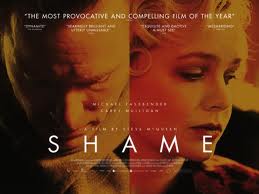
Shame Intrigues, but Does it Resolve?


SHAME (2011)

Directed by Steve McQueen

Fox Searchlight, NC-17 (explicit sex), 101 minutes

***

Starring: Michael Fassbender, Carey Mulligan

Steve McQueen directed Hunger in 2008, a harrowing film about the 1981

Northern Ireland hunger strikes, in which Michael Fassbender very effectively played Bobby Sands. Now McQueen takes a dubious risk portraying a man who is addicted to sex. Take a deep breath - this is not all it might appear to be. Fassbender plays Brandon – an upwardly mobile New Yorker living in a high rise apartment on 28th Street. Brandon's tempestuous private life, which allows him to indulge his sexual addiction, is disrupted when his sister Sissy–played with brilliant intensity by Carey Mulligan–arrives unannounced for an indefinite stay.

Her highlight is her funereal club performance of the song “New York, New York,” witnessed by Brandon and by his boss, who lusts after Sissy. Everyone seems to be addicted. Performances are excellent throughout - including Brandon’s creepy office colleagues imprisoned in their high-rise office in the same way as Brandon is in his apartment. But, for me, Mulligan is the real star. She goes full tile at the dialogue and appears to be as damaged as Brandon and in need of the same emotional support, the difference being that she’s open about it and he isn’t. Addiction is a fascinating topic from so many viewpoints: psychological, neurological, biochemical, sociological, legal, moral.... It’s a good example of the complexity this film seeks to address. At what point does a brain-state become something that removes personal responsibility? Does it ever? After all, we are our brains.

Whether the film successfully tackles any of these issues is problematic, but it does hint at them at several points along the way. However, I suspect McQueen also has a prurient interest in Brandon’s sexual proclivities, even when we are asked to accept them as a critique. Something tells me the line between this and fascinated appeal is crossed many times. In the end, this is a difficult film to love, but it’s one to admire from a technical point of view. New York is a city of blinding lights, shot through with dark blues and greens reflecting the coldness of Brandon’s apartment. Told through a series of flashbacks and anchored in the early 1980’s prior to the worst AIDS/HIV scares, it gives McQueen the freedom to accelerate though Brandon’s wild life. It certainly asks many questions, but whether it resolves much is hard to say.--Lloyd Sellus

1/27/12

The Iron Lady is Made of Lead


The Iron Lady (2011)

Directed by Phylida Lloyd

Film4, 113 mins. PG-13

*

Another bid for an Oscar goes down in flames. It began as a wastepaper fire, but raged out of control because the audience was too bored to notice until the flaming paper-–Abi Morgan’s screenplay–took down everything in its path.

The Iron Lady is, reputedly, a biopic of former British Prime Minister Margaret Thatcher, whose reign of error lasted from 1979 to 1990. Maggie Thatcher was Britain’s Reagan–a pol who gave the country over to bankers and speculators, privatized everything that wasn’t nailed down, smashed labor unions, and called it all “prosperity,” based on the evidence that a small percentage of Brits enjoyed wealth and clout the likes of which hadn’t been seen since the barons and gentry perished in the wake of World War I. She was the longest-serving PM of the 20th century, and won reelections that reflected her popularity for having presided over Britain’s victory in the 1983 Falklands War, which allowed Britain to entertain the fantasy that it was still a mighty empire. In the end, though, that proved as illusory as the second coming of the aristocracy. Brits continue to wrestle with her decisions to cut holes in the social safety net and break up British Telecom, British Airways, British Steel, and British Rail, to say nothing of her 1985 decision to reject integrating the British economy with the rest of the E.U.

Why the history lesson? Because you won’t learn much of this from the film. Thatcher, now 88, is suffering from Alzheimer’s disease, a fate one would wish on no one. This fact led to a curious decision on the part of Morgan and Lloyd: they focus most of the film on the post-2003 period, that year being the one in which Thatcher’s husband Denis died, and in which her own dementia began to spin out of control. Thatcher’s life is told episodically through a series of flashbacks, but the back story is truncated. That’s too bad. Young Thatcher-–actually Margaret Roberts–is played by Alexandra Roach. She is a fresh face and shows Roberts/Thatcher as a principled and fiercely determined young woman. Once Margaret is married and on the rise, Meryl Streep takes over.

I am such a huge Streep fan that I think she is this generation’s Katherine Hepburn, but she is–as the Brits would say–bloody awful in this film. Of course she can do the accent and, yes, there is some impressive acting on her part, which is part of the problem. This is one of those films in which you see the acting rather than losing yourself in the characterization. It’s as if the film should be titled The Iron Lady: Meryl Streep’s Bid for an Oscar. Streep’s attempt to wrench sympathy for the demented Thatcher is pure bathos, and her tirades against her Cabinet ministers are histrionic.

To be fair, she’s dealing with a lame script. Morgan’s screenplay has Margaret spending half the film speaking with Denis (Jim Broadbent) after his demise. Great! Just what we all wanted–Topper Goes to Parliament. The film’s longest sequences have Streep moving through a confused fog; the actual events of Thatcher’s ministry appear as snippets stripped of depth and nuance. Even worse is the film’s dishonest impression management. Thatcher is shown as argumentative, bullying, and obstinate, but small insertions such as a tabloid proclaiming booming stock markets juxtaposed against angry strikers leave the impression that she was ultimately right. Really? Ask the Scots about that; Margaret Thatcher’s 1989 poll tax almost single-handedly insured the success of Scotland’s 1997 devolution vote.

Even worse are the mawkish scenes in which Thatcher is presented as an inspiration for British women. That might be true of the Bloomsbury and fox hunting sets, but good God! I’m happy to debate the wisdom of Thatcher’s economic policies, but viewing her as a feminist icon is too absurd to warrant wasting my breath.

In the interest of full disclosure I should note that each of my three cinema companions loved the film. Who should you trust? Me on this one. Box office receipts have been scant, reviewers have been indifferent, and audience scores are low. It seems that The Iron Lady is made of lead.

1/25/12

I'm Not Pissed Off by Marine Pissing Incident

Aggressive pissing--not nice, but not a war crime.

You can place this one near the top of my “Damned-if-I-Care” list. The Obama administration and the U.S. Marines Corps have expressed shock over a video in which four Marines were shown urinating on the bodies of Taliban combatants. Disciplinary action is probably in the offing as, after all, we must show the world that Americans don’t do mean things. So once again, some kids will be made sacrificial lambs to cover the sins of their elders.

Do I condone urinating on bodies? No. But given what is asked of those sent to Afghanistan, if the worst troops do in such an untenable situation is pee on a few corpses, they’re hardly war criminal material. Isn’t it oh-so-easy to punish those on the ground for geopolitical obstacles that policymakers can’t solve and military leaders are powerless to remove? If these four Marines receive anything stronger than a stern lecture, their unit should demand a transfer stateside.

The hypocrisy of policymakers and military brass is stunning. What did you expect? You train young people to become killing machines, tell them that the enemy represents pure evil, build unit cohesion, then send them off to a place where they watch their comrades killed and brutalized. Then you say, “Remember kids; be nice.” How does that work, exactly? I also can’t condone the torture of living human beings the likes of which we saw at Abu Graibh, but those who were surprised by that are eligible to have their pictures posted in the dictionary beside the entry for naïveté.

As for complaints from the Taliban (in Pakistan, of course!) about American “brutality” and the “desecration” of Muslim bodies, please excuse me while I sneer. Listening to complaints from the Taliban is like listening to a hangman complaining about rope burn. I’ll get upset about Piss-Gate when I hear the Taliban apologize to Daniel Pearl’s widow. I wonder where the Marines got the idea to disrespect corpses? It couldn’t have anything to do with seeing the video of Pearl’s beheading, or of witnessing American bodies being dragged through the streets, could it? It’s hypocrisy even by the Taliban’s debased standards to moan about rules of war that it doesn’t respect.

The very best way to make sure this sort of thing doesn’t happen again is to bring the troops home. Retribution for 9/11 has been exacted, Osama bin Laden is dead, the Taliban is tucked away in Pakistan, and the Karzai government in Kabul is just as sexist and treacherous as the one he replaced. Every day troops remain active in the senseless Afghani conflict increases the odds that some soldiers will act in ways they’d normally find repulsive. It’s time to exit and let Afghanis sort out this Inferno for themselves.

As for me, I really do want people to be nice. So here’s my ecumenical gesture in the name of promoting world peace. If I die a natural death–as opposed to being killed by a religious fanatic–persons from all religious persuasions are invited to piss on me. I only ask that you line up nicely and don’t fight.

1/23/12

The Night Circus Thrills on Every Page


The Night Circus

By Erin Morgenstern

Doubleday, 2011

I began reading Erin Morgenstern’s debut novel The Night Circus in December and even when just half done I thought it the best work of fiction I read in 2011. I finished it in early January, and I’d not be the slightest bit shocked if it ends up being the best novel I read in 2012 as well. This is one of those rare books one is sorry to finish because it means an end to the wonderment.

The central premise is disarmingly simple. Today we live in a world of illusions and of skepticism. We see magicians, but we know they’re not real; there are even TV shows that demonstrate how the tricks are done. We marvel at the technology and at the clever performances that make us not see what is patently obvious once the ruse is revealed, but we don’t believe in magic. Morgenstern takes us to back to Victorian London. It too was a society in which illusionists abounded, but by the time this novel opens in 1886, most thinking people were as deeply skeptical as we are today. The floodgates opened in 1882 when the Society for Psychical Research began to expose mesmerists, mediums, and assorted tricksters as frauds. The bottom fell out of the spooky world cottage industry in 1888, when the Fox sisters, the period’s most famous spiritualists, were exposed as nothing more than carny con artists. Thus, the patrons who attend Le Cirque des Rêves marvel over the amazing illusions they witness, but they assume it to be a fantasy world no more real than the dreams alluded to in the spectacle’s name. But what if they’re wrong? What if they are witnessing bona fide magic and the real illusion is getting audiences to assume it’s chicanery? What if the entire circus was created by the paranormal powers of just a few individuals who were so good that not even the circus’s putative designers, managers, and other performers were entirely aware that most of their “artistry” was accomplished through magic?

If magic is real, what kind of alternative reality can be created? Morgenstern, a 2000 graduate of Smith College, gives her own imagination free rein, and what an imagination it is—gowns that change shape and color, ambrosia-like foods whose ingredients no one can quite pin down, gravity-defying rooms that appear to be made of clouds, ice-curtained fantasy realms without refrigeration, thrilling rides that defy the laws of physics, acrobatic kittens, clocks of greater complexity than a modern computer, actors that seem never to age… And it all unfolds within black and white tents that mysteriously appear overnight, as is appropriate for a circus that commences at sunset and closes at sunrise.

The circus, it seems, is actually the set for an elaborate contest between two ancient master wizards, Prospero and Alexander, which they wage through their proxies, Prospero’s gifted daughter Celia, and Alexander’s chosen ward Marco. The latter are also pawns, unaware of the degree to which they must participate, but increasingly drawn to concerns over the welfare of the circus, the innocents whose lives they control, and to each other. Who are Prospero and Alexander? Greek gods among mortals? Competing demons? Two cranky wizards who’ve been competing for so long that the game has become all-consuming?

Some critics have compared The Night Circus to Harry Potter and the works of Neil Gaiman. I can see the Gaiman connection, but this one is far more adult than Harry Potter. It also bears atmospheric similarities to Terry Gilliam’s The Imginarium of Doctor Parnassus and to Steven Millhauser’s Pulitizer Prize-winning novel Martin Dressler. And life inside the show bears some resemblance to Cirque du Soliel.

Does The Night Circus deserve to be mentioned amidst such august company? I’d concede that there are flaws that betray the author’s youth and inexperience. I wondered why she didn’t set the main action in New York, as she’s clearly American in her sensitivities and her evocation of Victorian London isn’t exactly Dickensian. Some of the characters have great depth, others seem sketchily underdeveloped. I’m sure that serious critics would say that there’s quite a bit of sleight of hand in the novel. You know what? I don’t give a damn. I haven’t been this engaged in a novel in years and I don’t care if the entire thing is as phony as the Fox sisters. I bought into the fantasy cape, cane, and rabbit.