Showing posts with label Album of the Month. Show all posts

11/24/25

Dream of the Middle Ages at Beynac


This might have been my favorite place that I visited. Like many places in the Périgord, it is rich with history but this one not only engages the imagination, it sends it into high gear.


The “et” alerts us that two small villages have been combined into a single administrative unit (commune), that collectively contain but 447 residents. When you are in the region through which the Dordogne River flows, wine, fois gras, truffles, walnuts, cheese, duck, goose, and pork roasted in duck fat are staples. To my taste buds, all but the fois gras (duck liver) are quite tasty.


The other unavoidable reality is that Eleanor of Aquitaine will be mentioned. When you hear that name, you know you are in an area that was contested during the Hundred Years War (1337-1453). Some quick arithmetic will tell you that the struggles between the French and English crowns is misnamed, as it actually took 116 years. Is that because the “116 Year War” doesn’t roll off the tongue. Not exactly. During the period known as feudalism, you can’t think of “France” or “England” as you would like today’s nation-states. Wealth was measured by land and it didn’t need to be contiguous. The Aquitaine region of modern France often saw the English nobles and kings own more land than the French, which was sort of what was behind the Hundred Years War. (A bigger reason was dispute over the rightful heirs to the thrones of each country.) Eleanor factors prominently into this, as she was married to Louis VII, King of France from 1137-1152. Louis had his marriage to Eleanor annulled on the grounds of consanguinity (being too closely related), but she subsequently married Henry II of England. Though she was 11 years older (30) than Henry, she bore eight children between 1152 and 1189, five of them sons. Three, Henry the Young, Richard, and John, were anointed as English kings whilst William and Goffrey became the dukes of  Poitiers and Brittany.  Matilda, Joan, and Eleanor Junior, married into royal families (Saxony, Castille, and Sicily).  


One historian aptly labeled Eleanor’s children a “den of vipers” that allied with or fought against their father depending on how the winds of ambition blew. When Henry died in 1189, Richard became King of England, though he spoke Occitan and Gascon, dialects related to French. He spent less than six months of his ten-year-reign in England and perhaps never spoke a word of English.


What’s this have to do with Beynac? The Beynac line died out in the 12th century and guess who inherited the castle. A gold star if you guessed Eleanor of Aquitaine. She gave the castle to Richard (as the third son he never expected to be king, but his older brothers predeceased him). A lot of what most people think of as medieval times occurred during Richard’s reign. He spent four years of at the Third Crusade (1189-93), battled Saladin, and was seldom out of armor. By the time of his death in 1199, English vassals owned more land in France than the French king, hence his sobriquet Richard the Lionheart. 


Alas for England, when Richard died in 1199, the crown went to Eleanor’s youngest son, John, often considered the worst king in English history for losing much of the land Henry II and Richard gained (including Beynac), and so much control over the English aristocracy that was forced to sign the Magna Carta. He is the only King John of England and a future monarch wouldn’t dare assume his name!


Getting back to Beynac, the château and castle sit high above the Dordogne River, prone to being swallowed by morning fog. It’s relatively empty, as most castles were. Few kings had just one castle. Most shifted royal residences several times a year, moves that entailed moving wall hangings, kitchen utensils, beds, chairs, etc. from one place to another. Only things like feasting tables were left behind because they were too massive to move. Beynac’s sparse furnishings allows you to imagine the dampness, darkness, rush-covered floors, fireplaces whose heat seldom filled a room, austere furnishings, the bustle of the kitchen, courtiers in echoey chambers, and servants and plotters clattering on stone steps. Build your own mental castle!


The village below is the usual assortment of small shops, eateries, services, and stone blocks. The riverfront village is built for ambling. Beynac is also a place where the Dordogne is wide and deep enough for boat sightseeing, the subject of a future travelogue.     


Rob Weir


11/1/24

October 2024 Music: Melanie MacLaren– Lucy Isabel – Abbie Thomas– Disappearing Act– Sicilian Music


October was a really great month for music, so much so I can’t get it all into one column. Let’s start with my Artist of the Month: Melanie MacLaren (above).


Melanie MacLaren might be the long-awaited Gen Z Folk Queen-To-Be. Her Bloodlust EP oozes “emergent talent.”  The eponymous title track has infectious melody hooks, bouncy internal rhymes, impeccable pacing, a voice that cuts through the instrumental mix, and something to say lyrically. Remember “Laika,” the little dog Russia sent to space to the sorrow and fury of millions around the world? Decades later, MacLaren adds her tears and outrage. Her finger-picked, gentle song brings the little pooch back to life in our hearts. “Get it Back” takes up the topic of things that slip away in different ways–moments glanced and lost from a speeding train window, death, grief …. The theme might be dark, but similar to “Laika,” there’s grace in memory. If you wonder if she can sound this good live, check out “Henry Hudson” (which isn’t on this EP). It’s about the man, the river, MacLaren’s family, changes in her New York neighborhood, and her innermost self. Who can’t relate to her linking refrain: Time, time, time/I’ll stay out of your way/If you stay out of mine. Kudos for having the guts to admit her shame of once judging of her grandfather’s trailer park: Thought I was too good for it, but I wasn’t. I am sincere when I say this song made me weep. MacLaren draws comparisons to Gillian Welch, but as much as I hate to saddle anyone with such a high-expectations comparison, how about Joni Mitchell in her wide-eyed youth? I don’t mean it in any copycat way, but, yeah, Melanie McLaren is that good. It would not be hyperbolic to call her voice ethereal. 


Lucy Isabel scores with All the Light. Note the spelling of her name. Although Jared Anderson, the producer of her new LP, has worked with Jason Isbell, Lucy just happens to have a similar-sounding surname. She’s a New Jersey gal now living in Nashville. She works well with bands, but All the Light highlights her inner folk persona. “A Better Life” is typical of the honest, vulnerable, and hopeful songs on the album. It opens with a lovely arpeggio that slides into to a sweet melody that frames a song about a choice: to let go or settle down. “Blind Ambition” speaks truth to dreams, namely the realization embedded in the old adage that the older we get, the less we know–because life and relationships are more complex than we ever imagined. “Miles From Home” shows off some of the album’s polished production; call it bluegrass-inflected folk in a pop wrapper. Nonetheless, a stripped down song like “A Hero’s Welcome” is even more affecting in communicating love’s promises and vicissitudes.


If you want to switch gears, try Abbie Thomas and The Crazy Hearts and Not Gonna Lie. Thomas is a combination of blue-eyed soul, retro country, and big-voice jazz. The title track showcases said big voice in a soulful plea to “hold on” when things seem “impossible.” But she takes no crap. On “Bitch Make the Coffee” she stands up for female workers expected to endure abuse to keep their jobs. Thick bass lines, electric guitar, and jazzy keys set an ominous mood. “Wild & Free” is a nostalgic no-apologies song about growing up and making ends meet, though by implication it could be any family, anywhere, anytime. It has a jazzy feel, though the key structure breaks a few rules. It and each song on the record puts Thomas upfront and lets her riff with the band. She is an indie artist. I suspect that won’t last much longer, but it’s open for discussion how a label will, well, label her.


 The Disappearing Act is a band-not-band of three longtime friends from Texas. Dallas-based Salim Nourallah is perhaps the best known, but Bob Blumenfeld is also a fine songwriter, and John Dufilho has a knack for bringing everything together. For lack of a better term, the three are a cross between folk and 60s bands in their quieter moments. Mainly you get the sound of synergy. Got that? Maybe it’s best to listen. “Why is Everyone So Damn Happy?” is an ironic and upbeat support of being glum: Why is everyone so damn up/Why won’t everybody just shut up…. but I know this will blow away. You might imagine some blood-curdling thrills in a song named Gun Barrel City,” but it’s actually as languidly-paced as a Jim Jarmusch film and just as deeply sardonic. Put a happier melody to this and you’ve got a carefree rejoinder in “Santorini,” and if you’ve ever been there you know exactly what they mean. If you like their vibe, also try “People in the Movies” or “I Feel Like I’m Howard Hughes,” the first evocative of a retro creepy film score and the second that could be from an offbeat early ‘60s TV program.


One reviewer has called Rachel McIntrye Smith the “Loretta Lynn for the TikTok Generation.” Maybe, though her old-style country vibe seems more like a natural inclination than an attempt to channel. I guess her slight twang and a song like “Stoke the Coals” invites such a Lynn comparison. As we hear on “Hold the Ladder,” though she’s more of a songbird than a hard hitter. This also comes through in “Grow Up Slow,” which walks a fine line between saccharine imagery and seizing her own identity. Unlike a lot of Southern wannabes, Smith actually hails from Tennessee, which stamps her EP Honeysuckle Friend with homegrown authenticity.


Finally, something that falls into the categories of folk music for scholars and specialized taste, there is Italy-Sicily, two dozen tracks (save one) collected by ethnomusicologist Sergio Bonanzinga between 1984-2004. A few things for the curious. Sicily, the “ball” kicked by the boot of Italy, has long been a crossroads. Although distinctive styles emerged in the 16th century, Sicilian music shows many influences: mainland Italian, Greek, Arab, Byzantine…. It also features a lot of polyphony which, in simple terms, means individual melodies woven together to harmonize. Here’s your link for the entire album, from drumming to dances to village songs. You might find it useful to use your slider to see what grabs you. If you’re moved to buy a track or so, go to the Website for the French label Ocora and type in Bonanzinga as your finding aid.


Rob Weir


4/17/24

Music for April 2024: Otava Yo, Steve Martin, Robby Hecht, Afro-Semitic Experience and more


I avoided Russian music in protest against the war in Ukraine until I came upon the St. Petersburg-based Otava Yo whose spearhead, Alexey Belkin, also opposes the war; he has a Ukrainian mother and a Latvian wife. Otava Yo has suspended concerts in Russia because of the war, a gutsy move given Putin’s iron hand and a reduced opportunity to shop its new recording Loud and Clear. I don’t speak a word of Russian, but I can tell you it’s one it’s an exciting record. The band is often called a folk rock band because of its emphasis on traditional music. In Belkin’s words, “[in] turbulent times … [when] everything we know literally crumbles before our eyes,” a return to heritage reinvigorates. (They also add modern touches.)


Otava Yo display an array of expected instruments–fiddles, guitar, bass, drums–but also those less familiar: glockenspiel, fife, gusli (a psaltery in the zither family), zhaleika (a type of hornpipe), and volynka (Russian bagpipes). Add the female vocal ensemble Vasilisa and the result is something that sounds like a hybrid of Swedish folk/grunge band Garmarna and the high-octane vocals of Finland’s Värttinä. Try “Don’t You Fly, Nightingale” for robust singing. Though it’s one of the more “subdued” pieces on the album you can see and hear what Belkin means about leaning on tradition during trying times. “This One” gives insight into their goofy sense of humor and how a gusli integrates into a tune. For crashing sounds, lusty voices, bagpipes and psychedelic fiddles, “Good Evening” will get you energized. “Timonia” reminds me of Quebeçois music when the performers decide to go full-scale insouciant. It’s over the top, but in a good way! I love Otava Yo and Loud and Clear is my album of the month.


I vividly recall when Steve Martin did a standup act at my Pennsylvania college before  he was a big star He was so funny that we rolled out thinking, “Who is this guy?” Back then, he had a banjo as comic prop. It’s no longer a secret that he really knows how to play it. If you’ve not gotten the word, listen to him exchange licks with Grammy Award bluegrass banjo artist Alison Brown, mandolin wizard Sam Bush, and Grammy Award fiddler Stuart Duncan. Martin even handles the vocals on “Bluegrass Radio” on a new Compass Records release.


New Haven-based Afro-Semitic Experience began as the meeting of two jazz-infused minds, African-American pianist Warren Byrd and bass player David Chevan, a white Jew. It grew into a movable feast of up to eight musicians in a mixed-race ensemble that ventures into jazz, funk, world music, swing, group singing, and social justice offerings. You’ll hear most of them on My Feet Began to Pray, words attributed to the late Representative John Lewis when he was a young man on the 1965 march from Selma to Montgomery. The band commemorates that episode, all so traumatic back then but now a pivotal moment that justifies the group’s sunny  treatment. Check out Byrd leading the band in “Unity in the Community,” which has a decided Black church feel. Then duck into the synagogue for “Rakhmones Nign,” rakhmones being Yiddish for mercy or empathy. “Moanin’” opens with some scat and sways into bebop-influenced jazz with sizzling horns and swinging keys. Get the picture?


Anandi is the one-name handle for Portland, Oregon-based jazz singer Anandi Gefroh. A Better Way is jazz-based but contains message music, some rock instrumentation, and tinges of pop. Anandi is Sanskrit for bliss and she brings that, her yoga practices, and her devotion to social justice to the fore. The title track, for instance, probes homelessness and poverty. Producer/keyboardist Greg Goebel lays down solid hooks that add drama to Anandi’s simple-yet-profound condemnation of the status quo: There’s got to be a better way. She gives a big-vocal bluesy soul treatment to “Truth, Peace, and Solitude,” a call to balance body, soul, and mind. Other songs are reverential (“Mandela”), reminders that love can be like Kahlil Gibran’s A Tear and a Smile (“Pleasure With the Pain”), and pleading with a scintilla of common sense (“Please Don’t Go to Bed Angry”). She also does a jazz cover of Jim Pepper’s “Witchi Tai To,” widely regarded to as the first Native American hit single back in 1969. You can decide what you think of a non-Native woman covering a peyote ritual chant. 


Robby Hecht
titled his new release Not a Number. It’s the title track as well, his attempt to put faces on the Covid’s human toll. His echoey guitar is designed to haunt and hurt. In numerous ways, the same sentiments are personalized elsewhere. This album deals with other forms of misfortune, disappointment, and struggle: divorce, sadness, recovery…. Hecht’s voice is perfect for conveying poignancy–sweet, but with a hint of pain. Note the content and video visuals of “Someone to Dance With.” He sings: I’m trying as hard as I can/To follow the steps of my well-rehearsed plan/To keep my wingtips on the ground/But up in my head I’m spinning around. The vid ends with dog adoption, but I’m pretty sure that’s not the dance he envisioned whilst acting as the proverbial third wheel. “Old Radio” is surface nostalgia, but its folk-styled wistfulness suggests both memory and yearning. As a transition Hecht offers a mirthful homage to “Tattoos.” That’s not my thing, but if it’s yours it’s show-and-tell time. I’m always a fan of well-crafted songs, though, and Hecht delivers.


If you don’t know the difference between bluegrass and “old-time” music, the first is recently composed and slicker, whereas the second is traditional and more raw. Listen to Molsky’s Mountain Drifters for a clinic in the latter. Bruce Molsky plays banjo, guitar, and fiddler but it’s the last of these in which he’s in the upper crust. Hence,  in his trio work Molsky leaves the banjo and guitar in the capable hands of Allison de Groot and Stash Wyslouch respectively. All of their recordings are wonderful but I recently took advantage of a two-for-one offer to score Closing the Gap and the eponymously titled Molsky’s Mountain Drifters. Theirs is Appalachian music stripped to its basics, yet filled with verve, energy, and expert musicianship. “There’s a Bright Side Somewhere” ought to get you sashaying. If you know the folk standard “Stewball,” “Old Kimball” is closer to its root. “Old Jawbone” is pure infectious hills music and “Cumberland Gap” is a classic Americana tune.  There’s lots more you can find online to whet your appetite.   


Rob Weir

11/20/23

November 2023 Artist of the Month: San Miguel Fraser


San Miguel Fraser

Dots of Light

Culburnie CUL129D


During the 2020 Covid lockdown, musicians were forced off the road. Luckily it couldn’t stop the flow of creative energy. In Valladolid, Spain fiddlers Maria San Miguel and Galen Fraser took part in the “Stay at Home Festival.” It was a key moment in the evolution of the duo San Miguel Fraser. Maria, who is also an accomplished singer, is Castilian, but was schooled as a classical musician and excelled as an adroit interpreter of Galician and Basque music. Galen is a Berklee School of Music grad, but you could say he learned fiddle at his father’s knee. That would be Alasdair Fraser, one of the finest fiddlers on the planet. Somewhere along the line Galen also learned to play excellent cittern. The album Dots of Light is defined by the way in which San Miguel and Fraser use tradition and dance music as a springboard for roots music explorations.


“Dots of Light” opens the album and is, appropriately dedicated to those who acted as rays of hope illuminating the way through the dark moments of the lockdown. That’s Natalie Haas adding cello to a mid-tempo mix somewhat evocative of Scandinavian music. Close your eyes and you can imagine fireflies fliting about, sometimes deliberately and at other moments in interweaving patterns. “Cocido” comes a few tracks later. The CD linear notes inform us that it was one of the first tunes they created as a duo. It has a primal point counterpoint feel with San Miguel taking the lead and playing high notes that border on stridency. Fraser frames it by alternately bowing lower, plucking notes, or using his fiddle percussively. Cocido translates as “boiled” and the tune feels like it bubbled out of them.


Bolero De Algorde” was composed in honor of the walled city of Zamora located in Castile and León region near the border with Portugal. Zamora is bisected by the Duero/Duoro River, a region known its wines in both nations. Miguel showcases her vocal talents with emotive gusto. At times the fiddle exudes a Roma vibe, but with quickened accents that invite you to click your heels. San Miguel showcases vocals exuding emotion and gusto. These days the bolero is associated with Cuban music and love songs, but it actually originated in Spain.


The jota/xota is another Spanish dance in 3/4 time­–sometimes 6/8–and it’s exuberant however its played. San Miguel and Fraser join forces with the Galician duo Caamaño & Amerixeiras. “Jota deGuijar/Xota deRiotortoto” has a very different sound. Galicia is so named for the Gallaeci, Celtic tribes that once occupied northwestern Spain and Portugal. This set invites you to add some quick time hand clap filler as you sway to and fro. Note how the tunes build, settle, and build anew. I’ve also added a link to Miguel and Fraser playing a different set of jotas. Notice Miguel’s precise fingering, perhaps an offshoot of her classical training. Above all, you can see the joyousness of the jota. As much as they concentrate, they can’t help but break out into smiles.


Dots of Light ends with a set perfect for the season: “A Waltz For Winter.” Like the other eight tracks, Miguel and Fraser let the tune determine the pacing rather than simply seeking to dazzle. This one goes from something as quiet as a downy snowfall to a blizzard and back to gentle. In all, Dots of Life is a reason to celebrate life and dance.


Rob Weir


9/29/23

Carrie Newcomer: September 2023 Artist of the Month


From the edges of the prairie comes a beautiful new album from Indiana’s Carrie Newcomer. A Great Wild Mercy officially drops on October 13, but there’s plenty of reason to order now. This is the project about which I spoke with her recently. [Link here] It’s also the strongest salve you can buy without a prescription.


The song “A Great Wild Mercy” is folk rock at its best. It began life as poem from Newcomer’s own collection. It opens with the image of a woman in a rainstorm huddled under a blue umbrella. She abruptly decides to fold it and let the waters wash over her. But the refrain embodies what the song/poem is really about: There’s a big wide sky filled with stars/That feels so close but feels so far/I'm tired of all the rage, tired of all the worry/I'm ready for a great wild mercy… In other words, it’s about letting go of despair, getting back to basics, and embracing our authentic selves. Bell-like backing within an energetic mix are clarion calls to be true to that path. Indigo Girls percussionist Jim Brock is an understated but steady presence in this and numerous other tracks and is emblematic of how the album’s production–with Newcomer and David Weber at the helm–frames the lyrics but never gets in the way. (You might think that’s what all producers do, but you’d be wrong!)


Newcomer’s voice has been described as “rich as Godiva chocolate.” I’m a Cadbury guy, but I get the metaphor. In a world of little girl voices, Newcomer’s mature, smooth, and deeper tones are perfect for coating the world’s woes and whines. Not that Newcomer sugarcoats such things; she’s interested in positive and constructive ways to deal with them and there’s nothing wide-eyed utopian about her approach. A song she wrote with John McCutcheon, “Start With A Stone,” reminds us that nothing worthwhile is born from nothing: Start with a stone/The humblest of things/From this relic of bedrock/Eternity springs. In an indirect but palpable way, this song is a companion to “In the Shape of a Perfect Arc,” which also speaks of how to stay upbeat. It is one of several offerings in which Newcomer’s folk sensibilities are infused with touches of bluegrass. That makes sense as Hawktail musicians such as Jordan Tice (guitar),  Brittany Haas (fiddle), and Paul Kolwert (bass) lend their talents throughout the album.


I’m always a sucker for a lovely waltz, so I give a ringing endorsement to “Questions Before Dark,” which focuses on small, seemingly trivial things that suggest bigger questions. “Another Day,” a lullaby, is one of several songs that spotlight Gary Walters’ gentle and dancing piano notes and it might be my favorite track. Who among us would not yearn for enough inner tranquility to sing: I’ve been looking for beauty/In these broken times/By making some beauty/In the world that I find/ Some say it’s no use/It’s too much to brave/But I believe there’s still/So much worth being saved. (The link is to a homemade demo.)


Newcomer is upfront about those who inspire her, including Thomas Merton on “Take More Time, Cover Less Ground,” and a monk who finds grace and service in silence (“Singing in the Dark”), but the album’s change of pace song–and the only other one with a pre-release video–is “Potluck,” which she co-wrote with Siri Undlin of Humbird. In the simple act of sharing food, Newcomer and Undlin unveil the “quiet mercy” of community and gratitude. And it doesn’t hurt a bit that the arrangement is tightly constructed but casts the illusion of an impromptu jam.


If you want to get a sense of how Newcomer sounds in a rehearsed live setting, “You Can Do the Hard Thing” isn’t on the new album, but it gives a flavor of how Newcomer turns a concert into a living room. It also shows why I’m one of Carrie’s biggest fans. Maybe someday I’ll be as well-adjusted as she!


You can watch more Carrie Newcomer videos here.


Rob Weir


7/21/23

Caroline Cotter: July 2023 Artist of the Month


Why is it that so much summertime music is dominated by rhinestone cowboys, geriatric rockers, and Jimmy Buffett? If you’d rather have something sweet and calm, get your Romneys (“mitts,” get it?) on the new Caroline Cotter release. By the time you read this, her third national release Gently As I Go should be available.


Cotter is a Rhode Island native now dwelling near Acadia National Park in Maine. She is an unabashed folk artist and a road warrior who has performed in 45 states and 14 countries. Cotter has shared stages with Heather Maloney, with whom she shares sensibilities and vocal qualities, though to my ear her soprano tones sound even more like Kate Rusby. Like those two artists, though, she prefers to strip music to its basics: a mellifluous voice and an acoustic guitar.


Gently As I Go is filled with Cotter’s observations on life, love, loss, and connections.

“Don’t Wait” is the first spinoff single and carpe diem is its core message. There are all manner of things–ranging from getting out of bed to embracing true love or making up your mind–that freeze us in place. It sounds simple, but her “don’t wait” message is disarmingly wise.


That song is the only one available to preview as the album doesn’t officially drop until August, but I can attest that the other ten songs are similarly serene.* They also prod her us in parallel ways, but usually with velvet gloves. “Coming Your Way” is at once a road song and an embrace of love wherever it’s found and for as long as it endures: And if this doesn’t last as all things shall pass/I’ll be coming your way. The title track also probes the potential pathos of learning to love without being loved back, but instead of plotting revenge or screaming to the heavens, she sings of closing doors and windows gently as I go. That same sense of grabbing the moment prevails in “The Year of the Wrecking Ball,” a tale of a woman seeking meaning and revelation. The last refrain shifts from “she” to “we” in a cautionary way: We sing hallelujah/sing to the holes in the walls/sing for the light through the broken windows/and the year of the wrecking ball.


The lyrics of the “The Call” are somewhat cryptic, but it was written for her grandfather who died at 104, so we can assume that he did more than his share of sucking the marrow from the bone of life. In “Morning Mantra,” the album’s concluding song, Cotter suggests we open each new day with gratitude and walk the path of the good and strong. Perhaps that’s easier said than done on some mornings, but it’s not a bad goal.


I won’t tell you that Gently As I Go is a perfect album. The only real change of pace is her giddy and delightfully silly “Do You Love Me?” with its litany of promises you know will be broken. She sometimes sings Dylan covers in concert, which we don’t need on an album of her songs, but I suspect she performs them for exactly such mood-changing moments. I’d also recommend that, as convenient as MP3s are, you get an LP or CD of Gently as the narrow sound band of MP3 recordings make her articulation difficult to decipher in spots. (At the very least, download a lyrics sheet.) But I will say this; Caroline Cotter will soothe you like a breeze rustling through a shade tree.


Rob Weir


 *There are also videos of past material on YouTube.


3/24/23

March 2023 Music: Mark Erelli, Karan Casey, Iberi Choir, Duplex, VRi, Cucchi , ARAR


Mark Erelli
named his newest record Lay Your Darkness Down and he wasn’t just dealing in metaphors; he’s been diagnosed with retinitis pigmentosa. He’s already legally blind in that he has lost his night vision and his overall prognosis prognosis is uncertain. That’s quite a blow, but Erelli has opted for optimism and clarity: Lay your darkness down/… Show us where the light is shining through. Though he came through then folk music ranks, Erelli has long been a hard act to classify. “The Man I Am” is bluesy and, though acoustic, dipped in Motown sprinkles. “Is It Enough” has some of the same flair, but is more blues/folk rock in construction. My favorite track is “Sense of Wonder,” which is summed by the line: If you ever lose you sense of wonder/Honey it will be too soon. It’s a paean to nature, but Erelli’s vocal style evokes Bob Dylan in stress and cadence. By contrast, “Up Against the Night,” whether acoustic or with a full band, is a driving rocker that would be at home on a Springsteen album. He rocks out some more on “Love Wins in the Long Run,” but “You” is quiet and tender. It’s impressive that Erelli has maintained his equanimity in the wake of what most would say is a tough break but, as he reminds us on “You’re GonnaWanna Remember This,” we all try to hang on to memories and glory because: it happened once and it might not happen again. The quality of the record alone impresses but coupled with courage, Lay Your Darkness Down makes Mark Erelli my March artist of the month.


Erelli will perform a 3 pm concert at the Parlor Room in Northampton, MA on March 25.


Karan Casey
has released her first solo record since 2018. If you can believe it, the former Solas lead vocalist is now 54, and Nine Apples of Gold continues her shift toward a diversified approach that often strays beyond a purely Celtic repertoire. The Irish press has made much of Sinéad O’Connor influences and you can certainly pick up flashes of mutually defiant feminism in Casey’s “I Live in a Country” that plumbs some of Ireland’s bleak past: We are the daughters of the witches you could not burn for centuries /We are the daughters of the Magdalene laundries when you had us down upon our knees. That’s Pauline Scanlan assisting on the track. Casey asserts sisterhood on other tracks such as “Daughter Dear,” upon which Ríoghnach Connolly guests. Though it’s a mother/daughter song, melancholy piano and Casey’s emotive vocals give it a mythic feel, which is a good time to mention the album’s title track Like many during Covid lockdown Casey took time to reconnect with nature and listen to bird songs. This took her back to an ancient Irish tale of Tonn Clíodhna, a goddess of love, who escaped her pursuers by turning herself into a wren. She is also associated with birds with magical apples that heal illnesses. Though it’s a new song, “The Rocks of Bawn” is the most traditional-sounding song on the record. It’s an accompanied track, but I’ve attached an a cappella performance that highlights Casey’s vocal prowess. My personal preference is for songs such as this, but I begrudge neither Casey’s powerful politics nor her more contemporary musical explorations.


And now for a change of pace. The Iberi Choir hails from the mountainous eastern region of the nation of Georgia, Iberi being the ancient Roman and Greek name for it. It is a place where polyphonic (many voices) choral singing is a hallowed tradition–so hallowed that a former professional rugby player leads the choir. Their latest album Supra features feast songs, lullabies, work music, and ballads. At first hearing it might remind you of Gregorian chant, though there’s more dissonance and overlapping melody in Georgian music. Here are three songs to sample. “Shen Khar Venakhi” is a gentle song evocative of a lullaby, though the title translates as “The Vineyard.” “Kutaisi Mraralzhamieri” is more spirited and you’ll hear a booming dissonant voice. It’s similar to the strong call out voice you’ll hear in “Arkhalalo”


Duplex is the Belgian duo of Didier Laloy (accordion) and Damien Chierici (violin), who ably assisted by guest artists on Malestrom. The title track literally builds a storm. Some gentle keys lead into rolling violin and resounding percussion brings the piece into full force, the melody unfolding within a mix that is slightly cacophonous in places. They head out to Western Canada for “Wapta Falls” with a drum machine and create a piece that sounds more like the Russian steppes than the Rockies or the prairie. “Magic House” opens like a gentle rain shower but weaves in other sounds that take us on a sonic journey. There are 14 tracks in all, which I found fitting for either quiet contemplation or pleasant background music whilst puttering about. Though Duplex might be considered New Age music, I found it more experimental and less structured. Maelstrom really grew on me.


VRï
might look like a hook developed by some hipster-wannabe marketer, but it’s legit. It’s an old Welsh word that means lifting or levitating. As anyone who has been to Wales knows, the only way to escape Methodism is to board a ferry for Ireland. The trio VRï (Patrick Rimes, Aneirin Jones, Jordan Williams) does the next best thing by taking the chapel tradition in new directions, in their case a mix of chamber and folk music. “Y Gaseg Feln,” for instance sounds as if it could be a slow sea chantey. “Glan Meddwdod Mwyn” has lovely fiddling that falls somewhere between classical and a slow Celtic air. And it’s hard not to admire the vocal purity and dexterity of “Brithi I’r Buarth.” Their newest album Islais a A Genir is a welcome change from bands playing to formulae..


It would be inaccurate to call Flavio Cucchi an Italian guitarist. He’s been thrilling festival and concert audiences around the globe for so long he has become an international virtuoso, a master of classical guitar, folk, and avantgarde offerings. The very name of his latest project, Flavio Cucchi Plays Dances, says it all. Want a slow sensual Cuban habanera? “Habanera para Maria” will fit the bill. How about a tango? “Tango da Balera” showcases his amazing fingering. Once you watch this live clip you don’t need me to tell you that man knows his way around, up, and down the fretboard.


Let’s stay on the quiet side. ARAR is the Barcelona-based duo of Marina Tomás Amado (voice/guitar) and Maria Cruz Millet (sax/piano/voice). Their self-titled album is explores topics such as creativity, youth, love, and the glories of the Catalonian language and culture. Some of it is as languorous as a lazy Sunday morning. The translation of a line from “Simulacres” is suggestive of their worldview: Tell me what we should do/So the sky does not fall on us. Gamma Velorum” references a star cluster with two binary systems that consist of one visible and one invisible star. The five-beat instrumental “Eclipsi Lunar” has a jazzier feel. There’s even a song (“Cucut”) in which voices emulate a cuckoo.


Rob Weir

12/14/22

Give Music as a Gift: Jamie McDell Artist of the Month and Others


Still searching for holiday ideas? Give the gift of music. Here are some artists to consider. 


“World-famous in New Zealand” was a joke punchline when I lived there in 2001. Back then the music scene consisted largely of bad cover bands and acts no one would ever wish to cover. Things have gotten better since then. Jamie McDell, my December Artist of the Month, is a case in point. She’s an Auckland native who has also lived in Nashville, Toronto, and Vancouver. McDell comes by her peripatetic lifestyle courtesy of her father, who quit his job when Jamie was 7 to move his family of four onto a boat for a year. Jamie got her sea legs by learning to play the songs of John Denver, James Taylor, and Jimmy Buffett, and obtained stardom of a sort when the record she made at 16 went gold. Ahh, but there’s the rub; in New Zealand gold means selling 2,500 units; in the USA you need half a million. That’s why so many from abroad trek to Nashville, which is where the self-titled Jamie McDell was made.

            Nashville’s potential pitfall is that it likes to pigeonhole. As you can hear, McDell can do country but she carries an alt.country label because: (a) Folk music isn’t a popular label, and (b) McDell’s country is somewhere between traditional and outlaw. Suits me just fine; she’s a wonderful storyteller and, once you listen to “Botox” and hear that catch in her voice you know that she’s a singer, not an all-flash-no-substance "performer." Call this one and “Boy Into a Man” later on the album feminism without the sermon. Why botox? Because the song is about the ways in which socially constructed masculinity is built upon forced images of femininity. As a sampled line puts it, ask the doctor to make me shorter/so you can get your manhood back. This record is filled with gems, including the semi-autobiographical “Sailor” (the studio version includes the McCray Sisters) and the power she draws from the open sea. On “Mother’s Daughter,” though she confesses that mom, not her wanderlust father, shaped her more. It's a weepie, but a good one. McDell isn’t afraid to tell tales on herself, as she does on “Not Ready Yet” and the dangers of running wild in “Limousine Running.” Let that one run as next up is amazing. McDell sits back-to-back with Robert Ellis to sing and harmonize on “Worst Crime.” What was her transgression? Listen.  


Picot is a Barcelona-based band built around the duo of Jordi Marfà (voice, mandolin, violin) and Daniel Pitarc (keyboards). Their debut record Les alles del cavall, which I’m told translates The Horse’s Wings. It’s Catalan, though, so I’m trusting my computer translation software on this. Don’t call it Spanish; Catalan has similarities in that it’s a Romance language, but it immediately derives from Vulgar (“popular”) Latin and probably began life as proto-Celtic. That helps explain why Catalan music often has a Celtic flair. “La casa que vull (The House I Want)” is an example of the Catalonia’s mixed roots. It sounds simultaneously African–as does a lot of Mediterranean music–but the plucked mando notes and swooping violin passages evoke pan-Celtic structures.

            Two other tracks to investigate are “T’he engendrat amb dolor (I Begot Your Pain)” which is as atmospheric as the video clip. Marfà’s voice is big and dramatic but the instrumentation is airy and light, almost nouveau Renaissance. It frames a song that borrows snippets of poetry (in Catalan) from everyone from Whitman to Jean Cocteau. “Tan Petita (So Small)” is another intriguing piece in that its African notes are more Caribbean than Sub-Saharan.  


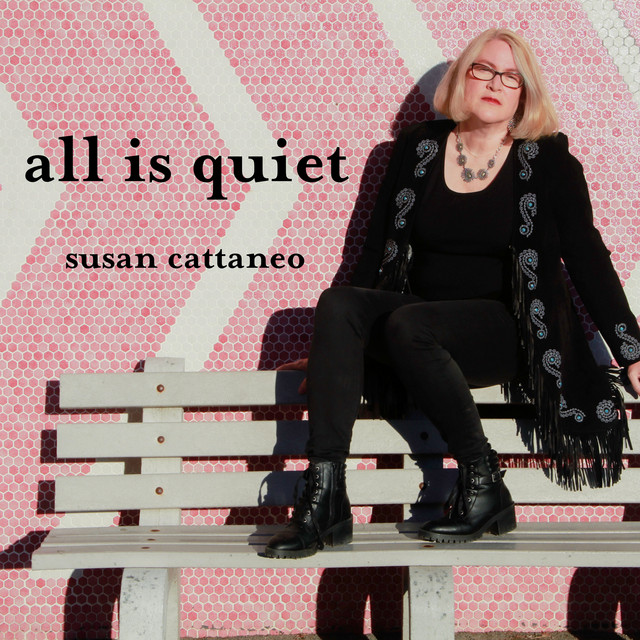
Susan Cattaneo has long been a mainstay of the Boston music scene. Don’t let her respectable demeanor fool you; she has a serious set of pipes and can sing about pain with the best of them. The title track of All is Quiet testifies to this. She sits serenely on the stage and rips off a line like idle hands make idle worries and when she soars on the all is quiet refrain, we’re talking upper part of the sky. Cattaneo gives us dark things, but also delivers the message to “Hold Onto Hope” and echoes an old Lui Collins line that the only way out is through. “Borrowed Blue” is a tender song about the bond between daughters and mothers. Again, though, Cattaneo has been around the block enough times to know there are also situations in which, as a song title puts it, there are “No Hearts Here.” Cattaneo is the kind of singer I really like, one who puts the song upfront in a voice that mixes pretty ornaments with burnished maturity that resonates around the edges. Hey, even songbirds have to land.       


Warden and Co. is a Saratoga Springs-based trio that began life making kids music and still dabble in it, but has evolved into a folk-rock band. If there is an upside to the COVID crisis, it is that most musicians spent more time at home and seized the day to write and create. Frontman Seth Warden, who is also a middle school teacher, wrote enough material for Somewhere and a future release. On the album version of “Somewhere” Warden shares the mic with his 13-year-old daughter, Lovella. The song is about a dad’s hope on one level, but it’s also about connecting with one’s roots. Doug Moody’s fiddle enhances the sweetness of Warden’s smooth vocal. Lovella’s pretty good, actually, but if you want something with more grit try “Middle of Madness,” which has a splash of Tom Petty, especially in its questioning of all the competing claims of “truth.” It also gives percussionist Brian Melick a workout. But it’s hard to argue with the self-explanatory pop-laced “Living for Love.” I like these guys a lot, though objectively its top-heavy mid-tempos offerings invoke a sameness, so some might wish to track shop.


How about some world music? Kadaily Kouyate is a Senegalese-born kora player who now lives in London. If, like me, a six-string guitar is perplexing enough for you, try 21. The kora is a demanding instrument but, in the hands of a master such as Kouyate it sounds a bit like a hammer dulcimer and is capable of virtuoso pieces as well as those of great delicacy. In the second category place “Janjon Ba,” Kouyate’s tribute to a 13th century warrior. It’s done with such gentleness that it evokes a seasonal tune more than anything military. “Diyanamo” opens with sprays of notes and eventually has the precision and feel of something classical. “Kontandiro” has slightly darker tones but is also a meditative journey. Kouyate is often known for his social message songs but this album, Aado, features Kouyate’s instrumental fingering rather than direct politics, even if the title does translate as social customs.


Doriana Spurrell hails from North Carolina. Her EP Forward opens with a goodbye song, “Don’t Wake Me.” It’s unusual to lead with an “I’m outta here” song, but one gets the sense that Spurrell would rather be in the moment instead of fantasy land. “Until I Die” is another enigmatic song that suggests she’s after a vibe somewhere between torch singing, the blues, and attitude. What do you do with lines such as: To tune out so many floating bodies, like seas of plastic strangling all my hobbies/I won’t bleed for them, I won’t bleed for them. She specializes in missed connections songs; “Never Needed Words,” which is about her late grandfather, is another example. Depending on your POV, she’s either being honest about how life can overwhelm or she’s still trying to figure out how to find the path forward. She has an interesting voice, though she should lay off comparisons to Nick Drake or Brandi Carlile until her voice ripens and her pencil sharpens.      


If you are a fan of swirly wall-to-wall sound, try HeyDreamer, a three- (sometimes four-) piece rock band from Atlanta anchored by lead singer and electric guitar slayer Melody Kiser. “Untamed” is poppy and danceable, “Feel the Fire” has heart-thumping bass lines, and “As Cities Burn” is spacey and echoey. The latter, though, is filled with studio tricks that don’t serve much purpose. Overall, the record strikes me as over-produced. When things quiet down for a song like “Choose Me,” they also thin out. It gives me pause, but that’s not saying you will react the same way.   


Rob Weir