7/1/11

Movies to See and Flee While Avoiding the Mall

They don'e make 'em like this any more, but they should!

A Few to Queue

So it happened just like this. A group of us thought we’d catch a film last weekend and, on impulse, we swung into the mall to see what was playing. (Apparently it’s too much bother to list films on the roadside marquee.) What were our choices? Let’s see…a Pirates of the Caribbean sequel, King Fu Panda II, an X-Men prequel, Hangover II, and another damn film about another damn wedding that I’m sure is as insipid as every other damn film about every other damn wedding. We just recently learned that the term “blockbuster” comes from a Latin term that means, “You’re too old and have too many brain cells to like this crap.” We ducked the brainbuster blockbusters and retired to a friend’s house and downloaded a few classics. Allow us to recommend a few recently viewed old and recent films that are far preferable alternatives to this summer’s mall fare.

First among them is the film we viewed that night, All About Eve, the 1950 masterpiece directed by Joseph Mankiewicz. We hadn’t viewed this in many years and had forgotten what a tour de force it was. It won six Oscars back in 1951, including Best Picture, Best Director, and Best Screenplay and it deserved them all. An aging actress (Bette Davis) attracts a starstruck devotee (Anne Baxter) who wants only to serve her idol. Sound too good to be true? You bet! As Davis remarked in the film’s most quoted line, “Fasten your seatbelts it’s going to be a bumpy night.” And reserve your judgment until near the end before you cast your vote for the film’s creepiest character. When the film was over a friend remarked, “There sure don’t make films like that any more.” More’s the pity.

If you fancy an old-fashioned mystery thriller, there’s a new video print of Les Diaboliques has just been released. Rent the 1955 original directed by Henri-George Clouzot, not the 1996 remake. You’ll get a lesson in 1950s style sexism, a portrait of dire post-World War II France, and a Hitchcock-like thriller that builds to a dastardly end. The headmaster of a rundown boarding school bullies and abuses his teacher wife (Vera Clouzot) at the same time he’s having an equally vituperative affair with another teacher (the icy Simone Signoret). The two women await an opportune moment and murder the headmaster. But where’s the body?

Another fine French film to rent is Man on the Train (2002), directed by Patrice Leconte. It’s essentially a duet between a loquacious, aging bachelor teacher (Jean Rochefort) and a virile young thug (pop star Johnny Halladay) who barely utters a word. They are thrown together by circumstance, but Leconte has far more in mind than making a silly caper film. How often have we looked at another’s life and fantasized what it would be like? Leconte gives this a bittersweet twist, with the teacher musing over a life of crime, while the thief longs to wear carpet slippers, smoke a pipe, and tutor bored boys. Can this end well? Watch and find out.

Nobody does sleazy politics quite as well as the Brits. We recently viewed a three-part British drama titled The Politician’s Wife, which aired on the BBC in 1995. The setting is conservative-led Britain just after the Margaret Thatcher/John Major era. The party is hanging onto power but there’s a power void that high flier Duncan Matlock (Trevor Eve) is poised to fill. He’s slick, but an egotistical sleaze ball of the worst kind. See what happens when Duncan, the minister for the family, is caught in an affair and seeks to enlist his wronged wife Flora (the delightful Juliet Stevenson of Truly, Madly Deeply fame) in an elaborate damage control scheme. This film is like watching a fast-moving chess match in which the black king and the white queen seek to avoid checkmate. Loved it!

Three to Avoid

We also viewed three films you should dump from your queue. Lloyd Sellus warned in a review on this blog that Fish Tank (2009) was a disappointment. We second that view. What could have/should have been a penetrating look at lower-class life in soulless British Council flats á la Mike Leigh is, in the hands of director Andrea Arnold, merely meandering angst. It’s at once a depressing film, but also an unaffecting one because everything in it seems forced.

The late Peter Sellers once said that he had no personality outside of the characters he inhabited. Despite wealth and fame he led a very sad life. Someone needs to make a good movie about a man who came alive only on the screen. Alas, The Life and Death of Peter Sellers (2004) is not that film. Geoffrey Rush plays Sellers and gets the look right, but he delivers a wooden performance that is more caricature than character. At least he’s better than John Lithgow, whose preening portrayal of Blake Edwards is an embarrassment. This film reeks of a low budget, slap-it-together-print-it ethos. Not even Inspector Clouseau could stumble upon life in this turkey.

We had heard that Despicable Me (2010) was a charming animated delight. Not! The send-up of Bill Gates (Vector) was mildly amusing, but the film is only interesting when its central character, Dr. Gru, is…well… despicable. Alas, once he adopts two orphan girls for a nefarious scheme we can see from miles away where the film is heading because we’ve seen it all before. This movie is so family values wholesome that we expected to see a Focus on the Family endorsement at the end. Give us nasty or give us a break!

6/28/11

David Mallett, a Pro Under Pressure


David Mallett in Concert

Porter-Phelps-Huntington Museum

Hadley, MA June 15, 2011

If there was every any doubts that David Mallett is the consummate professional, he laid them aside at his outdoor performance in the sunken garden of the Porter-Phelps-Huntington Museum on June 15. Mallett has dazzled with fourteen albums since 1978 and ranks among my favorite songwriters of all time. His peers agree; Mallett’s compositions have been covered by the likes of John Denver, Emmylou Harris, Arlo Guthrie, Alison Krauss, and Kermit the Frog. That’s right, Kermit the Frog. Is there anyone who does not know “The Garden Song,” the one covered by Kermit? (“Inch by inch/Row by row/Gonna make this garden grow…”)

All of this is to say that the man could rest of his laurels if he wanted to. Instead he showed up in Hadley and out-sang a thunderstorm. To say that conditions were less than ideal would be an understatement. He and bass player Michael Burd stepped out onto the lawn amidst abundant sunshine, but made it only to the end of the third song, “My Old Man,” Mallett’s tribute to his father, when a crack of thunder hit, a spooked sound man pulled the plug, and the (first) rains came. The concert should have been moved indoors at that point, but the museum staff mistook the rain as an aberration (none was forecast) and after a ten-minute rain delay, Mallett shrugged his shoulders, walked up to the mic, and launched into the next song. He and Burd made it through 70 minutes of intermittent showers; whenever the drops fell, two guys with golf umbrellas stood behind them and Mallett soldiered on. Well, he did a bit more than that. Being a sly old dog with a big repertoire, he dragged out backlist material with rain references, the only hint of irony being the occasional nod and a twinkle in his eye.

Mallett has long been hailed for his evocations of nature, small-town life, and ordinary folks doing the best they know how. He brushed the water off classics such as “Midnight on the Water,” “Summer of My Dreams,” “Moon Upon the Left,” and--a personal favorite--“Phil Brown,” maybe the best song ever about an unorthodox mentor. He also featured songs from his fine new recording, Alright Now. At age 60, Mallett is more than alright. He’s lost a smidgen of range, but he retains his smooth delivery and buttery tones and continues to pick a mean guitar and lay down solid backing on harmonica. Mallett saved his soggy best for last. About the time the evening was coming to an end, the skies turned dark, lightening flashed in the distance, and the rumbling grew louder. So what did Mallett do? He finished off with “Fire,” the autobiographical song--and clinic for aspiring lyricists, I might add--of the thunder storm that burned down the family homestead in Maine. He sang each reference--swaying willows, cracks of thunder, the imperiled barn, and the hopelessness of mortals amidst nature’s fury--as if he was choreographing the storm with the song. He bowed, ducked under a tree and, on cue, big fat raindrops pelted the grounds. Most folks rushed for their cars, but I figured it was the least I could do to get a bit wetter and tell David what a pro he had been. He just smiled and retorted, “Yeah, I guess you’re a professional if nobody gets electrocuted during a show.” Great line, but we both know there’s more to it than that. What the Hadley audience witnessed was the grace that comes from being around the block enough times to know how to play the cards you’ve been dealt. The evening could have been a disaster; David Mallett turned it into fond memories.

6/23/11

Stanley Cup Autopsy: Don't Bet on the Canucks Next Year

Finally--a Canuck as soft as the Sedins!


There’s an old sports adage that says that some times a top-ranked team’s glaring weaknesses aren’t revealed until they lose the championship. Chuck the Canucks into that file and, by all means, don’t bet on them to make it the Stanley Cup finals in 2012.

The Boston Bruins were a far superior team to the Canucks, who were lucky enough to run the series to seven games. I began watching the finals with a slight sentimental preference for a Vancouver win that would put Canadians out of their cups and into Lord Stanley’s after a thirteen-year drought. But even when they won games one and two, it appeared to me that the Bruins were better. And as the series went on and Vancouver evolved from being chippy to being dirty, I found myself pulling for the Bruins. It wasn’t just Aaron Rome’s vicious hit on Nathan Horton, it was small things like gloating, sticks to the midsection when officials were preoccupied, and defensemen who were clearly looking to line-up hits instead of skating to position to make a play. With a two-game lead they played like they were desperate; after that the Canucks played like what they were--a team that couldn’t match up and were trying to force their opponents to beat themselves. Good luck with that if you’re facing a team coached by Claude Julien, the NHL’s smartest coach. Poor Alain Vigneault was outmaneuvered time and time again, especially on home ice where it simply shouldn’t happen.

Here are six reasons why I don’t think Vancouver will recover from their game seven thumping.

1. The Sedins are soft. Look for renewed lampoons calling them the “Sedin Sisters.” Feel no pity; Daniel and Henrik earned their scorn. They sure as hell didn’t earn the $12 million they collectively pocketed. Daniel will win MVP this year, but don’t think for a moment the rest of the NHL didn’t see what the Bruins did: clog up the lanes, put a body of them, and never let them see open ice. The Sedins scored 198 points this year; I’m betting that drops by a third next year. Tim Thomas won the MVP award for the finals, but I think that Zdeno Chara was the real difference maker. Want to stop the Sedins? Park a Chara clone in front of the net and watch them skate away.

2. The Sedins have little help. As I said, the Bruins were a better team. Much was made of the Canucks being the league’s highest-scoring team. Actually, they weren’t; Daniel Sedin and Ryan Kessler scored nearly a third of their goals. After Kesler’s 73 points, the Canucks had only four guys with more than forty; the Bruins had ten with forty or more. Put simply, you can win games with several superstars, but you won’t win it all unless the rest of the roster is strong. (Ask the Miami Heat!)

3. Western conference hockey is too European. The Canucks were the best European team on the ice; too bad it was NHL ice. Teams west of Chicago tend to go soft in the playoffs because most of them like wide open offenses and lots of skating room--exactly what doesn’t happen once the playoffs begin and defenses clamp down like pit bulls with bones. In the past twenty years, only four teams from the far west have won the Cup (Anaheim ’06, Colorado ’00, ’97, Edmonton ’90.) The Canucks actually aren’t the worst team in the west when it comes to not being able to scrap, dig out pucks, or blast their way out of the neutral zone--that would be the chronically disappointing San Jose Sharks led by Powder Puff Joe Thornton.

4. Roberto Luongo is vastly overrated. Yeah, the guy puts up big numbers, but can he do it when it matters? Even before the finals this guys was as shaky as a can of grated parmesan. Bottom line--in game 7 of 1-0 game you simply can’t let a fallen player slide a shorthanded goal past the goal line with the play in front of you. Luongo gets a lot of praise, but who wouldn’t rather have any of the following: Marty Brodeur, Ryan Miller, Henrik Lundqvist, Marc-Andre Fleury, Casey Price, Jimmy Howard….

5. It’s hard to set up plays if you never win a face off. Seriously, did you ever see a team lose so many face offs on its home ice? That’s just horrible execution. Look for teams to learn from this and start pinching in their defensemen when a face off is in the attack zone.

6. The Canucks aren’t a pressure team. Some teams lose a series, get mad, and come back and win it all the next season. That doesn’t look like the Canucks’ MO to me. Here’s a team that had all of Canada rooting for them and they came out in game seven as flat as road kill. I’d say the Canucks have some serious character and courage issues.

6/21/11

New Neil Young Video a revealing Winner


NEIL YOUNG’S MUSIC BOX: HERE WE ARE IN YEARS

Directed by Alix Westbrook

Sexy Intellectual (2011)

* * * *

This two-hour video is true to its title; it opens Neil Young’s music box and samples the myriad styles that have inspired him from his boyhood on. Toward the end of the film one commentator notes that Young has been a sponge his entire career, yet within ten seconds of anything he’s every done you know it’s a Neil Young song! Young is not only a chameleon; in some cases he’s flat-out stolen licks and lyrics from other performers. As the film so astutely shows, “Tonight’s the Night” lifts melody lines from The Rolling Stones’ “Lady Jane,” “The Last Trip to Tulsa” is Young’s take on Dylan’s “Desolation Row,” and “Ambulance Blues” stripped of the vocals is a Bert Jansch guitar solo. But here’s the thing: Neil Young has never denied any of that! He has proudly honored musicians that have inspired him, refuses to be pigeonholed, thumbs his nose at corporate rock, continues to experiment--even when he doesn’t understand a genre--and lives according to a principle he took from Dylan in that he never bothers to explain or apologize for what he does. Is it any wonder that only a handful of performers have left their mark on as many forms of music as Neil Young? Since first hitting his stride in the 1960s as a solo artist and with the raw band Crazy Horse, Young has performed rock, folk, country, folk rock, country rock, punk, electronic music, grunge, and rhythm and blues. As he approaches his sixty-sixth birthday in November, Young continues to inspire.

Here We Are in Years is one of the stronger rockumentaries I’ve seen in some time. As Westbrook reveals Young’s influences we receive a survey history of rock music. The expected influences are there--Elvis, Little Richard, Dylan, The Beatles, The Rolling Stones--but what is most revealing is the exploration of less-obvious role models. Do you associate Neil Young with surf music? Watch the sequences featuring The Fireballs and The Shadows and you will. Of course Neil Young was influenced by folk music, but Jansch and Ian and Sylvia played a bigger role than Pete Seeger or Woody Guthrie. Young co-founded Farm Aid in 1985, hangs out in Nashville a lot, and owns Hank Williams’s guitar, but he didn’t play much country music until the early 1970s and his biggest influence wasn’t the Williams, Johnny Cash, or the Carter family, it was Don Gibson, whose “Oh Lonesome Me” he turned inside out. And when rock lost its way in the late 1970s, Young grooved on The Sex Pistols and adored punk’s irreverence. He felt the same way about early electronic music and embraced bands such as Devo and Kraftwerk, even while admitting he didn’t always understand all of what they were trying to do. As one music critic noted, “the lure of the new is irresistible to Neil Young.” So of course he embraced grunge, performed with Pearl Jam, and made several grunge-influenced albums. Or did he and Crazy Horse actually invent the genre? Just like he may have invented country rock.

Unlike far too many rock films, this one actually tells us some things we didn’t already know. Want to hazard a guess who his first guitar mentor was? You only go to the head of the class if you said Randy Bachman (The Guess Who, Bachman-Turner Overdrive). Who was his vocal model? Did you know it was Roy Orbison? Favorite Beatle? Most influential member of The Rolling Stones? Probably not whom you thought!

Okay, the film could have used more comments and music from Young, but the commentary is incisive and connections and influences aren’t merely asserted; they’re demonstrated. This DVD hits the streets on June 21 and I’d recommend you check it out.

6/19/11

Woody Allen Bombs Again!


Midnight in Paris (2011)

Directed and Written by Woody Allen

Mediapro Productions, PG-13, 100 mins.

(Zero--the pits!)

An old probability theorem holds that if you had an infinite number of monkeys banging away at an infinite number of typewriters, they’d eventually compile the complete works of William Shakespeare. I don’t know about that, but I suspect it would only take two or three to come up with more realistic dialogue than Woody Allen produces. I only made it through 45 minutes of his latest tortuous turkey before walking out. I’ve only myself to blame. I swore off of Allen years ago after a string of films that made me consider doctor-assisted suicide. But several people assured me that Midnight in Paris was different--”Paris is gorgeous, “I was told,” and “this one is actually enjoyable.” Right on part one, but pull the lever for the trap door in the floor on the second.

Yes, Paris is lovely to look at. If the opening montage feels familiar, it should; it’s the opening sequence of Manhattan set in full-color Paris minus the voice-over, and with Gershwin replaced with jazz. I guess it’s not plagiarism if you copy off your own paper, but you’ll also find Allen riffing off past works such as Zelig and The Purple Rose of Cairo. Michael Sheen playing Paul, a know-it-all professor, will also seem familiar. That’s because he’s channeling roles Tony Roberts played in Allen movies in the 1970s and 80s. It’s clear that Allen hasn’t had an original thought in years. It’s equally clear he hasn’t hobnobbed with any real people in decades. Honestly, dolphins communicate better with humans than Allen does.

The set-up? Another fabulously wealthy jet setter couple, Gil Pender (Owen Wilson) and his fiancé, Inez (Rachel McAdams), is in Paris where, for some strange reason, her folks have joined them to help plan a wedding that will take place in Hollywood. Huh? Wait, it gets worse. Gil is a wealthy screenwriter--Stop Woody, you’re killing me!--who wants to be a novelist. He’s in love with Paris and obsessed with the culture that developed there in the 1920s. He’d like to move to Paris, but his bubblehead fiancée finds Paris a bore. Paris a bore? Like anyone would believe that! There’s absolutely no spark between Gil and Inez. Fine; the plot demands that we find them incompatible before they tie the knot, but we are left wondering how they were ever compatible. The script is bad, but neither Wilson nor McAdams help it with their shallow performances. As has become his norm, Wilson expresses his full range of emotions--both of them--the gee-whiz astonished look, and the disaffected couldn’t-care-less pout. McAdams doesn’t have much to do, and she responds by living down to the role. She’s eye candy and nothing else.

Here’s the film’s big idea. Gil wanders Paris streets at night and when the clock strikes midnight, a fancy antique car appears, a voice commands him to jump in, and he’s with Zelda and F. Scott Fitzgerald in--you guessed it--Paris in the 1920s. In his various trips back in time he meets Picasso, Henri Matisse, Salvador Dali, t.s. elliot, Edgar Degas, Josephine Baker, and Ernest Hemingway, among others. Movie magic? Not really; it plays like one of the cheesier episodes of Star Trek: The Next Generation when the scriptwriters couldn’t come up with intergalactic ideas so they shipped the crew off to the holodeck and let them interact with historical figures. All of this so Gil can get feedback on his novel from Gertrude Stein. Good lord! It’s all just an excuse for actors such as Kathy Bates (Stein), Adrien Brody (Dali), Marion Cotillard and others to walk onto the set, chew up a bit of scenery, and say they’ve been in a Woody Allen movie. One performance demands note, that of Corey Stoll as Hemingway. He’s memorable, but only for being more wooden than the Home Depot lumberyard.

It baffles me how Woody Allen continues to be seen as an intellectual just because he quotes dead ones. Midnight in Paris is unimaginative filmmaking wrapped around turgid dialogue and recycled ideas. Maybe there were some better moments toward the end; like I said, I was outta there after 45 minutes. I’m officially taking the pledge--no more #@!*%$% Woody Allen films. My advice: If you want to see nice shots of Paris go to Google images, send your favorite images to your desk top, and create a slide show. Then go round up some monkeys and see if one of them can write a script.

6/16/11

Cave of Forgotten Dreams would be Better without Herzog

You'll see a lot of this image in Herzog's doc.

Cave of Forgotten Dreams (2010)

Directed by Werner Herzog

IFC Films/History Channel

90 mins. PG (in 3D)

* * ½

In 1994 three spelunkers plunged into a cave in the Ardeche River Valley of southern France; little did they know what awaited them. When their headlamps hit the wall of a limestone chamber they saw things no one had seen for 25-30,000 years. The underground cavity now known as Chauvet (show-vAy) Cave--named for one of the spelunkers--is one of the most spectacular collections of prehistoric art ever found. Its glories surpass even those of Lascaux, also located in southern France. The art is so impressive that scholars have begun to speculate that more was at stake than ritual, that perhaps an artistic aesthetic was present in ancient humans.

Filmmaker Werner Herzog was one of the few individuals allowed to view the cave, which was preserved by a fluke landslide that sealed its entrance for many millennia. He and his three-member film crew reveal an enchanted world of horses, panthers, hyenas, handprints, and fanciful figures sketched in charcoal upon the limestone walls. Several of the figures are akin to ancient abstraction, and quite a few anticipate Picasso by tens of thousands of years. Even more remarkable, some of the drawings were rendered to take advantage of curves, indentations, and varying shapes of the rock. They seem to leap off the cliff face, a compelling reason to film--as Herzog did--in 3D. (I’m not a big fan of 3D, a technology that’s still far from perfection, but for once I applaud the decision to use it.) Cinematographer Peter Zeitlinger lovingly reveals the cave’s magic for those of us (nearly anyone who isn’t a French scientist) who will never venture beyond the cave’s locked steel vault doors.

If only Herzog had left the paintings speak for themselves. This is a so-so film that should have been a great one. Herzog is like Michael Moore in that he can’t keep himself out of his own films. The people who used the cavern appear to have venerated bears, another Herzog fascination (See Grizzly Man, 2005). I mention this because Herzog’s presence in this film is close to unbearable. He seems to fancy himself a modern-day philosopher, but it’s hard to suppress the gag reflex for some of New Age pap and nostrums he dispenses. Mostly, though, his comments are just intrusive, which is also how I’d characterize the original score from composer Ernst Reijseger. It’s loaded with Wagnerian drama and a lot of it is very interesting as music, but it’s simply inappropriately operatic for the subject matter. (And it’s made doubly so by Herzog’s insistence that we contemplate the images and their possible meanings with the hushed reverence he fails to heed.) Because Herzog insists on cluttering the film with extraneous material that is neither enlightening nor needed, this film clocks in at 90 minutes when it could have easily been half that length. There is, for example, a spectacular panel of four horses running astride each other; Herzog shows this ad infinitum as a backdrop for his own musings. He also tells us so much about the challenges of filming in the cave that I wanted to shout “Save it for the film festival Q & A.”

If you can find a 3D theater showing this, by all means go; the film deserves to be seen on a big screen and in the format it was made. If you rent it, though, you could do worse than turn off the sound. Herzog seems to think he’s a shaman; much of the time he’s just a sham. --LV

6/13/11

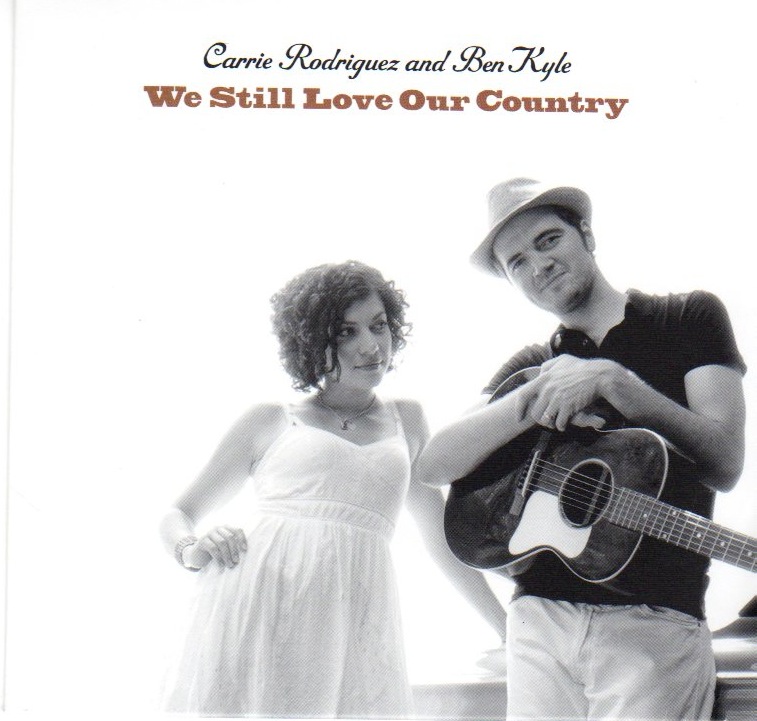
Carrie Rodriguez Teams with Ben Kyle


CARRIE RODRIQUEZ AND BEN KYLE

We Still Love Our Country

North Street Opus

* * *

Carrie Rodriguez bends the boundaries between country, folk, and rock. She also performs songs so sexy that they’re what Barry White would have done if he had worn a skirt and sang with a Texas twang. On her latest, though, she teams with Ben Kyle and returns to country music’s roots. This eight-song EP consists of old-style covers such as “If I Needed You,” My Baby’s Gone,” and “Love Hurts,” with a few vintage-sounding originals tossed in, including “Fire Alarm,” which could have been torn from the Ronettes’ backlist. The duo feature Kyle’s lead vocals a bit more than Rodriguez’s. I would have preferred the reverse, but the project is a sweet reminder of what country music was like before it got slicker than the waters of a Gulf Coast bayou.

Carrie Rodriguez is touring the East Coast this month; catch her if you can.