12/18/13

The Celestials Fails to Shine

The Celestials
Karen Shepard
Tin House Books 9781935639558
* *

There’s a popular proverb that goes: When life gives you lemons, make lemonade.  To this I would add: When someone hands you a lean, juicy sirloin, don’t chop it up, mix it with Wonder Bread crumbs, and make a second-rate hamburger. Kate Shepard has done the literary equivalent of the latter by serving us a unique tale, crumbling it, blending it with some of the blandest elements of Victorian romance, and trying to pass it off as fine literature. It doesn’t work; The Celestials is palatable in the way that a fast food burger is palatable–vaguely filling, but hardly a well-rounded meal.

T’is a shame because in the hands of a more skilled novelist, Shepard’s tale would have been a corker. The history behind the tale is fascinating. In 1870, North Adams, Massachusetts, shoe manufacturer Calvin Sampson faced labor unrest led by the Knights of St. Crispin. The Crispins wanted to reduce their workday from 11 hours to 10 and a raise, which the parsimonious Sampson could surely have afforded given the fortune he made selling shoes during the Civil War and the lucrative contracts in his possession. Instead of negotiating with his mostly Irish and French-Canadian laborers, he hired 75 scabs–in this case, Chinese lads aged 16-22 imported from California on a gang labor contract. Of them, only their foreman, “Charles” Sing, spoke any English. They arrived in North Adams unaware they were strikebreakers, but willing to work 11-hour days for 90 cents per day, half of what the Crispins were earning. This is the first known use of Chinese scabs in American labor history.

The Chinese arrived at a peculiar moment in history–a ten-year period in which those once viewed as exotic “Celestials” were inexorably transformed into the “Yellow Peril,” and the 1882 Chinese Exclusion Act banned future emigration to the United States. It was also a time in which more than 99% of all Chinese in America lived west of the Rockies. How would such Celestials, both far from home and far from the support of an ethnic enclave, survive in North Adams with her remoteness and unforgiving winters?

Shepard populates her novel with real people, including Sampson and his wife, Julia; Sing and his future wife, Ida Wilburn; the zealous Baptist proselytizer Fannie Blasingame and her gardener, Lue Gim Geng  (whose hybrid orange launched Florida’s citrus industry); and numerous others. What she doesn’t do is delve very deeply into the lives of the befuddled Chinese youths cut off from friends, family, and most things familiar. Although Samson hired 50 more Chinese in 1871, almost all left North Adams when their contract expired in 1873, and all but Sing and Geng were gone before 1880. (Both left before their deaths, Geng following Blasingame, his employer, and Sing fleeing when his store failed.) Shepard overplays the exoticism angle and would have us believe that hostility between whites and Chinese eventually cooled. That’s not what happened.

What could have been an elaborate fictive weaving of class, culture, and ideology gives way to the most conventional of all stories: a romance. It centers on Julia Sampson, whose 13 pregnancies all ended in either miscarriage or infant death, but who suddenly gives birth to a child whose features more than suggest an assignation between herself and one of the Celestials. Alas, this plot line means that our weaving unravels and we are left with the dullest and most recycled thread of all–the suppressed longings of white, Victorian women. Put simply, Julia just isn’t all that interesting, nor can the big-fish-in-a-small-pond social circle of the Sampsons hold a candle to the Chinese community that Shepard reduces to a single individual’s struggle to assimilate. The latter is handled in ways that might evoke in a modern reader’s mind Star Trek’s Data and his longings to be more human.

The narrative shift is a curious one given that Shepard is Chinese American and has previous writings that deal with the identity issues she sidesteps in The Celestials. She doesn’t deal with the Knights of St. Crispin very well, either, and they too are more interesting than Julia Sampson. My overall sense is that Shepard is a good researcher, a mediocre historian, and a writer whose sensibilities and style are better adapted for family memoirs and soapy romance than the grand sweeps of historical fiction. In short, she’s better with hamburger dishes. –Rob Weir

12/16/13

The Paris Wife: Portrait of a Not-Yet Artist

The Paris Wife (2011)
Paula McLain
Random House 9780345521316
* * * ½

Few novelists of the 20th century achieved the bigger-than-life reputation of Ernest Hemingway (1899-1961). There was, of course, a time in which Hemingway wasn’t Hemingway–just another guy dreaming of becoming a writer. Paula McLain takes us back to the dawn of the Roaring Twenties, that transitional period in which young men like Hemingway were trying to heal physical and psychological wounds suffered in World War One and suspected that part of the healing process involved society casting off dead cultural tissue. McLain shows the making of Ernest Hemingway through the eyes of his first wife, Elizabeth “Hadley” Richardson.

We first meet Hadley and Ernest in Chicago, in 1920, where Hadley is visiting a former Bryn Mawr roommate. McLain’s young Hemingway is a man of ambition, but he’s also plagued by self-doubt and Hadley, eight years his senior and an accomplished pianist, is just the ego booster he needs. They marry in 1921 and soon relocate to Paris, because–hard though it may be to believe–one could live cheaply there. Thus, Paris became a Mecca for other up-and-coming writers as well, and was the perfect base from which hand-to-mouth young folks could borrow some money and explore the Continent. This is precisely what the Hemingways do, and it’s how Ernest gains his first fascination with Spanish bullfighting.

The Paris Wife reads like a non-stop party through the 1920s, with all of its excitement, promise, and amorality. We meet Sara and Gerald Murphy, who are fabulously rich and vacuous. They’re perfectly willing to bankroll their abusive artistic friends as long as the booze flows and the music never ends. We also meet Hemingway’s first muse, Gertrude Stein, and see within that friendship the seeds of Hemingway’s bombast and outbursts of misogyny. Along the way we meet other soon-to-be literary lions still in their cub phases: James Joyce, Erza Pound, F. Scott Fitzgerald, John Dos Passos…. Stein notwithstanding, it’s a decidedly hyper-masculine world. Though Ernest seems genuinely smitten with Hadley, gathering gloom and doom mars their relationship. (Hemingway divorced Hadley in 1927; he would marry three more times.)

McLain’s novel is a fascinating portrait of a not-yet artist though oddly, her female protagonist, Hadley, is underdeveloped. I suppose we are to gather that patriarchy was a form of hubris for Jazz Age scribblers, but it’s often hard to see what, other than sex, these men saw in their companions. Hadley is supposed to be a concert-quality pianist, yet she’s tepid and passive throughout the book–a clueless victim. Journalist Pauline Pfeiffer, Hemingway’s second wife, comes across as little more than a husband-stealer and, if possible, Zelda Fitzgerald appears crazier than she probably was. One wonders what critics would have said of this book if a man had sketched these characters! Ditto McLain’s propensity to name drop or use clichés to advance thin plot lines.

The Paris Wife isn’t great literature, but it has its fascinations. McLain is much better at description and ambience than at dialogue or character development. The former are so sharply drawn that we can sweep away the blue tobacco haze and clinking booze glasses and mentally conjure old ways giving way to new. The Paris Wife is a breezy, non-taxing read–perfectly suitable for curling up by a winter fire, or saving for a July beach read. –Rob Weir

12/13/13

Philomena More of a Play than a Movie, but a Moving One

Philomena (2013)
Directed by Stephen Frears
Pathé, 98 minutes, PG-13
* * * *

Nobody does dramatic pas de deux like the British. They love to put two talented actors front and center and just let them have a go. There are other characters in Philomena, but it’s essentially a two-person play on film: Philomena (Judi Dench), and the jaded fallen politician-turned journalist Martin Sixsmith (Steve Coogan), who reluctantly agrees to help her uncover her son’s fate.

This film adapts the true story of Philomena Lee’s 50-year search for a son taken from her by the Irish nuns with whom she lived. It opens inside a 1950s chamber of horrors known as a Catholic convent, where Philomena Lee is a charity case/inmate. Like dozens of young single mothers, she slavishly toils for the nuns for the pleasure of the single hour per day they are allowed to be with their children. Each lives with the terror of knowing that the sisters are beating the bushes in search of ‘good families’ to adopt their sin-conceived offspring.

Flash forward to the early 21st century when an aged, widowed Philomena can no longer live without knowing the fate of her son, who would be turning 50. Her quest happens to coincide with Martin’s need to salvage his reputation. He’s a former Labour Party official who becomes the fall guy for deeds he did not commit, but from whose shadow he cannot escape. He’s also become a cynical bastard with very little interest in Philomena’s plight; Martin takes on what he feels to be a human-interest story beneath his dignity only because he’s out of work and it’s the only work-for-hire looming on the horizon.

The movie is as much about the developing rapport between Philomena and Martin as in solving a decades-old mystery. We expect Dench to be great, and she is. She also physically transforms herself into a dowdy woman of simple tastes and rock-steady faith–the exact opposite of Martin, who is more like an Icarus who survives the fall. He’s worldly, well connected, wealthy, and too angry to believe in much of anything. One of the film’s biggest revelations is that Steve Coogan can do drama. He is known on both sides of the Atlantic as a comedian (though I’ve never found him to be all that humorous). He, like Dench, stays within his role. Unlike what happens in far too many American films, both Dench and Coogan bend, but they never break. That is to say, there’s no conventional guess-we’re-all-the-same-under-the-skin phoniness. Quite the contrary; the Brits also excel at recognizing social class, and hard-to-traverse social gaps are a major subtheme within the script.

Speaking of the script, Coogan co-wrote it and he also helped produce the film, so we must assume that this project was one he found personally meaningful. The subject matter is biographical, though we’ve seen other films like this, including The Magdalene Sisters (2002). No spoilers here, though I will say that Philomena’s plight is among the many sins for which the Catholic Church needs to be held accountable. That topic assures that Philomena has a tailored audience waiting. (Ex-Catholics would make up the world’s 3rd largest Christian denomination. Practicing Catholics are the largest.)

Fine, but do we love Philomena as a movie? It has won a handful of awards worldwide, mostly at festivals. I liked it a lot, though it must be said that it just as easily could have been a play and might work even better on stage. When the film jets us to Ireland and Washington, DC, it feels more like scene padding and an excuse for class-based cheap comic relief than necessary detail. A stage production would require more character development on the part of cameos whose movie motives are incomplete. Still, watching Dench in anything is worthwhile, and the discovery that Coogan has both dramatic flair and screenwriting ability is its own reward, so let’s not be as cynical as Martin Sixsmith.

Rob Weir

12/11/13

Armory Show at 100: When Modernism was New

The Armory Show at 100
New York Historical Society, NYC
Through February 23, 1914

Taylor 1912
Two paintings from American artist Henry Fitch Taylor sum up the impact of the 1913 Armory Show–the first, from 1912, of a girl feeding ducks is saccharine enough to be from Thomas Kincaid. Now check out what Taylor did in 1915, just three years later. To say that the Armory Show rocked his world barely scratches the surface! It doesn’t really matter whether you prefer the first to the second, because there was no turning back the clock. The Armory Show marked the break between Victorianism and Modernism with such finality that, a hundred years later, it’s still the most important art exhibition ever to take place in the United States.

Taylor in 1915
The New York Historical Society gives us a small taste of what audiences saw a century ago. Its hundred sculptures, drawings, and paintings constitute just 7% of the 1400 pieces New Yorkers saw in 1913. Even this is a remarkable achievement given that works that were often ridiculed in the day are now “classic” works valued at many millions of dollars. More ironic still, they are also beloved icons that museums are loath to loan. Nonetheless, the sample is plenty to give us the flavor of 1913 and, because the display is in the NYHS, there’s plenty of accompanying context to consider. The exhibition took place at a crucial moment; among its contemporaries were the Industrial Workers of the World, the social problems images of the Ashcan painters, the suffrage movement, a surge in anarchist activity, labor strikes, and gathering war clouds in Europe that would, four years later, rain on America’s Progressive Era parade.

Augustus John
The Armory Show at 100 is revelatory on several levels, not the least of which is its ability to separate myth from reality. First of all, not everything there was shocking and quite a bit of it was uniformly praised. French Impressionists such as Monet and Renoir, for instance, were already beloved and American counterparts such as John Henry Twachtman and J. Alden Weir attracted kudos. Some works, such as those by Walter Pach, were fairly conventional, and the one that garnered fawning praise–Augustus John’s The Way to the Sea–is objectively an insipid exercise in unfettered sentimentality. On a more elevated level, not everyone could unravel symbolists such as Odilon Redon, but they viewed them as on par with allegorical artists such as Albert Pinkham Ryder and praised their “spiritual” characteristics. Just as long as they didn't get too creepy, like Edvard Munch, whose Madonna and Vampire induced mixed commentary.

Eberle-White Slave Trade
Second, Americans were not total naïfs at the time. Ashcan painters such as George Bellows and John Sloan paved the way for non-decorative painting, Sloan with his ungilded views of working-class life, and Bellows for showing the city’s seemly sides. There is, in fact, striking thematic similarity between the grotesque, zombie-like crowd faces found in a Bellows painting, and the angst-and-danger undertones of Munch. Among the big sensations of the 1913 show was Abasteria St. Leger Eberele’s bronze White Slave Trade and its powerful contrast between a cowering, legs clenched-together nude female and her hulking, legs astride, vulgar auctioneer. His expression is so vivid that we can (metaphorically) see the spit projecting from his open mouth and imagine saliva pooling at the edges. American artists also had familiarity with caricaturists such as Daumier, as evidenced by Guy Pene Du Bois’s Waiter!


Matisse
What did induce shock were the Fauvists and the Cubists, the first because they were viewed as either incomprehensible (Henri Rousseau) or obscene, and the second because classically trained painters viewed it as the death of painting. Two works that illustrate this are both nudes, but cut from different cloth: Henri Matisse’s carnal Blue Nude and Marcel Duchamp’s Nude Descending a Staircase, the latter of which one critic famously panned as “an explosion in a shingle factory.”
Duchamp

The biggest revelation is that none of these works shock us today. We admire them (or not), rejoice for being able to see them, smile at some ‘old’ favorites, or perhaps yawn at their familiarity, but we view them as neither art’s demise nor its future. As you exit the exhibit in your non-agitated state, take a moment to consider that you are not shocked because, a hundred years ago, the Modernists won.

Rob Weir

12/9/13

Lonliest Planet too Boring to Be Gorgeous


The Loneliest Planet (2011/12)
Directed by Julia Loketv
IFC Films, 113 mins. Not rated. In English and Georgian.
*

This independent film did a scant $128,519 at the box office, but was such a sensation at film festivals that Sundance Select decided to distribute it. Reconsideration is definitely in order.

The film putatively follows an engaged couple–Alex (Gael Garcia Bernal) and Nica (Hani Furstenberg)–on a high-adventure backpacking trip across the Caucus Mountains of Georgia. Since neither speaks more than a few words of Georgian, they hire Dato (Bidzina Gujabidze) to guide them. That’s pretty much it. Along the way, Alex screws up by reacting cowardly when a group of mountain locals confront the trio. We think he’s feeling inadequate and unmanly, but given that Bernal only says a few dozen words in the entire movie, it’s hard to know. We also get Dato’s confession of a failed marriage and brief bonding between him and Nica, but very little happens, even less is revealed, and nothing at all is resolved.

So what did festival juries see in this film? Surely not fine acting. Bernal is quickly establishing himself as a one-dimensional bore on the screen who specializes in puppy dog eyes and hangdog expressions, but is incapable of much else. T’is time for him either to stretch or find other employment. It’s hard to say much about Furstenberg, as she’s nearly as silent as Bernal. We first meet her as a soggy nude jumping up and down in the shower. We don’t know why she’s doing that, we don’t find out why, and we never discover much of anything else about her except that she travels a lot and is trying to learn Spanish–perhaps to coax a monosyllabic word from her fiancé. There’s really not much one can say about the film’s script, except that it might have been a good idea to have one. Nor can one commend Lektev’s static direction, which runs the A to B gamut from close-up to long short.  

What is good is the setting. We see the Caucus Mountains in all its guises–rolling pasturelands, cliffs of loose scree, gently folded mounds, sweeping hill-and-valley vistas, easy strolls, and high-elevation oxygen depleting scrambles. It’s also beautiful to see the sunlight streaming through Furstenberg’s fiery red mane. But this isn’t enough and it’s hard to imagine why Sundance decided to promote a film that has bombed with audiences. If you want to see the Caucasians of Georgia, National Geographic is a much better idea. Flipping the pages will provide more movement than you’ll see in this film.

Rob Weir 

12/6/13

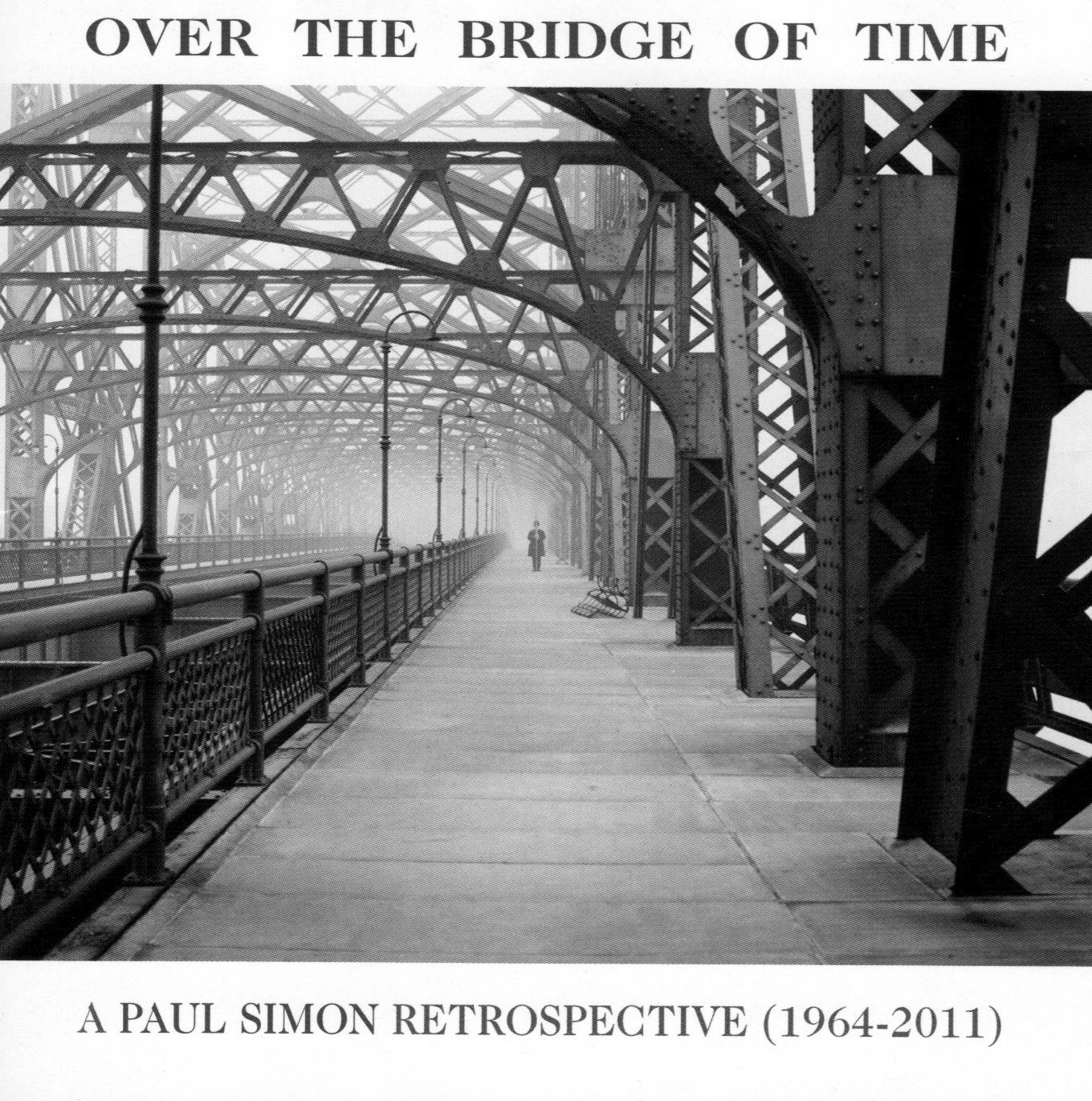
Paul Simon Restrospective a Worthy Overview of a Glorious Career

-->
PAUL SIMON
Over the Bridge of Time
Sony Legacy 88883757672
* * * * 

There’s no point to a conversation about the past six decades of songwriting if Paul Simon’s name isn’t invoked. His has been a (decidedly angelic) voice of poetry, wonderment, and explorations of the human condition. The greatest challenge of the 47-year (1962-2011) retrospective Over the Bridge of Time must have been deciding which 20 tracks to use. Producer Steve Berkowitz opted to select songs that hit the pop charts–from Simon and Garfunkel classics such as “The Sounds of Silence” and “The Boxer” straight through to 2011’s “Love and Hard Times,” with a brief stop for some of his Broadway ventures. In between lies another of Simon’s forays into world music on albums such as Graceland and The Rhythm of the Saints. Simon wasn’t the first to go global, but was there ever a timelier album than Graceland (1986), which introduced Ladysmith Black Mambazo to mass audiences just as South Africa was in the thralls of casting off apartheid? (In retrospect, those who accused him of boycott breaking and exploitation seem quite foolish.) Simon’s songs used to be taught in college poetry classes, but most of them bubble forth from the rainbow cosmopolitanism of New York City rather than ancient elegiac wellsprings. Turn a city corner and you leave one world for another–just like a Paul Simon song. Some might say he’s been a pop artist rather than a folk singer, but talk about conversations not worth having….

Rob Weir   

12/4/13

Kill Your Darlings a Fascinatiing Look at Pre-Beats Life

Kill Your Darlings  (2013)
Directed by John Krokidas
Sony Picture Classics, 104 minutes, R (language and sexual situations)
* * * *

William Burroughs… Allen Ginsberg… Jack Kerouac… Can we imagine the Beat movement without them? What became the most significant literary movement of the mid-20th century was almost nipped before it budded and, if justice had been served, it would have been.

No–this isn’t an anti-Beat rant. Like millions who came of age in the 1960s and 1970s, I was weaned on Naked Lunch, Howl, and On the Road. But I wonder if any of those works would have seen the light of day if the truth had been told in August of 1944, when Lucien Carr murdered David Kammerer. The film Kill Your Darlings takes us back to the early 1940s, when the world was at war, clubs served up sizzling hot jazz until the sun came up, gay and drug subcultures thrived in the shadows, and some of the brightest young minds in New York City spent more time dancing on the razor’s edge than studying in the hallowed halls of Columbia.

Ginsberg entered Columbia in 1943, a shy Jew from Paterson, New Jersey with a poet father, a mentally ill mother, and distressed musings over his own sexuality. There he met the brilliant-but-lazy Lucien Carr who shared his contempt for formalist poetry. In the film, Ginsberg’s relationship with Carr parallels that of Arthur Rimbaud and Paul Verlaine–madcap antics, initiation into gay life, free-flowing alcohol and drugs, and a coalescing circle of intellectuals-in-the-making. The latter group included John Clellon Holmes, Gregory Corso, Kerouac, and the older Burroughs, well on his way to a life of addiction and dealing. Through the use of occasional jumpy camera work, skewed angles, dark tones, and quick-spliced sequences, director Krokidas depicts a world that is, in measure, sordid but exciting, and experiences that rocket between surreal and hyper-real.

Krokidas gets superb performances from his cast. Daniel Radcliffe continues to leave Harry Potter far behind in his nuanced portrayal of Ginsberg. He is, in turn, prescient but naïve, lustful but frightened, brilliant but arrogant. Like Carr and Kerouac, he seems one step from success, but just a half step from implosion. Dane DeHaan’s depiction of Carr is reminiscent of that of Anthony Andrews as Sebastian in Brideshead Revisted back in the 1980s–volcanic, charming, infuriating, and androgynous but sexually alluring. The film implies that Carr and Ginsberg were lovers, which most biographers doubt. The same biographers debate Carr’s relationship with David Kammerer (Michael Hall), the older man who saved him from a teenaged suicide attempt and then became–depending on whom you believe–his lover, his stalker, and/or his despoiler. He was, most certainly, Carr’s victim, but one that yielded surprisingly little jail time as Carr used an “honor killing” defense at his trial.

The latter is a reminder of how dangerous it was to wander outside the mainstream in 1944. One could literally get away with murder if, as Carr did, you could convince a jury that your victim intended homosexual molestation. (Until 1961, sodomy was illegal everywhere in the U.S.) Nor is there much doubt that Burroughs (Ben Foster) and Kerouac (Jack Huston) obstructed justice in an attempted cover-up–Burroughs by not reporting it and Kerouac by helping hide evidence. Imagine if the entire truth had come out in 1944–that Ginsberg and Burroughs (and perhaps Carr) were gay, that Kerouac was bisexual, that all of them had used illegal substances, and that several of Carr’s friends conspired to hide a murder.

This is a very good film, though it’s not without its faults. Let’s just say, straight or gay, it’s decidedly a man’s world. You’ll see credits for Elizabeth Olsen, Kyra Sedgwick, and Jennifer Jason Leigh, but even the word cameo is a bit grandiose given how little screen time they have. In real life, Ginsberg was hardly the angelic naïf we see on the screen, nor was he exclusively gay in the 1940s. Moreover, Krokidas simply presumes you know who everyone is; if you don’t, you won’t quite know what role Burroughs plays in the drama. For my taste, Foster plays Burroughs as if he’s channeling Hunter Thompson instead of Burroughs, but I may be nitpicking. And, I suppose if one really wants to nitpick, the film’s implication that Carr cut his ties with the Beats is untrue.

But let’s let the literary biographers argue all of this. I often invoke the late Roger Ebert’s assertion that a really good film has the ability to take us inside a world we couldn’t enter on our own. Enter this one and you’ll see the madness, the junkies, the angelheaded hipsters, jazz cats, agitators, and the queens that led Allen Ginsberg to howl. Do we think Ginsberg might have howled even louder when he contemplated gay bodies sinking into the Hudson?  --Rob Weir

PS: Controversy has emerged because Daniel Radcliffe spends screen time tongue-locked with DeHaan and later has a nude love scene with another man. There is nothing salacious about either scene, though the furor is a distressful reminder that some 1944 attitudes remain.

FYI: For lovers of irony, Lucien Carr fathered three children, one of whom is novelist Caleb Carr.