4/7/14

Don't Overlook UMass and Hampshire College for Art

-->
Pioneer Valley Delights III:
University of Massachusetts Amherst and Hampshire College

Katy Schimert Sculpture
Visitors seldom consider UMass or Hampshire College to get their art fixes. Neither school possesses extensive permanent collections and I suppose serious collectors would say that neither school possesses iconic works. UMass has only been collecting since 1962, and Hampshire College didn’t even exist until 1970. UMass possesses just 2,800 objects–mostly photographs, prints, and works on paper, and Hampshire has but a single small gallery and houses what little it owns in the library ephemera collection. Sound as if you can give them a miss? Do so and you’ll miss out on all manner of things you’d not see elsewhere.

UMCA--The Building is Ugly, the Exhibits Thoughtful
UMass Amherst is the Commonwealth’s flagship public university–the key word being public. Taxpayers aren’t going to shell out for million-dollar Rembrandts hanging on the walls, but they will fork over for an innovative arts curriculum and a museum or two or seven that complement the educational mission. That’s right–seven. UMass is a small city unto itself, with a total student body of around 28,000 and over 1700 faculty members. UMass approaches its museums as dynamic changing galleries rather than static exhibition space. One of the more innovative of these is the Augusta Savage Gallery located in New Africa House, which features art from African Americans and others from the African Diaspora. There’s currently an exhibit there of paintings by Oliver Lake, who is best known as a jazz saxophonist. He’s actually a bit of a Renaissance man who also produces whimsical images that draw on folk tales and animal stories. The gallery in Herter Annex generally features work by faculty, visiting artists, or students. I was particularly taken with a current exhibit by landscape architecture professor Jane Thurber titled “Lenses.” Her work uses geometric shapes for everything from accordion books to tissue collages and cutouts to call our attention to ways of seeing and perceiving. There are additional galleries at the Southwest Residency Area dining hall (Hampden Gallery), a space in the Student Union Center, another in the Central Residency Area, and still another in the Studio Arts Building. 

Katy Schimert Painting
The centerpiece of UMass galleries is its Contemporary Art (UMCA) facility inside the Fine Arts Building (FAC). Let me get this out of the way. I’m a UMass alum and I teach there. I adore the big sprawling university, but the FAC–which dominates the end of the bus circle at the campus main entrance–is the ugliest building east of Boston City Hall, a hulking white whale that legend holds is supposed to look like a monumental piano from the air. It doesn’t; locals dub it the Starship Enterprise (in concrete). It’s also an appallingly awful place for anything related to the arts and one can only admire anyone who displays beauty amidst such brutalism. My chapeau tip goes to director Loretta Yarlow, who does interesting things in a space that could be better used to store drywall.  Changing exhibitions are the UMCA’s s trademark (consult https://fac.umass.edu/UMCA/Online/). Right now there are two very interesting exhibits.  The first is from New York-based artist Katy Schimert, who is serving as an artist-in-residence. Her large paintings are watery and water-themed, but they also have a hand-dyed quilt-like quality. She has a fascination with the octopus, but as rendered in dreamy semi-abstractions. She also renders sea bottom ridges in glass that are evocative of psychedelic Bakelite. Her love of the sea is also represented by four canvases from the relatively unknown Thomas Chambers (1806-86). I was smitten by two depicting castles on the Rhine that are reportorial, but which also evoke the fanciful hilly landscapes imagined by 17th century Dutch artists if they had used colors by Instagram and the sensibility of early video games such as Myst.
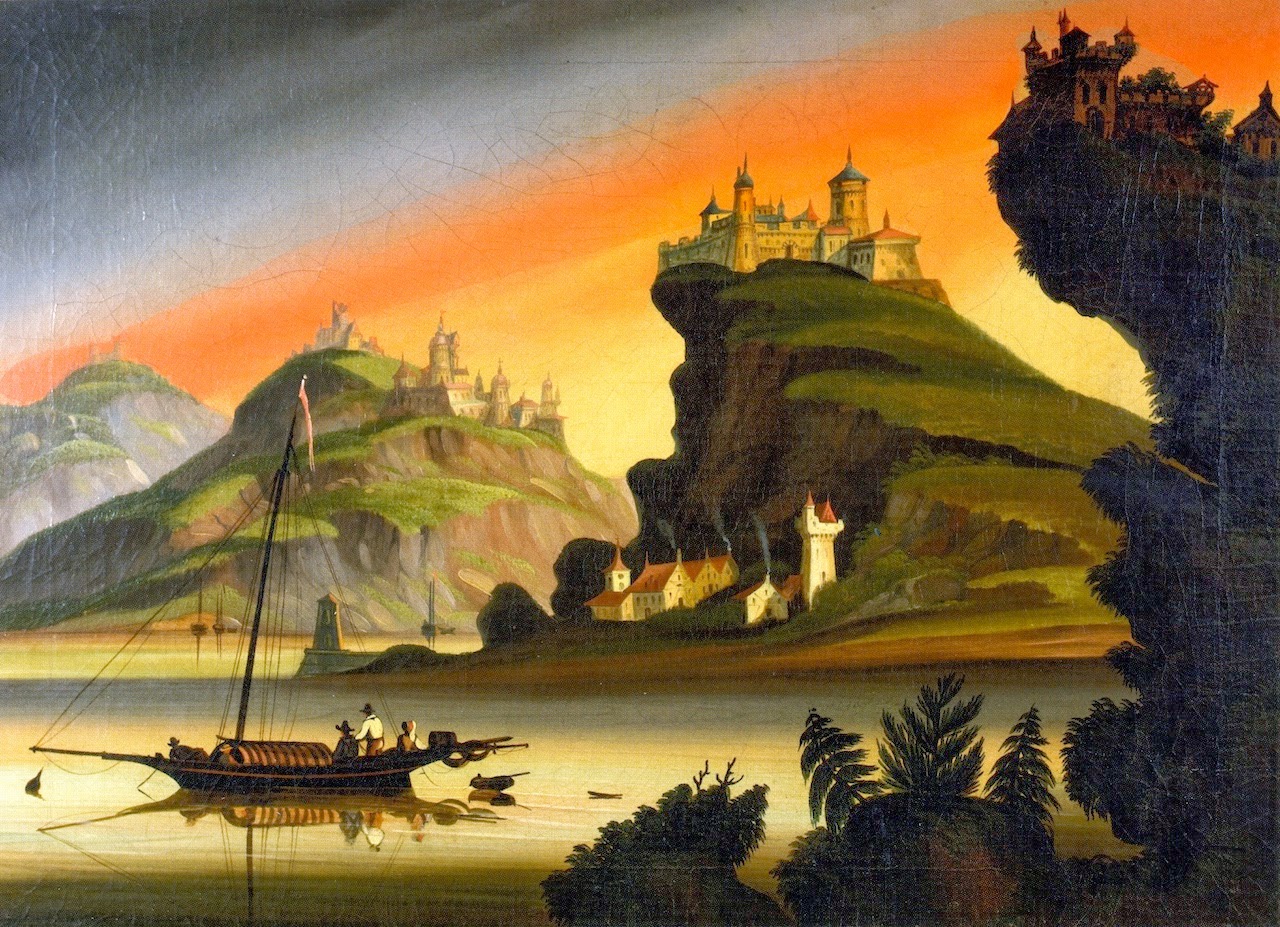
Thomas Chambers Castles on the Rhine
When you see ‘famous’ artists at UMass, it’s usually in the form of drawings or photos. There’s currently a nice exhibit titled “Fractured: The Modern Nude,” that sports depictions (mostly photographs) from luminaries such as Andy Warhol, Diane Arbus, and Jared French.

As noted, Hampshire College has very little in the way of a permanent collection, but what it does have is a student body and faculty that march to a different drummer. Its gallery, located in the basement of the library, tends to supplement offerings on urban history, ethnography, natural sciences, and the visual arts. There’s generally some student and faculty art on display. Most of what you see there is from artists whose names you don’t know–yet. A recent show featured photographs of James Baldwin; the current show is of work from Hampshire’s Division III (advanced studies) students. Much of it is gloriously off-kilter and unusual. Ken Burns is a Hampshire grad and his visual arts focus endures at Hampshire.   Rob Weir

4/4/14

Forget the Snooty Reputation: Visit the Mead

Pioneer Valley Delights II:
Mead Museum of Art

Ary Scheffer Paulo and Francesca
Amherst College’s Mead Museum of Art is one of the best-kept secrets in western Massachusetts. A lot locals have never been there because, let’s face it–Amherst College has a snooty reputation. Some of that is earned and some unfair, but anyway you slice it, AC doesn’t exactly go out of its way to invite visitors onto its campus. The Mead sits near the dead center of the campus and you’ll have to park wherever you can and walk to it. Aim for the stand-alone gray stone steeple, as it is the gateway sentinel to the Mead. Stick your camera in a locker–the Mead is the only Valley museum that won’t let you take pictures of its permanent collection (which doesn’t help AC’s frosty, and I don’t mean Robert, image.)

The Mead is both free and worth finding. Its 18,000-item collection makes it the Pioneer Valley’s second-largest and it may well have the most diverse collection in the region, including Tibetan scrolls and holdings in Russian and Japanese art that surpass those of other museums. It has also updated better than most college museums, with works from Alex Katz, Andy Warhol, Jim Dow, and Andreas Serrano–among others. I was also delighted to see four collages from our friend Lilli Pereira.

The Javanese Coat

As might be expected from a school founded in 1821, some of the American works date to the 18th and early 19th centuries. The opening gallery is actually the Mead’s least interesting, as it is devoted to older American artists such as Peale and Cropsey whose work appeals more to antiquarians than to art lovers. Ditto some of the Dutch masters, nearly all of which are minor works. There is an English paneled room that has fabulous ambience, though you’ll not find much eye-popping art in it. One of the more interesting works in the first gallery is a two-painting work by Thomas Cole, Present and Past, which shows a castle in ruin upon which a wanderer stumbles, and then imagines it in its glory days with a medieval pageant in full bloom. By far the most eye-catching is Ary Scheffer’s Paulo and Francesca, the lustful lovers from Dante’s Inferno unclothed and crawling over each other like fleshy hungry vampires. (See above) There is also a fine set of portraits from Robert Brackman of Charles and Anne Morrow Lindbergh, though most eyes will gravitate to Kyoehi Inukai’s The Javanese Coat.

The Fisher Girl
Side galleries contain an impressive Assyrian monumental relief, plus smatterings of antiquities, but the next large painting gallery is a true delight, aside from a dud of a Monet and a cloying Bouguereau. Robert Henri’s Salome Dancer * is probably the most important painting of the lot and it practically invites a debate over voyeurism, though it’s uncertain if the greater transgressor is the viewer or the insouciant central figure with her slutty come-hither stare. Check out some of the lesser-known paintings, Willard Metcalf’s Gloucester Harbor, work from Russia’s Filiip Maliavin and Label Filonov. There is also a superb Winslow Homer, The Fisher Girl
The Radio Fan


The gallery also contains my very favorite from the Mead, Alexander Brook’s The Radio Fan. Brook was best known as an illustrator, but he captures the Modernist spirit brilliantly in what is, at first glance, little more a twerpy nerd perched atop a box. But look at his left leg air dancing with the music. It’s at once whimsical and wonderful commentary on the early age of radio when it was so new that all were moved by its magic.


The next galleries bring the collection up to date. The Mead’s Andy Warhol Mao is one of the best in Warhol’s series of the Chinese revolutionary hero. There’s also a wonderful Leonard Baskin self-portrait and a chilling photograph of a Ku Klux Klan member from the Andrea Serrano–a single evil eye peeking through a ragged robe. I also quite enjoyed works from Kiyoshi Saito’sof the Hokkaido 1961 series.

Kiyoshi Saito
Kudos to director Elizabeth Barker and senior curator Bettina Jungen for updating the collection. The Mead does what a college art museum should do–make the best of what it has, and add when it can with an eye to the present and the future rather than the past.

Robert Henri, Salome Dancer
While you’re on the Amherst campus, air out your liberated camera by snapping sculptures of Robert Frost and Henry Ward Beecher. If you’re still around after 11 am, walk over to the Beneski Natural Science Museum for some impressive shots of dinosaur skeletons. If you find the pale yellow student center, you’re almost there. 

* Salome dancing was an early 20th century phenomenon that used the New Testament story of Herod II’s daughter as an excuse to erode Victorian strictures. Salome’s dancing was supposedly so seductive and exciting that she was granted her wish as a reward: John the Baptist’s head on a platter. She is often viewed as a harlot and seductress, but the sheen of a Biblical theme allowed risqué Modernist dancers and vaudevillian hoofers to bare some flesh and titillate audiences.

4/2/14

Mt. Holyoke College Art Museum

-->
Pioneer Valley Delights I;
Mount Holyoke Museum of Art

When “art” and “western Massachusetts” get mentioned in the same breath, most East Coast cognoscenti head for the Berkshires to take in the Stirling and Francine Art Institute, MassMOCA, or (gasp!) the Norman Rockwell Museum. Okay, I’ve developed a grudging admiration for Rockwell over the years, but he was mainly an illustrator and I’m just enough of a snob to say his work doesn’t qualify as fine art. But my biggest beef is that travelers to the Berkshires miss some serious art treasures if they fail to stop in the Pioneer Valley, home to the Five Colleges (Amherst, Hampshire, Mount Holyoke, Smith, and the University of Massachusetts Amherst). In that spirit, this is the first of four blog posts highlighting college art collections–first stop, the Mt. Holyoke College Art Museum (MHCAM).  

Milton Avery: Lone Goat
The MHCAM is located in South Hadley, just across the Connecticut River from Holyoke and just a dozen miles from Springfield as the crow flies, though it’s light years removed from the squalor of urban postindustrialism. Though the town has 17,000 residents, it feels like a village–especially when you venture further from the river and venture upon the Gothic campus of Mt. Holyoke, the nation’s oldest remaining women’s college. You’ll find the MHCAM beside the college greenhouses and fronting a narrow stream connecting Upper and Lower Pond. It’s a ‘teaching’ museum, which means it’s small, but that’s not a bad thing at all. Longtime curator Wendy Watson has always made the best of the museum’s 16,000 plus items and its new director, John Stomberg, is dedicated to bringing vest pocket but innovative special exhibits to at least one of the museum’s nine galleries. Through June 8, 2014 there is a show of six of Ghanaian artist El Anatsui’s monumental works, which he fashions from flattened bottle caps connected by cooper wire. This is a big deal indeed–El Anatsui’s works can be found in art museums in Boston, Brooklyn, New York and Washington.

Avery: Purple Ram
Because the MHCAM is a teaching museum, its on-display permanent collection is generally a sampler from the vault; that is to say that you get a splash of American art, a splatter of Asian, a dab of African, a daub of European, and a smattering of antiquities. Because the collection is small and changeable, there’s plenty of time to savor what you like and then return in the future for something new. My personal favorites are idiosyncratic. I’ve always enjoyed Milton Avery. His Discussion is at Mt. Holyoke, which most would consider a more important work, but I’m quite fond of two small pictures: Lone Goat and Purple Ram. Why? Because they remind me of how little a great artist needs to produce striking work–just a few squiggles and two or three colors.  

Joseph Cornell, Marsh Sunset
Lawren Harris, Mountain Sketch
The MHCAM also some dramatic pictures from the Hudson River School, including Albert Bierstadt’s Hetch Hetchy Canyon, but my heart raced faster for a small Joseph Cornell often called Marsh at Sunset, though Cornell didn’t name it. I also liked Mountain Sketch by Lawren Harris. His name might not be familiar to you, but Canadians know him–Harris was part of the influential Group of Seven credited with forging a distinctive Canadian style of art. If ever a painting can be described as icy and warm at the same time, Mountain Sketch fits the bill.

Japanese netsuke
A small favorite is a piece of Japanese netsuke–that’s small as in size, not in importance. I was magnetically drawn to a piece that’s made of ivory and is about two inches high. It’s a robed badger holding a bowl of saké. It comes from the 19th century and that’s about all we know about it. And what else do we need to know? Think of it as a metaphor for the MHCAM–lots of small pleasures that, like saké, can stagger you.     


While you’re on campus, make your way to the foyer of the library, where you’ll see a large white with gold flecks Dale Chihuly glass installation. Then cross the foyer and climb either of the side stairs and peek into the library’s fourth floor Reading Room. If you’ve had a cup of tea from the Rao’s in the foyer, you can squint your eyes and imagine yourself in Cambridge–the one in Britain, not the one across the Charles from Boston.  
Detail of Dale Chihuly glass scuplture

3/31/14

Way Way Back a Cut Above Usual Teen Fare

THE WAY WAY BACK (2013)
Directed by Nat Faxon and Jim Rash
Fox Searchlight, 103 minutes, PG-13
* * *

My family never owned a station wagon, so I had to be reminded that the “way way back” references the loading end of such a vehicle. If you’re a passenger in the seat-less way way back, it means you face away from other passengers. That’s the opening and ending setting for this film and its central metaphor. In this case, our wrong-way- facing passenger is 14-year-old Duncan (Liam James). It’s tough enough being 14, but it’s even harder if you’re scarred from your parents’ divorce and don’t much like mom’s new boyfriend, Trent (Steve Carrell). Duncan instantly sees what his moonstruck mom, Pam (Toni Collette), refuses to view: Trent is a Type A, and the A stands for asshole.

Duncan finds himself condemned to a beachside summer with Trent, his snooty 15-year-old daughter Steph (Zoe Levin), and his mom making cow eyes at Trent like she’s 14. How will Duncan ever endure an entire summer? Why can’t he just go live with his dad? He’s condemned to endless evenings with these creatures, plus next- door neighbors Kip (Rob Corddry) and his girlfriend Joan (Amanda Peet). And then there’s Betty (Allison Janney), a boozy, blowsy glad-hander with all the subtlety of a fatal coronary. She’d like nothing better than for Duncan to befriend her geeky son, Peter, who is much younger; if anything, Duncan has eyes for her older daughter Susanna (AnnaSophia Robb). Were this a French film, Duncan would come of age after sex with Susanna. Yeah, that would fly in the abstinence-obsessed American Bible Belt where one is led to believe teenagers never have sex. Off the table. Ain’t happening. Instead, directors Faxon and Rash have to figure out a more acceptable way for Duncan to find the entrance ramp to confidence and maturity.

Their approach is more fun than I ever thought it would be. Duncan’s liberation comes in the form of a girl’s bicycle plucked from the recesses of the garage. It’s the sort of thing a 7-year-old into My Little Pony would ride, but Duncan doesn’t have much self-esteem left to damage; to him, it’s a set of wheels to take him away from the adult aliens. It lands him at the Water Wizz theme park, where he encounters a group of folks who aren’t much better at being adults than he is at being an adolescent. It’s ‘managed’ by man-child Owen (Sam Rockwell), a wisecracking slacker whose stream-of-consciousness commentary is reminiscent of Robin Williams during his cocaine years. The place is really run by Owen’s love (lust?) interest Caitlyn (Maya Randolph), with very little help from surfer dude Roddy (Faxon) or eternal pessimist Lewis (Rash channeling Michael O’Donoghue). It’s always party world at Water Whizz, though the beer-guzzling and pot-smoking is considerably healthier than what’s going on at the beach house, including Joan’s temptress moves on Trent.

Worlds collide. When Duncan learns of his father’s lack of parental desire and has a heart-to-heart with Susanna, he begins to view Owen as a surrogate dad. Owen couldn’t be a worse choice save in one respect—he cares about Duncan and wants to see him snap out of his funk. Enter Duncan the Water Whizz model employee. Will it all work out in the end? Of course it will (sort of)—this is an American movie and we Yanks don’t like messy ambiguity. We also have an outsized tolerance for broad humor that transgresses the stupidity border. Some of the scenes in this flick make National Lampoon’s Summer Vacation seem like high art.

For all of this, The Way Way Back has a goofy charm that’s a cut above must teenagers-in-peril films. It starts with the cast, which is stellar no matter what one thinks of their characters. Liam James plays Duncan as a perfect 14-year-old storm, and Rockwell shows us just enough interior for us to know he’s more than an aging frat boy. Rash is hysterical as a man self-trapped in a dead-end job, and AnnaSophia Robb has an icy radiance that forces us to pay attention to her. The script is littered with clichés, but in between there are some brilliant lines, and the overall pacing is terrific. I suppose it’s even mildly subversive in its lack of a happily-ever-after ending and its impression that nuclear families are generally more dysfunctional than wholesome. Duncan’s takeaway point is worth considering: the people that choose you matter more than the ones acting in an official capacity.

The Way Way Back is ultimately like cotton candy—loosely spun, overly sweet, and messy. But’s also a treat, one in which one can safely indulge in moderation.
Rob Weir

3/28/14

Grand Budapest Hotel a Romp, Not a Masterpiece

-->
THE GRAND BUDAPEST HOTEL (2014)
Directed by Wes Anderson
Fox Searchlight, 100 minutes, R (because of totally innocent nudity, F-bombs, and paranoia!)
* * * *

Wes Anderson’s latest, The Grand Budapest Hotel, isn’t as funny as it’s billed, but it’s a delicious romp and perhaps Anderson’s best realized film to date. Even when its humor falls flat, it’s wildly inventive and off-kilter.

Set in the mythical Alpine nation of Zubrowka, Grand Budapest Hotel is essentially a caper film centering on the swishy Monsieur Gustave (Ralph Fiennes), the concierge of an elegant hotel retreat/spa for fading European aristocracy and shady characters posing as genteel. The year is 1932, and M. Gustave is breaking in a new lobby boy, Zero Moustafa (Tony Revolori), an orphaned Indian lad in whom Gustave takes a shine. Are his intentions paternal, philanthropic, or sexual? It’s one of the film’s purposefully ambiguous questions; all we know for sure is that, though Gustave set offs gaydar a mile away, he definitely beds aging dowagers such as Madame D (Tilda Swinton). When she dies several days later and leaves an insipid but precious painting to M. Gustave, heirs led by thug son Dimitri (Adrien Brody channeling John Turtrurro) seeks to dispossess him.  On a whim, Gustave and Zero steal the painting. Thus begins a madcap set of misadventures in which baddies, including the psychotic Jopling (Willem Dafoe), try to frame Gustave for Madame D’s murder and briefly jail him before he, with Zero’s help, breaks out of prison. The subsequent chase takes Gustave and Zero across the Alps by ski, snow machine, auto, train, and other forms of conveyance. Gustave calls upon a secret network of other concierges to stay one step ahead, whilst Zero longs merely to survive and marry Agatha (Saoirse Ronan), a pastry chef’s daughter whose face is inexplicably marked by a stain in the shape of Mexico. Military police—led by Chief Hackels (Edward Norton)–also give chase against a backdrop in which war looms on the horizon. (The film is supposedly set in the Alps, but its politics seem a pastiche of the pre-World War One Balkans.)

From this you might deduce that the narrative is slight, and so it is. The film is really a series of offbeat sketches held together loosely by a (sometimes imposed) narrative. There are tasty cameos throughout (Jeff Goldblum, Bill Murray, Harvey Keitel, Jason Schwartman, Léa Seydoux) and the adjective ‘wacky’ probably best describes the movie’s tone. There is no attempt whatsoever at realism; many of the situations and hair-raising escapes are absurd, and the hotel and mountains are often represented as hand-tinted color cutouts. Anderson washes his film in those same washed out Instagram-like cartoonish colors—thereby adding to the notion that we are: (a) witnessing the fading of a way of life, and (b) you shouldn’t try to attach too much meaning to any of this. The film is also bookended by a prologue and epilogue held in the now seedy Grand Budapest Hotel, where a nerdy and reclusive young writer (Jude Law) seeks to prise the hotel’s story from its aging proprietor, none other than Zero–played by F. Murray Abraham, who looks about as Indian as a cannoli. Was the decision to cast Murray Anderson having us on one last time, or just sloppy filmmaking? You decide, but it is one of my reservations about the film.

The tone of Grand Budapest Hotel is evocative of Jean-Pierre Jeunet projects (Delicatessen, Amélie, City of Lost Children) but Anderson lacks Jeunet’s narrative talent and his understanding of irony. (Anderson often thinks that detached sarcasm is the same thing as irony.) I always enjoy Wes Anderson films; I’m yet to declare one a masterpiece. In some ways his is classic slacker filmmaking—offbeat and wild ideas that he thinks speak for themselves, even when they don’t. This film, like his others, is a mix of creative and conventional. The prison scenes, for example, are deliciously droll, but the chase sequences evoke the cheap jokes we saw decades ago in Pink Panther films. Nor does the omniscient narrator gambit rise to the level of innovative filmmaking. It’s convenient and nothing else.  

The Grand Budapest Hotel is, though, visually entertaining and choked full of clever background jokes you need to stay on your toes to see. (Pay attention to the newspapers that appear on screen!) Fiennes is a hoot as Monsieur Gustave and Edward Norton chews whatever scenery Fiennes leaves undigested. Ronan wafts through the movie as an odd butterfly–often wordlessly strange, but always beguiling. Overall it’s a very pleasant way to spend 100 minutes–just don’t expect a masterpiece; Wes Anderson still has some growing up to do.
Rob Weir

Postscript: Need more proof that the ratings system is a farce? This got an R for brief frontal nudity that’s no more naughty than an unruly school child, and I’ll bet that same kid drops more F-bombs as well. Titanic got a PG-13. Is that because Kate Winslet’s breasts are British and don’t count?

3/26/14

The Ghost of the Mary Celeste Continues to Haunt

The Ghost of the Mary Celeste (2104)
Valerie Martin
Doubleday 978-0385533508, 306 pages
* * *

With the exception of the Flying Dutchman, the Mary Celeste is probably the most famous “ghost ship” of all time. Launched in 1861, the brigantine already had a long record of misfortune when Captain Benjamin Briggs, his wife Sarah (“Sallie”), their two-year-old daughter Sophia, and an experienced crew of seven loaded a cargo of 1700 barrels of commercial alcohol in New York City and sailed for the Gibraltar Strait. On December 5, 1872, the abandoned ship was discovered adrift near the Azores. The cargo was nearly intact, the ship was fully provisioned, and aside from some water damage, the Mary Celeste was completely seaworthy. There was no sign of foul play, but one boat was missing, so what happened to her crew? Theories abound from the fanciful (sea monsters, giant water spouts, piracy, mass hysteria, an Atlantic earthquake) to the prosaic (alcohol fumes that forced abandonment). Every few years someone purports to have “solved” the mystery, but there’s enough margin for error that the legend lives on. References to the Mary Celeste show up everywhere–in Star Trek episodes, in sci-fi novels, in a Stephen King story, on film, and in various books, including Arthur Conan Doyle’s historically inaccurate J. Habakuk Jephson’s Statement, which was serialized in Cornhill Magazine in 1884.   

Pardon the longwinded introduction, but many of these elements make their way into the Valerie Martin’s fictional treatment of the Mary Celeste. Hers is a mishmash of history, faux memoir, speculation, and invention. She mostly deals with real historical characters, though she manufactures dialogue, circumstances, and motives. The first third of the novel, though necessary, is confusing so hang on to the ship's rails. Martin introduces us to the blended Gibbs/Briggs family–one in which sisters and spouses are often also first cousins. The Briggs part of the clan suffered numerous losses at sea long before young Benjamin took command of the Mary Celeste. In fact, the book opens with an 1859 wreck off the North Carolina coast that drowns Benjamin’s aunt and her sea captain husband, a foreshadowing of Benjamin’s fate and a life-changing experience for Sallie’s 13-year-old younger sister, Hannah, who cares for the sickly one-year-old nephew left at home.

Spring forward 13 years. Hannah has disappeared, but Sallie is now Benjamin’s wife of three years and they (plus two-year-old Sophia) have sailed the world together. Martin cleverly connects their final voyage aboard the Mary Celeste and Victorian culture. The Mary Celeste cannot simply be an unsolved mystery within a culture as obsessed by the need to have a “good death” as that of American Victorians. The Civil War was both blood soaked and faith shaking in the sense that the bodies of many young men that died far from home were never identified or recovered. Spiritualism thrived after the war. How else would one know if Johnny died a good death if he didn’t come marching home? Swedenborgianism, Mesmerism, and séance leaders such as Cora Scott and the Fox sisters thrived during the late 19th century, especially among the middle classes that often became patrons for favored mediums. Martin asks us to consider an intriguing question. We know that most of those purporting to commune with the dead were as crooked as a snake on hot macadam, but does this mean all were fakes? Can we allow for the possibility that some people are more spiritually attuned than others, even if such individuals can’t articulate fully what or how they apprehend? Your answer to that question will determine what you think of frail spiritualist Violet Petra and of Phoebe Grant, the reporter who seeks to unmask her and ends up befriending her.

Among those believing in Spiritualism and (maybe) in Ms. Petra is Arthur Conan Doyle. Doyle–who really was a Spiritualist–populates the novel first through contact with those who took umbrage with his mistelling of the Mary Celeste story, and again as an examiner of Violet Petra. In Martin’s book, Doyle is a bourgeois boor far removed from Sherlock Holmes’ intuitive skills or Doctor Watson’s charm. But can he, Petra, Grant, or anyone else unravel the Mary Celeste mystery?

Martin’s novel is ambitious–often overly so–and one certainly takes a risk when assigning fictional events and thoughts to well-known historical people. When this novel works best, Martin conjures images plucked from Tennyson, Melville, Stephenson, and Conrad; when she misfires, the novel drags under the weight of contrivance and turgid prose. Mostly it works because the central mystery continues to intrigue more than 140 years after the fact. Does Martin solve that mystery? It would be wrong of me to say.

Rob Weir  


3/24/14

Nistha Raj Debut is Sensational

-->
NISTHA RAJ
Exit 1
Self-Released
* * * *

If you mixed the lonesome fiddle sounds of Mark O’Connor with the sweeping majesty of Alasdair Fraser, and the classical precision of Yehudi Menuhin, you’d still be a few elements short of Nistha Raj. Transpose some of Wu Man’s pipa and Anoushka Shankar’s sitar for violin, add Christylez Bacon’s human beatbox artistry, and filter it through Hindustani traditions and you still come up short. You’d also need to add some tabla, cello, guitar, bass, harmonium, and piano. All of this adds up to a stunning debut release from Ms. Raj, who spent much of her youth in Houston and is classically trained in both Western and Hindustani violin. This is an album of many moods, beginning with “Shivranjnai,” a reworked raga that sounds like Exit I might have been somewhere in Appalachia. Or is it on the road “From China to India,” her meeting-of-cultures masala that’s part Tibetan, part Chinese, and part Hindustani? Perhaps it’s the ingress to an innovative jazz club where an alto saxophone blares, as we hear in “Jayanthi,” or somewhere in Serbia (“Adje Jano”). And just when you think Raj is overcome by wanderlust, she bends her violin notes to emulate the sitar and muse upon traditional alaps and ragas (“Gravity” and “Alibi”). Hell’s bells––she even plays her instrument while sitting cross-legged on the floor. Expected only the unexpected! Rob Weir