4/21/14

Ka Provocative but Distancing

-->
SHIRISH KORDE
Ka
Svarassa Records
* *

File this one under the category of fascinating, but under realized. Shirish Korde is a genre-bending composer of symphonic music–think Phillip Glass with South Asian influences. Korde is also a music professor at Holy Cross whose works have been performed around the globe and is perhaps best known for his opera Phoolan Devi: The Bandit Queen. That work, like Ka, was developed with Boston Musica Visa, a group that melds chamber music, opera, theater and, in this case, Indian music. The term Ka comes from the Rig Veda and is a difficult-to-translate Sanskrit noun/pronoun that relates to creation and blurs the boundaries between who and what.

If that seems a bit dense to you, it’s emblematic of both this album’s provocative possibilities and its emotional distancing. It is a five-song cycle, though the term “song” is problematic as ka deemphasizes recognized language. It features soprano Deepti Navaratna, who is both a trained South Indian classical musician and a Harvard neuroscientist. Hers is a stunning voice, though much of what she produces is a vocalization array that aims at those parts of us that are primal and instinctual. They are also nearly impossible to comprehend. The music–arranged primarily for stringed instruments (mostly cello) and tabla–often sounds like the intersection between chant, opera, world music, and free form jazz. At is best it is so hypnotic that I suspect a live performance of Ka would be a transformative experience. Alas, we tend not to listen to CDs the same way in which we absorb concerts. Ka is meant an integrated musical experience. This means that the CD’s numerous quiet passages and silences often fail to provoke meditative reflection and simply seem empty. Likewise, keening vocals meant to tap into spiritual mysteries sound, when ripped from their context, sound like one of Yoko Ono’s odd departures.

None of this is to say that Ka is a bad composition. It might, in fact, be brilliant. But it also validates one of my long held axioms that not all great music should be recorded. Put the musicians on the stage, and barriers melt; remove the stage and mental walls can rise. The latter was my experience with Ka. If I might, it was too academic to be accessible.

Rob Weir     

4/18/14

Light Between the Oceans a Shining Debut

-->
The Light Between Oceans (2012)
M. L. Stedman
Simon & Schuster 978-1451681758
* * * *

This isn’t the sort of novel I generally read. Some would call it “chick lit;” others might dismiss it as “sentimental.” Call it what you wish, but my measure of a good book is one in which an author forces me enjoy a cup of tea the likes of which I’d usually not imbibe.   

Travel through Europe or Australasia and even the smallest towns have monuments to the fallen sons of the Great War, as World War One is generally called outside of North America. Call the conflict the final death of innocence–an event so horrifying that few retained enough faith to believe it would be the “war to end all wars,” as Woodrow Wilson promised. The Great War nipped in the bud the flower of sixteen million youths; those who survived were often physically or psychically scarred for life. Australian Tom Sherburne was one such man. Although he escaped bodily harm, he’s haunted by what he’s seen, what he’s done, and the comrades he’s lost. Above all, Sherburne is a moral man who believes in sin and cannot reconcile himself to his role in the carnage. He wonders why he survived when others he considers more heroic and noble did not. He feels so estranged from humanity that he chooses self-imposed exile and becomes a lighthouse keeper, first off the coast of Tasmania and later on Janus, a one-mile square hunk of rock a hundred miles off Australia’s western coast.

Fiction readers will recognize a guilty conscience as a loaded version of Chekov’s gun.  The Light Between the Oceans spans the years 1918 to 1950, with emphasis on the middle 1920s. A lighthouse keeper’s life couldn’t be lonelier. Every six months boatmen Ralph and Bluey show up to re-provision the keeper and, once every three years, Tom gets leave in the port town of Partageuse. There he meets Isabel Graysmark, ten years his junior, and they fall for each other. Tom tries valiantly to frighten off “Izzy,” as he thinks Janus too remote for a spirited young woman. He’s wrong about that; once they’re married, Izzy takes to Janus like a koala takes to eucalyptus leaves. The missing piece of her bliss is a baby, and that’s where misfortune deals a heavy blow–two miscarriages and a stillbirth in three years and no doctor within a hundred miles of ocean. The loss of the last child has pushed Izzy close to the edge. And then, a miracle?

In 1926, a boat washes ashore with an odd cargo: a dead man and a live baby. By-the-book Tom wants to report the incident immediately, but Izzy chooses to see a discarded cardigan as proof that the mother drowned, and the delivery of a half-starved babe to her milk-saturated breasts as a gift from God. Janus is a well-named island; it stands where the waters of the Indian Ocean tempestuously mingle with those of the Great Southern Sea. It’s also a metaphor for Tom’s dilemma. Does he please his wife, who has named and begun to raise “Lucy” as her own daughter, or does he do as his conscience commands and report the incident in case there’s a grieving mother somewhere on the mainland? Beacon lights are both comforts to seamen and warnings. Is the “light” between the oceans the glow of Lucy’s radiance, or the flickering of Tom’s conscience?  And, when it turns out there is a grieving mother, what does one do about now four-year-old Lucy? Does Tom do the moral thing and alienate his wife and break the hearts of in-laws Bill and Violet who lost both of their sons in the war? Can he give up Lucy? What would you do?

Stedman tugs at the heartstrings as she teases out the intricacies of Tom’s moral crisis and the emotional turmoil of biological mother Hannah (who has sorrows of her own), caregiver Izzy, and family members on both sides. In the middle stands Lucy. What is best for her? Much like the Great War, there doesn’t seem to be any happy ending.

I confess that motherhood tales are not generally on my reading list, but Stedman lured me in. Her descriptions of isolation, lighthouse tending, and survival on the margins are vivid and thought provoking. The moral dilemmas she poses could occupy an ethics class for a week and leave plenty on the table for a debate over gender dynamics. This is M(argot). L. Stedman’s debut novel and it’s (pun intended) an illuminating one.

Rob Weir

4/16/14

Brandeis Gutless to Reject Ayaan Hirsi Ali

Don't like what she says? Make it not so!
A tale of two honorary degrees. This May, Smith College will award an honorary doctorate to Christine Lagarde, the current head of the International Monetary Fund (IMF). That same month, Brandeis University will not award an honorary doctorate to Ayaan Hirsi Ali, whose degree was withdrawn because of her outspoken criticism of Islam.

Let us take pause. Both women are accomplished and deserving–though I agree with neither in total. Ms. Ali is undoubtedly controversial. She calls Islam the “new fascism” and calls for its defeat–and she means an overthrow of the entire faith, not just pacification of its radical elements. She has denounced Muhammad as a false prophet who lived an immoral life, and the Koran as a non-sacred book. Ali was born in Somalia–from which her family escaped when she was eight–and renounced Islam for atheism after the terrorist attacks of September 11, 2001. She was headed in that direction anyhow, as Ali witnessed Islamic misogny as expressed in forms such as genital circumscion of girls, forced marriages, Sharia law, and the veiling of women. Ms. Ali is the screenplay writer of the movie The Submission, for which her director, Theodore van Gogh, was assassinated in 2004. She too was targeted and was forced to go into hiding. Let’s just say the woman has her reasons for her views on Islam.

That said, Ali is indeed a distinguished person worthy of an honorary degree. In addition to her screenplay, she has authored three books and an autobiography–all of which are hyper-critical of Islam. She served for five years in the Dutch Parliament, has taught at Harvard’s Kennedy School of Government, and has won a host of freedom and humanitarian awards in both Europe and the United States, where she now resides. That’s a pretty good resumé for someone just 44-years-old. Did I mention that she’s also a political conservative?

Her political views are actually quite consonant of those of Christine Lagarde, though Lagarde has never voiced her views on Islam. Isn’t it interesting that a woman who has done no harm, has been the victim of hate crimes, has endured threats, and supports women thr rights of women is considered too dangerous and controversial, but the head of the IMF is viewed as “distinguished.” To reiterate, I find both women ‘distinguished,’ but the IMF has certainly done more harm around the globe than Ms. Ali. The IMF is singularly focused on the stablization of currency and free trade. Its policies are often very controversial and its fixation on economic stability has led it to support authoritarian governments and all manner of development projects that ignore the enviroment, cultural preferences, and health standards. It is an elitist organization that is inherently anti-democratic and often drafts policies that violate the national sovergnty of cooperating nations. The IMF is responsible for both the blessings of global capitalism, and its myriad curses. Oh, by the way, Lagarde–like Ali–is conservative politically, but also supports the dismanting of sexist barriers. I guess it’s not controversial if those barriers are economic.

Are Ali’s views too radical? Compared to what? Brandeis, a historically Jewish university, granted Amos Oz an honorary degree, though he was critical of Judaism! Ali’s husband, historian/commentator Niall Ferguson, has honoary degrees, though his views are on par with hers. Lots of schools confer degrees on controversial people: Andrew Card (George W. Bush’ chief of staff) got an honorary degree from UMass Amherst; SUNY Stony Brook gave one to Kermit the Frog, which is easier to stomach than those garnered around the world by Henry Kissinger. Barack Obama, who is pro-choice, collected one from Notre Dame, a Catholic univeristy. Judith Butler has one from McGill, though her anti-Israel views border on anit-Semitism. Hell, even Kim Cattrall has an honorary degee, though you’d have to argue mighty hard that she’s more distringuished than Ms. Ali.

The moral is that honorary degrees are given as much for name recognition (and hope of attracting donors) as contributions to scholarship or humanity. If you want to make a case for getting rid of these altogether, you’d find mine a willing ear. That hasn’t happened, which makes the Brandeis decision gutless and galling. To the millions of Muslims who find her views insenstive, I say two things–the first of which is that controversy and debate are the very touchstones of liberal democracy. Those unwilling to live under such free-exchange of ideas regimes should reside elsewhere. The second thought is that those who don’t like what Ali says should seek to change the horrifying conditions she documents. Ali doesn’t have a forum because she lies, but because she speaks truth to (male) power. The abuses she documents are not conjured from imagination, but from the daily news. Please spare us the empty sanctimony that other religions are also abusive to women. We know that. The challenge is to stop the abuse, not make mushy-headed excuses for it. I think Ms. Ali overstates her fears, but I share her view that human rights should always trump religious rights. It is nothing short of hypocrisy to award degrees to those who entertain us or run our economies, but turn our backs on those that tell us that half of the world’s population is being ill-served in the name of faith.  

4/14/14

Bill Bryson Takes Us Back to 1927

-->
One Summer: America, 1927. By Bill Bryson. New York: Doubleday, 2013. ISBN: 978-0767919401. 

This review originally appeared on the Website nepca.wordpress.com but is reprinted here because the book is of general interest. 

Travel, science, humor, language, memoir, history–in the past thirty years few writers have matched Bill Bryson’s observational skills, acerbic wit, sense of wonder, or appreciation for irony. For his twenty-second book, Bryson takes an in-depth look at the summer of 1927 when,

… Babe Ruth hit sixty homeruns. The Federal Reserve made the mistake that precipitated the stock market crash. Al Capone enjoyed his last summer of eminence. The Jazz Singer was filmed. Television was created. Radio came of age. Sacco and Vanzetti were executed. President Coolidge chose not to run. Work began on Mount Rushmore. The Mississippi flooded as it never had before. A madman in Michigan blew up a school and killed forty-four people in the worst slaughter of children in American history. Henry Ford stopped making the Model T and promised to stop insulting Jews. And a kid from Minnesota flew across an ocean and captivated the planet in a way it had never been captivated before. (Chapter 30, Location 38 of 39)

That’s extraordinary by any measure, yet it’s shocking how many scholars have rendered it prosaic under a mountain of turgid prose. Not Bryson–his account surpasses even Frederick Lewis Allen’s classic Only Yesterday (1931) as an accessible, lively account of the 1920s. He does so by putting the story back into history. Bryson skillfully weaves a cogent narrative of events rooted in biography, drama and melodrama–often using the figures above (and others) as the vehicle for unveiling the period. He’s aware that historical forces precipitate social change more than individuals, but what could be more appropriate than putting hyped heroes at the center of a study of the 1920s? As Warren Susman reminded us in his path breaking Culture as History (1984), the 1920s was when American culture began to value personality over character. The bigger that personality the better–the Roaring Twenties has long been configured as the Age of Ballyhoo.  

Bryson appropriately opens a book about excess with the lionization of Charles Lindbergh. His May solo flight across the Atlantic has become so legendary that it’s easy to overlook just how dangerous and audacious it was. He was indeed “Lucky Lindy,” as both sides of the Atlantic were littered with the bodies of those who sought the $25,000 Orteig Prize and vanished without a trace. Just 24 years had passed since the Wright brothers, plane bodies were still made of fabric, no one had yet invented an accurate fuel gauge, and most pilots–Lindbergh included–were dubbed “experienced” by virtue of having survived numerous crashes. Lindbergh couldn’t even see where he was going without leaning over the side of the fuselage. If nothing else, Bryson’s account is a superb short history of aviation.

As Bryson also shows, though, with the possible exception of President Calvin Coolidge, one could hardly have picked a less likely hero than Lindbergh. Bryson refuses to fall prey to hype. He honors Lindbergh’s bravery and pities the ordeal the agoraphobic Minnesotan was forced to endure, but he also explores Lindbergh’s misanthropy, authoritarian tendencies, and his vicious anti-Semitism. These two sides of the coin make up a subtheme of One Summer. The same month Lindbergh crossed the Atlantic witnessed the trial of Judd Gray and Ruth Snyder for the garroting death of Snyder’s husband. Likewise, the same summer that saw Babe Ruth slug 60 home runs and Jack Dempsey and Gene Tunney slug each other, also saw anarchists plant bombs, Al Capone be hailed as a civic model, Ku Klux Klan members elected to Congress, eugenics classes taught in American universities, and all manner of bigotry thrive–especially in rural America, the last bastion of Prohibition believers.

Bryson’s nuanced view of 1927 is one of the book’s many pleasures. Another is his attention to small details such as Coolidge’s 4 ½ hour naps, the final hours of Sacco and Vanzetti, and the delicious comment (from John Reed) that baseball commissioner Kenesaw Mountain Landis had the “face of Andrew Jackson three years dead.” Bryson also excels at summary–his epilogue manages to extrapolate the future implications of all that happened during the summer of 1927 into twenty-eight pages: Lindbergh’s fall from grace, Philo Farnsworth’s redemption, Herbert Hoover’s hubris, the collapse of prosperity walls built upon hope and sand….

It’s rare to find a book that’s at once historically sound, witty, and fun to read. One Summer is now available in paperback and e-text. It’s one of the better books on American politics and culture that I’ve read in some time.

Robert E. Weir
Smith College

4/11/14

Tev Stevig Contemplative Guitar Solos

-->
TEV STEVIG
Jeni Jol
Sain Clawhammer CLAW-001
 * * * *

Tev Stevig was raised in California and studied jazz guitar at Boston’s Berklee School of Music. I mention this because you won’t hear much of that on Jeni Jol. The phrase is Macedonian Roma and means “the new path,” an interesting choice since the solo guitar and banjo pieces feel (and often are) old. Stevig mines Turkish, Greek, and Balkan tunes for an album, but his is not a revivalist’s collection; in fact, the mood and style are evocative of John Renbourn’s world music forays. Like Renbourn, Stevig uses short bass runs to set up liquid melody cascades. He prefers dance cadences and the fluidity of his phrasing evokes the elegance of dance. The album’s dozen tracks are pretty evenly divided among original material that sounds ancient, traditional tunes of unknown provenance, and Turkish composers–especially those of Erkan Oğur. He also sometimes uses an African clawhammer and frailing banjo styles on fretless guitar. The Balkans are the direct inspiration, but unless you listen closely, you might think of it as  Renaissance court music that migrated south and east. It is a lovely album for background music, quiet contemplation, or serious listening. Methinks quite a few guitar pickers will develop serious envy from listening to this superb recording.

Rob Weir

4/9/14

Smith College Museum of Art: Jewel of the Valley Art Crown

Pioneer Valley Delights IV:
Smith College Museum of Art, the Jewell in the Crown

Sheeler, Rolling Power
Last summer, two New Zealand friends visited and we popped into the Smith College Museum of Art (SCMA). When we entered the third floor permanent collection gallery, Janet craned her neck to observe a wall of Impressionists and exclaimed, “There are more masterpieces on that wall then there are in all of New Zealand!” Masterpieces, of course, are in the eye of the beholder (and the pocketbook of the rich), but she’s not the first to be (if I may) impressed. There are but a handful of college art museums in the nation that can hold a torch to the SCMA, most of them scattered among the Ivies.

The SCMA doesn’t just collect–it’s a teaching museum par excellence. I wanted to use some art images for my Civil War class last fall and approached the museum’s enormously resourceful educational staff. They invited me to bring my class into the curatorial area, where they displayed an array of Matthew Brady photographs, Winslow Homer woodcuts, and original illustrations from Frank Leslie’s and Harper’s Weekly. I made sure that my young charges appreciated the depth of their extraordinary experience. The area in which they were working held an astonishing 1600 drawings, 8,000 prints, and 5,700 photographs!

Monet
The SCMA is a treasure chest, but it doesn’t make you feel like you’re being buried under a mound of shiny offerings. Because it is a teaching facility as well as a repository, the museum displays its fanciest baubles and puts on its work clothes in galleries whose content changes. The SCMA is spread across four floors, but only third and half of the second remain (relatively) static. The first floor is generally devoted to temporary exhibitions, like last summer’s rock posters of the Sixties extravaganza, and the more subdued (but also stunning) current exhibit of Anne Whiston Spirn’s landscape photographs. Like most college museums, the SCMA collects broadly rather than specilizing. Walking through the SCMA is akin to a virtual Art 100 textbook. This is especially true of its European collection, where you’ll find Cézanne, Courbet, Kandinsky, Manet, Monet, Pissaro, Rouault, and Seurat, among others. But you’ll also find antiquities, mannerist works, European romantics, African carvings, Inuit art, Impressionists, Abstract Expressionists, Chinese calligraphy, Ethiopian diptychs, medieval paintings, Native American beadwork, Latin American art works, and American paintings from the Colonial period to the present. Smith also honors its status as a women’s college with works by female artists ranging from Jaune Quick-to-See Smith to Georgia O’Keeffe. Make sure you walk down side corridors and into study galleries to see what Smith art students are contemplating. Lots of visitors make the mistake of neglecting the ground floor, which is where the SCMA houses more contemporary works. These works are generally not as good as those at the Mead (Amherst College), but they’re well worth a peek. In other words, the SCMA is a true jewel–heck, even the benches and restrooms are artist-designed.

My favorites are admittedly idiosyncratic. My top pick is Rolling Power by Charles Sheeler. It’s from 1939 and is a major work of Precisionist painting. I like it because it’s both geometrical and ideological. Sheeler just painted the bold shapes of a locomotive’s wheels, pistons, and drivers, but they end up as a synecdoche for American industrial might that we know (in retrospect) was bloodied by the Great Depression and chugged off into the postindustrial sunset during the 1970s.

Pissarro, Old Chelsea Bridge
You can see all of the images mentioned here on my Facebook Page, but here are some others I really like. I get a chuckle out of the huge honker of a nose on Johann Zoffany’s The Oboe Player, which stands in inelegant contrast to a gilded paining by Charles Pearce, Cup of Tea. It’s hard not to love any and all of the Rouen Cathedral series by Monet, or the stony solidity of Bridge at Moret by Theodore Rousseau. Camille Pissarro has always been my favorite Impressionist, in part because he didn’t always paint “pretty” subjects. I love his 1890 Old Chelsea Bridge, London.

The huntress Diana gets a double work out at the SCMA, once as an insouciant young girl by sculpture Jean A. T. Falguiiére (see image) and again in the controversial nude cast by Augustus Saint-Gaudens that once topped Madison Square Garden. Speaking of Madison Square Garden, Childe Hassam’s 1891 painting of the taxi stand outside that building is among my favorite Gilded Age paintings of all time. 
Childe Hassam

Want some drama? How about Gérôme and his 1850 Leap of Martius Curtius? Or Taddeo di Bartolo’s bloody 15th Century Death of St. Peter Martyr? Hardly anyone outside the Pioneer Valley knows the work of Edwin R. Elmer and the SCMA has two reasons for self-education, Lady of Baptist Corner, Ashfield, and Mourning Picture. The latter is a stunner. It looks like an idyllic 19th century rural scene unless you know that the curly-haired girl at the left has died, that her parents are in mourning, and that everything you see is either a death or
Mourning Picture
mourning symbol. A brighter favorite is View of Northampton, 1865 by Charles Farrer, which really is idyllic ruralism. It’s also an instant time machine, as it sits at the end of a gallery whose window opens toward the very spot upon that Farrer painted. It predates the founding of Smith College and few can resist the game of trying to transpose the present upon the past.

Get the feeling I love it all? I do. Check out Joseph Wright’s magical cavern, Randall Dahl’s disturbing look at the old Belchertown state school, Honoré Sharrer’s enigmatic Music for a Ballerina, and yes, stuff from O’Keeffe, Degas, Marsden Hartley, and others. Visit and share your favorites.

Important notice: Visit soon! The SCMA will be closing some of its galleries for renovations sometime this summer. Consult the Website: http://www.smith.edu/artmuseum/

4/7/14

Don't Overlook UMass and Hampshire College for Art

-->
Pioneer Valley Delights III:
University of Massachusetts Amherst and Hampshire College

Katy Schimert Sculpture
Visitors seldom consider UMass or Hampshire College to get their art fixes. Neither school possesses extensive permanent collections and I suppose serious collectors would say that neither school possesses iconic works. UMass has only been collecting since 1962, and Hampshire College didn’t even exist until 1970. UMass possesses just 2,800 objects–mostly photographs, prints, and works on paper, and Hampshire has but a single small gallery and houses what little it owns in the library ephemera collection. Sound as if you can give them a miss? Do so and you’ll miss out on all manner of things you’d not see elsewhere.

UMCA--The Building is Ugly, the Exhibits Thoughtful
UMass Amherst is the Commonwealth’s flagship public university–the key word being public. Taxpayers aren’t going to shell out for million-dollar Rembrandts hanging on the walls, but they will fork over for an innovative arts curriculum and a museum or two or seven that complement the educational mission. That’s right–seven. UMass is a small city unto itself, with a total student body of around 28,000 and over 1700 faculty members. UMass approaches its museums as dynamic changing galleries rather than static exhibition space. One of the more innovative of these is the Augusta Savage Gallery located in New Africa House, which features art from African Americans and others from the African Diaspora. There’s currently an exhibit there of paintings by Oliver Lake, who is best known as a jazz saxophonist. He’s actually a bit of a Renaissance man who also produces whimsical images that draw on folk tales and animal stories. The gallery in Herter Annex generally features work by faculty, visiting artists, or students. I was particularly taken with a current exhibit by landscape architecture professor Jane Thurber titled “Lenses.” Her work uses geometric shapes for everything from accordion books to tissue collages and cutouts to call our attention to ways of seeing and perceiving. There are additional galleries at the Southwest Residency Area dining hall (Hampden Gallery), a space in the Student Union Center, another in the Central Residency Area, and still another in the Studio Arts Building. 

Katy Schimert Painting
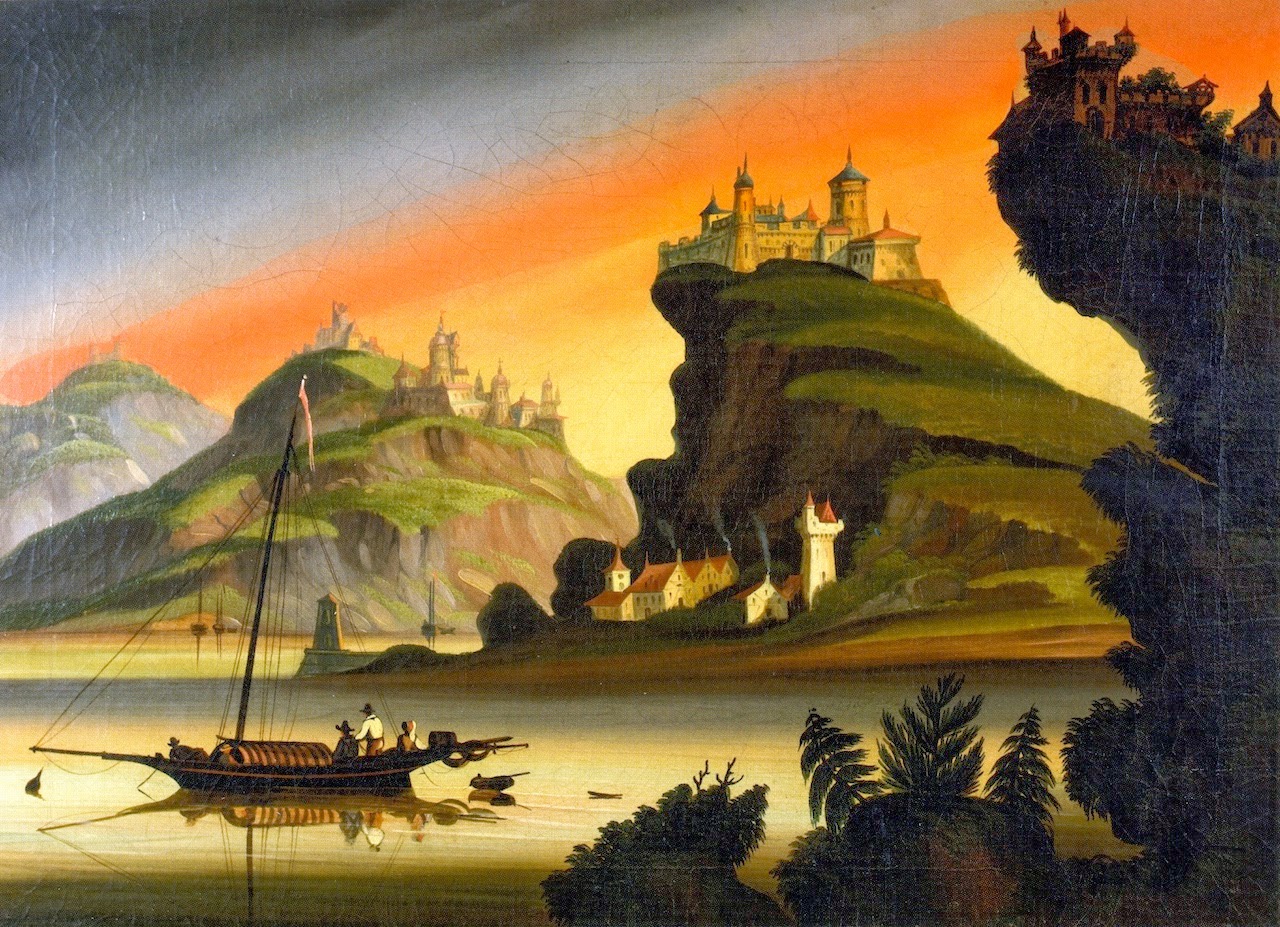
The centerpiece of UMass galleries is its Contemporary Art (UMCA) facility inside the Fine Arts Building (FAC). Let me get this out of the way. I’m a UMass alum and I teach there. I adore the big sprawling university, but the FAC–which dominates the end of the bus circle at the campus main entrance–is the ugliest building east of Boston City Hall, a hulking white whale that legend holds is supposed to look like a monumental piano from the air. It doesn’t; locals dub it the Starship Enterprise (in concrete). It’s also an appallingly awful place for anything related to the arts and one can only admire anyone who displays beauty amidst such brutalism. My chapeau tip goes to director Loretta Yarlow, who does interesting things in a space that could be better used to store drywall.  Changing exhibitions are the UMCA’s s trademark (consult https://fac.umass.edu/UMCA/Online/). Right now there are two very interesting exhibits.  The first is from New York-based artist Katy Schimert, who is serving as an artist-in-residence. Her large paintings are watery and water-themed, but they also have a hand-dyed quilt-like quality. She has a fascination with the octopus, but as rendered in dreamy semi-abstractions. She also renders sea bottom ridges in glass that are evocative of psychedelic Bakelite. Her love of the sea is also represented by four canvases from the relatively unknown Thomas Chambers (1806-86). I was smitten by two depicting castles on the Rhine that are reportorial, but which also evoke the fanciful hilly landscapes imagined by 17th century Dutch artists if they had used colors by Instagram and the sensibility of early video games such as Myst.

Thomas Chambers Castles on the Rhine
When you see ‘famous’ artists at UMass, it’s usually in the form of drawings or photos. There’s currently a nice exhibit titled “Fractured: The Modern Nude,” that sports depictions (mostly photographs) from luminaries such as Andy Warhol, Diane Arbus, and Jared French.

As noted, Hampshire College has very little in the way of a permanent collection, but what it does have is a student body and faculty that march to a different drummer. Its gallery, located in the basement of the library, tends to supplement offerings on urban history, ethnography, natural sciences, and the visual arts. There’s generally some student and faculty art on display. Most of what you see there is from artists whose names you don’t know–yet. A recent show featured photographs of James Baldwin; the current show is of work from Hampshire’s Division III (advanced studies) students. Much of it is gloriously off-kilter and unusual. Ken Burns is a Hampshire grad and his visual arts focus endures at Hampshire.   Rob Weir