1/9/19

Cody Jackson, Dave Burchfield, Rachel Baiman: Recent Releases


Cody Jackson, Where the River Meets the Sky (EP)

Isn't Cody Jackson a great name for a musician from British Columbia? The talent matches the handle. As heard on his new 5-song EP, Jackson sports a big voice that often calls to mind the husk in Richard Shindell's timbre. "Where the River Meets the Sky" isn't a good song; it's a great one. When Jackson airs it out, you can conjure big mountains, vast horizons, and cold rivers bending beyond the eye's vanishing point. The album version has added reverb, but I've seen videos of Jackson doing this one justice solo, and the fact that he plays an Epiphone dreadnaught further endears him to me. (It was my first guitar.) I also admire Jackson's ability with the pen. Who hasn't had a relationship that could be described as "Right Place, Wrong Time?" In spirited bursts and stops, Jackson proceeds to sing: We started out as two unknowns/A king and queen of different roads. That line alone tells you things probably won't go well. Ditto a line from "Unchanging:" I know I'm free of sin/But my actions speak differently. My second favorite song (after the title track) is "Cherished One," which is sparse yet powerful. Jackson builds the song through the use of ever-so-slight catches in his voice that dial drama up a notch without venturing into overkill territory. As a musician, singer, and songwriter Jackson is both expressive and impressive. ★★★★

Dave Burchfield, Beginnings

Dave Burchfield took a six-year hiatus from music that he thought would be permanent, but he's back with a band and a new EP that's ironically titled Beginnings. This is bluegrass from the folk end of the spectrum. He often takes his time laying out his tune and his light voice can sometimes get lost even though the melodies are generally quiet. Still, it's nice to welcome him back onto the trail. Sample "Arkansas" with its spare but pretty melody. "Have Tried" is also a good one, a waltz about that age-old dilemma: is this relationship working or not? ★★★


Rachel Baiman, Thanksgiving  (EP) 

Rachel Baiman sings, plays banjo, saws a mean fiddle, and can pick it on the guitar. You can sample her country, bluegrass, and old time music wares on her new EP Thanksgiving. Baiman has been clearly influenced by the late John Hartford. You can hear this on "Tent City," whose melody lines evoke "Gentle on My Mind." She also does a cover of "Madison, Tennessee," which isn't one of Hartford's but was penned by the John Hartford String Band. There's a fine video of her singing this one with Molly Tuttle and if you're not impressed by Tuttle's cross picking, there's no pleasing you. I will caution that Baiman's voice is nasal and deliberately muddy at times. This might not be everyone's taste, but she sure can play. ★★★
-->

1/7/19

Mary Queen of Scots? Not Really


Mary Queen of Scots
Directed by Josie Rourke
Focus Films, 125 minutes, R (violence, brief nudity, implied homosexuality)
★★½


Audience scores for Mary Queen of Scots have been tepid and it’s easy to figure out why. The 16th century players and details of Mary Stuart’s tragic reigns are convoluted even for historians who have studied Scottish and English history. For the non-historian, it would take a mini series to clarify the key figures, motives, and intrigue–not two hours plus change. Director Josie Rourke could have gone in either of two directions: simplify the details and withstand the wrath of historians; or just call the film Mary, make it fictional, and state at the end that it was loosely based on Mary Queen of Scots (1542-1587). Alas, director Josie Rourke tried to hybridize those options.

Rourke ought not to have assumed familiarity with the events portrayed on the screen. I overheard two remarks as I was leaving. “I had never heard of Mary Queen of Scots,” said one woman. Her friend replied, “I think she’s the one they called Bloody Mary.” (Nope!)  If you want to get a sense of the challenge Rourke faced, just peruse Mary’s Wikipedia entry and tell me how much of it you understand the next morning.

Here’s a Mary Queen of Scots skinny. The Tudor family took over the English throne after the War of the Roses (1455-1487). Years later, a Tudor you’ve heard of, King Henry VIII, went through six wives in his quest for a male heir. When his first wife, Catherine, failed to bear a son, Henry sought an annulment. When the pope refused, Henry booted the Catholic Church, and England became a Protestant nation. His third wife gave him a sickly male heir, the future Edward VI, but he died in 1553 with no issue. At that point Mary I, Henry’s daughter to Catherine, took over the throne and held it from 1553-1558. She was history’s “Bloody Mary,” as many died in her attempt to reinstate Catholicism in England. Guess what happened when she died? Her Protestant sister to Henry’s second wife took the throne. Queen Elizabeth I ruled England for 50 years (1553-1603)., which didn’t sit well with those Englishmen who were Catholic.

Henry never sired a virile male, but some of his siblings did. The following questions mattered in the 16th century. How closely related to Henry were those seeking to sit on the throne? What was their gender? Were they Protestant or Catholic? Mary I and Elizabeth I were direct offspring, but this was not a time in which a woman’s right to rule was widely accepted. Had Elizabeth birthed a male child, she would have gone from queen to regent­–a caretaker­­–until her son reached a suitable age to rule. Elizabeth sidestepped this by never marrying. (Whether or not she was the “Virgin Queen” of legend is unclear.) In other words, females were pawns in a male political game.

That’s the deep background of Mary Tudor (1542-1587), except for this. Mary had a better claim to the English throne than her cousin Elizabeth, as Mary’s lineage passed through proper male bloodlines. At 14, Mary Tudor was married to the heir to the French throne. She was queen for 13 months when her husband suddenly died. She returned to Scotland (where she was queen) in August 1561, an attractive 17-year-old widow.

Mary Queen of Scots (Saoirse Ronan) is set in the crucial year of 1569. Suffice it to say that very few in Scotland wanted a kingless queen­, especially not her illegitimate half-brother, the Earl of Moray (James McArdle), who had been regent until Mary returned; or the Protestant firebrand minister John Knox (David Tennant), who added sexism to his long list of intolerances. In 1565, Mary wedded her comely first cousin Henry Lord Darnley (Jack Lowden), an error of judgment. Darnley was frivolous, vacuous, vicious, and (probably) gay. He managed to help murder Mary’s beloved Italian secretary David Rizzio (Ismael Cruz Córdova) and impregnate Mary with the future James VI of Scotland/James I of England before his many enemies engineered Darnley's death. They also forced Mary to marry the Protestant Earl of Bothwell (Martin Compston), who probably raped her. With her son in the hands of the Earl of Moray and danger everywhere, Mary fled to England and hoped that her cousin Elizabeth (Margot Robbie) would protect her. Had Mary been less proud and scheming that might have happened but in 1587, she went to the chopping block as an accused traitor.

If your head is swimming, I can assure you that this summary is more coherent than the film. The film has a few redeeming features, the biggest of which is Ms. Ronan. Unless I miss my mark badly, she will soon become the Meryl Streep of this generation. Her Scottish accent is really good; she carries herself with royal, often haughty dignity; is physically appropriate for Mary; and is luminous on the screen. Also wonderful is John Mathieson’s cinematography, even if those who’ve been to Scotland and northern England recognize that his is an often-illogical travelogue of images. David Tennant is also spot-on ominous as Knox. He even looks like the statue of Knox in Edinburgh’s St. Giles Cathedral.

Nonetheless, Rourke’s hybridization efforts call attention to the film’s ahistorical details. She calls upon a crew of National Theatre actors to flesh out the cast. Each is up to the task, but none of them would have held such important positions in the 16th century, and you will see more black actors on the screen than you’d see in a month of travel in Scotland. Rourke also attempted to make a feminist bonding film. Okay, but to do so, she reduces Mary and Elizabeth to sob sisters (semi-) bonding over male dominance. (In real life, the two never met face-to-face, and no one ever said Elizabeth was soft!) In addition, Robbie is merely a so-so actress and she’s out of her league cast against Ronan.

Let me state again that a film about rivals in love, politics, and power simply called Mary would work better–sans Max Richter’s overdone soundtrack–but what we see simply isn’t Mary Queen of Scots. Alas, I can foresee others leaving the theater saying, “I never knew there was a Mary Queen of Scots.”

Rob Weir
-->

1/4/19

Roma a Not-Quite Masterpiece


Roma  (2018)
Directed by Alfonso Cuarón
Netflix, 135 minutes, R (absurd rating for full frontal male nudity)
In Spanish, Mixtec, English with subtitles
★★★★


I know several friends who grew up with household servants. They insist that they considered those individuals to be “members of the family.” It’s a nice sentiment and they no doubt mean it, but it’s also the ultimate bourgeois conceit. The “help” almost always have families of their own, plus they cannot be family members for the same reason that a president cannot really have “consensual” sex with an aide; the power differential creates a gulf between superior and subordinate.

Mexican director Alfonso Cuarón’s new film is what reviewer Owen Gleiberman sagely calls a “meditation” on his boyhood. The title refers to the middle-class section of Mexico City where Cuarón lived as a child, though you could be forgiven if your immediate thought was of Fellini. Roma is gloriously filmed in black and white and its episodic structure is evocative of earlier auteurs such as Fellini or Bergman.

Roma centers on an haute bourgeois family in the early 1970s. This was a chaotic moment in Mexican history in which a series of American-backed authoritarian presidents were in power that didn't hesitate to unleash the Mexican army to put down student protests. If you recall or have read about Kent and Jackson State, you know how the combined six deaths threw American society into paroxysms of anger and remorse. That was peanuts compared to Mexico, where the army killed hundreds in 1968, and another 120 during the Corpus Christi demonstration of 1971. The latter is touched upon in Roma and “touched upon” is the right description. We see it from the POV of our middle-class family as they watch from the window of a furniture store to which they’ve thoughtlessly traveled because their pregnant maid needed a crib.

The latter act is one of the ways in which those with money spin the “member of the family” tale. Roma focuses closely on Cleodegaria Gutierrez (Yalitza Aparicio), one of two live-in maids caring for a middle-class family with four minor children. “Cleo” (named for an Agnes Varda film!) is from an impoverished Mesoamerican Indian family. She and coworker Adela dearly love the children, hence materfamilias Sofia (Marina de Tavira) doles out small kindnesses and considers herself their benefactor. That is, until she barks orders at them to clean up the shit in the narrow patio/garage where they keep their dog penned all day, or when she nudges them to drop everything and run an errand. Much of Cuarón’s film is silent; he needs no words to convey how hard Cleo and Adela work while Sofia and the children obliviously move through their routines as if it’s the most natural thing in the world to have others pick up after them or indulge their spontaneous whims.  

The class dynamic is all the more absurd given that this bourgeois family is dysfunctional to the point of impending dissolution. The father is an egotistical doctor who is as tyrannical as the country’s leaders. Although the kids initially think he’s on his way to a conference in Quebec, he’s actually leaving them for his mistress. To add to the already lopsided gender dynamics of the 1970s, it was very hard to force men to support the children they abandoned–a dynamic that plays out several ways in the film. Sofia seeks to maintain a veneer of materialism and stability, but we suspect the handwriting is in the wall.

Roma is also a film about race. If anything, Mexican society is more racially stratified than that of the United States. Some have called it a caste society, as Mexico parses race in more than the black/white paradigm that prevails in the United States. There is, however, no doubt that Spanish-speakers of Iberian origin view themselves as superior to indigenous peoples such as Cleo and Adela. The scene of Cleo visiting her village displays poverty and deprivation that evoke South African townships under apartheid.

Class, gender, and race…. These certainly give Roma contemporary relevance, even if the setting is in the 1970s. There are other reasons to watch this film. First among them is the astounding cinematography. From the opening shots of water rushing across tiles and swirling into a drain onward, Cuarón’s assemblages of images gives credence to my long-held assertion that black and white is frequently a more creative medium than color. If you're skeptical of that remark, watch carefully the wordless sequence of five people in a car returning from a beach holiday and get back to me. Cuarón uses light and contrast in ways that rival the impact of Peter Bogdanovich’s The Last Picture Show.

Several critics have hailed Roma as the best film of 2018, and it has already won several awards. I understand the hoopla, but I must stop short of declaring it a masterpiece. The film’s problems occur when Cuarón has to do more than just point the camera. His is not really a conventional narrative but still, there are so many telegraphed scenes in this film as to suggest Chekov’s gun was loaded with a full clip. At every juncture the story could have veered, Cuarón aimed straight toward where you would anticipate. Why such a conservative script for such innovative filmmaking? This is a semi-autobiographical film and Cuarón is still in touch with the woman upon whom Cleo is based. One wonders if there is also a way in which Cuarón still doesn’t quite get the racial dynamics of his own film. By this I mean there is a way in which this film could easily be read as a depiction of the Noble Savage, an inference that seems especially palpable in the film’s closing sequence.

Cuarón is the director who also gave us Gravity, Y Tu Mama Tambien, one of the Harry Potter films, and Children of Men. The last of these remains his masterpiece, though Roma is a superior work of craft. It is an almost-masterpiece, but Cuarón didn’t get enough distance from his past to see the full extent of his childhood false assumptions.  Rob Weir

1/2/19

No Man's Land at Smith: Reasons to Remember WWI


No Man’s Land: Prints from the Front Lines of WWI
Smith College Museum of Art
Through February 17, 2019


By the time you read this, a lot of hoopla about the end of World War I will be over. That’s because we love anniversaries that end in a five or a zero, but we don’t get overly excited by, say, the 101st year since a historical event occurred. World War I famously ended on “the eleventh hour of the eleventh day of the eleventh month” in 1918. .

2019 will bring its own anniversaries to the fore, but we should not forget World War I. More than any other event, it shaped the subsequent structure of the 20th century, which–all things considered–was not one of humanity’s finest historical periods. There were many problems before World War I guns began firing, but consider how different the world was before and after. Old aristocracies were swept away, but many of the new civil governments were corrupt, weak, bankrupt, or all three; perfect conditions for the rise of fascism. The Russian czar gave way to a Bolshevik Revolution that ultimately devolved into a Stalinist nightmare and led to a Cold War long before anyone thought of using that term. The WW I armistice wasn’t even signed before a flu pandemic broke out that killed more than the war. A global economic depression loomed on the horizon, as did another world war, a declared Cold War, an arms race, weapons of mass annihilation, and untold numbers of small conflicts that threatened to bring on World War III.

William Strang "The Convalescent"
Conservatives are fond of using World War II as an example of why pacifism doesn’t work. They ought to pay more attention to the lesson of World War I: that wars generally don’t resolve much and quite often leave behind worse problems than those addressed by conflict. Gaze upon the prints, postcards, scrapbooks, photos, and paraphernalia displayed at the Smith College Museum of Art (SCMA), and you’ll get a glimpse of war’s ugliness, futility, and horror. No Man’s Land will never show up in military recruiting ads. There was very little logic to World War I and there surely wasn’t much glory either.


Artists whose names you probably don’t know died in the war. You don’t know of Franz Marc, for instance, because his bud was plucked before it could flower. Those who survived were deeply impacted by what they saw. It is no accident that cubism reached its highest expression after the war. If the work of someone such as Georges Braque confuses you, ask why you would expect those who witnessed the Great War to see the world in anything other than abstract and fragmented forms. 

Kerr Eby


Otto Dix
There aren’t many American artists represented in the SCMA exhibit and that is as it should be. Kerr Eby is a noted exception. It was, after all, Europe that bore the brunt of trench warfare, gas attacks, and senseless charges across barbed wire terrain on their way to senseless death. When Otto Dix sketched the conflict, he didn’t see grand military pageantry, he saw grotesque waste such as he conveyed in “Wounded Soldier, Autumn 1916.”  In fact, whenever on-the-scene artists presented soldiers marching or riding off to war, it was more akin to shades entering a void. Much was viewed as humanity’s undoing. Consider, for instance, that a grand Gothic cathedral such as that in Rheims, France, took centuries to complete. Then look at Raoul Varin’s depiction of how all was undone in 1917.   
Varin, "Rheims"


McBey, "The Torpedoed Essex"
Quite a few images come from Scottish artists, especially James McBey, David Muirhead Bone, and William Strang. If these names aren’t familiar to you, it’s because their work discomforts and depresses. That might have something to do with the fact that English commanders often deployed Scots, Australians, Canadians, and New Zealanders for suicidal forays. How to display the nightmare? Boston Globe critic Mark Feeney observed that new styles such as cubism and futurism were trotted out but, “Most of all, it was an Expressionist war.” For those unfamiliar with the term, it’s something of Impressionism’s opposite. Impressionists sought to convey new ways of showing what they saw; expressionists showed us how art could convey feelings and emotions. Max Beckmann is perhaps the most famous of the artists on the wall, but his "The Large Operation" isn't an impression; it's a lamentation. 
Beckmann, "The Large Operation"


Grosz, "The Hero"
There are military medals on view at the SCMA, but they feel both inappropriate and ironic. This is a powerful exhibit and you should take time to linger over what might first seem rough sketches or quick sketches. You won’t find much that bespeaks military heroism. World War I was a lethal freak show. We should ponder that and look away from modern military recruiting ads with their emphasis on testosterone-fueled images of manhood and faux promises of glory. Above all, we should rage against the lie of antiseptic warfare. When the guns fire, people die. As the George Grosz sketch "The Hero" reminds us, war isn’t pretty.

Rob Weir

12/31/18

2018 Best and Worst in the Arts


2018 Best and Worst of the Arts

Time for the end of the year reckoning of things I loved and didn't. I admit that lists of this sort are often subjective, but here goes. A reminder: I'm not impressed by things that were first released only in New York and/or LA, so a few of these books, films, and recordings, are technically 2017 releases. We should honor things in the calendar year in which most Americans have access to them.

Anything underlined links to longer reviews. The lists below are in preferential order. 


BOOKS

The Best:

1. Michael Ondaatje, Warlight:  Wars don't end when the fighting stops.
2. Richard Powers, The Overstory: Yes, it's about trees and you should care.
3. Gail Honeyman, Eleanor Oliphant is Completely Fine: You'll laugh; you'll cringe.
4. Kristin Hannah, The Great Alone: Alaska. Mother Nature doesn't care.
5. Walter Mosley, John Woman: Reinvention, of a sort.
6. Stephen Markley, Ohio: Blue-collar grit, hopes, and despair in the Heartlands.
7.  Jesmyn Ward, Sing, Unburied, Sing: Memory, history, and slavery's legacy.
8. Jennifer Egan, Manhattan Beach: Girl power, redemption, and danger.
9. George Saunders, Lincoln in the Bardo: Spoon River and its ghosts updated.
10. Tim DeRoche, The Ballad of Huck and Miguel: Huck Finn in the 21st century.

Books that Wasted Trees:


1. Billy Coffey, Steal Away Home: Preaching posing as a baseball novel.
2. Lauren Groff, Florida: Snakes, gators, losers, and who cares?
3. Anna Quindlen, Alternate Side: Well-written book but unworthy characters.

MOVIES


Best on Screen:

1. Leave No Trace: Debra Granik scores again with her tale of damaged people who just want to be left alone.
2. BlacKkKlansman: Spike Lee's improbable but true tale of a black KKK member.
3. A Fantastic Woman: My vote for the best film about a transgendered person.
4. The Insult: Palestinians and Christians failing to exorcise the past.
5. On Chesil Beach: Overlooked gem of young love derailed.
6. Love, Gilda: Documentary that does justice to Radner's genius.
7. RBG: Call this documentary the making of a Supreme Court justice.
8. Roma: Beautifully filmed, though flawed remembrance of a family maid. Best             cinematography of the year.
9. Eighth Grade:  So well done you'll relive the pain!
10. Won't You Be My Neighbor? Great year for documentaries. Good time to remember Mr. Rogers.

Please Turn on the Lights!


1. Three Identical Strangers: If a scandal isn't a scandal, why film it?
2. Victoria and Abdul: Enough with the warm fuzzy Queen Victoria genre already.
3. I Tonya: Billed as a comedy about Tonya Harding. I didn't laugh.
4. Professor Marston and the Wonder Woman: Does it take talent to make a boring  film about fascinating subjects? Not really.
5. Planetarium: What I just said above, with séances.
6. The Circle: This Google-not-Google movie is an episodic mess.
7. The Death of Stalin: Comedy as broad as Siberia left me chilled and surly.
8. From the Land of the Moon: Marion Cotillard imagines things, such as that there might be a point to this movie.
9. Nuts:  What I said in 4 and 5 above, but with goat glands.


MUSIC


This is always the hardest category for me to judge. So much good music. So many talented folks–young and old.

New Releases:

1. Moira Smiley, Unzip the Horizon: Innovative, inventive, bold & miles from her Solas days.
2. Thea Gilmore, Run: A veteran British chanteuse with a powerful voice.
3. Eleanor Dubinsky, Soft Spot of My Heart: Multilingual cross-genre music that's just flat-out gorgeous.
4. Kittel and Company, Whorls; Jeremy Kittel takes bluegrass fiddle deep into jazz  terrain and paints contemplative moods.
5. Gretchen Peters, Sad Songs Make Me Happy: Hear the woman whose pen launched dozens of country hits.
6. Eliza Gilkyson, Secularia: Can an anti-religion album be spiritual? Yep.
7. Vivian Leva, Time is Everything: Spare and pure mountain music vocals.
8. Mink's Miracle Medicine, House of Candles: The miracle is Melissa Wright! Country and folk without gimmicks.
9. Greg Hawks, i think it's time: Time for country-influenced artists to address issues from the left side of the political spectrum.
10. Too many good people to leave off the list, so a collective shout out to Anita Aysola, Big Little Lion, Don Gallardo, Guy Menilow Ensemble, John Gorka,  Newpoli,  and Graham Stone.

Change the Earbuds:


1. Catherine Bent, Ideal: Not! Cello meandering to nowhere.
2. Elena Andukar, Flamenco in Time: Maybe hip flamenco isn't really a thing.
3. UNIFONY, Unifony: Three Euro jazz giants make a dull record.
4. Katie Herzig, Moment of Bliss: Pop grooves that failed to induce bliss.

Best Live Shows of 2018:

1. Richard Shindell: He was 100% on at the Parlor Room with new and old material and an alphabetical set list!
2. Cowboy Junkies: After 6 weeks on my back, the Junkies at the Academy of Music helped me heal.
3. James Keelaghan: James never gives a bad concert and pulled out the stops all weekend at the New Bedford Folk Festival.
4. Musique à Boucher: The surprise hit at New Bedford. A Capella mouth music of the most spirited kind. Surprising as their CDs are restrained.
5. Eliza Gilkyson: An intimate evening at the Parlor Room with a Texas treasure.
6. Jim Henry: Our own Western Mass hero. His Parlor room show was a love fest.
7. Richard Thompson: His electric show at the Academy needed a better mix, but he  rocked the joint.
8. Rory Block and Cindy Cashdollar: The warm-up act trumped the headliners.
9. The Weepies: Amazing harmonies and a refreshing December show with no holiday music!
10. The Kittel Trio: Not your mother's bluegrass at the West Whatley Chapel.

Not Feeling It:

St Paul and the Broken Bones opened well at the Academy of Music, but then everything sounded exactly the same. Better shtick than repertoire.

I simply don't get the hype surrounding Lake Street Dive. I love vocalist Rachel Price, when she sings in a register quieter than Celine Dion at an airport. Lots of glitz and light show bling that makes them more of an experience than a musical act. Boring. I wish Rory Block and Cindy Cashdollar had headlined.  

12/28/18

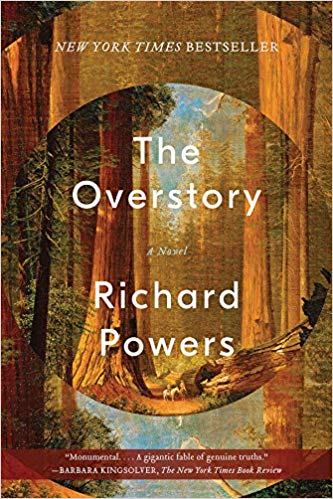
The Overstory is Brilliant and Unsettling


The Overstory (2018)
By Richard Powers
W. W. Norton and Company, 502 pages.
★★★★★

Pete Seeger used to muse, "The human race, if it survives...." Richard Powers' magisterial and National Book Award-winning The Overstory, might lead you to conclude that the best hope for the planet would be humankind's demise.

Powers dons the mantle of a literary sociologist/biologist with a deep streak of sympathy for eco anarchists. His is a hard novel to explain, but it is both an important book and—despite its bleak assessment of our species—a joy to read. Stick with me; it's more about trees than humans. Powers draws inspiration from Peter Wohlleben 's 2015 bestseller The Hidden Lives of Trees. Powers sees trees as social, migratory, emphatic, and communicative. They sing, warn each other of dangers, feel pain, remember, and forecast the future. If that sounds too crunchy for you, consider that there are trees—increasingly fewer—that have lived since Jesus was on earth. Powers writes, "… [T]he word tree and the word truth come from the same root." The Overstory opens with a two-page meditation that closes with this line: "The pine she leans against says: Listen. There is something you need to hear."

The Overstory is an ambitious novel with nine major characters; ten if we consider Powers as an interlocutor. It has two major themes that are philosophical questions of the highest order. The first is: Who owns the earth? The second comes from the character Doug Pavlichek, a former Vietnam War pilot who plants saplings to placate an eco consciousness that awoke when he was shot down and his parachute came down in a banyan tree. His question is coarse, but on target: "What the fuck went wrong with mankind?"

Nature and plants define all of the characters in the book. Nick Hoel, a fifth generation Iowan, is the last heir to a tree many thought extinct, the American chestnut. We meet him as he's trying to give away his art and about to lose the farm. Only one person bothers to exit the highway to explore his free art offer, Olivia Vandergriff, a lass whose life took a new turn after she electrocuted herself while stoned, but was revived. Patricia Westerford—clearly patterned after Wohlleben—also took new turns. As a graduate student, her theories of tree intelligence met with such ridicule she was dubbed "Plant Patty" and driven from academia. She retreated to Oregon, became a park ranger, and is 'discovered' in her old age. Needless to say, she is deeply conflicted about all of this. 

We also find Mt. Holyoke grad Mimi Ma, who is shocked when the mini park outside her office is taken down; and Adam Appich, a psychologist studying activist mindsets who becomes a covert convert. Ray Brinkman and Dorothy Cazaly were college sweethearts and actors who planted a tree on each anniversary, until ennui turned the flame to a smolder. And then there is the intriguing Neelay Mehta, a precocious computer geek who "skitters through the schoolyard like a traitor to childhood." His life changes when he is paralyzed from a fall from an oak tree. From his wheelchair, he designs elaborate games and complex alternative universes that make those of Second Life and Sim City look as simple as checkers.

All nine will, in various ways, be drawn into the battle for the planet, several of them gravitating to a radical activist group modeled on Earth First. Such struggles take place against long odds. Powers is no Pollyanna when it comes to tree huggers and radicals. At times you will find yourself wondering whether you are reading about the only sane people left on the planet, or a band of dreamers who make Summer of Love hippies seem like pragmatists. Powers pits them against an industry that is the wood-based equivalent of oil and coal barons intent upon extracting resources until the last penny is earned from them. As in most such confrontations, the ones accused of being "violent" are not the ones who light the first fuse.

Powers' sympathy is with the trees, but his skepticism parallels that of Doug Pavlichek: "The greatest flaw of the species is its overwhelming tendency to mistake agreement for truth." (You can almost hear Al Gore shouting "Amen!" from the wings.) There are magic words we use: jobs, housing, renewable resources, reforestation…. Yet, as Westerford contemplates the question of how to best help the world she realizes, "The problem begins with the word world. It means two opposite things. The real one we cannot see. The invented one we cannot escape." Wisdom lies in what is hidden: "The beech told the farmer where to plow. Limestone underneath covered in the best, darkest loam a field could want." Powers vividly describes the worlds that dependent upon trees. As he puts it, "People aren’t the apex species they think they are. Other creatures–bigger, smaller, slower, faster, older, younger, more powerful–call the shots, make the air, and eat sunlight. Without them, nothing."

This is such a beautifully written book that you can unearth Websites devoted to quotes from it. Ultimately, though, Powers' message is, "Be still and feel." Then act and hope that it's not already too late to reverse what went wrong with mankind.

Rob Weir
  

12/26/18

Hark is a Misfire Remake of Being There


Hark (2019)*
By Sam Lipsyte
Simon & Schuster, 304 pages
★

There is a thin line between that which is snarky and hip, and prose that loses its impact. Sam Lipsyte's Hark weaves across both sides of that border on a regular basis.

The first chapter, which serves as something of a prologue, is so chaotic that I almost bailed on the novel before I even got started. I received an uncorrected advance copy, so perhaps editors have rescued the book's gateway, but the rest of what I read is a mix of sharp satire and sociology masquerading as fiction. Maybe Hark rushes to a brilliant conclusion, but I can't comment upon this. Hark is a work that I kept pushing aside in annoyance and picking up again in the hope that I was missing something. There will be no spoilers in this review; I gave up for good two-thirds of the way in.

Lipsyte's intent is to skewer celebrity culture, as well as Americans' rush to jog down a dollar-strewn path to bliss. His antihero is Hark Morner, who just wants everyone to "focus" and pay attention. His is essentially a Ram Dass Be Here Now point of view that replaces Dass' idea of building mental mandalas with "mental archery." What is mental archery, you ask? It's pretty much as it sounds. There are 52 exercises in which one strikes various archers' poses. There is no quiver or arrow; the act of moving and visualizing allegedly helps one "focus." This is an intriguing backdoor critique of the American Rut, one marked by rushing from one mindless task to another, and the anesthetizing effects of helter-skelter surfing in a plugged in and screen bound world.

Hark's only message is that we need to "focus," but American society isn't big on simple messages unless they can be monetized. Hark is a blissful naïf, but his devotees are neither. Lipsyte populates Hark's world with those who think mental archery is a marketable concept, though they've clearly failed to achieve the focused state Hark advocates. Or, more accurately, they are focused on quite different goals. Hark wants to give mental archery to the world as a gift; his devotees want to promote him as a pay-to-see guru.

Hark is thus shoved into a world of hucksterism and hype that he neither desires nor understand. Imagine a motivational speaker who only tells people to focus. No one would pony up to hear that, right? Wrong! The best parts of Lipsyte's novel probe how easy it is to get people to buy bromides and placebos, no matter how improbable or trite. Hark doesn't even tell his massed audiences what we should focus upon. He is akin to a benign and clueless Wizard of Oz, but there is no Toto to pull back the curtain.   The problem, though, is that because we already know this, we plow through Hark hoping to find interesting character backstories. Alas, mainly we find a cast that's either amoral, dull, or both. What is left is a lampoon for the yoga-and-sprouts crowd that they probably won't get.

I leave open the possibility that others will find this book funnier than I. There is, however, no getting around the fact that we are riding the one-trick pony that is the runt litter of a mighty stallion: Jerzy Kosinski's Being There (1970). Hark Morner is an updated Chance Gardner, the shut-in innocent groundskeeper set adrift, and whose knowledge base consists of advertising hooks he overheard on television. Chance is similarly embraced and promoted by those seeking easy answers. Toss in the focus angle from Robert Pirsig's Zen and the Art of Motorcycle Maintenance (1974) and Barbara Ehrenreich's Bright-sided (2009), her searing critique of the positive thinking movement, and you've got Hark.

There is, of course, room for revisiting old ideas; with the exception of Ehrenreich, we are talking about decades-old works. Alas, Hark is not that book. Lipsyte's pursuit of a hipster vibe that is just out of his reach is made manifest in a lack of thoughtful or likable characters. This distances the reader from both the humor and the author's chosen tone. Regarding the latter, there is a sense that maybe Lipsyte really wanted to remake the values-challenged world of Bonfire of the Vanities.

Once again, I cannot comment upon how Lipsyte resolved (or failed to resolve) all of this. I guess I lost my focus.

Rob Weir

* This book is scheduled for release in 2019, but it's already widely available.