2/7/22

Love at the Worcester Museum of Art


LOVE STORIES FROM THE NATIONAL PORTRAIT GALLERY, LONDON

Worcester Museum of Art

Worcester, Massachusetts

Through March 13, 2022


London’s National Portrait Gallery is an underappreciated gem. It’s filled with so many splendorous things that it can loan enough items to fill a large exhibition. That’s a good thing indeed if you can get to the Worcester Art Museum (WAM) before March 13. Call Love Stories from the National Portrait Gallery the perfect art show for Valentine’s Day. It consists of lovers from the 15th century to the present. Best of all, its definition of love is broad.


The Sandys 1571 Artist Unknown


In that spirit, the first thing one sees upon entering the gallery is a series of photos of Audrey Hepburn (1929-93), surely one of the most beloved screen stars of all time. I’ve heard it said that she was the kind of person who, upon first viewing, one simply wished to cuddle. I’m not sure everyone felt that way, but I surely did. But to jump back in time, I was also enamored of a double portrait of Edwin Sandys and his wife Cicely. You wouldn’t infer from their faces, but theirs was a forbidden love; as Archbishop of York before the Reformation, his marriage was deemed illegal. Yet he and Cicely had nine children, so stuff that in your papal mitre and smoke it!


Burton and Taylor by Terry'Neill 1971


Paul and Linda McCartney by Humphrey Ocean 1976

John and Yoko by Tom Blau 1969

Hughes and Plath by Rollie McKenna 1959


John Maynard and Lydia Keynes by William Roberts 1932


I’ll circle back to forbidden love, but first let’s take a look at famous lovers. Robert and Elizabeth Browning fell into that category, but I was more moved of a bronze casting of their intertwined hands than of their painted portraits. Being that WAM borrowed from a British collection, we see paintings and photographs of famous UK lovers, even when their main squeezes are from the Colonies and beyond: Paul and Linda McCartney, Mick and Bianca Jagger, Prince Harry and Meghan Markle, John Lennon and Yoko Ono, Richard Burton and Elizabeth Taylor, Ted Hughes and Sylvia Plath, Lord Byron and Lady Caroline Lamb, and John Maynard Keynes and Lydia Lopokova, among others. The latter has a particularly unusual quality, as John Maynard is painted conventionally for the time, but Lydia has an art deco abstracted look. 


Helen and Kate by Graham Hughes 2014 


Strachey

Pears and Britten by Kenneth Green 1943


The exhibit isn’t confined to heterosexual love. You can also see Oscar Wilde posing with Lord Alfred Douglas, Gertrude Stein and Alice B. Toklas, singer Peter Pears and composer Benjamin Britten, Olympian gold medalists Helen and Kate Richardson-Walsh, and Lytton Strachey and Dora Carrington. The latter couple had perhaps the most daring of all relationships. Theirs was a lavender marriage, a term indicating that he was a gay man and she a lesbian. I posted Strachey’s painting by Carrington, as it captures Strachey’s understated effeminate qualities.


Ellen Terry by Watts, 1864


Peake and Gillmore, 1940s


Other items in the exhibition are simply stunning images. George Frederic Watts’ oil of his young bride actress Ellen Terry is one such image; artists Maeve Gilmore and Mervyn Peake’s oil paint selfies another. It’s hard not to see the humanity in Ford Maddox Brown’s painting of Henry and Millicent Fawcett, as she tenderly ministers to her husband who was blinded in a hunting accident. The most unorthodox image is surely Ben Nicholson’s self-portrait with Barbara Hepworth, a marriage made in modernist heaven. There is even unrequited love such as that painter George Romney (1734-1802) held for his muse Emma Hamilton, a maid and a bawdy one at that.


The Fawcetts by Ford Maddox Brown, 1872


Nicholson and Hepworth 1933


If you are one of those who tend not to read museum labels, I understand; many curators tell us way more than we need or want to know. I would, however, urge you to break that habit for this exhibit. Those wall placards tell us about the relationships as well as the art and many of the former are touching. In the time of pandemic, maybe all we need is love.


Rob Weir


2/4/22

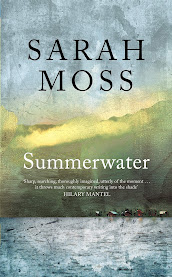
Summerwater: Brilliant or Annoying?


SUMMERWATER (2020)

By Sarah Moss

Picador, 125 pages.

★★ ½ 


If you thought I was neutral about the movie Dune, I’m positively cowardly in my evaluation of Summerwater. I rated it 2 ½ stars because my wife loved it and I was pretty much annoyed with it from start to finish. Luckily, at just 125 pages, the finish came quickly. It’s short because its inspiration is a poem: William Watson’s “The Ballad of Semmerwater.” You will notice that Watson wrote Semmerwater rather than Summerwater. That’s appropriate, as the setting is in the Trossachs region of Scotland, where Watson’s spelling would be more in line with local brogues.


From what I gather from how others have rated it there is a decided gender breakdown concerning this novella from Sarah Moss. The best part of Moss’ work is that most of what we read is what is seldom said: the internal perceptions and judgments of characters, most of whom wouldn’t dare voice their thought bubbles. That’s especially the case because most of them are English and they are not known for being vocal about their emotions.


Think of Summerwater as one day in a vacation from hell. It is set in a holiday park, a British phrase that references destinations of various quality in which there are activities that encourage guests to stay within the camp confines most of the time. We infer from the context that this park is more rustic than posh. What is not open to interpretation is the weather. The six families gathered therein have seen rain, rain, and more rain. Most are going stir crazy and we all know that crazy is crazy. In such matters, reason tends to fly out the door.


Among the guests are a teenage boy forced to share a room with his sister and looking for a place where he can masturbate in peace. That leads to a kayak trip in the wind and teeming rain that could have ended quite badly indeed. There is a young married couple seeking mutual orgasm, or at least he is; she is thinking about everything else under the “bruise-colored clouds.” There are kids on a lochside swing set that sways over the water, an elderly couple peeking out at others, a man in a tent whom an obsessed jogger imagines an axe murderer (he’s not); a busy mother given an hour to herself and cleans because she can’t think of anything else to do; and a loud group of partying Eastern Europeans of indeterminate origin that induce outrage among everyone else–perhaps because they actually wish they too had joie de vivre.


Those who like Summerwater have praised its elemental qualities; that is, its mix of sky, water, animal, land, and human interactions. It also wins kudos for its style that has won raves from Hilary Mantel. That’s another way to tell if this book is for you. Mantel is the acclaimed author and two-time Booker Prize winner for her novels on Thomas Cromwell. If you think she’s a marvel, try Summerwater; if you find Mantel’s work more style than substance, you’ll feel the same about Moss.


An oft-made comment is that Summerwater is a funny book. It is amusing to contemplate what we might hear if the aforementioned thought bubbles took on a life of their own. My beef is that I didn’t care what any character thought about anything. They reminded me of those whom I got out of my way to avoid: whiny, self-centered people who complain about everything. Critical thinking is one thing, but you know the type to whom I allude, those with such low esteem that they judge others so they can feel self-righteously superior. But what do I know? Like I said, my wife loved this book.


Rob Weir

2/2/22

Dune: I'm Neutral


DUNE: PART ONE (2021)

Directed by Denis Villeneuve

Warner Brothers, 156 minutes, PG-13 (violence, language)

★★★


Go figure. The 1984 film version of Frank Herbert’s 1965 sci-fi novel Dune was a box office dud even though it had a famous director (David Lynch) and a cast of well-known actors. Denis Villeneuve directed the 2021 version and though he’s no hack, he’s certainly no David Lynch and his cast lacks the box office power of its predecessor. Yet the new Dune has raked in nearly $400 million.


We’ve learned that Dune can be popular, but it remains an open question whether it’s akin to Don Quixote and simply can’t do justice to a complex book. Villeneuve is certainly giving it his all, as the current 156-minute blockbuster is but the first of three installments. Will it be the next Lord of the Rings, which made $3 billion, or will it run out of steam? It might boil down to whether the measure is quality or what people will pay to see.


I’m already trending toward skeptical on the quality front. Villeneuve’s first film is a visual feast, courtesy of Greig Fraser’s cinematography, especially his sweep of geometric shapes carved by shifting sands. It is, however, more Star Wars than cultural anthropology, the latter being one of the things that made Herbert’s novel a cult success. I hope Villeneuve will delve deeper into the religious mysticism and meeting-of-cultures that made the novel so intriguing, but will that resonate with those who want to see things blow up and spaceships blasting away at each other? I liked, but didn’t love Part One, but then I’m more of a Star Trek fan than Star Wars, a way of saying I’m more into relationships than watching things go boom.


As a refresher–those who hate sci-fi won’t care–Dune is set in the distant future. Interstellar travel is common, though it relies upon the spice sands of the planet Arrakis to make warp speeds possible. The plot line involves warring clashes between the Atreides House and the House of Harkonnen for the right to hold Arrakis as a fiefdom from the Padishah emperor. Think of Atreides as the white hats, Harkonnen as the black, and the emperor as the Big Cheese of the universe. Harkonnen has held Arrakis, but the emperor has ordered a transfer to Atreides. It’s a setup, but unless you’ve read the book or seen the 1984 film, you won’t yet learn who’s in on the fix.


Dune: Part One plays an awful lot like the original Star Wars film that saw the Rebel Alliance do battle with the arrogant Galactic Empire; that is, sandwiched between the action sequences we meet the tragic figures and future heroes and villains. In Dune this includes: Leo Atreides (Oscar Isaac), his son Paul (Timothée Chalamet), weapons master Gurney Halleck (Josh Brolin), swordmaster Duncan Idaho (Jason Momoa), Baron Harkonnen (Stellan Skasgård), his nephew Glossu Rabban (Dave Bautista), Dr. Wellington Yeuh (Chang Chen), and Imperial ecologist/judge Dr. Liet-Kynes (Sharon Duncan-Brewster). There is also the matter of Paul’s mother and Leo’s paramour Lady Jessica (Rebecca Ferguson), a member of the mysterious Benet Gesserit, and Gaius Helen Mohiam (Charlotte Rampling), its Reverend Mother. Their loyalties are uncertain.


There are two wildcards in controlling Arrakis. The first involves sandworms and we’re not talking fishing wigglers; they are enormous, sensitive to vibrations, and deadly to machines or mortals that awaken them. The second is that the dessert planet has an indigenous population, the Fremen (get it?), who are hostile to both sides. (The blue-eyed Fremen are akin to today’s Tuareg tribes of Northern Africa.) We are introduced to Stilgar (Javier Bardem), the leader of Sieth Tabr (think rocky oasis), and Chani (singer Zendaya), who has her eyes on Paul.


To me, it seems like a two-and-half hours plus film should do more than have a lot of bloodshed and merely introduce characters that will be important later. To be frank, the sandworms are no better in this film than in Lynch’s effort and in my opinion, they are best left to the imagination. If I might contrast Dune to Lord of the Rings, the first LOR film developed full characters–and visually convincing villains–and the second devoted itself to battles. That makes more sense to me (even though the second film was my least favorite of the LOR series). Given that I already know what will happen from past brushes with Dune, my decision to view the next two will probably rest upon whim. I realize that’s not a ringing endorsement. Guess my neutrality is showing.


Rob Weir

1/31/22

Katie Callahan: January 2022 Artist of the Month


KATIE CALLAHAN

The Water Comes Back 


The first thing to know about Katie Callahan is that she grew up in an evangelical Christian tradition. Then came the 2016 election, Trumpism, and a failed marriage that left her a single mother and tapped out as a songwriter. As she rebuilt her life–a new marriage, a second child, and recovered inspiration–she abandoned evangelicalism.


Too often, though, liberals read a paragraph like the one above with a degree of smug satisfaction and the assumption that it must have been a relief to cast off the oppressive bonds of evangelical religion. Even allowing for the fact that both those with and without faith suffer from misfortune, there is another factor that flies in the face of easy-transition narratives: The hole left behind when faith leaves.


Callahan’s journey under the microscope in The Water Comes Back is  raw and honest. It’s gutsy to write a song like “I Miss God” and toss in a chorus like this: But I miss God and the surety/Of knowing I was right/Where is God when uncertainty/Turns out the light? Callahan is no longer an evangelical, but make no mistake; this is a deeply spiritual record on many levels. “Baptism,” for instance, is a lamentation to her first marriage. Odd? Not really; even great thinkers such as St. Augustine called doubt a foundation of faith.


Callahan is generally classified as a folk singer these days, but that label doesn’t quite fit. “In a Garden” really is about getting her hands in the dirt, but with its big choruses, stomp and clap percussion, and layered vocals, it is evocative of gospel music. It is also one of several songs in which she sings of resurrections of various sorts, including the possibility of finding God in the ashes, the pain, and in nature. That won’t fly with Biblical literalists, but she’s done with the one-road crowd, so why not add feminism to the list of things that light holy fires? On “Witches” she celebrates female power: We are the wild ones/We howl at the moon/We dance in the desert/We are the monsoon. Late in the song she takes a poke at rigid faith: If Eve ruined Adam/If she brought the fall/How challenged his conscience/How weak his resolve. I also like how this one begins with a subdued feel but builds, drops back down, and pings back and forth between solemn and energetic.


She takes a pop approach to “One Sided Sea,” splashes a tiny bit of country in “I Won’t Give Up,” links personal and universal brokenness in “Notre Dame,” and opts for an echoey prayer-like treatment to “Sri Lanka,” her low-key testament to a bombing of a church by militants in that strife-torn land. Callahan can play solo, but she likes robust arrangements, so the album has everything from organ, strings, and electric guitar backing acoustic guitar and mandolin. Mostly, though, you’ll thrill to a songbird voice that alternates between avians– a fragile sparrow in one breath, a soaring eagle the next.


A gorgeous voice–sometimes influenced by Joan Osborne–superb lyricism, and meaningful themes, who could ask for more? So, here’s my one-word review for this wonderful album: Hallelujah!


Rob Weir

1/28/22

Murder at St. Anne's Well-Plotted but....


MURDER AT ST. ANNE’S (2021)

By J. R. Ellis

Thomas &  Mercer, 283 pages

★★★


Murder at St. Anne’s is Book Seven of J(ohn) R. Ellis’ “A Yorkshire Murder” series. It takes place in Knaresborough (a real place) and involves the slaying of a Church of England minister in line to become the next bishop of Kendal. That’s bad enough but the victim is a woman, the Rev. Clare Wilcox, and her head was brutally smashed by the pulpit of her parish church. No discernible weapon is in evidence that could inflict such a crushing blow, nor could any human possibly wield such an object.


Making sense of this is the job of Detective Chief Inspector Jim Oldroyd, whose sister the Rev. Alison Oldroyd was Clare’s friend, former mentor, and the last person to whom Clare spoke before she was killed. Wilcox left behind her husband Jeremy, a doctor, and their two daughters away at university, Jenny and Fiona. It’s all the more baffling given that just about everyone thought Clare was a wonderful person and a fine pastor—even those so old-fashioned that they disapproved of female clerics.


It’s no wonder that many at St. Anne’s entertain the idea that the murderer was a ghost. It seems that many parishioners since the 15th century claim to have seen a monk appear and disappear, he presumably one accused of being a Lollard heretic who was hurled from a cliff into the River Nidd gorge. Before his fatal chucking, the monk uttered a curse that would endure until the church (Roman Catholic back then) acknowledged its crime in executing him. Several gruesome murders subsequently took place, though none since the 19th century. Try telling that to parishioners who’ve sworn they’ve heard strange noises inside the church and have seen fleeting glimpses of a cowled figure.


Ellis fashions his murder mystery in the style of M. R. James (1862-1936), one of Britain’s exemplars of Gothic ghost tales, and each new chapter is prefaced with a short excerpt from James' Barchester stories. Oldroyd is a rationalist who takes his queues from his psychologist partner Deborah. His subordinates Detective Sergeants Andy Carter and DS Stephane Johnson also adhere to logic, though Andy’s more squeamish about ghostly matters, as he admits when he and Oldroyd are forced to spend the night in the old stone church when Biblical snowstorms stall their investigations.


Like many U.K. churches, St. Anne’s has an ageing congregation—also an eccentric one. There is no shortage of persons of interest. Clare’s husband automatically goes to the top of the list–they are the ones most often guilty of a wife’s demise–but Jeremy appears to have been shattered by the news. Church warden Donald Avison freely admits he didn’t think women should administer sacraments, but professes he liked Clare. That’s true also of Maisie Baxter, another person who doesn't cotton to female ministers. Avison advises Oldroyd to look into the shabby hobo and heavy drinker seen hanging around the burial ground; if not he, perhaps organist Harvey Ferguson whom Avison is sure is a “disgusting pervert” (gay). Baxter fingers parish treasurer Olive Bryson, who misappropriated funds and had to answer to Rev. Wilcox. There is also busybody Violet Saunders, who cleans the church and can't possibly be as clueless as she seems, and Oldroyd isn’t too keen on other church officials such as the local bishop, the archdean, or Robyn Eastby, the assistant minister who seems overly eager to help out. Two problems: everyone has an alibi and none of them could have inflicted that much physical damage to the victim. Plus, the drunken hobo, Donald Tanner, isn’t such a bad bloke after all.


Even before the body and assault count rises, Oldroyd pays a visit to local historian and secondhand bookseller Austin Eliot to find out more about the ghost and the church. Before the dust settles a lot of things come into play: a cabinet, a bit of Edgar Allen Poe’s “The Pit and the Pendulum,” progressive politics, infidelities, the very modern dark web, and not-new-at-all misogyny and homophobia.


 I would call Murder at St. Anne’s as a well-plotted but stylistically inelegant novel. Ellis wisely kept the book short, as the murder motive seems pretty obvious to everyone except the investigators and readers would soon weary of the strip tease. The novel has thrilling moments and strong characters, but Ellis frames everything in ways that are often as old-fashioned as some of St. Anne’s parishioners. But if you were ask me if I’d like to visit Knaresborough if I get back to Yorkshire, my answer is you bet your chains and belfries I would.


Rob Weir     


1/26/22

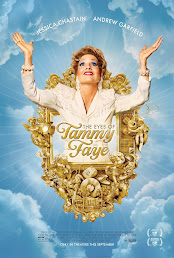
The Eyes of Tammy Faye: Look Away!


THE EYES OF TAMMY FAYE (2021)

Directed by Michael Showalter

Searchlight/Disney Pictures, 126 minutes, PG-13 (sexual innuendos, greed)


What is the difference between The Joker and Tammy Faye Bakker? The Joker was honest about his intentions and had better makeup.


I can assure you my cheap joke is better than The Eyes of Tammy Faye, which should not be confused with a revealing 2000 documentary of the same name. Abe Sylvia used the latter to fashion a screenplay for this 2021 turkey, but he burnt the bird.  


In the 1980s, Jim and Tammy Faye Bakker were the most famous televangelists in the country. Out of curiosity, I tuned in a few times and couldn’t believe anyone would send money to such obvious charlatans. Their empire ultimately crumbled under the weight of scandal, debt, and lawsuits though incredulously, Jim Bakker has gotten a post-prison second act. The Eyes of Tammy Faye traces the rise, pinnacle, and fall of the Bible-thumping power couple.


One of the many problems of the film is grounded in trying to do too much. We see young Tammy (Chandler Head) seeking conversion, but being barred from entering the church because her mother, the pianist, is barely tolerated herself because she divorced her husband, a no-no among evangelicals in International Falls, Minnesota. But when a defiant Tammy enters on her own, falls to the floor, and begins speaking in tongues, she is proclaimed a miracle. From that point on, we are fed a steady diet of how Tammy loves people of all sorts and wants to bring them to Jesus–again not a popular thing among those hueing to the narrow path. And, a straight one; preachers admonished flocks to avoid homosexuals.  


We jump to 1960, when Jim Bakker (Andrew Garfield) and Tammy Faye LaValley ((Jessica Chastain) are in Bible college. They married the next year but even Rachel (Cherry Jones) pegged Jim as a huckster in pursuit of mammon, not souls. Should have listened to mama, Tammy. After small-time hustling, Jim ingratiated himself into the evangelical power circle of Jerry Falwell (Vincent D’Onofrio), Pat Robertson (Gabriel Olds), and Jimmy Lee Swaggart (Jay Huguley), an unholy a trinity. After some time as a Hee-Haw-like “act” on Robertson’s Christian Broadcasting Network–Tammy sang and did a puppet show–the two launched the PTL (Praise the Lord) Club on their own in 1976. At their height (mid-1980s), the Bakkers claimed to reach an audience of 20 million.


The movie casts Tammy as sincere and Jim as a materialistic conman. He was/is, but it’s hard to swallow the notion that Tammy was so naïve or so far under a Svengali spell as to deserve our pity. We do see her have a brief (fully-clothed) fling with record producer Gary Paxton (Mark Wystrach), though the film omits the fact that contractor/real estate developer Roe Messner–who bankrolled and built the Bakkers’ hokey Heritage USA theme park–ended up marrying Tammy Faye when she divorced Jim in 1992. By then, Jim was in prison, for bankruptcy fraud and the news was filled with stories of an affair Jessica Hahn–who claimed he raped her­–and rumors of gay flings—which he denies to this day–with his PTL assistant the Rev. Richard Fletcher (Louis Cancelmi) and a PTL director. Bakker was originally sentenced to 45 years in jail, but it was reduced to eight and he served less than five. (Guess who his parole lawyer was? None other than follow-the-money Alan Dershowitz!) The movie correctly shows how Falwell and Robertson double-crossed Bakker as a way to gain control of PTL. (I know; who could imagine such nice men doing such a thing?) Does it surprise you to learn that Huckster Jim was recently sued in Missouri for peddling fake Covid cures?


The film shows Tammy living in a down-market neighborhood, where she was the butt of jokes because of her red wigs and clown-like eyes. Not exactly! She married Messner but when he also went to jail for fraud, Falwell exiled Tammy Faye to Palm Springs–not exactly a ghetto–to keep her quiet. She died of cancer in 2007, by which time she was considered a champion of LGBT rights.


What in the name of all that is holy was Chastain thinking? She plays Tammy Faye as if she was Minnie Mouse. Memo: When life hands you a parody, don’t tamper with it! The wounded-daughter-seeks-mama’s-approval subplot is positively insipid.  Garfield the Cat could have done a better Jim Bakker than Andrew Garfield, who comes off as a dopier and greedier version of Mr. Rogers. His performance invites adjectives such as incompetent, maladroit, and amateurish.


I’ve written more words than this gobbler deserves. If I see a worse film than this in 2022, I will write down and eat Psalm 38:18: “I confess my iniquity; I am sorry for my sin.”


Rob Weir


1/24/22

January 2022 Music Roundup: Dwight and Nicole, Aigua, Elgin, and…


Dwight + Nicole

Further


Dwight Richter and Nicole Nelson
have been nominated for fistfuls of music awards in Boston and throughout New England. Deservedly so. Theirs is a delightful throwback to the age of straight-ahead soul, blues, and R & B of the sort that can actually be played on stage and doesn’t resort to gimmicky attempts at rapping. They have recently dropped a new EP, Further, that pays homage to musical inspirations such as the Staples Singers, Roberta Flack, and Etta James but without being derivative of them. Nelson, who also plays bass and violin, isn’t merely a talented vocalist; she knows how to sing, if you catch my distinction. The reason this is noteworthy is that she’s a natural soprano within genres that have traditionally favored mezzos and altos, so she resorts to her full bag of skills to roam on the range. Richter is also an adept singer, though his Flying-V Gibson is the first thing you’ll notice. They’ve added Erza Oklan, a steady drummer, to the mix and everything is oh-so-fine. Check out “The Next Go Round,” which croons, swoons, and busts out its lo-fi wrapper to soar. Richter takes the mic for the title track and gives it a quasi-Aaron Neville treatment. "Wait" is another muscular treat–and it has a message. Keep your eyes peeled for these folks.   ★★★★


Aigua

Noninó


First let’s get this straight. There are two groups called Aigua, one of which is a jazz ensemble. This review is of the folk duo of Lies Hendrix and Joan Pieiró Aznar, he from Belgium (and now living in Sweden) and she from the Valencia region of Spain. Not that nationality matters very much, as most of the vocals are in Spanish from the Belgian-born Hendrix who plays a lot flamenco-style guitar, while Aznar accompanies on melodeon, a diatonic button accordion invented in Germany. Does it work? It sure does; listen to the album’s first single “Décime de la mare terra” and hear it for yourself. Is it a multicultural world or what? Aigua is Catalan for water and that’s a good metaphor for music that flows, cleanses, and takes us on journeys and lets us dance a bit as we go. You might feel like traipsing along the water’s edge to “Bruidsmazurka,” or breaking out the castanets for “Fandango D’Aiora.” Perhaps you’d rather queue up the Nonino and feel a bit melancholic. It’s based on a tango that Astor Piazzolla dedicated to his father, whose nickname was “grandfather, the meaning of noninó. It’s an apt way of thinking of the entire project, which has echoes of Piazzolla and the manouche jazz of Django Reinhardt throughout. ★★★★


Elgin

Weightless Still


The Irish band Elgin used to be called The Young Folk and there comes a time when that’s the kind of handle you want to lose. It’s really a duo of Anthony Furey and Paul Butler, with a programmer usually sitting in as well. I have mixed feelings about the latter. Weightless Still is what you might get if you blended Clannad, The Low Anthem, and an electronics-heavy indie band. Furey and Butler have soothing voices and when you see them in performance, those voices make for a pleasing effect. You can witness this to good effect on “Cherry Picked,” the first single released from Weightless Still. There is a nice balance between the voices, acoustic guitar, keyboards, and a small dose of computer-generated backing. Matters shift a bit when we hear studio recordings and the electronic portions get bigger. Watch the video of “"Stone’s Throw,” which could be summed as a girl, a swirl, and a whorl. Perhaps there’s a bit too much of the last of these, as the light voices are easily subsumed when too much is going on. Another in this vein is “Sloe,” which uses programmed drum loops. The album is actually terrific as background music, as it’s melody-heavy and unobtrusive. The question is whether this is the vibe they aimed to create. ★★★  


Hmmmm…


Ro Myra

Nowhere Nebraska


Ro Myra makes no bones about needing to break away from her rural Nebraska roots and sew her own wild oats. She has met a lot of the right people to help her along her musical path, but she might wish to consider really busting out. Although she’s now in Nashville, Nowhere Nebraska feels too subdued and introspective for a town that’s crawling with hungry talent. I watched the video of “She's Not the Road” one of her singles, and immediately thought “folk circuit.” Another song is titled “More Than Just Okay,” but her repertoire needs to establish more distance from that low-bar standard. There’s promise here, but my Spidey-Sense tells me that her songs, arrangements, and presence need to marinate. ★★


Errin Peet Lukes
is from California but she too is now in Nashville. Her EP titled EPL shows that Lukes has a nice voice, but it’s not a clear one and you’ll need a lyrics sheet to unravel them. I wouldn’t bother; there’s not much poetry to them. Her music is informed by a bit of bluegrass, her youthful devotion to Britney Spears, and a lot of indie pop and rock. The melodies are strong, as one would expect from Nashville sessions musicians. Frankly, though, they threaten to overwhelm her. Lukes may have a bright future, but EPL doesn’t establish a unique identity. Try “Catalyst” or “Country Music Breaks My Heart.” If they don’t grab you, she won’t. ★★


Esbe
apparently has a following in London where she’s a composer, producer, and singer. Her LP Under Cover is, at the title suggests, ten covers of everything from The Beatles (“Yesterday,” “Eleanor Rigby”) and Simon and Garfunkel (“Bridge Over Troubled Water’) to Cole Porter (“Night and Day”) and a Christmas song (“Silent Night”). There’s a reason why great performers parsimoniously parcel out covers. After all, you didn’t come to a show to hear someone else. Esbe’s covers are piano-based and so deliberate that somnambulant would not be too strong a word to describe her approach. It doesn’t matter how many candelabra you put on the piano or how many strings you fold in, unless you’re breathing new life into old tunes, you’re a cover band and I can hear really good ones in bars near me. Zero stars.