6/14/23

Babylon: Anatomy of a Big Mess


BABYLON (2022)

Directed by Damien Chazelle

Paramount, 189 minutes, R (graphic nudity, sex, language, violence)

½ 


Babylon might not be the worst film I’ve ever seen, but why quibble when it comes to rubbish? Everything about it is big: big cast, big budget, big mess. It’s on target to hemorrhage nearly $100 million, which makes it such a big  turkey that it can probably be seen by the Webb telescope.


The definition of a broad comedy is an opening sequence involving a man being shat upon by an elephant. That’s setting a low bar,  but it manages to go lower. It’s a mystery why this film wasn’t rated NC-17 as there’s a lot of full frontal nudity and active copulation. Don’t get too excited; on-screen nudity hasn’t been this boring since Eyes Wide Shut (1999). Much of the dialogue consists of F and MF bombs, so it’s literary merits aren’t exactly Shakespearean either.


Ostensibly, Babylon is about movies, fantasy, and transition. There are three time sequences­­–1926, 1932, and 1952–that correspond to the apex of silent films, their demise at the hands of talkies, and a what-happened-to-whom coda. We witness an orgiastic party in which Hollywood glitterati and hangers-on celebrate their presumed importance and invulnerability. The amoral behavior you see is exaggerated, but the for-real 1920s movie crowd drove moralists to fury. Prohibition scarcely existed in Hollywood, drugs of all sorts proliferated, bedrooms were like airport lounges, and high-profile scandals occurred, such as the trial of Fatty Arbuckle, the addiction death of Wallace Reid, and the murder of William Desmond Taylor. Many of the film characters are based loosely on historical figures.


The sprawling script (sort of) concentrates on a handful of characters: egotistical/substance-impaired actor Jack Conrad (Brad Pitt), a Douglas Fairbanks/John Gilbert mashup; depressed producer George Munn (Lucas Haas); hot jazz trumpeter Sidney Palmer, a Curtis Mosby parallel; Nellie LaRoy (Margot Robbie), whose willingness to sleep her way to celebrity borrows the reputed behavior of Clara Bow; gossip columnist Elinor St. John (Jean Smart), a thinly disguised Adela Rogers St. Johns; Lady Fay Zhu (Li Jun Ji), whose ribald lesbian cabaret act is an Anna May Wong riff; and Mexican immigrant Manuel Torres (Diego Calva). Robbie dominates the first part of the film and Calva the latter part. In 1926, everyone parties like the good times will roll forever; in 1932, they face the reality they are yesterday’s scandal sheet, and in 1952, we check to see who is left standing and when the others were planted. (Some self-destruct, some disappear, and some move on.)


Babylon alienated many critics, excited a few, and was largely ignored by audiences. A few called it a story of invention and reinvention. That would be true for Calva’s character, who transforms from the gofer Mexican immigrant Manuel to Manny, a “Spaniard” director, to an assimilated Mexican American. It’s technically true of others in a pattern that runs from unknown to star to forgotten. Mostly, though, trying to freight Babylon with gravitas gives it more credit than is due. I can assure you that my synopsis is far more coherent the movie’s wandering narrative, a nicer way of saying that this three-hour plus production is overly long for no good reason. Terms such as “redundant” and “exhausting” proliferate among those who disliked Babylon. When we look at the large number of cameo actors–including Flea, Olivia Hamilton, Tobey Maguire, Max Minghella, Eric Roberts, and Olivia Wilde–one wonders if the intent was for director Damien Chazelle to secure paydays for his posse.


As for the principals, Brad Pitt is simply bad. His affect is flat, his smirk is annoying, and his range stayed home. Margot Robbie has talent, but if you feed her corn, she chews the scenery and leaves sucrose oozing from the screen. Excuse the term, but her role was that of a manipulative tramp. She spends much of the movie in costumes that evoke a striptease and must have been riveted to her body. Li Jun Ji seems to have wandered in from a tryout for Cabaret and Lucas Haas mopes his way through. Forget the big names; the most consistent performances come from Adepo and Calva.


There is a lovely movie montage to take us out, but it’s too late by then. Overall, Babylon makes Showgirls seem like Gone with the Wind. What a let down from Chazelle, who directed the masterful Whiplash and the crowd-pleasing La La Land. Babylon suggests he needs to exit Tinseltown while there’s still hope.


Rob Weir


Postscript: Better films on Hollywood decadence include: The Artist (2011); Hail Caesar (2016), Day of the Locust (1975); Hollywood Land (2006), LA Confidential (1997), Mulholland Drive (2001), The Player (1992), and Sunset Boulevard (1950).


6/12/23

Black Potters in Antebellum SC: Tragedy and Triumph

Hear Me Now: the Black Pottery of Old Edgefield, South Carolina

 Museum of Fine Arts, Boston

Through July 9, 2023


Have you ever traveled to see a blockbuster show and found yourself blown away by a different exhibit? This happened to me last month when I went to the Museum of Fine Arts (MFA) in Boston to see its featured exhibit on Japanese artist Hokusai, but was more deeply moved by a smaller display of earthenware pottery produced by black potters.


The leading light of Hear Me Now was David Drake (c. 1801- c.1870s), who took the surname of his first enslaver, Harvey Drake. Harvey Drake was the co-owner of a factory in an area near Edgefield, South Carolina that was dubbed Pottersville. “Dave the Potter,” as he was nicknamed, gained a reputation for utilitarian pots that were unique in several ways. First, though their purpose was functional, Dave’s works were exceptionally well crafted. Some were enormous; one is 29” x 85,” so it would have been done in two parts with the bottom part thrown on a wheel and then coiled to finalize it. The larger pots would have been used for storage of pork, lard, and beef; the smaller ones for liquids. “Face jugs” were also produced, and scholars presume that some of these represented actual individuals.


 More surprising, Dave inscribed many of his works in a state where a 1740 law made it illegal to teach slaves to read or write, and 1834 legislation prescribed 50 lashes for any enslaved person to teach another said skills. No one knows exactly how Dave became literate. Some have suggested that Abner Landrum, Harvey Drake’s business partner, may have taught him. This may be so; Landrum family members, including the Rev. John Landrum and then his son Franklin owned Dave from 1836-46. (Harvey Drake died in 1832 and Dave had two short-term owners before the Landrum family.) Maybe not though, as the particulars of Dave’s life remain more speculative than known. For instance, Dave lost a leg at some point. One tale holds it resulted from a vicious beating from Franklin, who was said to be both cruel and furious that Dave knew how to read and write. The opposing argument is that Dave’s literacy would have been well known by the time Franklin entered the picture.


In other words, legend and contemporary politics muddy the waters. We know that Dave inscribed his projects as early as 1834. Legend holds he did so as an act of defiance, but that theory presupposes that no one noticed writing that anyone attending the exhibit can clearly see. Dave liked to use couplets, some whimsical but others bearing lines that make the defiance thesis credible. In 1857 he wrote: I wonder where is all my relations/Friendship to all and every nation. This corresponds with the time of Franklin’s control of the pottery works, as did one from the next year: Nineteen days before Christmas Eve/Lots of people after its [sic] over/How they will grieve.


If Franklin was a nasty as some think, both of the above would have been risky. This is especially true of the second if you know that the end of the winter holidays ushered in slave sales and auctions. Dave was indeed sold in 1849 to Lewis Miles, who held Dave through the end of the Civil War, after which he obtained his freedom. What happened in Dave’s remaining years is clouded in mystery. We suspect he died in the 1870s, but thus far the historical record merely whispers.


What we can say is that Dave and numerous other black potters–there is a list of known enslaved artisans from the region displayed at MFA–inspired many artists of color in the future, including Woody De Othello, Theaster Gates, Simone Leigh, and Robert Pruitt. Work from such modern artists working in similar idioms rounds out the show. Call them living links to Dave the Potter and his contemporaries.


Catch this show if you can. I can guarantee you will never again look at pottery as just cleverly shaped lumps of clay. 


Rob Weir


6/9/23

Indiscreet is Lost in the 1950s


INDISCREET (1958)

Directed by Stanley Donen

Warner Brothers, 100 minutes, not rated.

★


It would be safe to say that 1950s values were not like those of today. We don’t expect movies made earlier than World War Two to reflect current sensibilities, but the Fifties are a challenge if, for no other reason, a lot of people remember them. You are left with two choices: You can either go with what you see on the screen without judgement, or smugly congratulate yourself for having left those values behind. In the case of gender expectations such as we see on display in Indiscreet, my vote goes for smugness. This Cary Grant/Ingrid Bergman vehicle is a Model T in a Maserati world.


Indiscreet was the first time that Grant and Bergman acted together since Notorious in 1946, but whereas the latter Alfred Hitchcock film is considered a classic, the 1958 Stanley Donen-directed flick now seems classically bad. Renowned London stage actress Anna Kalman (Bergman) is searching for Mr. Right. She meets economist Philip Adams (Grant), who is attracted to her, and she’s over the moon. Yet despite their chemistry, Philip is a distressing combination of romantic wooing and ghosting. Anna’s friend Margaret “Megs” Jenkins (Doris Banks) is wary of that pattern. When Philip subsequently tells Anna he’s married but estranged from his wife, Megs advises Anna to retreat with all haste. Because this is a romantic comedy, that’s the last thing she’s likely to do!


Anna imagines herself a worldly, mature woman capable of just enjoying the moment. That is, until Philip tells her that he’s being transferred to NATO in New York City for five months and will be mostly incommunicado. (It’s 1958, so no email, Skype, or Zoom, and overseas phone calls were both unreliable and wicked expensive.) Things get even more dicey when Anna tells an old friend Alfred (Cecil Parker) that she plans to surprise Philip by sailing to New York to see him. Alfred spills the beans that Philip is a confirmed bachelor who has never been married.


There’s a now arcane proverb that goes: “Hell hath no fury like a woman scorned.” Anna responds with a bit of subterfuge of her own. She pretends that everything is fine, but plots to lure Philip to her apartment where a former boyfriend David will pretend to be her current flame. At the last minute, though, David can’t make it, so she asks her elderly building superintendent Carl (David Kossoff) to hide in her bedroom, open the door when Philip arrives, quickly peek into the room, then retreat behind closed doors. Think that will work? Think Philip will see the folly of his ways and propose?


From the vantage point of 1958, Anna’s desperation to corral a husband was in keeping with social expectations. Sixty-five years later it looks sappier than sugaring season in Vermont. Still, there’s a disconnect in having our two principals looking outwardly sophisticated while inhabiting roles more appropriate for younger actors. It was one thing for Bergman to play a lovestruck young woman in Casablanca when she was 27, but it’s weird to crawl back into such a role at 43. The part she plays–and I swear her Swedish accent had grown thicker–would have been more appropriate for ingenue types such as Doris Day or Audrey Hepburn. One might also think that the 54-year-old Grant would be well cast as a cad, but too long in the tooth to be convincing as a fraternity boy-style seducer. To be clear, I’m not saying that older actors shouldn’t be cast as romantic leads, but I am suggesting that we should see at least some connections between their accomplished careers and their past unrequited affairs. On screen, though, Philip is a wolf on the prowl and Anna his she-wolf shadow, the difference being that he wants to mate and she wants a mate. At times it felt cruel to laugh. Imagine Bergman and Grant reduced to emotional cripples.


Perhaps, though, I over-intellectualize. It might be enough simply to say that this is a dumb movie whose major virtue is that it looks good in Technicolor.


Rob Weir


6/7/23

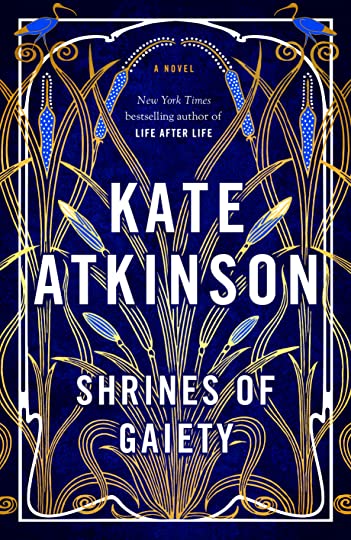
Shrines of Gaiety a Complex Mystery


SHRINES OF GAIETY (2022)

By Kate Atkinson

Doubleday, 397 pages.

★★★★


Shrines of Gaiety is fiction, but it’s based on Kate “Ma” Meyrick, a real-life 1920s London nightclub owner. Depending on who tells the story, Meyrick was either the slightly crooked “Night Club Queen” (her nickname), or was the Queen of Racketeers. Kate Atkinson uses Meyrick as her role model for Nellie “Ma” Coker, who definitely tilts to the more serious end of the transgression spectrum.  


The novel opens in 1926, when Ma has just gotten out of jail for a relatively minor offense–to the cheers of the hoi polloi and the chagrin of Detective Chief Inspector John Frobisher. He suspects Ma is connected to the disappearance of numerous young women, including several who were fished from the Thames. Ma runs five nightclubs that Frobisher is certain are also brothels, and she rules the roost of a presumed felonious  brood of offspring: Niven, Edith, Betty, Shirley, Ramsay, and Kitty. Each except Niven runs one of the clubs, though both Betty and Shirley went to Cambridge and leave the heavy lifting to others. Frobisher wants the Cokers permanently out of commission, but it’s not easy to nab her when untold numbers of the police are on the take.


Enter Gwendolen Kelling, a former librarian in York, who is down to London on behalf of a friend with whom she served during World War One. Gwen is seeking  two 14-year-old girls, Freda and Florence, who ran away from home with visions of becoming stage actresses. Shrines of Gaiety is filled with unorthodox characters. For instance, Ramsay Coker thinks he will become a famous writer; after all, he has just read Agatha Christie’s The Murder of Roger Ackroyd and he knows about crime, so how hard can it be? A strange man named Azzopardi senses that a stretch in the pen has left Ma tired and weak, and he can force her to sell her clubs to him. There is Sgt. Oakes, who is dubbed the “Laughing Policeman,” but is his an expression of jollity or a nefarious cackle? Quite a few individuals are nervous about the Curse of King Tut, whose tomb Howard Carter opened in 1922, and was subsequently blamed for all manner of suspicious deaths thereafter. Perhaps not even Gwen is above suspicion. She is initially attracted to Frobisher, but he’s so awkward that she thinks maybe Niven is a better catch. So can Frobisher trust her as she promises to go “undercover” to get the goods on Ma? Ma herself is a conundrum. Has she really so shaken by her time in jail that she has soured on a life of crime, or is she as wily as a fox with a stiletto? There’s even a deranged wife, á la Jane Eyre.


There’s a bit of everything in Shrines of Gaiety–drugs, illicit homosexuality (very illegal in those days), punch-ups, Jazz Age parties, fortunetelling, a club shoot-out, a nosy boarding house matron, a pawned broach, gambling, a fire, secret lovers, an unresolved guilt trip, a possible ghost, wanton cruelty, miscalculations, financial shenanigans, assumed identities (and motives), and enough double crosses to lay down railroad tracks. Don’t be sure that you know who most wants the House of Coker to fall. Definitely don’t assume you know who knows what! 


If you conclude from all of this that Shrines of Gaiety is not your paint-by-the-numbers murder mystery, you are absolutely right. In many ways it’s one giant moral dilemma for characters working out how they will satisfy ambition, desire, love, and honor. Atkinson refreshingly empowers female characters by giving them greater senses of self than their male counterparts. Frobisher is the putative investigator, but he’s nebbish and anything but intuitive. Gwen, by contrast, is a proto-feminist.


Atkinson offers a fascinating dissection of England between World War One and World War Two, a period that saw a decline in aristocratic power. In a roundabout way Ma Coker embodies a democratization of society, even if some of it veered toward vice.  


There are a lot of characters–it’s not a bad idea to make yourself a cheat sheet–and the plot is labyrinthine. Shrines of Gaiety resolves, but Atkinson won’t take you there in a straight line. My only real criticism is that the novel doesn’t end so much as provide a hodgepodge afterword that’s heavy on flash-forward disclosures.


Rob Weir

6/5/23

Silence is Golden: Buster Keaton, Rudolph Valentino & Gloria Swanson


 Is silence golden? For the early days of cinema, the answer is decidedly yes. It might strike modern movie-goers as odd to watch a film without sound, but watching classic films from the silent era makes you observe how actors communicated without any words other than the occasional intertitle, the term for placards bearing words that advance the plot. Here are two to try.


STEAMBOAT BILL, JR.  (1928)

Directed by Charles Reisner and Buster Keaton

United Artists, 71 minutes, not rated.


Many have claimed that only Charlie Chaplin was a more brilliant physical comedian than Buster Keaton. Steamboat Bill, Jr. gives you the best of both, as co-director Charles Reisner was one Chaplin’s favorite collaborators. It’s also unusual in being a movie named for a 1911 hit song.


Captain William Canfield (Ernest Torrence) operates the Stonewall Jackson somewhere in the Deep South. You’d need a telescope to see the glory days of his tatterdemalion tub. When local banker J. J. King (Tom McGuire) launches his spanking new paddle wheeler, customers gravitate to it and King can’t help but gloat and make fun of the Stonewall Jackson. When Canfield gets a telegram from his son whom he hasn’t  seen in many years, he holds out hope that maybe Junior can help him get back in the river game. Canfield Sr. heads to the rail station and searches for a burly man such as himself. Imagine his disappointment when a nerdy, uke-carrying, beret-wearing fop steps off the train, oh-too-well-mannered from his years living in Boston.


Job one is to make a man out of this pencil-necked geek. Job two is to get his mind off King’s daughter, Kitty (Marion Bryon), which should be easy since J.J. King doesn’t want him within a country mile of Kitty. But Kitty is also “modern” and is smitten with Bill, Jr. All of this is a setup for a comedy of errors–Junior’s inappropriate riverboat costume, his even less appropriate piloting skills, his awkward courting skills, papa’s assault on King, a botched jail break–but the “plot” of all Keaton films are excuses for acrobatic comedy, some so dangerous that a few critics speculated that Keaton was suicidal. (Keaton never used stuntmen, but there’s no evidence he wished to harm himself.) Audiences of the day liked comedies mixed with romance, so you can count on Keaton to come through in the end, rescue an erstwhile enemy and his daughter, and win the “girl,” as they were called back then.


There are some astonishing stunts in this film that demonstrate why Keaton’s star shone so brightly in the silent era. Alas, this film also marked Keaton’s fall from grace. It was his last movie for United Artists, which really was a non-commercial coalition of actors in its inception. Keaton went on to bigger paychecks at MGM, but lost creative control over his films. Steamboat Bill, Jr. is now considered one of his best movies, but it was a box office bomb. But here’s a legacy: It inspired an animated film called Steamboat Willie, which was the first film for a character who didn’t yet have a name: Mickey Mouse.  


BEYOND THE ROCKS (1922)

Directed by Sam Wood

Paramount, 80 minutes, not rated.


Who could ask for more than a love quadrangle between two of the silent era’s greatest stars, Rudolph Valentino and Gloria Swanson? To add to its allure, Beyond the Rocks was considered a lost film–until it surfaced in a damaged nitrate version in 2003 and was restored in 2006. It is set in Dorset, England, but no need to worry about bad British accents in a silent film! (Valentino reportedly had a very high voice.)


Theodora Fitzgerald (Swanson) is one of three daughters to a retired seaman in dire financial straits. She is accident-prone and is plucked from a rowboat capsize by Lord Hector Bracondale (Valentino). She swoons over him, but he’s a confirmed bachelor. (Yeah, right!) To help her family, Theodora agrees to marry the considerably older Josiah Brown (Robert Bolder). Lord Hector is being actively pursued by Morella Winmarleigh (Gertrude Astor), a match the “proper” classes favor, except for Hector who warms to the spirited Theodora. She yearns for Hector, but she’s married to Josiah. This little scenario was risqué for 1922 as it involved situations the Hollywood Code would later seek to eliminate. (The sanctity of marriage was a core Code value.)


Josiah adores Theodora, but he’s no fool and can see what’s before his eyes. Another interesting aspect of this film is that it’s simultaneously a romance and a tragedy. If you’re wondering who owned the screen, Valentino was the pretty boy but Swanson ruled the nitrate. Director Sam Wood later became controversial for his difficult personality and his right-leaning politics, but he knew his way around the camera. This is a film that could be made today and I’d not be surprised if someone attempts a remake. Good luck finding Swanson and Valentino substitutes.


Rob Weir

6/2/23

Now is Not the Time to Panic: What Sticks from Adolescence


NOW IS NOT THE TIME TO PANIC (2022)

By Kevin Wilson

Ecco/HarperCollins, 248 pages.

★★★★


Sociologists tell us that most fads and crazes are short-lived and harmless. Not all though; some degenerate into rumors and mass hysteria. Now is Not the Time to Panic, the newest novel from Kevin Wilson, explores the dark side of fads, albiet in an often humorous way.


Precocious sixteen-year-old Frances “Frankie” Budge lives in Coalfield, Tennessee, a dishwater-dull generic town. She comes from a home broken when her father was discovered having a second family on the side, including another daughter who is also named Frances. Frankie’s mom is a free spirit, which probably serves her well given that Frankie is working through her adolescent blues and she also needs to rein in her ABC triplet sons (Andrew, Brian, Charlie). They’re more rambunctious than criminal, but they don’t hesitate to walk off with things that aren’t nailed down. That includes a copy machine that sits under a tarp in the garage, because they think they broke it by, of all things, making copies of their butts!


Frankie is so bored that she’s writing a novel about a bad Nancy Drew knockoff and worrying that she’ll be rutted in Coalfield forever. Did any of you ever have an unexpected summertime experience that changed your life? Frankie is about to. A kid “trying out” the name Zeke is in town. He, Benjamin Ezekiel Brown, is staying with his grandmother in Coalfield, because his parents in Memphis are also having marital problems. Neither Frankie nor Zeke have friends and are in that physical stage of adolescence best described as plain-looking.


The two hang out, engage in some awkward kissing, and listen to 1990s grunge, but their big adventure begins when Frankie’s wordcraft and Zeke’s drawing ability collide. Out of the blue Frankie comes up with a phrase you’ll see over and over in Wilson’s novel: The edge is a shantytown filled with gold seekers. We are fugitives, and the law is skinny with hunger for us. Zeke illustrates the slogan with a comic book-like drawing featuring a pair of hands. It is also adorned with dots resulting from pricking their fingers to splash blood on the poster. Much to their surprise, the printer is easily fixed and they begin to reproduce the poster and secretly hang it all over Coalfield. At first residents ignore it, then they grow curious, then rumors begin. An unexpected event/lie thrusts the poster into the public consciousness and pushes the panic button. Most of the rumors are patently ridiculous–until they become serious.


As such things go, the poster cycle evolves from copies to copycats. Zeke and Frankie are scared to reveal their authorship, as some things have gone down that could get them into trouble. Plus, Frankie is obsessed with their creation and doesn’t want to stop plastering the town with posters. Crazes tend to burn out via circumstances and time. Such is also the case for the partnership between Zeke and Frankie, but obsession is harder to shake.


Wilson moves the clock forward 21 years, by which time Frankie has been to college, has published books, has moved away, has a marriage and family of her own, and has lost touch with Zeke. What would you do, though, if a New Yorker writer contacted you as she (Mazzy Brower) is positive that Frankie made the poster that once dominated the news? Do you fess up? If so, do you give Zeke credit? Do you even know if he’d want it? For that matter, is he even still alive? There’s also the fact that Frankie still tacks up posters. All of these are interesting dilemmas and I invite you to imagine what path you’d choose.   


Now is Not the Time to Panic is a short novel that stays that way by not straying far from its original premise. Some readers questioned the believability of Frankie’s two-decades’ obsession. I can’t resolve its veracity and Wilson doesn’t try; within a book on collective hysteria the answer probably depends upon individual personalities. Speaking only for myself, as much I’d like to deny it, I suspect there are various values, habits, tastes, and patterns that link to my adolescence. But I would argue against anyone who finds the hysteria part of novel far-fetched. As H. L. Mencken is credited with saying, “No one ever went broke underestimating the intelligence of the American public.” That wasn’t his exact quote, but close enough! 


Rob Weir

5/31/23

Three Documentaries That Could Have Been Better


Documentaries are often a problematic film genre. They are didactic by nature, not “movies” whose major purpose is to entertain. Good ones present new information; mediocre ones merely rehash the familiar under the pretense of “discovery.” I tend to avoid ones that deal with traumatic subjects with which I’m already familiar, but offer no solutions. Why wallow in sorrow or anger? Quite a few documentaries disappoint because they could/should have been better. Here are three that are perfectly decent, but left me wanting more.

_____________________________________________


Kurt Vonnegut: Unstuck in Time (2021)

Directed by Robert Weide and Don Argott

IFC Films, 127 minutes, not rated


 What’s new: As he grew older, Kurt Vonnegut (1922-2007) settled into a self-crafted public persona: witty, eccentric, harmlessly cranky, aloof. He was deep into that role when he was a writer-in-residence at Smith College and overlapped with my time there. The most revelatory part of the documentary shows a tender, sentimental side at odds with the image he cultivated. Interviews with some of his children–three biological and four adopted–adds a personal touch. One that resonates out my way comes from his daughter Nanny, an artist who lives in Northampton, MA.


What’s old: Talking heads are a documentary cliché. Did we need testimonials from a Morley Safer or a John Irving to tell us that Vonnegut was an interesting writer? Likewise, his foundational experiences– growing up in Indianapolis, being a POW in Dresden during World War II, working for GE, struggling to get published–are decidedly old info.


What’s bad: I want a law that bans filmmakers from telling us how hard it was to make their documentaries. Memo: All filmmakers struggle to bring their vision into being! Co-director Robert Weide tells us he doesn’t want the film to be about himself, but that’s exactly what he gave us. He had a 40 year friendship with Vonnegut, but we learn as much about how Weibe’s other projects–Curb Your Enthusiasm, Parks and Recreation, Lenny Bruce: Swear to Tell the Truth–sidetracked his documentary than we do about his subject. Even IMDB calls this one “a filmmaker’s journey.”


Be There to Love Me: A Film About Townes Van Zandt (2004)

Directed by Margaret Brown

Palm Pictures, 99 minutes, not rated


What’s new: What’s new is exactly what made Townes Van Zandt (1944-97) an almost impossible subject: He was an alcoholic, a heroin addict, suffered from mental illness, and an id-driven individual. The external squalor of his life was more extensive than you might imagine.

What’s old: Van Zandt is presented as a lynchpin of the outlaw country movement. I’m not sure he was that influential, but this is a well-traveled assertion. We also see a parade of other “outlaws,” such as Willie Nelson, Steve Earle, Emmylou Harris, Kris Kristofferson, and Guy Clark, the true father of the genre. They paled around with Van Zandt, rehashed old stories and each, of course, declared him a genius. 


What’s bad: Director Margaret Brown couldn’t find a center to give coherence to her film, which gives it a random and episodic feel. I really wanted her to make me admire Van Zandt, but she could not make sense him. This may rub some readers the wrong way, but I think Van Zandt was overrated. He wrote a few gems–“Pancho and Lefty,” “Waitin’ Around to Die,” and “If I Needed You” are my favorites–but the film didn’t change my opinion about is overall repertoire.


Jean-Michel Basquiat: The Radiant Child (2010)

Directed by Tamra Brown

 Arthouse Films, 90 minutes, not rated.


What’s new: I was late to the party in appreciating street art, which has been elevated to the kind of art that gallery owners sell for major bucks. The commodification of street art came more rapidly and was more extensive than I realized. The best insights into Jean-Michel Basquiat (1960-88) come from other artists such as Julian Schnabel, Fab Five Freddy, and Kenny Scharf. (Sonic Youth’s Thurston Moore is pretty good as well.)


What’s old: Tamra Brown spends a lot of time presenting the views of collectors, gallery owners, and the self-proclaimed (read pretentious) New York avantgarde who pursue the darling of the moment. Do we need more validation that they are the equivalent of sleazy ambulance-chasing lawyers? 


What’s bad: Nothing is bad per se, but once I started to appreciate street/outsider art, the figure who most perplexed me was Basquiat, whose use of repetition and symbolism requires decoding. The film’s tone is flat and my attention began to drift. It was also too laudatory. I learned to appreciate and see some of Basquiat’s personal and artistic flaws, but  from a 2020 MFA Boston exhibition and from Jane Oneail of Culturally Curious.


Rob Weir