6/16/23

The Buried Giant: Discover this Ishiguro Fantasy


THE BURIED GIANT (2016)

By Kazuo Ishiguro

Penguin Random House, 317 pages.

★★★★


I adore Japanese-British author Kazuo Ishiguro, in part because the man seldom repeats himself. The Buried Giant is a new spin on Arthurian legends. Several fellow authors complained that Ishiguro was disrespectful of the fantasy genre, as if there’s such a thing as a fantasy standard.


Ishiguro takes us to late 6th century Britain. I emphasize the last word because by the 6th century, much of modern-day Britain was under the control of Anglo and Saxon tribes that filled the vacuum as Roman Empire control collapsed. Without getting into too much detail, “England” is a vulgarization of “Angle-Land,” a nod for one of the dominant Germanic tribes that migrated across the Channel during the 4th-6th centuries. The “Britons” were Celtic peoples who battled both Roman and Germanic invaders. If you want to identify the true “British” peoples, they are Scots, Welsh, and various tribes that inhabited the Cornish peninsula. King Arthur, if he existed at all, was likely a 6th century Welsh Briton who temporarily stymied Saxon advances into the region.  


Ishiguro riffs off the post-Arthurian period, mixes in a Greek legend, and fashions a fable of identity, memory, and the fragility of peace. Buried memory is the “giant” of the book’s title. Though Ishiguro has never said so directly, he was probably also inspired by a mysterious landmark of a giant figure carved into a chalky Dorset hillside near Cerne Abbas.  


Cerne Abbas


The central protagonists are an elderly Briton couple, Axl and Beatrice–her name a possible Dante homage–who live in a village of joined homes and passages that evoke a thatched-roof version of ancient Skara Brae. They have long been devoted to each other, insofar as they can recall. That’s a problem; a strange mist hangs over the land and no one has clear long-term memory. They have just suffered the indignity of having their candle taken away by the villagers, ostensibly because locals fear Axl and Beatrice are too elderly to be trusted with a candle. They decide to visit their son, who left many years ago. Beatrice only thinks she knows the way to his village and neither of them can recall his face. Call it a strange pilgrimage.


Along their route they are warned to avoid the ferryman, whose unanswered questions have dire consequences. If you conjure images from the Greek myth of Charon who ferries souls down the River Styx, you’re on the right track. Axl and Beatrice encounter other figures whose roles and loyalties are uncertain. One is Sir Gawain, the last knight of Arthur’s Roundtable, now aged and more like a rusty-armored Don Quixote than the courteous and gallant Grail-seeker of medieval romance. They also encounter Wistan, a Saxon warrior raised among Britons, and Edwin, an orphan Saxon boy whom Wistan identifies as a future warrior–if Edwin can avoid being killed by zealots. The Buried Giant is also an allegory of the struggle between Briton Christianity and Saxon paganism, though both peoples inhabit a world inhabited by faeries and ogres. Edwin has a wound interpreted as an ogre bite, which both Christians and pagans associated with black magic.  


Quite a lot happens on the various journeys of each character, including a very strange stayover at a monastery. Axl has no idea about his own past, but he and Beatrice suspect that the mist that robs people of their memory is the breath of a she-dragon named Querig. Perhaps if Gawain or Wistan can kill the Merlin-enchanted beast, memory can be restored. But what if the same mist also obscures old hatreds between Britons and Saxons and has kept the peace? Is it desirable to slay the aging dragon or let her live out her fading life? Ishiguro writes via Wistan, “The giant, once well buried, now stirs. When he rises … the friendly bonds between us will prove as knots young girls make with the stems of small flowers.” Allegorically, the candle is memory, the mist is collective forgetfulness, and the giant is a painful past.


Ishiguro’s enigmatic ending has been criticized with some validity. He also took hits for taking liberties with legends, though that’s another strange critique as doing so is pretty much par for Arthurian tales. I found it a fascinating novel chockful with provocative dilemmas. A Guardian writer called it “Game of Thrones with a conscience.” Indeed!


Rob Weir

6/15/23

Fixing the Celtics


Adjustments needed for another banner

The NBA finals just concluded. This was the year the Boston Celtics were favored to win it all, but  they spit the bit against Miami, who was subsequently destroyed by the Nuggets. In 2023, Jayson Tatum went from being a surefire MVP to a player who will be lucky to be in the top ten in voting. Boston Globe reporter Chad Finn observed that even if the Celtics had gotten to the finals, the real MVP, Nikola Jokic, would have “throttled” the C’s.Yep.


The Celtics don’t need a rebuild, but if they hope to hoist another championship banner, they need to address flaws like ones below.


--Enough with the bloody threes!

            Nearly half (48%) of their shots were hoisted from afar. Tatum is one of the worst offenders, heaving an average of 9 per game but making just 30% of them. He’s very talented, but he too often plays like an undisciplined version of Kobe Bryant. Put another way, he’s no Steph Curry.   

            The Big Tell is that the Celtics were second in the league in scoring but 25th in offensive rebounds. It’s hard to get a rebound when hero ball shooters let loose from behind the arc with no teammates in sight.


-- Pass the rock:

            Two-pointers don’t have the dramatic flair of a three-pointer, but they go in more often. Tatum shoots 56% from mid-range and Jalen Brown almost 58%. Teams with good ball movement cause defensive problems for opponents, including increasing the likelihood there won’t be hands in the face when you need to take a three.


-- Jaylen Brown isn’t the problem.

            There’s hue and cry to trade him. Huh? How do you replace an All-Star who averages 26.6 points per game? He gets my vote for the grittiest Celtic, even if he did falter during the playoffs. Remember that he had to wear a mask from February on after a facial fracture. Without Brown the Celtics’ prospects for even repeating as division champs are dim.


-- It’s Marcus Smart who needs to go.

            His defensive prowess hardly matters in a league that plays none. He’s not a good distributor, is three-ball happy, and prone to boneheaded decisions. Plus, He. Can’t. Shoot. This makes him a huge drain on a team that averages 118 points per game, nearly half of which come from Tatum and Brown.

            Boston needs someone who can put up big numbers when shots aren’t falling for JT or JB. Smart is not that guy. Both Derreck White and Malcom Brogdon are far better and need more minutes. Trade Smart for a lanky penetrator who can pass and drain mid-range shots.


-- When you have a big lead, slow it down.

            There’s no excuse for blowing 12+ point leads going into the 4th quarter. Work the clock, move the ball, and take high-percentage shots. If that’s an alien concept, maybe the Celtics should watch WNBA games to see how it’s done!


--Practice bloody free throws.

            Once again, see the WNBA.


-- The Joe Mazzulla Factor.

            Mazzulla is a quality person, but making him head coach was handing the keys to a Maserati to a kid who just got his learner’s permit. He’s green in the wrong way.

            He’ll be back because management impulsively extended him, but newly-hired assistant Sam Cassell should be the head. At the least, put Cassell in charge of the offense. He wouldn’t be afraid to sit a superstar—I’m talking about you, JT–who takes his team out of its rhythm.

            Coaches also need to reduce the floor time for Tatum and Horford, both of whom were gassed by playoff time.


-- Needed roster adjustments:

            The “Green Team” was more of a buzz phrase than a reality. It was Brogdon, White, and Mazzulla was lost after those two. Solidify players 6 through 10. 


            The center/power forward position is in flux. Rob Williams is a great rim protector when he’s healthy, but he seldom is. That means that Al Horford gets too many minutes (30.5) for his 36-year-old body, even if he did lead the team in three-point shooting percentage. The Celtics need a reliable and impactful big. Danilo Gallinari? Three years ago maybe, but he’s making a lot of money and missed all of last season. I’d move that contract. They picked up Mike Muscala and buried him on the bench. Play him or move him. Luke Kornet is good to have in a pinch, but only then. He’s strictly an end-of-the-bench option.


           The Celtics should rely more on Sam Hauser, who has great potential and can shoot out the lights when he’s in his groove. 


            Grant Williams is a free agent seeking big bucks. Hard pass on him. If someone else wants to make him rich, that’s on them.


            Payton Pritchard is a feisty player who can shoot, but wants to be traded if he can’t get more playing time. I’m not seeing it. He gets burned on defense, so he will probably be moved.

            Do they have anything in Mfiondu Kabengele or Justin Jackson? Maybe with Kabengele, but need to see more to know. Jackson has no role.


            Why did they draft JD Davidson? The guide says he’s 6’1 but he’s really 5’11, too small for today’s NBA . He’ll soon be playing overseas. 


            Blake Griffin is pretty much a spent force ready to begin his coaching career. 


            How to fill out the roster? A few bargain-basement free agents can wave the towels, but why not…


-- Send out the scouts.  

            Basketball has become the second most popular global sport after soccer.  Millions of kids around the world are playing hoops. Scour the globe in search of talent the analytics nerds have never seen play. Sign a point guard with a sweet shot and an instinct for the floor, and a Big who can get to the paint without picking up 3 fouls in 4 minutes. Apprentice them from the bench and see if they can adjust. (Being a # 13-18 bench player is better than playing in the no-defense NBDL.) It won’t cost much to experiment and it might yield a gem.


6/14/23

Babylon: Anatomy of a Big Mess


BABYLON (2022)

Directed by Damien Chazelle

Paramount, 189 minutes, R (graphic nudity, sex, language, violence)

½ 


Babylon might not be the worst film I’ve ever seen, but why quibble when it comes to rubbish? Everything about it is big: big cast, big budget, big mess. It’s on target to hemorrhage nearly $100 million, which makes it such a big  turkey that it can probably be seen by the Webb telescope.


The definition of a broad comedy is an opening sequence involving a man being shat upon by an elephant. That’s setting a low bar,  but it manages to go lower. It’s a mystery why this film wasn’t rated NC-17 as there’s a lot of full frontal nudity and active copulation. Don’t get too excited; on-screen nudity hasn’t been this boring since Eyes Wide Shut (1999). Much of the dialogue consists of F and MF bombs, so it’s literary merits aren’t exactly Shakespearean either.


Ostensibly, Babylon is about movies, fantasy, and transition. There are three time sequences­­–1926, 1932, and 1952–that correspond to the apex of silent films, their demise at the hands of talkies, and a what-happened-to-whom coda. We witness an orgiastic party in which Hollywood glitterati and hangers-on celebrate their presumed importance and invulnerability. The amoral behavior you see is exaggerated, but the for-real 1920s movie crowd drove moralists to fury. Prohibition scarcely existed in Hollywood, drugs of all sorts proliferated, bedrooms were like airport lounges, and high-profile scandals occurred, such as the trial of Fatty Arbuckle, the addiction death of Wallace Reid, and the murder of William Desmond Taylor. Many of the film characters are based loosely on historical figures.


The sprawling script (sort of) concentrates on a handful of characters: egotistical/substance-impaired actor Jack Conrad (Brad Pitt), a Douglas Fairbanks/John Gilbert mashup; depressed producer George Munn (Lucas Haas); hot jazz trumpeter Sidney Palmer, a Curtis Mosby parallel; Nellie LaRoy (Margot Robbie), whose willingness to sleep her way to celebrity borrows the reputed behavior of Clara Bow; gossip columnist Elinor St. John (Jean Smart), a thinly disguised Adela Rogers St. Johns; Lady Fay Zhu (Li Jun Ji), whose ribald lesbian cabaret act is an Anna May Wong riff; and Mexican immigrant Manuel Torres (Diego Calva). Robbie dominates the first part of the film and Calva the latter part. In 1926, everyone parties like the good times will roll forever; in 1932, they face the reality they are yesterday’s scandal sheet, and in 1952, we check to see who is left standing and when the others were planted. (Some self-destruct, some disappear, and some move on.)


Babylon alienated many critics, excited a few, and was largely ignored by audiences. A few called it a story of invention and reinvention. That would be true for Calva’s character, who transforms from the gofer Mexican immigrant Manuel to Manny, a “Spaniard” director, to an assimilated Mexican American. It’s technically true of others in a pattern that runs from unknown to star to forgotten. Mostly, though, trying to freight Babylon with gravitas gives it more credit than is due. I can assure you that my synopsis is far more coherent the movie’s wandering narrative, a nicer way of saying that this three-hour plus production is overly long for no good reason. Terms such as “redundant” and “exhausting” proliferate among those who disliked Babylon. When we look at the large number of cameo actors–including Flea, Olivia Hamilton, Tobey Maguire, Max Minghella, Eric Roberts, and Olivia Wilde–one wonders if the intent was for director Damien Chazelle to secure paydays for his posse.


As for the principals, Brad Pitt is simply bad. His affect is flat, his smirk is annoying, and his range stayed home. Margot Robbie has talent, but if you feed her corn, she chews the scenery and leaves sucrose oozing from the screen. Excuse the term, but her role was that of a manipulative tramp. She spends much of the movie in costumes that evoke a striptease and must have been riveted to her body. Li Jun Ji seems to have wandered in from a tryout for Cabaret and Lucas Haas mopes his way through. Forget the big names; the most consistent performances come from Adepo and Calva.


There is a lovely movie montage to take us out, but it’s too late by then. Overall, Babylon makes Showgirls seem like Gone with the Wind. What a let down from Chazelle, who directed the masterful Whiplash and the crowd-pleasing La La Land. Babylon suggests he needs to exit Tinseltown while there’s still hope.


Rob Weir


Postscript: Better films on Hollywood decadence include: The Artist (2011); Hail Caesar (2016), Day of the Locust (1975); Hollywood Land (2006), LA Confidential (1997), Mulholland Drive (2001), The Player (1992), and Sunset Boulevard (1950).


6/12/23

Black Potters in Antebellum SC: Tragedy and Triumph

Hear Me Now: the Black Pottery of Old Edgefield, South Carolina

 Museum of Fine Arts, Boston

Through July 9, 2023


Have you ever traveled to see a blockbuster show and found yourself blown away by a different exhibit? This happened to me last month when I went to the Museum of Fine Arts (MFA) in Boston to see its featured exhibit on Japanese artist Hokusai, but was more deeply moved by a smaller display of earthenware pottery produced by black potters.


The leading light of Hear Me Now was David Drake (c. 1801- c.1870s), who took the surname of his first enslaver, Harvey Drake. Harvey Drake was the co-owner of a factory in an area near Edgefield, South Carolina that was dubbed Pottersville. “Dave the Potter,” as he was nicknamed, gained a reputation for utilitarian pots that were unique in several ways. First, though their purpose was functional, Dave’s works were exceptionally well crafted. Some were enormous; one is 29” x 85,” so it would have been done in two parts with the bottom part thrown on a wheel and then coiled to finalize it. The larger pots would have been used for storage of pork, lard, and beef; the smaller ones for liquids. “Face jugs” were also produced, and scholars presume that some of these represented actual individuals.


 More surprising, Dave inscribed many of his works in a state where a 1740 law made it illegal to teach slaves to read or write, and 1834 legislation prescribed 50 lashes for any enslaved person to teach another said skills. No one knows exactly how Dave became literate. Some have suggested that Abner Landrum, Harvey Drake’s business partner, may have taught him. This may be so; Landrum family members, including the Rev. John Landrum and then his son Franklin owned Dave from 1836-46. (Harvey Drake died in 1832 and Dave had two short-term owners before the Landrum family.) Maybe not though, as the particulars of Dave’s life remain more speculative than known. For instance, Dave lost a leg at some point. One tale holds it resulted from a vicious beating from Franklin, who was said to be both cruel and furious that Dave knew how to read and write. The opposing argument is that Dave’s literacy would have been well known by the time Franklin entered the picture.


In other words, legend and contemporary politics muddy the waters. We know that Dave inscribed his projects as early as 1834. Legend holds he did so as an act of defiance, but that theory presupposes that no one noticed writing that anyone attending the exhibit can clearly see. Dave liked to use couplets, some whimsical but others bearing lines that make the defiance thesis credible. In 1857 he wrote: I wonder where is all my relations/Friendship to all and every nation. This corresponds with the time of Franklin’s control of the pottery works, as did one from the next year: Nineteen days before Christmas Eve/Lots of people after its [sic] over/How they will grieve.


If Franklin was a nasty as some think, both of the above would have been risky. This is especially true of the second if you know that the end of the winter holidays ushered in slave sales and auctions. Dave was indeed sold in 1849 to Lewis Miles, who held Dave through the end of the Civil War, after which he obtained his freedom. What happened in Dave’s remaining years is clouded in mystery. We suspect he died in the 1870s, but thus far the historical record merely whispers.


What we can say is that Dave and numerous other black potters–there is a list of known enslaved artisans from the region displayed at MFA–inspired many artists of color in the future, including Woody De Othello, Theaster Gates, Simone Leigh, and Robert Pruitt. Work from such modern artists working in similar idioms rounds out the show. Call them living links to Dave the Potter and his contemporaries.


Catch this show if you can. I can guarantee you will never again look at pottery as just cleverly shaped lumps of clay. 


Rob Weir


6/9/23

Indiscreet is Lost in the 1950s


INDISCREET (1958)

Directed by Stanley Donen

Warner Brothers, 100 minutes, not rated.


It would be safe to say that 1950s values were not like those of today. We don’t expect movies made earlier than World War Two to reflect current sensibilities, but the Fifties are a challenge if, for no other reason, a lot of people remember them. You are left with two choices: You can either go with what you see on the screen without judgement, or smugly congratulate yourself for having left those values behind. In the case of gender expectations such as we see on display in Indiscreet, my vote goes for smugness. This Cary Grant/Ingrid Bergman vehicle is a Model T in a Maserati world.


Indiscreet was the first time that Grant and Bergman acted together since Notorious in 1946, but whereas the latter Alfred Hitchcock film is considered a classic, the 1958 Stanley Donen-directed flick now seems classically bad. Renowned London stage actress Anna Kalman (Bergman) is searching for Mr. Right. She meets economist Philip Adams (Grant), who is attracted to her, and she’s over the moon. Yet despite their chemistry, Philip is a distressing combination of romantic wooing and ghosting. Anna’s friend Margaret “Megs” Jenkins (Doris Banks) is wary of that pattern. When Philip subsequently tells Anna he’s married but estranged from his wife, Megs advises Anna to retreat with all haste. Because this is a romantic comedy, that’s the last thing she’s likely to do!


Anna imagines herself a worldly, mature woman capable of just enjoying the moment. That is, until Philip tells her that he’s being transferred to NATO in New York City for five months and will be mostly incommunicado. (It’s 1958, so no email, Skype, or Zoom, and overseas phone calls were both unreliable and wicked expensive.) Things get even more dicey when Anna tells an old friend Alfred (Cecil Parker) that she plans to surprise Philip by sailing to New York to see him. Alfred spills the beans that Philip is a confirmed bachelor who has never been married.


There’s a now arcane proverb that goes: “Hell hath no fury like a woman scorned.” Anna responds with a bit of subterfuge of her own. She pretends that everything is fine, but plots to lure Philip to her apartment where a former boyfriend David will pretend to be her current flame. At the last minute, though, David can’t make it, so she asks her elderly building superintendent Carl (David Kossoff) to hide in her bedroom, open the door when Philip arrives, quickly peek into the room, then retreat behind closed doors. Think that will work? Think Philip will see the folly of his ways and propose?


From the vantage point of 1958, Anna’s desperation to corral a husband was in keeping with social expectations. Sixty-five years later it looks sappier than sugaring season in Vermont. Still, there’s a disconnect in having our two principals looking outwardly sophisticated while inhabiting roles more appropriate for younger actors. It was one thing for Bergman to play a lovestruck young woman in Casablanca when she was 27, but it’s weird to crawl back into such a role at 43. The part she plays–and I swear her Swedish accent had grown thicker–would have been more appropriate for ingenue types such as Doris Day or Audrey Hepburn. One might also think that the 54-year-old Grant would be well cast as a cad, but too long in the tooth to be convincing as a fraternity boy-style seducer. To be clear, I’m not saying that older actors shouldn’t be cast as romantic leads, but I am suggesting that we should see at least some connections between their accomplished careers and their past unrequited affairs. On screen, though, Philip is a wolf on the prowl and Anna his she-wolf shadow, the difference being that he wants to mate and she wants a mate. At times it felt cruel to laugh. Imagine Bergman and Grant reduced to emotional cripples.


Perhaps, though, I over-intellectualize. It might be enough simply to say that this is a dumb movie whose major virtue is that it looks good in Technicolor.


Rob Weir


6/7/23

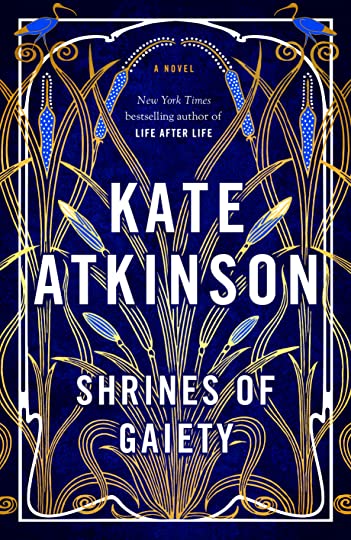
Shrines of Gaiety a Complex Mystery


SHRINES OF GAIETY (2022)

By Kate Atkinson

Doubleday, 397 pages.

★★★★


Shrines of Gaiety is fiction, but it’s based on Kate “Ma” Meyrick, a real-life 1920s London nightclub owner. Depending on who tells the story, Meyrick was either the slightly crooked “Night Club Queen” (her nickname), or was the Queen of Racketeers. Kate Atkinson uses Meyrick as her role model for Nellie “Ma” Coker, who definitely tilts to the more serious end of the transgression spectrum.  


The novel opens in 1926, when Ma has just gotten out of jail for a relatively minor offense–to the cheers of the hoi polloi and the chagrin of Detective Chief Inspector John Frobisher. He suspects Ma is connected to the disappearance of numerous young women, including several who were fished from the Thames. Ma runs five nightclubs that Frobisher is certain are also brothels, and she rules the roost of a presumed felonious  brood of offspring: Niven, Edith, Betty, Shirley, Ramsay, and Kitty. Each except Niven runs one of the clubs, though both Betty and Shirley went to Cambridge and leave the heavy lifting to others. Frobisher wants the Cokers permanently out of commission, but it’s not easy to nab her when untold numbers of the police are on the take.


Enter Gwendolen Kelling, a former librarian in York, who is down to London on behalf of a friend with whom she served during World War One. Gwen is seeking  two 14-year-old girls, Freda and Florence, who ran away from home with visions of becoming stage actresses. Shrines of Gaiety is filled with unorthodox characters. For instance, Ramsay Coker thinks he will become a famous writer; after all, he has just read Agatha Christie’s The Murder of Roger Ackroyd and he knows about crime, so how hard can it be? A strange man named Azzopardi senses that a stretch in the pen has left Ma tired and weak, and he can force her to sell her clubs to him. There is Sgt. Oakes, who is dubbed the “Laughing Policeman,” but is his an expression of jollity or a nefarious cackle? Quite a few individuals are nervous about the Curse of King Tut, whose tomb Howard Carter opened in 1922, and was subsequently blamed for all manner of suspicious deaths thereafter. Perhaps not even Gwen is above suspicion. She is initially attracted to Frobisher, but he’s so awkward that she thinks maybe Niven is a better catch. So can Frobisher trust her as she promises to go “undercover” to get the goods on Ma? Ma herself is a conundrum. Has she really so shaken by her time in jail that she has soured on a life of crime, or is she as wily as a fox with a stiletto? There’s even a deranged wife, á la Jane Eyre.


There’s a bit of everything in Shrines of Gaiety–drugs, illicit homosexuality (very illegal in those days), punch-ups, Jazz Age parties, fortunetelling, a club shoot-out, a nosy boarding house matron, a pawned broach, gambling, a fire, secret lovers, an unresolved guilt trip, a possible ghost, wanton cruelty, miscalculations, financial shenanigans, assumed identities (and motives), and enough double crosses to lay down railroad tracks. Don’t be sure that you know who most wants the House of Coker to fall. Definitely don’t assume you know who knows what! 


If you conclude from all of this that Shrines of Gaiety is not your paint-by-the-numbers murder mystery, you are absolutely right. In many ways it’s one giant moral dilemma for characters working out how they will satisfy ambition, desire, love, and honor. Atkinson refreshingly empowers female characters by giving them greater senses of self than their male counterparts. Frobisher is the putative investigator, but he’s nebbish and anything but intuitive. Gwen, by contrast, is a proto-feminist.


Atkinson offers a fascinating dissection of England between World War One and World War Two, a period that saw a decline in aristocratic power. In a roundabout way Ma Coker embodies a democratization of society, even if some of it veered toward vice.  


There are a lot of characters–it’s not a bad idea to make yourself a cheat sheet–and the plot is labyrinthine. Shrines of Gaiety resolves, but Atkinson won’t take you there in a straight line. My only real criticism is that the novel doesn’t end so much as provide a hodgepodge afterword that’s heavy on flash-forward disclosures.


Rob Weir

6/5/23

Silence is Golden: Buster Keaton, Rudolph Valentino & Gloria Swanson


 Is silence golden? For the early days of cinema, the answer is decidedly yes. It might strike modern movie-goers as odd to watch a film without sound, but watching classic films from the silent era makes you observe how actors communicated without any words other than the occasional intertitle, the term for placards bearing words that advance the plot. Here are two to try.


STEAMBOAT BILL, JR.  (1928)

Directed by Charles Reisner and Buster Keaton

United Artists, 71 minutes, not rated.


Many have claimed that only Charlie Chaplin was a more brilliant physical comedian than Buster Keaton. Steamboat Bill, Jr. gives you the best of both, as co-director Charles Reisner was one Chaplin’s favorite collaborators. It’s also unusual in being a movie named for a 1911 hit song.


Captain William Canfield (Ernest Torrence) operates the Stonewall Jackson somewhere in the Deep South. You’d need a telescope to see the glory days of his tatterdemalion tub. When local banker J. J. King (Tom McGuire) launches his spanking new paddle wheeler, customers gravitate to it and King can’t help but gloat and make fun of the Stonewall Jackson. When Canfield gets a telegram from his son whom he hasn’t  seen in many years, he holds out hope that maybe Junior can help him get back in the river game. Canfield Sr. heads to the rail station and searches for a burly man such as himself. Imagine his disappointment when a nerdy, uke-carrying, beret-wearing fop steps off the train, oh-too-well-mannered from his years living in Boston.


Job one is to make a man out of this pencil-necked geek. Job two is to get his mind off King’s daughter, Kitty (Marion Bryon), which should be easy since J.J. King doesn’t want him within a country mile of Kitty. But Kitty is also “modern” and is smitten with Bill, Jr. All of this is a setup for a comedy of errors–Junior’s inappropriate riverboat costume, his even less appropriate piloting skills, his awkward courting skills, papa’s assault on King, a botched jail break–but the “plot” of all Keaton films are excuses for acrobatic comedy, some so dangerous that a few critics speculated that Keaton was suicidal. (Keaton never used stuntmen, but there’s no evidence he wished to harm himself.) Audiences of the day liked comedies mixed with romance, so you can count on Keaton to come through in the end, rescue an erstwhile enemy and his daughter, and win the “girl,” as they were called back then.


There are some astonishing stunts in this film that demonstrate why Keaton’s star shone so brightly in the silent era. Alas, this film also marked Keaton’s fall from grace. It was his last movie for United Artists, which really was a non-commercial coalition of actors in its inception. Keaton went on to bigger paychecks at MGM, but lost creative control over his films. Steamboat Bill, Jr. is now considered one of his best movies, but it was a box office bomb. But here’s a legacy: It inspired an animated film called Steamboat Willie, which was the first film for a character who didn’t yet have a name: Mickey Mouse.  


BEYOND THE ROCKS (1922)

Directed by Sam Wood

Paramount, 80 minutes, not rated.


Who could ask for more than a love quadrangle between two of the silent era’s greatest stars, Rudolph Valentino and Gloria Swanson? To add to its allure, Beyond the Rocks was considered a lost film–until it surfaced in a damaged nitrate version in 2003 and was restored in 2006. It is set in Dorset, England, but no need to worry about bad British accents in a silent film! (Valentino reportedly had a very high voice.)


Theodora Fitzgerald (Swanson) is one of three daughters to a retired seaman in dire financial straits. She is accident-prone and is plucked from a rowboat capsize by Lord Hector Bracondale (Valentino). She swoons over him, but he’s a confirmed bachelor. (Yeah, right!) To help her family, Theodora agrees to marry the considerably older Josiah Brown (Robert Bolder). Lord Hector is being actively pursued by Morella Winmarleigh (Gertrude Astor), a match the “proper” classes favor, except for Hector who warms to the spirited Theodora. She yearns for Hector, but she’s married to Josiah. This little scenario was risqué for 1922 as it involved situations the Hollywood Code would later seek to eliminate. (The sanctity of marriage was a core Code value.)


Josiah adores Theodora, but he’s no fool and can see what’s before his eyes. Another interesting aspect of this film is that it’s simultaneously a romance and a tragedy. If you’re wondering who owned the screen, Valentino was the pretty boy but Swanson ruled the nitrate. Director Sam Wood later became controversial for his difficult personality and his right-leaning politics, but he knew his way around the camera. This is a film that could be made today and I’d not be surprised if someone attempts a remake. Good luck finding Swanson and Valentino substitutes.


Rob Weir