9/2/24

Relive the Age of Rail at the Shelburne Museum


All Aboard: The Railroad in American Art, 1840-1955

Pizzagalli Center for Art and Education

Shelburne Museum, Shelburne, Vermont

Through October 20, 2024


Do you ever wonder what it would be like to jump on a train and go anywhere in the United States you wanted? Take a look at this map from the late 1890s and you’ll see a spidery steel web that could have made your dream come true. 


Then


Now look at the map of what we have today. What happened? In a word, the automobile. Once Americans fell in love with the private automobile, railroads started to get ripped up. The building of interstate highways from 1956 on was the final blow that reduced the once-robust rail network of yore to today’s 80-pound weakling Amtrak system. 


Now


An exhibit at Vermont’s Shelburne Museum takes us back to the days in which rail was king. Lest you think automobile travel is superior, consider that in 1880 it took about 3 ½ days to get from New York to the West Coast by train. It still does, Amtrak jokes aside. If you drive and you actually stop to eat, see things, and sleep, it takes 5-6 days.


The railroad did as much if not more to knit the nation together as the Civil War. Think of living in the hinterlands in say, North Williston, Vermont, the Catskills of New York, some lonely outpost in the middle of nowhere, or the vast Texas plains and seeing a puff of steam in the distance. Even if you weren’t waiting to board, it reminded you there was a larger world to explore beyond your little slice of it. Actually, you don’t need to imagine it; the artists included in All Aboard: The Railroad in American Art have done it for you. 

Charles Heyde Steam in North Williston VT 1850

Thomas Cole River in the Catskills 1843


Charles Bowling Church at the Crossroads 1936

Georgia O'Keeffe Train Coming in Canyon, TX 1916


Artists have also captured the urban experience, the tunnels, bridges, fire-breathing factories, and the crush of patrons. Rail lines also advanced communications–telegraph lines frequently paralleled the rails–as well as American industry. In the latter case, they railroads were also a site for capital-labor conflict such as the Great Uprising of 1877, a significant nationwide general strike. It’s no coincidence that so many strikes took place among railroad workers. Theirs was hard work and the stress demands on engineers  were such that their jobs invaded their dreams.


Edward Hopper, Train Approaching a Tunnel


John Sloan, Six O'Clock

Otto Kohler ,Steel Valley Pittsburgh


Aaron Bohroad, Slag Heaps 1938

Joe Jones, All the Live Long Day

William Robinson Leigh, Attempt to Fire the PA RR Pittsburgh Roundhouse 1877

Thomas Hart Benton, Engineer's Dream 1931


 Railroads also spelled the end of the world known by Great Plains Indians, their counter-offensive notwithstanding. To this day historians debate the degree to which the railroad was a form of creative chaos or an instrument of genocide insofar as Native Americans were concerned. 


Henry Farny, Morning of a New Day 1907


In the end, urban Americans shaped the future, though Henry Ford literally paved the way to a post-rail society. Still, the railroad holds a romantic attachment in the minds of millions. Thoughts of train travel induces nostalgia and yearning in ways other forms transport seldom do. People still gawk inside Grand Central Station, but who lingers in the family garage or gets excited abut hanging out at an airport? 

Samuel Johnson Woolf, Under World 1910
 

You should see All Aboard if you can. After you have, walk down the hill to Shelburne Museum’s exhibit on Shelburne Station. Walk inside and imagine being a telegraph operator or sitting on a wooden bench with your luggage awaiting the train. It’s hard not to feel awe at the pistons and big wheels. 


Rob Weir


8/30/24

The Torqued Man: John Le Carre Meets Irish Legend


The Torqued Man (2022)

By Peter Mann

HarperCollins, 384 pages

★★★★


If you enjoy wartime thrillers, try The Torqued Man, the debut novel of Stanford history lecturer Peter Mann. To raise a glass to my own profession, there’s nothing like a historian to add detail to what would otherwise be a mere chronicle.


The main character is Frank Pike, based loosely on the biography of Frank Ryan. He  has been around, though most of the novel takes place in an around Berlin during World War II. Pike has been inside jails in Ireland for his Irish Republican Army (IRA) activities and in Spain after the losing crusade to prevent the reign to Francisco Franco’s fascist-like Falangist movement. Spain is where Abwehr official Johann Grotius–code name Adrian De Groot–finds Pike. (He is an adaptation of Kurt Hälker.)


The key to understanding Mann’s novel is to know that Mann has grounded the novel in real circumstances. De Groot officially springs Frank Pike from a Spanish prison to help Nazi Germany recruit Ireland as an ally and a possible base for invading England. That effort–called Operation Green–was a real proposal. It didn’t happen because the new Irish Republic lacked stability and sufficient defenses, and Northern Ireland was part of Great Britain. Both Irelands remained neutral during the war, but if the German navy couldn’t cross the English Channel during the war, the Irish Sea would have been a logistical nightmare. Of course, such realities were clear only in retrospect.


Understanding a bit about the Abwehr is also key. If you were a citizen or live somewhere occupied by Germany, you rightly feared the Gestapo. Yet, the Gestapo was the domestic secret police; the Abwehr was a military intelligence agency. In the grand scheme of things, the less-discussed Abwehr had greater power as it controlled spy operations. De Groot is, at best, a reluctant Nazi; in truth, he kept his mouth shut about his views and assumed his position to protect himself. The Abwehr had others like him whose loyalty was “soft.” Mann’s take on internal opposition to Hitler isn’t 100% accurate, but there was indeed a large internal plot to kill Hitler in July 1944.


Mann’s novel fascinates because both Pike and De Groot are slippery characters. Pike is pansexual with big appetites for all things sensual. His character is deeply informed by Finn McCool, a hero in Irish mythology who performed deeds of strength and cunning. Like McCool, Pike is filled with energy, bravado, ego, and recklessness. He is the novel’s titular torqued man full of twists, intensity, and shifting agendas.


De Groot falls in love (lust?) with Pike. Although it’s probably untrue that many high German officers were gay, some were. Discretion, of course, was necessary. Put all of this together and add personal backstories, wild children, the horrors of wartime Berlin, turf wars, “vitamin” shots, murder of doctors, necessary (and unnecessary) sacrifices, and Finn/Pike’s hidden journal and what it adds up to is deliciously ambiguous. After all, should we trust anything connected to Pike. Don’t blame yourself if can’t always unravel who is playing who. The Torqued Man is like John Le Carré meets Irish mythology– thus a blend of truth, storytelling, and literary license.


The only thing that mars Mann’s novel is what I would dub a scholar’s mistake. During his studies he encountered Frank Ryan and the Connolly Column (Irish volunteers during the Spanish Civil War), but decided that material would work better as a novel. I agree, but there’s an inherent danger when one gets too close to the research; namely, it’s easy to think that what you know is common knowledge. Given that he wrote a piece of fiction in English, it would have helped immensely had he translated German military terms and key vocabulary. I assure you, though, that even if your German doesn’t extend beyond wiener schnitzel a wade through The Torqued Man is an exciting journey.


Rob Weir

8/28/24

New Richard Thompson Release


Ship to Shore (2024)

By Richard Thompson

New West Records


Richard Thompson has been among my favorite musicians since he was a young whelp in Fairport Convention. I tend to like his acoustic music a bit more because I can hear song lyrics more clearly and appreciate his guitar wizardry when it’s stripped of electronic tricks, but RT’s also a fine rock musician.


On the cover of his newest recording Ship to Shore Thompson looks like an old salt in his watch cap, intense gaze, and seagulls perched on his shoulders. But don’t expect sea shanties or ballads; this is a plugged-in album. The one link to the cover’s sailor persona is that many of the songs are about traveling, the loneliness it entails, and searching for close contact, even the temporary kind. Even the song titles bespeak this yearning: “Lost in the Crowd,” “What’s Left to Lose,” “Maybe.” The last of these has a catchy guitar riff, but can we really picture Richard Thompson in any kind of long-term relationship with a lady in her Jimmy Choo shoes and her Lily Grace sweater/A splash of Opium between her knees?


The closest Thompson gets to a sea song vibe is “Singapore Sadie,” a tale of a mysterious no-nonsense lady who looks out for herself and believes that romance is overrated. Thompson has long been considered the duke of darkness; “Sadie” is almost sunny by his standards. If you need confirmation of that, try “The Fear Never Leaves You” or “Life’s a Bloody Show.” His “Turnstile Casanova” is a (sort of) companion piece to “Sadie.” The most “sentimental” (-ish) song might be “Old Pack Mule.” It’s one of my favorite tracks on the album, but fate isn’t kind in this one either. Check out the hypnotic snake handler background music.


I suspect my fellow Thompson devotees will agree with me that this is both a solid recording, but one that settles in the middle of his oeuvre pack. I appreciated that Thompson confines electric guitar to instrumental breakouts and did his best to make Ship to Shore a lyrics-forward project. What the album seems to lack–and maybe my view will change as I listen more–is a couple of “holy smoke!” signature tracks. I don’t mean to imply the production is all of piece, but nothing shoots out the lights (as it were). That said, anything Richard Thompson does is better than most of what you hear elsewhere. Will I be at Northampton’s Academy of Music on October 11 when he brings the Ship to Shore to the stage? Do seagulls crap on parked cars?


Rob Weir


8/26/24

The Story Teller Could Have Been Spun Better


The Story Collector (2024)

By Evie Woods

One More Chapter (Harper Collins,) 384 pages.

★★


I once attended a talk at Smith College when Kurt Vonnegut was a writer in residence. Students asked him for advice for young writers. He told them that it was important to explain vital things, but cautioned not to over-explain. That advice could have helped The Story Teller.


Evie Woods is the pen name of Evie Gaughan. She lives in Ireland, the setting of The Story Collector, which was originally published in 2018. It's a tale within a tale that jumps between 1910 and 2010. Sarah Harper is about to leave her three-year marriage and take temporary refuge in Boston with her overbearing sister. Sarah drinks too much, staggers onto the wrong plane, falls asleep, and awakes as she is about to land in Shannon. Huh? She didn’t need a passport to fly to Boston and how does a drunken woman make it through customs?


She's a mess and knows it, but decides to stay in Erin to sort out her emotional distress and her lack of future plans. Luckily she encounters a kindly bus driver who helps her get oriented and find a place to stay in Ennis. Everyone is nice to her except widowed conservation office officer Oran Sweeney even though she's a clueless Yank who knows nothing about County Clare. Sarah gets the lowdown about early 19th century Thornwood House and why the motorway mysteriously goes around it. It seems to have something to do with cnoc na sí, the hill of the fairies, though locals only half believe in said supernatural beings. As Sarah settles into the wintry land and walks a lot–how else to secure the wine she guzzles on the sly?–she chances upon an old diary hidden in a tree.


This is the hook for the Wayback chapters that spotlight 18-year-old Anna Butler and her family. The book’s namesake character is Harold Griffin-Krauss, an American reading anthropology for an Oxford PhD on fairy beliefs. He hires Anna to be his regional contact for setting up interviews. The Butlers are reluctant to allow Anna to travel with Harold, but she's bright, responsible, and the farmstead needs the extra money she earns. Harold's a complete gentleman, quite unlike twin siblings George and Olivia Hawley, the rich, privileged heirs to Thornwood House. As it fittingly transpires, Thornwood and the Hawley family are cursed. Do the fairies have a role in that?


It should be noted that story collecting was a real thing. The study of folklore and social anthropology came into their own in the early 20th century. As industrialism, urbanization, and modernism proved transformative, scholars combed the countryside to analyze disappearing traditions. In similar fashion, “song catchers” went into European villages and the Appalachians to trace the origins of folk songs.


Woods employs a forth-and-back [sic] narrative structure that parallels the lives of Sarah and Anna; that is, if we broadly interpret trauma, pluck, and confusion about relationships. In both time periods Woods suggests that proper matches are a mix of luck and magic. Overall, Anna's tale is much more compelling than Sarah's. Anna is a young woman forced to grow up, whereas Sarah is an adult who struggles/refuses to do so. Though one can sympathize with Sarah’s misfortunes and allegiance to the bottle, she's essentially awaiting a rescuing knight in shining armor.


The Story Collector is thus an awkward hybrid that's not quite a slice of Irish life, not quite a romance, and not quite magical realism. This perhaps explains the novel’s uneven tone. In all candor, at times it read like a YA novel. Why do modern-day residents of Ennis act more like Americans than Irishmen? Does anyone need a character explain where the Celtic lands are located? (Surely most contemporary readers could at least name Scotland, Ireland, and Wales.) Aside from stereotypical foodways and fairies, this story could have taken place in the pine barrens where the Jersey devil is said to roam, or in the Pacific Cascades where Bigfoot is alleged to reign.


Tonal shifts and obvious contrivances notwithstanding, The Story Collector is easy reading and has delightful moments. I suspect it will have an audience, but to me it seemed more a treatment for a novel than a finished product.


Rob Weir

8/23/24

Folk Art in Magog


Musee International D’Art Naif of Magog

61 Rue Merry N.

Magog, Quebec


Let’s finish off this week of art by going full Monty (Python): “And now for something completely different.” The Musee International D’Art Naif  (MIANM) is the only museum in all of Canada devoted to “primitive” art.


That term doesn’t mean prehistoric or tribal. It goes by other names: craft, folk art, naïve art, traditional, outsider art…. The last handle is pretty good in that it infers a primary characteristic of folk art; it’s usually “outside” of the formal art canon. Its practitioners are usually untrained–though famed painters such as Gaugin, Picasso, and Rousseau dabbled in it–and they pay little attention to the conventions that make up (so-called) fine art. Folk art is often pragmatic, even when it’s a painting on canvas–think rural people trying to make the old homestead more cheerful.


For some viewers primitive art evokes “my ten-year-old could do that” responses and that could be true in some cases. Primitivists frequently pay little or no attention to perspective, geometry, relative sizes, or sharp detail. Bold colors are another hallmark, as is an overall flatness. Mostly it fails the proverbial sniff test in that it doesn’t look like “real” art (whatever that means).


In the United States, the most famous folk artist is probably Grandma Moses (Anna Mary Robertson Moses 1860-1961). There’s an entire wing devoted to her work at the Bennington Museum of Art in southern Vermont. In Canada, thanks to the excellent 2016 biopic Maudie, Maud Lewis (1903-70) might wear the folk crown, though you might have to visit the Art Gallery of Nova Scotia in Halifax to see a lot of it. (You can also see some on Google Images.)


Folk art has been rescued from the categories of charming or quaint and is now collectible. Some of it fetches decent U.S. dollars and Canadian loonies on the open market, but mostly the categories have collapsed in ways that bring to life the old saw “I don’t know if it’s art but I know what I like.” The MIANM in Magog is just plain fun. There are no works from Moses or Lewis there, but the galleries have loads of things your ten-year-old could not paint. Quebec has a solid folk art tradition–Arthur Villeneuve, Robert-Émile Fortin–but when we visited earlier this month the MIANM was featuring the work of Gaetan Bibeau. What he does very well is capture our sense of imagination in ways that a good story can do. Here are some samples.


Note how the perspective is off

Bibeau imagining what's put there in the heavens!


Radio City!


This reminds me of 'toon towns from my childhood


Of course, MIANM also focuses on the international part of its moniker. And like I said, it’s just a lot of fun. If you find yourself in Magog–the head of Lake Memphremagog–stop in. If not, start looking for folk/primitive/outsider, etc. art. There’s much to be said for taking a break from all things academic!


Barbara Sala, River of Penguins


Despoena Leonis


This Guylaine Cliche reminded me of Grandma Moses


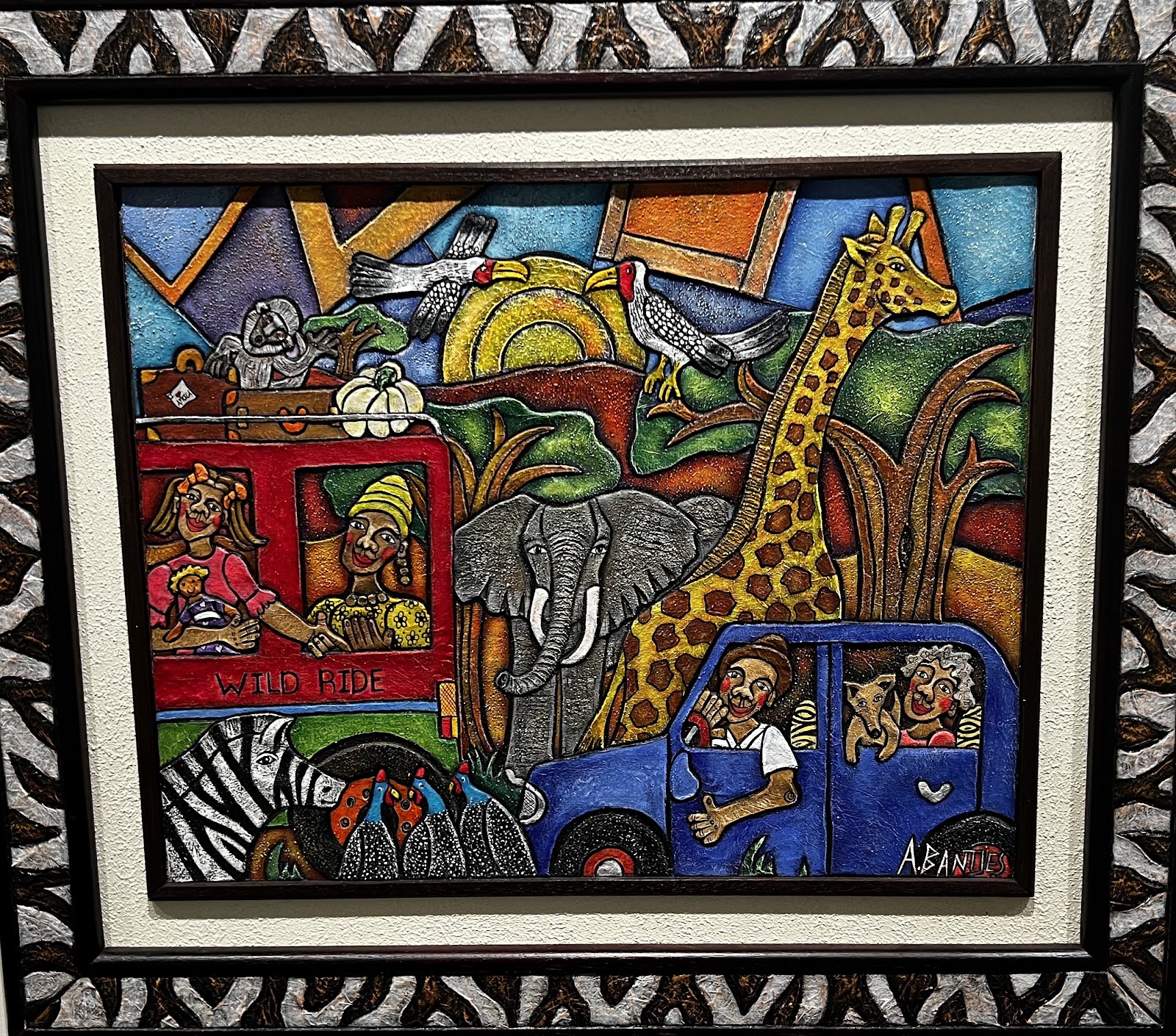
Adele Bantjes is from South Africa


Jean-Claude Dupont take on werewolf tales


I've lost the painter's name, but this could be an illustration from a creepy graphic novel


8/21/24

Vermont: The Best Place to See a Circus Museum


Shelburne Museum

Shelburne, Vermont


Surprise! You don’t need to journey to Sarasota to see the best circus remembrance in America. I’m happy about that because I doubt I’ll ever return to Florida: too hot, too many bugs, too many reptiles, and too many Republicans. The best place to capture the atmosphere, excitement, and assorted paraphernalia of the circus is Vermont’s Shelburne Museum, 7 miles south of Burlington.


The entire 45-acre campus is a delight that includes some of the finest folk art in America, 39 buildings, 20 gardens, and a landlocked steamship, but let’s focus on the Circus Building. Instead of jabbering on, I will divide a smattering of photos into sections: circus posters and objects; the circus parade; and circus photographs.


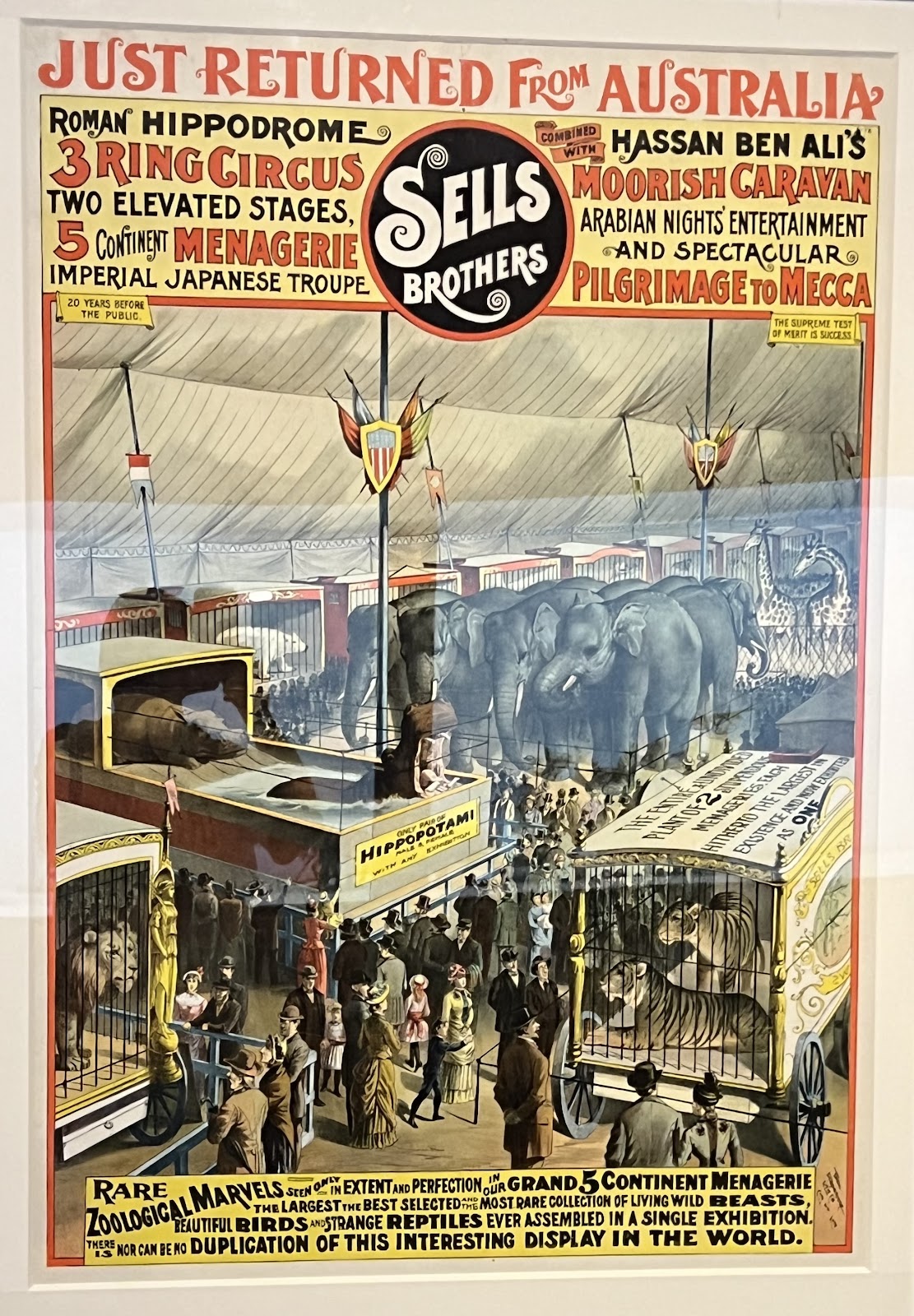
Let’s start with the posters. There are more of them than you will see in Sarasota, they are quirkier, and they are culled from more circuses. There were nearly large ones in American history and scores of smaller ones. Here’s a good index if you want to explore some.  A downside about which I’ve previously written: It’s hard to put posters under glass, hang them straight, and avoid bounce from indoor lighting. I’ve selected some that can be best captured digitally.


Ye Olden Days carousel painting


 The centerpiece of the Circus Museum is it’s enormous circus parade. It is the work of two men best described as obsesses visionaries: Edgar Decker Kirk of Harrisburg, Pennsylvania who, between 1910-56 jig-sawed some 3,500 pieces. They began as a creative toy for his four kids and evolved into a delight for neighborhood children as well. The second was Roy Arnold of St. Johnsbury, Vermont. He was more systematic in his designs and had a small team of assistants who fashioned a 1” = 1’ parade stretching 525 linear feet that were carved between 1925-55. The Shelburne Museum’s collection is considered folk art mastery and I think you can see why. 


The Big Top (darkened to take me out of reflection)


Note the detail in the figures


Tableaux were often circus features


One could do a study of ethnic misrepresentations at the circus

Including the all Indians are Plains Indians stereotype!


This summer the museum also has a small photo display from Elliot Fenander of a shoot he did in Pittsfield, Massachusetts of the Beatty-Cole Brothers Circus in 1972. The circus rolled into a very wet town in 1972 in which the soil was too soggy to erect the Big Top but–as the expression  goes–the show must go on! 


8/19/24

Ringling Museum in Sarasota


John and Mabel Ringling Museum

Sarasota, Florida


It’s summertime and this year the living has been more muggy than easy. It seems like a good time to think about the circus, but don’t ask me to explain my logic. As I have written elsewhere on this blog, the circus­, professional baseball, and vaudeville were the first forms of American popular culture. People didn’t or couldn’t travel very far from home until well into the 20th century, so the circus came to them.


It was truly “lions, tigers, and bears, oh my!” Imagine rural America, which was most of it until after 1920. There were backwater towns in which the most exciting thing was the sound of a train whistle. Now imagine the circus arriving at a local train station and unloading fancy wagons, some of which contained exotic animals. As roustabouts hurriedly erected tent cities at the fairgrounds, a giant parade as much a mile long snaked through the town. What gawker would not wish to see the animals, acrobats, clowns, and sideshows? As late as the early 1960s the arrival of the circus thrilled kids like me in my medium-sized Pennsylvania town.


My adult self understands how cruel circuses were to animals and “freak show” attractions, but I confess a lifelong fascination with three-ring circuses. I’ve been fortunate enough to visit three of the best repositories of circus memorabilia in America. Baraboo, Wisconsin, used to be the granddaddy of all. From 1884-1918 it was the winter home of the Ringling Brothers circus. For a time it in consolidation with Barnum & Bailey was the “Greatest Show on Earth.” I visited Baraboo back in the 1980s, aka/the age of film photography so I have no digital images to post, but Baraboo’s collection of circus wagons was second to none, as was its poster gallery. Both remain vivid in my memory.


Baraboo is still open but it closed for a time in the 21st century and came back as Circus World Museum. I’ve not been there but I’ve heard it’s not the same, though there is a Bigtop where you can see some live acts. After 1917 the Ringlings briefly wintered in Bridgeport, Connecticut, before decamping to Sarasota, Florida, the subject of this travelogue. So too did other circuses, including Forepaugh, Golmer, and Sells. John Ringling deeded the property to Florida and it’s now overseen by Florida State University. 


Sarasota is a huge complex whose main attraction is Ca’ d’Zan, John Ringling’s fanciful and palatial mansion. It also features a large art museum (the subject of a later piece). I wouldn’t say the Circus Museum is forgettable, but it’s certainly not the best collection of circus art in North America. It does have several restored circus wagons and an open-space culling of memorabilia, but we often find out more about the Ringlings and other entrepreneurs than the circuses and performers. 


John Ringling's private rail car


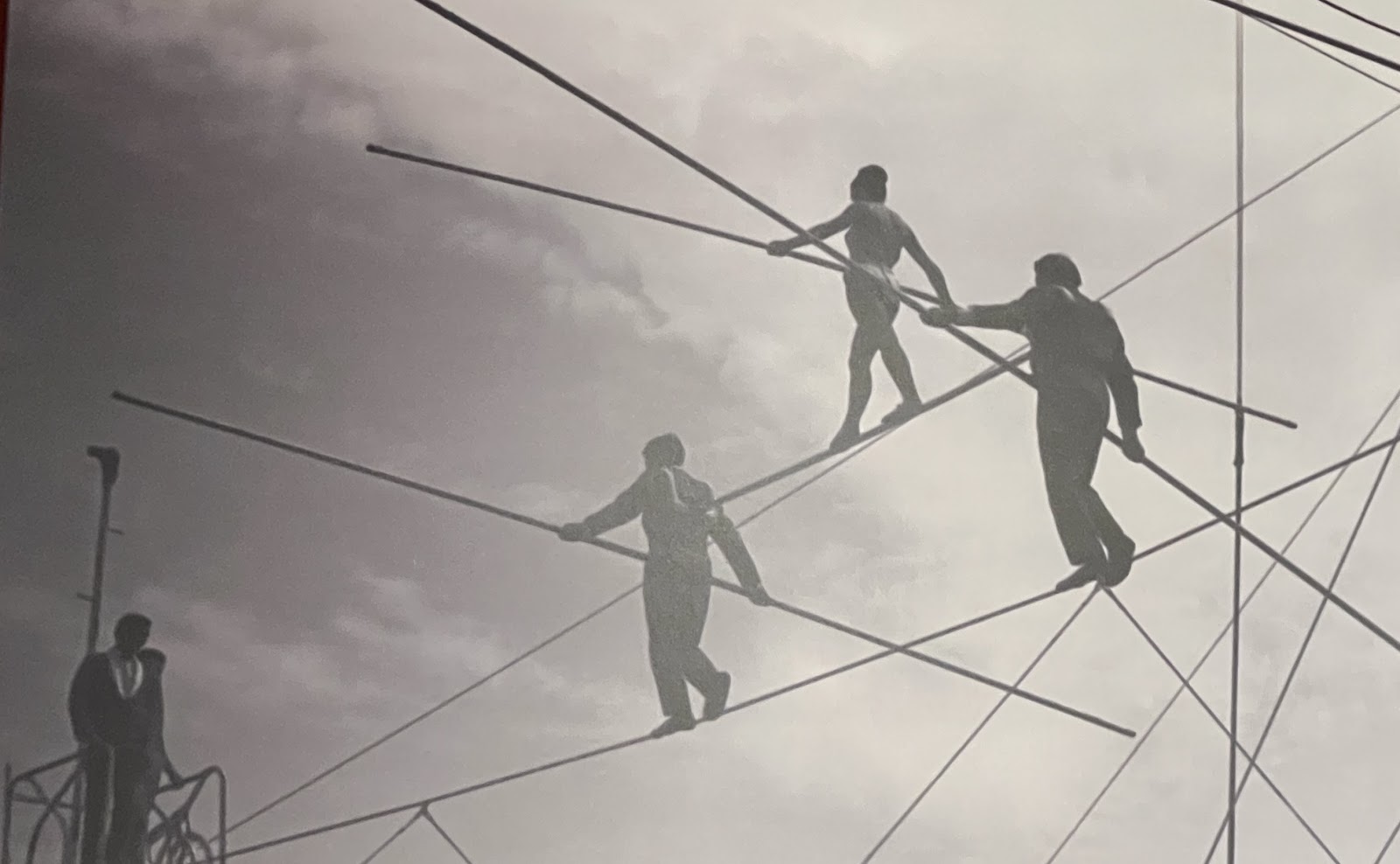
The foyer has a wall of colorful posters, but they are under glass and harsh lighting makes many of them hard to see. The most outstanding part of the Circus Museum is, oddly, the memorabilia linked to its star acts. These, though, could have been better interpreted. Information is given but (ironically) this part of the museum suffers from being too dark! You have to be of a certain age to recognize names such Clyde Beatty, Emmett Kelly, the Flying Wallendas, General Tom Thumb, or the Zacchini Brothers. I’d recommend that if you visit you jot down names of objects and people that intrigue you and look them up later.


The original clown car


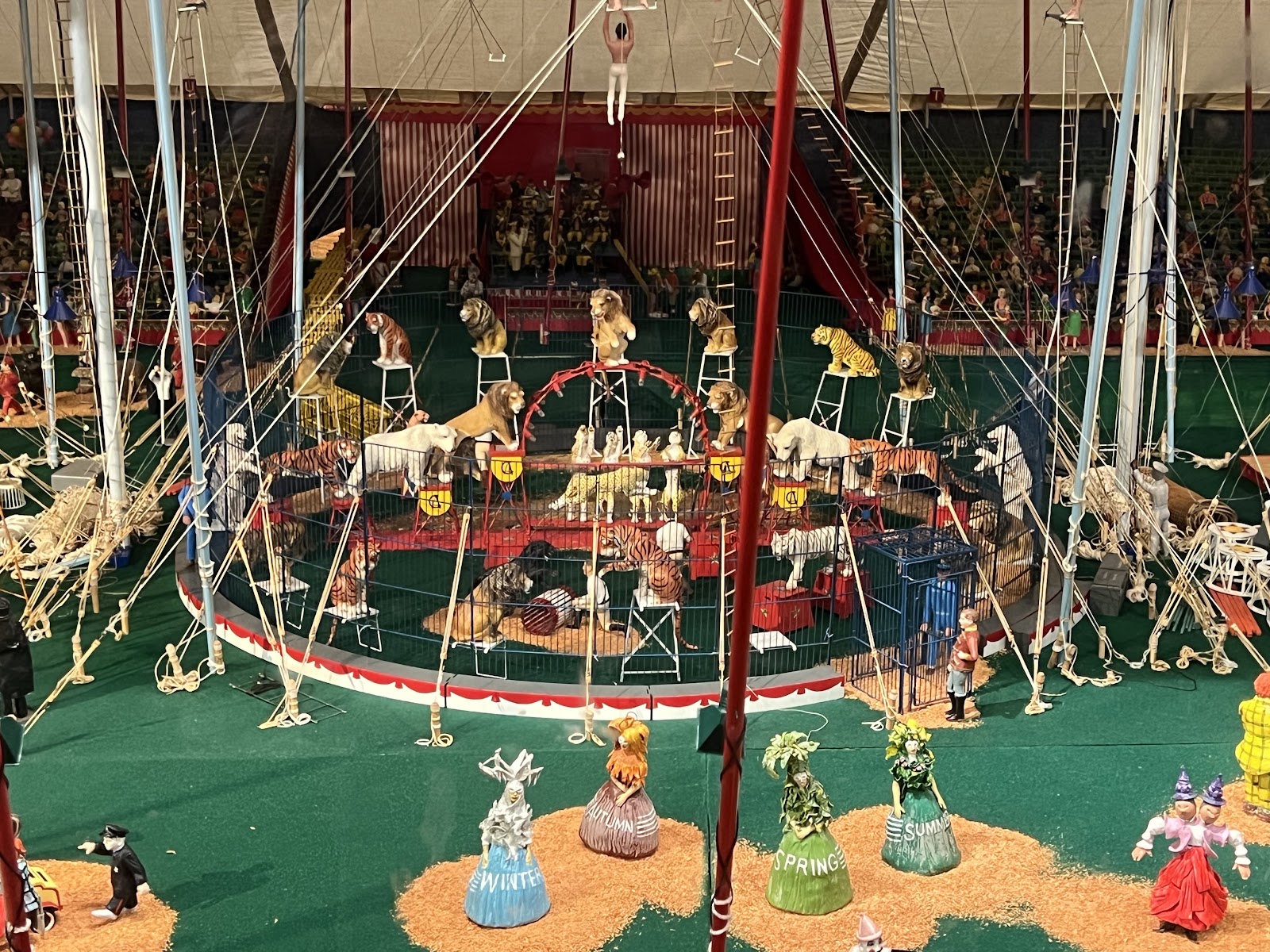
 The centerpiece of the Circus Museum is an entire circus in miniature created by businessman Howard Tibbals (Hartco Flooring). It’s a combination of assemblage and handmade objects that swelled to 42,000 pieces over 30 years–a 20th century circus in ¾ model scale. Tibbals was handy with tools and fashioned much of the circus in his workshop, a tribute to his skill and his obsession with the circus. It’s quite impressive, even when the overall effect is that of a model train project on steroids. Tibbals had an eye for detail, though, and you will come away with a sense of how awesome the circus could be. It’s mind-boggling to consider that such a thing in reality could roll into a town in the morning and be ready to welcome patrons in the evening. 


Stay tuned, though, for my vote for the best capture of circuses available to curious minds and kids seeking wonderment.


Rob Weir