5/2/25

The Last Ferry Out Will Likely Satisfy NA Readers


The Last Ferry Out (May 2025)

By Andrea Bartz

Random House Publishing–Ballantine Books, 320 pages

★★★


Mysteries and thrillers frequently parallel Alfred Hitchcock movies in that most have details that defy logic and probability. As Hitchcock observed, if you do the details well, your audience won’t notice. The new Andrea Bartz novel The Last Ferry Out works well as a heart-thumping thriller, but is marred by too much foreshadowing and forced resolution. It partially redeems itself by exposing the flaws of internalized colonial thinking.


Bartz’s protagonists are Abby and Eszter, a couple who met at the University of Wisconsin and, at age 27, became engaged. They are besotted with each other, though they are an odd couple. Abby grew up with an indecisive alcoholic mother, couldn’t wait to be out on her own, has minimal contact with her mother, and is an extrovert who goes hard (sometimes too fast) at things she wants. Estzer is a child of a successful Hungarian/Jewish immigrant family, but is introverted, analytical, and deliberate. Her parents don’t outwardly condemn her choices, but give little outward sign of agreeing with them or of embracing Abby. This enrages Abby, who reminds her beloved that she is an adult who doesn’t need their permission to get married. To Abby’s chagrin, Eszter wants to have a relationship with her parents.


Both young women are socially conscious. Eszter’s portfolio project at UWI–the feasibility of pairing those with resources with those without by opening a hybrid high-end resort that subsidizes low-income housing–evoked equal parts admiration and skepticism. Insofar as Abby knows, Eszter abandoned it as impractical. She tells Abby she is going to Miami to think things through. Abby, in turn, imagines that Eszter is getting cold feet. Has her father talked her out of getting married?


Bigger shocks await. Abby has actually gone to Isla Colel, a Mexican island off the Yucatan peninsula. (It’s an invention, though it shares some physical characteristics with Isla Mujeres near Cancun.)  Abby is devastated but filled with questions when she discovers that Eszter died of anaphylaxis there after accidentally consuming orejas cookies that contained nuts. Where was her EpiPen, which she so assiduously carried everywhere? Why didn’t she write and where is her journal? Why did Eszter lie to Abby about her whereabouts? Abby is inconsolable, hence she puts her job on de facto hold to go to Isla Colel, grieve, and investigate.


The bulk of the novel takes place on the island, which holds surprises of its own. The titular ferry to the mainland only runs once a week. It was once a tourist destination until a hurricane blasted its infrastructure. It is now home to an offbeat, tightknit assortment of expatriates, and locals who don’t find them as charming as they think they are. The oldest emigrant is German-born Rita, who acts as an experienced elder to the non-native community. Among the others on the island is hyper-sensitive Brady, who left his homophobic home in Australia; LA-born naturalist Pedro; and Amari, a gorgeous lesbian. The expats are carefree and gay-positive, as if a band of 20th century hippies were crossed with 21st century college students. (One wonders if Bartz intended her title to be a faint pun!)


 Most of the ex-pats rent from grumpy islander Gloria, whose husband Esteban is a fisherman whose fair-weather boat is one of the few private vessels on Isla Colel. He holds his views inside, but it seems as if everyone on the island holds secrets of one sort or another. Thus, Abby’s search for answers runs up against what is not said, temperamental WiFi, diversions, bad weather, Eszter’s lies, and dissuasion. Abby is suspicious of everyone she encounters, but how does one investigate without trusting someone or hastily jumping to conclusions?


NA (new adult) readers will probably find The Last Ferry Out satisfying and sensitive. As an older reviewer, I admired the strong framework Bartz established and her attempts to normalize non-heterosexuals. Yet, I also felt that the novel packed less wallop than it should have. There was too much petulance from major characters old enough to know better, and too many telegraphed clues and coincidences. The post-island revelations perhaps soothe, but they made me think of Hitchcock’s warning.  


If Bartz’s target audience is indeed the NA sector, The Last Ferry Out is the ticket aboard. Older readers, though, may long for something–for lack of a better term–more literary.


Rob Weir


4/28/25

What's On at the Rose Art Museum


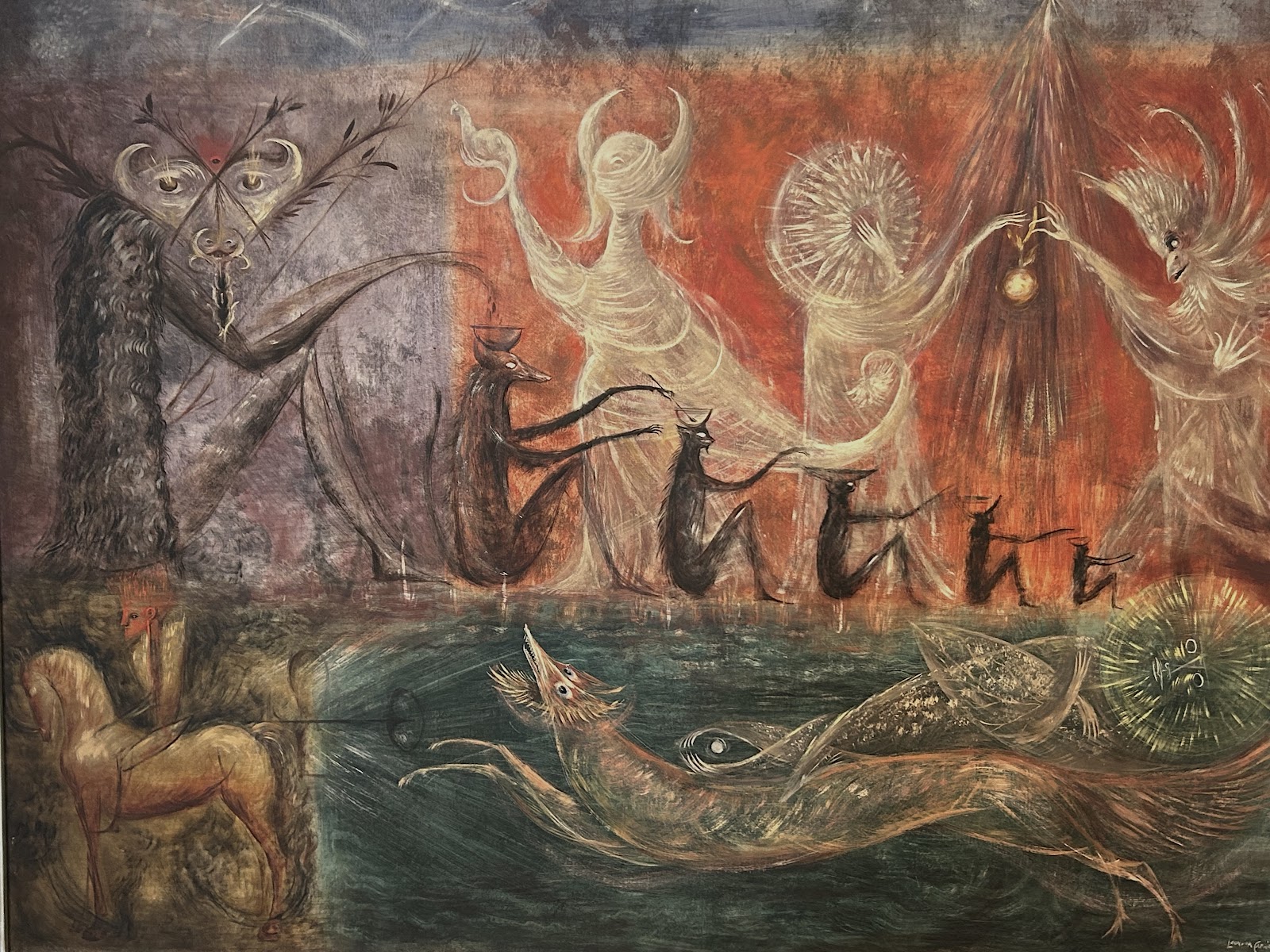
Carrington, The Last Resort (homage to Mexico?)


Leonora Carrington: Dream Weaver

Hugh Hayden: Home Work

Surrealism Then and Now

(All through June 1, 2025)

Rose Art Museum, Brandeis University

415 South Street, Waltham, Massachusetts

Wednesday-Sunday 11-5


I had never been to the Rose Art Museum or the campus of Brandeis University before. Although it’s inside Route 95/128 and is now considered a Boston ‘burb, you pretty have to drive to it as the MTA won’t get you near enough. If you go on a weekend, though, it’s an easy drive back to Alewife where you can stash your car and ride the Red Line into Boston. I took a chance and drove into Harvard Square where, miraculously, I found a parking spot. 


Pastoral 1950. Note the wink to Manet's dejeuner sur l'herbe


The main objective was the see paintings and drawings of Leonora Carrington (1917-2011), who was born in England but spent most of her life in Mexico. She came from wealth but rejected bourgeois society and English culture but, then again, there wasn’t much she did rebel against. She was influenced by German surrealist Max Ernst and upon meeting him, the two became lovers that very night. 


Nephesh as the Soul in a State of Sleep (dreams, the soul, the Kabbala all in one!)


Carrington is often considered that last of the surrealists, though that’s a problematic handle and many consider her more of a symbolist like Paul Gaugin or Odilon Rédon. There’s quite a lot of that in Carrington’s work, her major themes being nature, animals, myth, and the female body. (She would later identify with women’s liberation.) Yet her work also fits surrealist ideas of dreams, emotions, and the subconscious mind with all of its illogic and troubling aspects. Unlike most surrealists, though, she had no interest in Freud; like some of them, she had a psychotic breakdown (treated with electroshock, and barbiturates), and like many sought asylum in Mexico during World War Two. She and Ernst split when he was arrested by the Nazis as a “degenerate.” Peggy Gugenheim got him to the United States and married him! Carrington took up with a poet, whom she married and divorced.


Here are a few more works on display at the Rose. In my mind it doesn’t matter if she doesn’t fit snugly in any art movement. She was fiercely independent and I suspect she was doing her own thing, as we used to say back in the day.


Nunscape at Manzanillo  


Noah's Ark. (He has too many deer!)    


uuuuuuuuuuuuuu uuuuuuuuuuuuuu


The Rose is, however, spotlighting surrealism in a broad sense. Also on display is the intriguing work of Dallas-born Manhattanite Hugh Hayden (1983-). His acclaimed Home Work series shows him working in his favorite medium, wood. He adorns desks in thorns and branches growing on them and through them as if the desks are the Ur root of a living thicket. Hayden enjoys the irony and whimsy involved in taking familiar objects and transforming them.


He doesn’t always work in wood, though. Another series involves taking cookware and making them into masks, displaying bones as a playful take on “American Gothic,” or make think of Siberia through the use of a small hut and a several big mirrors. I suppose we could label this surrealism, though we might just want to call it clever.  


As a boy he was encouraged to participate in sports, which he hated. I’m pretty sure these works fall into a category best called “revenge!”


uuuuuuuuuuuuuu uuuuuuuuuuuuuu


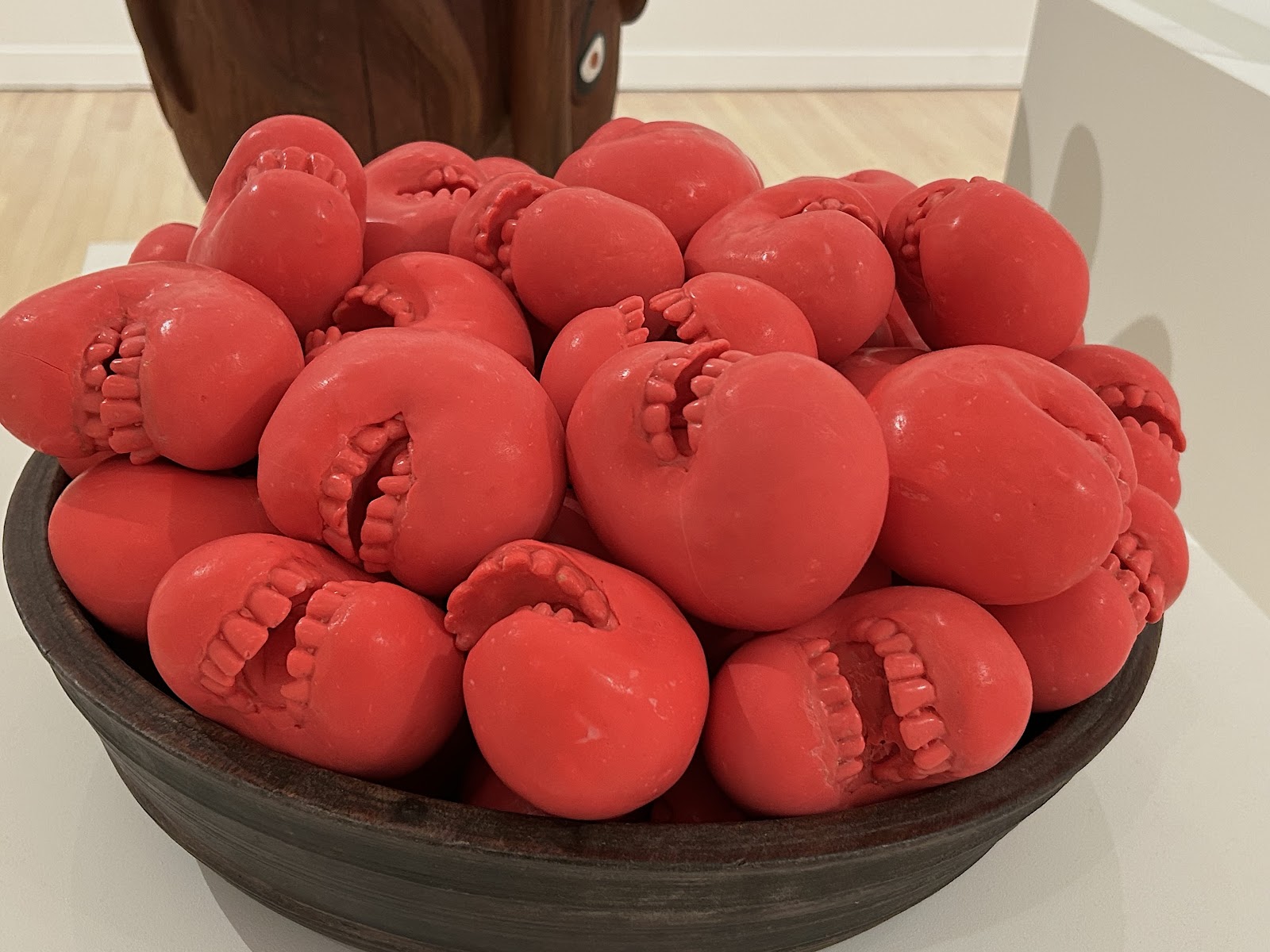
Surrealism Then and Now seeks to take surrealism out of the past and into the present. It was my least favorite exhibit at the Rose for the simple reason that I found myself spending more time appreciating the old “masters,” if you will than newer works we might read as surrealist. It’s a compact display, but it perhaps doesn’t do justice to hang younger artists in the same gallery as De Chirico, Ernst, Sage, Tanguay, and Kahlo. (For the record, Kahlo never identified as one.)


I get it that curators want to unbind surrealism from a specific moment in time. As a historian rather than an art historian, I think it’s a discussion worth having, but I generally end up feeling that most movements should be placed amidst their historical circumstances. Most of what I saw was trying too hard to be seen as surrealism and hence seemed derivative. But here are several that work. 


Gregory Crewsdon, Ophelia


Rona Podnick, Red Bowl


4/25/25

While the Getting is Good a Fine Thriller


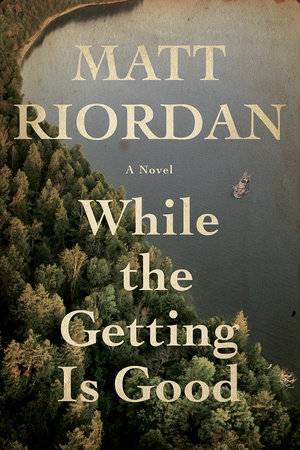
While the Getting is Good
(2025 )

By Matt Riordan

Hyperion Avenue, 326 pages.

★★★★


While the Getting is Good is a new novel about the Depression era that builds off the now-common knowledge that Prohibition created more crime than it prevented. To its defenders a booze-free nation was supposed to reduce everything from domestic violence to drunk driving and impulse crime. Instead, it created bootleggers, peddlers of poisonous beverages, and illegal speakeasies. Organized crime syndicates arose, each seeking to control the rising demand for contraband alcohol. Even the murder rate went up, as mobs rubbed out rival gangs, cops, and whoever else got in the way.


Prohibition proved nearly impossible to enforce, especially in places like Michigan where Canadian booze was just a short boat ride away. The Mitten State is the setting of Matt Riordan's new novel. It's a tale with more anti-heroes and heroines than virtuous characters.


Eld(ridge) is a Detroit-based fishermen who plucks herring from Lake Huron. He is married to Maggie, an Irish American lass who is both practical and feisty. They have two children, “Doc” and Bea. Eld, a World War One vet, works hard and makes about $1400 a year, decent money back then until the Great Depression hits. Like all fishermen, what he makes isn't what he clears. Fuel costs, repairs, boat payments, groceries, and rent chew away at his income and dropping fish prices make it harder to stay afloat, as do Bea’s school uniforms and donations to the Catholic Church. It's a good year if Eld can pay off his debts and have a little left over.


What would you do if some guy named Leon presented you with a plan that lets you fish to fish and make big money at the same time? All Eld has to do is briefly dock his boat on Sanilac Island, eight miles offshore but on the Canadian side of the watery border with the United states, load cases of whiskey, cover them with his catch, drop off the whiskey at a warehouse, and sell the fish as he normally would.


The usual preference to “while the getting it's good,” is “get out....” It’s another way of saying “if it sounds too good to be true it's not.” Eld realizes this too late., but how do you say no to the high life? Eld gets drawn into dreams beyond his imagination: lobster dinners, Leon's flashy boss Mickey Solomon, rolls of cash, and his sister Georgia. Before you know it, Eld is recruiting his friends, bedding Georgia who is as exotic as Maggie is pragmatic, as is often the case with women who in the parlance of the day would be called “floozies.” Even Doc is attracted to the smuggling business, despite his father's warnings to stay away. Eld and his family are rubes in a (literally) deadly game. What do they know of the Purple Gang, Detroit's big-time crime syndicate that doesn't take kindly to encroachment on what it sees as its turf?


Both Eld and Doc “disappear,” seldom a good thing when dealing with organized crime. In Part II of the novel, the women take over. Maggie initially despises Georgia, but they bond when word reaches them that thugs have made inquiries, a veiled threat the experienced Georgia knows way better than Maggie. Besides, Georgia gets on really well with Bea. Violence stalks them and people die, but Maggie and Georgia pull their own disappearing act by vamoosing to Indiana, then Ohio. The ultimate plan is to head to California.


One of the delights of Riordan’s tale is that it continues to toss unexpected curves. We learn a lot of unexpected things about Maggie, including why she finds it easy to be malleable. She does whatever she thinks is necessary to support Bea; including joining a cult-like religious group, becoming an industrial inspector, and getting sucked into a scheme of her own.


I like historical novels, and enjoyed While the Getting is Good quite a lot. It does have weaknesses though. Riordan runs out of steam and leaves us with an ending that comes off as clichéd and contrived. Some might also find the book’s parallel structures too convenient to be believable. Maggie's transformation also stretches the imagination, as does a Return of the Native-like reappearance. That said, While the Getting is Good is a fine thriller and a goes-down-easy portrait of American working-class life in the early 1930s.


Rob Weir


PS: The Purple Gang was a real crime syndicate.

4/21/25

Glasstastic Returns to Brattleboro

Glasstastic (Through November 1, 2025)

Brattleboro Museum and Art Center

10 Vernon Street

Brattleboro, VT Weds-Sun 10-4


Welcome back! I’m talking about one of the coolest ideas ever. Fourteen years ago the folks at the Brattleboro Museum and Art Center (BMAC) launched an innovative and delightful idea. They asked kids from kindergarten through sixth grade to draw an imaginary creature and write a “story”– usually just a few lines, often filled with charming misspellings– about their beasties. As the curators note, quite a few creatures “love pizza and dancing.” A panel of 20 artists chose one to be rendered into glass sculptures based on the kids’ drawings.


It started small but these days they get more than a thousand entries from all over the country. I must say that if you’re like a lot of Americans you’re probably not feeling very hopeful about the nation these days, but the 2025 Glasstastic show is guaranteed to put a smile on your face, even when a child or two writes something personal that will tear at the old heart strings.


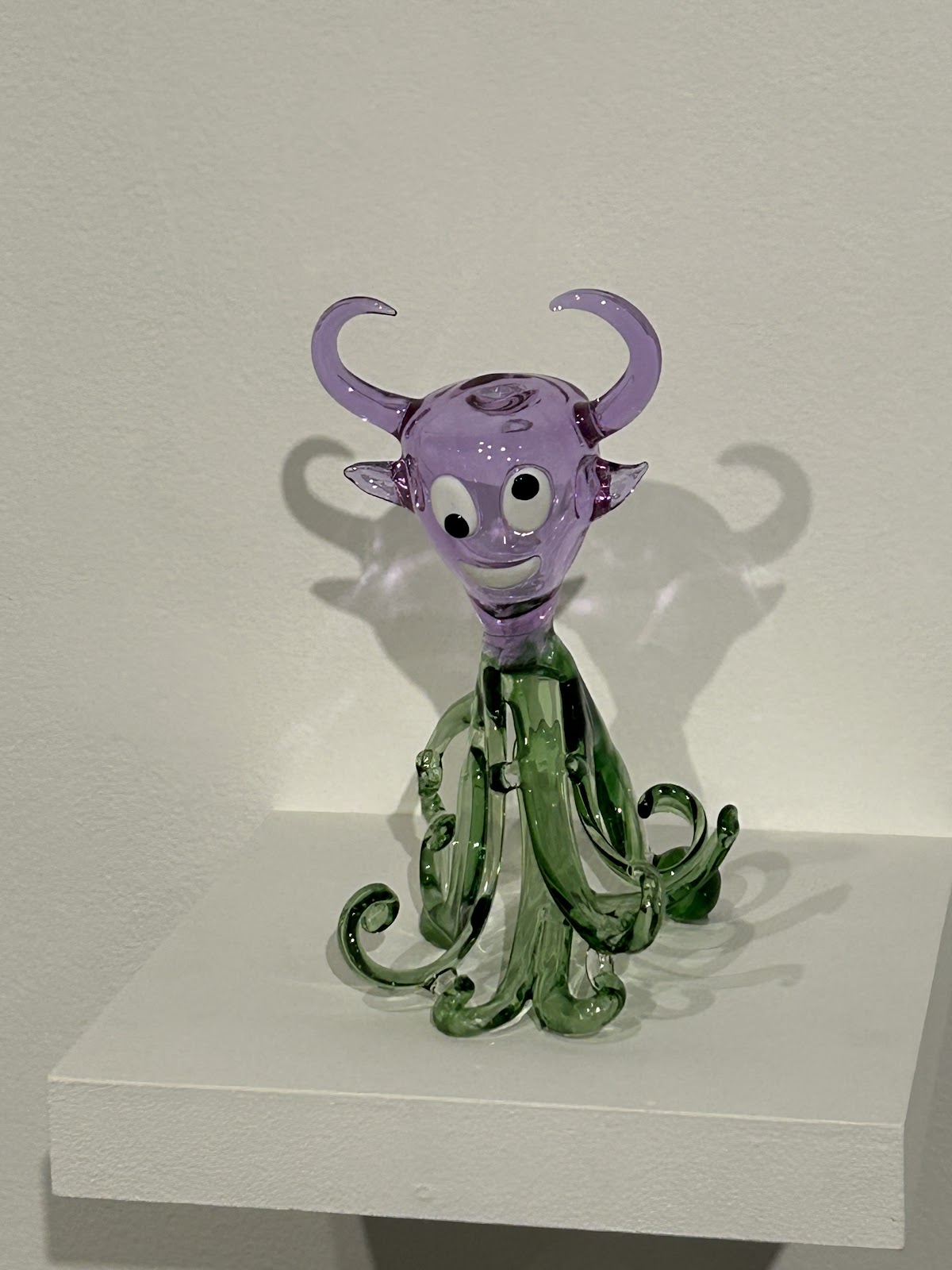
Here are a few images to whet your appetite. I highly recommend that you get there to see this exhibit in person. These iPhone shots can’t convey the overall vibe, whimsy, and creativity involved. Major kudos to the BMAC for taking the minds and experiences of children seriously and to the glass artists for allowing their inner children to come out and play.


Admit it. You’d like to have a “Demon Slug” on your dresser. Or perhaps a glass pirate skeleton, or Tina, an underwater creature who turns colors according to her emotions. Then there’s Alf, who has anger issues because his father died from cancer. You reckon eleven-year-year-old Simon might be sharing his own pain? We can only wish that he gets to meet “Smilie” soon. Or maybe Alfred, the 82-year-old critter whose mustache is so strong he can stand on it and can hoist little George over his head.


Photos are labeled with the child’s name and age followed by the artist’s name. Enjoy! (Ignore last label; there is a format error I can't find!)


Gavin Oparowski, 10, Demon Slug – Andrew Weill


Maddie Kolb, 10, Tina – David Colton

Clara Lumenello, 11, Smilie – Chris Sherwin
Maddie Gruey, 11, Alfred & George – Bryan Randa


Simon Hamilton, 11, Alf – Jen Violette     


    Reagan Loucy, 8, Webs the Tarandrabat

 – Wesley Fleming


4/18/25

Provocative and Magical Show at New England Quilt Museum


Fierce Planets (through May 3, 2025)

New England Quilt Museum

18 Shattuck Street

Lowell, MA

Tuesday-Saturday 10-4


There are only a few more weeks left but if you find yourself anywhere near the New England Quilt Museum in Lowell, make sure to stop in to see Fierce Planets. Two things. First, I never really thought about fiber arts until Emily took up quilting and I saw firsthand the intricacies and creativity that go into things most people might consider as utilitarian. As one trained in folklore, that was a major shame-on-me moment. Second, Fierce Planets is such an inherently good idea that I wondered why no one thought of it before. Stay with me; it is a collaboration between the Studio Arts Quilt Association and Johns Hopkins University.


Professor Sabine Stanley’s seminars and books on planetary science inspired quilters to render in fabric and stitches what the ever-evolving science of astronomy tells us about the universe and what lies beneath and beyond the Little Blue Marble we call Earth. In all there are 42 works from artists from six different nations. Science and math allow us to imagine many things, but if you think it odd to sew postulates onto coverlets and hangings, know that humankind is still in its infancy insofar as knowing what lies beneath our feet, let alone what lies many light years into outer space.

Dorothy Raymond 


Libby Williamson

Dorothy Raymond (Colorado) quilted “Dragons Playground” when she mused upon the rivers of lava we believe course in the Earth’s core. Libby Williamson (California) reminds us that what we know of ancient life before humans exits in fossil remnants. Her work “Buried Treasure” is filled with clues that simultaneously provide hints about prehistory, but we can only infer and extrapolate the details based on the little we have found. (We’ve only known since the 1990s that some dinosaurs sported bright feathers.)


Laurie Fagen


Eileen Searcy


Cathy Calloway


Consider also that all we know about our own solar system is based on space-based telescopes, flyby unmanned spacecraft that have either crashed or floated thousands of miles above planetary surfaces, or a handful of rovers that have explored tiny portions of Mars. Laurie Fagen (Arizona) gives us “Sun with Mercury” to help us consider how huge the Sun is and how tiny its closest star is. We might never know exactly what Mercury is like–it’s probably a gas ball–because no human could survive there. Mars might be doable, but Eileen Searcy (North Carolina) knows most of it also remains a mystery. Her “Valle Marineris” depicts how she thinks of an area that many believe to be analogous to the Grand Canyon of Mars. One would do well to be wary of analogies based on indirect observations! And what do we do with Jupiter, the elephant in the solar system. Cathy Calloway (Montana) was blown away by consideration of “Jovian Winds,” as would anyone looking at relays from the Juno spacecraft suggesting Jupiter’s powerful wind belts are somewhere from 2500-4000 miles wide.

Mieko Washio  

Judith Constant


Maria Eugenia Corbella 


Paula Rafferty


What lies beyond they solar system? Only Voyager I and II have gone into interstellar space and they’re not saying much these days! Mieko Washio (Japan) did a clever thing with “Cosmos.” Like an actor breaking the fourth wall, her fabric juts beyond what we imagine should be the shape and regular dimensions of a quilt. Why would be assume regularity in deep space? Judith Constant (California) drew inspiration from stars being born and dying in “Nebulae.” How many are out there? Maria Eugenia Corbella (Spain) embraces what she calls “The Beauty of Chaos,” though Paula Rafferty (Ireland) sees perhaps a more awesome and terrifying “Storm.” 


Mary Tyler
 

And then there is the Big Question: Is the universe intentional and created, or an accident whose consequences we and potentially billions of other lifeforms must live with until we become extinct or find new homes under new suns? The secularist rejoinder to creationism is the Big Bang Theory. Mary Tyler (Washington) gives us a possible image in her all upper case “BANG.”  I’m taking the coward’s way out. I’m with Kathy Nida (California) who threw together lots of things and titled it “I’m Floating in a Most Peculiar Way.”


Kathy Nida


Rob Weir

4/16/25

Io Capitano and Illegal Immigration


Io Capitano (2024)

Directed by Matteo Garrone

Cohen Media Group. 121 minutes, R (gore, torture)

In Wolof and French with subtitles.

★★★★★


North Americans are often fixated on south-to-north immigration and forget that peoples from all over are on the move. They emigrate for a variety of reasons, from climate change to war, but poverty is usually the major reason. Io Capitano begins in West Africa where two teenaged Senegalese cousins, Seydou (Seydou Sarr) and Moussa (Moustapha Fall) dream of going to Europe. They drastically underestimate how difficult such a journey could be, but despite caring families, it’s easy to appreciate how Europe might seem a better option than life at the bottom in Dakar, Senegal. The boys work at odd jobs, hock goods on the street, and literally bury their earnings in the sand. They sneak off into the night when Seydou thinks they have plenty of money to get to Italy.


It might have been if the boys didn’t have to buy forged passports, pay bribes, encounter thieving gangs, and shell out the extortive rates for guides and drivers. It would also have been easier were there stable and honest governments between Senegal and Italy. Instead, their stash is severely depleted before they make it from Senegal into Mali. At each step, Seydou and Moussa experience harrowing border crossings and nightmarish treks across barren lands where marauding nomads and cutthroat bandits are a law unto themselves. In Niger, they are tossed into open vehicles and bounce their way across the rutted and shifting sands of the Sahara in a desperate attempt to outrun pursuers. Fall out of the truck and you will die; no one can stop to rescue you. Riders are promised passage to Libya, but the trucks halt, unload, and the sizable human caravan is turned over to a guide who wordlessly hikes ahead with the same attitude of stop and you’re on your own. Director Matteo Garrone and cinematographer Paolo Carnera punctuate the rigors of such a flight through what seem to be splashes of magical realism but are actually walking dream hallucinations brought on by exhaustion.


 In Libya, they are stopped by brutal men who demand that they turn over all of their money. They have a novel way of uncovering those who claim they are broke but have hidden their money in their rectums. The cousins are separated, with Moussa tossed into a Libyan prison that makes Abu Ghraib seem like Club Med. It doubles as a torture chamber, as Seydou discovers first hand. He survives but is sold a slave. Luckily, he and a French-speaking prisoner who is a skilled bricklayer are chosen to build a fence and fountain for a vain, rich Libyan who eventually allows them to go to the coastal city of Tripoli, where there are expatriate Senegalese communities.


Will Seydou and Mussa ever reunite? Will either of them make a successful crossing of the Mediterranean Sea? The attempt at the latter gives the film it’s title. Io Capitano means “I am the captain.” Seydou doesn’t have enough money to pay for a voyage, but he is allowed to try by a–shall we say sarcastically–enterprising individual with a rust bucket boat who has collected a large number of paid fares to be ferried to Italy. He really doesn’t much care if the refugees get there or not and isn’t of a mind to make the trip himself. The deal is that Seydou can board the ship if he agrees to sail it himself. Remember, he is 16-years-old. Has he ever piloted a boat of any sort? That would be a hard no!


At this juncture I should mention that Il Capitano is not based on a true story. It has been called a “Homeric tale” and shares similarities with The Odyssey (as it does with other immigration sagas such El Norte, Green Border, and the classic Black Girl). By doing a mashup of numerous dangers involved in what we often glibly call “Illegal immigration,” Garrone makes us see the inherent inhumanity of how outsiders are treated without conforming to a predetermined conclusion. In my estimation, his was a bold and effective strategy. The film was nominated for a Best International Feature at the 2024 Oscars. It did not win, but carried off numerous prizes elsewhere. Homeric tales are filled with heroes, fallen warriors, and victims. Which will be the fates of Seydou and Moussa?


Rob Weir

4/14/25

MLB West


Could the postseason be an all-West Coast phenomenon in 2025? Probably not in the AL, but it’s not out of the realm of possibility in the NL. 


American League:


Three teams are vying for supremacy, but I think one will falter.


1. Texas Rangers slipped a year after winning the World Series, but look for them to right the skateboard. They live and die by pitching and have exciting young arms–Rocker and (Jack) Leiter– knocking at the door. If everyone else is healthy and kids live up to their hype, who can match them plus Corbin, Eovaldi, deGrom, and (Jon) Gray? Texas had run production problems last year but Pederson, (Aroldis) Garcia, Seager, Higashioka, and Semien should snap back to form. Many analysts see OF Wyatt Langford as MLB’s top prospect.


2. Seattle Mariners might finally snag a Wild Card. Their problem, as always, is that the Mariners always look better on paper than on the field. There is no reason for a team with Arozarena, (Joely) Rodriguez, Crawford, Solano, and Polanco not to hit, though they are not big power guys. Robles either hits or goes down as a hyped mediocrity. Several pitchers are on the IL right now, which puts a burden on young pitchers like Vargas, (Bryce) Miller, and Woo to produce. If they do and Castillo adds more W’s than L’s behind his stats, the M’s should be alright, though they have a history of disappointment.


3. Houston Astros won the division last year, but they deleted such talent as Bregman and Tucker. They still have Altuve, Pena, and added Walker, but if Rogers can’t hit outside of Colorado’s thin air and Paredo (from Tampa) doesn’t either, the Astros will be challenged to score runs. Their pitching­­–Valdez, (Hunter) Brown, (Luis) Garcia, McCullers, and Blanco–is strong and Hader is one of the best closers in baseball. Pick the ‘Stros  to surprise one way or another, either by being better or worse than expected.


4. Sacramento Athletics: Another team displaced and, like Tampa, calling a minor league park home. Let’s see, a team 16th in batting and 24th in ERA competing to stay out of the basement with one 19th in batting and 25th in ERA. Go with the A’s but don’t get too excited. What do Andujar, Medina, Sears, Severino, Urshela, and Waldichuk have in common? They were all dumped by the Yankees. Springs from the fellow homeless Rays will help. It’s hard to see the A’s putting up a lot of runs, so don’t be shocked if they flip their weak batting and pitching rankings.


5.  Los Angeles Angels: Trout will be 35 this year. Even if he claws back from several years of injuries he is destined to go down as one of baseball’s best players never to play in a World Series game. Angels ‘pitching could improve if Kochanowicz (25) and Soriano (27) come into their own, but don’t expect miracles from Cubs castoff Hendricks or Kikuchi whose career ERA in 4.57. Besides Trout, the offense offers Moncada, who has been around long enough to call a bust, Ward, and catcher O’Hoppe. Ouch!


National League:


Two Wild Cards could come from the NL West. The only sure thing is that the Dodgers will win the division. I wouldn’t bet against them to repeat as World Series champs.


1. Los Angeles Dodgers: This is what a billion dollar investment looks like: Freeman, Muncy, Betts, Edman, Conforto, (Will) Smith, (Toescar) Hernandez, and Ohtani. If the Dodgers ever let Ohtani pitch again, they’re nuts! Here is a partial list of possible starting pitching: Yamamoto, Snell, Glasnow, May, Sasaki, Stone, Gonsolin, and Kershaw. They could trade for anything they need in a nanosecond. Only an earthquake that swallowed Dodgers Stadium could stop them from winning the Series again.


2. San Diego Padres: In a fair world the Padres would be a favorite to win the division. They have a fine pitching staff­–Cease, Darvish, King, Musgrove, Pivetta–and a terrific lineup of Bogaerts, Machado, Merrill, Sheets, and Tatis. Hayward has never lived up to his hype, though.


3. Arizona Diamondbacks: If the Holy Fathers slip, the Snakes could slither past them. The pitching is solid–Burnes, (Shelby) Miller, (Eduardo) Rodriguez, (Merrill) Kelly, and some youngsters in the pipes. Aside from Carroll you may not know the lineup but Marte, Gurriel, Perdomo, (Eugenio) Suarez, (Josh) Naylor, and the underrated Gilchuk are capable. Right now the pitching is okay but not dominant. Pick them for fourth if that doesn’t change.


4. San Francisco Giants: They play in my favorite MLB park and have a good team that suffers from being in MLB’s best division. Best case scenario is that one of their rookie hurlers (Roupp, Birdsong) catches fire and pushes Webb, Ray, converted reliever Hicks, and aging Verlander to surpass expectations. Ditto a potentially productive lineup of Adames, Chapman, Encarnacion, Flores, and Yastrzemski that’s good but probably not good enough to contend for a Wild Card.


5. Colorado Rockies: The future isn’t now. You’ve heard of Bryant, but probably not any other hitter. Likewise, you might know that Freeland is their ace. There are young arms waiting, assuming they don’t have to check into asylums from pitching in the Rockies’ mile-high gopher ball facility.


Rob Weir