7/27/18

Art Road Trip to Brattleboro, Vermont

Steve Gerberich, Best of Springs, Sprockets, and Pulleys
Robert Dugreiner, Handle with Care
Roz Chast, Can’t We Talk About Something More Pleasant
Brattleboro Museum and Art Center through September 24, 2018

Not many people think of Brattleboro, Vermont, when they think of art museums. After all, it’s a small venue—only five galleries—located in a town of just 12,000 people that’s 100 miles from Boston and 200 from New York. Sometimes it’s a good thing to have some distance between you and the art establishment. The Brattleboro Museum and Art Center (BMAC) often launches creative exhibits that are not the sort you’d find elsewhere. This summer it has three strong shows.

The star of the summer is Steve Gerberich, an Iowan who has an eye for what he can do with small motors, cast off objects, a vivid imagination, and an offbeat sense of humor. He says his whimsical assemblages are equal doses of Joseph Cornell, Marcel Duchamp, Alexander Calder, Robert Rauschenberg, and Jean Tinguely, but somehow I think he forgot to mention Rube Goldberg. It takes a creative mind to find a personified plastic mouse, fit it back-to-the-viewer in a box, and then imagine metal tea strainers as cat faces that move back and forth as a rodent’s worst nightmare—even if he is conducting the orchestra!

“Cash Cow” (1990) is funnier still, a wood, bicycle, and hide body—the bovine sporting sneakers instead of hooves—plus various gears, levers, musical instruments, and machine parts slapped together to create a surrealistic milking machine. In other pieces he uses teapots for heads, lampshades for hats, broom bristles for hair, and machine parts for noses to create everything from the world’s strangest-looking rock band to machines that do nothing but still manage to fascinate. Gerberich is just a lot of fun. His kinetic sculptures are where engineering, artistic vision, and boyhood wonder collide. You will smile your way through this exhibit. That is, whenever you’re not exclaiming, “This is so cool!”


In “Handle With Care,” Robert DuGrenier juxtaposes glass and objects to create self-contradictory combinations. For instance, his “In Case of Fire Break Glass” is a series of metal hammerheads attached to glass handles. “Double Burner” is a gas oven grate atop melted glass extruded below. A rusty can is shown with a milky substance pouring forth—also glass. In his own way, DuGrenier is making small jokes á la Gerberich. His are a bit more poignant, though, as a fire that swept away his barn inspired them. In such situations we learn that not even “rugged” implements such as hoes, rakes, and shovels emerge unscathed. On a more basic level, though, mixing glass and metal invites the viewer to reconsider all things prosaic.


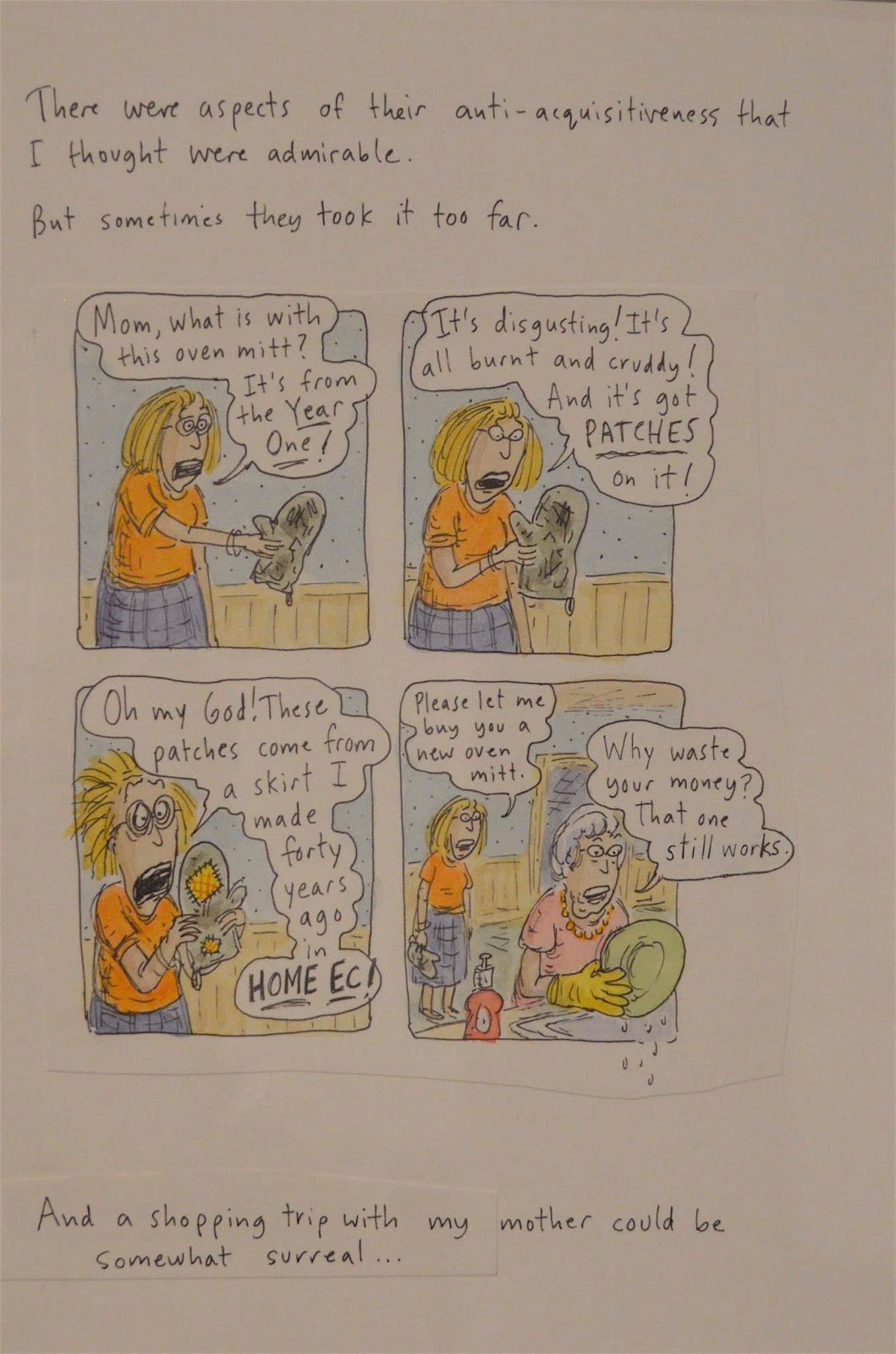
Humor has long been the stock and trade of Roz Chast, one of the best known of all American cartoonists and graphic novelists. Her “Can’t We Talk About Something More Pleasant” demonstrates the levity within the deeply tragic: the care for elderly parents and their ultimate demise. The panels on display come from two sections of her memoir: “The Beginning of the End” and “The End.” If you know anything about Chast, you are aware that she had a complicated relationship with her parents; on one hand, they drove her crazy, but on the other they provided an endless supply of mirth and material. Some would classify Chast’s work as New York Jewish humor. Although there is truth in that, her work transcends any particular religious or cultural tradition. How many of us have, at some point, shaken our heads when pondering how we managed to come from that family? And what is more commonplace than negotiating the communications and values gaps that divides one generation from the next? Chast dares wonder if these haunt from beyond the grave. 


The BMAC has several other exhibits that, in my view, are less successful. David Rios Ferreira creates collage like illustrations in which botany, race, gender, and colonialism intersect. Or, at least, that’s his aim. I see that, but only is glimpses. His densely layered surfaces too often come across as chaotic mishmash that's like a dinner entrée with too many ingredients. Maybe it was the obfuscatory statements he made about his own work, maybe it was the overuse of earth tones, or maybe it was that he tried to tick the box of every au courant oppression, but this exhibit never engaged me.

I enjoyed the vibrant colors in “Painting Time” by Debra Ramsay, but it’s hard to get past the reality that this installation is simply strips of acrylic painted in bold hues and strewn willy-nilly onto the floor of a small side gallery. The various colors represent the four seasons. Conceptually, I like the idea of reducing time’s passage to basic colors rolled onto strips suggestive of film stock. Mostly, though, I saw only a pile of pleasant pigments. I would have been more enamored of a video showing Ramsay rolling paint and talking about how we can “see” time as flowing ribbons of color.  

I zipped through “Terrestrial Vale” by Susan Macdonald, her silverpoint and graphite on paper look at plants bedded down for winter. She produces spectral like renderings of bundled-up plants and captures in spirit the fragility of living things as winter settles in. I confess, however, that I have never warmed to the forms Macdonald uses. To my eye—admittedly sharpened by photography—the images appear sketchy and incomplete, as if they are black and white negatives waiting to be printed.

But here’s the deal. Not even artists themselves like or appreciate all art. What’s special about the BMCA is that it’s small enough that visitors end up sampling things they’d otherwise not consider at all. I applaud it for its diversity and its boldness. And who knows, maybe one day I’ll come to appreciate silverpoint.

Rob Weir

7/25/18

Love and Mercy: Video Review

Love and Mercy (2015)
Director Bill Pohland
Lionsgate, 120minutes, PG-13
★★★

Films about Baby Boomer idols seldom set the box office on fire. I suspect that’s because Boomers have their own memories and no one else particularly cares, though it certainly doesn’t help that so many films about the 1960s and 1970s are either dreck or uneven. Love and Mercy, a Brian Wilson biopic, falls into the second category. Although it’s no masterpiece, it is certainly worth watching as a download or stream. That’s how most of us ended up seeing it, as it did only modest business when it went into wide distribution in June 2015.

Here’s why you should see it. First, the Beach Boys were far more than the surf songs that get radio oldies play ever summertime. Brian Wilson is one of the most creative minds in the music business, and I mean that across genres. The sand-and-party hits notwithstanding, the Beach Boys’ 1966 album Pet Sounds was and is a landmark in soundscaping. Rolling Stone lists it as among the 40 most influential albums in popular music history; some claim it surpasses Sgt. Pepper’s Lonely Hearts Club Band as the most important recording of the entire 1960s. Such debates seldom go deeper than personal preference, but wherever it’s ranked, serious music critics will tell you that familiarity with Pet Sounds is an essential part of anyone’s musical education. The next time you hear “Good Vibrations,” listen deeply. On that hit single and throughout Pet Sounds, Brian Wilson reinvented what we think “rock” music means and sounds like. From the opening Theremin sounds to all the strings, horns, key shifts, and “pet” sounds—today we'd call them “found sounds” (bicycle bells, soda can percussion, disconnected background voices)— Wilson collapsed composition and genres to create music that some found “weird,” but which has stood the test of time.

The second reason to see the film is that this music came from Brian Wilson’s head. Paul Dano, who does a superb job of inhabiting the mind of a tortured genius, portrays the youthful Wilson. I was reminded of Tom Hulce’s performance as Mozart in the 1984 film Amadeus. Actors, of course, are paid to pretend to be another person, but it’s another thing altogether to display how the mind works. It’s hard enough to define creativity, let alone make an audience “see” it at work. Like Hulce, Dano used facial expressions and body movements to make us imagine what the inside of Wilson’s head was like.

That’s not a place most of us would wish to reside; Brian Wilson battled with mental illness, and must still use heavy-duty meds to control schizophrenia. When we meet an older Wilson—played by John Cusak—in 1986, he was under the tyrannical and Svengali-like control of Dr. Eugene Landy (Paul Giamatti), a charlatan who tore down Wilson’s ego, kept him sedated, and bilked him. The film presents Landry as a more evil version of Wilson’s authoritarian father (Bill Camp). That’s both simplistic and a contrived close the circle Hollywood device. Still, we get the point that Brian Wilson often lacked the support systems he needed.

The film is essentially four acts and a coda: a truncated look at the rise of the Beach Boys, Wilson’s simultaneous creative assent and mental descent, the nadir of the Landy years, and romantic salvation at the hands of his eventual second wife, Melinda Kae Ledbetter (Elizabeth Banks). The coda, which plays over the final credit, is the real Brian Wilson performing the movie’s titular song, which he released on his 1988 comeback album.

Dano, Cusak, and Banks are very good in the film. Also convincing are Kenny Wormald, Brett Davern, and Jake Abel in the roles of Brian’s brothers Dennis and Carl, plus cousin Mike Love. Graham Rogers is also solid as the fifth Beach Boy, Al Jardine. The musical sequences are all the more remarkable given that the soundtrack is a pastiche of Beach Boys tapes, recreations by the actors, and an original score from Atticus Ross.

I was less enamored of the usually reliable Paul Giamatti, whose Landy was both histrionic and cartoon-like. I felt the same about Camp’s performance. As is often the case, the film also takes liberties with Wilson’s actual biography and gives him credit for several innovations that weren’t actually his. One wonders why this was necessary given that Wilson’s story is already sufficiently dramatic and unique. The film’s major flaw, though, lies with continuity lapses in the script penned by Michael Alan Lerner and Oren Moveman. They opted for flashback/flash forward sequencing that works for those who already know about Wilson and the Beach Boys, but which is clunky for those who don’t. I also found it jarring to see Dano, who looks sufficiently like younger Wilson, in one moment, and Cusak the next. Cusak is a fine actor, but he doesn’t look much Dano or Wilson.

Overall, though, this is a decent look at Brian Wilson. All non-Boomers should see it to learn about Wilson’s iconic compositions. Maybe the Beach Boys will never be your thing, but Pet Sounds will change the way you hear music.

Rob Weir


7/23/18

Wonderstruck an Overlooked Small Gem


WONDERSTRUCK (2017)
Directed by Todd Haynes
Amazon Studios, 117 minutes, PG.
★★★★


Director Todd Haynes' latest film is titled Wonderstruck, and I was gobsmacked by it. I also understand why it only earned back about a third of its budget at the box office. The reason is the same as why I didn't make it to the cinema to see it; it appears to be a kids' film. It is, after all, based on Brian Selznick's illustrated children's book. (Had I known Selznick also wrote The Invention of Hugo Cabret, which Martin Scorsese so successfully brought to the screen, I might have reconsidered.)

Wonderstruck is indeed a kids' film, yet it isn't. In my experience, most neither-fish-nor-fowl projects confuse more consumers than they land. That's too bad, as Wonderstruck is truly a movie that can be enjoyed by audiences of all ages. It centers on a boy named Ben (Oakes Fegley), who lives in Gunflint, Minnesota, with his single mom (Michelle Williams in a cameo). Ben is plagued by two obsessions—a reoccurring nightmare in which he's pursued by wolves and questions about the father he has never known. When Ben turns 12—the year is 1977—he asks for information on his father; instead he gets a wallet for his birthday.

Soon thereafter, his mother dies in a car crash and he is sent next door to live with a relative. Circumstance sends him across the way to his old home on a stormy night—a play on the film's title—and he is struck by lightening at the moment he is using a landline to call a New York City bookstore that he thinks is linked to his mysterious father. Ben survives, but he is left deaf.

Interwoven with Ben's story is that of Rose (Millicent Simmonds), a whip-smart but headstrong girl living in Hoboken, New Jersey, in 1927. She too is deaf—and no, the connection is not entirely direct; the stories are separated in time by 50 years. In each story, though, our two deaf children run away from home and journey to New York in search of an absent parent—a mother (Julianne Moore) in Rose's case.

Rose's New York is a city of wonder—Broadway lights, elegantly dressed people, energy, and a palpable air of optimism. It's also on the cusp of technological change; horses vie with early automobiles for the right of way, and pedestrians know to be careful when trying to cross streets. Ben's New York a half-century later is a decayed, dirty, perilous place filled with winos, hustlers, thieves, and stack-heeled black men. It's still a wonder, but of an edgier sort.

Haynes bathes Rose's New York is grey and sepia tones, as though he's providing a gauzy peek behind time's curtain. Ben's New York is in color, but one of the jarring, garish hues of late psychedelia. Haynes also adds small splashes of grounding detail. Rose's 1927 is that of Babe Ruth, radio, and the transition from silent to sound movies; Ben's 1977 is stamped by inner city blight, television, and the big Consolidated Edison power blackout. In each case, though, the children will need benefactors to survive in a city that's hard on the ears, but is positively cruel to those who hear nothing. 
Wonderstruck is like two separate fairy tales, but Haynes stitches them together expertly into a heartwarming and uplifting story. He skirts the borders of sentimentality, but never quite transgresses them. That's quite a trick, as every part of this film could have gone too far. You will be impressed by the storytelling and strong performances—the kids are very good and Moore plays two roles—but the film's visual impact will stay with you for even longer. In addition to the light, watch what Haynes does with spaces—confined ones such as small rooms, cramped buses, and crowded streets, but also empty ones such as after-hours' theaters and museums, or Flushing Meadows 13 years after the World's Fair closed, the Unisphere already showing signs of wear. Such spaces are perfect metaphors for our two deaf children. They are, at once, open to the vast vistas that their eyes take in, but closed to subtle meanings that are hard to communicate through signs or hastily scribbled words. 

Maybe this film also struggled to put people in the seats because audiences don't expect such sweetness from Todd Haynes. He is, after all, known for hipper projects such as Velvet Goldmine (1998), Far From Heaven (2002), I'm Not There (2007), and Carol (2015). It may not be Haynes' usual fare, but Wonderstruck is wonderment—a veritable cabinet of curiosities. That's a clue, by the way, but you'll have to watch the film to know why!

Rob Weir

7/20/18

July 2018 Album of the Month: Eleanor Dubinsky


ELEANOR DUBINSKY
Soft Spot of My Heart


Chances are that when an artist is declared a rising star in French, Spanish, Portuguese, and English language publications, she’s probably pretty good. If you retain any doubt, let me proclaim that Eleanor Dubinsky is very, very good. She’s also working on her Czech, so maybe by the time you read this she will have added another feather to her crowded accolade cap.

Ms Dubinsky hails from St. Louis. We know she’s good with languages, but she’s even better as musician. She has studied cello and guitar and has tremendous voice control over a repertoire that’s a jazz/folk mash—with perhaps more jazz shining through on Soft Spot of My Heart, her third release. But she’s really eclectic. How many performers do you know who have been seen at both Lincoln Center and on Animal Kingdom?

Among the many things that is obvious from the start is that Dubinsky is more than just a lovely a voice; she knows how to sing. Her timing is impeccable and she hits all those small spaces in the way that marks gifted jazz chanteuses. She is not, however, grounded in classical jazz. Like many of today’s artists, hers is a mashable musical planet.

This album is folk music as blended with the rhythms of Brazilian and Latino jazz. It was recorded in Portugal and in New York, and it's easy to detect her global influences. After all, "El sabor de la vida" is in Spanish, and "Cuando voya me trabajo” at once shows off her chops in Spanish, Portuguese, and French. In the latter, she sways to bright piano and hollow percussion beats with such ease that you’ll  understand why she wins raves everywhere she appears.

“Turn It Around” is a catchy song with bright splashes of brass, soulful background singers, and stunning phrasing. “Soft Spot of My Heart” is so fragile and beautiful that it could be a spotlight slow dance for future weddings. It’s also the most folk-like song on the album. The album version of “Wind Will Not Knock It Down” is jazzier—mainly just Dubinsky, piano, and beats. Listen to how she allows the song to breathe. She paces her vocals and when she soars, it’s to allow the drama of the song to shine through, not because she’s trying to impress us with pyrotechnics.

I also quite admired “Free Again,” an I-love-you-but-I-must-let-you-go song with late-night coloring in her voice, piano heavy on the dark keys, and small touches of electric guitar. If you need some uplift in these our troubled times, try “You are Special, You are Beautiful.” It was written to empower all those folks the Trumpinistas like to decry— a song that urges all to standup and be valued. Dubinsky's arrangement is equal parts soulful, blue, and bright.

Eleanor Dubinsky has enormous talent, a global worldview, a positive values system, and an amazing voice. I’d say that’s pretty much the complete package. If you don’t know her music, listen and love. Clear a soft spot in your heart to store the joy she will bring.

Rob Weir
-

7/18/18

Eliza Gilkyson, Arthur Buck, Salim Nourallah, Trampled by Turtles, Heather Maloney


Eliza Gilkyson, Secularia

Two things everyone knows about Eliza Gilkyson: she's fearless, and she's one hell of a songwriter. On her newest album, we should use the word "hell" ironically. This quiet-but-brilliant album is deeply spiritual, though it won't bring joy to the acolytes of any established religion. Gilkyson has deep doubts that any have a purchase on truth, she's had it up to her guitar nut with holy patriarchy, and she's calling bullshit on the idea that any god sanctions greed-and-hate-based politics. "In the Name of the Lord" Gilkyson sings, We're prisoners in a fairytale/A ship of fools set to sail/We watch the Empire's epic fall/On shiny hand-held screens/The rapture of the buy and sell/The faithful at the wishing well/They rage against the infidel/Lurking in their dreams/And it's all in the name of the lord. Yeah—we're talking that level of razor-sharp writing! Gilkyson has been musing on matters such as these for quite some time. Her stunning and gorgeous "Emmanuelle"—note the feminine spelling—was penned in 1994, as was "Through the Looking Glass." If you think these go back in time, consider that her parents wrote "Solitary Singer" in 1949, and two others—"Dreamtime" and "Sanctuary"—date from 1993 and 2000, respectively.

Gilkyson gives us a refreshing take on faith; her worldview is shaped by openness to wonderment held within a vessel of honest doubt. At one moment, as in "Conservation"—a duet with Shawn Colvin—she sings, I have no god, no king, no savior; yet she mystifies time itself in the new song "Instrument." I'm your unworthy instrument/Come strike my final tones/And blow your horn magnificent/Through the hollows of my bones. Gilkyson's vocals are gorgeous, and the backing Austin musicians add rich depth that is at once understated and complex. Need more than this? How about some soulful gospel from the Rev. Sam Butler "Sanctuary," and a duet with the late Jimmy LaFave on an amazing cover of "Down By the Riverside?" Were it not that the Grammy Awards favor things safe and mainstream, Eliza Gilkyson would be deserving of a third Grammy nomination for this, her 20th album.★★★★★ 

Arthur Buck, Arthur Buck

Arthur Buck is the fruitful collaboration between singer/songwriter Joseph Arthur of Fistful of Mercy, and guitarist Peter Buck of the much-missed band R.E.M. I have heard three tracks from their debut album and it's stunning material the likes of which will make you think rock n' roll is on the cusp of a big comeback. National Public Radio likened their material to "Oasis-styled rock anthems," but to me it's a blend of acid rock and The Beatles in their Magical Mystery Tour guise. There's even a mindfulness song—sans the Maharishi—titled "I Am the Moment," with lines such as, Open your third eye and stop being insane, though it may somewhat tongue and cheek as Arthur confesses it was inspired by watching inspirational videos on YouTube, which might be an oxymoron! This is rock with big swelling moments, the likes of which we hear on "Forever Waiting." But I was simply floored by "Are You Electrified," a layered assemblage of ascending and descending scales merged with power chords and a bridge and chorus. It makes for the kind of worm you'll want to make a permanent resident of your aural canal. Check out the video that goes with it and you might think you've flashed back to the Summer of Love. Yeah—I'm electrified. ★★★★★

Salim Nourallah, North; South; Somewhere South of Sane

Illinois-born, Dallas-based singer/songwriter Salim Nourallah has come up with an innovative build-the-buzz promo. On September 18, he will drop a double-CD album titled Somewhere South of Sane. In the buildup, he's been putting out EPs that contain a few new songs and back catalogue bonus tracks. I've heard two of the EPs—North and South—plus a pre-release of the album. (Love the title, by the way.)

Nourallah acknowledges John Lennon's influence and it's hard not to notice the influence of The Beatles' on Somewhere South of Sane. The title of "Sweet as a Weed" came from a friend who insists it's a Southern expression. Maybe, though I suspect someone is pulling our leg, as it shows up a lot as pot lingo! Nourallah is more candid in telling us that The Beatles' "For No One" (from Revolver) inspired the song. A lot of Nourallah's songs have a trippy feel. "Tucumcari" is about a small New Mexico town with an Apache legend associated with a nearby mountain. Although its melody is quite different, some of the imagery reminds me of "Lucy in the Sky with Diamonds," as do the ambient sound and overlays. That mood is even more pronounced on "This is Where the Trouble Begins," with electric guitar poking small holes in the acoustic lead, then shredding it and sending the composition into a swirl. Think of the electric guitar as analogous to George Harrison's sitar. And then there are the bent acoustic notes of "Rainbow Dolphin" with "Lucy"-like evocations such as trapeze artists swinging from the moon, a polar bear dancing with a broom, and dolphins painting rainbows in the sky.

This is homage at its very best—inspirational, but not derivative. "Totally Lost" uses piano, texturing cello, and lots of other instruments to set us adrift on a sea of uncertainty. "Boy in the Record Shop" is at once bouncy, wistful and contemplative, and the label "acid folk" pops to mind. "The Bullies are Back" is another thick arrangement. The tone is ominous, the feel is ethereal, and the bullies—compared to cockroaches and wild dogs—seem frighteningly familiar in a draw-your-own-conclusions way. But there's also the hopeful promise they won't win, because they can't stand the truth. My favorite track is "Relief," with its pulsing melody, buzzy bass, and heavy beats. It asks, How we ever going to love each other/When we can't even love ourselves? About two minutes in, Nourallah pushes off into an abyss of confusion and darkness. Yet for all of that, the song is about trying to make connections. No one ever said that would be easy. ★★★★


Trampled by Turtles, Burn for Free

Longtime TBT fans will recognize this EP title as a track from a 2005 release. It's a good one—a bluegrass shit-kicker, "Burn for Free," that opens at a frantic pace and never lets you catch your breath. It's one of four back-catalogue tracks being given away to celebrate the band's newest release, Life is Good on the Open Road. Ironically, one of the songs takes the opposite approach; "Midnight on the Interstate" is a sad song for those facing a birthday and feeling lousy about life and how things have been lately. That's the thing about this six-piece Minnesota-based group—they bring you up, and then ease you down. The other two songs are the amped up not-quite-a-waltz "Victory," and "Keys to Paradise," which is sweet but uncertain: It's the secret of the winner/That's why I never got it/I come to find the savior/In your eyes. In it, Dave Simmonett's vocals manage to sound hopeful in one breath, but troubled the next. If you've not yet heard TBT, by all means check them out. The only folks I've ever met who haven't been delighted to awake with turtle prints on their foreheads are those who just don't get bluegrass—if, indeed, that's even the proper label for TBT. I don't care what you call 'em; they're a delight. ★★★★

Heather Maloney, Just Enough Sun

How lucky is Western Massachusetts that New Jersey native Heather Maloney chose it for new home? Maloney is a rising star who has attracted notice for her own fine songwriting, and a cover of Joni Mitchell's "Woodstock" that makes you sit up and take notice instead of running for the original. She takes a whack at Dylan's "A  Hard Rain's A Gonna Fall" on her new six-track EP, but the project's stellar track is "Let Me Stay." Maloney excels at plucking universal chords, and the latter song is something everyone has experienced in adult life: the realization that when you visit your childhood home, I am a guest in every room I've ever known. It's the ultimate poignant road song: at once at rite of passage, a yearning to be back in your own space, and the pull of feels-right-but-it-doesn't nostalgia. Maybe you can also relate to "Bullseye," that moment in a relationship in which you toss caution to the wind and decide, it's a long shot, but I'm taking aim at your heart. This is what Ms. Maloney does best. Here is a mix of fragility, beauty, and simple wisdom. ★★★★ 
 
-->

7/16/18

The Party is a Minimalist Gem


The Party  (2017)
Written and Directed by Sally Potter
Picturehouse Entertainment, 71 minutes, R (language, drug use, sex talk)
★★★★

A politician, a cynic, a banker, a sick man, a guru, and two lesbians go to a party. Waiting for the punch line? How about a punch in the gut instead? Welcome to the latest project by writer/director Sally Potter, one of the more inventive minds in contemporary British film. In a taut 71 minutes you will be treated to a dramatic comedy that redefines the word acidic.

This tart black-and-white offering is really more of a play than a film, but that’s all you’ll need to see how far top-drawer actors can take a sparse script and a stripped down set. All of the action—most of it verbal jousting—takes place in the home of Janet (Kristin Scott-Thomas), who is holding a party to celebrate an electoral victory that promises to catapult her to the top of the Parliamentary heap.

If you think you’ve ever assembled an incompatible guest list, you’re probably a rank amateur compared to Janet. Her closest friend, April (Patricia Clarkson), is on hand, though doesn’t believe elections can change a damn thing. She comes with current boyfriend Gottfried (Bruno Ganz) in tow. He’s a New Age lifestyle coach who rockets between wisdom and hollow platitudes, all the while smiling through April’s razor-wire insults. Tom (Cillian Murphy) shows up, but where is his partner Marianne, Janet’s top aide? And why is Tom as nervous as a caffeinated rabbit? At least he’s animated, which is more than can be said for Janet’s husband, Bill (Timothy Spall), who’s practically catatonic. The party is rounded out by a May-December lesbian couple, Jinny (Emily Mortimer), a topnotch chef who is also pregnant; and her considerably older and more serious partner, Martha (Cherry Jones), a women’s study professor. What could possibly go wrong with a jolly crew such as this?

The only one really in her element is April. The insults and cynicism fly in ways that make Who’s Afraid of Virginia Woolf? seem like a therapy session. It’s just what you’d expect from a roomful of incompatibles holding onto secrets that are about to see harsh light of day.

What a script! What acting! Kudos to Potter for writing such fast-paced and biting dialogue, and huzzahs to Scott-Thomas for her role as a bundle of expertise and self-control that’s about to unravel. As astonishing as she is, Clarkson steals the show in a performance that rightly won her Best Supporting Actress honors at the British Independent Film Awards. Her April has long ago lost her innocence and idealism; even her “kind” remarks strike like a stiletto in the back and a knee to the groin. And let’s throw another bouquet to Sally Potter for packing so much into just 71 minutes, for trusting her audience, and for having the smarts to assemble amazing actors who can squeeze profundity from roles that would lack credibility coming from actors plucked from the next drawer down.

Rob Weir    

Graduation: A Romanian with a Universal Dilemma?


GRADUATION (2016)
Directed by Christian Mungíu
Voodoo Films, 128 minutes, Not-rated.
In Hungarian (and some English) with subtitles
★★★ ½

This small film—released as Baccalaureate in Europe— slipped under the radar in U.S. markets, but it won a few prizes at Cannes. I'm not sure I'd have sent anyone to the winners' podium, but the film is certainly worth a download or DVD rental.

Forget that it's a subtitled film. Instead, ask yourself a very North American question: What would you do to assure your child's place in a great college? Would you call in favors? Would you consider cheating? Now let's take it to another level. What if you determined that getting into a good university was your daughter's ticket to escape an untenable present and a dree future?

This is the dilemma facing 49-year-old physician Romeo Aldea. He and his wife, Magda, left Western Europe to return to Romania shortly after it tossed off communism in 1990. They arrived full of idealism and hope, but those dreams died as communism merely gave way to authoritarian capitalist thuggery. To put it in perspective, more than two million people have left Romania since it joined the European Union in 2007—and this is a nation whose communist dictator, Nicolae Ceauçescu, was considered among the worst!

The Aldeas' Transylvania town is rundown and dysfunctional, cynicism reigns, corruption is rampant, and the pall of resignation hangs over the citizenry. Good jobs are rare—and being a doctor isn't one of them. Perhaps the only thing deader than the town is the Aldea's marriage. Eighteen-year-old Eliza, though, is brilliant. She has been provisionally accepted to Cambridge and needs only to score a 90 on one of her final exams—and the English test is in the bag.

Or, at least it should be. On the cusp of her exams, Eliza is assaulted. Though she fends off her attacker, her struggle leaves her with a massive flexible arm cast—on the side with which she writes, of course. Romania isn't a bureaucratic communist state any more; it's a bureaucratic capitalist state. Rules are rules; Eliza cannot reschedule her exams, nor is she supposed to get extra time to complete them. So what would you do to try to help her? Who do you know who could fix the situation?

 This is the gist of the central dilemma. I'll leave it to you to see how it plays out—though I will note that I found the film's resolution way too pat. It also takes some of the sting out if you know that if Eliza stays in Romania, she will attend Cluj University, which is very highly regarded. But let me discuss instead some of the things that are very good about the movie. First, it explodes our notion of what the fall of communism meant in Romania. Maybe communism was supposed to mean one for all, but Romanian capitalism has become—in director Mungíu's depiction—all for none.

Second, there are some fine performances, starting with that of Adrian Titieni as Romeo. He gives us something seldom see on the screen: a helicopter dad. And, nope, this isn't any sort of glorification of Superdad; his helicoptering is just as horrific as female versions. Titieni plays the role well; he also shows he various ways in which one who wishes to be a "good" man can be tempted, as well as the inability of a parent to let go and acknowledge his offspring as an adult. Lia Bugnar has a nearly silent role as Magda, but she doesn't need to speak: her physical presence says it all. If you wanted to display the very essence of a person hollowed out by hopelessness, you could do worse than look at scenes in which the gaunt Bognar sits smoking in the kitchen, staring at nothing. Also noteworthy is Mălina Manovici, who plays a 35-year-old single mother. Her story parallels with Romeo's in that she too is trying to determine what she can do for her child in the face of difficult circumstances.

Maria Drăguș plays Eliza. I gather she's an emerging star in Europe, though I wouldn't say she's more than adequate in this movie. She's sort of the flip side of the movie; that is, the parts that are merely okay rather than compelling. Overall, though, this is a solid film. It's also one that takes you to places you'll probably not see on your own. And maybe its lesson is that it's not like where you live, but you probably share more in common with folks living there than you might assume.

Rob Weir