5/26/23

Less is Lost a Disappointing Sequel


LESS IS LOST (2022)

By Sean Greer

Little, Brown & Company

★★
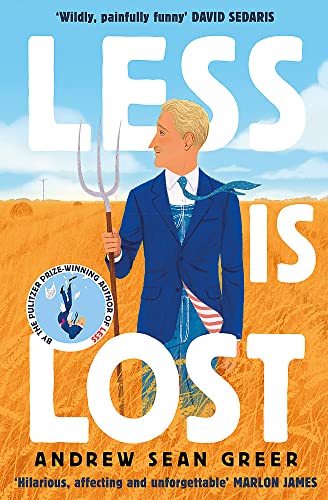


I really liked Book 1 of this series, but too much of the sequel comes off as if Sean Greer was as discombobulated as his main character, Archie “Arthur” Less. Greer is an established figure in gay literature­–Less won a Pulitzer Prize in 2018–but Less is Lost lacks the strong narrative and sharp humor of Book 1.


This novel is another travelogue of sorts for Less, a man who definitely comes down on the first side of the flight or fight scale. He’s now in his 50s and the mirror tells him the bloom is fading from the rose. So too did the death of his longtime lover, poet Robert Brownburn. He’s now in a (sort-of) relationship with Freddy Pelu, one that’s probably clearer to Freddy than to Arthur. In other words, Arthur is having a major end-of-midlife crisis. To top it off, he’s broke, though that’s nothing new.


His objective is to make his way from the West Coast to Valonica Island off the coast of Maine to be with Freddy and assess where things are headed. All manner of things conspire to waylay him. First, his agent Peter Hunt hands him the task of interviewing iconic poet H.H.H. Mandern, an 84-year-old primo uomo who has settled into the role of pampered crank. Arthur has met him before, but Mandern doesn’t recall that, keeps calling him “Yes,” and has two conditions for the interview: a question answered in exchange for a question of his own, and Arthur’s agreement to drive him, his pug Dolly, and his campervan Rosina across the Southwest to find his daughter. This gives Less limited time to join a tour across the South with a theater company that has adapted one of his stories (“The Last Word”), make it to his home state of Delaware to a lecture/awards ceremony, and then to Maine to join Freddy.


As if things couldn’t be messy enough, he’s also on a prize committee that doesn’t seem to care about his opinion, there’s another Arthur Less, and his father Lawrence, from whom he is estranged, is allegedly going to meet him somewhere. Arthur thinks Lawrence might be underwriting the theater tour. Arthur doesn’t want to do any of these things­­­–especially see his father–but he hopes to collect enough money to pay off debts. Did I mention that Hurricane Herman is bearing down on the South? Or that he is asked to meet with the foundation that is sponsoring the play?


A gay man in the Deep South holds the potential for humor tinged with danger. Less (Book 1), had some very funny situations, but Less is Lost falls more into the mildly amusing category. More’s the pity; in this case, less is not more. There is a redux of Arthur’s misplaced belief in his proficiency with German, plus mistaken identities, partners traveling in opposite directions, and a switcheroo that falls into a category marked “obvious.”   


I wouldn’t call Less is Lost a bad novel, but Greer has previously played the disappointments of aging card and second acts seldom pack the same dramatic punch. There is an overall flatness to the prose and an often confusing narrative structure. Freddy is the putative narrator for most of the book–Arthur the rest–but this leads to illogical jumps between past and present tenses. How can Freddy even be the narrator of things happening to Arthur in the present when he hasn’t yet arrived in Maine? (There is nothing to suggest that Freddy has chronicled Less’ journey ex post facto.)


I know nothing about Greer’s writing process, but the four year gap between Book 1 and Book 2, the short length of Book 2, and its copy of a copy elements suggest either writer’s block or publisher demands for a sequel. Let’s just say that Less is Lost is not an LGBTQ parallel to John Updike’s Rabbit series. I could add that I’m not terribly inclined to read Book 3, should one appear.


Rob Weir

5/24/23

Fox Creek a Thrill Ride Across the US/Canada Border


FOX CREEK (2022)

By William Kent Krueger

Atria/Simon & Schuster, 385 pages.

★★★★


Fox Creek is the 19th book in the Cork O’Connor series. I know what you’re thinking: “This book’s not for me. There’s no way I’m going to plow through the first 18 to get to this one!” Don’t despair. Author William Kent Krueger possesses a skill many claim to have but few actually demonstrate; longtime readers know his characters well, but Krueger produces discrete stories independent of what was previously written.


Krueger specializes in mystery and crime novels that invite comparisons to the late Tony Hillerman. Like Hillerman, he’s not Native American, but he draws praise among the Anishinaabe/Ojibwe peoples about whom he writes. His main character, Cork O’Connor, is of mixed Irish/Ojibwe blood, but he identifies mostly as the latter. He was once a sheriff, but now works in a restaurant, does private detective work on the side, and lives in northern Minnesota.  


This mystery unfolds when a man claiming to be Lou Morriseau asks Cork to help him find his wife Delores. He claims she ran off because she was having an affair with Henry Meloux. Cork agrees because he it’s not hard to smell a wolverine when you know that Henry, a Native healer, is 100 years old and the great uncle of his second wife Rainy Bisonette, who has been with Henry organizing a sweat lodge ceremony. (Cork’s first wife was murdered.) Cork finds Delores easily, so who is the imposter and what’s his game?


The plot thickens when Cork’s son, Stephen, has a vision of Henry dying in the woods, and Cork learns of the real Lou via his brother Anton, a tribal cop from a nearby reservation. The real Lou is a real estate lawyer and Cork surmises that maybe he’s in over his head on some deal. Besides, it’s never a bad idea to think money is at the root of lies. Cork also realizes he’s been had in locating Delores and essentially did the fake Lou’s work for him. When Rainy and Delores vanish, Cork senses serious danger and concludes he has a limited amount of time to find them. The only clue he has is a cryptic reference to “kill Catie.” Or is it “Katie?”


The situation grows murkier when Tanya Baptiste, a Native woman, shows up at the home of the real Lou’s parents to tell them she really needs to talk to the real Lou. Stephen, who plans to study law enforcement, is sucked in when he meets Lou’s sister Belle, a law student. He’s falling for her and feeling might be mutual. But the first problem is finding Lou, who has also disappeared.


The flight of Delores, Rainy, and Henry is at the heart of the story and the bad guys make a mistake by underestimating Henry; nobody knows the woods as well as he and he’s incredibly resilient for a centenarian. A substantive and unexpected obstacle appears, though. Henry recognizes that their pursues have enlisted a tracker so skilled that he has to be a Native American. We ultimately learn that his name is Le Loup. His visions play a major role in the novel as do his divided loyalties. The drama plays out at the novel’s namesake Fox Creek, which empties into a lake near Winnipeg, Manitoba, thereby making this a cross-border tale.


Fox Creek is a thrilling read made all the more so by the ambiguity of motives, identities, and circumstances. Pay close attention; this is not  a WYSIWYG novel. Be as suspicious as Cork as you read, but perhaps more astute. One of the things I like about Krueger’s stories is that Cork is often impulsive and makes flawed assumptions, just like real investigators often make rather than the omniscient ones that show up in detective stories that place personality above probability.


Krueger’s sympathies for the Ojibwe are on display, but he doesn’t make them uniformly virtuous. When you discover the identity of “Catie,” the key to the mystery, you might be prompted to investigate some recent Native American history from the Minnesota/Canadian border. My sympathies align with Krueger’s, but if we take weapons and illegal activity out of the equation, complex political issues remain. That’s seldom good news for Natives living outside the pages of a work of fiction.


Rob Weir


5/22/23

Marjorie Morningstar: Wood, Kelly, and 1950s Values


MARJORIE MORNINGSTAR (1958)

Directed by Irving Rapper

Warner Brothers, 123 minutes, not rated.

★★★


Though it has been 42 years since her death–officially a drowning, though possibly a murder–Natalie Wood (1938-81) continues to be the subject of nostalgic remembrances and lurid tabloid stories. At age 8 she attracted attention in Miracle on 34th Street and went on to become a famed beauty, a rare raven-haired siren at a time in which Hollywood definitely preferred blondes. Whether or not she was a great actress has been hotly disputed.


You can get an education in gender mores during the 1950s by watching Wood in Marjorie Morningstar. She is the title character, though that’s a pet name slapped onto her by Noel Airman (Gene Kelly) and the actual surname is Morgenstern. Wood plays the daughter of Rose and Arnold (Claire Trevor and Everett Sloane), an upwardly mobile Jewish family in New York City. (Wood was actually Russian Orthodox.) One refreshing thing about the film is that there was no attempt to homogenize Jewishness; we see outward professions of faith, a Passover meal, and a debate over Noel’s non-faith. This reflects the refashioning of Americanism after World War II to become, as an influential book put it, “Protestant, Catholic, Jew.”


Wood’s Marjorie is a vivacious Hunter College student with aspirations of becoming an actress who is too spirited for her about-to-be-ex boyfriend Sandy. Her best friend Marsha Zelensky (Carolyn Jones) convinces Marjorie that she needs a change and should accompany her to the Catskills where the two become camp counsellors. The trouble begins when Marsha also convinces her to paddle across the lake­–filming took place at Schroon Lake near Glens Falls, New York–because there’s an adult resort on the other side. They need to be careful and inconspicuous, though, as South Winds Resort owner Maxwell Greech (George Tobias) would not hesitate to have them arrested for trespassing. Now there’s an obvious setup! Marjorie sneaks into a dance rehearsal and is enthralled by the professionalism and skill of social director of Noel Airman. When the two are indeed caught, Airman claims Marjorie is a job candidate and offers her employment.


That’s settled, but as you probably suspect, the employer/employee relationship will evolve from fascination into romance. Okay, that’s very 1950s, though it did raise some eyebrows even back then. Kelly’s character is said to be 32, though he was actually 46, and Wood was just 19. Marjorie’s parents, of course, have reservations, the aforementioned indifference to religion among them. Marjorie, though, sees Noel as a genius and a show biz bigshot who might help her realize her dreams. We viewers have our doubts, as she’s actually quite amateurish and is starting to suspect it herself. Nonetheless, she rebuffs the advances of the age-appropriate budding playwright Wally Wronkin (Martin Milner), who is smitten by her. The best Marjorie’s parents can do in hope of keeping her from screwing up her life is to plant her uncle Samson (Ed Wynn) at the resort.

Marjorie Morningstar is a romantic drama with comedic touches. Many of the latter are provided by the barbed comments of Claire Trevor and the clowning of veteran character actor Ed Wynn. They are, however, diversions in a story about obsession involving Wood, Kelly, and Milner. This is something of a problem, because the tone of Marjorie Morningstar is an uncomfortable mix of high schoolish skits, Kelly’s dancing, and adult themes of ambition, desire, coming of age, flight, and realizations of one’s limits. It doesn’t quite turn out the way you might expect; some audiences of the day applauded the film’s resolution and others were disappointed. It departed from the ending in the Herman Wouk novel from which the movie was adapted.


There is no question that this was a vehicle for a rising star (Wood) and fading one (Kelly), nor can we divorce the content from what was acceptable in the 1950s, cringe-worthy though some things were. I confess that I fall on the side of those who saw Wood as a beautiful young woman, but a fairly ordinary actress. You can make up your own mind about all of that, but the film is probably best viewed through the gauzy Technicolor lens of Harry Stradling’s cinematography. It often looks like an old snapshot rescued from a photo album in the back of a closet. Some might see Marjorie Morningstar as a classic. I’d call it an artifact on par with the Borscht Belt Catskills where it was set.


Rob Weir  

5/19/23

Last Orders is Masterful Ensemble Acting


LAST ORDERS (2001)

Directed by Fred Schepisi

Columbia TriStar, 106 minutes, R (language), in Cockney English

★★★★


Last Orders is an adaptation of Graham Swift’s 1996 Booker Prize-winning novel of the same name. It is an excellent example of how well Brits do ensemble movies. Of course, it helps to cast with actors of the gravitas of Michael Caine, Tom Courtney, Bob Hoskins, David Hemmings, Helen Mirren, and Ray Winstone.


Director Fred Schepisi wisely made Last Orders as a classic “small film,” meaning it doesn’t try to dazzle you with intricacies of plot, cinematography, or production. Rather, it is a character study of friends whose relationship is kept together as much by inertia as common interests. The title holds a dual meaning. In British pubs it’s the equivalent of last call; that is, the bar tender’s announcement that it’s the final chance to order drinks before closing. In this case, though, it also means a duty. Jack Dodds (Caine) has died and his old compadres are charged with taking his ashes from London to Margate to be scattered in the sea.


In other words, The Last Call is a road trip that’s filled with flashbacks, squabbles, remembrances, irreverence, and poignancy. As we quickly surmise, Jack, a former butcher, was the glue that kept unlikely associates together. Jack wasn’t a saint, but he was a good person, and the same is questionable about the company he kept. In World War II he battled alongside Ray “Lucky” Johnson (Hoskins), a punter who spends most of his time wagering on horses. He is joined by Lenny (Hemmings), a former boxer who didn’t leave his fists in the ring, and Jack’s pretentious son Vince (Winstone), a dealer in posh used cars who–to his annoyance–is treated as if he’s still a kid by the others. There’s also  Vic Tucker, a mortician who tries his best–mostly unsuccessfully–to play the role of ego to Ray’s superego and the ids of the other two. Along the way they meet up with Jack’s widow Amy (Mirren), who is on her way to visit her developmentally challenged daughter who has been institutionalized for over 50 years.


The journey is marked by numerous aforementioned flashbacks (with younger actors as stand-ins). As is often the case with youth, none of them had their lives figured out back then, but they were more vital before responsibilities, work, and cynicism redefined them. Arguments abound–often instigated by sharp-tongued Ray–punctuated by good old Jack stories. Son Vince would just like to get the whole thing done and dusted, but what’s a road trip without detours? It’s only 76 miles from London to Margate and can be done in under two hours, but not if you take side trips to Canterbury and the Chatham Naval Memorial, and certainly not if all wars of words are defused at pub stops.   


 Let me emphasize again that the storyline is spare. This film only works if you cast skilled actors who can hold audience attention through the sheer force of their craft and personalities. Any one of veterans such as the principals could recite from actuarial tables and you’d be enthralled. Despite the glum task of dumping Jack into the English Channel, Last Order is often very funny. After all, what’s more ripe for lampoon than a carful of guys lacking in filters and self-awareness? Yet because they have a solemn mission, the humor is leavened with ouch! moments in which pathos intervenes.   


Last Orders is ultimately a film that rests on verbosity, wit, and inference. The side trips are not so much tourist travel as diversions that challenge the living to confront the mundanity of their post-Jack selves. It’s a bit like That Championship Season without basketball. I liked it quite a lot, though I had to swallow the biter pill that neither Hoskins nor Hemmings are with us any longer.


Rob Weir

5/17/23

The Latecomer Lands Its Punches


THE LATECOMER (2022)

By Jean Hanff Korelitz

Celadon Books, 440 pages.

★★★★


Jean Hanff Korelitz scores again with The Latecomer. As in her previous novel, The Plot, she throws us into circumstances muddied by murky morality. It unfolds in three acts that take us from 1972-2017. In an unusual twist, Phoebe Oppenheimer,  the book’s namesake latecomer, narrates events from before she was born.


How many life decisions have their genesis in a single action? In Act I, Solomon “Salo” Oppenheimer, a 20-year-old Cornell student, has an auto accident in which two are killed and a third, Stella Western, an African American woman, is seriously injured. How do you put such a horrifying event behind you? If you have a conscience, you don’t; you merely move forward. Salo marries Johanna Hirsch, who wants children, but it’s just not happening. After several years, Johanna opts for in vitro fertilization and one of her frozen eggs bears fruit–in a big way. Suddenly, she is the mother of triplets: Sally, Lewyn, and Harrison. Salo, though, is more cut out to be a recluse. He comes from money, makes even more in financial services, and impulsively buys a Cy Twombly painting for reasons he can’t explain. It becomes his entrĂ©e into Outsider art–including Henry Darger and Achilles Rizzoli–which he collects and stores in a warehouse that his family doesn’t know about. They think his relative absence from their big house in Brooklyn Heights is work-related.  


The kids are definitely not all right. The triplets positively despise each other, show little deference to either parent, and lack empathy. The children imagine themselves as the equivalent of Outsider art. Actually, they replicate parental patterns: each preps at the “progressive” school their parents once attended and at which Johanna works, two end up at Cornell, and none connect family money to the unorthodox lives they seek to build.


Part II follows the triplets’ college years. Sally and Lewyn live in adjacent dorms at Cornell, but never even acknowledge knowing one another. That’s awkward when Lewyn begins to date Sally’s roommate Rochelle Steiner, on whom Sally also has a crush. Good luck keeping those secrets! More weirdness abides. Though he is Jewish, Lewyn contemplates becoming a Mormon like his roommate, and Sally puts Cornell in the rearview mirror to become a furniture picker like an older woman with whom she informally interned. Harrison attends an alternative school in New Hampshire, where he becomes a devotee of Eli Absalom Stone, whom he views as a genius and defends in a school contretemps turned tempest. Stone identifies as black, an ambiguous claim. He and Harrison yearn to be conservative intellectuals, attend the Hayek Institute*, and act like Tucker Carlsons-in-training. As Phoebe put it, “Harrison lived on the Upper East Side but traveled constantly in his noxious mission to make the world awful.”


The Oppenheimer marriage collapses when Salo reconnects with Stella, fathers  Ephraim, and announces he’s leaving his wife. This (eventually) sets the stage for Act III. Johanna uses another stored embryo to bring Phoebe into the world 19 years after the triplets. Johanna rationalizes that the family that she thought she wanted was never really a family at all. And how! Phoebe’s voice dominates the third section.


There’s a lot in this novel: 9/11, visions of what a post-racial society might look like, hoarding, blurred lines between invention and fraud, imagining ethnic reassignment, legal battles, fourth-wave feminism, the gap between what is said and inferred, and things that can be forgiven and those that are what they are. Although the novel’s ending ties loose ends too neatly, Korelitz doesn’t offer instant character redemption. That would be inconsistent in a work in which loners struggle to change their ways. The very constancy of fully realized characters helps explain dysfunctionality Oppenheimer-style.


Korelitz deftly interweaves thematic contrasts. The most obvious is the tension between progressive and hard right politics, but you might ponder, for instance, the gulf between the art Salo collected and the Shaker furniture that Sally salvaged. I admired Korelitz’s courage to dive into treacherous cultural war waters. The Latecomer runs the risk of angering the woke and the deliberately non-woke. It’s as if she’s telling us that any of us would be best rendered as an Outsider portrait.


Rob Weir


*Friedrich Hayek (1889-92) was an influential free-market economist. His staunch belief that government should remain neutral in economic matters, should not artificially manipulate “natural” interest rates, or engage in New Deal-like spending has made him a posthumous neo-conservative icon.


5/15/23

Is Guess Who's Coming to Dinner Still Relevant?


GUESS WHO’S COMING TO DINNER? (1967)

Directed by Stanley Kramer

Columbia, 108 minutes, not rated.

★★


Does a “classic film” ever cease to be one? I raise this question because I recently rewatched Guess Who’s Coming to Dinner? to see how well it weathers. Answer: Not very well. It’s certainly true that a post-racial society exists only in the naĂ¯ve rhetoric of the woke, but GWCTD mostly reminds us of how much has changed since 1967.


Its premise is straightforward. Twenty-three-year-old Joanna “Joey” Drayton (Katharine Houghton) cuts her trip to Hawaii short to return home (San Francisco) with a surprise in tow: her thirty-seven-year-old fiancĂ©, Dr. John Wade Prentice (Sidney Poitier). She’s white and he’s a “Negro,” the term of preference in 1967, but Joey “knows” her parents Christina (Katharine Hepburn), a gallery owner, and Matt (Spencer Tracy), a crusading publisher, will love John. After all, they’re both liberal. Of course, it’s not that simple.  Both are surprised and Matt is very much against the idea of nuptials–for social reasons of course. So too is their black housekeeper Tillie Bix (Isabel Sanford), who thinks Prentice doesn’t know his place. As it transpires, John’s parents, John Sr. (Roy E. Glenn Sr.), a retired postal carrier, and his wife Mary (Beah Richards) have reservations as well–for, you know, social reasons. The only person other than Joey who is enthusiastic is family friend Monsignor Mike Ryan (Cecil Kellaway). Even Dr. Prentice promises Matt no wedding will take place without his blessing.


The entire racial comedy/drama takes place in a single day as Dr. Prentice must fly to Geneva that evening, with or without Joanna. In order to keep the focus on race, director Stanley Kramer and screenwriter William Rose transformed Prentice into a veritable black Superman. Prentice is handsome, a widower whose wife and son died years earlier, and a renowned physician about to take a posting with the World Health Organization. Audiences of the day were challenged to confront their own “If only he were white” biases, as Prentice’s character, qualifications, and sense of honor were impeccable.


GWCTD was considered bold in 1967. It came just three years after the Civil Rights Act of 1964 theoretically desegregated American society. Alas, there is often lag time between the passage of acts of Congress and widespread implementation. Tillie and John’s father were not playing Uncle Tom roles; they were from the generation in which what was under discussion could not have happened. There are references to 17 states where the Prentice/Drayton marriage would have been illegal. That also remained true, though the Supreme Court’s Loving v. Virginia decision in June 1967 overturned bans on interracial couples.


Entrenched custom no doubt factored into decisions to interject comedy into the drama. Some of it is embarrassing by current standards, none so much as an impromptu dance between a white delivery boy and a sexy black part-time helper. (Memo to filmmakers: Never show actors performing a dance craze du jour; it will look insipid by the time it wraps.) Even the film’s title comes across as amusing, as if white viewers were expected to laugh uncomfortably about what they’d do in the same situation. It was the right touch for the time, as GWCTD was a box office smash and even did well in the South. That despite Poitier’s big speech on his humanity. (Poitier specialized in impassioned monologs.)


The film garnered 10 Oscar nominations and won two: Hepburn as Best Actress and Rose for Best Screenplay. Hepburn’s win, for a merely competent turn, seems like one that happened because the Academy stiffed her for better past roles. In many ways this was Tracy’s film, but everyone gave strong performances with the exception of Houghton–Hepburn’s niece–whose cluelessness and lack of a strong adult self simply don’t resonate.


In retrospect, the most notable thing to be said is that this was Tracy’s final film. He was so ill at the time that no one would insure him. He, Hepburn, and Kramer put their salaries in escrow in case he had to be replaced. Tracy died 17 days after the film wrapped and Hepburn, whose Parkinson’s disease was visually evident, was so devastated that she never watched the theatrical release. These matters are sad, but they don’t change the fact that watching GWCTD today is like watching a documentary on rotary dial phones. Does it remain a classic? More like a quaint artifact, I fear.


Rob Weir


5/12/23

Kitty Macfarlane: May 2023 Artist of the Month


Kitty Macfarlane

Namer of Clouds (2019)

Navigator Records


I follow Karine Polwart , one of my favorite folk/traditional artists of all time. When Polwart recommends someone, I take notice. My artist/album of the month is a bit unusual in that the featured recording came out in 2019. I had not heard of Kitty Macfarlane until I sampled her on Polwart’s Website, but I’m sure glad I did.


Macfarlane hails from Somerset in England and is both a lovely singer and a smart, thoughtful person. Let’s start with the title track of Namer of Clouds. It’s an offbeat title, but it befits the song. Ever wonder where we get categories such as nimbus, cumulous, stratus, and so on? Give credit to Luke Howard who thought of them back in 1802. The song imagines him as a small boy doing what kids do, gazing into the sky with amazement at the shifting shapes of clouds. Howard took it to the next level: The changing shapes, the chaos and calm/The shadows cast as winds collide/Tries to explain with words not written/Put name to face, the need to define.


You’ll get all of that, though the first things that will strike you is Macfarlane’s own sense of calm and a voice whose purity invites comparisons to a young Joni Mitchell. Mitchell, ironically, released a 1969 album titled Clouds that included the song “Both Sides Now” with its quotable line: I really don’t know clouds at all. Macfarlane does.


Macfarlane has keen environmentalist instincts. “Wrecking Days” catalogues the damage done by the things we cast into the sea and reappear on the strandline (the highwater mark on a beach); “Man, Friendship” simultaneously muses upon climate change and hope, which is quite a trick. “Seventeen” parallels coming of age with the observation that nature cycles–the growth of trees, the growth of lichen, the migration of birds, tides, and so on–are both humbling and bewildering to the young. Some of the songs actually incorporate natural sounds. You’ll hear a rushing waterfall on “Morgan’s Pantry.” In this case, sea morgans are legends, not people. This is Macfarlane’s take on a traditional song about rather nasty sea creatures that lure sailors to waterfall portals to another world. “Glass Eel” ponders both continental drift and the miraculous 4,000-mile annual migration of small transparent eels. (Puffins find them delicious!)


Macfarlane dazzles us with voice and wonderment, not flashy instrumentation or dramatic arrangements. Her lyrics employ an economy of words that invites us to intersect our narratives with hers. “Starling Song,” for example, is just twelve lines long, but there’s much room to draft stories in lines such as Like the rush in a sea shell or a hum in the maize/Or the mutter of pages turned in haste. “Frozen Charlotte” is the wordiest song on the album, but they come from poet Seba Smith that recount a decidedly weird 1839 event in which a vain young woman was so determined to attend a dance despite the frigid winter weather that she arrived frozen to death. (Some versions say she was found in her bath.) In a level of the macabre only Victorians could conjure, alabaster white frozen Charlotte dolls enjoyed a 70-year run of popularity.


Macfarlane draws inspiration from all manner of things large and profound. Among the latter is “Sea Silk,” and you’ll hear background clicking. It’s the sound of needles from a woman she met off the coast of Sardinia spinning delicate silk strands that appear brown inside but glow gold in the sunlight. By now you won’t be surprised when I say that Macfarlane spins some gold of her own: I’ll spin saltwater into sun/Until the time I am undone. How good is Macfarlane? Even Iggy Pop, the Grandfather of Punk, is a fan.  


Rob Weir