8/9/21

Art Road Trip Bennington, Vermont I


Performative Acts

Dona Ann McAdams

Through August 15, 2021


Robert Frost in Vermont

Through November 7, 2021


Selections from the Permanent Collection

Bennington Museum of Art


A few weeks ago, we decided to get out of the Pioneer Valley to visit one of our favorite small art museums in Bennington, Vermont. One of the shows there–alas, closing soon–are the photos of Dona Ann McAdams. Her work is often compared to that of Dorothea Lange and Henri Cartier-Bresson in that she is fond of candid photography, though her work is more overtly feminist than that of Lange, the images less soft focus-wise than those of Cartier-Bresson, and ARE more confrontationally political than either of them. The Bennington exhibit samples work from past McAdams retrospectives and is heavy on wit and irony, but also touches upon her deep commitment to social justice.


The gallery has harsh lighting, but here are several images that say more than I can about them. You will notice, though, that McAdams (b. 1954) likes ironic juxtapositions.


Nature’s first green is gold,

Her hardest hue to hold.

Her early leaf’s a flower;

But only so an hour.

The leaf subsides to leaf.

So Eden sunk to grief.

So dawn goes down to day.

Nothing gold can stay.


Few 20th century poets were as celebrated as Robert Frost (1874-1963). His poetic reputation has faded a bit in our jaded age. To some critics, Frost’s works seem antiquated, his rhymes straightforward, his subjects naively apolitical, and his tone homiletic. Yeah, yeah. His are still among the most memorable lines in the English language. Frost’s fame remains such that three New England states–Massachusetts, New Hampshire, and Vermont–try to claim him and each has a case, as he lived in all three. There’s a bust of him at Amherst College, where he once taught, and its library is named for him. New Hampshire is one of the places where he failed as a farmer. But given that his physical remains lie in a Bennington churchyard, he taught at Middlebury College, and lived in Shaftsbury part of the year from 1920 on, Vermont has maybe the best claim.


Bennington has a show linked to Frost’s time in Vermont. How, you might wonder, does an art museum display a poet? A few objects are obvious, such as his chair and portable writing desk. That assemblage looks all the world like an outtake from Mr. Rogers Neighborhood.


For much of the rest, though, curators chose paintings and graphics that evoke Frost’s favorite subjects: the New England landscape, weather, its beauty, and the precariousness of existence in what can be an unforgiving region. The images come with snippets of his poetry and there are several sound files of him reading his works. Here are several evocative images. 


Above: Top to Bottom--Rockwell Kent "Puritan Church;" Arthur Burton, "Putney Melting;" Lucius Lankes, "Vermont Farmhouse"


I’ll be frank, though. The show is too text heavy for an art museum, so if you’re the impatient sort, take a notebook with you, jot down titles of the mentioned poems, find them later, and savor them at your leisure. Here’s a famous one–“Fire and Ice”– that’s  distressingly appropriate for both the flinty hardness of the New England landscape and a nod to our time of plague and climate change.    


Some say the world will end in fire,

Some say in ice.

From what I’ve tasted of desire

I hold with those who favor fire.

But if it had to perish twice,

I think I know enough of hate

To say that for destruction ice

Is also great

And would suffice.


No pictures are allowed in the Grandma Moses exhibit which is housed in the refurbished schoolhouse wing. So instead, here’s an eclectic sample of images from the rest of the permanent collection–just for the heck of it.


From the Vermont Modernists: Francis Colburn, “Family Group” (1939); John Atherton, “The Ore Pit” (1947).


Ever wonder what happens to displays at a World’s Fair when the gates close for the last time. Sometimes they end up in museums. This over-the-top ceramic was first seen at the 1853 Crystal Palace fair in London, which is often said to be the first modern world’s fair. Bennington was once a center of ceramics manufacturing, but now this piece looks like a harbinger of Gilded Age excess. 


Speaking of the Gilded Age, Brattleboro is at the other end Molly Stark Trail, but Bennington holds a fine example of an Estey organ such as a Gilded Age family seeking instant cred might have plopped in the parlor, even if no one could actually play it.


Finally, when did the ideal of American democracy disappear? I’d have to cogitate upon that, but it was alive in 1927, when Harriet Miller titled this sculpture “Democracy.”  


8/6/21

The Current War Fails to Sizzle


THE CURRENT WAR (2017/19)

Directed by Alfonso Gomez-Rejan

101 Studios, 107 minutes, PG-13

★★ 1/2


The Current War depicts the late 19th century race between Thomas Edison (Benedict Cumberbatch) and George Westinghouse (Michael Shannon) to provide electricity to American businesses and homes. Its route to North American cinemas was, shall we say, short-circuited. It was released in Britain in 2017, and was slated for distribution here by Harvey Weinstein Productions. Unless you’ve been napping on the dark side of the moon, you know why that plan ran into trouble. It took some time before 101 Studios acquired distribution rights, though it’s arguable whether it was worth the effort.


Without getting all geeky about it, the gist of the matter was which system was most feasible, Edison’s Direct Current or Westinghouse’s Alternating Current. Edison was first to the table and made money on installing DC for businesses, but his system required a lot of machinery and had a very short coverage area. He also made the boneheaded maneuver of hiring a bright young immigrant, Nikola Tesla (Nicholas Holt) to work for him. Tesla was under the impression that Edison would bankroll some of his innovations, whereas Edison saw him as just another hireling whose main job was to stroke his ego and enhance his reputation as a genius. Tesla eventually quit and took his talents to Westinghouse, who also treated him shabbily. As we know, however, Westinghouse’s AC won the day, nearly bankrupted Edison in the process, delayed Tesla’s acclaim, and relied upon banker/investor J. P. Morgan (Matthew Macfadyen) to bankroll it. Guess who got a massive share of the profits.


There’s not inherently unique about Gilded Age magnates battling or cheating one another, so director Alfronso Gomez-Rejan tried to interject tension wherever he could, though most of the movie’s dramatic moments call out for the qualifier “melo.” The women of the film­–Westinghouse’s wife Marguerite (Katherine Wilkerson) and Edison’s first wife Mary (Tuppence Middleton)–are there to cheer on their men folk or, in Marguerite’s case, to encourage ruthlessness. (Yes, this is another film in which women are appendages.) Gomez-Rejan develops the relationship between the respective collaborators of Edison and Westinghouse–Samuel Insull (Tom Holland) and Franklin Pope (Stanley Townshend)–better than those of their wives. Loyalties are tested and shifted and details are added, such as the first criminal electrocution (of William Kemmler) and the lighting of the 1886 World’s Fair. These ostensibly add color to Michael Mitnick’s script, but they come off more as padding than exposition.


There is a tangible sense that this entire project sounded better in the planning stage than it turned out in the studio. I am generally a Cumberbatch fan, but the problems begin with him. He doesn’t look a thing like Edison and though the latter was known for being difficult, pigheaded, and driven, his intensity was of a different quality than Cumberbatch’s, which is geared more toward nervous energy leavened with snark. To up the sense of competition, the film casts Edison as the villain, Tesla as a victim, and Westinghouse as sympathetic. That’s all very neat, but not very accurate.


Films “inspired by” real events often take liberties, so one might be tempted to dismiss my previous critique. I would as well, had I been drawn in better. The Current War isn’t terrible, just bland. If you will, the major problem with The Current War is that it simply doesn’t spark.


Rob Weir


8/4/21

Win: A Fascinating Character to Hate


WIN (2021)

By Harlan Coben

Grand Central Publishing, 371 pages.

★★★★


Did you ever watch a show or read a book in which you find the main character utterly despicable, yet that individual fascinates you? You want to look away, but you can't. The namesake character of Harlan Coben's new novel Win is like that. “Win” is short for Windsor Horne Lockwood III and the numbers behind the name say it all. He's as rich as Croesus, uses his money lavishly, has contempt for his social inferiors, went to Duke, and is a martial arts expert who enjoys violence. About all he and I share in common is that he finds hipsters faintly ridiculous and he doesn't countenance violence against women. (Win is, however, a sex addict willing to use a dark web app to locate women and pay fortune to bed them.)


He's also a self-appointed vigilante with a sense of justice and the money to get him out of scrapes like how a suitcase with his initials showed up at a crime scene. His philosophy is pretty much summed by this assertion: “People buy into the ‘everyone is equal’ rationale we Americans brilliantly sold throughout our esteemed history, though lately more and more get what has always been obvious: Money tips all scales.” Says the guy with his own jet, helicopter, a chauffeur/accomplice named Kabir, a suite in the Dakota, and a family that hangs masterpieces on the wall, though someone long ago nicked a Picasso and a Vermeer.


Hate Win yet? Maybe this will make you feel better. When we first come in on him, he is in the process of putting college basketball coach Teddy Lyons on the permanent disabled list, as he's a serial abuser, including of minor children. Or maybe you'll like Win's comments on a hipster bar frequented by those who:


… were trying so hard not to appear mainstream that they simply redefined the mainstream. The men had hipster glasses; … asymmetrical facial hair; flimsy scarfs draped loosely around their necks; suspenders on strategically ripped jeans; retro concert tees that struggled to be ironic; man buns or a potpourri of awful hats, such as the cable knit slouchy beanie, the Newsie flat cap and of course, the carefully tilted fedora (unwritten hipster rule: only one guy per table can wear the fedora at a time); and of course, boots could be high or low or any hue but somehow you’d still label them hipster boots. The female of the species offered up a wider range–secondhand vintage pickups, flannels, cardigans, unmatching layers, acid wash, fishnets– the rule being nothing mainstream, which again makes them just mainstream with a desperation stench.


Win’s official task is to help a police friend find out what happened to the Jane Street Six, a group of 60s anarchists who failed to blow up an apartment, but spooked a bus driver who veered over the side of a bridge. That cold case reopened when a murdered recluse who lived in a penthouse is found murdered and is identified as one of the members of the Jane Street Six. Win is useful because his methods are often the sort that would land a cop in court. It's also a bit personal, as Win’s cousin Patricia was kidnapped when she was younger and held in a "Hut of Horrors” until she escaped. Maybe there's a connection with the Jane Street Six, and maybe not, but at least six girls were killed in the woods near where Patricia was held and Win wants to find their murderer.


Win embarks on parallel manhunts that place him in harm’s way many times–just as he likes it – and he has pursuers of various ilk. Among them is Leo Staunch, the heir to his father's organized crime syndicate. Things are personal for the Staunches as well; young Sophie Staunch was a casualty when the bus plunged over the rail in 1973. Leo claims he wants Wyn to help him locate Jane Street Six leader Arlo Sugarman in order to forgive him and save him from being murdered by other family members. Leo makes it clear, though, that his is something stronger than a request.


As you could probably tell, Coben’s prose isn’t the next coming of Dickens, but he can spin a good thriller. Win’s probe takes him down many corridors–some blind alleyways and some superhighways–and forces him to shovel some serious Lockwood family dirt, reopen art heist leads, solicit a few almost-deathbed confessions, plumb the dark web, give his private conveyances a serious workout, threaten bodily harm to a lawyer, and rekindle distressing American history. On top of all of this, he has to stay alive.


Maybe, just maybe, Win will also have to admit that sometimes money doesn't tip all scales. At a poker table at which all the players are amoral, it's hard to tell who holds the winning hand.


Rob Weir

8/2/21

Les Lalanne: The Importance of Peeking Into Side Galleries


CLAUDE and FRANÇOIS-XAVIER LALANNE: NATURE TRANSFORMED

Clark Art Institute, Williamstown MA

Through October 31, 2021


Let’s hear it for side galleries! Most people who head for a major art museum such as Williamstown’s Clark Art Institute head straight one of two things: the blockbuster special exhibit or the famous stuff.


There’s plenty of reason to do both at the Clark. I’ve already posted on the superb Nikolai Astrup exhibit that will be there into mid-September. As for famous, the Clark’s Impressionist gallery is rightly renowned, and it also has scattered holdings from art world heavyweights such as Sandra Botticelli, William-Adolphe Bouguereau, Winslow Homer, George Innes, Jean-François Millet, Edvard Munch, John Singer Sargent, Lawrence Alma-Tadema, J. W. W. Turner, and scores of others.


As you come in the main entrance, though, there is a side gallery to the right that often features material that the Clark has not historically collected–a lot if quirky and offbeat. That is certainly the case of the works of Claude (1924-2019) and François-Xavier (1927-2008) Lalanne, a married French couple often known collectively as “Les Lalanne.” (Claude was a woman; many French names–including Dominique, Jean Marie, Laurence and Loïs–can be male or female.)  


Les Lalanne are often labeled as sculptors, but that doesn’t quite prepare you for their whimsical and imaginative works. They reveled in taking forms, especially from nature, stylizing them, and metamorphizing them into multifunctional objects. They are at once, practical in tongue-in-cheek ways, and amusing pieces of art. A rhinoceros desk? Why not! 


While we’re at it, why not a cabbage that looks as if it could sprint away on its chicken legs? How about resting your tea cup on a round table held up by a monkey? Or toss your keys into a metal duck?  


Les Lalanne were sort of the missing link between surrealism, abstract art, and the pop art movement of the 1960s. They were also consummate crafters skilled in using electroplated metals that gave their works a distinctive texture and sheen. 


Above all, they had a puckish sense of humor. Ever drive in a rural area where you had to stop for sheep crossing the road? If so, you’’ lave extra appreciation for a slice of that they fashioned from textiles and other materials. But look carefully and you’ll notice that no all the sheep have heads. After all, when they dawdle across the road and bend down to sniff, look for food, or whatever else sheep do, they appear to impatient motorists as headless malingerers. Les Lalanne preferred a sparse, sometimes spartan look and saw no need to waste materials. Exactly!


This is a very small exhibit that will only take a few moments out of your search for famous art. You’ll leave chuckling, an emotion that’s often in short supply in the (overly) serious world of art. It might even give you an extra burst of energy to sustain your meanderings through the bigger rooms. Hopefully it will also remind you to always pop your head into small ones just in case there’s magic lurking.


Rob Weir


7/30/21

Artist of the Month: Sandy Denny


Sandy Denny: An Appreciation


1947-78


I heard some good new music this month, but nothing blew me away. It’s an opportunity to crawl into the Way Back Machine for my artist of the month: Sandy Denny. Sandy is my favorite female vocalist of all time. Was she the best ever? That question, surely, covers too many genres and too many personal tastes. I will say, though, that her “Who Knows Where the TimeGoes?” is my favorite song and is surely one of the greatest folk songs ever pressed onto vinyl. (I can't hear it without tearing up.)


Denny (1947-78) gets labeled a “forgotten” singer. That’s not accurate, but it is true that she was better known in the UK than in North America. For rock fans, hers is the voice dueling with Robert Plant on the Led Zeppelin song “The Battle of Evermore” and, for once, Plant met his equal. Sandy was better known, though, as a pioneer of folk rock.


She didn’t invent it–the label was first used in 1965 to describe The Byrds–but Denny was one of the first to update “traditional” music, not just singer/songwriter compositions. She made her first two recordings for the Saga label in 1967 before joining the rock band The Strawbs. With them, she began performing “Who Knows Where the Times Goes.” Judy Collins heard a demo tape and covered it, which helped propel Denny’s career. The Strawbs, though, were basically a second-tier band–its best player was/is guitarist Dave Cousins–that wanted to rock out. Remember Joni Mitchell’s line “you don’t know what you’ve got ‘till it’s gone?” Sandy and The Strawbs parted ways over creative differences and Sandy went in search of simpatico musicians.

Check out the guy on the right!


She landed in Fairport Convention, which needed a new lead singer. Denny might have passed on them, had they not hired a teenaged guitarist whose talents Sandy thought were equal to her own. Arrogant? What if I tell you that guitarist’s name is Richard Thompson? She joined a lineup that included Thompson, Iain Matthews, Ashley Hutchings, and Simon Nicol, a veritable supergroup. Between 1968-70, Denny was on three Fairport albums. The first was slightly tentative, but included a wonderful original titled “Fotheringay” and a terrific remake of “She Moves Through the Fair.”


Fairport hit their stride with the next album, Unhalfbricking, which included “Who Knows Where the Time Goes?” “A Sailor’s Life,” and Thompson’s “Genesis Hall.” Then came Liege and Leaf. If you don’t know this record, there’s an Alaska-sized hole in your musical education. Sandy’s take on "Reynardine” “Matty Groves," and "Tam Lin" are both definitive and unparalleled. She proved that songs whose origins might go back as far as the Middle Ages could become rock songs. She also defined Thompson’s “Crazy Man Michael” and originals such as “Come All Ye.” To get a sense of how she and Thompson meshed, listen to “Tam Lin.” It’s a good Halloween song, as it tells of how the faeries kidnap knights, but paraded them on October 30. Anyone–young Janet in the song–who can grab on to a knight and maintain their grip as the knight shape shifts through monstrous forms redeems that knight. It is seven plus minutes of spooky mystery and joy.


In 1970, Sandy left Fairport to form Fotheringay with future husband Trevor Lucas because she wanted to do more original songs. Five of the nine tracks on their one album were from her pen, my favorites of which are “Winter Winds” and “Nothing More.” Ironically, though, the standout track is another traditional, “Banks of the Nile.


This lineup was sunk by a dispute with notoriously controlling producer Joe Boyd. She formed a new band–that included Thompson, Conway, and Dave Richards–and, in 1971, released what is arguably her best “solo” album: The North Star Grassman and the Ravens. It had seven originals, my favorites of which are the title track, “John the Gun,” and “Late November,” but again it was her reimagining of a traditional that stands out: “Blackwaterside,” a song some might know from the Irish band Altan. She also rescued an old Brenda Lee hit “Jump the Broomstick.”


She followed with Sandy in 1972, a nice record, but somewhat subdued. I recommend “Sweet Rosemary” and “It Will Take a LongTime” from that one. The heavily airbrushed cover, though, presaged a major misstep. In 1973, Lucas produced Like an Old Fashioned Waltz that found Denny in a standards moods, even though she wrote six of the eight tracks. The song “Solo” is considered the best, but the album is marred by mawkish orchestral strings, plus who wants to hear Denny sing Fats Waller? Lucas dropped the production ball.


Denny rejoined Fairport in 1974, left again, burt reunited with several members, including Thompson, for two records that came out in 1977: Rendezvous and Gold Dust, the second of which is most of the material from the first, plus eight other originals, a live recording of what turned out to be Sandy’s last concert. Standout tracks include Denny kicking it in high gear to cover Thompson’s “I Wish I was a FoolFor You” and “Gold Dust,” the latter of which she sounds a lot like Grace Slick. The concert recording features her in a full rock n’ roll mode. She was good at it, but she was better at folk rock.


Alas, Sandy was also spiraling out of control by then. She had given birth to her only child, Georgia, but her marriage was tumultuous, she was depressed, her health was fragile, and she drank heavily. By all accounts, she was not a good drunk. She unraveled when Lucas took Georgia and moved to his native Australia without telling her. She died on April 21, 1978, from brain trauma resulting from a fall down a set of stairs. That was 43 years ago. Indeed, who knows where they times goes?


Rob Weir

7/28/21

Discover Nikolai Astrup at the Clark


NIKOLAI ASTRUP: VISIONS OF NORWAY

Clark Museum of Art, Williamstown, MA

Through September 19, 2021.


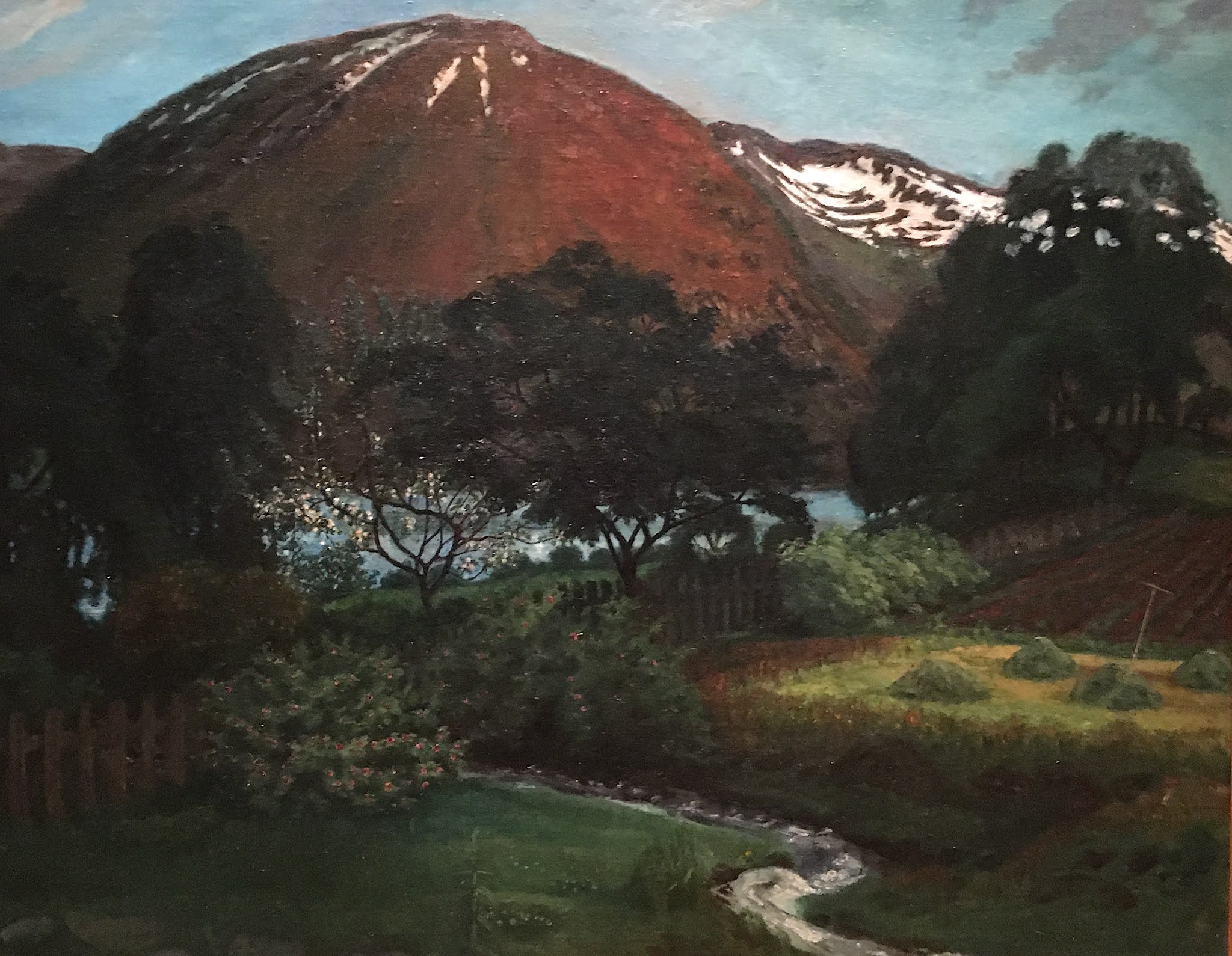
Scandinavians are often the forgotten artists of Western Europe. Could you come up with a Norwegian artist not named Edvard Munch? Within Norway, Nikolai Astrup is ranked just below Munch, and you might detect a splash of Munch in the way Astrup deals with reflected moonlight, as seen in the woodcut “The Moon in May.” 


Funeral Day
Funeral Day


Astrup (1880-1928) did some traveling in his short life–he died of pneumonia at age 47–but he did most of his 210 paintings and 48 woodcuts in a single region, Western Norway, and largely in two places, near and in his childhood village in Jølster and in Sandalstrand (now called Astruptunet). (Ironically, one of his earliest paintings was titled “Funeral Day in Jølster.”) He also often depicted the same features repeatedly, a time-honored practice among painters; think Claude Monet and Rouen Cathedral, for example. Astrup was particularly fond of a mountain that loomed over a small fjord and experimented with coloring, moods, and perspectives. 


His early life was like something from a Norwegian Gothic novel. In his youth, Norway was ruled by Denmark. That suited his father just fine, but Nikolai tended towards nationalism. He also wanted little to do with his father’s austere faith–he was a Lutheran priest at Ålthus church in the Jølster village of Sogn og Fjordane. You might have thought that Christian Astrup was Catholic; he sired 14 children, of which Nikolai was the eldest. He disappointed his father, who expected Nikolai to become a priest as well. 


Nikolai’s church was the landscape, both the sod-roofed built environment and the features and light nature provided. One of his largest oils, “Clear Night in June” features all three, with swamp irises forming a perfect V-shape in front of a village tucked below a snow-topped mountainside and a fading orange-yellow sky. If you wonder about the snow and the light, remember that this is Norway, a land where many hills wear a frosty crown for most of the year and the summer sun dims rather than sets. His “Night in August” shows an analogous setting. The flowers have changed, but the snow remains. 


In 1907, Nikolai married Engel Bunde (1892-1966), who bore him eight children and still managed to become a respected textile artist in her own right. A photo of the couple perhaps explodes your view of what a paint-flecked artist looks like. With his wavy over-the-ear hair and wire-rimmed glasses he looks like he could be either a school teacher or John Lennon’s grandfather. He was devoted to Engel and often depicted her working in their Sandalstrand garden, the latter of which he also repeatedly painted. The close up posted here shows Engel harvesting rhubarb. She is also one of the figures in the enigmatically brooding “By the Open Door.”


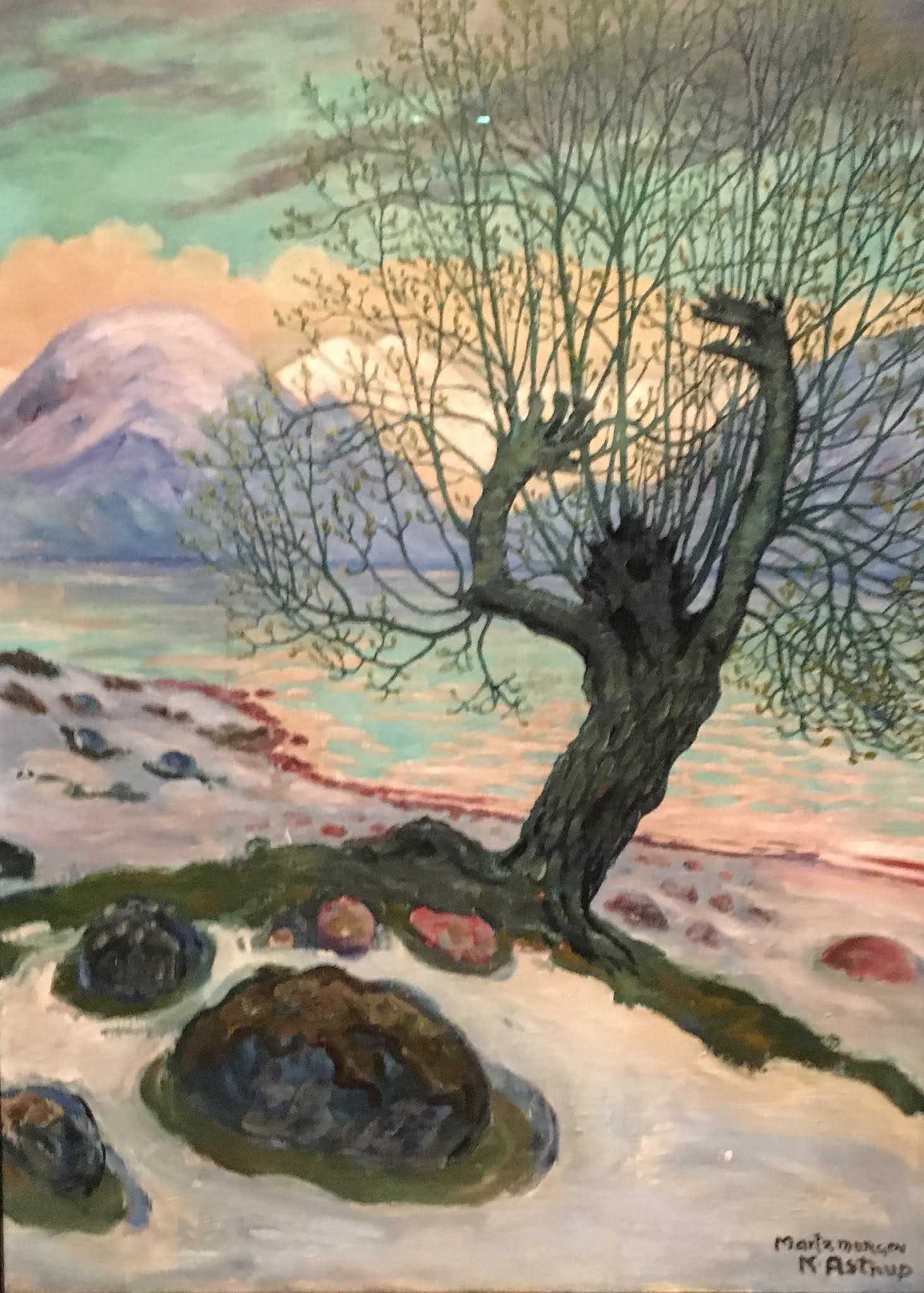
Astrup also drew upon Norwegian folktales and, in what must have horrified his dogmatic father and younger brothers who also became Lutheran priests, pagan rituals. He did several paintings and woodcuts of Midsummer bonfires and rituals, the latter pre-Christian solstice gatherings in which faeries were allegedly active and needed to be appeased. (Christians appropriated it as the Feast of John the Baptist.) He also used nature to give a nod to other pagan legends. The woodcut “Spring and Desire” transforms a hillside into a nude woman’s body, a reminder that May Day was once a fertility celebration that involved active carnality. “Spring and Willow” sports an eerie-looking tree that looks supernatural because its inspiration was the Ice/Snow Queen, an ogress. 


It should be noted that Astrup’s use of wood block prints was actually unusual in Norway. Because he was working outside of tradition, Astrup was unrestrained in his use of textures and colors. Personally, I prefer his starker black and white prints to brightly colored works such as “Milling Weather,” which skirts the boundary of garishness, but I admire Astrup's willingness to experiment. 


A few of his late works, notably “White Horse” in spring show him taking tentative steps away from representationalism. For me, there is a Marc Chagall-like quality to this work. It also tells us another thing about Nikolai Astrup. He was an artist active in and between several artistic traditions: impressionism, expressionism, primitivism, and modernism. 


It’s always a joy to be astonished by lesser-known artists. You have a few months left to catch this show–and you should.


Rob Weir

7/26/21

July 2021 Angela Autumn, Annabelle Chovstek, Sol y canto, Surrender Hill and more


Angela Autumn
hails from the small borough of Zelienople, Pennsylvania, which is a bit west of the Allegheny ridge, but you wouldn’t be wrong to think that she’s been baptized in Appalachian streams.  You need but hear a few bars of “Old Time Lovers” to imagine bluegrass stains on the back of her guitar. There is that plaintive voice, the small catches, and the woo-hoos coming at you like a muddy creek. The foot-stompin’ and fiddle-supplemented good ‘ole girl vibe of “Sowin’ Seeds,” the two-step pacing of “God’s Green Earth,” the plucked banjo and lonesome tones of “Western Skies,” and rolling melody of “Back in Line” all owe more to hardscrabble mount than the lights of Nashville, where she now lives. Her idea of a change of pace is to mix a tiny Dylan vibe into “Shooter” or sing about “Texas Blue Jeans.” To be sure, she’s a young singer who could use a tad more variety in her repertoire and depth to her vocals, but you surely can’t go wrong by giving a serious listen to her new LP Frontiers Woman.


Listening to Annabelle Chvostek is like discovering a retro gypsy musician melded with a carefree, bilingual, quirky chanteuse. Sporting a steampunk-inspired album cover, the album title is a throwback: String of Pearls. (For you young’uns, that was the name of a massive 1944 hit for the Glenn Miller Orchestra.) Chovstek is a vet of the Canadian folk- and folk-rock scenes. Though she’s a Toronto native, she attended Concordia University in Montreal and is comfortable enough in French that a quarter of her 12-track recording are sung en français. Chvostek has always been a bit on the cheeky side of things and her cover of the title track is a jumpy little number evocative of how Django Reinhardt might have approached it. Chovstek goes into a jazzy Edith Piaf mode on “Je T’ai Vue HeirSoir,” complete with plinky keys and guitar, and maniacal fiddling. She’s a few shades more serious on “Walls,” a song about who we are and what we leave behind. She gives it an orchestral treatment and ices it with lyrics such as: I'm a holy fool/And a killer too/And I leave it all with you/The light's an open palm/And the branches keep us calm/We don't leave today/But when we do/We won't be gone…. But don’t worry, Chvostek mostly keeps the mood lighter. Check out her live take on “The Fool,” which is like being at a carnival from the comfort of your office chair.


Some recordings review themselves. In 1994, Brian Amador and his Puerto Rican/Argentine wife Rosi formed the Cambridge, MA-based Sol y canto, which is a spinoff of an ensemble they created a decade earlier, Flor de caña. They have been making pan-Latin music since the days when it was niche music that was yet to live up to Sol y canto’s mission: to make music accessible to both Spanish- and non-Spanish-speaking audiences. These days their daughter Alicia often joins them on stage to create glorious three-part harmonies. She’s on the band’s fifth release, En vivo, en familia (Live, as a family). “Amaras” is typical of what Sol y canto does. It’s mostly just Spanish guitar, bongos, and three voices. They sing with sunny joy, even on songs such as “Epidemia de soledad (Epidemic of Loneliness)”. By keeping things simple, our minds can travel to the marketplace to take in “Olor de chiles (Smell of Chilis),” though it’s a rare song in which other things (flute, bass) are as close as the trio gets to being slick. There are even touches for gringos, as in “En vivo (Home Again),” which is in English. As legions already know, Sol y canto’s power comes from being true the music, their hearts, and spirits.


I’ve previously railed against the “Civil Wars Syndrome,” the tendency to compare every energetic country/folk duo to the long-disbanded Grammy Award-winning partnership of Joy Williams and John Paul White. Don’t do that with Surrender Hill, the husband/wife collaboration between Robin Dean Salmon and Afton Seekins Salmon. First of all, Robin was born in South Africa before he surrendered to wanderlust and made numerous ports of call, played in a punk rock band, and eventually drifted to Arizona. For her part, Afton is an Alaskan who studied dance in New York City before landing in the Grand Canyon State. Their latest project, A Whole Lot of Freedom, opens with the title track, a quick nod to Robin’s punk rock days before turning country: Got a little country in my soul/little bit of rock and roll/got a lot of whiskey in my blood. Robin handles most of the lead vocals, but Ashton provides tight harmonies that are really evident in quieter acoustic-led pieces such as “Healing Song” and “Beautiful Wren,the latter which is about their daughter. They draw on a lot of inspirations, including outlaw country, family tales, life experiences, and their “road-dog status.” You’ll hear echoes of Guy Clark on “Turn This Train Around,” but don’t be deceived by the title “Badge of a Punk Rock Band;” if you can believe it, it was inspired by a bad trade of a saddle, an electric guitar, and car restoration! I’d like to hear more Afton leads on an 18-track album that sometimes feels like Robin is trying too hard to sound like the boy from Texas he isn’t, but this is a very solid country album that takes interesting turns. 


Jazz lovers will appreciate Refuges Mouvant by rising Québéçeois star Mireille Boily. Her new project is a collection of cool jazz song, poetry, and spoken word that pays homage to signs of heaven and earth. It is combo jazz in which she’s accompanied by saxophone, piano, standup bass, and percussion. She is a gifted songstress though, to be honest, this genre of music simply doesn’t move me. This, of course, is a personal statement and not a critique of Boily’s obvious gifts. Try tracks such as “Crépuscule” or “Nouvelle Lune,” as she might be your cup of tea. 


If I could give young singers one piece of advice, it would be: We want don’t want to hear anything else until we’ve heard you. I think that Sarah Cicero has a nice voice, but her EP Cold Immaculate Opposite doesn’t let me know for certain. PR material describes her voice as “incandescent,” but the thing about light-emitting rays is that they are encased in a shell. There are so many layers and drifting departures that Cicero only emerges as refracted light. The overproduction is such that a rough video of her singing “Atticus” while sitting on stairs warbling against street noise is better than the studio version. The same issues turn her single “Letter to the Editor” into something approaching aural wallpaper. Cicero should simplify and add where needed, not just because she can.


Rob Weir