7/16/21

Home Body is Unfinished Verse


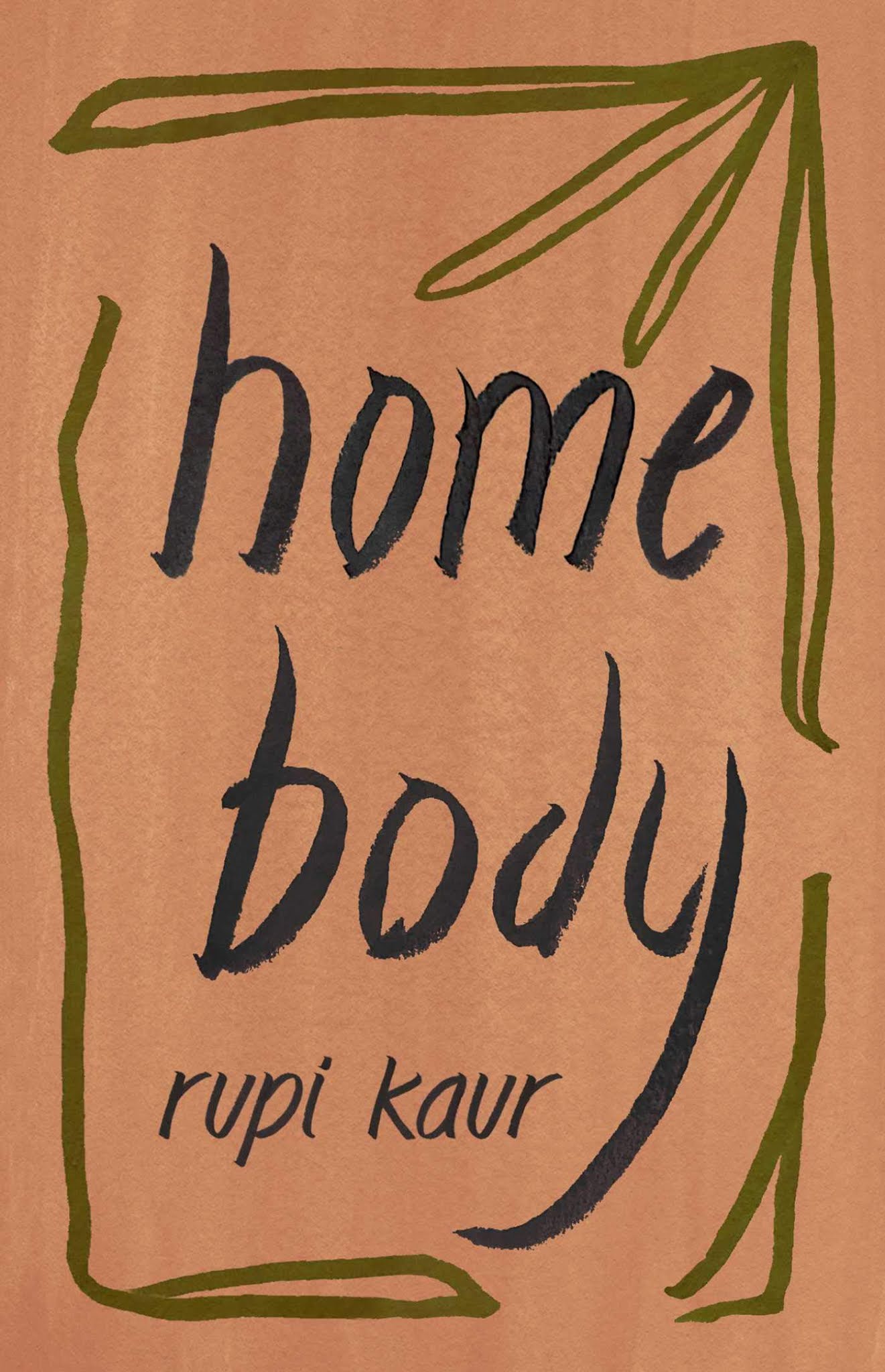
Home Body (2020)

By Rupi Kaur

Andrews McNeel Publishing, 194 pages.

★★


When all I was in my early 20s, I wrote reams of heartfelt but horrible prose poetry. Most of it tumbled into four boxes: I am depressed, I'm in love, I'm not in love, I’m depressed again. Rinse and repeat. Life is nothing if not a teacher and I came to learn that reducing all experience to just a few categories was naïve.


I mention this because Rupi Kaur’s Home Body reminds me of my younger self, and not in a good way. She fills a few more boxes than I–abuse memories, ethnic identity, production anxiety, masturbation–but she doesn't escape the young poet’s trap of placing herself at the center of a very constricted universe. Even her stick figure doodles bespeak a 20-something mind that has not yet come to grips with the reality that most of us find ways to muddle through life’s downturns so that the sublime moments seem even more special.


Kaur, an India-born Sikh-Canadian, divides her collection into four parts–Mind, Heart, Rest, Awake – and the very best way to approach it is to not think of as poetry at all. The overarching theme is it she refuses to be broken, and that’s a fine approach to healing but a long way from being finished verse. What stands out is not entire compositions–even though most are very short–but lines such as these:


you are lonely/but you're not alone/– there is a difference


i am not my worst days/i am not what happened to me


your voice is your sovereignty


i'm not interested/in a feminism that thinks/simply placing a woman on top/of oppressive systems is progress


You can probably see the inherent problem in all of this. Simply using the lower case doesn’t make her into e e cummings. (I tried that as well!) We learn a lot about Kaur’s views on capitalism –she's not a fan–depression, commercialization, manufactured desire, and balance. Her short punchy observations play well on Instagram, but hers are talking points, not poems. As readers we feel her pain and, at resolute moments, sigh with relief but we are also anonymous and faceless. What we cannot be is her therapy group, cheerleading squad, personal sounding board, or writing coach.


I don't mean to sound heartless. I'd love to know what Kaur thinks of this work a decade from now. After all, I confessed she reminded me of my younger self. In retrospect, though, I'm glad only a few people ever read what I wrote back then. 


Rob Weir

7/14/21

Lady from Shanghai Seems Naff in Hindsight


The Lady from Shanghai (1947)

Directed, produced, and screenplay by Orson Welles

Columbia, 88 minutes, not-rated


It has been said that in his prime, Orson Welles never made a bad movie. Yes, he did; it's called The Lady from Shanghai. The title means less than you might imagine. It is set in Mexico, the Caribbean, and San Francisco, the latter’s Chinatown being the closest we get to the Celestial Kingdom other than a bit of travel story babble.


Welles directed, wrote the screenplay, produced, and starred in the film and he didn't do a particularly great job in any of these roles. He plays a free-spirited roustabout known as “Black Irish” Michael O'Hara. The “black” part is it backhanded allusion the legend that survivors of the Spanish Armada washed ashore on Ireland and cohabitated with some of Erin’s lasses–an explanation for why some Irish have darker features. I suppose this helps explain why Welles doesn't look the slightest bit Irish. He doesn't sound Irish either, though he labors through a lousy brogue. I am of Scottish and German ancestry but I'm pretty sure that with a little practice, I'd sound more Irish than Welles. Black also refers to Michael's temperament. He killed a Franco spy during the Spanish Civil War, and though he is well spoken and formal for a sailor, he lets it slip that he could kill again under the right circumstances.


Hubris comes in the form of pursuing a beautiful woman named Elsa, whom he calls “Rosalie” (Rita Hayworth). Too bad she's married, and to a famous trial lawyer Arthur Bannister (Everett Sloane) to boot. Against his better judgment, Michael takes a job on Bannisters’ yacht. Given that Bannister is crippled and a contemptible, amoral creep, it’s not hard to see why Elsa might desire someone more robust and kinder. The film is overly seasoned with references to how Michael is attractive, strong, and tough. Too bad he doesn't have a brain to go with the physical package.


The Lady from Shanghai. Hmmm…. Another meaning of “shanghai” is being coerced or tricked into doing some unfavorable task. That's metaphorically true for Michael. All of this movie’s dealings require the adjective “double” to make sense of them. Even then we are not entirely sure we are viewing a WYSIWYG situation. Is Elsa in love Michael? Maybe. Or is it George Grisby (Glenn Anders), her husband’s law partner? Do either of the two Bannisters give a potato for the dense Michael, or is one of them trying to save him?


Sharks are discussed and appear in the film, and it's another ham-handed metaphor. Suffice it to say that no credit accrues to the legal profession in this movie. Bannister is filthy rich and is part of the subspecies of that small class that invites adjectives such as: self-indulgent, misanthropic, sexist, classist, judgmental, and cold- hearted. Michael finds himself a patsy in several schemes. By the time he figures out he's being used, viewers wonder what breed of fool is so deprived of brain cells that he couldn't see that plans presented to him have more holes than a $600 pair of distressed designer jeans. You need not have majored in philosophy to determine that Welles’ screenplay is severely logic impaired.


The Lady from Shanghai is famous for its climactic scene inside a mirrored funhouse at a closed-for-the-season amusement park. It is only here that Welles shines. It may be because he isn't on the screen much during pivotal moments and could pay attention to the sort of detail that won renown: unconventional camera angles, narrative bleeding into surrealism, and shadows so dark you could slice them with a knife.


Cool stuff, but not enough to redeem this badly aged dud. Wells was a consummate mannered actor who sought psychological impact over realistic human actions but with the right script, his flair for melodrama melded with straight drama Not here. “Hokey” is a descriptor that springs to mind. Rita Hayworth is a gorgeous presence, but one with little depth. There are scenes of her and Sloane wearing faux seafaring garb that makes them look like Lovey and Thurston Howell from Gilligan’s Island. In this film, I'd liken Hayworth to a classier version of Marilyn Monroe, but with comparable (non-)acting chops.


The Lady from Shanghai is hailed as a vintage Orson Welles film. Sorry, but the calendar has flipped and it now seems an implausible mess. It should be moved out of the classics file, but cue it the next time you plan a weekend slate of campy movies.


Rob Weir


7/12/21

All-Star Game, Norman Rockwell, and Nostalgia


Tomorrow is Major League Baseball’s All-Star Game. Southern outrage over shifting the game out of Atlanta has died down, and most people–including diehard baseball fans–yawn at the misnamed Midsummer Classic. All-star games of all sports are passé, but baseball’s is particularly meaningless.  


Baseball players used to go all out because they were heroic to millions of Americans. Gone are the days in which Pete Rose barreled over the catcher to score the winning run, Stan Musial homered in the 12th to give the NL a victory, and Ted Williams did the same for the AL. Gone also is what was a good idea: the champion of the league that won the All-Star Game got home field advantage if the World Series went seven games.


The game is now of such low importance that some selected All Stars feign injuries or “family emergencies” to get out of it. After all, the biggest reason to be named an All Star is that it activates escalator clauses in player contracts. A few innings of the game gets an average payout of $18,500, but be called an All Star activates contract bonus clauses of $100,000 or more. Why not just cash the big check and stay home? That’s what Jose Altuve, Carlos Correa, and three other Astros plan to do. (Leave to the Astros to bring the game down another notch.)


So, let’s forget the game and talk about nostalgia differently. At my last visit to the Norman Rockwell Museum, I ducked down to the basement to see some of Rockwell’s Saturday Evening Post covers. Few Americans were as good at nostalgia as Rockwell and it’s hardly surprising that he often used baseball as a metaphor for values and activities that helped define a distinctly American character.


Rockwell (1894-1978) grew up in a devout Christian home. His father managed a Philadelphia textile firm, though young Norman spent summers on New England farms. When he was eight, the family moved to New York City and Norman’s schools stressed physical education and team sports. He wasn’t very good at them and was destined to make his mark in art, but Rockwell’s boyhood was one in which Victorianism was giving way to a movement known as muscular Christianity, as exemplified by the Boy Scouts, the YMCA, outdoor life, and the national pastime of baseball. 


Rockwell grew to be a skinny beanpole (6’ 140 pounds) but he also became suspicious of dandies. Some worried that Americans were becoming soft and effete. A 1916 Saturday Evening Post cover captures it. The upper-class toff pushing the baby carriage is dressed as a miniature adult: suit, leather gloves, derby hat, and carnation in his lapel buttonhole. We can easily imagine ta banker father. Two scruffier and happier boys are having a laugh at his expense. Of course, they are decked out in their baseball uniforms. Rockwell suggests that baseball is a class leveler.


Six years later, a cover of a gangly, nerdy boy could very well be Rockwell himself. Everything about the boy is amusingly ironic: a shirt that says “Champ,” arms only slightly thicker than his glasses, and feet way too big to balance his frame. Somehow, we don’t think the small barbells he grips will transform him into the poster image at which he stares.


Some of Rockwell’s best covers, though, refracted baseball through lenses of whimsy and nostalgia. Here are two personal favorites. Rockwell’s 1939 cover for baseball’s 100th anniversary–if you believe the hoary Abner Doubleday myth–is pure nostalgia. It appears to be a game from either from the late 19th or early 20th century. Note the hurler’s uniform and mustache, and the fact that the formally attired umpire is crouching behind the pitcher rather than the catcher. How different the pitcher looks from mound heroes of 1935 such as Dizzy Dean, Lefty Grove, Carl Hubbell, or Red Ruffing.


A 1949 illustration often titled “Rained Out” is just great fun. Gaze upon the umpires’ gurning faces and notice that they now wear uniforms. The rain bounces and puddles in the Homeplate ump’s hand. Behind two managers are having a funny conversation. Rockwell took some liberties, but this is Ebbetts Field, which we know because Brooklyn is the home team on the scoreboard. The sourpuss manager certainly isn’t Dodgers skipper Burt Shotton. We might be looking at a caricature of Pirates manager Billy Meyer, who had a bulbous nose. The scoreboard tells us that Pittsburgh is the visiting team.


Norman Rockwell captured things in baseball now sorely lacking: the joy of the game, ways it evoked the American spirit, and imagining simpler times. The 2021 All-Star Game evinces a different America. Escalator clauses for millionaires are not nostalgic or pure. Alas, they are too much like an America dominated by materialism, cutthroat business, and narcissism.


Rob Weir   

7/9/21

Hockey for the 21st Century


These guys need to go away


The National Hockey League just finished its season and that’s a problem. It’s July and you may have noticed that not even Moose Jaw has any ice on the ponds. Training camps open in less than 10 weeks.

The NHL also lacks a major TV contract in the United States, which is a shame because it’s the most-exciting of the four “majors.” That’s also a problem, as these days few sports franchises can survive on ticket sales alone.

Those who aren’t hockey fans often complain that they have trouble following the game. They should, of course, learn how to watch it, but the NHL is also in need of changes that make it friendlier for TV, computers, and tablets. There are several changes the NHL desperately needs, none of which requires that all hockey players wear mullets:


 ·     -- Shorten the season by playing more games per week and by pulling NHL players out of Olympic competitions. They are professionals for heaven’s sake; leave the Olympics for amateurs. The season should open on November 1 and the Stanley Cup should be raised in mid-April.

·      --Do, however, widen rinks to the Olympic standard of 200 feet. This encourages more magnificent skating, leads to more odd-man rushes, and creates greater scoring opportunities.

·      --More importantly, a wider rink discourages boring clutch-and-grab hockey. On a wider sheet, good skaters zoom around the goons.

·      --Speaking of goons, hockey is a skill sport, not UFC on skates. Rodney Dangerfield once joked, “I went to fight the other night, and a hockey game broke out.” Good line, but in the age of much bigger players and revelations about CTE, the goons need to be retired. Some fans drool over bone-crunching checks and toe-to-toe scraps, but top players can skate up to 30 mph. Imagine what would happen if you aimed your car at a pole at 30 mph. Besides, would you rather see Connor McDavid on skates or a stretcher? 

     ---Either widen the nets or shrink goalie equipment once again.

·      --Promote the talent! If the lords of the boards and TV moguls are struggling with that concept, spend more time in Canada to see how it’s done.

_--- Have a trade deadline that makes sense. How about no trades after January 31? It's ridiculous when the teams that go to the playoffs scarcely resemble the ones that got there in the first place. Plus, late trade deadlines pretty much mean that the fans of mediocre teams are robbed of seeing anyone on the ice worth seeing.

---- No more expansion! Prune the dead wood. Five teams generate more than 25% of the league’s revenue and that must change. For the record, two of them play in Canada (Toronto and Montreal). And if anyone can explain to me why Phoenix, Miami, Raleigh, or Columbus still has a team, I’m listening. Winnipeg needs a new rink or wave goodbye. Ottawa could use one that’s actually in Ottawa and the less said about the Islanders’ two rinks, the better.


Rob Weir

7/7/21

Not Just Baseball but….


Clever, but MLB does have issues!
 

I made a $129 mistake this spring: I bought a subscription to MLB.com and I’ve already made a note to cancel it the day the World Series ends. 


Much has been written about the slow pace of baseball, but that’s not why it has become boring. All sports have become crushingly dull and television is a major culprit. Even so, baseball is in need of a major overhaul, though probably not in the direction the commissioner’s office is headed.  


Baseball been under the microscope more than any other sport and has dragged out all manner of gimmicks that reek of desperation, The first thing to do is dump all of the ridiculous crap currently being tried: beginning an extra-inning game with a runner on second, 7-inning doubleheaders, undressing pitchers in search of grip substances, etc. While we’re at it, dump Interleague play, an experiment whose day has passed, and serves only to cheapen the World Series. 


Here are some other ideas: 


·      Starting pitchers must complete at least 5 innings, even if they are getting shellacked. Cruel? No more so than some reserve outfielder being drafted as a reliever.

·      All relievers must throw to at least 3 batters. End the era of roster-clogging “specialists” who can only throw to one type of hitter. This would also speed the game along so we don’t have to endure the constant cycle of pitching changes and TV commercials.

·      Speaking of commercials, limit them to 2 minutes between innings. This alone would subtract at least 9 minutes from the game. Limit the break to 1 minute if a reliever comes in during an inning. In total, the average game would be over roughly 15 minutes faster.

·      Use technology to call balls and strikes, but mandate that umpire decisions on the field are final unless a rule infraction is at issue. No video reviews. This would save another 10 minutes.

·      Baseball also needs some new statistics to replace meaningless nerds-only gibberish. I suggest these: MHR (Meaningless Home Runs that come when the outcome isn’t in doubt); WCSP (Who Cares Slugging Percentage demerits for hitters who don’t produce in key situations); LRE (Little League Error for times in which a fielder doesn’t actually touch a ball that any Little Leaguer would have gotten to); YDDYJ (You Didn’t Do Your Job demerits each time hitters, fielders, and pitchers flub basic things); TS (Throw Strikes demerits to pitchers who manage to run 0-2 counts to 3-2; 5 demerits if they walk the hitter and 10 if they toss a 3-2 gopher ball).; BYG (Burn Your Glove demerits for catchers who call lousy games, don’t throw our runners, and are prone to passed balls. It’s also known as the Gary Sanchez Factor).


Now for a few things that would make the game more exciting to watch.


·      Baseball needs better coaching at every level. MLB has made home runs boring, as its biggest hitting “stars” strike out 25% of the time by swinging for the fences.

·      Hire coaches who teach situational hitting. This isn’t new. I learned on the playground that you choke up on the bat and cut down on your swing once there are two strikes on you. There’s a world of difference between “hitters” and “swingers.”

·      Teach bunting and I mean proper drag bunts. It’s pathetic to see some guy making millions stick his bat out in front of him like a statue before the pitcher even begins his wind up.

·      Teach other basic fundamentals. Like how to set your feet on a ground ball, how to execute a hit-and-run play, and how to beat a defensive shift.  

·      Baseball needs more speedy guys who can get on via an infield single. It would also be nice to see more base stealing, and runners with the speed to make it from first to third on a single to right.

·      If MLB abolishes sticky substances for pitchers, abolish pine tar for hitters. Allow pitchers to throw inside and call a strike is a hit batter has leaned into the strike zone.

·      Allow starting pitchers from the previous game to be replaced by one- or two-day call-ups from the minors.

·      Make the designated hitter rule applicable in both leagues. Most pitchers simply can’t hit and it’s boring to watch them try.

·      Owners should insist on contracts that are incentive-laden and provide for salary cuts for under-performance. Managers used to fine players who didn’t advance runners or plate a runner on third with less than two outs. Players should have to earn their salaries–just like the rest of us!


Now for the radical stuff.


First, institute a hard salary standard for all MLB teams. No more super-spenders or pocket-the-revenue owners.

·      Every team in MLB would have a set level for total salaries—say $150 million per roster Not a dime more and not a nickel less.

·      Cut ticket prices for fans by 20%.


My most radical proposal involves expansion and reemphasizing team success rather than single players. Hear me out. It’s modeled on European soccer leagues.

·      Create two MLB divisions in each league of 6 teams each and call it MLB-A. That would be 24 teams, not the current 30. The top two finishers in each division go to respective league playoffs seeded by their overall records (1 vs. 4; 2 vs. 3 vs. winners) and the survivors vie to play the winner of the other league’s playoffs in the World Series.

·      Take the 8 teams with the worst regular season winning percentages and drop them to an MLB-B division with a hard salary standard of $100 million. Players on teams dropped to the B-division incur an across-the-board salary cut of 1/3 and must play a full season of MLB-B even if they would otherwise be free agents.

·      Potential expansion cities include:  Montreal, Calgary, Vancouver, Buffalo, Indianapolis, Louisville, Nashville, Las Vegas, New Orleans, San Antonio, Portland, and Salt Lake City. Teams whose finances don’t work–goodbye Tampa!­– can be replaced by other cities and owners.

·      Each year, drop the bottom 8 from MLB-A to MLB-B and elevate the top 8 MLB-B squads to MLB-A with players receiving an immediate 33% bonus.

·      Reduce the regular season from 162 games to 154, with the season beginning no earlier than April 15.


Rob Weir
7/5/21

House in the Cerulean Sea: Fantasy for Adults Seeking Wonderment


THE HOUSE IN THE CURULEAN SEA (2020)

By T(ravis) J Klune

Tor Books, 396 pages.

★★★★★


If you like fantasy books, The House in the Cerulean Sea is like a Harry Potter-meets-Tim Burton novel for adults. It is also one of the most wildly creative works of fiction I’ve read since Susanna Clarke’s Piranesi.


On paper, 40-year-old Linus Baker has an interesting job. He’s a caseworker for the Department in Charge of Magical Youth (DICOMY). You read that correctly. At some unspecified period in British history–probably either an alternative present or a very near future–magic has been decriminalized, though many individuals without such attributes distrust those who have them. (You can probably infer analogies to immigrants and people of color.) If it’s not easy being paranormal, imagine what’s it’s like for special needs children, some of whom don’t even have human bodies.  


That alone is an interesting twist on social work, but Baker isn’t exactly Mr. Excitement. He’s a roly-poly asexual bachelor, lives in an undersized home, is unpopular among his DICOMY colleagues, and his only real companion is Calliope, a cat with a mind and loyalties of its own. His job title notwithstanding, Baker is akin to the Charles Dickens character Thomas Gradgrind (from Hard Times); that is, he’s more of a cipher than a dynamo. He’s a facts guy like Gradgrind and a stickler for bureaucratic detail. He has memorized most of the DICOMY manual Rules and Regulations and treats it the way some literalists use holy books. Moreover, DICOMY isn’t an easy place to work. In what is perhaps a nod to Orwell’s Nineteen Eighty-Four, a shadowy group known only as Extremely Upper Management (EUM) issues directives and employees know that it’s seldom good if commanded to board the elevator and appear before the EUM.


 When Linus gets exactly such a summons, his colleagues prepare to divvy up the remains from what they assume will be his firing. They’re wrong; Linus has been given a special task for which he feels wholly unprepared. He is chosen because he’s a gradgrind who assumes Rules and Regulations protects children. EUM wants to send Linus to a coastal village, where he is to board a boat to an offshore island to investigate Marsyas Orphanage and its unconventional proprietor, Arthur Parnassus. The island name alludes to a Greek myth of a musical satyr who angered the gods. If Baker was apprehensive before, imagine setting foot on an island whose children are considered dangerous. They include Talia, a bearded female gnome who loves gardens; the diminutive Sal, a shapeshifter; lithe Phee, a sprite; the obsequious squid-like Chauncey, who dreams of becoming a bellhop; and Theodore, a wyvern (winged dragon), who communicates in chirps. It’s most infamous resident, though, is Lucy; it’s short for Lucifer and his father is listed as Satan!   


Calliope seems at home, but Linus is understandably ill at ease. Arthur and caretaker Zoe Chapelwhite aren’t what he expects either. Arthur doesn’t give a fig about Rules and Regulations. He sees his brood merely as children in need of healing and guidance, encourages Linus to get to know them, and trusts Baker to write his report to EUM however he feels is appropriate. He even encourages a field trip to the mainland village, a place the children have never been and whose residents are not exactly comfortable with the idea, though they’re very content to take government subsidies to supply the island through Chapelwhite or the price-gouging ferryman Merle.


As you can imagine, there’s not much the meets the eye that can be trusted on or off the island. The House in the Cerulean Sea is true to its subject in that it’s magical, but it’s more than that. It’s a reminder that surfaces are seldom the same as essence, an exploration of hidden identities, a paean to nature, a celebration of play, a cover-up, a love story, and a road map for how Linus finds his groove. Leave it someone named Lucifer to correct Linus when he proclaims he has no magic: “You do Mr. Baker. Arthur told me there can be magic in the ordinary.” Think of it; to those deemed weird, normal is exotic.


I will admit that sometimes the novel has a YA feel, but isn’t that another magical thing? How often must adults be remembered that wonderment comes in many forms and is everywhere when they bother to look for it? Or that, as another character put it, “You fear what you don’t understand.” Open this book and prepare to be enchanted.


Rob Weir

7/2/21

Mayflies: Punk Rock to Hard Decisions


MAYFLIES (2020/21)

By Andrew O’Hagan

Faber and Faber, 207 pages.

★★★★


Nature has its own rules. Mayflies have an average lifespan of 24 hours. In his sixth novel, Scottish writer Andrew O’Hagan uses them as a metaphor to remind us that our own moment in the sun is briefer than we imagine when we bask in our youth and the world seems a cool stream into which we can wade at our leisure.


Mayflies centers on youthful male bonding. At is heart is the lifelong friendship between Tully Dawson and James “Noodles” Collins. Collins has just “divorced” his irresponsible parents. He is bright, well-read, and if his mentor English teacher has anything to do with it, bound for a university education. He’s not sure about that. His real mentor is Tully, whose dad Woodbine is a local soccer legend and whose mother Barbara treats Collins as one of her own.


Like most males in the Paisley suburb of Glasgow, Tully and Noodles are mad about football, especially Celtic, which commands fierce loyalty among Irish-heritage Scots such as they. But it’s 1986, and the Scottish working-class is reeling from Margaret Thatcher’s barbaric economic policies, the crushing of a massive miners’ strike, and her assault on unions. Thus, Tully and Noodles have a love greater than football: punk rock. Punk is to them as early rap was to disaffected black youth: a grassroots voice of defiance, rebellion, and rejection of Establishment values. Not since the mid-1960s had Western society experienced such a generation gap.


The first half of Mayflies depicts a drunken, stoned, f-bomb-laced, snogging, spit-soaked, head-bashing road trip to Manchester, England, for a punk rock band fest. It’s a veritable Mohawk-haired Woodstock–the 10th anniversary of punk–headlined by heavyweights such as The Smiths, The Fall, Shop Assistants, and New Order. Everyone is going, even if means walking away from their jobs to be there. Or perhaps, especially if it means thumbing their noses at employers; Tully proudly calls himself a socialist and is of the anarchist end of that spectrum. Tully, Noodles, “Limbo” McCafferty, and “Tibbs” Lennox set off for Manchester, meet some young women, and run into other mates such as Bobby “Dr. Clogs” McCloy and David Hogg. Of their id-driven descent into mayhem O’Hagan writes, “The night seemed to last forever and there was no direction home.”   


What they did not realize as they spiked their hair with Coca-Cola was that they were experiencing an ending, not a beginning. The DYI ethos of anarcho-punk soon gave way to polished musicians and the music fragmented into subgenres such as alt-rock, New Wave, post-punk, and pop songs with grungy echoes. In short order, Thatcher was gone and followed by empty Tory suits like John Major and Gordon Brown. Then, Tony Blair took power, but his government often resembled Thatcherism with a human face, not a revival of the Labour Party.


Move the clock forward to 2017 and Jimmy Collins is a tie-wearing successful writer/journalist married to Iona, an in-demand actress/playwright. Tully has kept the faith, but only sort of; he’s Head of English at an East End Glasgow school and playing drums with a band called Kim Philby*. Tully also has terminal cancer and has two things on his plate before he checks out at age 53. He agrees to marry his long-term partner Anna, a Glasgow lawyer, but he makes Jimmy promise he will take him to Switzerland for a doctor-assisted suicide when his suffering becomes intolerable.


The wedding is more posh than Tully wished, but the Manchester lads reassemble. As is often the case, some remain simpatico and some are not. Clogs still insists, “Punk was right…. We are in a constant state of co-exploitation,” but Tibbs seems “made for reading glasses and sharp angles and a bit of grey.” The nuptials go well enough, but the final decision is tougher. Anna is against it and Iona, though supportive of James, observes, “Men have a way of writing themselves into each other’s experience and placing it away from the women they love.”   


Mayflies is a powerful book, but it should be noted that its two settings are radically different in tone. Numerous reviewers have commented upon the book’s “dark humor,” but some have confused smart characters and witty banter with comedy. It is more accurate to say that the first half is shot through with angst and the second with pathos. O’Hagan boots us from the world of potty-mouthed anger and into one described with prose that is eloquent, moving, and reflective. Is it too much of a stretch? Since we know nothing of the intervening 40 years, Mayflies occasionally reads as if it is two different novels welded together with a globby bead. I leave it to you to decide if the shift is too jarring, or an unsettling reminder that we are all mayflies.


Rob Weir  


* Kim Philby was a British intelligence agent and double agent who fled to the Soviet Union in 1963, when his cover was blown.