7/22/22

Tracy Flick Novel A Tad Flat


TRACY FLICK CAN’T WIN (2022)

By Tom Perrotta

Simon and Schuster, 262 pages.

★★★


In the 1932 Marx Brothers film Horse Feathers Professor Wagstaff (Groucho) is the new president of a college that hasn’t had a winning football season in many years. He tells shocked colleagues that the school can’t afford both education and football, so he intends to tear down the college and build a stadium.


Tracy Flick* has an analogous problem. She has been the loyal assistant principal to Jack Weede for many years. Jack is retiring and Tracy is in line to move up, but the school board and community are more anxious to fire its football coach and return Green Meadows High School (GMHS) to the glory it knew before previous coach Larry Holleran bolted to head a college gridiron program.


Still, Tracy is a shoo-in to replace Jack if she can bite her tongue and win over board president Kyle Dorfman. Tracy is whip smart, has a Ph.D., and nearly finished a law degree at the University of Chicago. She likes working at GMHS, but she does have a cold personality and a blunt manner. Tracy slips a bit when she tells Kyle she has some ideas on improving the curriculum—especially for high-ability students—but admits she doesn’t care much about football. Oops! He does care and longs for a new Holleran.


In an attempt to redeem herself she accedes to an idea of Kyle’s she doesn’t think has merit. He wants to up the school’s profile by setting up a hall of fame to honor notable people associated with GMHS. The problem is that GMHS isn’t a bad school, but neither has it been a distinguished one. This becomes obvious (and amusing) as nominations come in. In Kyle’s mind the obvious choice is Vito Falcone, who quarterbacked the football team in its glory days and had a brief NFL career. Tracy finagles the idea of having two inductees and champions a longtime administrative assistant known to all as Front Office Diane.


If you know much about the inner workings of bureaucracies, search committees, or ad hoc committees you know each has the capacity to complicate simple things and that even decisions set in stone are precarious until cemented into place. Bickering and discontent ensue, but the hushed backroom plotting is even worse. Tracy finds it hard to “be the flame” swaying in the wind as she has been advised to become. Matters are complicated by personalities, many of which are out of accord with reputations. Among those suffering from the catchall malady “issues” include Vito, Jack, Diane, Kyle, his wife Marissa, a student named Lily, and Tracy. The usual complications emerge: not-so-secret affairs, old wounds, revenge fantasies, hidden agendas, and let’s not forgot a losing football program. Perrotta wends his way to a conclusion that’s partly predictable and partly surprising.


I am a Tom Perrotta fan, but I had mixed feelings about Tracy Flick Can’t Win. It’s short and breezy but also flat in ways that are more visceral than easy to articulate. It is fair to say that if we ignore personality deficiencies there’s not much going on in the novel until the very end. Moreover, after a while the bickering, scheming, and anxiety begin to grate. Even Tracy, our protagonist, comes off as calculating and entitled. Others will be revealed to be either deeply flawed or imposters.


I think that Perrotta wanted to write a novel about powerful men versus talented women who have to force their way into the Boys’ Room in order to shine. If that was the goal, too many punches were pulled that should have landed with force. In my estimation it would have helped to have emphasized Tracy’s likable qualities earlier in the book. I won’t say if she “wins” or loses, but it’s certainly the case that some readers will conclude that GMHS should wipe its slate clean on every level. To return to Horse Feathers, Groucho’s big musical number was “Whatever It Is, I’m Against It.” That is the stuff of comedy, but it’s marshy ground for readers in search of sympathetic characters.


Rob Weir  


*If the name is familiar, she appeared as a high school student in Perrotta’s 1998 novel Election and was played by Reese Witherspoon in a 1998 movie adaptation.

Licorice Pizza Leaves a Bad Taste


LICORICE PIZZA (2021)

Directed by Paul Thomas Anderson

MGM/United Artists, 133 minutes, R (language, drugs, mentions of sex)


If you don’t know, a licorice pizza is an LP record. I’d sooner eat vinyl than ever see this film again. It is embarrassing, trite, and as empty as an LP’s center. Why this “comedy-drama-romance” (whatever that is) was nominated for a Best Picture Oscar can only be explained as still another Hollywood attempt to win over a youth market that long ago ceased to care.


The story, if there is one, involves the attraction of 15-year-old teen actor Gary Valentine (Cooper Hoffman) to 25-year-old Alana Kane (Alana Haim), a photographer’s assistant. Rather than tell him to get back to run along until he’s old enough for his acne to clear, she finds herself hanging out with Gary and his child actor friends. Despite protestations to the contrary, she kind of likes Gary. Oooookaaaay. She’s not elderly, but Harold and Maude this ain’t. It’s unclear to me what exactly it is supposed to be. It’s very broad–in an empty desert wasteland kind of way.


The movie is set in California’s San Fernando Valley in 1973, presumably because it provides director Paul Thomas Anderson with an excuse to present all the boys and men in ugly clothing and bad haircuts, and all the girls and women in miniskirts, dorky bikinis, and death-defying shoes. The story takes place against a backdrop of technological change, shifting cultural trends, Richard Nixon, Vietnam, and the OPEC oil embargo. It’s fair to say that another thing this film isn’t is something you’ll ever find on the History Channel. It’s easy to see that Anderson is commenting upon the vacuity of 70s’ society. It’s easy, though, because Licorice Pizza is all surfaces and no depth.


The script is as thin as a blade of grass on a diet. See Gary flirt. Watch Gary enrage the host of the Lucy Doolittle Show (Christine Ebersole channeling Lucille Ball) by conking her with a pillow. Oh, Gary has a great idea: Let’s sell waterbeds and round up kids, teens, and Alana to run it. A bad encounter with a stoned, threatening, and Barbara Streisand-invoking Jon Peters (Bradley Cooper) leads Gary to go into the arcade biz instead. Both ventures bear the name “Fat Bernie’s.”


That’s hardly the most-insulting aspect of the film. There is, for instance, Gary harassing Alana until she agrees to show him her “boobs.” William Holden and Mark Robeson stand-ins Jack Holden (Sean Penn) and Rex Blau (Tom Waits) show up in a demented scene that is so random it’s as if Anderson randomly plucked script pages from the binder. LA mayor-wannabe Joel Wachs (Benny Safdie) inexplicably decides to risk everything once he sees Alana’s legs. What all of them have in common is a burning desire to have sex with Alana, as does Gary. Perhaps this is indirect commentary on Harvey Weinstein, but you’d have better luck locating the Holy Grail than making that connection. These offenses are amateur hour in comparison to the character of Jerry Frick (John Michael Higgins), a so-called businessman who pops up from time to time to trade in stereotypes of Japanese women. There are multiple comments on Alana’s “Jewish nose.”  It’s enough to make me believe that Anderson’s 1973 mise en scรจne is simply an excuse to engage in naughty little boy behavior for which he’d be pilloried were the setting a contemporary one.


Surely, you might argue, the movie is a quirky offbeat lampoon of shallowness Hollywood-style. Charles Yu did this brilliantly in his novel Interior Chinatown and so have movies as diverse as Adaptation, Barton Fink, Day of the Locust, The Player, and Sunset Boulevard. I probably do a disservice to mention these in the same breath as Licorice Pizza, a collection of vignettes in search of any semblance of unity. How many tortured devices can one cram into 133 minutes? Let’s see, Haim’s mother and sisters play her mother and sisters. How meta (not!). Cooper is the late Philip Seymour Hoffman’s son. Leo DiCaprio’s father cameos as Mr. Jack, a cheesy emcee. Etc.


But let’s not quibble. At least Licorice Pizza has a good 60s’/70s’ soundtrack. Surely that must count for something, but I doubt it. I waited several months for this film to arrive via interlibrary loan, yet somehow that seemed shorter than the two plus hours I wasted on a concept as twisted as a stick of licorice. I never liked licorice.


Rob Weir

7/20/22

Museum of Dumb Guy Stuff (You've Got to See It!)


MUSEUM OF DUMB GUY STUFF

114 Mechanic Street

Portsmouth, NH


If you were walking down a street and saw this sign, would you stop and take a look? Of course, you would and so did we.   


Most museums take themselves very seriously. Not this one. It’s as advertised, a collection of guy-centric toys, treasures, and kitsch. Call it where tongue-in-cheek machoism meets the desire for perpetual boyhood. 


You’ll find it in Clay Emery’s basement. He convinced his wife Susan it would be a good idea by promising it would keep him out from underfoot, though Susan is often there to greet visitors as well. (Also two massive but gentle dogs.) Mostly, though, Emery gets artistic help–if that’s the right word–from his good friend Rod Hildebrand who helps him fashion and build dioramas.


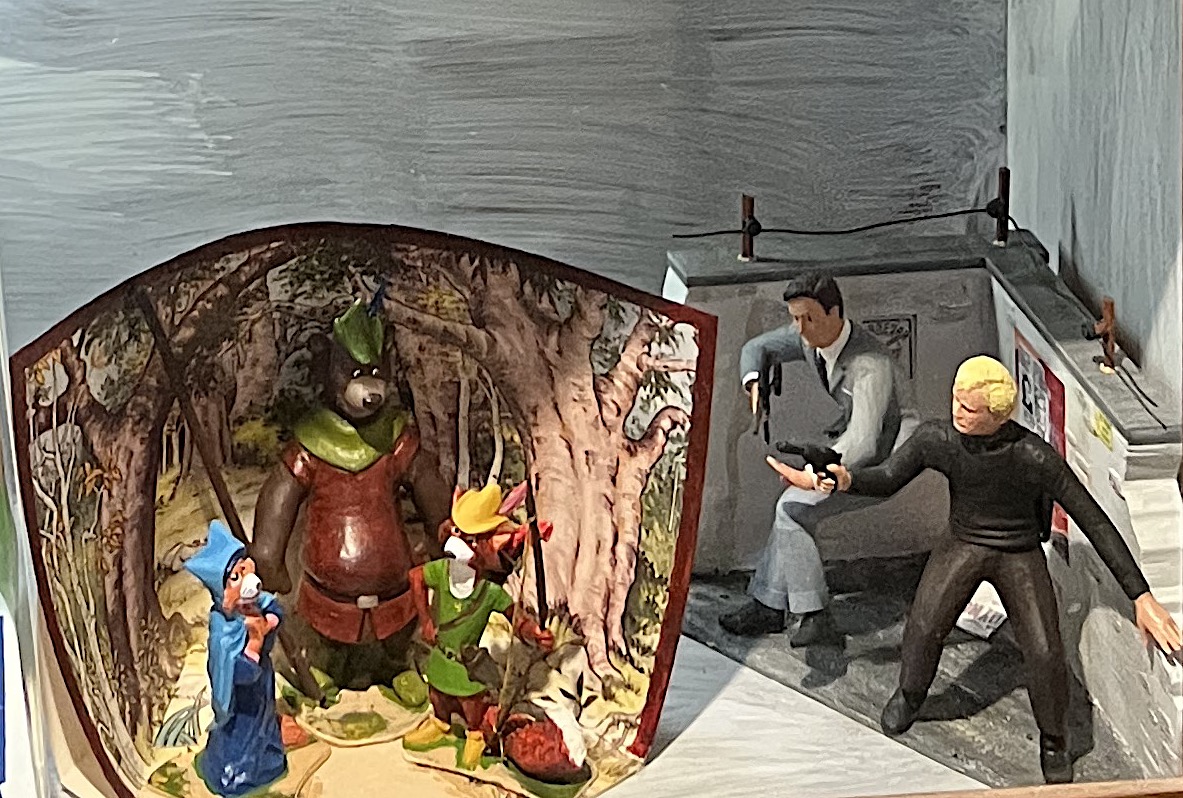
There's a bit of everything in Emery’s basement. Some of it is pieces from “kit busting,” a term previously unfamiliar to me. It’s pretty much self-defining. Manufacturers sell action figures and dolls with all manner of official accessories they think you will like. Emery and Hildebrand aren’t afraid to snap the lines they’re given and play figures within other scenarios. Why not have cartoon figures meet the Man from U.N.C.L.E.? They also did plenty of building g of their own; for instance, a coffee filter became part of the dress for an Old West female doctor. (Susan was a doctor in real-life.) 


I especially enjoyed the nostalgia trip as evinced in dioramas featuring Peanuts characters, The Three Stooges, and Crusader Rabbit and his friend Rags the Tiger. (They were the prototypes for Rocky and Bullwinkle and you can sort of see that in them.) 


You will also see Lara Croft and action figures of real people in movie roles such as Sean Connery, Clint Eastwood, and Tom Hanks. Barbies and G.I. Joe dolls get cast in new roles. And, of course, every collection needs some army guys. Both World War II and the French and Indian War get a workout in the museum. And what guy collection would be complete without a dinosaur or two or three? 


The centerpiece is a recreation, complete with toy train set, of Dover, New Hampshire as it was in 1959. Hildebrand even built the rocks used in the set. The trip back to 1959 is appropriate, as the entire museum is one big nostalgia trip.


Women need not fear drowning in a sea of testosterone. Irony and self-deprecating humor perhaps, but not testosterone. The greatest thing about the Museum of Dumb Guy stuff is that it’s done with such non-seriousness that you simply can’t see it and leave without chuckling. Nyuk, nyuk, nyuk.


Rob Weir


7/18/22

Rediscover Local Hero


LOCAL HERO (1983)

Directed by Bill Forsyth

Warner Brothers, 111 minutes, PG

★★★★


Local Hero was a favorite film of my friend Michael, who recently passed away. Like me, he loved all things Scottish. Local Hero is a classic that is part of a series of Scottish films from Bill Forsyth, a beloved director. Although the film’s externals–hair styles, clothing, automobiles, gender dynamics­–are dated, Local Hero bears another look for its what-goes-around-comes-around relevance.

Local Hero is a pastiche of farce, broad comedy, fairy tale, Brigadoon parody, and moral lessons. It begins in Houston, where Felix Happer (Burt Lancaster), the head of Knox Oil, has his eye on draining some of Scotland’s North Sea oil. Knox Oil needs a place to build facilities and a deep port for big tankers. His experts advise him that only a place called Ferness meets the criteria. Happer decides that “Mac” MacIntrye (Peter Riegert) is the man to finalize the details based on Happer’s mistaken assumption that Mac is “Scottish.” Mac is actually an 80s-style Yuppie of Hungarian descent who’s about as Scottish as Scotch tape, but what Happer thinks equals reality.

Mac is also commanded to report on what he sees in the sky because Happer is a passionate amateur astronomer. So, it’s off to Caledonia where he meets his gawky local contact Danny Olden (Peter Capaldi). Danny is instantly smitten with Marina (Jenny Seagrove), an oceanographer who believes her geologist bosses actually want to build a marine biology center in Ferness. When she exits–and she will resurface–Mac and Danny are off to the village via moors, one-track roads, Biblical rain, and fog.

They finally check into a B & B run by Gordon Urquahart (Denis Lawson), who is also the local accountant, bar owner, and unbeknownst to the visitors, pre-selected by Ferness residents to wring as much money as he can from the Yanks. Mac is all-business and wound tighter than a bodhran, but he can’t help but be attracted to Gordon’s wife Stella (Jennifer Black). Think of every joke you know of yokels getting over on city slickers and kilted variants appear in the film. Mac is oblivious to the fact that villagers have dollar signs dancing in their heads and discuss what they intend to do with their instant wealth the moment Mac and Danny are out of earshot.

Plot lines emerge involving everything from a rabbit, a baby no one wishes to discuss, a fishing boat whose name changes daily, misadventures with the village phone booth, a madcap motor bike fanatic (John Gordon Sinclair, the future star of Forsyth’s Gregory’s Girl), an African-born minister with the unlikely name of Murdo McPherson (Christopher Asante), a joie de vivre Russian fisherman, city guys on rocky beaches, a twist on mermaid legends, and a celidh whose musical selections vary (to put it mildly). The film’s humor—even that of the sexual variety—is gentle and droll. Some of it, such as Happer’s abusive therapist (Norman Chancer), is a thudding dud, but it helps to remember the film’s fairy tale qualities are unmoored from quotidian logic.

As you might expect, there is a midge in the cockaleekie soup. Everyone is anxious to sell except one hermit living in contented squalor on Ferness beach: Ben Knox (Fulton MacKay). Note the surname! Mac’s reports on seeing the aurora borealis and stalled negotiations are enough to send Happer to Ferness and Mac back to Houston.

From today’s perspective, several things stick out. The first is a difficult nut to crack, the question of preservation versus modernization. Should a place like Ferness be left alone like tartan encased in amber, or would locals benefit from joining the “real” world? Ferness–real-life Pennan–exudes stark beauty, but it’s also remote and jobs are scarce. On the other hand, refineries (and Mac’s Porsche) do enormous ecological damage. Forsyth cleverly and subtly riffs off Brigadoon rather than moralize, but from the perspective of 2022 it’s hard not to infer that Big Oil needs to become as archaic as Brigadoon.

A funny snippet occurs early on that suggests not even hurricanes wish to be in Houston. Forsyth used Mac, whose stay in Scotland unbuttons him, to consider desire. In short, what do we really want, things themselves or things that feed our souls? Watch and consider who is the happiest person in Local Hero. I thought about Michael as I viewed it, a sad moment but also one that made me ponder and smile.

Rob Weir


7/15/22

Edward Gorey House a Must-See for Cape Cod Travelers


EDWARD GOREY HOUSE

Yarmouth Port, Massachusetts


I’d like to introduce some new material for the Art Smarts section of the blog. If you will, call it small museums. Maybe you’re one of those who gets overwhelmed by places like New York’s Metropolitan Museum of Art, Boston’s MFA, or the Chicago Institute of Art. Often, you’re in one of those places, have a limited amount of time, try to cram in as much as you can, and end up viewing art the way you might observe a roadside fender-bender. Or, perhaps, you’ve simply grown weary of the “great artists” approach of such places. Small museums are antidotes. Many are more creative and few of them will exhaust you.


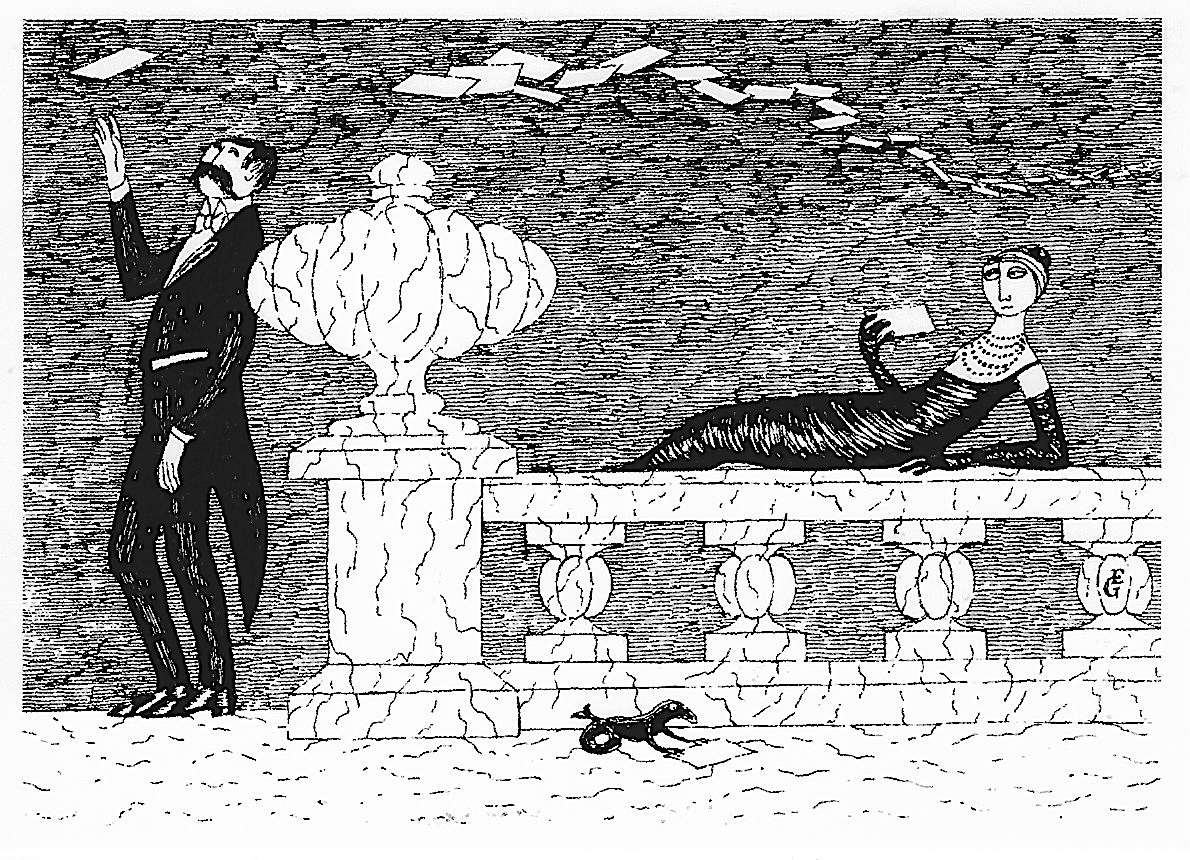
If you are headed for Cape Cod this summer or fall, be sure to stop at the Edward Gorey House in Yarmouth Port. It will be an hour or so well spent. Does the name Edward Gorey (1925-2000) ring a bell? If you’ve ever seen an episode of Mystery on PBS, Gorey’s illustrations introduce the episodes, complete with damsels in distress, falling cornices, cracking lightning, and lurking shady characters. 


Gorey is often labeled an illustrator, but that doesn’t quite get it. He specialized in etchings and drawings, but he also loved theatre and bagged two Tony Awards, one for costume design and the other for set design. In addition, he wrote or illustrated an untold number of books for children of non-snowflake parents. You know, the kind of kids who love a bit of, well, gore and a good scare now and then. Not that there was anything explicit about his work. I like to think of his verse, stories, and illustrations for the younger set as Edwardian surrealism. It’s analogous to his lead-ins for Mystery in that it’s vaguely creepy and endlessly amusing. The latter quality makes it irresistible for adults as well. 


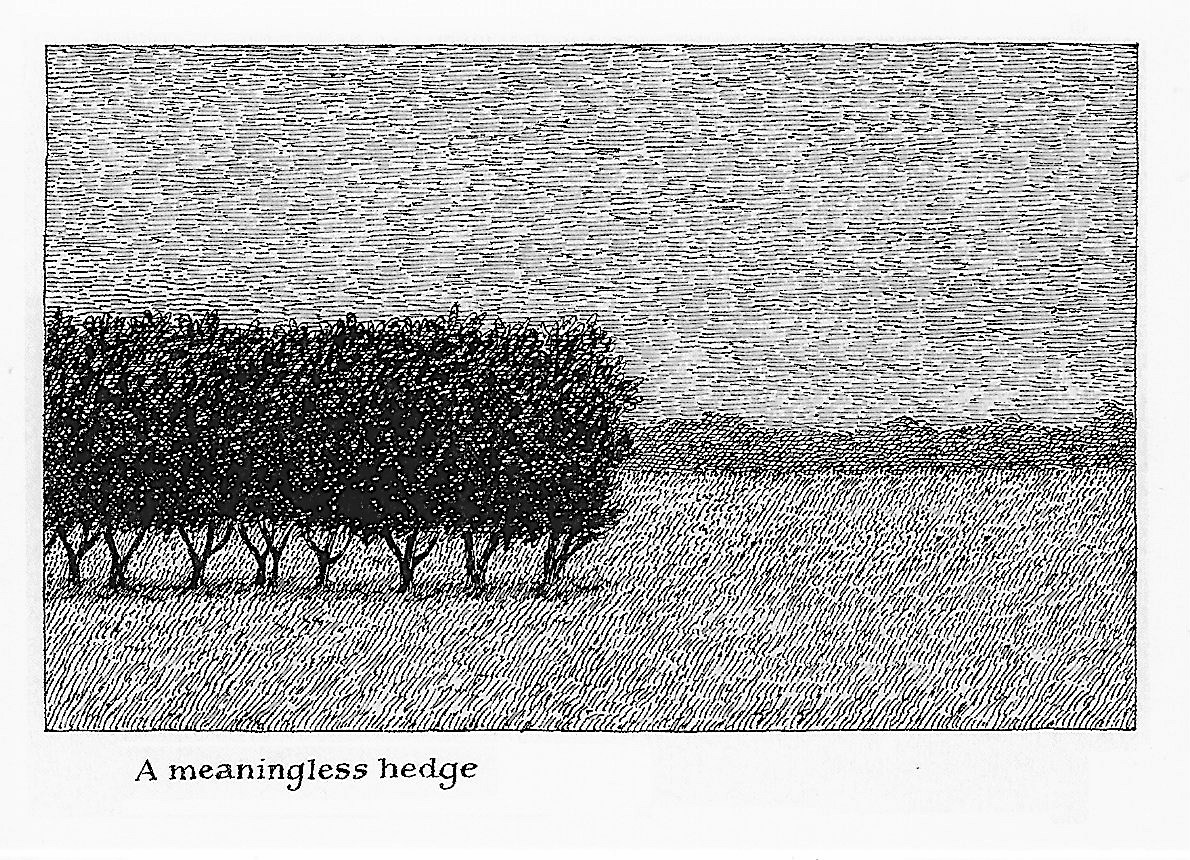
Gorey was embraced by the Goth movement, but that doesn’t quite fit either. It’s more like tongue-in-cheek Gothic. Gorey simply couldn’t resist figures with capes pulled across their faces, architecturally challenging hats, and faces as enigmatic as the Mona Lisa. Toss in some broken crockery, animals plucked from some madcap Bestiary, falling objects, Seuss-like odd words, and vile-weather settings and it’s welcome to the vision of Edward Gorey. He also delighted in offbeat humor–many of his books were credited to those with anagrams of his own name, such as Dodgear Wryde–and in finding offbeat ways of depicting prosaic things such as hedges, rocks, articles of clothing, or simply people doing nothing. 


Gorey was born in Chicago and studied at its Art Institute. He served in the Army during World War II, then attended Harvard. At the latter he got involved with the Poets Theatre and rubbed elbows with luminaries such as Alison Lurie and Frank O’Hara. He was a great admirer of Broadway choreographer George Balachine and worked on several of his shows, including Dracula. (What could be more appropriate?) His personal life was open to great speculation, the consensus being he was probably an asexual gay man. Meh. Who cares? 


Each season the Gorey House features one aspect of Gorey’s work and for 2022 the theme is dance. Think you don’t care about theatrical dance and ballet? Forget tulle and tutus; Gorey brought his skewed views to illustrations of dance as snobs would never recognize it!


The Gorey House also maintains shelves, niches, and cabinets of curiosities as he left them. Like a lot of artists, he was fascinated by shapes, picked up found objects whose designs he liked, and purchased items that simply caught his fancy. He adored cats, owned lots of them, and was a serial fascinationist who thought nothing of procuring bronze bugs, masks, and all manner of bric-a-brac. Treat yourself to a visit. You’ll leave smiling, which is the right attitude to have as you battle Route 6 traffic to wherever you’re headed.


Rob Weir

7/13/22

Little Fires Everywhere Deserves Its Kudos


LITTLE FIRES EVERYWHERE (2017)

By Celeste Ng

Random House, 308 pages.

★★★★★


Little Fires Everywhere was so much in demand that the waiting list was too long at my local library, I gave up, and moved on. I came across it on an old list and finally got my hands on it. By then I had forgotten why I wanted it in the first place. Now I know; what a book! I can see why author Celeste Ng was praised to the skies.


On the surface it’s about the collision of two unlikely families. Haute bourgeois Elena and Bill Richardson live in the tony Cleveland suburb of Shaker Heights with their four children: high school senior “Lexie” (Alexandra); her jock brother Trip; Moody, the aptly named younger brother; and “Izzy” (Isabella). Lexie is 18 and siblings were popped out in highly regimented fashion, just like Shaker Heights. Two passages from the book establish the barriers for a novel set in 1995-96. The first is a prologue from a 1963 Cosmopolitan that dubbed Shaker Heights a Utopia; the second a thought from Elena: “Rules exist for a reason: if you followed them you would succeed; if you didn’t, you might burn the world to the ground.” When you see material like this you immediately think, “uh-oh.”


The second family is that of peripatetic artist and single mother Mia Warren and her 15-year-old daughter Pearl. Mia is a rolling stone and has been since she was an art school dropout, though she remains a person who simply must create. Every six months or so, Mia and Pearl pack their few possessions into a VW Rabbit and move on–sometimes because they are low on money and sometimes because Mia needs to recharge her artistic batteries. That VW is occasionally their home, but they scrape by and, against all odds, Pearl is a brilliant kid who burns through AP classes. When they finally arrive in Ohio, Mia promises they’ll settle down there–another “uh-oh,” if I’ve heard one. It helps figure that out when the novel opens and closes with a conflagration.


Remember the Billy Joel song “We Didn’t Start the Fire?” In this book, everyone seems to start fires of some sort. Ng once lived in Shaker Heights, but the morally ambiguity of Little Fires Everywhere gives it verisimilitude. It is at once a love letter to Ng’s former home, a withering social critique of it, and a series of cross-cultural clashes. It's Lexus, Explorer, and Jeep versus one battered VW; invention versus reinvention; falling in line versus making your own rules; shopping at thrift shops because they are retro cool versus those who can’t afford to go to the mall; McMansions and rental units; and ethnic identity versus liberal make-believe. On the last score, Lexie has a Black boyfriend, but if his family is as Shaker Heights as Lexie’s, does that make her enlightened? Don’t expect simplistic answers in a book that also delves into who should have the right to an abandoned Chinese baby, who is taking advantage of whom, who is sincere and who isn’t, who is following their dreams and who is simply following, good lies and bad ones....  


Pearl is a jewel, but I also really liked Izzy, a Doc Marten-wearing surly teen who knows she doesn’t fit but finds an unexpected bond. I also appreciated how Ng situated her tale amidst Jerry Springer scream fests and the Bill Clinton/Monica Lewinsky debacle via subtle references that neither dwell upon details nor moralize. (I admire writers who, in turn, respect readers enough to let them draw their own conclusions.) Ng ultimately challenges us to evaluate whether deceptions lie along a spectrum or are always indefensible. That’s not easy to answer given that a lot of people end up playing the parsing game. You will probably come away hating busybody Elena and worring about Lexie, but we can’t be sure who will turn out okay and who will be shattered.


I really admired how Ng negotiated the question of what makes a person free: their possessions, their essential nature, who they pretend to be, or who they want to be. A lot hinges on a challenge hurled by Mia in a different context, “What do you want to do about it?” Bill Clinton infamously dodged an uncomfortable query with the oily retort, “It depends on what the definition of is, is.” I think that Little Fires Everywhere wants us to answer Mia’s question with a more substantive comeback: it depends on what “it” means.


Rob Weir


7/11/22

The It Girl Ruth Ware's Lastest Mystery


THE IT GIRL (2021)

By Ruth Ware

Scout Press (Simon & Schuster) 389 pages.

★★★★


Do you prefer drama or melodrama? If you don’t care, The It Girl is a murder mystery you will enjoy. Few modern authors can spin a tale as well as Ruth Ware. At her best, readers scarcely notice when Ware transgresses the drama/melodrama border; when the storyline is weak—think The Woman in Cabin 10 (2016)—we do. Luckily, The It Girl falls into the first category.


The term “It Girl” originated in the film industry. Evelyn Nesbit (1885-1967) is considered the first Hollywood It Girl, though the most famous was 1920s starlet Clara Bow. It Girl conjures an ingรฉnue who is sexually alluring and draws a crowd. That’s April Clarke-Cliveden in a nutshell in this 21st century story set at Oxford University’s Pelham College. April seemingly has it all going on; she’s filthy rich, smart, beautiful, and a good actress. Never mind that she’s also pampered, privileged, vain, drinks too much, and is occasionally cruel. 


Against usual odds, her assigned first-year roomie at Pelham College is Hannah Jones, a rare working-class Oxfordian whose background necessitated working at a supermarket before coming to university. Against even greater odds, April becomes Hannah’s best friend and Hannah need not worry about pocket change any more; April thinks nothing of lending or giving Hannah designer frocks and shoes worth a small fortune. April becomes Hannah’s entrรฉe into social circles she’d never crack on her own. Not surprisingly, many of them are men, especially medical student Hugh Bland, economy undergrad Ryan Coates, and hunky Will de Chastaigne, allegedly April’s boyfriend, though she’s so flirtatious that her sexual mores are hazy.


Ware applies a “Before” and “After” structure for much of the book, the “Before” largely confined to a single year at Oxford (2012) and “After” a decade later. The Oxford sections are light on serious studies and heavy on pub-crawls, pushing boundaries, and Hannah’s transformation from a mousy frump to a vivacious wit and intellect. It is also fraught with encounters with an older porter, John Neville, who is too familiar and has a creepy tendency of appearing in inappropriate places. But the only known strain in Hannah and April’s friendship is frisson between Hannah and Will. The Oxford experience collapses when April is strangled in her room and Neville is arrested for her murder, partly on Hannah’s testimony that he was the only person leaving the building after she discovered April’s body. 


In the “After” sections, Hannah and Will are married, living in Edinburgh, and expecting a baby. Will is a reluctant accountant; Hannah works in a bookstore, having left Oxford without her degree after April’s death. (She was too shattered by April’s death.) A big reason for moving to Scotland was to escape the endless hounding of journalists seeking her take on the death of the It Girl. Hannah’s been working on trauma recovery and is doing okay—though she occasionally thinks she has “seen” April­­-–until the cycle starts anew upon Neville’s death in prison. To his dying day, Neville proclaimed his innocence and Ryan, who had been a journalist before he had a stroke, thinks Neville might have been wronged. Ryan’s newshound friend Geraint discovered that none of Neville’s DNA was found on April’s body and there were other inconsistencies that cast doubt on the verdict.


A heavily pregnant Hannah travels back to Oxford to reopen a sealed can of worms, not that raging hormones, high blood pressure, and old wounds make for logical thinking. At around this juncture, Ware switches to a “Before” and “Before” format in which hours and days are in play, not a decade. Hannah discovers many things about her old friends, a mentor, and April that further muddle her perceptions. The novel concludes with a beat-the-clock chase and confrontation. If you ponder the latter too much, you might perceive that Ware careens into melodrama. Ditto the introduction of one of April’s family members who is more convenient than believable.


And yet… The It Girl is a classic page-turner that most readers will zip through in a sitting or two. Even when the plot turns obvious, Ware twists matters just enough to keep those pages turning. This novel is too new to have “Soon to be a Motion Picture” emblazoned on its cover, but I suspect it’s just a matter of time.


Rob Weir